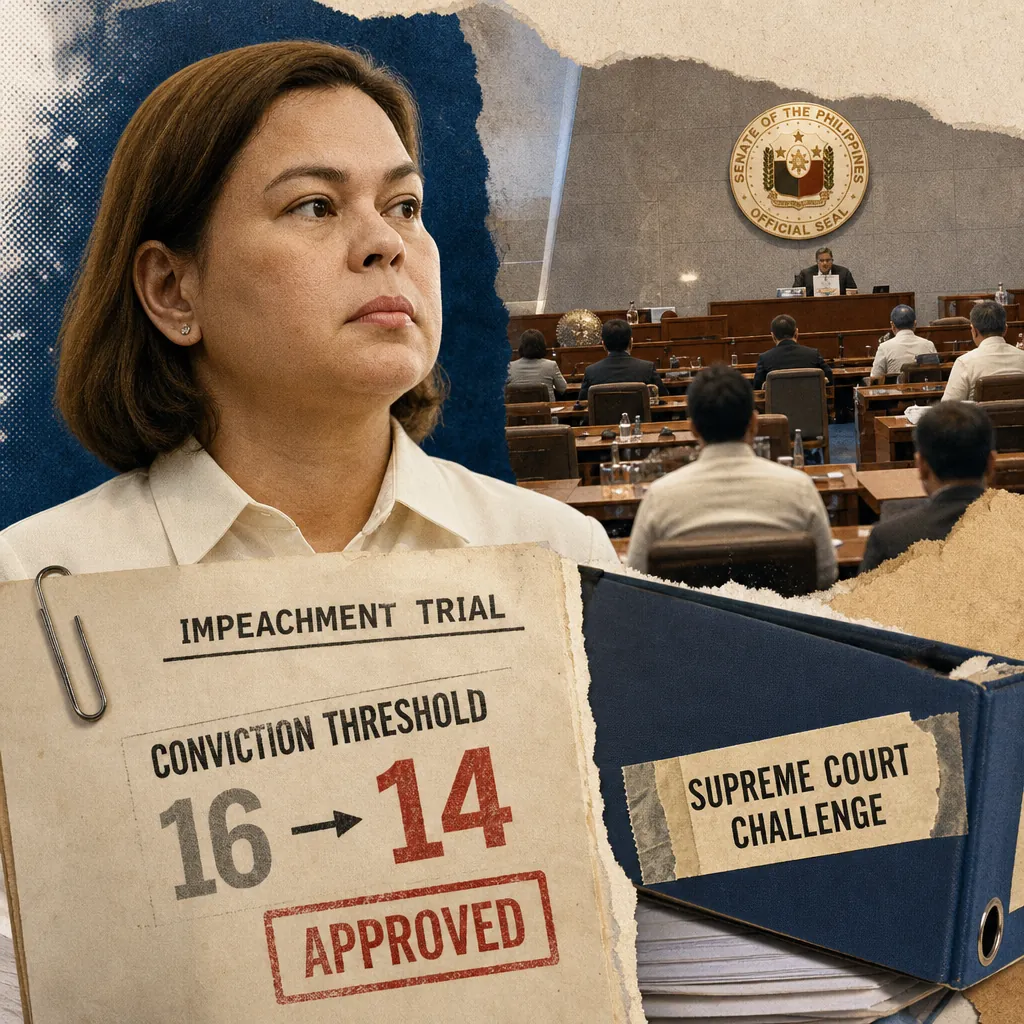
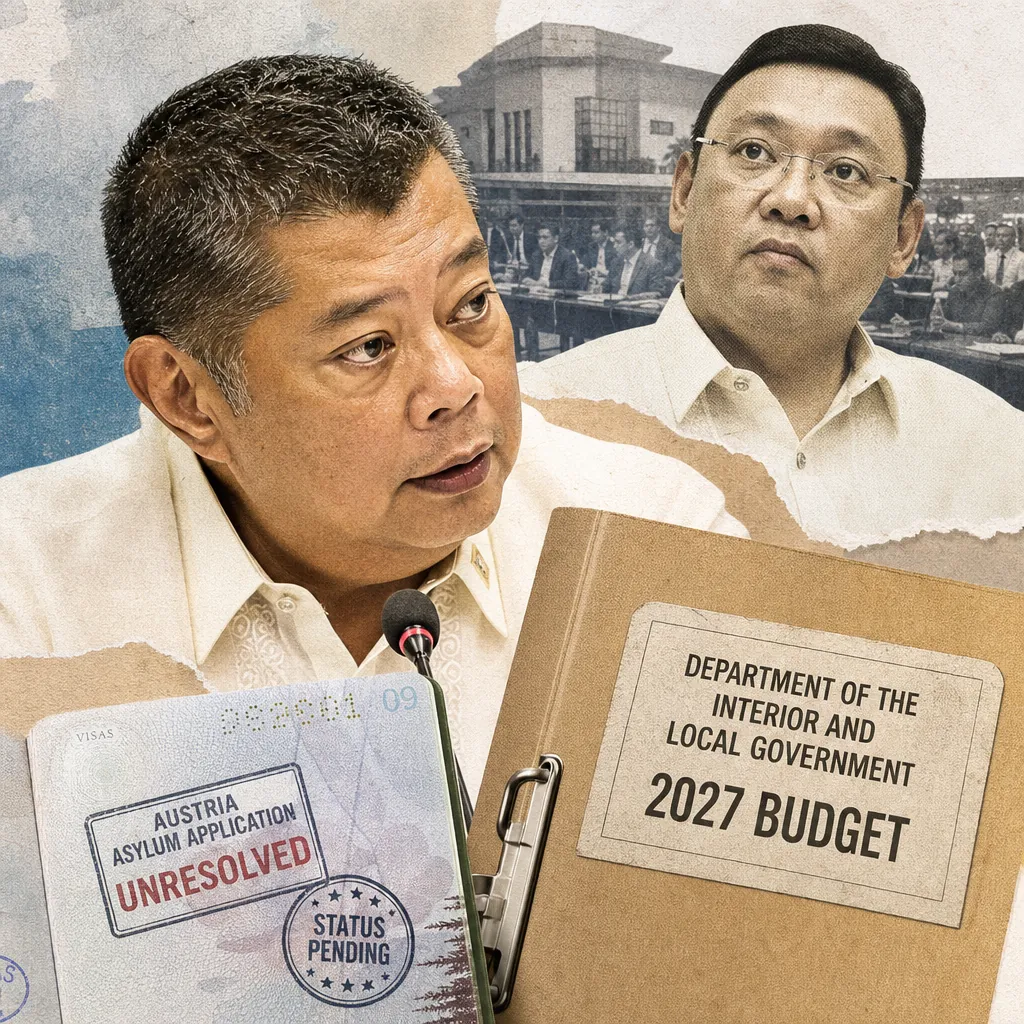
Senate Lowers Sara Duterte Conviction Bar to 14 Votes
The Senate impeachment court voted 13-1 to base Sara Duterte's conviction threshold on senator-judges able to sit, cutting the bar to 14 votes, as the Commission on Audit flagged P168 million in OVP relief spending.
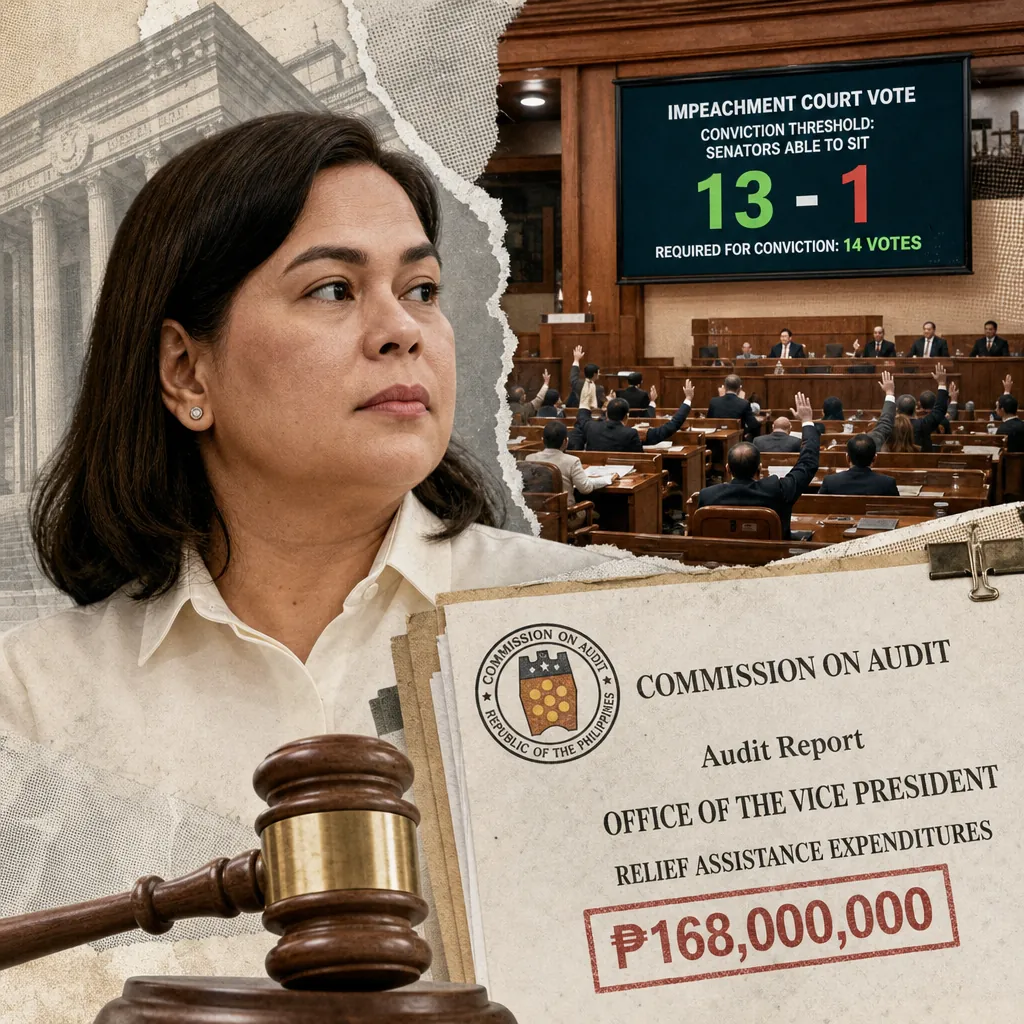
The Senate impeachment court voted 13-1 on Wednesday, September 23, 2026, to overturn its own July 6 ruling that convicting Vice President Sara Duterte required 16 votes, and to count instead only senator-judges legally and factually able to take part. Six senator-judges did not participate, and Presiding Officer Francis "Chiz" Escudero cast the lone dissent.1720 With 20 senator-judges qualifying, two-thirds comes to 13.33, which the court rounds up to 14 — the number now needed to remove the Vice President from office and disqualify her perpetually from public office.212275
The ruling landed on Day 29 of a trial that has become the country's dominant political story, and it arrived alongside a second front of scrutiny: the Commission on Audit flagged the Office of the Vice President over documentation gaps in P168 million of 2025 disaster relief spending.4581 Philippine outlets — Inquirer, GMA News, Rappler, Manila Bulletin, Manila Times, Philstar, BusinessMirror and the state-run Philippine News Agency — produced near-simultaneous coverage, with explainers walking readers through the new arithmetic and vote-by-vote breakdowns naming the 13 in favor, the lone no, and the six who did not participate.215770 Regional broadcasters carried the same ruling in Cebuano, Ilocano and Hiligaynon, including a Hiligaynon explainer that broke down the 13.33 computation and the rounding to 14.5960
On social platforms, the vote drew a mix of celebration and alarm. One widely shared Facebook commentary argued that "You do not need to change the Constitution if you can change the attendance sheet," while another post described the outcome as "not surprising but deeply troubling."6263 A GMA News post on the separate COA finding drew 29,009 views and 1,019 likes.107 The day's conversation was not confined to the impeachment court: the same news cycle carried the Department of Finance's move to suspend excise taxes on cooking gas and kerosene, a criminologist's warning that Philippine school shootings are being treated as isolated incidents, and the Senate's ratification of an expanded private-school voucher bill.86208220
Key themes
- Conviction now needs 14 votes, not 16. The Senate impeachment court voted 13-1 to compute the two-thirds requirement only from senator-judges able to participate, excluding those detained, in hiding, medically incapacitated, or beyond the Senate's coercive powers. With 20 qualifying, the bar falls from 16 to 14.2021
- Escudero dissented from the ruling he must enforce. The presiding officer said his July 6 position rested on the Supreme Court's Bayan v. Zamora decision, then said he would give effect to the majority's decision anyway: "The presiding officer, after all, is not the court. He is merely the custodian of the process, not the proprietor of its outcome."2728
- Four senators are absent, and their absence is the whole dispute. Jinggoy Estrada and Rodante Marcoleta are detained on separate plunder cases, Ronald "Bato" dela Rosa has been in hiding since the International Criminal Court ordered his arrest, and Loren Legarda has been on medical leave abroad since early August.2175
- The defense says it may go to the Supreme Court. Lead counsel Michael Poa called a petition "a real possibility," and the PDP-Laban party said it would turn to the high court after branding the Senate "damaged goods."6978
- The Commission on Audit flagged P168 million in OVP relief spending. The audit cited P19.67 million in inconsistencies between situational reports, P39 million in deviations from approved mission orders, P84.1 million in open-ended mission orders naming no beneficiaries, and P25.2 million in unsupported documents covering more than 33,000 beneficiaries.81
- The government moved to cut excise taxes on cooking gas and kerosene, but not on diesel or gasoline. Finance Secretary Frederick Go signed a resolution citing a potential P12-billion monthly revenue loss, and the Department of Energy certified that Dubai crude averaged $99.41 per barrel from August 13 to September 11, above the $80 trigger set by Republic Act 12316.86
- A criminologist said school shootings are being treated as isolated incidents. Dr. Gerry Caño, president of the Asian Criminology Society and Professional Criminology Associations in the Philippines, pointed to a "collapse in the family" and failures in school security and state regulation, days after a September 18 shooting at Banga National High School.208
- Congress ratified an expanded private-school voucher program. The reconciled bill institutionalizes vouchers from Kindergarten to Grade 12, with Education Secretary Sonny Angara saying it addresses public-school crowding — a backlog of 147,347 classrooms as of September 2025, with 1,889 schools running double or triple shifts.171220
How the narratives stack
Dominant. The impeachment threshold vote is the day's dominant story by any measure available here: it drew the most items in the captured set, the most distinct framings, and the most consequential procedural change. The court's 13-1 vote to overturn Escudero's July 6 ruling, the failed 13-6-1 motion by Senator-Judge Alan Peter Cayetano to defer the question to the Supreme Court, and the resulting 14-vote bar were reported by every major Philippine outlet and carried into regional languages.202976 The dominance is partly a property of the captured set — the monitoring behind this snapshot was configured around Philippine government and political keywords, so the impeachment trial's weight here reflects both its genuine consequence and the search terms that gathered it.
Counter-narrative. The Duterte camp and its allies reject the framing that the threshold was "lowered." Senator-Judge Erwin Tulfo, whose September 8 motion to reconsider drove the issue, insisted "Two-thirds is still two-thirds," and that only the counting base changed.3250 Vice President's spokesperson Salvador Paolo Panelo Jr. called the decision "unfavorable" to Filipinos and said the court had changed the Constitution: "Binago nila ang Saligang Batas. Hindi ito ang nasa batas natin. Ang nasa batas natin 2/3 of all members, klaro po 'yun."3738 Davao City Rep. Paolo Duterte said the Supreme Court should settle the interpretation, arguing that "Majority vote does not automatically make an interpretation constitutional," and that "positions in government are temporary. The Constitution is not."41 Detained Senator Rodante Marcoleta said he was prepared to boycott the proceedings, accusing the court of "bastardizing" the 1987 Constitution.35
Emerging. The COA finding on the Office of the Vice President is a second, quieter line of scrutiny that may outlast the procedural fight. The audit covered P168 million in 2025 relief operations under the Disaster Risk Reduction and Management Fund, and the report was submitted to Defense Secretary Gilberto Teodoro as concurrent chair of the National Disaster Risk Reduction and Management Council.81 One relief distribution sheet was reportedly lost during Typhoon Kristine and replaced with certification documents.81 This is a governance story with a paper trail, and it sits alongside separate anti-corruption threads: the National Bureau of Investigation subpoenaed the Department of Public Works and Highways regional office in Davao for records on 47 infrastructure projects worth about P3.53 billion, mostly flood control and drainage.100
Under-covered. The school shooting story placed low in the captured set. A criminologist's warning that Philippine classrooms are becoming killing fields, delivered days after a September 18 shooting at Banga National High School in Cagayan de Oro, drew a single Inquirer report, and an NBC News item on a separate Philippine school shooting that killed three students including the gunman carried no follow-up in the material gathered here.111208 The absence of sustained coverage is notable given the subject matter, though it may reflect the monitoring's keyword configuration as much as newsroom priorities.
Platform insights
- Facebook. The threshold vote generated the day's most pointed commentary. One post argued that "You do not need to change the Constitution if you can change the attendance sheet," and another described the outcome as "not surprising but deeply troubling."6263 Duterte-aligned pages were active: Rep. Paolo Duterte's camp circulated a post asking "HINDI SUBPOENADO PERO BAKIT GALIT?" over the NBI's Davao flood-control subpoena, noting the subpoena went to DPWH regional officials rather than the congressman.95 Former presidential spokesperson Harry Roque described President Marcos as "evil" and called for the country's "deliverance."97 Singer-lawyer Jimmy Bondoc praised Senator-Judge Camille Villar's emotional appeal with the words "Can we stop it?" and called it "the most human, most sincere, and most necessary words ever spoken since this started."186
- X (formerly Twitter). The platform carried the fast, headline-level version of the story. GMA News' post on the COA finding drew 29,009 views and 1,019 likes, and Philippine Star and BusinessMirror accounts pushed the threshold ruling and the defense's Supreme Court signal to followers tracking the trial in real time.4068107 The format favored the number — 14 votes — over the constitutional argument behind it.
- Reddit. Philippine subreddits split between procedural explainers and partisan reaction. A thread on r/Philippines titled "14 votes to convict VP Sara Duterte" and a parallel thread on r/newsPH walked through the arithmetic, while r/ChikaPH and r/inthephilippines threads tracked the defense's vow to exhaust legal remedies.223071 A separate r/newsPH thread on the COA finding drew discussion of the OVP's relief spending.46
- YouTube. Full-session uploads and clips carried the oral arguments and the vote itself, including the exchange in which Diokno argued the vote count was never fixed at 16 and Poa countered that "the language of the Constitution is clear."2324 The format let viewers watch the procedural maneuvering that the written coverage compressed into a paragraph.
Key voices and communities
The Senate impeachment court. The 13 senator-judges who voted to overturn the July 6 ruling — including Senate President Sherwin Gatchalian, Senate President Pro Tempore Vicente Sotto III, Majority Leader Juan Miguel Zubiri, and Senators Erwin Tulfo, Raffy Tulfo, JV Ejercito, Risa Hontiveros, Kiko Pangilinan, Panfilo Lacson, Joel Villanueva, Bam Aquino and Mark Villar — set the procedural ground rules for the rest of the trial.31 Their framing matters because the ruling applies pro hac vice, for this trial only, and is not binding precedent.20
The prosecution and defense panels. House prosecutor Chel Diokno framed the dispute as "Two-thirds of how many?" and called the hard-16 reading an "acquittal by default."2053 Defense lead counsel Michael Poa argued that absences do not create vacancies and that changing the threshold mid-trial raises due process concerns.26 Prosecution spokesman Robert Ace Barbers said the panel is not relying on numbers: "Let the evidence speak."55
Duterte-aligned political figures. Panelo, Paolo Duterte, Marcoleta and Senator Robin Padilla form the bloc most likely to challenge the ruling. Padilla added Bondoc to his list of possible 2028 running mates for the Vice President and said he has no ambition except for Sara Duterte to be president in 2028.4758135
Regional broadcasters and community commentators. Bombo Radyo, GMA Regional TV, DZGB Legazpi and Aksyon Radyo Iloilo carried the ruling in local languages, with Aksyon Radyo Iloilo explaining the 13.33 computation and the rounding to 14.5960 These outlets carry the story into non-Metro Manila and non-English audiences, which matters for gauging sentiment beyond national outlets.
Filipino mental-health communities. A separate cluster of Reddit posts from r/MentalHealthPH and related forums described difficulty accessing psychiatric care, including one user weighing a consult who wrote "I actually do have a plan on how I will end my life, and I'm aware that I have the capacity to do so," and another asking whether follow-up check-ups are realistically available at the Philippine General Hospital.36 These posts are personal expressions rather than organized advocacy, but they surface how patients themselves frame gaps in the health system.
Narrative streams
The Senate rewrites the arithmetic of conviction
The vote itself was narrow and procedural, but its effect is concrete. The court rejected Cayetano's point of order 13-6 with one abstention, then voted 13-1 to adopt a formula counting only senator-judges "legally and factually capable" of participating.2976 Escudero's ruling specifies five exclusion categories: senators detained or otherwise legally restrained, those sought by authorities whose whereabouts are unknown, those with a physical or medical incapacity, those beyond the Senate's coercive processes, and others similarly situated. The court must first determine by competent evidence whether a senator falls within any category, and if the computation yields a fraction it is rounded up to the next whole number, even below 0.5.2120
The legal argument beneath the vote is a dispute over what "all the Members of the Senate" means in Article XI, Section 3(6) of the 1987 Constitution, which states an impeached official may only be convicted on the concurrence of two-thirds of all the Members of the Senate.21 Four retired Supreme Court justices sat as amici curiae on September 16; three — former Chief Justices Artemio Panganiban, Reynato Puno and Hilario Davide Jr. — took the position that the minimum vote is not automatically fixed at 16, while retired Associate Justice Adolfo Azcuna argued that "all means all."66 Davide, identified in coverage as a framer of the 1987 Constitution, submitted a memorandum stating the threshold should be based on senators qualified to vote.6667
Both sides reached for precedent. Poa cited the 1992 impeachment of former Chief Justice Renato Corona, noting that trial proceeded with only 23 senator-judges present while the voting threshold remained unchanged.26 Diokno drew on Avelino v. Cuenco, arguing it showed 24 senators would not always be the denominator, while acknowledging that case involved a legislative quorum under the 1935 Constitution rather than the two-thirds impeachment requirement.67 The material does not describe any prior Philippine impeachment trial in which the vote threshold was amended mid-proceeding.
For the sector, the practical consequence is that the prosecution's path to conviction is now narrower by two votes, and every senator-judge's public positioning becomes more consequential. The ruling applies only to this trial, so it does not change the bar for future impeachments — but it does change what the House prosecution must deliver in evidence over the remaining hearing days.
The defense signals a Supreme Court challenge
Within hours of the vote, the defense made clear it would not accept the ruling as final. Lead counsel Sheila Sison said Vice President Duterte "does not shrink from accountability nor does she fear the outcome," and would participate with all rights reserved and exhaust legal remedies.3954 Poa said a petition to the Supreme Court is "a real possibility."68 PDP-Laban called the Senate "damaged goods" and said it would turn to the high court.69
Diokno countered that the issue is not yet ripe. "Your Honor, I believe that the matter is not yet justiciable and cannot yet be brought to the Supreme Court," he said, arguing that until the senator-judges actually vote, nobody knows how many votes will be cast for conviction. "If, for example, the votes come out to 16 or more, then there is no issue to bring to the Supreme Court," he said.148 That procedural argument — that the dispute is hypothetical until a final vote — is the first obstacle any petition would face.
The read for the sector is that the legal question now sits in two places at once: inside the impeachment court, which will keep hearing evidence, and potentially before the Supreme Court, which has not yet been asked to rule. For government-facing communicators, the practical effect is that the story will not settle on one official reading in the next several days, and any statement that treats the 14-vote threshold as settled law risks being overtaken by a filing.
The Commission on Audit flags the Office of the Vice President
The same day as the threshold vote, the Commission on Audit released a 273-page report on the Office of the Vice President's 2025 relief operations under the Disaster Risk Reduction and Management Fund, flagging documentation deficiencies across almost P168 million in spending.4581 The Inquirer's breakdown specifies P19.67 million in inconsistencies between situational reports from agencies and the OVP's own reports, P39 million in deviations from approved mission orders without documented approval, P84.1 million in open-ended mission orders that named no specific beneficiaries, and P25.2 million in goods for 33,980 beneficiaries supported by incomplete documents.81 COA said the deficiencies reduced assurance on the completeness, reliability and verifiability of the distribution records.45
The Commission on Audit is the government's independent audit body, constitutionally mandated to examine how public funds are spent and report findings to Congress and the agencies concerned. Its findings are not criminal charges; they are audit observations that agencies are expected to answer. The report was submitted to Defense Secretary Gilberto Teodoro as concurrent chair of the National Disaster Risk Reduction and Management Council, the inter-agency body that coordinates disaster response.81
This is a second front of scrutiny on the Vice President's office, distinct from the impeachment trial, and it lands in the same news cycle. For the sector, the consequence is that the OVP now faces questions on two tracks — legal exposure in the Senate and financial accountability before the audit body — and newsrooms will use the COA finding as the reference point when the next relief-funding or budget story breaks.
The government moves on fuel taxes, but only for cooking gas and kerosene
Finance Secretary Frederick Go signed a resolution seeking to suspend excise taxes on liquefied petroleum gas and kerosene while holding off on similar relief for diesel and gasoline, citing an estimated P12-billion monthly revenue loss and concerns about progressivity.86 Under Republic Act 12316, the president may suspend or reduce excise taxes on specific petroleum products once the average Dubai crude price reaches or exceeds $80 per barrel for a month. The Department of Energy certified on September 15 that the benchmark had been breached, with Dubai crude averaging $99.41 per barrel from August 13 to September 11.86 Go said the move would effectively revive relief granted earlier this year, when Marcos suspended excise taxes on LPG and kerosene for three months beginning in April.86
Energy Secretary Sharon Garin separately said the government was in talks with Russia, Canada, the United States, Colombia, Australia, China and Japan "to diversify risks" amid tight petroleum supply due to the Middle East crisis, noting that some 80 percent of the Philippines' petroleum supply comes from the Strait of Hormuz, whether directly or indirectly.88 Transport groups set a three-day strike over rising fuel costs, and the Department of Transportation vowed to alleviate fuel pressures.104
The read for the sector is that the excise decision creates a visible split between products that get relief and products that do not, and transport groups have already organized around the cost of the latter. For banks and consumer-facing businesses, fuel cost is a live grievance with an organized action attached, which is the kind of item that surfaces in customer sentiment and in the political coverage their clients track.
A criminologist says school shootings are not isolated incidents
Dr. Gerry Caño, president of the Asian Criminology Society and Professional Criminology Associations in the Philippines, said on Wednesday that a cascading "collapse" of family guidance, school security and government regulation is turning Philippine classrooms into killing fields, and criticized the Philippine National Police and state agencies for treating recent fatal school shootings "as isolated incidents" rather than symptoms of institutional breakdown.208 Caño, who also serves as national dean of Phinma Education and sits on advisory councils for the PNP Internal Affairs Service and Anti-Cybercrime Group, pointed to the "erosion of foundational institutions" as the root cause.208 His statement came days after a September 18 shooting at Banga National High School in Cagayan de Oro.208
A separate NBC News report said three students were killed in a Philippine school shooting, including the gunman, who officials said told friends to go home "because after lunch, I will be executing my plan" before turning the gun on himself.111 That item carried no further details on the location, the school involved, or the identities of the victims, and no follow-up reporting appeared in the material gathered here.111
The read for the sector is that school safety is now a subject with an expert voice attached, and the Department of Education faces pressure to respond to a framing that treats shootings as a systemic failure rather than a series of unrelated crimes. For government-facing communicators, the question is whether the department addresses the pattern or continues to treat each incident separately.
Congress ratifies an expanded private-school voucher program
The Senate ratified the reconciled version of a bill overhauling the Government Assistance to Students and Teachers in Private Education (Gastpe) Act, expanding government support for private basic education and creating a targeted voucher system from Kindergarten to Grade 12.220 The measure, a priority of the Legislative-Executive Development Advisory Council, was principally authored by Senators Bam Aquino, Joel Villanueva, Sherwin Gatchalian and Loren Legarda.220 Education Secretary Sonny Angara said the legislation "provides a pragmatic solution to public school constraints while giving families more equitable access to quality schooling."171
The reform seeks to address persistent overcrowding. Department of Education data showed a classroom backlog of 147,347 as of September 2025, while 1,889 schools had double or triple shifts in school year 2024-2025, requiring an estimated 52,871 additional classrooms to eliminate shifting.220 Under the expanded program, qualified learners from Kindergarten to Grade 6 may receive Basic Education Voucher Assistance to enroll in participating private schools, and the program is projected to accommodate about 22.5 percent of the eligible population.220
Separately, Angara said private-sector support could help the department speed up the rollout of computers and internet connectivity in public schools, acknowledging that the government cannot equip all schools at once. He cited an initiative involving private groups Ahonanan and Prime Infra that could complement the department's annual spending on school technology.198 The Department of Education also said private-sector partners had pledged 47,439 work immersion slots for Senior High School learners, bringing the agency to nearly 95 percent of its 50,000-slot target.209
The read for the sector is that the voucher expansion shifts public money toward private schools at a scale that will affect enrollment patterns, and private institutions that participate will need to meet the program's standards. For families, the practical question is whether the voucher covers enough of private-school tuition to make the switch viable.
Conversation trajectory
Supreme Court petition watch (next 1–2 weeks). The defense has called a petition "a real possibility," and PDP-Laban has said it will go to the high court.6869 The trigger to watch is whether a petition is actually filed, and whether the Supreme Court accepts it or declines on ripeness grounds, as Diokno argues it should.148 A filed petition would change the story from a Senate procedural vote to an active constitutional challenge.
Whole-day hearings begin in October. Escudero announced the trial will move to whole-day hearings starting in October, which will compress the remaining evidence into fewer calendar days and likely increase the volume of daily developments.49 The trigger is the first whole-day session, which will show whether the pace of testimony accelerates.
Marcos decision on the excise resolution (within the week). The resolution still needs President Marcos Jr.'s approval, and coverage says a decision is expected within the week.86103 The trigger is the signing or rejection, and the follow-on question is how transport groups respond if diesel and gasoline remain taxed.104
COA follow-up and OVP response (next 2–4 weeks). The audit report has been submitted to the disaster-response council, and the Office of the Vice President has not yet issued a substantive response in the material gathered here.81 The trigger is whether the OVP answers the findings or whether Congress takes them up in budget hearings.
School safety policy response (next 2–4 weeks). The criminologist's statement and the September 18 shooting put pressure on the Department of Education and the Philippine National Police to address school security.208 The trigger is whether either agency issues a policy response or whether the story fades after the initial coverage.
Response guidance
Prepare a reconciled reference on the threshold ruling. Government-facing teams should have a single document distinguishing the operational facts — 14 votes if 20 senator-judges qualify, five exclusion categories, pro hac vice application only — from the competing characterizations already circulating, specifically Erwin Tulfo's "the threshold did not change, only the count basis" line versus the framing that the threshold was lowered.2050 Press questions will test whether the spokesperson can hold both facts at once.
Track the Supreme Court filing signal as a discrete escalation marker. A filed petition changes the story from a Senate procedural vote to an active constitutional challenge, which requires a different briefing than the procedural ruling itself.6869 Teams should monitor court filings and PDP-Laban statements daily.
Separate the impeachment story from the COA story in internal briefings. The two are being consumed by the same audiences on the same news cycle, but they carry different implications: one is a legal proceeding, the other an audit finding.81 Conflating them risks overstating the legal exposure or understating the financial accountability question.
On fuel taxes, prepare for questions about who benefits. The excise suspension covers cooking gas and kerosene but not diesel or gasoline, and transport groups have organized a three-day strike.86104 Consumer-facing teams should expect questions about the split and should be able to explain the progressivity rationale and the revenue cost in plain terms.
On school safety, avoid treating incidents as isolated. The criminologist's framing — that shootings reflect institutional failure rather than unrelated crimes — is now in the public record.208 Education-sector communicators should be prepared to address the pattern question rather than only individual incidents.
On the voucher program, explain the scale and the eligibility rules. The expansion covers Kindergarten to Grade 12 and is projected to accommodate about 22.5 percent of eligible learners.220 Families and private institutions will need clear guidance on who qualifies and what the voucher covers.
Monitor regional-language coverage for sentiment shifts. The threshold ruling was carried in Cebuano, Ilocano and Hiligaynon, and regional commentary may diverge from national framing.5960 Teams tracking public sentiment should sample regional broadcast and social content, not only Metro Manila outlets.
See the full picture behind today's signals.
This report draws from Media Meter's MediaWatch, our real-time monitoring engine tracking 2,470+ Philippine sources across print, broadcast, digital, and social. Explore how the platform turns raw coverage into decision-grade intelligence, then see how it's configured for teams like yours — whether you're in PR agencies, corporate comms, government, or marketing.
Want more? Browse our Report Library for sector and crisis intelligence, or request a demo and we'll have your brand set up before the call.
Want this kind of intelligence on your brand?
This brief is built on the same MediaWatch methodology that runs continuously across every brand we monitor. See your competitive landscape, Impact Score, and narrative trajectory in a 30-minute demo.