SMFB Profit Falls 9% as Petron, MSMEs Face Cost Pressure
San Miguel Food and Beverage reported a 9% drop in nine-month net income to P30.6 billion as costs rose and consumers spent less, while Petron's earnings nearly halved and a new PSA figure put the digital economy at 9.8% of output.
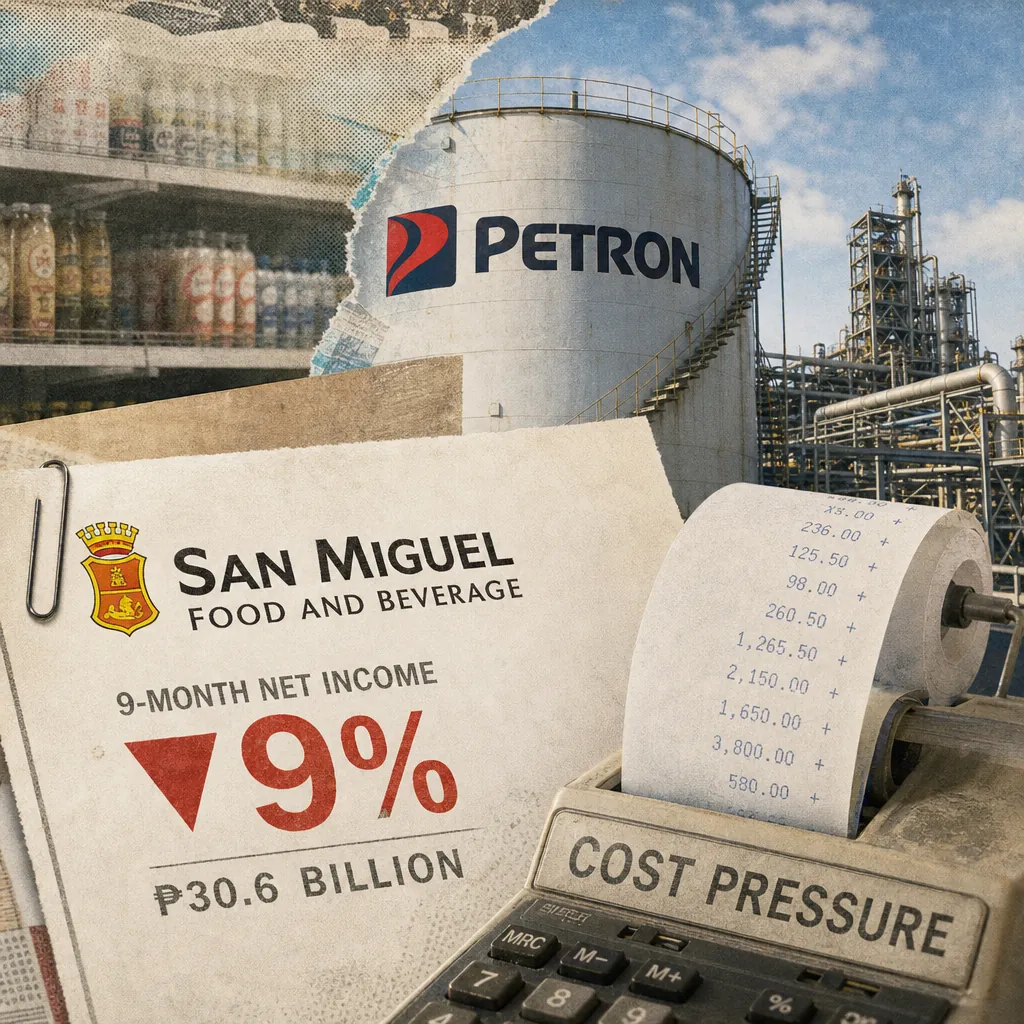
San Miguel Food and Beverage Inc. (SMFB) earned ₱30.6 billion in net income in the first nine months of 2026, 9 percent less than the ₱33.6 billion it reported a year earlier, the company said on Wednesday, and the same squeeze showed up across the day's corporate results: Petron Corp.'s nine-month profit nearly halved, and the country's largest food and beverage groups split sharply between those gaining and those losing ground 863. SMFB's revenue still grew 2 percent to ₱309.6 billion, but operating income fell 9 percent to ₱40.6 billion as the company spent more on brand promotion to hold demand 8. The results ran in the Manila Standard business pages under the headline "SMFB's nine-month profit dropped 9% to P30.6b," where chairman Ramon Ang said: "This has been a challenging year so far for Filipino consumers, so we continue to make every effort to keep our products affordable while managing our costs carefully" 52.
On the same day, Monde Nissin Corp., maker of Lucky Me! noodles and SkyFlakes crackers, reported net income up 20.8 percent to ₱8.06 billion for January to September, with revenue up 7.3 percent to ₱67.9 billion 9. The two results describe the same consumer economy from opposite ends: one company's costs rose faster than its prices, the other's sales grew fast enough to absorb them. Petron's revenue jumped 56 percent to ₱928.2 billion on higher oil prices and sales volume, yet net income fell 44 percent to ₱5.4 billion from ₱9.7 billion, dragged down by crude costs, import premiums and freight charges tied to Middle East tensions, plus narrower refining margins in Malaysia 63.
A separate data release framed the longer trend those results sit inside. The Philippine Statistics Authority (PSA), the government's statistical agency, put the digital economy's share of national output at 9.8 percent in 2025, and Inquirer.net used that figure to ask whether micro, small and medium enterprises (MSMEs) can keep pace 1. MSMEs make up more than 99 percent of registered businesses and employ most of the workforce, according to the Philippine Chamber of Commerce and Industry (PCCI), the country's largest business membership group; the PCCI identifies limited access to financing, fragmented supply chains, low productivity and gaps in digital adoption as their main constraints 1.
Key themes
- SMFB's nine-month net income fell 9% to ₱30.6 billion on higher costs and weaker demand. Revenue rose 2% to ₱309.6 billion while operating income dropped 9% to ₱40.6 billion, as the company increased brand spending to defend sales 852.
- Petron's profit nearly halved to ₱5.4 billion even as revenue jumped 56%. Higher crude costs, import premiums and freight charges from Middle East tensions, plus thinner Malaysian refining margins, cut net income 44% from ₱9.7 billion 63.
- Monde Nissin's net income rose 20.8% to ₱8.06 billion, with revenue up 7.3% to ₱67.9 billion. Both its Asia-Pacific branded food business and its protein unit posted gains, and gross profit rose 13.4% 9.
- The digital economy accounted for 9.8% of Philippine output in 2025, per the PSA. MSMEs, which are more than 99% of businesses, face financing, supply-chain and digital-adoption gaps that limit how much of that growth they capture 1.
- Seventeen Philippine companies made TIME's inaugural Asia-Pacific Best Employers 2027 list, led by Unilab at No. 24. The ranking, compiled with data firm Statista from employee satisfaction surveys run from 2024 to 2026, placed Ayala Corp. at 32, Metrobank at 44, San Miguel Corp. at 55 and Jollibee at 89 6536.
- The draft framework for the US-led Pax Silica initiative has cleared Philippine review and gone to Washington. Malacañang said the Bases Conversion and Development Authority (BCDA) is awaiting the US response before signing, and hinted the deal could be sealed around the 49th ASEAN Summit in Manila 4851.
- Metrobank launched EntrepRISE, a financial-literacy program for Luzon business owners. Initial seminars in North Luzon, Metro Manila and South Luzon drew nearly 100 of the bank's business clients, covering cash flow, borrowing costs and expansion planning 59.
- The ASEAN Trade Expo 2026 opens Nov. 10–12 at Okada Manila under the theme "Way of the Weave." Organized by the Women's Business Council Philippines with the Department of Trade and Industry (DTI) and other agencies, it gathers textiles and crafts from ASEAN member states plus Japan and India 45.
How the narratives stack
Dominant. The corporate earnings cluster carried the day's business coverage in the items reviewed here. SMFB's 9 percent profit decline appeared in both a broadsheet business page and an online business desk, and the Manila Standard version carried Ang's full statement on consumer conditions 528. Petron's 44 percent profit drop and Monde Nissin's 20.8 percent gain rounded out a picture of a consumer economy where input costs and household budgets are moving in opposite directions 639. This dominance is a property of the captured set: the monitoring behind it drew heavily on business desks, so the earnings stories appear more often than a general-news sweep would have produced.
Counter-narrative. Against the profit-decline stories sat Monde Nissin's record core net income of ₱8.35 billion, up 16.1 percent, and the TIME/Statista employer ranking, which put 17 Philippine firms among the region's 500 best workplaces 965. The ranking measures employee satisfaction surveys rather than financial performance, and its presence in the day's coverage shows that Philippine corporate news was not uniformly negative. SM Investments president and chief executive Frederic DyBuncio tied his company's 206th-place finish to workforce retention: "Our people are central to SM's continued growth" 36.
Emerging. Two policy threads ran beneath the earnings news. The Pax Silica initiative, a US-led framework that the BCDA is negotiating for a site in Tarlac, moved from Philippine review to US review, with Malacañang declining to release details until the text is final 5148. Separately, the PSA's 9.8 percent digital-economy figure gave a hard number to a long-running concern about MSME digital adoption, and the PCCI's list of MSME constraints — financing, supply chains, productivity, digital gaps — names the specific bottlenecks that number implies 1.
Under-covered. The day's most consequential consumer-finance story drew the least business-page attention in this set: the Institute for Climate and Sustainable Cities (ICSC) urged the government to assess the country's power requirements before the Department of Energy (DOE) auctions roughly 3,800 megawatts of mid-merit natural gas capacity, warning that new gas plants could lock consumers into volatile imported fuel prices, especially in the Visayas 57. The same day, Petron's results showed exactly how imported-fuel exposure hits a company's bottom line 63. The ICSC position ran on a regional news site rather than the national business desks.
Platform insights
- Facebook. The day's most-shared consumer-facing items in this set were human-interest and service stories rather than corporate results: a Bandera report on a 4Ps cash-transfer beneficiary who graduated magna cum laude on a ₱20 daily allowance, and a Davao Bloggers Society post marking its 20th anniversary 4640. Both are the kind of content that travels through personal networks rather than news feeds, and both put a face on the affordability squeeze the earnings reports describe in aggregate.
- X. Business and policy reporters used the platform to relay the day's hard numbers — the SMFB and Petron results, the Pax Silica timeline, the PSA digital-economy share — in short form, with the Manila Standard and BusinessMirror items providing the fuller versions that circulated as links 52511. The platform carried the fastest-moving version of the earnings story but little original analysis.
- Reddit. Discussion clustered around the practical consequences of the cost squeeze: fuel-price rollbacks, El Niño water rationing in Davao Oriental, and the Iloilo health office's heat-illness warning 25653. Threads on the coming fuel rollback — world-market gasoline prices down ₱9.40 per liter per Mean of Platts Singapore (MOPS) trading data — drew the most sustained back-and-forth, with users comparing the projected cut against what they actually pay at the pump 25.
- YouTube. Local broadcasters posted the day's Palace briefing and the Department of Agriculture's El Niño budget hearing, where officials confirmed a ₱61.99 billion plan funded from the 2026 national budget 4762. Video carried the policy detail that text summaries compressed, particularly the breakdown of the agriculture plan's ₱35 billion allocation for seeds, fertilizer and planting inputs.
Key voices and communities
Corporate executives and investor-relations desks. Ramon Ang's statement on consumer conditions and SMFB's cost management anchored the earnings coverage, while Petron's management framed its 44 percent profit drop around "our diversified portfolio, financial discipline and robust risk management" 5263. These voices set the terms of the day's business conversation: costs up, demand soft, holiday season ahead.
Government economic managers. The PSA's digital-economy release, the BCDA's Pax Silica negotiations and the Department of Agriculture's El Niño plan put three agencies in the same day's news, each describing a different pressure on household and business finances 15147. Palace press officer Claire Castro handled the Pax Silica briefing and, separately, defended the government's upskilling programs against a Philippine Institute for Development Studies (PIDS) warning that low wages are pushing workers abroad 62.
Business membership and advocacy groups. The PCCI supplied the MSME statistics and the list of constraints, and the ICSC pushed back on the DOE's gas-capacity auction 157. Both groups translate diffuse economic pressure into specific policy asks, which is why their statements tend to surface in coverage even when the underlying data is months old.
Regional and community media. Sunstar Davao, Daily Guardian Iloilo, Bombo Radyo and Panay News carried the local consequences — water rationing, heat-illness warnings, fuel-price projections, a license revocation — that national desks did not pick up 6532555. Their reporting is where the national cost squeeze becomes a specific household problem.
Narrative streams
SMFB's profit falls 9% while revenue grows 2%
San Miguel Food and Beverage's nine-month net income of ₱30.6 billion was 9 percent below the same period in 2025, and the company attributed the decline to elevated commodity prices, inflation and slower economic growth squeezing household budgets 8. Revenue rose 2 percent to ₱309.6 billion on higher food and spirits sales, but gross profit slipped to ₱85.7 billion and earnings before interest, taxes, depreciation and amortization (Ebitda) — a rough measure of operating cash earnings before financing and accounting charges — fell 5 percent to ₱55.5 billion 8. The Manila Standard report added that San Miguel Foods posted sales of ₱151.4 billion, up 6 percent 52. Ang's statement that the company will "continue to invest in capacity and in our brands so we are ready when demand picks up" signals that management expects the soft patch to end, and that it is spending now to be positioned when it does 52. For food and beverage manufacturers, the read is that volume can be held with brand spending, but margin cannot: the cost of defending market share is coming directly out of operating income. The holiday season, which Ang called "traditionally our busiest time of the year," is the next test of whether that spending pays off 52.
Petron's revenue jumps 56% and profit falls 44%
Petron Corp., the country's largest oil company, earned ₱5.4 billion in the first nine months of 2026, down 44 percent from ₱9.7 billion a year earlier, even as revenue climbed 56 percent to ₱928.2 billion 63. The divergence is a refining story: higher crude costs, import premiums and freight charges tied to Middle East tensions raised the cost of every barrel the company processed, and narrower refining margins in Malaysia cut what it earned on the output 63. A company that sells more fuel at higher prices can still make less money if the spread between what it pays for crude and what it charges for refined product narrows. The same Middle East tension that lifted Petron's revenue also fed the world-market price decline that Bombo Radyo reported: gasoline down ₱9.40 per liter, diesel down ₱3.30 and kerosene down ₱3.50 based on Mean of Platts Singapore (MOPS) trading data, with the Department of Energy cautioning motorists not to expect the full rollback because the trading week was young 25. For consumers, the two stories point in different directions — cheaper pump prices ahead, but a domestic oil industry earning less on each liter it sells. For the sector, Petron's result shows that Philippine refiners carry direct exposure to geopolitical events they cannot control, and that revenue growth is a poor guide to their health.
Monde Nissin's net income rises 20.8% to ₱8.06 billion
Monde Nissin's January-to-September net income rose 20.8 percent to ₱8.06 billion from ₱6.67 billion, with core net income attributable to shareholders reaching a record ₱8.35 billion, up 16.1 percent 9. Revenue grew 7.3 percent to ₱67.9 billion, gross profit rose 13.4 percent to ₱23.85 billion, and core Ebitda rose 9.8 percent 9. Both the Asia-Pacific Branded Food and Beverage segment and the protein business posted gains. The result matters because Monde Nissin sells at price points close to what SMFB's mass-market brands charge, and its ability to grow margins while SMFB's slipped suggests that category mix and input exposure differ enough between the two that "weak consumer demand" is not a uniform condition. For food manufacturers, the read is that the companies selling staples with strong brand loyalty and favorable input positions can expand margins in the same economy where others are spending to defend volume.
The digital economy reaches 9.8% of output and MSMEs lag
The PSA's estimate that the digital economy contributed 9.8 percent of Philippine economic output in 2025 gives a hard number to a shift that has been described mostly anecdotally 1. The Inquirer.net report paired it with the PCCI's assessment that MSMEs — more than 99 percent of businesses and the majority of employers — face limited access to financing, fragmented supply chains, low productivity and gaps in digital adoption 1. Those four constraints are connected: a sari-sari store that cannot get a working-capital loan also cannot invest in an online storefront, and a supplier network that runs on paper cannot easily plug into a digital marketplace. The read for the sector is that the 9.8 percent figure measures the digital economy's contribution to output, not its reach across businesses, and the gap between the two is where most Philippine enterprises still sit. The same day, Metrobank's EntrepRISE program — seminars in North Luzon, Metro Manila and South Luzon for nearly 100 business clients on cash flow, borrowing costs and expansion — addressed the financing-literacy end of that gap directly 59.
Pax Silica's draft framework goes to Washington
The framework agreement for the US-led Pax Silica initiative, which the Bases Conversion and Development Authority (BCDA) is negotiating for a site in Tarlac, has been reviewed by the Office of the President and submitted to the US government, Malacañang said on Wednesday 51. Palace press officer Claire Castro said the agreement will be ready for signing once Washington responds, and that provisions were adjusted based on input from the Office of the Executive Secretary and the Department of Trade and Industry 51. Asked whether President Ferdinand Marcos Jr. would sign it during the 49th ASEAN Summit in Manila, Castro said, "Let us see" 48. The BCDA is the state-owned corporation that manages former US military bases and converts them to civilian economic use, which is why it is the Philippine counterpart on a deal sited in Tarlac, where the former Clark air base complex sits. Castro declined to release the agreement's contents before it is final 51. For the business sector, the read is that a US-anchored industrial initiative in Central Luzon is close enough to signing that companies should be watching for the final text, but the government is not yet saying what commitments it contains.
Seventeen Philippine firms make TIME's Asia-Pacific employer ranking
United Laboratories (Unilab) ranked 24th among 500 companies in TIME magazine's inaugural Asia-Pacific Best Employers 2027 list, compiled with data firm Statista from employee satisfaction surveys conducted between 2024 and 2026 65. Ayala Corp. followed at 32, Metrobank at 44, San Miguel Corp. at 55, Jollibee Foods Corp. at 89, Del Monte Philippines at 105, BDO Unibank at 164, Philippine Airlines at 186, Aboitiz Power at 196, SM Investments at 206 and Solaire Resort and Casino at 222 6536. Further down the list were Rizal Commercial Banking Corp. at 260, JG Summit at 262, Century Pacific Group at 279, Real Page Philippines at 280, Megaworld at 304, PLDT at 327 and ABS-CBN at 338 52. The ranking measures employee perceptions, not pay or retention, and its inaugural status means there is no prior year to compare against. For employers, the read is that workforce reputation is now being scored by an international publication that clients and recruits read, and the Philippine firms on the list have an external benchmark they did not have before.
El Niño's cost reaches water rationing and health warnings
Water is being rationed in Manay, Davao Oriental, with the local government distributing supply by fire truck after the town's rivers turned unusable as a source, the Office of Civil Defense 11 (OCD-Davao) said on Wednesday 6. "So El Niño is being felt," regional director Ednar Dayanghirang said, adding that local governments are looking into buying water filtration and desalination machines in case sources run dry 6. The Department of Science and Technology's Philippine Atmospheric, Geophysical and Astronomical Services Administration (DOST-PAGASA) reported a strong to very strong El Niño in the tropical Pacific, expected to peak before the end of 2026 and persist through the first quarter of 2027 53. The Iloilo Provincial Health Office warned of dehydration, heat-related illness and infectious disease, and the Department of Agriculture confirmed a ₱61.99 billion response plan funded from the 2026 national budget, including ₱35 billion for seeds, fertilizer and planting inputs, plus irrigation rehabilitation, solar-powered irrigation, small water storage and cloud seeding 4753. For food and beverage companies, the read is that agricultural input costs will stay elevated into the first half of 2027, which is the same pressure SMFB cited in its results 8.
Conversation trajectory
Fuel prices at the pump, next few days. The MOPS-based projection of a ₱9.40-per-liter gasoline rollback will be tested against the actual weekly price adjustment oil companies announce, typically early in the week. The Department of Energy's caution that the trading week was young means the final figure could be smaller; watch whether the rollback lands near the projection or is trimmed by the Middle East escalation 25.
Pax Silica signing, through the 49th ASEAN Summit. Malacañang has said the draft is with Washington and could be signed at the summit. Watch for the US response and for whether the Palace releases the agreement's contents before or after signing 4851.
SMFB and Petron full-year results, early 2027. Both companies' nine-month figures set up a fourth-quarter test: SMFB's holiday-season sales will show whether brand spending held volume, and Petron's refining margins will show whether Middle East tensions eased 5263.
El Niño peak, through the first quarter of 2027. PAGASA expects the phenomenon to peak before the end of 2026. Watch the DA's ₱61.99 billion plan's disbursement pace and whether water rationing spreads beyond Manay 47653.
ASEAN Trade Expo and Business and Investment Summit, Nov. 10–15. The trade expo runs Nov. 10–12 at Okada Manila, and the ASEAN Business and Investment Summit runs Nov. 14–15 at the same venue, with sessions on artificial intelligence, the digital economy and energy 4552. Both are scheduled events that will generate business-desk coverage.
Trigger events. A US reply on Pax Silica; the next weekly fuel-price adjustment; PAGASA's next El Niño monitoring update; and the release of fourth-quarter corporate results in early 2027.
Response guidance
Earnings communications. Lead with the operating metric that explains the result rather than the headline profit figure. SMFB's revenue growth and Petron's margin compression are both more informative than the net-income decline alone, and reporters will ask for the bridge between the two 863.
Consumer-affordability messaging. Ang's framing — keeping products affordable while managing costs — is the register that works in this environment. Avoid claims that demand is recovering until the holiday quarter's numbers are in 52.
MSME-facing programs. Financial-literacy initiatives such as Metrobank's EntrepRISE should report participation and follow-up outcomes, not just seminar counts, because the PCCI's list of MSME constraints gives journalists a checklist to measure against 591.
Policy-adjacent announcements. On Pax Silica, expect questions about the agreement's contents and the Tarlac site's terms. Prepare a line on what can be disclosed before signing and stick to it, as the Palace has done 51.
El Niño contingency planning. Food and beverage companies sourcing agricultural inputs should communicate their supply-chain contingencies before the peak, when the DA's disbursement pace becomes the story 4753.
Employer-brand communications. A place on the TIME/Statista list is a credential that can be cited in recruitment and client materials, but it measures employee perception from surveys run between 2024 and 2026, so pair it with retention and pay data rather than presenting the rank alone 65.
See the full picture behind today's signals.
This report draws from Media Meter's MediaWatch, our real-time monitoring engine tracking 2,470+ Philippine sources across print, broadcast, digital, and social. Explore how the platform turns raw coverage into decision-grade intelligence, then see how it's configured for teams like yours — whether you're in PR agencies, corporate comms, government, or marketing.
Want more? Browse our Report Library for sector and crisis intelligence, or request a demo and we'll have your brand set up before the call.
Want this kind of intelligence on your brand?
This brief is built on the same MediaWatch methodology that runs continuously across every brand we monitor. See your competitive landscape, Impact Score, and narrative trajectory in a 30-minute demo.