Inflation Hits 7.8% as Transport Costs Drive Prices
Philippine inflation climbed to 7.8 percent in October, the highest since November 2022, with transport costs contributing nearly two-thirds of the increase. The reading drew coverage across broadsheets, tabloids, and online outlets, and prompted renewed calls for tax relief.
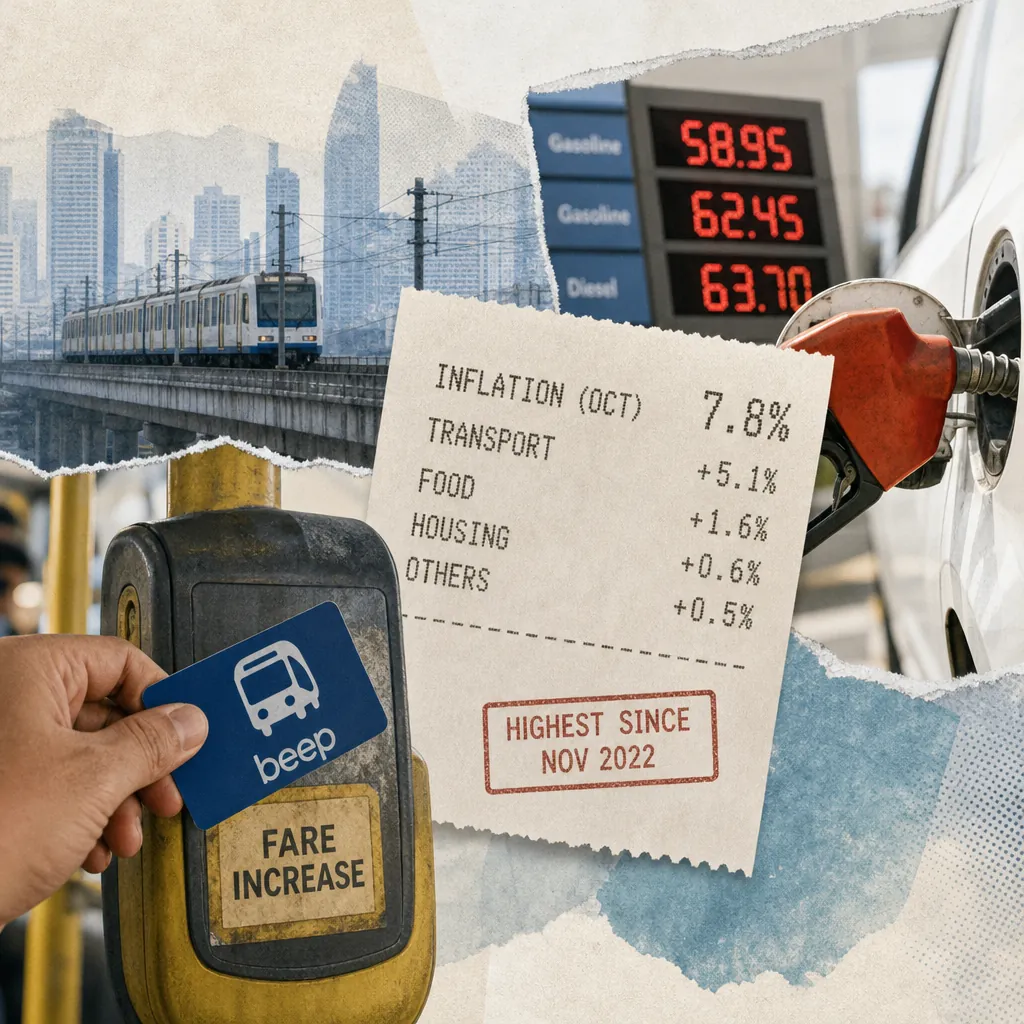
October inflation in the Philippines reached 7.8 percent, the fastest pace of price increases since November 2022, when the rate stood at 8 percent. The Philippine Statistics Authority (PSA), the government agency that compiles the consumer price index, reported on Thursday that the rate had climbed from 7.2 percent in September and from 1.7 percent in October last year1750. The October 2025 comparison is the more striking one: twelve months ago, price growth was running at less than a quarter of today's rate, helped by a sharp deceleration in food inflation to 0.3 percent that the Daily Tribune attributed largely to importation policies under Executive Order 6217.
Transport carried most of the increase. The PSA's National Statistician, Claire Dennis Mapa, said transport recorded inflation of 20.1 percent and accounted for 62.9 percent of the total rise, driven by higher jeepney and bus fares and by increases in the prices of gasoline, liquefied petroleum gas (LPG), and electricity5017. Housing, water, electricity, gas, and other fuels rose 9.3 percent, up from 8.4 percent the previous month. Food inflation slowed slightly to 6.4 percent from 6.8 percent on softer fish and vegetable prices, but rice inflation remained at 20.7 percent50. The year-to-date average through October stands at 5.6 percent, well above the government's target band of 2 to 4 percent50.
The reading landed across the captured coverage in several mediums. The Daily Tribune led its online edition with the headline "Inflation rockets to 7.8%," framing the number as evidence that household purchasing power has been eroded and that the Marcos administration's response to the cost-of-living problem has reached its limits17. The Manila Times' tabloid PM ran a Filipino-language report in its Punto Mo section noting that this was the second consecutive month of acceleration and that the year-to-date average had breached the target50. Philstar's Pilipino Star Ngayon carried a parallel Filipino report with the same PSA figures50. The story also drew a policy response: Senator Bam Aquino renewed his call to raise the personal income tax exemption to ₱480,000, equivalent to a monthly living wage of ₱40,000 for a family of four or five, citing both the inflation reading and the peso's close at ₱63.535 to the dollar on Wednesday31.
Key themes
- Inflation reached 7.8 percent in October, the highest since November 2022. The rate rose from 7.2 percent in September and 1.7 percent a year earlier, according to PSA data1750. The year-to-date average of 5.6 percent is above the government's 2 to 4 percent target band.
- Transport accounted for 62.9 percent of the increase. Transport inflation hit 20.1 percent, driven by jeepney and bus fare adjustments and higher fuel and electricity prices50. Housing and utilities rose 9.3 percent, up from 8.4 percent.
- Rice inflation stayed at 20.7 percent even as overall food inflation eased. Food inflation slowed to 6.4 percent from 6.8 percent on cheaper fish and vegetables, but rice remained the single largest food contributor50.
- Senator Bam Aquino pushed a ₱480,000 income tax exemption. The proposal, Senate Bill No. 267, would raise the annual personal income tax exemption cap and is pitched as relief equivalent to a ₱40,000 monthly living wage for a family of four or five31.
- The peso closed at ₱63.535 to the dollar on Wednesday. Aquino cited the exchange rate alongside inflation as the reason for the tax relief proposal31.
- The Department of Agriculture is seeking ₱1 billion to vaccinate small hog farms against African swine fever. The request for the 2027 budget follows the September approval of the first commercially available ASF vaccine in the country, AVAC ASF LIVE, and would prioritize smallholders and backyard raisers who cannot afford the vaccine themselves447.
- Philippine exports grew 35.7 percent through September 2026. Trade Secretary Ma. Cristina Roque cited the figure at the Philippine Exporters' Trade Exposition & Forum 2026, attributing it to global demand for locally made products and market-access efforts23.
- PAL finalized an order for up to 14 additional Airbus A350-1000 aircraft. The flag carrier signed definitive agreements for nine jets with purchase rights for five more, bringing its total firm A350-1000 orders to 18, with deliveries of the new batch expected between 2034 and 20361.
How the narratives stack
Dominant. The inflation reading dominated the captured coverage. It appeared in the Daily Tribune's online lead, in the Manila Times' tabloid PM, in Philstar's Pilipino Star Ngayon, and in the policy response from Senator Aquino175031. The story's dominance within this set reflects both its consequence for every household and the breadth of outlets that picked it up. The framing across outlets was consistent on the numbers and differed on interpretation: the Tribune emphasized the limits of the government's response, while the Filipino-language reports led with the PSA data and the breach of the target band.
Counter-narrative. The Aquino tax proposal offers a policy answer to the inflation number rather than a challenge to it31. It is a counter-narrative in the sense that it reframes the story from a report on prices to a debate about whether workers should keep more of their income. The proposal is not new — Senate Bill No. 267 predates the October reading — but the inflation figure gave it fresh urgency.
Emerging. Two agricultural stories point to the next phase of food-price pressure. The Department of Agriculture's ₱1-billion ASF vaccination request and the seizure of 82 live hogs worth about ₱1.1 million at an ASF checkpoint in Aklan both signal that the government is treating swine disease as a continuing threat to pork supply44738. The Aklan operation, which led to three arrests and charges under Executive Order No. 044, series of 2026, shows enforcement is now part of the disease-control effort38. Separately, the export growth figure of 35.7 percent through September offers a contrasting economic signal: trade is expanding even as consumer prices accelerate23.
Under-covered. The peso's movement against the dollar received only passing mention, inside Aquino's statement, despite its direct effect on import costs and therefore on the prices Filipinos pay31. The exchange rate closed at ₱63.535 on Wednesday, and the relationship between a weaker peso and imported fuel, rice, and manufactured goods is the mechanism that connects the currency story to the inflation story. No item in the captured set examined that link in detail.
Platform insights
- Facebook. The inflation story circulated through the Facebook pages of mainstream outlets, where the Filipino-language versions from PM and Pilipino Star Ngayon were positioned for sharing among general audiences50. The Aquino tax proposal, carried by the blog Iconic MNL, was framed for Facebook-style distribution with a direct appeal to workers and families31.
- X. The Daily Tribune's online edition, which led with "Inflation rockets to 7.8%," is the kind of headline built for rapid sharing on X, where business and policy accounts amplify breaking economic data17. The 7.8 percent figure and the comparison to November 2022 were the most quotable elements.
- Reddit. Discussion of the inflation reading on Philippine subreddits tends to focus on personal budgeting and the gap between official figures and household experience. The PSA's breakdown — transport at 62.9 percent of the increase, rice at 20.7 percent — gives commenters specific numbers to argue over50.
- YouTube. The export forum where Trade Secretary Roque spoke, and the broader business coverage of the inflation reading, generated video segments on the YouTube channels of Philippine broadcasters23. The Aquino proposal also circulated as short-form video commentary31.
Key voices and communities
The Philippine Statistics Authority. National Statistician Claire Dennis Mapa presented the October data and the sectoral breakdown50. The PSA is the government's official statistical agency, and its monthly inflation report is the baseline against which all other economic claims are measured. Mapa's attribution of 62.9 percent of the increase to transport gave the story its most concrete explanatory detail.
Senator Bam Aquino. Aquino's proposal to raise the personal income tax exemption to ₱480,000 is a direct response to the inflation reading and the peso's weakness31. His framing — that the exemption equals a ₱40,000 monthly living wage for a family of four or five — translates an abstract tax measure into a household budget.
The Department of Agriculture. DA spokesman Arnel de Mesa announced the ₱1-billion ASF vaccination request for 2027, positioning the agency as the manager of a food-supply risk that feeds directly into pork prices447. The DA's vaccination program would prioritize smallholders and backyard raisers, the producers least able to absorb the cost of the vaccine.
The Department of Trade and Industry. Trade Secretary Ma. Cristina Roque used the export forum to highlight 35.7 percent export growth through September, presenting trade expansion as a counterweight to the domestic price story23.
Filipino households and budget-conscious consumers. The inflation reading is the story that reaches every household, and the Filipino-language coverage in PM and Pilipino Star Ngayon was written for that audience50. The Aquino proposal speaks directly to workers and families watching their purchasing power decline31.
Narrative streams
Inflation reaches 7.8 percent, the highest since November 2022
The PSA's October report put headline inflation at 7.8 percent, up from 7.2 percent in September and 1.7 percent in October 20251750. The comparison to November 2022, when the rate hit 8 percent, places the current reading at the top of the post-pandemic range. The Daily Tribune noted that the rate now sits alongside Lao PDR's in the Association of Southeast Asian Nations region17.
The composition of the increase matters more than the headline. Transport inflation of 20.1 percent contributed 62.9 percent of the total rise, according to Mapa, with jeepney and bus fare increases and higher gasoline, LPG, and electricity prices as the named drivers50. Housing and utilities rose 9.3 percent from 8.4 percent. Food inflation eased to 6.4 percent from 6.8 percent, but rice stayed at 20.7 percent50. The year-to-date average of 5.6 percent is above the 2 to 4 percent target band the government sets for itself50.
For households, the read is straightforward: the prices rising fastest are the ones with the least room to cut — transport to work and school, electricity, and rice. A family that cannot reduce its commute or its rice consumption absorbs the full 7.8 percent. For the government, the reading complicates the case that its importation policies have stabilized food prices; the October 2025 comparison shows food inflation at 0.3 percent a year ago, and the current 6.4 percent is a reversal of that progress17.
Senator Aquino proposes a ₱480,000 income tax exemption
Aquino renewed his call for Senate Bill No. 267, which would raise the annual personal income tax exemption cap to ₱480,00031. He framed the figure as equivalent to a ₱40,000 monthly living wage for a family of four or five, and cited both the 7.8 percent inflation reading and the peso's close at ₱63.535 to the dollar on Wednesday31.
The proposal is a tax measure, not a spending program. Raising the exemption cap means workers keep more of their income before the tax schedule applies, which increases take-home pay without a direct government outlay. Aquino's argument is that inflation and currency depreciation have eroded the real value of the existing exemption, so the cap needs to rise to restore its original intent31.
For workers, the read is that the proposal would put more cash in hand at a moment when transport and rice costs are rising fastest. For fiscal planners, the cost is foregone revenue at a time when the government is also seeking new spending for programs like ASF vaccination4. The proposal's path through the Senate is not specified in the captured coverage, and no counterpart in the House of Representatives is named31.
The Department of Agriculture seeks ₱1 billion for ASF vaccination
The DA is requesting approximately ₱1 billion in the 2027 budget to procure African swine fever vaccines for smallholder and backyard hog raisers447. DA spokesman Arnel de Mesa said the program would prioritize those who cannot afford the vaccine themselves47. The request follows the September approval by the Bureau of Animal Industry of AVAC ASF LIVE, a live, attenuated, gene-deleted vaccine developed by AVAC Vietnam Joint Stock Co., as the first commercially available ASF vaccine in the Philippines4. The DA conducted a government-controlled vaccination at registered hog farms in 2024 after the Food and Drug Administration issued a certificate of product registration47. De Mesa said another ASF vaccine from South Korea is under review47.
African swine fever is a viral disease that is lethal to pigs and has no cure; outbreaks have repeatedly cut Philippine pork supply and driven up prices. Vaccination of smallholders matters because backyard raisers are the least able to absorb the loss of a herd and the least able to pay for the vaccine privately. The read for the pork sector is that government-funded vaccination would lower the cost of protection for the producers who supply a large share of the domestic market, which in turn affects retail pork prices. The read for the DA is that the program's success depends on the 2027 budget allocation, which is not yet decided4.
Aklan checkpoint seizure shows ASF enforcement in practice
Authorities seized 82 live hogs worth approximately ₱1.1 million after two drivers and a hog owner allegedly tried to evade an ASF checkpoint in Barangay Pinatuad, Nabas, Aklan, on Saturday night38. Three individuals were arrested, including two 52-year-old drivers and a 37-year-old hog owner. The operation was led by the 3rd Maneuver Platoon of the 2nd Aklan Provincial Mobile Force Company, in coordination with the Office of the Provincial Veterinarian38. The suspects face charges of disobedience to a person in authority and violation of Executive Order No. 044, series of 202638.
The seizure shows that ASF control is not only a vaccination program but also a movement-control regime. Checkpoints stop infected animals from moving between provinces, and the Aklan case indicates that some traders attempt to bypass them. For hog raisers in ASF-free areas, enforcement at checkpoints is the first line of defense against reintroduction of the disease. For traders, the case is a warning that evasion carries criminal charges38.
Exports grow 35.7 percent through September
Trade Secretary Ma. Cristina Roque said Philippine exports grew 35.7 percent as of September 2026, attributing the increase to global demand for locally made products and efforts to expand market access23. She spoke at the Philippine Exporters' Trade Exposition & Forum 2026. The figure is a cumulative growth rate for the year through September, compared with the same period a year earlier23.
The export number sits alongside the inflation number as a contrasting economic signal: external demand for Philippine goods is expanding while domestic purchasing power is being squeezed. For exporters, the read is that market-access work is producing results and that the government intends to keep pursuing new buyers. For the domestic economy, the read is that export growth does not by itself lower the prices households pay for transport and rice23.
PAL finalizes an order for up to 14 additional Airbus A350-1000s
Philippine Airlines signed definitive agreements with Airbus and Rolls-Royce for nine A350-1000 aircraft, with purchase rights for five more, bringing its total firm orders for the type to 181. The signing formalized commitments first announced at the Farnborough International Airshow in July. PAL expects to take delivery of the nine additional aircraft between 2034 and 20361. Lucio Tan III, chair of PAL and president and chief operating officer of parent PAL Holdings Inc., said the agreement reflected the airline's commitment to investing in its future1.
The order is a long-haul bet. The A350-1000 is a wide-body jet used on long international routes, and PAL's decision to commit to 18 of them signals that it expects demand for long-haul travel to grow through the 2030s. For the airline, the read is that fleet renewal is a multi-decade project that proceeds regardless of short-term economic conditions. For travelers, the read is that more long-haul capacity is planned, though the deliveries are eight to ten years away1.
The peso's slide and the import-cost channel
The peso closed at ₱63.535 to the dollar on Wednesday, a detail Aquino cited in his tax proposal31. The exchange rate matters for inflation because the Philippines imports much of its fuel, rice, and manufactured goods; a weaker peso raises the peso cost of those imports, which feeds into the prices consumers pay. The October inflation breakdown, with transport at 20.1 percent and rice at 20.7 percent, is consistent with that channel50. The captured coverage did not include an item that traced the peso's movement to specific import categories, leaving the link as an inference from the two data points rather than a documented analysis3150.
Conversation trajectory
The November inflation release (observation window: mid-December 2026). The PSA will publish November inflation data in early December. The key question is whether transport inflation continues to drive the headline or whether food, particularly rice, takes over. If transport remains the largest contributor, the case for fare and fuel measures strengthens; if rice accelerates, the policy focus shifts to agricultural supply50.
The 2027 budget deliberations (observation window: through the budget's passage). The DA's ₱1-billion ASF vaccination request and the broader fiscal cost of any income tax exemption will both be weighed in the 2027 budget process431. The vaccination request is a specific line item; the tax exemption is a revenue measure. How the two are reconciled will indicate the government's priorities between food-supply protection and household income relief.
Senate Bill No. 267's progress (observation window: the current legislative session). The bill's path through the Senate and any House counterpart will determine whether the ₱480,000 exemption becomes law31. The inflation reading gives supporters a fresh argument, but the fiscal cost is the constraint.
ASF enforcement and vaccine rollout (observation window: the next several months). The Aklan seizure and the DA's vaccination plans will play out against the question of whether ASF outbreaks recur during the holiday season, when pork demand peaks3847. A new outbreak would raise pork prices and strengthen the case for the vaccination budget.
PAL's delivery timeline (observation window: 2034–2036). The A350-1000 deliveries are years away, but the order's progress through financing and regulatory approvals will be tracked by the aviation sector1.
Trigger events. The next PSA inflation release, the signing of the 2027 national budget, any Senate committee action on Senate Bill No. 267, and any new ASF outbreak report are the events that would move these stories forward.
Response guidance
Lead with the household budget, not the headline rate. The 7.8 percent figure is abstract; the transport and rice components are what households feel50. Communications should translate the rate into the specific costs — jeepney fares, electricity, rice — that are rising fastest, and avoid presenting the number without the breakdown.
Address the peso-inflation link directly. The peso's close at ₱63.535 is a fact that connects currency to import costs31. Communicators should be prepared to explain, in plain terms, how a weaker peso raises the price of imported fuel and rice, and what the government's options are.
Treat the tax exemption proposal as a live policy debate. Senate Bill No. 267 is a specific measure with a specific number — ₱480,000 — and a specific rationale31. Communications should engage with the fiscal trade-off rather than dismissing or endorsing the proposal without addressing its cost.
Explain ASF vaccination as a supply measure. The DA's ₱1-billion request is a food-supply intervention, not a health measure for consumers447. Communicators should connect vaccination of smallholders to the stability of pork prices, and explain why backyard raisers are the priority.
Use the export growth figure with context. The 35.7 percent export growth is a genuine positive signal, but it does not offset the domestic price story23. Communications should present it as one part of the economic picture, not as a rebuttal to inflation concerns.
Avoid predicting the next inflation reading. The data support a description of October's drivers, not a forecast for November50. Communications should state what is known and identify the next data release as the point at which the trend will be clear.
See the full picture behind today's signals.
This report draws from Media Meter's MediaWatch, our real-time monitoring engine tracking 2,470+ Philippine sources across print, broadcast, digital, and social. Explore how the platform turns raw coverage into decision-grade intelligence, then see how it's configured for teams like yours — whether you're in PR agencies, corporate comms, government, or marketing.
Want more? Browse our Report Library for sector and crisis intelligence, or request a demo and we'll have your brand set up before the call.
Want this kind of intelligence on your brand?
This brief is built on the same MediaWatch methodology that runs continuously across every brand we monitor. See your competitive landscape, Impact Score, and narrative trajectory in a 30-minute demo.