Sugar Output Cut to 1.662 MMT as El Niño Bites
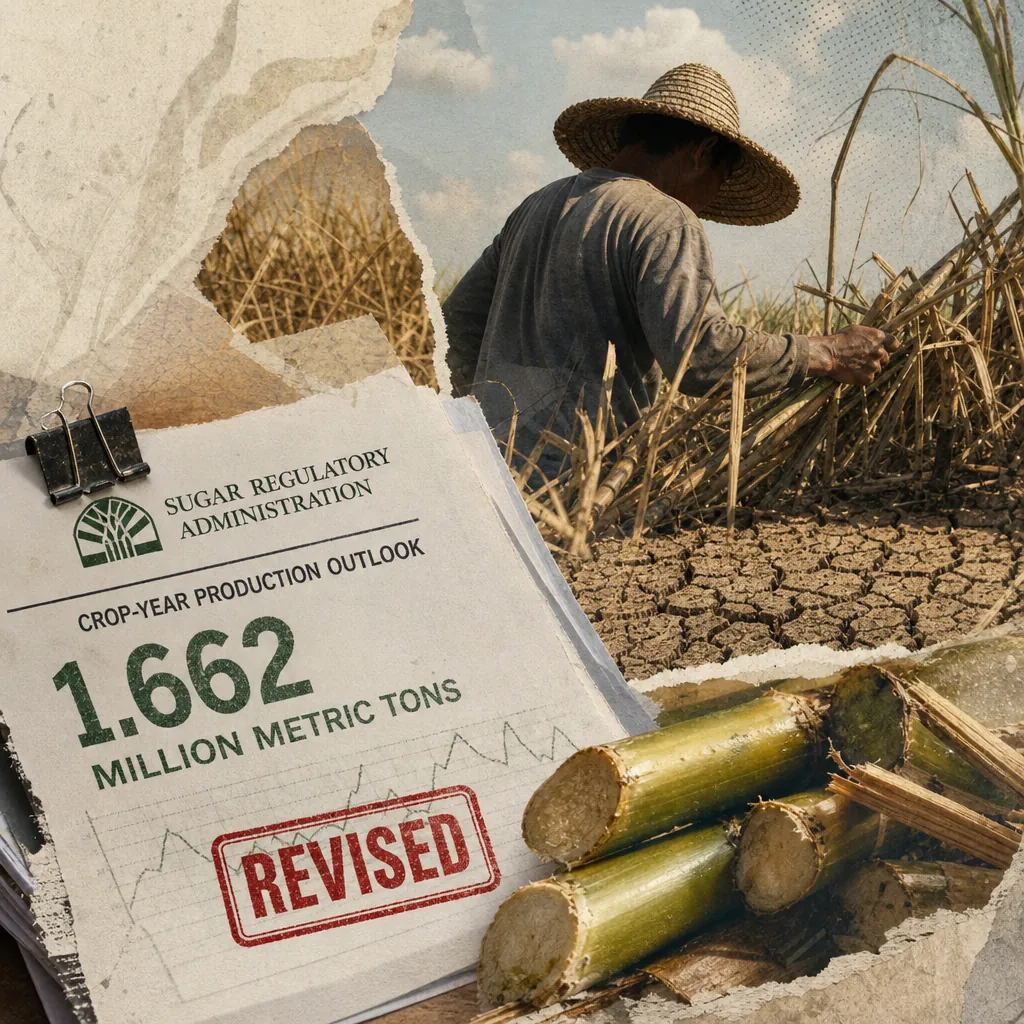
The Sugar Regulatory Administration lowered its crop-year production forecast to 1.662 million metric tons, citing rainfall losses of up to 70 percent in Negros, while farmers pressed for a ₱2,600 floor price and labor groups sought a fully domestic allocation. The same dry spell prompted the Climate Change Commission to urge schools and agencies to shift working hours away from the hottest part of the day.
The Conversation
The Sugar Regulatory Administration (SRA) cut its production forecast for the current crop year to 1.662 million metric tons, down from an earlier estimate of about 1.85 million, and Administrator Pablo Luis S. Azcona told reporters the shortfall was mostly weather-driven: southern Negros normally receives about 2,500 millimeters of rain a year but got roughly 40 percent less, while northern Negros rainfall fell 60 to 70 percent, prompting the Bureau of Soils and Water Management to run cloud seeding 1427. The downgrade, reported by BusinessWorld and carried in the Manila Times, landed the same day sugar farmers asked the SRA to set a minimum millgate price of ₱2,600 per 50-kilogram bag — the amount paid to producers when sugar leaves the mill, before transport and retail costs are added — and the National Congress of Unions in the Sugar Industry of the Philippines (NACUSIP) and the Agrarian Reform Beneficiaries Council asked the agency to classify 100 percent of the coming crop as "B," or domestic-market sugar, to keep local supply at home 1427.
The dry spell behind the downgrade also produced a second, broader story. The Climate Change Commission (CCC), the government body that coordinates Philippine climate policy, advised schools and government agencies to move their schedules out of the 10 a.m. to 3 p.m. window, with Commissioner Albert dela Cruz suggesting classes run from 6 a.m. to 9:30 a.m. so students can go home before the heat peaks 9. The CCC said it would also coordinate with the Department of Trade and Industry (DTI) and the Department of Labor and Employment on workplace adjustments. El Niño is the periodic warming of the central and eastern Pacific Ocean that shifts rainfall patterns worldwide; for the Philippines it typically means below-normal rain and hotter days, which is why the same phenomenon appears in both the sugar forecast and the school-schedule advisory.
Away from agriculture, the day's captured coverage was wide and mostly unrelated: a Philippine-European Union free trade agreement signed on Sept. 22 drew two separate opinion pieces 1237; the Department of Agriculture (DA) set a Dec. 31 deadline for warehouse registration 17; the DTI launched an upgraded online portal for small businesses and signed a partnership with foodpanda Philippines to train micro, small and medium enterprises (MSMEs) 3032; and Meralco opened bidding for a 15-year contract to supply 900 megawatts of baseload power 45. The items reviewed here are a monitored selection rather than a complete record of the day's publishing, and the mix skews toward business and general-news outlets.
Key themes
- Sugar production forecast cut to 1.662 million metric tons. The SRA lowered its crop-year estimate from about 1.85 million metric tons, attributing most of the drop to rainfall losses of 40 percent in southern Negros and 60 to 70 percent in the north 14.
- Farmers seek a ₱2,600 per-bag floor price the SRA says it cannot set. Azcona said price-setting falls outside the agency's mandate, though he acknowledged lower inventories could support higher millgate prices 14.
- Labor and agrarian groups want the entire crop reserved for the domestic market. NACUSIP and the Agrarian Reform Beneficiaries Council filed a joint position paper asking the SRA to classify 100 percent of 2026–2027 production as "B" sugar, citing pest infestations and erratic weather 27.
- The Climate Change Commission wants schools and agencies to avoid the 10 a.m. to 3 p.m. heat window. Commissioner Albert dela Cruz proposed a 6 a.m. to 9:30 a.m. class schedule as part of local climate action plans 9.
- The DA gave warehouse operators until Dec. 31 to register. Agriculture Secretary Francisco Tiu Laurel Jr. said registration is meant to improve supply-chain data and curb smuggling and hoarding of agricultural and fishery commodities, especially rice 17.
- The DTI expanded digital services for small businesses. The Negosyo Center Online Portal 2.0 centralizes registration assistance, advisory support and virtual coaching, and a separate partnership with foodpanda Philippines will train MSMEs on e-commerce and the Internet Transactions Act 3032.
- Meralco opened a 900-megawatt baseload auction. Bidders have until Oct. 15 to express interest in a 15-year supply contract delivering 600 megawatts from February 2031 and another 300 megawatts a year later 45.
- The Philippines–EU free trade agreement drew continued commentary. Two opinion pieces described the Sept. 22 deal, which liberalizes more than 94 percent of tariff lines covering over 97 percent of bilateral trade, as a framework for diversifying export markets 1237.
How the narratives stack
Dominant. The sugar production downgrade and the price fight around it carried the most consequence in the items reviewed. The SRA's cut to 1.662 million metric tons against expected domestic demand of about 2.0 million metric tons implies a gap of roughly 340,000 metric tons that will have to be covered by imports or carryover stock 1427. The story ran across a broadsheet business desk and a regional online outlet, and it connects directly to consumer prices: millgate prices feed into the retail cost of sugar, which in turn feeds into processed food, beverages and baked goods. The warehouse-registration deadline and the CCC's heat advisory are part of the same supply-and-climate picture, though they were covered separately 917.
Counter-narrative. The DTI's digital push for small businesses ran against the day's more cautionary agricultural news. The Negosyo Center Online Portal 2.0 and the foodpanda partnership were framed by the agency as ways to widen market access for MSMEs, with Trade Secretary Cristina A. Roque saying small businesses are "the beating heart of our economy" 3032. The counterweight is that the same DTI was criticized in a Senate budget hearing for taking up to seven months to resolve consumer complaints, which suggests the agency's service-delivery record is uneven across its own programs 25.
Emerging. The El Niño advisories are the earliest stage of what could become a sustained story. The CCC's schedule guidance is voluntary and framed as part of local climate action plans, but if the dry spell deepens, the same logic could extend to workplace rules, water rationing and agricultural planting calendars 9. The sugar industry's request for a fully domestic allocation is also an early signal: if the SRA grants it, importers and industrial users will have to adjust, and if it does not, farmers will likely escalate 27.
Under-covered. The LPG safety question raised in a BusinessMirror column received little attention relative to its stakes. The piece cited an Aug. 27, 2026 explosion in Valenzuela City that injured three family members and asked whether every cylinder entering the Philippine market is properly tested 39. Liquefied petroleum gas (LPG) is the cooking fuel used by most Filipino households, so a gap in testing standards would affect a very large population, yet the item appeared as a single opinion column rather than a news story with follow-up reporting.
Platform insights
- Facebook. The day's most shareable agricultural content was the sugar price story, which lends itself to household-budget framing: a ₱2,600 millgate price translates into retail prices that consumers feel at the palengke. Posts that pair the production cut with the import gap tend to travel further than straight policy reporting because they answer the immediate question of whether sugar will get more expensive.
- X. The CCC's school-schedule advisory generated the kind of quick, practical reaction that platform rewards: parents and teachers debating whether a 6 a.m. start is workable given transport schedules, and whether the 10 a.m. to 3 p.m. window is realistic for government offices. The conversation split between those treating it as sensible heat adaptation and those pointing out that early dismissal creates childcare problems.
- Reddit. Discussion clustered around the DTI's consumer-complaint backlog, with users sharing personal experiences of defective products and difficult returns. The seven-month figure gave the thread a concrete anchor, and the tone was more investigative than outraged, with users comparing the DTI's mediation and adjudication stages to similar processes in other countries.
- YouTube. The Meralco baseload auction drew explainer-style content from energy-focused channels, breaking down what baseload power is and why a 15-year contract matters for electricity prices. The sugar story appeared mainly as repackaged news segments rather than original analysis.
Key voices and communities
Sugar farmers and mill workers. The SRA's production downgrade gave producers a concrete number to organize around, and the ₱2,600 millgate request is the sector's opening position. NACUSIP President Roland de la Cruz framed the domestic-allocation request as protection for farmers, mill workers and consumers against "severe price volatility and premature market flooding from foreign imports" 27. This group matters because it sits at the start of a supply chain that reaches every household.
The Sugar Regulatory Administration. As the agency that oversees the sugar industry, the SRA is caught between farmers asking for a price floor and a legal mandate that Azcona says does not include price-setting. His statement that "it is difficult for the SRA to recommend a price because that is outside our mandate" sets up the central tension: the agency can project shortages but cannot directly set the price farmers want 14.
The Climate Change Commission. The CCC's advisory puts it in the unusual position of shaping school and work schedules, which are normally the domain of the Department of Education and the Civil Service Commission. Commissioner dela Cruz's proposal is a signal that climate adaptation is moving from long-term planning into immediate operational decisions 9.
Small-business advocates and the DTI. The Negosyo Center portal launch and the foodpanda partnership position the DTI as the main government interface for MSMEs, a sector that accounts for the vast majority of Philippine businesses. The agency's credibility on this front is complicated by the Senate hearing where Sen. Raffy Tulfo reprimanded it over complaint-processing times 253032.
Energy watchers. Meralco's 900-megawatt auction is a routine but consequential event for anyone tracking electricity prices, because baseload contracts lock in supply and cost for more than a decade. The Oct. 15 expression-of-interest deadline and Nov. 6 pre-bid conference give this group clear dates to watch 45.
Narrative streams
Sugar output falls to 1.662 million metric tons as Negros rainfall drops 40 to 70 percent
The SRA's revised forecast of 1.662 million metric tons for the current crop year is a downgrade of nearly 190,000 metric tons from its earlier estimate of about 1.85 million 14. Azcona attributed the decline to rainfall patterns, noting that southern Negros received roughly 40 percent less rain than its normal 2,500 millimeters and northern Negros 60 to 70 percent less, which led the Bureau of Soils and Water Management to conduct cloud seeding 14. The agency is also mounting soil rejuvenation and varietal improvement programs, though those take multiple seasons to show results. Against expected domestic demand of about 2.0 million metric tons, the forecast implies a shortfall of roughly 340,000 metric tons 27. For the sector, that gap is the number that matters: it determines how much sugar the Philippines will need to import, and import decisions affect both the price farmers receive and the price consumers pay. The last time the country faced a comparable shortfall, in the 2021–2022 crop year, the government authorized imports that drew criticism from farmers who said the timing undercut local prices. The current request for a 100 percent domestic allocation is an attempt to avoid a repeat of that sequence 27.
Farmers ask for a ₱2,600 millgate floor the SRA says it has no power to set
The millgate price is what a farmer receives when sugar leaves the mill, before transport and retail markups are added, so a floor at ₱2,600 per 50-kilogram bag would set a minimum income for producers 14. Azcona's response was direct: "It is difficult for the SRA to recommend a price because that is outside our mandate" 14. He did note that sugar inventories are lower than last year, which could support higher prices without a mandated floor. The read for the sector is that farmers have a sympathetic supply argument but no clear legal mechanism to get the price they want; the SRA can project scarcity but cannot set the terms of trade. If millgate prices do not rise, the risk is that smallholders reduce planting or shift to other crops, which would tighten supply further in the following crop year. The Manila Times reported the farmers' request, and the story also ran in BusinessWorld, giving it coverage across two business desks 14.
Labor and agrarian groups seek a fully domestic sugar allocation
NACUSIP and the Agrarian Reform Beneficiaries Council submitted a joint position paper asking the SRA to classify 100 percent of 2026–2027 production as "B" or domestic-market sugar 27. In the Philippine sugar classification system, "B" sugar is reserved for the local market, while other classifications cover export and reserve stocks; a full "B" allocation would effectively bar exports and prioritize local supply. De la Cruz cited "severe pest infestations and unpredictable weather patterns" as reasons to keep supply at home 27. The request puts the SRA in a second bind: granting it would protect farmers and consumers from import competition, but it would also reduce export earnings and could strain relations with trading partners. The read for the sector is that the domestic-allocation fight is really a fight about who absorbs the cost of a short crop — farmers, consumers or the government through imports. The Digicast Negros report is the only item in the captured set covering this position, which suggests the story has not yet reached national business desks 27.
Climate commission advises schools and agencies to avoid the 10 a.m. to 3 p.m. heat
The CCC's advisory is the first concrete operational guidance to come out of the government's El Niño preparations 9. Commissioner dela Cruz suggested classes run from 6 a.m. to 9:30 a.m., with students going home before the hottest part of the day, and said the commission would coordinate with the DTI and the Department of Labor and Employment on workplace adjustments 9. The advisory is voluntary and framed as part of local government climate action plans, which means implementation will vary widely depending on local capacity. For schools, the practical challenge is that early dismissal shifts childcare responsibilities to families and may not align with transport schedules. For government agencies, the question is whether service hours can be compressed without reducing output. The read for the sector is that climate adaptation is moving from planning documents into daily schedules, and the institutions that adapt first will set the template others follow. The Inquirer reported the advisory, and it connects directly to the sugar forecast: both are consequences of the same rainfall deficit 914.
DA sets Dec. 31 deadline for warehouse registration to curb smuggling
Agriculture Secretary Francisco Tiu Laurel Jr. directed officials to issue a public notice requiring warehouses and other facilities storing agricultural and fishery commodities to register by Dec. 31 17. The stated purpose is to improve supply-chain data and curb smuggling, hoarding and other market abuses, with particular attention to rice. "We have to strictly follow the law," Tiu Laurel said at a meeting with DA officials 17. The registration requirement matters because the government's ability to manage food supply depends on knowing how much stock is held where; without that data, import decisions and price interventions are based on estimates rather than counts. For warehouse operators, the deadline creates a compliance burden, and for traders, it creates a paper trail that could make hoarding harder to hide. The read for the sector is that the DA is building the data infrastructure it needs to intervene in food markets, and the Dec. 31 deadline is the test of whether operators comply voluntarily or force enforcement action. The Manila Times reported the directive 17.
DTI expands digital services for small businesses while facing criticism over complaint delays
The DTI launched the Negosyo Center Online Portal 2.0 on Sept. 28, centralizing business registration assistance, advisory support, educational modules and virtual coaching for MSMEs 30. The portal also includes client profiling and data analytics tools that let the agency track entrepreneurial trends and extend services to remote communities. Separately, the DTI's E-Commerce Bureau signed a memorandum of understanding with foodpanda Philippines to train MSMEs on e-commerce operations and the Internet Transactions Act, a law that governs online commercial transactions and consumer protection in digital markets 32. Trade Secretary Roque said the portal reflects the agency's view that "when we empower a local enterprise, we do not just build a business—we uplift families, transform communities and drive national growth" 30. The counterpoint came the same day in a Senate finance subcommittee hearing, where Sen. Raffy Tulfo reprimanded the DTI after Fair Trade Group Assistant Secretary Regino Mallari admitted that consumer complaints can take up to a month in mediation and as long as six months in adjudication, for a total of up to seven months 25. Tulfo said he still receives complaints about defective products that are hard to return because sellers are evasive, and raised concerns about the DTI's implementation of the No Return, No Exchange policy, which prohibits stores from posting blanket no-return signs but is often misapplied 25. The read for the sector is that the DTI is expanding its digital front door while its back-end dispute resolution remains slow, and small businesses that depend on consumer trust have an interest in both improving.
Meralco opens bidding for 900 megawatts of baseload power
Manila Electric Co. (Meralco), the country's largest electricity distributor, is seeking bidders for a 15-year contract to supply 900 megawatts of baseload power, the minimum amount of electricity needed on the grid to meet constant demand 45. The auction opened after the Department of Energy issued a certificate of conformity covering the terms of reference for the power supply agreements to be awarded. The contract will provide 600 megawatts starting Feb. 26, 2031, and an additional 300 megawatts a year later, subject to approval by the Energy Regulatory Commission, which reviews and approves electricity rates and supply contracts 45. Power generation companies may submit expressions of interest until Oct. 15, with a pre-bid conference on Nov. 6. The read for the sector is that this auction locks in a significant share of the country's future electricity supply more than four years before delivery, and the terms will shape generation costs — and therefore consumer rates — for a decade and a half. The Philstar report gives the timeline and the process, but the outcome will depend on how many generators bid and at what price 45.
Philippines–EU free trade agreement draws commentary on export diversification
The Philippines and the European Union signed a bilateral free trade agreement on Sept. 22 that would liberalize more than 94 percent of tariff lines, covering over 97 percent of bilateral trade 1237. The deal covers goods, services, investment and government procurement, as well as digital trade, energy and raw materials, and trade and sustainable development. Two opinion pieces in the captured set described it as a framework for diversifying export markets at a time when global trade faces uncertainty 1237. The agreement matters because the EU is a large market for Philippine agricultural and manufactured exports, and tariff reductions lower the cost of entry for Filipino producers. The read for the sector is that the FTA gives exporters a second large market alongside the United States and China, but the benefits depend on whether Philippine producers can meet EU standards on sustainability and traceability, which the agreement's sustainable-development provisions address. The BusinessWorld and Head Topics pieces are commentary rather than news, which suggests the deal's operational details are still being digested 1237.
Conversation trajectory
Sugar supply and price decisions (next 4–6 weeks). The SRA is expected to decide on the domestic-allocation request and respond to the millgate price petition. Watch for the agency's next production update and any announcement on imports. The trigger events are the SRA's crop-year allocation announcement and any DA import authorization, both of which would move prices and farmer sentiment 1427.
El Niño advisories and school schedules (next 2–4 weeks). The CCC's guidance is voluntary, so the signal to watch is whether the Department of Education or local government units issue binding schedule changes. If heat indices rise, expect more agencies to follow the CCC's lead, and expect debate about whether early dismissal creates more problems than it solves 9.
Warehouse registration compliance (through Dec. 31). The DA's deadline is a fixed date, and the trigger is the compliance rate the agency reports. If registration is low, the DA will have to decide between extending the deadline and enforcing penalties, and either choice will signal how serious the anti-hoarding effort is 17.
Meralco auction participation (Oct. 15 and Nov. 6). The expression-of-interest deadline and pre-bid conference will show how many generators are willing to commit to a 15-year contract at current terms. A thin field would suggest generators expect higher prices or see risks in the contract structure, which would affect the final rate 45.
DTI consumer-complaint reform (next 1–3 months). The Senate hearing put the DTI's seven-month complaint timeline on the record. Watch for the agency to announce process improvements or for legislators to file bills addressing the backlog. The trigger is any DTI response to Tulfo's criticism or a follow-up hearing 25.
Response guidance
For agricultural producers and cooperatives: Lead with the production number and the demand gap when communicating about the sugar shortfall. Farmers' groups should state their price request alongside the supply evidence — the 1.662 million metric ton forecast against 2.0 million metric tons of demand — because that pairing is what makes the case legible to consumers and policymakers. Avoid framing the request as a demand for subsidy; frame it as a response to a documented shortfall.
For food and beverage manufacturers: Prepare for input-cost volatility by modeling scenarios around the SRA's allocation decision. If the agency reserves the full crop for domestic use, import-dependent manufacturers should expect tighter supply and higher prices; if it does not, farmers will likely escalate. Communicate sourcing plans clearly to retail partners so that price changes can be explained when they reach consumers.
For schools and local government units: Treat the CCC's schedule advisory as a planning input rather than a directive. The practical questions are transport availability at 6 a.m., childcare arrangements for early dismissal, and whether compressed hours reduce instructional time. Schools that communicate their reasoning to parents will manage the transition better than those that announce changes without explanation.
For warehouse and logistics operators: The Dec. 31 registration deadline is a compliance event, not a negotiation. Operators should register early and document their storage volumes, because the DA's stated purpose is to track imported commodities, especially rice. Late registration invites scrutiny, and accurate reporting builds the case for the sector's role in supply-chain transparency.
For MSMEs and e-commerce sellers: The Negosyo Center portal and the foodpanda partnership offer free training and market access, but the DTI's complaint-processing backlog is a reminder that consumer trust depends on dispute resolution as much as on onboarding. Sellers should document transactions and respond to complaints quickly, because the DTI's mediation process, however slow, is the channel consumers will use.
For energy sector communicators: The Meralco auction is a long-horizon story, and the public's main concern is what it means for electricity bills. Explain baseload power in plain terms — it is the steady supply that keeps the grid running — and connect the contract timeline to the delivery dates in 2031 and 2032 so that consumers understand why the decision matters now even though the power arrives later.
For all sectors: The day's items show climate and supply-chain risk moving from forecasts into operational decisions. The CCC's heat advisory, the sugar downgrade and the warehouse-registration deadline are all responses to the same underlying pressure: the need to manage scarce resources with better data and earlier planning. Communicators should treat these as connected rather than separate stories, because audiences experience them that way — as a single question about whether the country is prepared for a drier, hotter year.
See the full picture behind today's signals.
This report draws from Media Meter's MediaWatch, our real-time monitoring engine tracking 2,470+ Philippine sources across print, broadcast, digital, and social. Explore how the platform turns raw coverage into decision-grade intelligence, then see how it's configured for teams like yours — whether you're in PR agencies, corporate comms, government, or marketing.
Want more? Browse our Report Library for sector and crisis intelligence, or request a demo and we'll have your brand set up before the call.
Want this kind of intelligence on your brand?
This brief is built on the same MediaWatch methodology that runs continuously across every brand we monitor. See your competitive landscape, Impact Score, and narrative trajectory in a 30-minute demo.