Sugar Planters Press for P3,000 Millgate Price
Sugarcane growers and labor groups in Negros Occidental renewed their push for higher millgate prices as raw sugar bids climbed to P2,888 per 50-kilogram bag, while the provincial governor appealed to traders for what he called compassionate pricing. The day's coverage also tracked a P30-million cloud seeding allocation for Negros and Panay and a separate set of food-price stories, including the peso's record low against the dollar and the government's P20-per-kilo rice program.
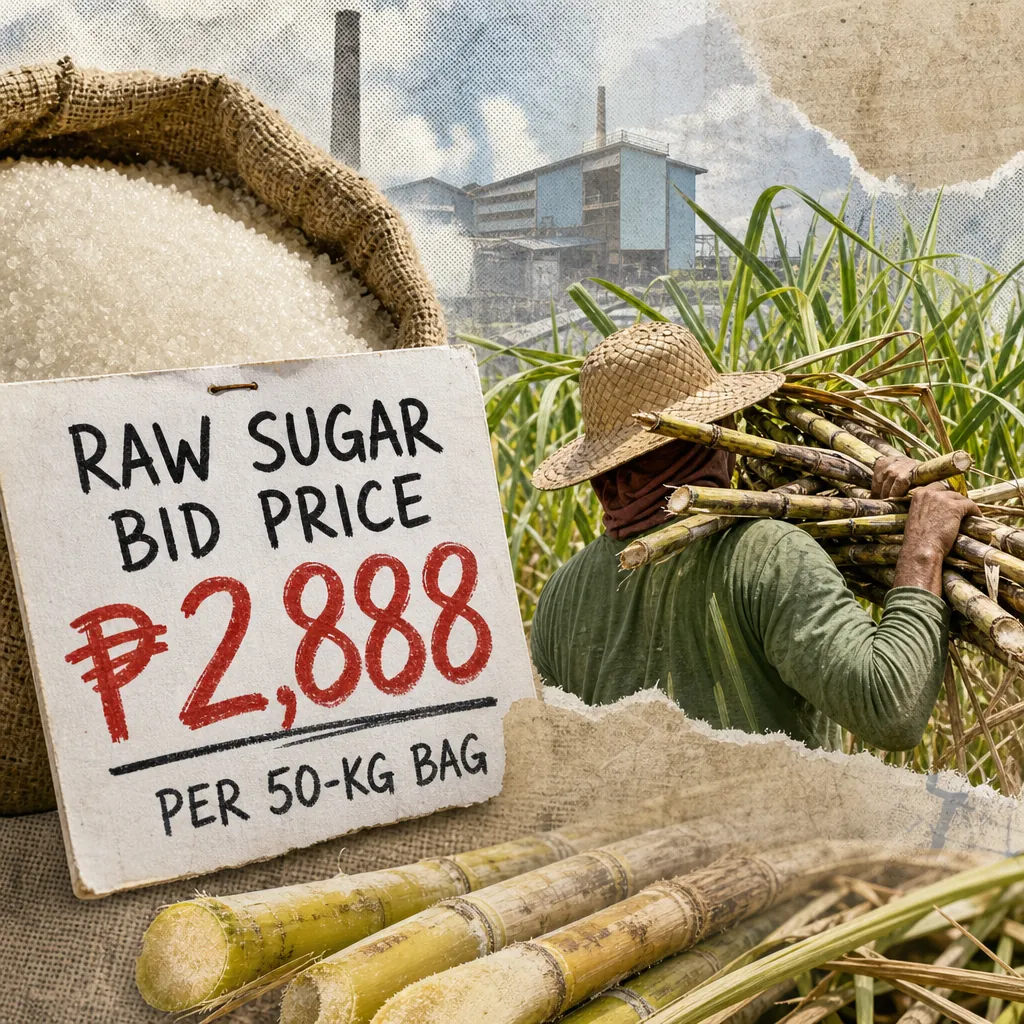
Sugarcane growers and labor unions in Negros Occidental spent Saturday pressing for a millgate price of P3,000 per 50-kilogram bag, arguing that the gains posted at recent raw sugar biddings still leave small planters short of covering production costs4. The bids themselves moved in their favor: Hawaiian-Philippine Co. reached P2,888 per bag, First Farmers Holding Corp. hit P2,760, and the mills of Universal Robina Corp. and Victorias Milling Co. both climbed to P2,6604. Molasses prices also improved, which the joint statement from the Sugar Council and labor groups described as slight relief for distressed farmers4.
Negros Occidental Gov. Eugenio Jose Lacson put the gap in plain terms. At the current P2,600 per bag, he said, even efficient farms only break even, and small farmers fare worse1. He is hoping traders will buy at P3,000 per bag, though he conceded the provincial government cannot compel them. "We cannot compel the traders to buy at the price we want [but] we are hoping they understand the situation and are more compassionate," Lacson said1. The country is estimated to produce 1.6 million metric tons of sugar this crop year, and Lacson said an average of P3,000 per bag is what would make the industry sustainable for the people growing the cane1.
The same day brought a second sugar story with a different mechanism behind it. The Sugar Regulatory Administration (SRA) — the government agency that oversees the sugar industry, sets production policy, and manages the country's sugar supply — has set aside P30 million for cloud seeding over Negros Island and Panay, according to Manuel Lamata, president of the United Sugar Producers Federation2. Lamata said he received a letter dated October 26 from SRA Administrator Pablo Luis Azcona confirming the budget, and that operations would begin in November2. Cloud seeding is the practice of dispersing particles into clouds from aircraft to encourage rain, used here to protect a crop exposed to a severe El Niño — the periodic warming of the Pacific that brings prolonged dry spells to the Philippines and has already damaged standing cane. Lamata welcomed the allocation and said he hoped it would be enough to get growers through the dry period2.
Key themes
- Millgate bids rose to P2,888 per bag but planters say the floor is P3,000. The Sugar Council — made up of the Confederation of Sugar Producers Associations Inc. (CONFED), the National Federation of Sugarcane Planters (NFSP), and the Panay Federation of Sugarcane Farmers (PANAYFED) — joined labor groups in a statement saying the recent increases still do not cover production costs for small-scale planters4.
- The governor framed the price question as a matter of trader discretion. Lacson said the province cannot force a buying price and appealed instead for what he called compassionate pricing, setting P3,000 per bag as the level at which farming stays viable1.
- The SRA committed P30 million to cloud seeding in Negros and Panay, starting in November. The fund is aimed at offsetting a super El Niño, and the planters' federation confirmed the allocation through a letter from the SRA administrator dated October 262.
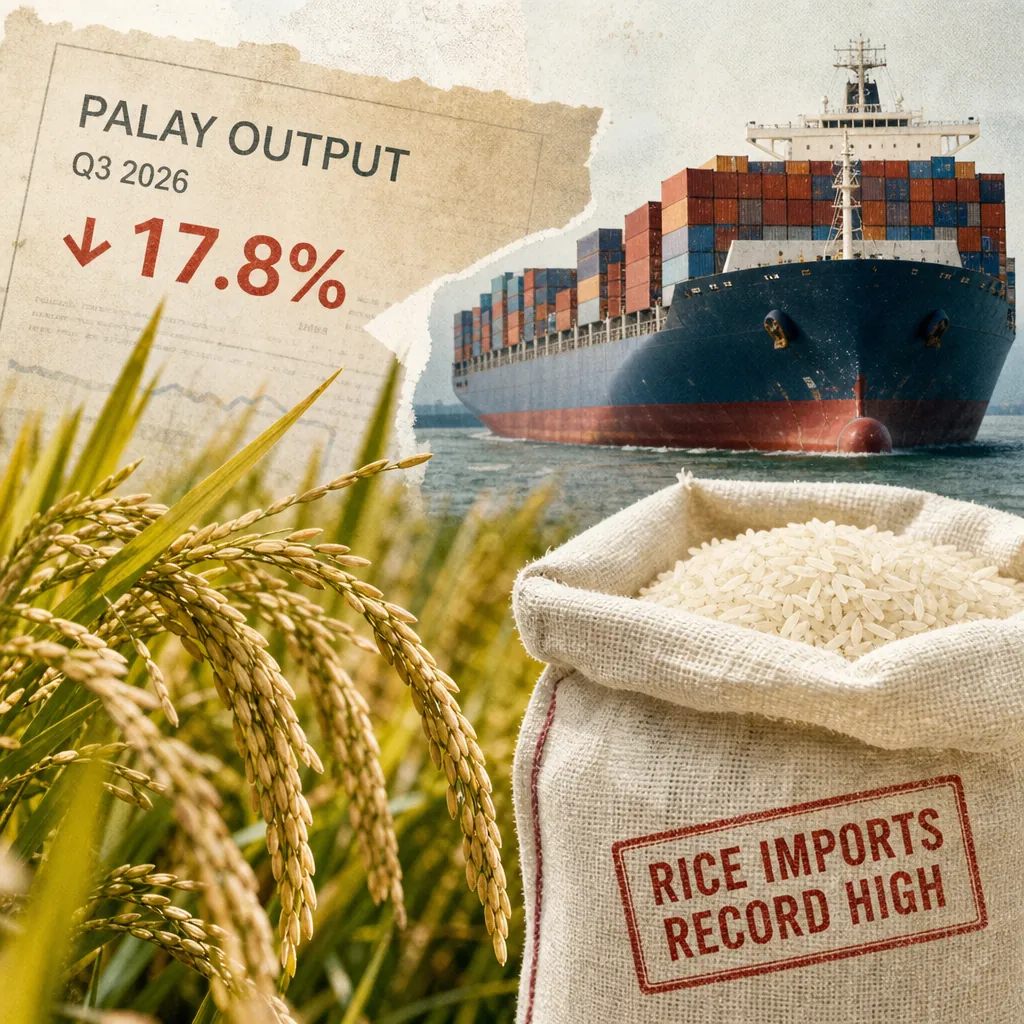
- The peso's record low of 64.17 to the dollar is expected to raise the cost of imported rice and fertilizer. Department of Agriculture (DA) Assistant Secretary Arnel De Mesa said imported farm goods will need more pesos for the same volume, with imported rice possibly ticking up by November, though he said retail prices would not reach P60 per kilo30.
- The government's P20-per-kilo rice program recorded its largest monthly turnout in September. The DA reported 961,346 Filipinos bought 21.4 million kilos of the subsidized rice in September, up from 838,695 buyers in April and the highest monthly figure since the Benteng Bigas, Meron Na! program began in May 20253234.
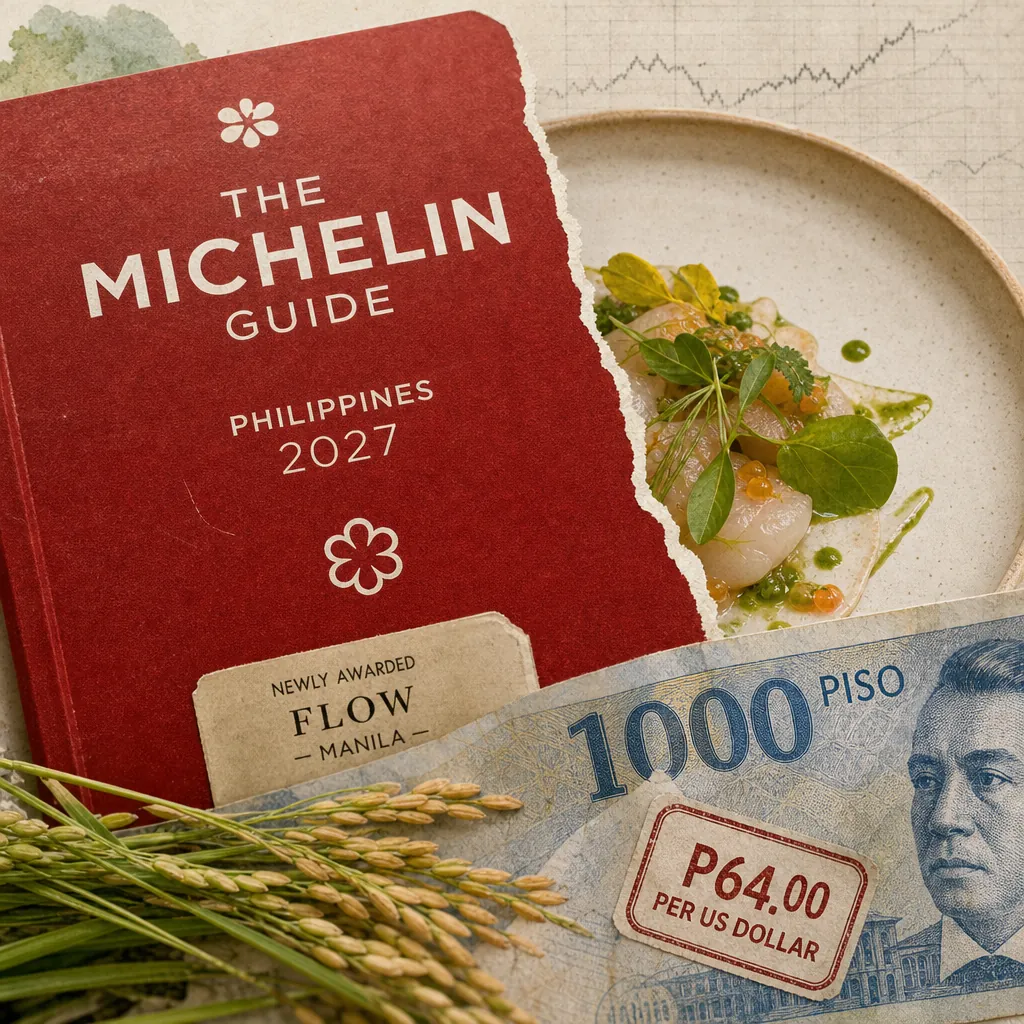
- A Philippine restaurant newly awarded a Michelin star drew attention to the country's fine-dining sector. Flow, a Philippine-Peruvian tasting-menu restaurant in Makati led by chefs Kevin Jonathan Uy and Gabriel Ong, was the only newcomer to earn a star in the 2027 Michelin Guide, less than a year after opening11.
- A lawmaker proposed a National Artist category for culinary arts. Senior Citizens Party-list Rep. Rodolfo Ordanes urged the National Commission for Culture and the Arts (NCCA) and the Cultural Center of the Philippines (CCP) to create the category, noting that culinary arts are not currently recognized separately under the Order of National Artists26.
- A Filipino indie game platform launched at Gamescom Asia in Bangkok. The Game Developers Association of the Philippines (GDAP), payments company Xsolla, and the Department of Trade and Industry's Export Management Bureau unveiled Alon, a non-exclusive distribution platform for games made by Filipino studios5.
How the narratives stack
Dominant. The sugar price campaign carried the most weight in the items gathered here, and it did so on both counts that matter: it produced the most distinct stories and the most consequential ones. Four separate items covered it — the planters' and labor groups' joint statement, the governor's appeal, the SRA cloud seeding allocation, and the underlying bidding results — and together they describe a single industry making a coordinated public case for a price floor while a government agency spends public money to protect the crop that would supply it124. The coverage value attached to these items is substantial: the planters' statement alone carried an estimated P267,624 in advertising-equivalent value, the cloud seeding story P284,256, and the governor's appeal P219,996, meaning the sugar story accounted for the largest share of the estimated cost of the coverage captured here. That figure measures what it would have cost to buy the same space as advertising, not how many people read the stories.
Counter-narrative. The food-price story that ran alongside the sugar campaign pointed in a different direction. The peso's slide to a record low of 64.17 to the dollar on October 27 is pushing up the peso cost of imported rice and fertilizer, and the DA expects imported rice prices to move slightly higher by November30. That is the opposite pressure from the one the sugar planters are applying: they want buyers to pay more for a domestic crop, while import-dependent commodities are getting more expensive on their own. The DA's assurance that retail rice will not reach P60 per kilo is the government's attempt to keep that second pressure from becoming a public complaint30.
Emerging. Two stories about Philippine food culture gaining institutional recognition ran in the same window. Flow's first Michelin star, awarded in the 2027 guide less than a year after the restaurant opened in December 2025, puts a Philippine-Peruvian tasting menu in the country's fine-dining elite11. Ordanes' proposal to add culinary arts to the Order of National Artists is the policy counterpart, arguing that the people who preserved and developed Philippine cooking deserve the same state honor given to painters and writers26. Neither story has the immediate economic weight of the sugar price fight, but both extend the same question — what Philippine food is worth, and to whom — into the cultural register.
Under-covered. The peso's effect on farm input costs appeared in a single item in this set, and the connection between a weaker peso and the sugar planters' cost problem was not drawn explicitly in any of the sugar stories30. Fertilizer is imported, so a peso at 64.17 to the dollar raises the cost of the very inputs the planters say they cannot recover at P2,600 per bag. That link sits in the coverage as two separate facts rather than one story.
Platform insights
- Facebook. The sugar stories moved through the Inquirer's online channels and were framed for a regional audience in Negros and Panay, where the planters' federations and the provincial government do their public communicating. The governor's appeal for compassionate pricing reads as a message aimed at local traders and at growers who need to hear that the province is on their side1.
- X. The day's fastest-moving items were the sports results, with TNT's 98-87 win over Magnolia to sweep their quarterfinal series drawing same-day write-ups from the Inquirer, ABS-CBN, and Abante Tonite32133. Playoff elimination produces immediate reaction, and the sweep gave fans a clean result to argue about.
- Reddit and forums. The peso's record low and the DA's rice price comments are the kind of household-budget story that circulates in discussion threads, where readers compare what they paid for rice against the official assurance that prices will stay below P60 per kilo30. The P20 rice program's September numbers — 961,346 buyers and 21.4 million kilos — give those threads a concrete figure to check against their own experience32.
- YouTube and video. The Michelin announcement and the Gamescom Asia launch are visual stories: a tasting menu and a game platform both sell through footage, and the Alon launch at the Philippine Pavilion in Bangkok was built for a trailer-and-demo audience511.
Key voices and communities
The Sugar Council and the planters' federations. CONFED, NFSP, and PANAYFED speak for the growers who set the terms of the price debate, and their joint statement with labor groups is the organized voice of the campaign4. Manuel Lamata, as president of the United Sugar Producers Federation, is the named figure confirming the SRA allocation, which makes him the planters' channel to the agency2.
The Negros Occidental provincial government. Lacson's appeal is the local state's attempt to influence a price it cannot set. His framing — that the province hopes traders will be compassionate rather than that it will require a price — tells growers where the limits of official help lie1.
The Department of Agriculture. The DA is the government's food-price voice in this window, speaking through De Mesa on imported rice and through Secretary Francisco Tiu Laurel Jr. on the P20 rice program's record September3032. Its assurances are the benchmark against which consumers will measure their own receipts.
The fine-dining and culinary-recognition community. Flow's chefs, Uy and Ong, and the lawmakers and cultural agencies weighing a National Artist category for cooking represent the push to treat Philippine cuisine as a field worth formal honors1126.
The Philippine game development sector. GDAP president Ria Lu and the Alon partners are building infrastructure for an industry that, by the association's own account, is scattered enough that assembling a showcase requires a fresh call for participants each time5.
Narrative streams
Planters hold out for P3,000 per bag as bids reach P2,888
The Sugar Council's joint statement with labor groups is the most detailed document in the set. It reports the bidding results mill by mill — Hawaiian-Philippine at P2,888 per 50-kilogram bag, First Farmers at P2,760, URC and Victorias Milling at P2,660 — and then argues that these numbers, while higher than before, still fall short of what small planters need4. The distinction matters: the planters are not disputing that prices rose, they are disputing that the rise is enough. Molasses, a by-product sold separately, also fetched better prices, which the statement treats as marginal relief rather than a solution4.
Lacson's contribution is the arithmetic behind the complaint. At P2,600 per bag, he said, efficient farms break even and small ones lose money; at P3,000, farming becomes sustainable1. He also pointed to a political development inside the industry: recent events show the sugar sector has united against sugar importation, which he called a good sign1. That unity is the planters' leverage. An industry that speaks with one voice on imports can also speak with one voice on price.
For the sector, the read is that the millgate price campaign will be decided less by the biddings than by whether traders and millers accept a P3,000 floor voluntarily, because the provincial government has said it will not impose one. Growers who borrowed against this crop need the higher price to service debt; if it does not arrive, the consolidation of small farms into larger holdings accelerates, and the labor groups that signed the joint statement lose the small planters who employ their members4.
The SRA puts P30 million into cloud seeding for Negros and Panay
The cloud seeding allocation is the government's answer to a production problem rather than a price problem. Lamata's account of the October 26 letter from Azcona confirms the P30 million and the November start date, and his statement thanks the administrator for acting on the planters' concerns while noting that he hopes the budget is more than enough2. The same report notes that Lamata criticized Negros Occidental Gov. — the sentence is cut off in the source, so the substance of that criticism is not established here2.
Cloud seeding is a mitigation measure, not a cure. It works by seeding clouds with particles to encourage rainfall over a target area, and its effectiveness depends on the clouds being there in the first place. The SRA's decision to fund it reflects how exposed the crop is to El Niño, the Pacific warming pattern that has brought dry spells and damaged standing crops in Negros. The planters' federation's public thanks is also a signal of the relationship between the industry and its regulator: the SRA can move money quickly when the planters ask, which is the kind of goodwill that matters when the same agency will have a say in import policy.
For growers, the P30 million buys a chance at a normal harvest, and a normal harvest is what makes a P3,000 price achievable without a shortage. If the rains come, supply holds and the price argument continues on its merits; if they do not, the planters' case for a higher floor gets stronger and the government's food inflation problem gets worse at the same time.
The peso at 64.17 to the dollar raises the cost of imported rice and fertilizer
The DA's warning is the day's clearest statement of how a currency move reaches a kitchen table. De Mesa said the peso's decline means importers need more pesos to buy the same volume of rice and fertilizer, and that most imported items will be affected30. He put a timeline on it — imported rice prices could see a slight increase by November — and a ceiling, saying retail prices for the staple would not reach P60 per kilo30. The peso hit a record low of 64.17 to the dollar on October 27, which is the baseline against which those expectations are set30.
Fertilizer is the part of this story that connects to the sugar campaign. Cane growers buy fertilizer, much of it imported, and a weaker peso raises that cost in pesos at the same moment they are arguing that P2,600 per bag does not cover their costs. The two stories ran separately in this set, but they describe the same squeeze from both ends: input costs rising on the currency, output prices capped by what traders will pay430.
Consumers will feel this first in the rice aisle, where the DA's assurance is a promise about a ceiling rather than a plan to lower prices. For the agriculture sector, the read is that the peso is now a food-price variable as much as a financial one, and any further weakening puts the DA's P60 assurance under public scrutiny before the next harvest data arrives.
The P20 rice program records its biggest month
The DA's numbers on the subsidized rice program are the counterweight to the import-price story. In September, 961,346 Filipinos bought 21.4 million kilos of rice at P20 per kilo, up from 838,695 buyers in April and the highest monthly turnout since the Benteng Bigas, Meron Na! initiative launched in May 20253234. From January to September, the program served more than 5.6 million Filipinos, and 135.98 million kilos of rice were sold through Kadiwa stores since the start of the year32. Tiu Laurel estimated that if each beneficiary represents an average household, around 22.4 million people have been fed by the program32.
The program matters because rice is the single largest food cost for poor families. The DA's own figure puts rice at nearly 9 percent of the budget of a typical Filipino household, and higher for poorer families34. A subsidized price of P20 per kilo against a market price that the DA says will stay below P60 is a large discount, and the September turnout suggests demand for it is still growing. Kadiwa stores are the government's rolling outlets for cheap agricultural goods, and the rice program runs through them.
For the sector, the read is that the P20 program is becoming a structural part of the rice market rather than an emergency measure. Every buyer who shifts to subsidized rice is a buyer the commercial trade does not serve, and the program's growth gives the DA a visible answer to food-price complaints even as import costs rise. The risk is fiscal and logistical: the larger the turnout, the more the program costs to run, and the harder it is to wind down without a public backlash.
A Michelin star and a push to honor cooks as national artists
Flow's star is the kind of recognition that changes a restaurant's economics overnight. The Makati restaurant, opened in December 2025 by chefs Uy and Ong, serves a Philippine-Peruvian tasting menu and was the only newcomer to earn a star in the 2027 Michelin Guide, the second edition of the guide in the Philippines11. The Michelin Guide is one of the oldest and most influential fine-dining rating systems, and a star brings international bookings, higher prices, and a place on the country's culinary map.
Ordanes' proposal is the policy echo. The Senior Citizens Party-list representative asked the NCCA and the CCP to create a National Artist category for culinary arts, noting that cooking is not currently recognized as a separate category under the Order of National Artists, the state's highest honor for artists26. "As Philippine cuisine gains wider international recognition, we must also honor the leading practitioners who have preserved, developed and elevated our country's culinary traditions," he said26.
For the restaurant sector, the read is that international validation is now being converted into state recognition, and that conversion has practical consequences: a National Artist category would create a formal ladder for chefs, a budget line for cultural agencies, and a reason for culinary training to be treated as cultural preservation rather than hospitality labor. The Michelin star and the legislative proposal are two different institutions arriving at the same conclusion about Philippine food in the same week.
Filipino game developers get a storefront of their own
Alon, the distribution platform launched at Gamescom Asia in Bangkok, is a small piece of infrastructure with a specific problem to solve. GDAP, Xsolla, and the DTI's Export Management Bureau built it for games made by Filipino studios, and it was unveiled at the Philippine Pavilion with Xsolla sharing the cost of the launch5. GDAP president Ria Lu said the platform may look like Steam or Itch.io but is not trying to compete with them: it is non-exclusive, and games on Alon can also be sold on Steam and elsewhere5.
The problem, according to the association, is fragmentation. The Philippine games industry is scattered enough that putting together a showcase takes a fresh call for participants every time5. A single storefront gives buyers, publishers, and players one place to find Filipino-made games, which matters for an export-oriented sector trying to attract attention outside the country.
For developers, the read is that distribution is now a shared utility rather than an individual studio's problem. A small studio that cannot afford its own marketing can list on Alon and still sell on Steam, which lowers the cost of being found. The platform's success will depend on whether it attracts enough games to be worth browsing, and on whether the DTI's involvement turns into sustained export support rather than a one-time launch.
Conversation trajectory
Millgate price biddings, next round (observation window: the coming weeks). The planters' case rests on the trajectory of the bids. If the next round of raw sugar biddings pushes past P2,888 toward P3,000, the Sugar Council's argument that the market is moving in the right direction gains credibility and the pressure on traders eases. If bids stall or fall, the campaign escalates toward import restrictions, which Lacson has already identified as the industry's unifying issue14.
Cloud seeding operations in November (observation window: November). The SRA's P30 million is scheduled to be deployed starting in November2. Whether the operations produce measurable rainfall over Negros and Panay, and whether the DA reports crop damage figures that show improvement, will determine whether the allocation is treated as adequate or as a first installment.
Imported rice prices in November (observation window: the next four to six weeks). The DA has said imported rice prices could rise slightly by November because of the peso, while promising retail prices will stay below P60 per kilo30. The next retail price survey and the DA's own updates will test that assurance, and any breach becomes a public story quickly given the P20 program's visibility.
P20 rice program monthly data (observation window: the next monthly release). September's 961,346 buyers was the highest monthly turnout since the program began32. The next monthly figure will show whether demand is still climbing or has plateaued, which matters for the program's budget and for the government's food-price messaging.
Michelin Guide 2027 and the National Artist proposal (observation window: the coming months). Flow's star will draw bookings and imitators, and the 2027 guide's full list will show whether the Philippines is producing a durable fine-dining cluster or a single standout11. Ordanes' proposal now sits with the NCCA and the CCP, and any public response from either agency is the next checkpoint26.
Trigger events. A new raw sugar bidding round; the first SRA cloud seeding flights; the DA's November rice price update; the next P20 rice monthly report; and any NCCA or CCP statement on a culinary National Artist category.
Response guidance
Sugar traders and millers: prepare a public position on the P3,000 floor. The planters have made a specific, repeated ask and the governor has endorsed it as the sustainability threshold14. A buying policy that explains how the millgate price is set, and what portion of the final retail price goes to the farm, gives traders something to say when the campaign escalates. Silence leaves the field to the planters' framing.
Grower associations: publish the cost breakdown behind the P3,000 figure. The planters' case is strongest when it shows what a bag costs to produce — fertilizer, labor, transport, milling — and how the peso's move affects each line30. A cost table that a journalist can check is more persuasive than a statement of need.
Government agencies: keep the rice price assurance specific and dated. The DA's commitment that retail rice will not reach P60 per kilo is a testable promise30. Pairing it with the date of the next price survey and the current average retail price gives consumers a benchmark and gives the agency credibility if prices move.
Food and restaurant businesses: treat the Michelin recognition as a sector story, not a single-restaurant story. Flow's star and the National Artist proposal are both about the standing of Philippine cuisine1126. Restaurants that tie their messaging to the broader recognition — training, sourcing, regional dishes — benefit from the attention without claiming credit for it.
Game developers and export promoters: explain what Alon does for a studio that already sells on Steam. The platform's non-exclusive design is its selling point, and the fragmentation problem GDAP describes is the reason it exists5. Messaging that shows a small studio's path from Alon listing to international sale will do more than a launch announcement.
Communicators across the food sector: connect the peso to the plate. The currency's record low and the sugar price campaign are the same story told from two ends130. Explaining that link in plain terms — imported fertilizer costs more, so the price a farmer needs rises — gives audiences a reason to follow both stories rather than treating them as separate bad news.
See the full picture behind today's signals.
This report draws from Media Meter's MediaWatch, our real-time monitoring engine tracking 2,470+ Philippine sources across print, broadcast, digital, and social. Explore how the platform turns raw coverage into decision-grade intelligence, then see how it's configured for teams like yours — whether you're in PR agencies, corporate comms, government, or marketing.
Want more? Browse our Report Library for sector and crisis intelligence, or request a demo and we'll have your brand set up before the call.
Want this kind of intelligence on your brand?
This brief is built on the same MediaWatch methodology that runs continuously across every brand we monitor. See your competitive landscape, Impact Score, and narrative trajectory in a 30-minute demo.