Tacloban School Shooting Sparks Juvenile Justice Debate
A school shooting in Tacloban City kills three students, reigniting debate over juvenile justice reform and school security. The conversation spans grief, policy polarization, and institutional accountability.
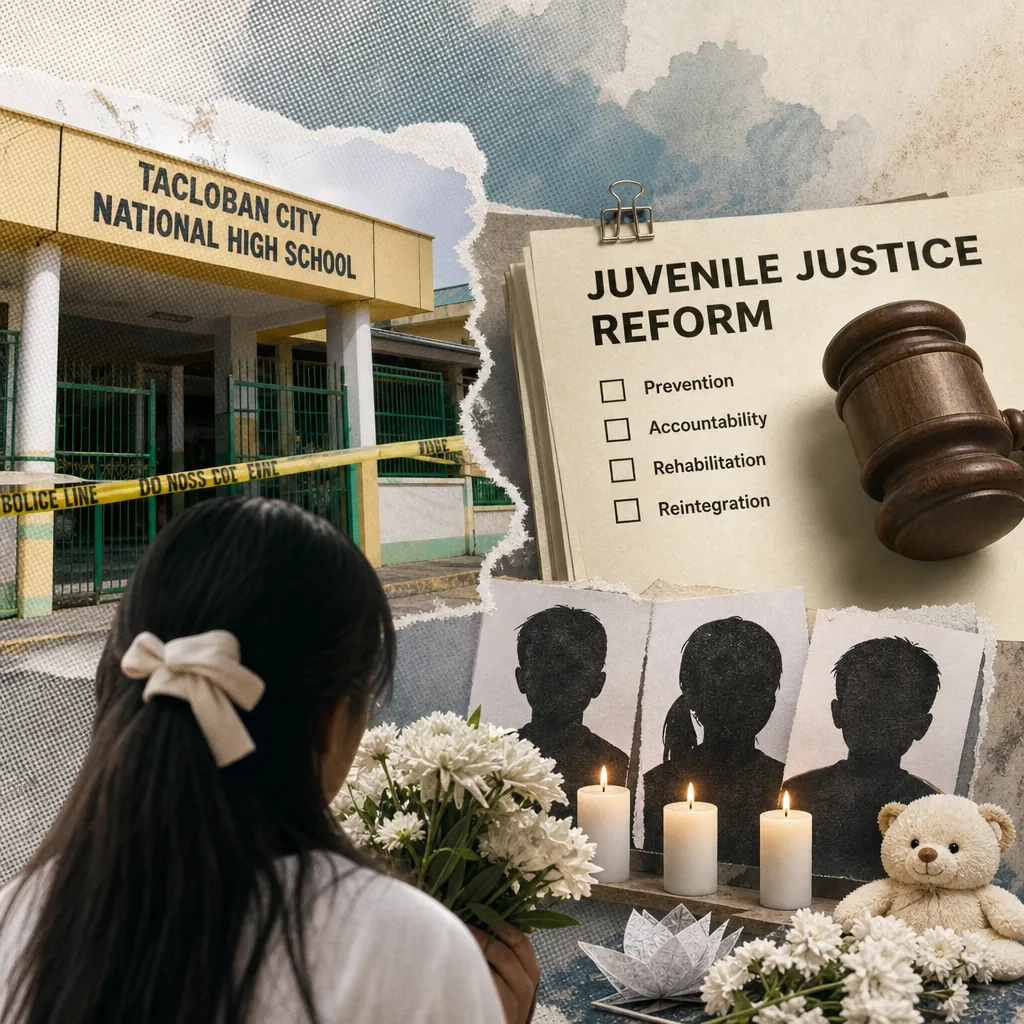
The conversation began with shock and grief on the morning of June 22, 2026, when @phemergencyalerts posted a detailed timeline of school violence across the Philippines, culminating in the Tacloban school shooting that killed three students and injured 13 others. The post accumulated 1,954 likes and an overwhelming 8,340 sad reactions, reflecting immediate public anguish. Within hours, official statements from the Philippine National Police (PNP) and the Department of Education (DepEd) began reshaping the narrative—the PNP's announcement garnered 14,347 likes and 8,917 comments, signaling intense public engagement as users demanded answers about how two 14- and 15-year-old suspects obtained firearms. By mid-day, the focus shifted from raw grief to systemic concerns when @pnagovph reported that one suspect was the nephew of a policewoman and used her service Glock, while the other weapon came from a security agency. This revelation triggered a wave of outrage, with users questioning police accountability and school security protocols.
As the day progressed, a heated policy debate emerged. Senator Robin Padilla renewed his push to amend the Juvenile Justice and Welfare Act, calling for a special session to lower the minimum age of criminal liability to 10 years old. His remarks—quoting "nagagaya na tayo sa America…"—were widely shared, but also met with strong pushback. In contrast, @insurersforleni posted a detailed rebuttal defending the current law, arguing that accountability and rehabilitation are not mutually exclusive and pointing to implementation failures rather than the law itself. This juxtaposition created two parallel narrative threads: one demanding harsher punishment for minors, and another calling for better enforcement of existing safeguards, including holding parents liable and strengthening Bahay Pag-asa facilities. By evening, the conversation had expanded to include calls from local officials, with Tacloban Vice Mayor Raymund Romualdez and Leyte Rep. Martin Romualdez issuing statements of condolence and promising immediate aid, while the Department of Social Welfare and Development (DSWD) deployed psychosocial support teams to hospitals.
Conversation snapshot. The highest-engagement post came from @phemergencyalerts, with 1,954 likes, 8,340 sad reactions, and 8,874 shares, making it a focal point for collective mourning. The PNP's official statement on Facebook received 14,347 likes and 8,917 comments, indicating intense public demand for accountability. A post from @pnagovph detailing the policewoman's involvement garnered 397 likes and 95 comments, reflecting anger over the firearm's origin. Senator Padilla's call to lower the age of criminal liability, shared by @inquirerdotnet, drew 14,738 views on Twitter, while a News5 poll on the same topic received 4,460 likes and 3,696 comments, revealing deep public division. A legal explainer by @crimlaw75 went viral with 2,142 shares, indicating high demand for accessible legal information.
Key themes
- Shock, Grief, and Condolences – The initial flood of reactions centered on the tragedy itself. Users expressed sorrow and anger, with @phemergencyalerts' post receiving 8,340 sad reactions and 8,874 shares, making it a focal point for collective mourning. Religious groups like @ccfmain offered prayers, garnering 1,574 care reactions, while local governments like Muntinlupa City announced emergency security assessments, showing how the incident triggered immediate precautionary measures nationwide.
- Juvenile Justice Debate – By mid-afternoon, the discussion pivoted to legislative responses. Senator Padilla's call to lower the age of criminal liability to 10 sparked a poll by @news5everywhere that drew 4,460 likes and 3,696 comments, revealing deep public division. Meanwhile, Senator Kiko Pangilinan, the principal author of the Juvenile Justice and Welfare Act, emphasized that existing law already allows criminal liability with discernment and that parents can be held accountable—a position that garnered 212 likes but also 3,626 haha reactions and 607 angry reactions, suggesting polarized sentiment. This theme evolved into broader scrutiny of the law's implementation, with users citing the need for better rehabilitation facilities rather than purely punitive measures.
- Accountability and Security Failures – As details emerged about the policewoman's gun being used in the shooting, public anger shifted toward institutional failures. @ramilvayuman reported that the policewoman was under custodial investigation, while @tiphuman8997 on Reddit shared the confirmed details about the weapons, earning 397 upvotes and 95 comments. Users questioned how the suspects accessed firearms and why school security failed to detect them, with many pointing to the earlier stabbing incidents in Cavite as warning signs that went unheeded.
- Inter-Agency Response and Calls for Action – Throughout the day, multiple government agencies issued coordinated statements. The DepEd declared a "high-alert situation" and suspended classes in affected schools, while the PNP directed police chiefs nationwide to increase visibility around schools. The Department of Justice (DOJ) ordered an investigation, and the DSWD provided psychological first aid. This narrative thread emphasized institutional readiness, but also fueled criticism that reactive measures are insufficient without proactive prevention.
How the narratives stack
Dominant narrative – The dominant narrative is one of tragedy and outrage, centered on the Tacloban school shooting as a symptom of systemic failures in school security, gun control, and juvenile justice. The public's grief quickly turned to anger as details emerged about the policewoman's firearm and the suspects' ages, fueling demands for accountability and reform. This narrative is driven by high-engagement posts from news outlets and official agencies, with emotional reactions (sad, angry) dominating the conversation.
Counter-narrative – A counter-narrative, led by civil society groups and legal experts, argues against lowering the age of criminal liability, emphasizing that the existing Juvenile Justice and Welfare Act, if properly implemented, already provides for accountability and rehabilitation. Posts from @insurersforleni and @crimlaw75 highlight that the law allows for criminal liability with discernment and that the focus should be on improving rehabilitation facilities and holding parents accountable, not on punitive measures. This narrative gains traction through shares and detailed explainers, but is often drowned out by the emotional weight of the tragedy.
Emerging narrative – An emerging narrative focuses on the role of firearms in the hands of minors, particularly the revelation that a police-issued Glock was used in the shooting. This thread is gaining momentum as users question PNP protocols for securing service weapons and call for stricter gun control measures. Posts from @ramilvayuman and @tiphuman8997 have sparked discussions about police accountability and the need for better oversight of firearms. This narrative is likely to intensify as the PNP's internal investigation progresses.
Suppressed narrative – A suppressed narrative concerns the broader context of school violence, including the two stabbing incidents in Cavite that occurred in the week leading up to the Tacloban shooting. While some users reference these incidents as warning signs, the conversation remains largely focused on the Tacloban tragedy itself. The lack of sustained attention to these earlier events suggests a pattern of reactive rather than preventive discourse, which could be a missed opportunity for systemic reform.
Platform insights
- Facebook – The primary platform for emotional engagement and official announcements. The PNP's statement received 14,347 likes and 8,917 comments, while the mayor's office of Tacloban posted updates on assistance, accumulating 1,376 likes and 840 love reactions, showing community solidarity. The legal explainer by @crimlaw75 went viral with 2,142 shares, indicating high demand for accessible legal information. The platform's reaction buttons allowed rapid sentiment expression, with sad and angry reactions dominating early posts.
- Twitter – Faster dissemination of breaking news and official statements. The DepEd's initial tweet garnered 13,525 views and 10 likes, but the broader conversation gained traction through news outlets like @inquirerdotnet (14,738 views on Padilla's call) and @philippinestar (6,336 views on bullying motive). Twitter also served as the platform for real-time updates on hospital admission issues raised by Education Secretary Angara.
- YouTube and Reddit – Deeper analysis and community discussion. The Manila Times video of the suspect's arrest reached 131,405 views and 589 likes, while Reddit threads like u/notadog_1010's post about the policewoman's gun earned 29 upvotes but sparked focused debate. Reddit users also questioned the effectiveness of the Juvenile Justice law, with u/bhi3Latte calling for policy revisions after listing multiple violent incidents.
Key voices and communities
- National Government Agencies – The DepEd, PNP, DSWD, DOJ, and the Department of the Interior and Local Government (DILG) formed a unified official response, issuing coordinated statements across Facebook and Twitter. Their posts collectively reached over a hundred thousand engagements, with the PNP's statement alone receiving thousands of shares and comments reflecting both public grief and anger over the incident. The messaging centered on condemning violence, ensuring thorough investigation, and deploying psychosocial support to affected families.
- Political Figures and Legislators – Senators and House representatives drove the legislative narrative, with Senator Robin Padilla's renewed push to lower the minimum age of criminal responsibility to 10 years old generating the highest political engagement—over 4,000 reactions on a news outlet's poll post and hundreds of comments on multiple platforms. Senator Kiko Pangilinan, principal author of the Juvenile Justice and Welfare Act, countered by calling for proper enforcement of the existing law, receiving both support and ridicule (over 3,600 "haha" reactions on one post). Leyte Representative Martin Romualdez expressed condolences and directed assistance coordination, reinforcing local-national ties.
- Media and News Organizations – Mainstream outlets such as News5, GMA News, Philippine Star, Manila Times, and local radio stations amplified every development through real-time updates, explainer videos, and official statements. Their content dominated viewership across Twitter and YouTube, with one news video reaching over 130,000 views. Many outlets framed the incident as "the Philippines' first mass school shooting," drawing international comparisons and fueling both grief and outrage.
- Legal and Civil Society Voices – Legal experts, advocacy pages, and civil society organizations (including religious groups) provided contextual analysis and calls for nuanced reform. A detailed legal explainer distinguishing criminal liability from rehabilitation reached over 2,000 shares, becoming a reference point in online debates. Religious organizations, such as a major church group, posted prayer and solidarity messages that garnered over 3,000 caring reactions, signaling strong community support for healing rather than punitive measures.
Narrative streams
The Tacloban School Shooting and Immediate Aftermath
The shooting occurred at San Jose National High School in Tacloban City at around 9:20 a.m. on June 22, 2026. Two Grade 9 students, aged 14 and 15, opened fire, killing three students and wounding 13 others. The suspects were described as "very close friends" and were taken into custody—one arrested at the scene, the other surrendering later. Initial investigation suggested that anger over bullying was a possible motive, with police stating that the suspects had been bullied since Grade 7. The incident marked one of the deadliest school-related attacks recorded in Eastern Visayas, if not the country. Videos circulating online showed students and teachers running from the campus in panic, with some students carrying an injured female classmate to safety while others cried and screamed, hiding inside a classroom as gunfire erupted.
The Juvenile Justice and Welfare Act Debate
The shooting immediately reignited the debate over the Juvenile Justice and Welfare Act (Republic Act 9344), which sets the minimum age of criminal liability at 15 years old. Senator Robin Padilla called for a special session to amend the law, proposing to lower the age to 10 for heinous crimes. His remarks were widely shared but also met with strong opposition. Senator Kiko Pangilinan, the law's principal author, defended the existing framework, arguing that the law already allows for criminal liability with discernment and that the focus should be on proper implementation, including functional Bahay Pag-asa centers and parental accountability. A News5 poll asking the public "what age should criminal liability start?" attracted nearly 4,700 reactions, revealing deep polarization. Legal experts and civil society groups weighed in, with a viral explainer by @crimlaw75 clarifying that the law does not grant impunity but requires a nuanced approach to juvenile justice.
Firearm Accountability and Police Trust
The revelation that one of the suspects used a Glock 9mm pistol registered to his aunt, a policewoman, became a major sub-narrative. The PNP confirmed that the policewoman was under custodial investigation, and that the weapon was her service firearm. This development triggered intense anger and questions about PNP protocols for securing firearms. Users on Facebook and Reddit demanded accountability, with many calling for stricter oversight of police-issued weapons. The PNP's internal investigation is ongoing, and the outcome will likely shape public trust in the institution. This narrative also intersects with broader concerns about loose firearms in the Philippines, a persistent issue that the shooting has brought to the forefront.
School Security and Bullying Prevention
The shooting has prompted immediate calls for enhanced school security measures. The DepEd declared a "high-alert situation" and suspended classes in affected schools, while the PNP directed police chiefs nationwide to increase visibility around schools. President Marcos ordered a thorough investigation and instructed authorities to ensure protection and safety in all places, especially in schools. The PNP also announced plans to coordinate with barangay tanods (village watchmen) as part of measures to bolster school security, acknowledging budget constraints for more expensive measures like X-ray scanners and metal detectors. The bullying angle—confirmed by the PNP as the likely motive—has forced DepEd to confront a longstanding systemic issue, with many users citing the earlier stabbing incidents in Cavite as missed warning signs.
Conversation trajectory
The conversation is expected to evolve along several tracks over the coming weeks. First, the policy reform debate will intensify, with Senator Padilla's call for a special session on juvenile justice amendments likely to dominate political discourse. The prosecution's request for 62 trial dates in the Sara Duterte impeachment trial may compete for attention, but the emotional weight of the Tacloban shooting is likely to keep it at the forefront. Second, the gun accountability sub-narrative will deepen as the PNP's internal investigation progresses, potentially broadening into broader discussions about loose firearms and police accountability. Third, the systemic school safety and mental health scrutiny will shift from isolated tragedy to systemic failures, with discussions centering on inadequate anti-bullying programs, gaps in mental health support, and the absence of robust threat assessment protocols in schools. Key trigger events include the potential special session of Congress on juvenile justice amendments, the PNP investigation results regarding the policewoman's firearm, and the DepEd-PNP joint school security guidelines rollout. The next 4–6 weeks will be critical for shaping the narrative, with the emotional peak expected to fade within two weeks, giving way to more analytical policy discussions.
Response guidance
Communicators should prioritize victim-centered messaging that demonstrates empathy and concrete action. Immediate steps include releasing a joint DepEd-PNP-DSWD statement detailing specific aid delivered (e.g., number of families reached, amount of medical assistance, psychosocial sessions conducted) and concrete security measures being implemented across all schools (e.g., single-point entry, mandatory ID checks, police patrol schedules). This shows the government is not just talking but acting. On the juvenile justice debate, communicators should avoid endorsing any specific legislative proposal but instead emphasize that the executive branch respects the legislature's role while focusing on proper implementation of existing rehabilitation facilities and Bahay Pag-asa centers. A clear, accessible explainer on the Juvenile Justice and Welfare Act should be released to address common misconceptions and reclaim the narrative from both punitive-only advocates and those defending the status quo without accountability. On the firearm accountability issue, the PNP should release a clear timeline of how the weapon was accessed, what administrative proceedings have begun against the policewoman, and whether any previous red flags existed. Proactive communication about stricter oversight of issued firearms can preempt negative amplification. On Facebook, use official pages to post coordinated, empathetic updates focused on victim support and investigation progress rather than defensive statements. On Twitter, use agency handles to issue concise, regular situational updates under a dedicated hashtag to serve as a reliable source against rapid rumor spread. On YouTube, upload a short, official statement video from a senior DepEd or PNP official that combines condolence, commitment to investigation, and a clear outline of immediate steps being taken.
See the full picture behind today's signals.
This report draws from Media Meter's MediaWatch, our real-time monitoring engine tracking 2,470+ Philippine sources across print, broadcast, digital, and social. Explore how the platform turns raw coverage into decision-grade intelligence, then see how it's configured for teams like yours — whether you're in PR agencies, corporate comms, government, or marketing.
Want more? Browse our Report Library for sector and crisis intelligence, or request a demo and we'll have your brand set up before the call.
Want this kind of intelligence on your brand?
This brief is built on the same MediaWatch methodology that runs continuously across every brand we monitor. See your competitive landscape, Impact Score, and narrative trajectory in a 30-minute demo.