VP Duterte Petitions Supreme Court as Impeachment Trial Nears
Vice President Sara Duterte asked the Supreme Court to halt the grave-threat cases against her and to void a Quezon City court resolution, while the Senate prepared to seat amici curiae at her impeachment trial on September 16. The Department of Justice maintained that only the President holds immunity from suit.
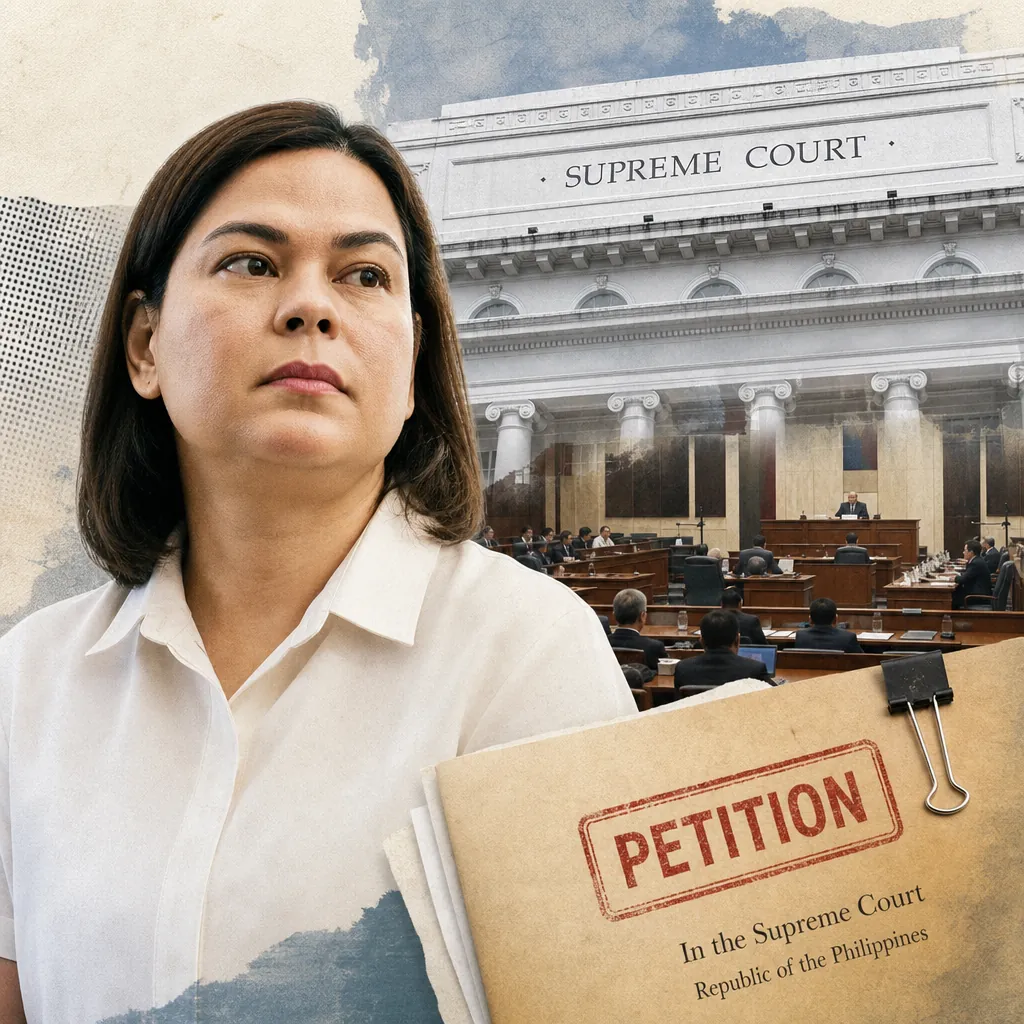
[Vice President Sara Duterte](https://media-meter.com/report-library/barmm-ambush-budget-scrutiny-and-impeachment-trial "Barmm ambush budget scrutiny and impeachment trial") asked the Supreme Court to stop the Department of Justice from prosecuting three counts of grave threats against her, filing a Petition for Certiorari and Prohibition that also seeks to void a Quezon City Regional Trial Court resolution and offers to post bail if the court allows it.6 The same day, the Department of Justice restated its position that only the President of the Philippines enjoys immunity from suit, and that the Vice President does not.5 Both developments landed on September 10, four days before the Senate was scheduled to resume her impeachment trial and seat a panel of amici curiae — advisers to the court — on September 16.3
The legal maneuvering is the latest turn in a months-long collision between the country's two highest elected offices. Duterte, elected separately from President Ferdinand Marcos Jr. in 2022, has been the subject of an impeachment complaint in the House of Representatives and now faces criminal cases filed by the justice department. The Supreme Court petition and the immunity dispute are separate tracks, but they converge on the same question: how much legal exposure the Vice President carries while she remains in office and while the Senate sits as an impeachment court.
Coverage of the legal fight was heavy in the items captured for this window. A Manila Bulletin explainer on the meaning of amici curiae carried an estimated advertising-equivalent value of ₱282,304 — the notional cost of buying the same space as paid advertising, not a measure of readership.3 A Manila Bulletin report on the temporary restraining order request was valued at ₱186,560,6 and a Bombo Radyo report on the justice department's immunity position at ₱51,765.5 Those figures describe the captured coverage, not the whole of the day's reporting.
Key themes
- Duterte asks the Supreme Court to halt the grave-threat prosecutions. Her petition seeks a temporary restraining order and a writ of preliminary mandatory injunction directing respondents to stop prosecuting the grave-threat charges, and asks the court to void the Quezon City Regional Trial Court resolution.6
- The justice department says immunity covers the President alone. Justice Secretary Fredderick Vida said the exemption from suit applies only to the country's chief executive and does not extend to the Vice President, and that the department maintains that position even with Duterte's petition pending before the Supreme Court.5
- The Senate will seat amici curiae at the impeachment trial on September 16. Senators agreed to bring in the advisers as the trial continues, following questions raised by Senator-Judge Erwin Tulfo about whether senators absent from the proceedings can validly vote on the final question.3
- Attendance problems are shaping the trial's calendar. Tulfo noted that Senator Loren Legarda is on medical leave, Senator Ronald dela Rosa is in hiding, and Senators Jinggoy Estrada and Rodante Marcoleta are in the custody of authorities, raising the question of how many senators can validly vote when the trial reaches its final question.3
- Senators' personal travel does not require Senate clearance. Senate President Sherwin Gatchalian said senators need not inform the chamber of personal trips, only of official travel that requires a travel authority and an official invitation, after reports that Senators Alan Peter and Pia Cayetano left the country on September 9.13
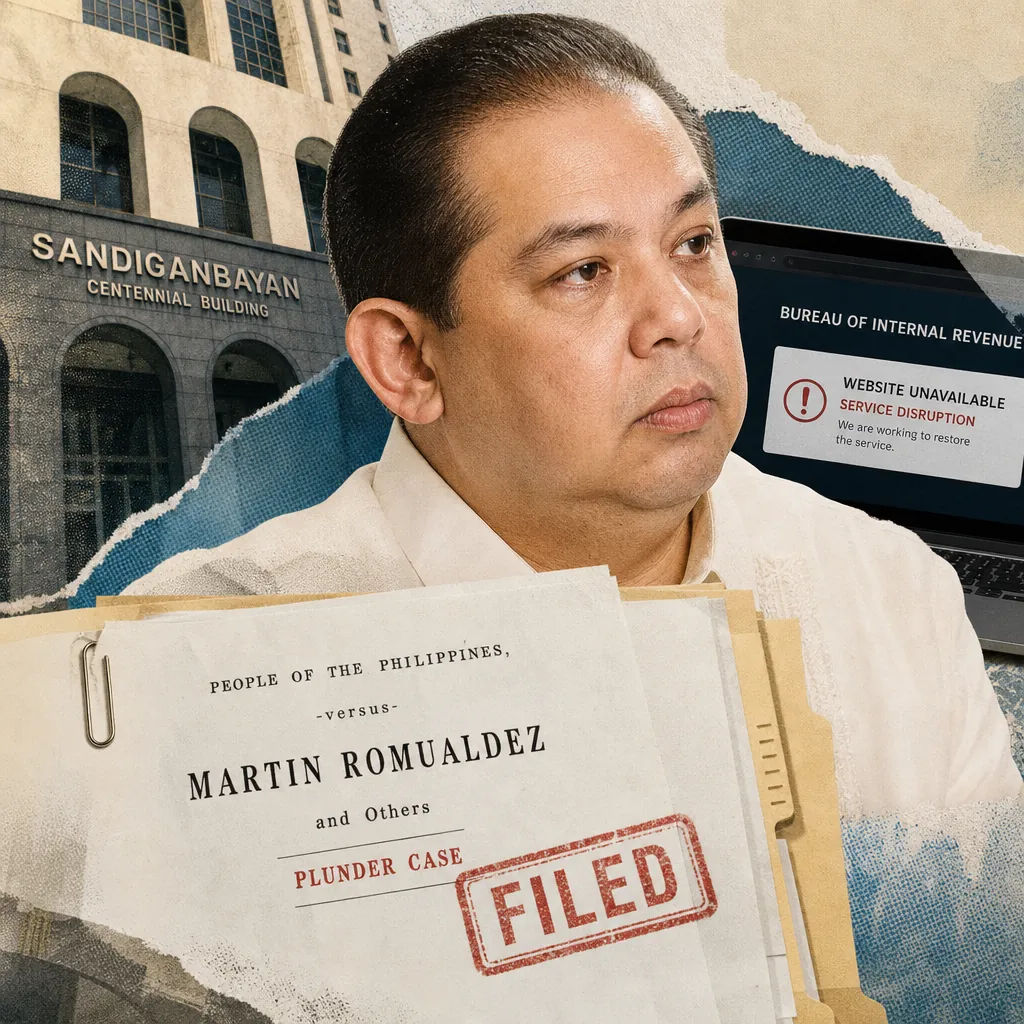
- A separate plunder case against Martin Romualdez is moving through the Sandiganbayan. The anti-graft court's Third Division issued arrest warrants against the Leyte representative and three others over an alleged ₱7.4-billion kickback scheme tied to flood control and other government projects funded from 2022 to 2025.12
- The Romualdez arrest happened while he was hospitalized. He was taken into custody under warrant while confined at Cardinal Santos Medical Center in San Juan City on September 5, and his health became part of the public discussion around the case.12
How the narratives stack
Dominant. The Vice President's Supreme Court petition and the justice department's immunity position dominated the legal and political coverage in this set. The petition is the more consequential of the two because it asks the high court to stop an active prosecution, not merely to clarify a legal doctrine. The immunity question matters because it determines whether the Vice President can be tried at all while in office, and the justice department's answer — that only the President is covered — is the government's formal position in a dispute that Duterte has already elevated to the Supreme Court.56 The impeachment trial's September 16 session, where amici curiae will be seated, is the next scheduled event that could change the picture.3
Counter-narrative. The Senate leadership's position that personal trips by senators need no clearance cuts against the implication that absences from the impeachment trial are a procedural problem to be managed. Gatchalian's statement frames travel as a private matter outside the chamber's purview, which is a different emphasis from Tulfo's question about which senators can validly vote.313 The two positions are not contradictory — one concerns travel rules, the other concerns voting — but they pull attention in different directions.
Emerging. The plunder case against Romualdez and three co-accused is at an earlier stage than the Duterte proceedings but carries its own weight: the Ombudsman alleges ₱7.4 billion in kickbacks and other financial benefits from flood control and other projects funded between 2022 and 2025, and the Sandiganbayan found probable cause to issue arrest warrants.12 The case is the first in this set to reach the arrest stage against a former House Speaker, and its progress will be watched as a test of how the anti-graft courts handle high-profile defendants who are hospitalized at the time of arrest.
Under-covered. The clearest under-covered story in this set is the first Bangsamoro Autonomous Region in Muslim Mindanao (BARMM) parliamentary elections, scheduled for September 14, 2026, for which about 4,000 police officers from Mindanao regions have been deployed.26 The BARMM is the autonomous region created under the 2019 Bangsamoro Organic Law to replace the Autonomous Region in Muslim Mindanao, and the parliamentary vote is the first under its new system of governance. The deployment drew a single item in this set, with an estimated advertising-equivalent value of ₱231,142,26 while the Duterte legal story drew several items. The election is four days away and involves the region's first parliamentary ballot; the coverage in this set does not reflect that proximity.
Platform insights
The monitoring writeup for this window did not include platform-level engagement data, so this section is limited to what the article set shows about where the political stories ran.
- Online news. Every item in this set ran online, including the political and legal stories. The Duterte petition, the immunity dispute, the amici curiae explainer, the Romualdez case, and the BARMM deployment all appeared on online news sites.3561226
- Facebook. The only Facebook-specific item in the set is the Lara Quigaman post about her mother's diverted flight, which the actress shared on her page.16 No political post engagement figures were captured.
- No X, Reddit, or YouTube activity was captured in this set. The absence of platform-level data means the distribution of public response across social platforms cannot be described from these inputs.
Key voices and communities
The Office of the Vice President and its legal team. Duterte's camp filed the petition for certiorari and prohibition, sought a temporary restraining order, and offered to post bail, framing the grave-threat charges as procedurally defective and asking the Supreme Court to void the Quezon City court's resolution.6
The Department of Justice. Secretary Fredderick Vida restated the department's position that immunity from suit covers only the President, and noted that Duterte has a pending petition before the Supreme Court on the same question.5 The department is the respondent in the petition and the agency prosecuting the grave-threat cases.
The Senate as impeachment court. Senator-Judge Erwin Tulfo raised the question of valid votes by absent senators, and Senate President Sherwin Gatchalian addressed the travel rules for personal trips.313 The Senate's decisions on amici curiae and on attendance will shape how the trial proceeds.
The Sandiganbayan and the Ombudsman. The anti-graft court issued the arrest warrants against Romualdez and three co-accused, and the Ombudsman is the agency that filed the plunder case and put the alleged ₱7.4-billion figure on the record.12
The Philippine National Police in Mindanao. Regional offices from Davao, SOCCSKSARGEN, Northern Mindanao, Zamboanga Peninsula, and CARAGA deployed about 4,000 officers for the BARMM parliamentary elections, with some serving as members of Special Electoral Boards.26
Narrative streams
Duterte asks the Supreme Court to stop the grave-threat cases
The petition for certiorari and prohibition asks the Supreme Court to issue a temporary restraining order and a writ of preliminary mandatory injunction directing the respondents to cease and desist from prosecuting the grave-threat charges.6 A temporary restraining order is a court order that pauses an action while the court studies the case; a writ of preliminary mandatory injunction would compel the respondents to stop the prosecution. Duterte also asks the court to void the Quezon City Jail Regional Trial Court resolution, and says she is willing to post bail if the court allows it.6 The grave-threat charges are criminal cases filed by the Department of Justice, separate from the impeachment complaint in the House of Representatives. The petition puts the Supreme Court in the position of deciding whether the prosecution can proceed while the impeachment case is also active. For the justice department, the petition is a direct challenge to its authority to prosecute; for Duterte, it is an attempt to stop the cases before trial. The next checkable event is the Supreme Court's action on the temporary restraining order request, which the petition asks the court to issue immediately upon filing.6
The justice department draws the immunity line at the President
Justice Secretary Fredderick Vida said the department's position is that only the President of the Philippines has immunity from suit, and that the Vice President does not.5 Immunity from suit is the legal protection that shields an official from being sued or prosecuted while in office; the scope of that protection for impeachable officers is the question Duterte has raised before the Supreme Court. Vida said the department maintains its earlier position even with Duterte's petition pending.5 The dispute matters because if the Vice President were covered by immunity, the grave-threat cases and possibly other proceedings could not move forward while she holds office. The department's position, if upheld, keeps the cases alive. The Supreme Court's ruling on the petition will settle the question for this set of cases, though the broader issue of immunity for impeachable officers may require separate resolution.
The Senate prepares for amici curiae and confronts attendance gaps
Senators are set to seat amici curiae at the impeachment trial on Wednesday, September 16.3 Amici curiae, Latin for "friends of the court," are outside experts or advisers who provide guidance on legal questions without being parties to the case. The decision followed Senator-Judge Erwin Tulfo's question on September 8 about whether senators who have been absent can validly vote on the final question, given what he described as a changing calendar and expedited proceedings.3 Tulfo noted that Senator Loren Legarda is on medical leave, Senator Ronald dela Rosa is in hiding, and Senators Jinggoy Estrada and Rodante Marcoleta are in the custody of authorities.3 The attendance problem is procedural but consequential: if enough senators cannot vote, the trial's final question could be decided by a smaller group than the Constitution contemplates. For the Senate, seating amici curiae is a way to get legal guidance on the procedural questions without delaying the trial. For the Vice President, the trial's progress is the main threat, and any procedural irregularity is a potential ground for challenge.
Senators' personal travel does not require Senate clearance
Senate President Sherwin Gatchalian said senators need not inform the Senate of personal trips, and that clearance is required only for official travel that needs a travel authority and an official invitation, particularly when the Senate pays for hotels.13 The statement followed reports that Senator Alan Peter Cayetano and his sister, Senator Pia Cayetano, left the country on September 9, and that Taguig City Mayor Lani Cayetano left on September 10.13 The clarification matters because it sets the boundary between official and personal travel at a time when the impeachment trial is in session and attendance is already a live issue. For the Senate leadership, the statement closes off the implication that the chamber polices its members' private movements. For the public, it leaves open the question of how absences from the trial are accounted for, which is the question Tulfo raised separately.3
The Romualdez plunder case reaches the arrest stage
The Sandiganbayan Third Division issued arrest warrants against Leyte 1st District Representative and former House Speaker Martin Romualdez and three co-accused after finding probable cause.12 The Ombudsman alleges ₱7.4 billion in kickbacks and other financial benefits from flood control and other government projects funded from 2022 to 2025.12 The co-accused are former Ako Bicol party-list Representative Elizaldy "Zaldy" Co, personal aide Joselyn Tragua Serenio, and businessman Felicito Cristobal Guevarra.12 Romualdez was arrested under warrant while confined at Cardinal Santos Medical Center in San Juan City on September 5, and his health became part of the public discussion.12 Plunder is a non-bailable offense in the Philippines when the evidence is strong, which is why the arrest warrants and the hospitalization are significant: the case now moves to the Sandiganbayan, the special court that tries graft and corruption cases against public officials. For the House of Representatives, the case removes a former Speaker from the political scene while it is pending; for the anti-graft courts, it is a test of how quickly a high-profile plunder case can proceed.
The first BARMM parliamentary elections draw a police deployment
About 4,000 police officers from Mindanao regional offices have been deployed for the first BARMM parliamentary elections on September 14, 2026.26 The officers come from Davao (Region XI), SOCCSKSARGEN (Region XII), Northern Mindanao (Region 10), Zamboanga Peninsula (Region 9), and CARAGA (Region 13), and some will serve as members of Special Electoral Boards.26 The Police Regional Office 12 sent 808 personnel to a send-off ceremony at Capitol Ground in Kidapawan City, Cotabato, for deployment to Maguindanao del Sur, Maguindanao del Norte, and Cotabato City.26 The BARMM is the autonomous region created under the 2019 Bangsamoro Organic Law, which replaced the Autonomous Region in Muslim Mindanao and established a parliamentary form of government. The September 14 vote is the first parliamentary election under that system, and the police deployment is the government's main security measure for it. For the region, the election is the first test of whether the new parliamentary system can hold a peaceful vote; for the national government, it is a measure of whether the peace agreement that created the BARMM is producing stable institutions.
Conversation trajectory
Supreme Court action on the temporary restraining order request (observation window: days to weeks). The petition asks the court to issue the order immediately upon filing, so a response could come quickly, though the court's calendar is not public. If the court grants the order, the grave-threat prosecutions pause; if it denies or ignores the request, the cases proceed. The court could also refer the immunity question to oral arguments, which would extend the timeline.6
The September 16 impeachment trial session (observation window: one week). The Senate is scheduled to seat amici curiae on that date, and the session will show whether the attendance problems Tulfo raised have been resolved or have worsened. The amici's guidance could shape how the Senate handles the final vote.3
The BARMM parliamentary elections on September 14 (observation window: one week). The vote is four days after this window, and the police deployment is the main security measure. The result will determine the first parliamentary government under the Bangsamoro Organic Law, and any violence or disruption would test the deployment's adequacy.26
The Romualdez case's next procedural step (observation window: weeks). After arrest, the case moves to arraignment and pre-trial at the Sandiganbayan. Romualdez's hospitalization could affect scheduling, and the court's handling of the health question will be watched.12
Trigger events. The Supreme Court's action on the petition, the September 16 Senate session, the September 14 BARMM vote, and the Sandiganbayan's scheduling in the Romualdez case are the checkable events that will determine how these stories develop.
Response guidance
For government communicators handling the Duterte cases: State the legal position plainly and avoid characterizing the petition as an admission or a delay tactic. The justice department's immunity position is a legal argument, not a finding, and the Supreme Court has not ruled. Explain what a temporary restraining order does and what it would change, because the public will encounter the term without context.56
For Senate communicators: The amici curiae decision and the attendance question are procedural, but they will be read politically. Explain what amici curiae are and why the Senate is seating them, and be clear about which senators are absent and why, since the reasons are already public.3
For anti-graft and justice communicators: The Romualdez case involves a former House Speaker and a ₱7.4-billion allegation, so expect scrutiny of every procedural step. Confirm what the Sandiganbayan has and has not decided, and avoid commenting on the defendant's health beyond what the court records show.12
For BARMM election communicators: The September 14 vote is the first parliamentary election under the Bangsamoro Organic Law, and the police deployment is the main security measure. Provide clear information on voting procedures and security arrangements, and avoid framing the deployment as a response to a specific threat unless the police have said so.26
For all communicators in this window: The legal and political stories are moving on separate tracks with different timelines. Do not merge the impeachment trial, the grave-threat cases, and the immunity question into a single narrative, because the courts and the Senate are handling them separately and the outcomes may diverge.356
See the full picture behind today's signals.
This report draws from Media Meter's MediaWatch, our real-time monitoring engine tracking 2,470+ Philippine sources across print, broadcast, digital, and social. Explore how the platform turns raw coverage into decision-grade intelligence, then see how it's configured for teams like yours — whether you're in PR agencies, corporate comms, government, or marketing.
Want more? Browse our Report Library for sector and crisis intelligence, or request a demo and we'll have your brand set up before the call.
Want this kind of intelligence on your brand?
This brief is built on the same MediaWatch methodology that runs continuously across every brand we monitor. See your competitive landscape, Impact Score, and narrative trajectory in a 30-minute demo.