Philippine jobless rate hits 6%, highest in four years
The July 2026 unemployment rate rose to 6 percent, the highest since mid-2022, as fresh graduates entered a slowing labor market. The day's coverage also tracked the impeachment trial of Vice President Sara Duterte, a new P60 minimum wage order for Metro Manila, and power grid alerts.
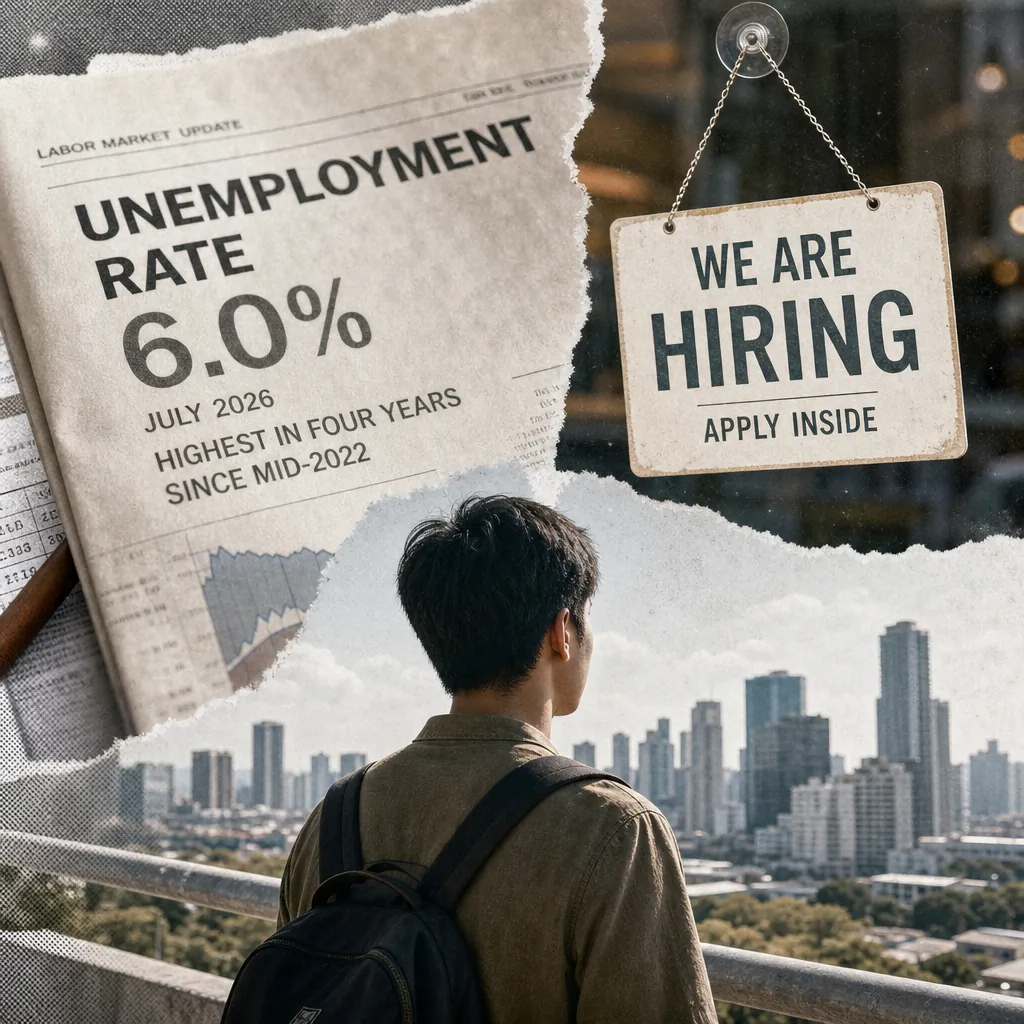
The July labor force survey landed like a cold front on an already unsettled economy. The Philippine Statistics Authority (PSA) reported a 6 percent unemployment rate for July 2026, up from 4.9 percent in June and translating to roughly 3.14 million Filipinos without work — the worst reading since mid-2022, when the economy was still climbing out of the pandemic. National Statistician Claire Dennis Mapa attributed the jump to a surge in labor force participation, particularly among 15-to-24-year-olds transitioning from school to work, many of whom companies could not absorb amid a slowing economy. Metro Manila logged the highest regional jobless rate at 8.2 percent, with manufacturing accounting for most of the month's job losses, followed by information technology and technical activities. The PSA noted the last time unemployment hit 6 percent was June 2022. The data, released as the government defends its economic record, drew immediate attention across broadcast and online news, with outlets framing it as the clearest sign yet of labor market strain. 1
The unemployment figure did not arrive in a vacuum. The same news cycle carried the impeachment trial of Vice President Sara Duterte, now on its 23rd day, where the House prosecution panel dropped its remaining 15 witnesses for Article 1 — the alleged misuse of confidential funds — and signaled it may seek to call Duterte herself to the stand. Senator-judges also sparred over the voting threshold needed to convict, with Senator Erwin Tulfo questioning whether the 16-vote requirement should stand given that only 20 of 24 senators are attending proceedings. The trial's twists dominated television and radio coverage, with several networks running extended segments on the day's developments. 2
Away from the political and economic headlines, the day's coverage also tracked a new P60 minimum wage order for Metro Manila, power grid alerts triggered by simultaneous plant failures, and the aftermath of severe flooding that has damaged over a thousand classrooms in the Cordillera region. The breadth of stories — from labor statistics to impeachment maneuvering to infrastructure strain — painted a picture of a country grappling with multiple pressures at once. 3
Key themes
- Unemployment hits 6 percent, highest since mid-2022: The July 2026 labor force survey showed 3.14 million Filipinos out of work, up from 4.9 percent in June. Metro Manila's rate reached 8.2 percent, with manufacturing and IT leading job losses. 1
- Impeachment prosecution rests Article 1, may call VP Sara: The House panel dropped its remaining 15 witnesses on confidential fund misuse after presenting ten, and signaled it may subpoena Vice President Sara Duterte to testify, a move her defense calls a violation of her right against self-incrimination. 2
- Senate to vote on 16-vote threshold September 23: Senator-judges will decide whether 16 votes — two-thirds of the 24-member Senate — remain the bar for conviction, after Senator Erwin Tulfo questioned the math given only 20 senators are attending. Oral arguments are set for September 23. 3
- New P60 wage order for Metro Manila faces questions: The Regional Tripartite Wages and Productivity Board approved Wage Order No. 28, adding P60 to the daily minimum wage, separate from the P85 hike under Wage Order No. 27 that a court injunction has blocked. Labor groups called the new order a "white flag." 4
- Power grid red alerts after 30 plants fail: Luzon and Mindanao grids experienced red alerts lasting over eight hours after 30 power plants went offline simultaneously, with 14 more running below capacity. The Department of Energy targets normal operations by September 21. 5
- Flooding damages over 1,100 classrooms in Cordillera: The Department of Education reported 1,106 classrooms damaged by successive typhoons and the southwest monsoon, with 908 suffering major damage across Abra, Benguet, and Baguio City. 6
- PISA scores rise but remain below OECD average: Philippine 15-year-olds improved their scores in science (373), mathematics (371), and reading (367) in the 2025 Program for International Student Assessment, though most students remain below minimum proficiency. The OECD called the Philippines the fastest-improving country in reading over the past decade. 7
- Digital economy push continues amid scam warnings: The Department of Information and Communications Technology launched new child online protection measures and held freelance enablement activities in Bicol, while GCash urged vigilance against phishing and smishing, which now account for over 80 percent of reported digital fraud. 8
How the narratives stack
Dominant: The impeachment trial of Vice President Sara Duterte dominated the day's news coverage, with multiple television and radio networks dedicating extended segments to the proceedings. The prosecution's decision to rest its case on Article 1 and its stated intention to potentially call Duterte as a witness generated the most sustained attention, followed by the debate over the 16-vote threshold. Within the captured set, this story drew the heaviest coverage value, with several broadcast segments exceeding ₱1 million in estimated advertising-equivalent value. 2
Counter-narrative: The unemployment data offered a counterpoint to the political drama, grounding the day's news in economic reality. The 6 percent jobless rate — the highest in four years — received prominent coverage across television, radio, and online outlets, with analysts noting the strain on fresh graduates entering a slowing labor market. This narrative competed with the impeachment story for airtime, particularly on business and news channels. 1
Emerging: The power grid alerts emerged as a developing story, with red alerts declared on both Luzon and Mindanao grids after 30 plants failed simultaneously. The Department of Energy's target of September 21 for normal operations suggests the issue may persist for nearly two weeks, potentially affecting businesses and households. The story carries implications for economic activity and public perception of infrastructure reliability. 5
Under-covered: The flooding's impact on education infrastructure received comparatively less attention than its severity warranted. Over 1,100 classrooms in the Cordillera region have been damaged by successive typhoons and monsoon rains, with 908 suffering major damage. This story affects thousands of students' access to education and will require significant rehabilitation funding, yet it drew fewer and shorter segments than the political and economic stories of the day. 6
Platform insights
- Facebook: The primary platform for official government announcements and public engagement. The DICT used its official Facebook page to announce new child online protection measures, while the National Anti-Poverty Commission posted about Manny Pacquiao's oath-taking as its new secretary. Government agencies appear to use Facebook as their main channel for reaching citizens directly. 8
- X (formerly Twitter): Used by journalists and public figures to share real-time updates from the impeachment trial and other breaking news. The platform's text-based format suits rapid-fire commentary on legal proceedings, with lawyers and political observers weighing in on the voting threshold debate and the prosecution's strategy. 2
- YouTube: Served as a repository for extended interviews and analysis segments, particularly around the impeachment trial and labor issues. Broadcasters' YouTube channels carried full interviews with labor leaders like Sonny Matula of the Federation of Free Workers, who discussed the wage order controversy in depth. 4
- TikTok: Emerging as a platform for consumer and lifestyle content, with brands like Anker soundcore and HONOR promoting 9.9 shopping deals through the platform. The short-form video format suits product demonstrations and promotional content, though it carries less weight in hard news coverage. 9
Key voices and communities
- Government officials and agencies: PSA, DICT, DOE, DSWD, and other agencies drive official data releases and policy announcements. Their statements set the agenda for much of the day's coverage, from unemployment statistics to power grid status updates. 1
- Labor unions and workers' groups: The Federation of Free Workers and Trade Union Congress of the Philippines emerged as vocal critics of the new wage order, with FFW President Sonny Matula calling it a "white flag" and vowing to continue fighting for the P85 increase. These groups represent millions of minimum wage earners and provide a counterpoint to government narratives. 4
- Legal and political commentators: Lawyers, former justices, and political analysts featured prominently in impeachment coverage, offering interpretations of constitutional questions around voting thresholds and witness testimony. Their commentary shapes public understanding of complex legal proceedings. 2
- Business and economic analysts: Market commentators like Christina Ulang of First Metro Investment provided context on economic conditions, noting the market's sideways movement amid Middle East tensions and high oil prices. Their analysis helps translate raw data into implications for investors and businesses. 10
- Consumer technology communities: Tech bloggers and gadget reviewers covered new product launches and 9.9 shopping deals, from the Infinix XPAD 30 Pro tablet to the HONOR 600 Pro MOLLY Edition. These communities drive consumer awareness and purchasing decisions in the digital economy. 9
Narrative streams
Unemployment rises to 6 percent as fresh graduates enter a slowing market
The Philippine Statistics Authority's July 2026 Labor Force Survey delivered sobering numbers: 6 percent unemployment, up from 4.9 percent in June, representing approximately 3.14 million Filipinos without work. National Statistician Claire Dennis Mapa explained the increase as a function of more people entering the labor force — participation rose by 3.71 million year-on-year — with the bulk being 15-to-24-year-olds transitioning from education to employment. Unfortunately, not all found jobs. Metro Manila recorded the highest regional unemployment at 8.2 percent, while manufacturing led job losses, followed by information technology and technical activities. The last time unemployment reached 6 percent was June 2022, when the economy was still recovering from the COVID-19 pandemic. The data suggests that while more Filipinos are seeking work, the economy is not generating enough jobs to absorb them, particularly for young entrants. For the sector, this signals continued pressure on consumer spending and social services, as households with unemployed members reduce discretionary expenditure. 1
Impeachment prosecution rests Article 1, eyes VP Sara as witness
On the 23rd day of the impeachment trial of Vice President Sara Duterte, private prosecutor Lorna Kapunan announced the House prosecution panel would no longer present its remaining 15 witnesses for Article 1, which concerns the alleged misuse of confidential funds. Ten witnesses had already testified, with stipulations covering two more. Kapunan indicated the prosecution may seek to subpoena Duterte herself to confirm her claims of innocence, though no formal request has been made. Defense counsel Sheila Sison rejected the plan, arguing Duterte cannot be compelled to testify against herself under constitutional protections against testimonial compulsion. "I think this matter and issue has been settled on Day 1," Sison said, noting Duterte is participating through her lawyers. The trial resumes Monday at 10 a.m., with the court also set to hear arguments on the voting threshold. For the sector, the trial's trajectory affects political stability and investor confidence, as prolonged uncertainty around the vice president's fate could weigh on market sentiment. 2
Senate to decide 16-vote threshold on September 23
Senator-judge Erwin Tulfo raised a procedural question that could determine the trial's outcome: should 16 votes — two-thirds of the 24-member Senate — remain the threshold for conviction when only 20 senators are attending proceedings? Senators Jinggoy Estrada and Rodante Marcoleta are detained, Senator Ronald "Bato" dela Rosa is evading an International Criminal Court warrant, and Senator Loren Legarda has been on medical leave for over a month. Tulfo argued that if the voting base is fixed at 24 regardless of attendance, the absence of senators "will result in an acquittal by default." Presiding Officer Francis Escudero has scheduled consultations with former Supreme Court justices on September 16 and oral arguments on September 23, when the court will decide whether to maintain or lower the threshold. The ruling carries significant implications: if the threshold drops, conviction becomes easier; if it stays, Duterte's defense may benefit from the absent senators. For the sector, the decision will shape the trial's pace and outcome, affecting political dynamics for the remainder of the administration. 3
New P60 wage order draws labor criticism as "white flag"
The Regional Tripartite Wages and Productivity Board approved Wage Order No. 28, adding P60 to the daily minimum wage for Metro Manila workers, effective September 26 or 27. The order came just days after a Pasig court issued a preliminary injunction against the P85 increase under Wage Order No. 27, which labor groups had fought for. Federation of Free Workers President Sonny Matula called the new order a "white flag," saying it surrenders to employer pressure. "For FFW and the Nagkaisa labor coalition, the fight for Wage Order No. 26 with its P85 increase continues," Matula said. Acting Labor Secretary Francis Tolentino defended the process, noting only the court can lift the injunction. The situation has created confusion among lawmakers, with House Deputy Speaker Raymond Mendoza questioning the legal basis for a new order while the previous one remains contested. For the sector, the wage controversy highlights the tension between labor demands for higher pay and business concerns about costs, with the outcome affecting millions of minimum wage earners and their employers. 4
Power grid red alerts expose infrastructure fragility
Both Luzon and Mindanao grids experienced red alerts lasting over eight hours on September 8, after 30 power plants failed simultaneously while 14 more operated below capacity. The National Grid Corporation of the Philippines (NGCP) implemented manual load dropping — rotational power interruptions — to prevent grid collapse. NGCP spokesperson Cynthia Alabanza explained that many Visayas plants have been offline for extended periods, forcing the region to borrow power from Luzon and Mindanao. The Department of Energy targets normal operations by September 21, but the timeline depends on plant repairs. Five plants with 722 megawatts of capacity have already returned or are scheduled to return by late September. The situation highlights the fragility of the country's power infrastructure and its dependence on a handful of large plants. For the sector, prolonged alerts could disrupt business operations, particularly in manufacturing and services that rely on consistent power supply. 5
Flooding damages over 1,100 classrooms in Cordillera
The Department of Education reported that 1,106 classrooms in the Cordillera region have been damaged by successive typhoons and the southwest monsoon, with 908 suffering major damage, 150 minor damage, and 8 totally destroyed. The affected areas include Abra, Benguet, and Baguio City, which were hit by typhoons Luis, Maymay, Neneng, Obet, and Pilandok. Beyond classrooms, the flooding damaged 7,000 learning materials and 200 information and communications technology equipment units. The damage compounds the challenges facing the education sector, which is already grappling with the aftermath of the pandemic and the need to improve learning outcomes. For the sector, the destruction of school infrastructure will require significant rehabilitation funding and may disrupt classes for thousands of students, potentially affecting the country's educational performance in international assessments. 6
PISA scores improve but proficiency gaps persist
Philippine 15-year-olds improved their scores in the 2025 Program for International Student Assessment (PISA), with science at 373, mathematics at 371, and reading at 367 — all up nearly 20 points from 2022. The Philippines surpassed 14 countries in science, 16 in mathematics, and 18 in reading. Education Secretary Sonny Angara called the results proof that Filipino students can improve, while the OECD named the Philippines the fastest-improving country in reading performance over the past decade. However, most students remain below minimum proficiency, and almost no Filipino students reached top-level performer status. The assessment also flagged issues outside the classroom, including bullying, school safety, noise, and digital device distractions. For the sector, the improvement is encouraging but underscores the need for continued investment in education quality, teacher training, and learning environments. 7
Digital economy advances amid scam warnings
The Department of Information and Communications Technology (DICT) launched new measures to protect children online, including stricter age verification, faster information takedown, and direct coordination with law enforcement. The agency also held its sixth Freelance Stakeholders Enablement Activity in Naga City, part of its digital jobs initiative to strengthen the regional digital economy. Meanwhile, GCash urged users to stay vigilant against phishing and smishing, which now account for over 80 percent of reported digital fraud in the Philippines. A Gogolook report found malicious link attacks nearly quadrupled in 2025, with scammers impersonating trusted institutions. For the sector, the push for digital inclusion must be balanced with robust security measures, as the growth of online services creates new opportunities for fraudsters. 8
Conversation trajectory
- Impeachment trial voting threshold decision (September 23): The Senate impeachment court will hold oral arguments on whether to maintain the 16-vote threshold for conviction. The decision will shape the trial's trajectory and could determine the outcome. Watch for signals from senator-judges in the coming weeks, particularly around the September 16 consultation with former Supreme Court justices. 3
- Wage Order No. 28 effectivity (September 26-27): The new P60 minimum wage increase takes effect pending publication and National Wages and Productivity Commission approval. Labor groups have vowed to continue fighting for the P85 increase, suggesting the wage controversy will persist. Monitor for court rulings on the injunction against Wage Order No. 27. 4
- Power grid recovery target (September 21): The Department of Energy expects normal operations by September 21, but the timeline depends on plant repairs. Continued red alerts could disrupt business operations and public services. Watch for updates on plant restorations and any extension of the alert status. 5
- July labor force data follow-up (October): The PSA will release August labor force data in early October, which will indicate whether the July spike was a one-off or the start of a trend. Economists will watch for signs of labor market absorption of fresh graduates. 1
- Trigger events: A Supreme Court ruling on the voting threshold, a court decision on the wage order injunction, or a major plant failure extending power alerts could each shift the narrative significantly. Any of these would warrant immediate attention. 3
Response guidance
- Labor and employment communicators: Frame wage and unemployment data with context. Acknowledge the P60 increase as a step while being transparent about the P85 order's legal status. Avoid declaring victory or defeat; instead, emphasize the process and next steps. Labor groups should articulate their position clearly without inflammatory language that could alienate neutral stakeholders. 4
- Energy sector communicators: Provide regular, transparent updates on power plant restorations and grid status. Explain the causes of the alerts in plain language, distinguishing between planned outages and unexpected failures. Proactive communication can mitigate public frustration during prolonged disruptions. 5
- Education communicators: Highlight the PISA improvement while being honest about remaining gaps. Emphasize the connection between classroom conditions — including flood damage — and learning outcomes. Advocate for continued investment in school infrastructure and teacher support. 7
- Digital economy communicators: Balance promotional messaging about digital inclusion with practical scam prevention advice. Partner with platforms and law enforcement to amplify security messages. Avoid fear-based appeals; instead, empower users with actionable steps to protect themselves. 8
- Political and legal communicators: Maintain factual accuracy in impeachment coverage, avoiding speculation about outcomes. Respect the legal process and the rights of all parties. For those involved, focus on legal arguments rather than personal attacks, as public opinion may be shaped by the tone of the discourse. 2
See the full picture behind today's signals.
This report draws from Media Meter's MediaWatch, our real-time monitoring engine tracking 2,470+ Philippine sources across print, broadcast, digital, and social. Explore how the platform turns raw coverage into decision-grade intelligence, then see how it's configured for teams like yours — whether you're in PR agencies, corporate comms, government, or marketing.
Want more? Browse our Report Library for sector and crisis intelligence, or request a demo and we'll have your brand set up before the call.
Want this kind of intelligence on your brand?
This brief is built on the same MediaWatch methodology that runs continuously across every brand we monitor. See your competitive landscape, Impact Score, and narrative trajectory in a 30-minute demo.