300 Arrested as ASEAN Summit Opens in Manila
Philippine police detained more than 300 protesters as Manila opened the 49th ASEAN Summit, with the Palace urging demonstrators not to damage the country's image and students planning a nationwide walkout over education funding.
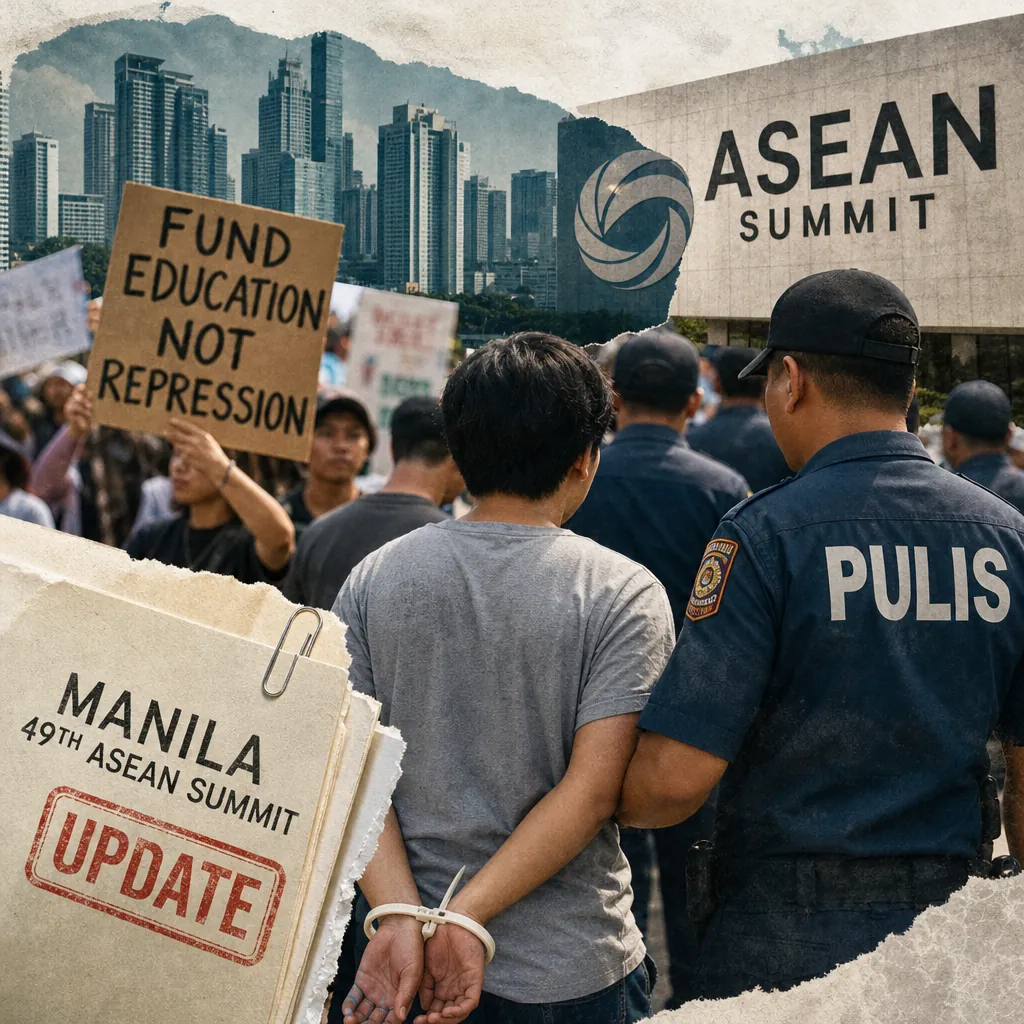
More than 300 protesters were arrested in Metro Manila on Sunday as the Philippines opened the 49th Association of Southeast Asian Nations (ASEAN) Summit, the regional bloc's annual gathering of heads of state, which this year runs November 15 to 18 at the Philippine International Convention Center and the Coconut Palace in Pasay City under the theme "Navigating Our Future Together"8. The arrests drew a sharp condemnation from the left-wing alliance Bagong Alyansang Makabayan (Bayan), whose president, Renato Reyes, called the day's detentions the "biggest mass arrest in a single day" under the administration of President Ferdinand "Bongbong" Marcos Jr.1. The National Capital Region Police Office confirmed that the arrested demonstrators, drawn from Bayan Southern Tagalog, the labor group Kilusang Mayo Uno and the party-list group ACT, were taken to Camp Bagong Diwa in Taguig City because police station facilities could not hold more than 200 people and to avoid overcrowding that could endanger detainees' health31.
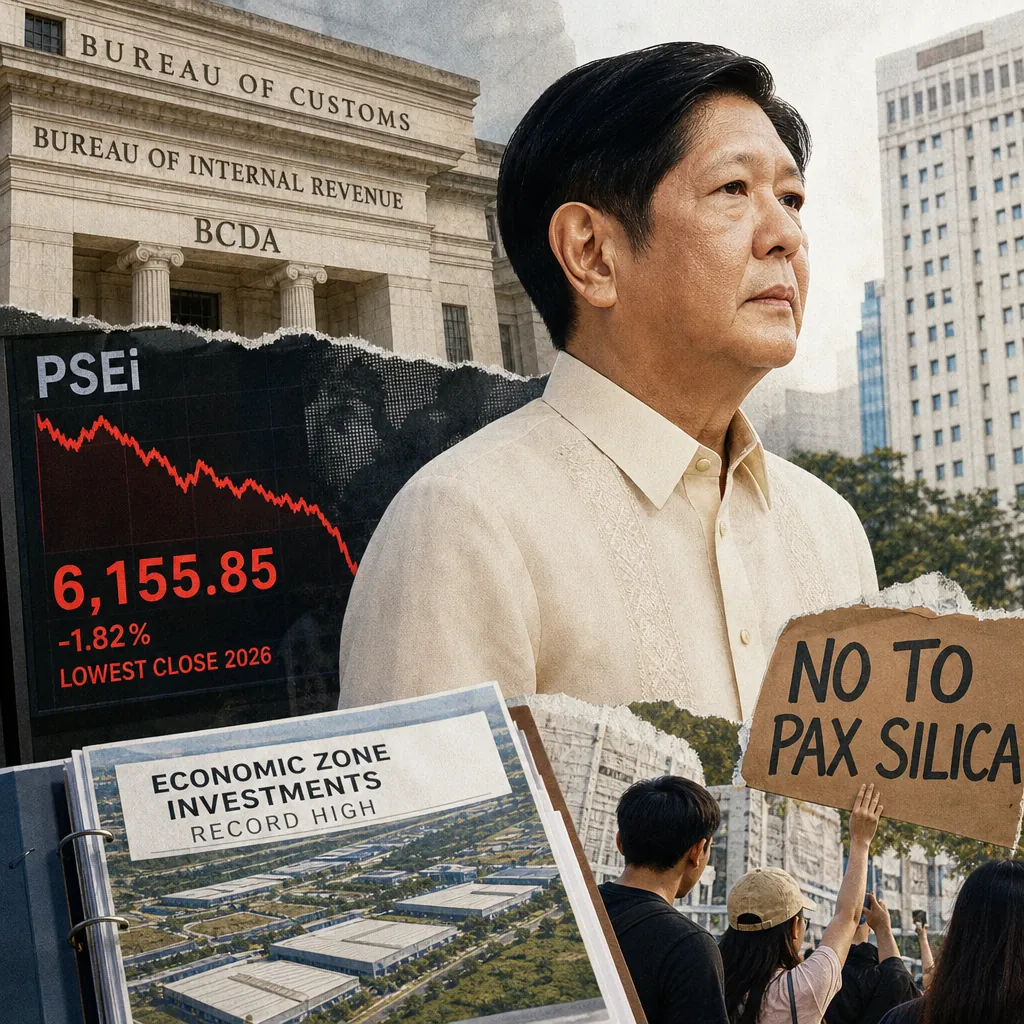
The protests targeted two things at once: the anticipated visit of United States President Donald Trump for the summit, and the Pax Silica initiative, a US-backed program for artificial intelligence and supply-chain security that includes plans for an AI-native industrial hub of more than 1,600 hectares in New Clark City, Tarlac21. Organizers said the project would displace indigenous communities and farmers in Central Luzon1. By Sunday evening the Palace had responded, with Press Officer Undersecretary Claire Castro telling a press conference at the International Media Center in the World Trade Center that protesters should not "tarnish the image of the Philippines before the international community" and that "matters like these can be discussed at the proper time and through the proper channels, rather than through rallies"4.
The confrontation is not confined to Manila. Students across Panay Island have called a walkout for November 17, National Students Day, under the banner "DUES Day: The Day of Reaping," assembling at the University of the Philippines Visayas Iloilo City campus and West Visayas State University in La Paz before marching to the Iloilo Provincial Capitol to demand greater investment in classrooms, teachers, facilities and free public education20. Organizers pointed to flooded classrooms, overcrowded campuses and shortages of laboratory equipment, and framed the timing deliberately against the ₱22.9-billion summit20. The day's coverage in this set also carried the summit's diplomatic business — ASEAN's call on Myanmar's warring forces to de-escalate and stop attacks on civilians6 — and the practical disruptions of hosting: banks announced branch schedules for the declared special non-working holiday in the capital region24, and utilities scheduled maintenance outages across Metro Manila and nearby provinces1325.
Key themes
- Police detained more than 300 protesters in a single day, the largest such count Bayan says it has recorded under Marcos Jr. Nine were arrested at Liwasang Bonifacio in Manila, around 300 in Barangay Sucat in Muntinlupa City, and 21 Central Luzon delegates in San Rafael, Bulacan, according to Reyes, who added that the exact total was not yet known because lawyers were still accounting for detainees1. The police account confirms more than 300 taken to Camp Bagong Diwa31.
- The Palace framed the protests as a reputational risk to the country during a diplomatic showcase. Castro's appeal to "stand united" and refrain from "creating issues" came hours after video and photos of pushing and shoving between protesters and police at a barricade circulated from Liwasang Bonifacio4.
- Pax Silica is the specific grievance behind the demonstrations. The initiative is a US program for artificial intelligence and supply-chain security; its Philippine component is a planned AI-native industrial acceleration hub of over 1,600 hectares in New Clark City, Tarlac, which opponents say will damage the environment and displace indigenous peoples from ancestral land21.
- An Ayta community in Tarlac says it no longer trusts government promises on the project. Joel Soria, 40, an Ayta resident, told Balita on the third day of the Kampuhan Kontra Pax Silica encampment at UP Diliman that he wants the data-center construction stopped so that "hindi masira ang kabuhayan sa aming bundok" — the livelihood in our mountains is not destroyed21.
- The Palace asked protesters to file position papers instead of holding rallies. Castro said detailed submissions would let the President and concerned agencies evaluate the objections and decide whether corrections are needed24.
- Students in Panay have scheduled a walkout for November 17 over education funding. The mobilization, timed to National Students Day and the summit, demands investment in classrooms, teachers, facilities and free public education, and cites flooded classrooms and laboratory shortages20.
- The summit's own agenda included a call on Myanmar to stop attacks on civilians. ASEAN member-states reaffirmed full implementation of the five-point consensus, the bloc's 2021 peace plan for Myanmar, and urged state forces and armed groups to de-escalate6.
- Hosting the summit reshaped daily life in the capital for three days. Metro Manila was declared a special non-working holiday, banks published adjusted branch schedules, and Meralco, Manila Water and Maynilad scheduled maintenance interruptions across the capital region, Bulacan, Cavite and Rizal from November 16 to 24241325.
How the narratives stack
Dominant. The arrests and the Palace response dominated the items captured here. Inquirer led with Bayan's condemnation and the count of detainees1, Philstar's Filipino-language service confirmed the police account and the transfer to Camp Bagong Diwa31, and the Palace statement drew its own story4. The dominance is partly a matter of how many items the monitoring captured on this thread, but the underlying event — the largest single-day detention count claimed by the country's main left alliance during a diplomatic summit — is consequential on its own terms. The coverage value attached to these items was substantial: the Inquirer report on Reyes's statement carried an estimated ₱306,936 in advertising-equivalent value, the Palace story ₱338,688, and the Philstar arrest report ₱263,134, figures that estimate what the same space would have cost as paid advertising rather than how many people read them.
Counter-narrative. The Palace's position is the day's clearest counter-frame: that the protests endangered the country's standing at a moment of international attention, and that grievances should be submitted as position papers rather than shouted at barricades424. Castro's challenge to students to "substantiate their objections" through formal submissions is the administration's attempt to move the argument from the street to the paperwork stage24.
Emerging. The Panay student walkout on November 17 is the next scheduled flashpoint and had only a single item in this set20. Its significance is geographic: it moves the protest frame from Metro Manila to the Visayas and links the summit's cost to school funding, a connection that travels further than a Pax Silica-specific complaint. The Ayta testimony from the UP Diliman encampment is a second emerging thread, giving the anti-Pax Silica movement a named human voice and a specific demand — stop the data-center construction21.
Under-covered. The summit's diplomatic substance received comparatively little attention in the items captured here. ASEAN's review of the five-point consensus and its call on Myanmar's forces to stop targeting civilians — against the backdrop of an airstrike on an internally displaced persons camp in Rakhine State that local media and humanitarian workers said killed at least 12 people on November 136 — ran as a single item while the protest story ran across several. That reflects the news value of confrontation, but readers following the summit through this set would come away with a thin picture of what the leaders actually agreed.
Platform insights
- Facebook. The day's most consequential social artifact was a Facebook post: Reyes used his account to announce the arrest counts and to describe the day as the biggest mass arrest under the current administration, and the post became the primary source that news outlets quoted1. The Palace's response was delivered at a televised press conference rather than on social, leaving the government's counter-argument to be relayed secondhand through reporters4. The asymmetry matters: the opposition's framing reached audiences directly and in its own words, while the government's reached them through the filter of coverage.
- TikTok. A Cebuano designer's TikTok page, where he posts colorful pageant costumes made from onion sacks, tarpaulins and other discarded material, was the subject of a Balita feature on sustainable fashion10. The item sits far from the summit story but shows how a single creator's feed can carry a recycling message into mainstream coverage — the designer, Kyle Jay of Cebu City, frames sustainability in fashion as a step toward helping the environment amid the country's chronic waste and flooding problems10.
- X. No post-level engagement data appears in the items captured here, so the volume and reach of reaction on the platform cannot be stated. What can be said is that the summit generated a steady stream of service journalism — heat-index warnings1423, power and water interruption schedules1325, bank branch advisories24 — the kind of practical information that circulates heavily on X during Manila disruptions but whose spread this set does not measure.
Key voices and communities
Bayan and the militant left. Bagong Alyansang Makabayan, the country's largest left-wing alliance, supplied the day's defining quote and the arrest tally through its president, Renato Reyes1. Its framing casts the detentions as a civil-liberties question and the summit as a stage for suppressing dissent. Bayan Southern Tagalog, Kilusang Mayo Uno and ACT supplied the detainees named by police31.
The Palace and the press office. Undersecretary Claire Castro spoke for the administration at the International Media Center, positioning the government as host, guardian of the country's image, and reasonable interlocutor open to written submissions424. Her statements set the terms of the counter-narrative.
Indigenous Ayta communities and the Pax Silica encampment. The Kampuhan Kontra Pax Silica at UP Diliman entered its third day on Sunday, and the testimony of Joel Soria put a name and a livelihood to the displacement argument21. This group's authority rests on direct experience of the land in question rather than on partisan affiliation.
Student organizers in Panay. Student councils, campus publications and youth organizations across Iloilo and the wider Visayas have organized the November 17 walkout, tying education funding to the summit's price tag20. Their framing is generational and budget-focused rather than anti-American, which may broaden its appeal.
Police and the NCRPO. The National Capital Region Police Office is the operational authority behind the detentions and the source for the Camp Bagong Diwa transfer, explaining the decision in terms of facility capacity and detainee health31. Its account is the factual spine against which Bayan's characterization is measured.
Narrative streams
Police held more than 300 protesters at Camp Bagong Diwa after clashes at Liwasang Bonifacio
The sequence of Sunday's events is documented across several items. Protesters gathered at Liwasang Bonifacio in Manila and at other sites to oppose Trump's visit and Pax Silica; at Liwasang Bonifacio, a police barricade led to pushing and shoving between the two sides4. Reyes reported nine arrests at Liwasang Bonifacio, around 300 in Barangay Sucat, Muntinlupa, and 21 Central Luzon delegates in San Rafael, Bulacan, while cautioning that the exact number was not yet known because lawyers were still tracing detainees1. The NCRPO confirmed more than 300 were taken to Camp Bagong Diwa, citing the capacity of police stations and the risk of overcrowding31.
The legal picture is the part still unresolved. Under Philippine law, arrests without warrants are permitted in specific circumstances such as in flagrante delicto or hot pursuit, and detainees must be charged or released within prescribed periods; the items captured here do not say what charges, if any, have been filed, and Reyes's statement that lawyers were still locating detainees suggests the accounting was incomplete as of Sunday night1. For the sector, the practical consequence is that the next 24 to 72 hours will determine whether this becomes a mass-arrest controversy with named cases and court filings or a one-day headline. Civil-liberties groups, human-rights lawyers and the Commission on Human Rights will be the actors to watch; the government's handling of the detainees' processing will shape how the summit is remembered internationally.
The Palace argued the protests damaged the country's image and asked for position papers
Castro's press conference produced the day's most quoted government language: "At this time, we should stand united. Let's not tarnish the image of the Philippines before the international community," and "For now, let us refrain from creating issues"4. Later, addressing the student protesters specifically, she said the government would prefer dialogue and position papers so that the President and agencies could evaluate particular issues and determine whether corrections are needed24.
The framing carries an implicit theory of when dissent is legitimate — after the summit, in writing, through channels — that protesters are unlikely to accept, since their complaint is precisely that the channels have not delivered. The ₱22.9-billion summit cost cited by Panay organizers20 gives the other side a concrete counter: that the money spent hosting foreign leaders exceeds what is being invested in the classrooms students say are flooded. For communicators in government, the risk in the "image" argument is that it can be heard as prioritizing foreign opinion over domestic grievance; for opposition communicators, the risk in the street-first strategy is that arrest imagery can overshadow the policy argument about Pax Silica and school funding.
An Ayta farmer said he wants the New Clark City data centers stopped
The most specific testimony in the set came from Joel Soria, 40, an Ayta resident who spoke to Balita at the UP Diliman encampment: "Gusto po namin na hindi matuloy 'yong project na 'yan para po…hindi masira ang kabuhayan sa aming bundok" — we want that project not to push through so that the livelihood in our mountains is not destroyed21. The article explains that Pax Silica is a US initiative for artificial intelligence and supply-chain security, and that its Philippine component is a planned AI-native industrial acceleration hub of more than 1,600 hectares in New Clark City, Tarlac, raising fears of environmental damage and displacement of indigenous peoples from ancestral land21.
This is the substantive core of the opposition, and it is the part least addressed by the Palace's invitation to file position papers: ancestral-domain claims are legal questions under the Indigenous Peoples' Rights Act, which recognizes native title and requires free, prior and informed consent for projects on ancestral lands. The items captured here do not say whether such consent processes have begun for the New Clark City site. For the sector — developers, locators and the government agencies promoting the hub — the read is that the project's timeline now carries a social-license risk that will be priced in by investors and scrutinized by lenders with environmental and social safeguards. For indigenous communities, the encampment and the testimony are an attempt to establish, in the public record, that opposition existed before any signing.
Students across Panay scheduled a walkout for November 17 over school funding
The Panay mobilization, "DUES Day: The Day of Reaping," will begin at 2:30 p.m. on November 17, with students assembling at UPV Iloilo City and WVSU in La Paz before marching to the Iloilo Provincial Capitol20. Organizers cite flooded classrooms, overcrowded campuses, inadequate student facilities and shortages of laboratory equipment, and demand greater government investment in classrooms, teachers, school facilities and free public education20. The date is National Students Day, and the framing explicitly challenges the administration's spending priorities while the country hosts the ₱22.9-billion ASEAN Summit20.
The choice to protest in Iloilo rather than Manila is strategic: it demonstrates that the grievance is national, not a capital-city phenomenon, and it avoids the heavy police deployment around the summit venues. For universities and local governments in the Visayas, the practical question is how to manage a walkout that is likely to be peaceful and photogenic; for national policymakers, the walkout will test whether the education-funding argument can sustain momentum after the summit ends and the cameras leave. The comparison worth keeping in view is the 2025 and earlier student mobilizations over budget cuts, which similarly used symbolic dates to aggregate campus-level grievances into a national story.
ASEAN pressed Myanmar's forces to stop attacks on civilians as the summit opened
In a document shared by the ASEAN secretariat, member-states reaffirmed full implementation of the five-point consensus — the bloc's 2021 peace plan for Myanmar, agreed after the military coup that year, which calls for an immediate end to violence, dialogue among all parties, and humanitarian access — and urged state forces and armed groups to de-escalate and stop targeted attacks against civilians and civilian infrastructure6. The statement came days after an airstrike hit the Byar La camp for internally displaced people in Rakhine State late on November 13, killing at least 12 people and injuring 18, according to local media and humanitarian workers6.
The five-point consensus has been the subject of repeated criticism since 2021 because Myanmar's military government has not implemented it, and ASEAN's own review process has struggled to produce consequences. For the sector, the summit statement's significance is procedural: it keeps Myanmar on the agenda and preserves a consensus among member-states that includes countries with close ties to the junta. For humanitarian organizations, the gap between the statement's language and the airstrike's toll is the operative fact — the bloc's diplomacy has not yet changed conditions on the ground in Rakhine.
Hosting the summit rearranged work, power and water across the capital
The summit's most widely felt effects were logistical. Metro Manila was declared a special non-working holiday for the summit period, and banks published adjusted schedules: Bank of the Philippine Islands said all its Metro Manila branches would remain open although operations may be adjusted for road closures and security measures, while UnionBank kept 12 Metro Manila branches open from November 16 to 18 and temporarily closed its others in the capital region, with branches outside Metro Manila operating normally24. Meralco scheduled power interruptions in Parañaque, Las Piñas and Taguig on November 18 and 19 for line reconstruction and facility replacement along the South Luzon Expressway West Service Road13, and Manila Water and Maynilad announced water service interruptions across the capital region, Bulacan, Cavite and Rizal from November 16 to 24 for maintenance25.
For households and small businesses, the read is straightforward: the three-day diplomatic calendar translates into lost work hours, backup power needs and water storage planning, and the burden falls unevenly on daily-wage workers who are not covered by holiday-pay rules in the same way as formal employees. For utilities and local governments, the coordination challenge is to keep maintenance from compounding the summit's traffic and security restrictions.
Conversation trajectory
November 16–18 (summit period): detainee processing and further confrontations. The immediate signal to watch is whether charges are filed against the more than 300 detainees and how quickly they are released. If processing drags past the summit's close on November 18, the story shifts from a one-day arrest count to a detention-conditions story, which typically sustains coverage longer. The presence of Trump and other leaders through the week raises the probability of additional small protests near venues, each of which carries arrest risk.
November 17 (National Students Day): the Panay walkout. The Iloilo march will show whether the student frame travels. A large, peaceful turnout would give organizers a template for campus mobilizations elsewhere; a small one would suggest the education-funding argument has not yet displaced the Pax Silica frame. Watch whether student leaders in Metro Manila announce sympathy actions the same day.
Within two to four weeks: the Pax Silica paper trail. The Palace's invitation to submit position papers creates a checkable test. If student and Ayta groups file formal submissions, the government will have to respond on the record, and the free, prior and informed consent question for the New Clark City site will move from slogans to documents. If no submissions are filed, the Palace's dialogue offer will look like a deflection.
December 18: the Aznar Shipping listing and the business calendar. The summit week's business coverage continued alongside the protests, with Aznar Shipping Corp. targeting a December 18 listing on the Philippine Stock Exchange to fund two new vessels and a shipyard12, and CREIT reporting steady nine-month net income of ₱1.03 billion37. These are the kinds of scheduled events that will pull attention back to markets once the summit ends.
Trigger events. A court filing or habeas corpus petition on behalf of detainees; a statement from the Commission on Human Rights; an announcement on the New Clark City project's consent process; a larger-than-expected Iloilo turnout; and any repeat of the barricade clashes would each restart the cycle.
Response guidance
Government communicators: separate the host role from the protest response. The "don't tarnish the image" framing reads as an appeal to foreign audiences at the expense of domestic ones. A statement that acknowledges the right to assemble, states the legal basis for any detentions, and gives a processing timeline would address the civil-liberties question directly rather than deflecting it to "the proper time."
Police and local government: publish the detainee accounting. The discrepancy between Reyes's "we don't know yet the exact number" and the NCRPO's confirmation of more than 300 is the kind of gap that fuels suspicion131. A daily count of detained, charged and released persons, with locations, would close it.
On Pax Silica: put the consent process on the record. The Ayta testimony is specific and sympathetic21. The most effective response is not a general defense of the project's economic benefits but a concrete account of consultations held, agreements signed, and environmental safeguards in place for the New Clark City site.
For universities and student affairs offices in the Visayas: prepare for a peaceful walkout. Coordinate with student councils on assembly points and routes, avoid confrontational security postures, and keep channels open for a post-march dialogue. The November 17 event is scheduled and public20; the risk is in improvisation, not in the plan.
For business and utilities: communicate service changes early and in local languages. The bank, power and water advisories are already public241325; the remaining gap is reach to daily-wage workers and small businesses who may not follow corporate channels. Barangay-level announcements and vernacular social posts would close it.
On the Myanmar statement: avoid overclaiming. ASEAN's call for de-escalation is a consensus document, not an enforcement action6. Communicators should describe it as a reaffirmation of the five-point consensus and avoid implying that it changes conditions in Rakhine.
Sensitive topics to handle with care. The comparison between summit spending and education funding is the opposition's strongest frame20; dismissing it as sour grapes will not work. The detention of Central Luzon delegates in Bulacan ties the protest story to the Pax Silica story geographically, and any suggestion that provincial protesters were treated differently from Manila ones will draw scrutiny.
See the full picture behind today's signals.
This report draws from Media Meter's MediaWatch, our real-time monitoring engine tracking 2,470+ Philippine sources across print, broadcast, digital, and social. Explore how the platform turns raw coverage into decision-grade intelligence, then see how it's configured for teams like yours — whether you're in PR agencies, corporate comms, government, or marketing.
Want more? Browse our Report Library for sector and crisis intelligence, or request a demo and we'll have your brand set up before the call.
Want this kind of intelligence on your brand?
This brief is built on the same MediaWatch methodology that runs continuously across every brand we monitor. See your competitive landscape, Impact Score, and narrative trajectory in a 30-minute demo.