DICT mulls cutting SIM registration IDs to three
The DICT proposes reducing valid IDs for SIM registration to three types, a move that could ease onboarding for prepaid users. The day also saw cybersecurity breaches, Roblox compliance deadlines, and an AI governance framework announcement.
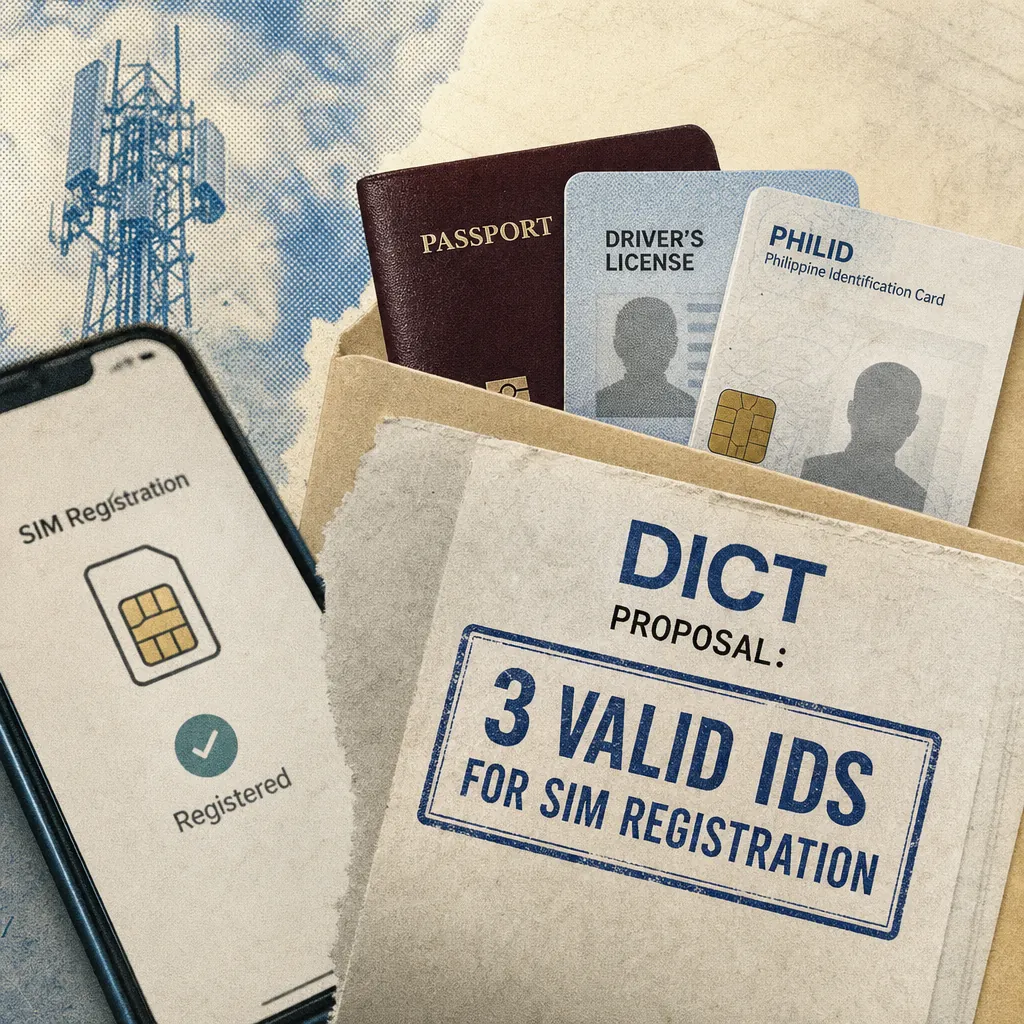
The Department of Information and Communications Technology (DICT) is considering a significant simplification of SIM card registration rules. During a House of Representatives budget hearing on Monday, September 7, DICT Secretary Henry Aguda told lawmakers that the agency is thinking of reducing the number of acceptable valid IDs for SIM registration from around 17 to just three: the national ID, passport, and driver's license.24 The proposal, aimed at preventing identity falsification, would directly affect how millions of Filipinos—particularly prepaid subscribers—register their SIM cards. The hearing, streamed live on YouTube, drew 3,669 views but only 12 likes and no comments, indicating a passive audience for a policy shift that could reshape customer onboarding for the country's major telcos.1
The day's conversation around telecommunications was anchored by this regulatory development, but it unfolded against a backdrop of more attention-grabbing political news. A Facebook post about Interior Secretary Jonvic Remulla's statement that former House Speaker Martin Romualdez was under police guard in a hospital drew 73 likes and 34 comments—far more engagement than the SIM registration story, which managed just 4 likes on Facebook and 3,427 views on Twitter with no comments.423 This divergence highlights a challenge for the sector: policy changes that matter deeply to telcos and their customers are struggling to compete for public attention in a news cycle dominated by political drama.
Beyond the SIM registration proposal, the day's coverage included several other technology and connectivity stories. The DICT also revealed that gaming platform Roblox has until October to comply with safety requirements, including age verification through the national ID system.7 Meta, the parent company of Facebook and Instagram, announced it would study integrating the Philippine national ID into its platforms for age verification.34 Meanwhile, a separate cybersecurity story emerged: hackers claimed to have accessed the network of the Department of Migrant Workers (DMW), as the DICT probes a series of government cyberattacks.9 These developments, alongside the SIM registration news, paint a picture of a sector grappling with digital identity, security, and regulation.
Key themes
- DICT proposes cutting SIM registration IDs from 17 to three: The agency is considering accepting only the national ID, passport, and driver's license for SIM registration, a move that could simplify onboarding for prepaid users but raises questions about fraud prevention.24
- Roblox given October deadline for safety compliance: The gaming platform must establish a local office and enforce age verification through the national ID, following a May directive from the DICT.7
- Meta to study Philippine national ID integration: The tech giant is exploring using the national ID's e-verify system for age verification on its platforms, following a meeting with DICT officials in Singapore.34
- Government cyberattacks under investigation: Hackers claim to have accessed the Department of Migrant Workers' network, with the DICT probing the breach alongside a separate defacement of a Department of Labor and Employment web host.9
- AI governance framework expected this September: The Department of Economy, Planning and Development (DEPDev) is finalizing the country's first AI governance framework, pending President Marcos's approval.13
- PLDT Enterprise signs connectivity deal with microfinance firm: Taytay Sa Kauswagan, Inc. (TSKI) has tapped PLDT's corporate arm to upgrade connectivity across its branch network as it expands financial services.28
- Smart launches annual roaming wallet for Infinity plans: The new Roam+ feature gives premium subscribers up to 40GB of international roaming data valid for a year, a first for the Philippine market.31
- Cignal expands streaming reach through Smart and TNT partnerships: The pay-TV provider is bundling its Cignal Play streaming service with prepaid mobile load deals from TNT and Smart.55
How the narratives stack
Dominant: The DICT's proposal to reduce SIM registration IDs is the most significant regulatory story for the telecommunications sector. It emerged from the House budget hearing and was syndicated across Facebook and Twitter, though engagement was minimal.23 The proposal signals a potential shift toward streamlined customer onboarding, which could lower friction for prepaid users—a critical segment for Smart's TNT and Globe's TM brands. Within the captured set, this story drew the most direct attention from telco stakeholders, even if public engagement was low.
Counter-narrative: The cybersecurity story offers a contrasting frame. While the DICT pushes to simplify identity verification, hackers are actively targeting government systems, claiming access to sensitive worker data.9 This tension between convenience and security is a recurring theme in the sector. The breach at the DMW, if confirmed, could undermine public confidence in digital identity systems just as the government seeks to expand their use.
Emerging: The AI governance framework, expected this month, represents a new regulatory frontier. DEPDev Secretary Arsenio Balisacan said the framework would cover AI use across education, health, and public infrastructure, and would map ways to shorten government processes.13 For telcos, which increasingly rely on AI for network management and customer service, this framework could introduce new compliance requirements.
Under-covered: The PLDT Enterprise partnership with microfinance institution TSKI received relatively little attention but carries strategic significance. It demonstrates how connectivity providers are positioning themselves as enablers of financial inclusion, a narrative that could resonate with policymakers and the public alike.28 Similarly, Smart's Roam+ launch and Cignal's streaming partnerships are commercial developments that show how telcos are diversifying beyond core voice and data services.3155
Platform insights
- Facebook: The platform carried the two most engagement-heavy posts—the Romualdez/Remulla update and the DICT SIM registration news—but only the political item triggered meaningful interaction (34 comments).4 The SIM registration post's muted response (4 likes, 1 share) suggests that policy updates without immediate consumer pain points fail to activate Facebook's comment-driven discourse.2
- Twitter/X: Both the SIM registration story and a PLDT volleyball referee post were syndicated here, but neither gained traction, with views below 3,500 and no engagement metrics beyond passive impressions.35 Twitter's real-time nature did not translate into conversation, confirming that September 7 was a low-urgency news day for telecom topics.
- YouTube: The DICT budget hearing was the only video content captured, functioning as an official broadcast channel rather than a discussion space.1 With zero comments, the platform served as a one-way information distribution point, indicating that audiences seeking policy details watch but do not engage in visible deliberation.
Key voices and communities
- Government oversight and policy stakeholders: The House Committee on Appropriations and the DICT are the primary shapers of the regulatory environment. Their proceedings, streamed live, generate modest but engaged viewership. This group's decisions directly alter the compliance landscape for telcos.1
- Mainstream media and content syndicators: News outlets like the Inquirer and their digital syndication networks are the primary dissemination channels for regulatory changes. Their coverage focuses on institutional processes rather than consumer-level service issues.23
- Cybersecurity researchers and watchdogs: Groups like Deep Web Konek, which reported the DMW breach, play a critical role in surfacing security incidents that government agencies might otherwise downplay. Their technical assessments shape public understanding of cyber risks.9
- Sports and entertainment communities: While not directly involved in telecom policy, this group creates organic chatter drawing on telecom brand names, primarily through the Premier Volleyball League (PVL). The PLDT High Speed Hitters team generates discussion across platforms, though engagement on September 7 was negligible.5
- Corporate and enterprise clients: Companies like TSKI, which announced a connectivity partnership with PLDT Enterprise, represent a growing segment of telco customers. Their needs—reliable connectivity for branch operations and financial services—drive demand for enterprise solutions.28
Narrative streams
DICT's SIM registration ID reduction proposal
The most substantive policy story of the day emerged from the House Committee on Appropriations briefing on the DICT's proposed 2027 budget. Secretary Henry Aguda told lawmakers that the agency is considering reducing the number of valid IDs accepted for SIM registration from around 17 to just three: the national ID, passport, and driver's license.24 Aguda said the current number of acceptable IDs has become a problem in the registration process, and that using the national ID would help prevent identity falsification.
The proposal, if implemented, would mark a significant shift in the regulatory framework governing SIM registration. The SIM Registration Act, which took effect in 2022, was designed to curb text scams and fraud by requiring all SIM users to register their identity. However, the process has been criticized for being cumbersome, particularly for prepaid users in rural areas where government-issued IDs are less common. Reducing the ID requirements could lower barriers to registration, but it also raises questions about whether fewer ID types might make it easier for fraudsters to use stolen or fake documents.
The story was syndicated across Facebook and Twitter, but engagement was strikingly minimal—just 4 likes on Facebook and 3,427 views on Twitter, with no comments registered on either platform.23 This muted response suggests either low awareness or indifference among the general public. For telcos, however, the proposal carries significant operational implications. If the DICT formalizes the change, PLDT, Globe, and DITO would need to update their registration systems and customer communications. The lack of public engagement means there is no existing narrative to correct or amplify—creating a clean slate for proactive messaging when the policy is formalized.
The read for the sector: Telcos should prepare for a potential regulatory easing that could simplify subscriber acquisition, particularly for prepaid brands like TNT and TM. Communications teams should anticipate consumer queries about updated requirements and position themselves as supportive partners in easing the digital onboarding experience. However, they must also navigate the tension between convenience and fraud prevention, avoiding language that appears to undermine the SIM Registration Act's security rationale.
Government cyberattacks and the DMW breach
A separate cybersecurity story emerged late Monday, as the DICT investigated unauthorized access to the Department of Migrant Workers (DMW) website and the defacement of a Department of Labor and Employment (DOLE) web host.9 Cybersecurity monitoring page Deep Web Konek reported that hacktivist group HappyGoLuckyPH had claimed responsibility for defacing the DMW website and alleged that it maintained access to the agency's Active Directory environment for more than a month. The group claimed it eventually compromised a domain controller and gained access to internal systems, security-management consoles, databases, and server directories.
The alleged breach is particularly concerning because it reportedly exposed repositories containing worker, recruitment, contract, financial, legal, and administrative information, including database backups, identity-verification records, and scanned identification documents. If confirmed, this would represent a serious compromise of sensitive personal data belonging to overseas Filipino workers.
The DMW and DICT have not released a detailed technical assessment, leaving the scope of the breach uncertain. The story underscores the cybersecurity challenges facing government agencies, which are increasingly targeted by hacktivist groups. For the telecommunications sector, this story is relevant because it highlights the importance of robust identity verification systems—the same systems that the DICT is seeking to streamline through its SIM registration proposal. The tension between convenience and security is not just a policy debate; it has real-world consequences for data protection.
The read for the sector: Telcos should monitor the DICT's investigation closely, as it may influence how the agency approaches identity verification requirements. If the DMW breach is confirmed to have exposed identity documents, it could strengthen the case for more rigorous verification—potentially conflicting with the push to reduce SIM registration IDs. Telcos should also review their own security postures, as the incident may prompt regulators to scrutinize data protection practices across sectors.
Roblox compliance and the national ID as a verification tool
During the same budget hearing, Aguda revealed that gaming platform Roblox has until October to comply with safety requirements, including establishing a local office and enforcing age verification through the national ID system.7 The DICT gave Roblox five demands in May, and three have already been met. Roblox agreed to segment its platform into three versions—Roblox for Kids, Roblox Select, and Roblox—and to monitor chat activities.
The Roblox case is significant because it represents the first major test of the national ID's e-verify solution as a tool for age verification. Aguda said the e-verify system allows platforms like Roblox to verify a player's age using the national ID without transferring personal information to the gaming platform. This approach could become a template for other platforms, including social media giants.
Meta, the parent company of Facebook and Instagram, has taken notice. Aguda told lawmakers that Meta will send a team to the Philippines to study integrating the national ID system into its platforms.34 The meeting in Singapore discussed identity verification concerns, and Meta reportedly sees the national ID e-verify solution as a potential tool for age verification.
These developments come amid a broader push to protect children online. The House of Representatives recently approved the Children's Social Media and Online Gaming Safety Act, which would prohibit children under 13 from creating social media accounts and require platforms to redesign interfaces for users aged 13 to 17 to remove "predatory features" like infinite scroll and targeted ads.8
The read for the sector: The national ID is emerging as a central piece of digital infrastructure, not just for SIM registration but for age verification across platforms. Telcos, which are already integrated with the national ID system for SIM registration, could play a role in expanding its use. However, they must also navigate privacy concerns, as the system's effectiveness depends on public trust in how personal data is handled.
AI governance framework and the future of regulation
Beyond the immediate telecom stories, the day saw the Department of Economy, Planning and Development (DEPDev) announce that the country's first artificial intelligence (AI) governance framework is expected this September, pending President Marcos's approval.13 DEPDev Secretary Arsenio Balisacan said the framework would cover AI use across key sectors, including education, health, and public infrastructure, and would map out ways to shorten government processes and improve project monitoring.
The framework represents a new regulatory frontier that could have significant implications for the telecommunications sector. Telcos are increasingly using AI for network management, customer service chatbots, and fraud detection. A governance framework could introduce new compliance requirements, particularly around data privacy and algorithmic transparency.
The read for the sector: Telcos should monitor the AI framework's release closely, as it may introduce new obligations for how AI tools are deployed. Companies that use AI for customer-facing services should prepare for potential disclosure requirements and ensure their algorithms are free from bias. The framework could also create opportunities for telcos to position themselves as responsible AI adopters.
PLDT Enterprise and the connectivity-for-financial-inclusion narrative
Amid the regulatory and security stories, a quieter commercial development highlighted the role of connectivity in financial inclusion. Microfinance institution Taytay Sa Kauswagan, Inc. (TSKI) has tapped PLDT Enterprise to strengthen connectivity across its branch network as it expands financial services to underserved communities.28 TSKI said connectivity issues across some locations had begun affecting communication, operational efficiency, and service delivery to members.
Under the partnership, PLDT Enterprise will provide fixed and wireless connectivity solutions intended to support branch operations, member transactions, and communications. PLDT Enterprise Vice-President for Domestic Enterprise Javier C. L. (full name not provided) said the partnership is about giving TSKI's teams a stronger digital foundation so they can operate more efficiently and continue extending accessible financial services.
This story received relatively little attention in the captured set, but it carries strategic significance. It demonstrates how telcos are positioning themselves as enablers of financial inclusion, a narrative that resonates with policymakers focused on digital transformation. For PLDT, the partnership also represents a revenue stream beyond consumer services, as enterprise clients increasingly rely on reliable connectivity for their operations.
The read for the sector: Enterprise connectivity is a growing market as businesses across sectors digitize their operations. Telcos that can demonstrate the social impact of their services—such as enabling financial inclusion—may find it easier to navigate regulatory scrutiny and build public goodwill. This narrative could be amplified in communications with policymakers and the public.
Smart's Roam+ and the premium subscriber market
Smart Communications announced the launch of Roam+, described as the Philippines' first annual roaming wallet for its premium Infinity Plans.31 The feature gives Infinity members up to 40GB of international roaming data, credited at the start of their contract year and available for use across multiple trips within 365 days. Members keep their primary Smart number, manage their connectivity through one bill, and can check their Roam+ balance through the Smart App.
The launch is part of Smart's strategy to differentiate its premium offerings. Roam+ joins a suite of benefits including Worldwide Concierge Services, complimentary airport lounge access, and dedicated Relationship Manager support. For frequent travelers, the annual roaming wallet eliminates the need to purchase separate roaming packages for each trip.
The read for the sector: The premium subscriber segment is becoming increasingly competitive as telcos seek to lock in high-value customers. Features like Roam+ are designed to reduce churn by offering tangible, year-round benefits. Competitors like Globe may need to respond with similar offerings to retain their own premium subscribers.
Cignal's streaming pivot through Smart and TNT partnerships
Cignal, the pay-TV provider under the PLDT group, is expanding its streaming reach through partnerships with mobile brands TNT and Smart.55 Starting September 4, TNT prepaid subscribers gained access to Cignal Play special mobile load bundles through SAYA ALL deals. Smart prepaid subscribers will follow soon with their own tailored offers.
This mobile integration supports the recent relaunch of Cignal Play, which has evolved into a comprehensive streaming hub offering live and on-demand sports, linear channels, news, and entertainment. By bundling Cignal Play with prepaid mobile loads, Cignal is tapping into the large prepaid market, which is particularly popular among younger, data-hungry users.
The read for the sector: The convergence of telecom and media is accelerating. Telcos are no longer just connectivity providers; they are content distributors. Partnerships like this one allow PLDT to leverage its ecosystem—Smart, TNT, and Cignal—to offer bundled services that increase customer loyalty and average revenue per user. Competitors may need to develop similar ecosystems to compete effectively.
Conversation trajectory
- SIM registration ID reduction (2–4 weeks): The DICT's proposal is expected to move to formal committee discussions within the coming weeks. Telcos should prepare for potential official announcements and anticipate consumer queries about updated requirements. The lack of public engagement means there is no existing narrative to correct or amplify, creating a clean slate for proactive messaging when the policy is formalized.23
- Roblox compliance deadline (October): The gaming platform has until October to meet the DICT's safety requirements, including age verification through the national ID. The outcome will set a precedent for how other platforms, including Meta, approach age verification in the Philippines.734
- AI governance framework release (this month): DEPDev is expected to present the final framework to President Marcos this September. Its release could introduce new compliance requirements for telcos using AI, particularly around data privacy and algorithmic transparency.13
- DMW breach investigation (ongoing): The DICT's investigation into the alleged DMW breach is ongoing. A confirmed breach could strengthen the case for more rigorous identity verification, potentially conflicting with the push to reduce SIM registration IDs.9
- PVL Invitational finals (September 8): The Nxled Chameleons face Thailand's Est Cola in the PVL championship on Tuesday. PLDT's brand is associated with the league through its High Speed Hitters team, and any officiating controversy could resurface depending on game outcomes.1437
Trigger events to watch: The formal filing of the DICT's proposed budget adjustments, which will likely surface detailed provisions on SIM registration requirements and digital infrastructure spending. The release of the AI governance framework. Any official statement from the DICT or DMW on the cyberattack investigation. The outcome of the Roblox compliance review in October.
Response guidance
SIM registration policy: Prepare proactive monitoring alerts for the SIM registration ID reduction story. Brief clients on potential consumer sentiment shifts, particularly around convenience narratives versus fraud prevention concerns. Recommend that clients hold substantive public announcements until the immediate political story subsides, while preparing internal readiness assessments alongside the DICT hearing developments.23
Cybersecurity messaging: Advise clients to avoid commenting on the DMW breach until the DICT's investigation concludes. If clients are asked about their own security practices, emphasize robust identity verification and data protection measures. Avoid language that appears to exploit the breach for competitive advantage.9
National ID integration: Position clients as supportive partners in expanding the national ID's use for age verification and other purposes. Emphasize the privacy safeguards built into the e-verify system, which allows verification without transferring personal information.34
AI governance: Monitor the AI framework's release and prepare clients for potential compliance requirements. Encourage clients to document their AI use cases and ensure algorithms are transparent and free from bias.13
Sports brand mentions: For the PLDT volleyball team, issue a short statement through official channels expressing confidence in the league's governance without attacking referees. This proactive stance can preempt a viral clip narrative, especially with the volleyball conference still active.5
Political climate: Given the charged political atmosphere, advise clients' communications heads to refrain from public commentary on ongoing government prosecutions or related controversies. Instead, reinforce messaging around consumer benefits, network expansion, and digital inclusion—areas where they can maintain positive visibility without being drawn into combustible online discourse.4
See the full picture behind today's signals.
This report draws from Media Meter's MediaWatch, our real-time monitoring engine tracking 2,470+ Philippine sources across print, broadcast, digital, and social. Explore how the platform turns raw coverage into decision-grade intelligence, then see how it's configured for teams like yours — whether you're in PR agencies, corporate comms, government, or marketing.
Want more? Browse our Report Library for sector and crisis intelligence, or request a demo and we'll have your brand set up before the call.
Want this kind of intelligence on your brand?
This brief is built on the same MediaWatch methodology that runs continuously across every brand we monitor. See your competitive landscape, Impact Score, and narrative trajectory in a 30-minute demo.