Telco capex hits $2.2B as NLEX floods strand motorists
Philippine telcos PLDT, Globe, and Converge have lined up $2.21 billion in 2026 capital spending to expand connectivity, even as severe flooding along the North Luzon Expressway strands motorists and raises infrastructure resilience concerns. The day's conversation also touched on SIM-card-linked cybercrime and digital inclusion barriers.
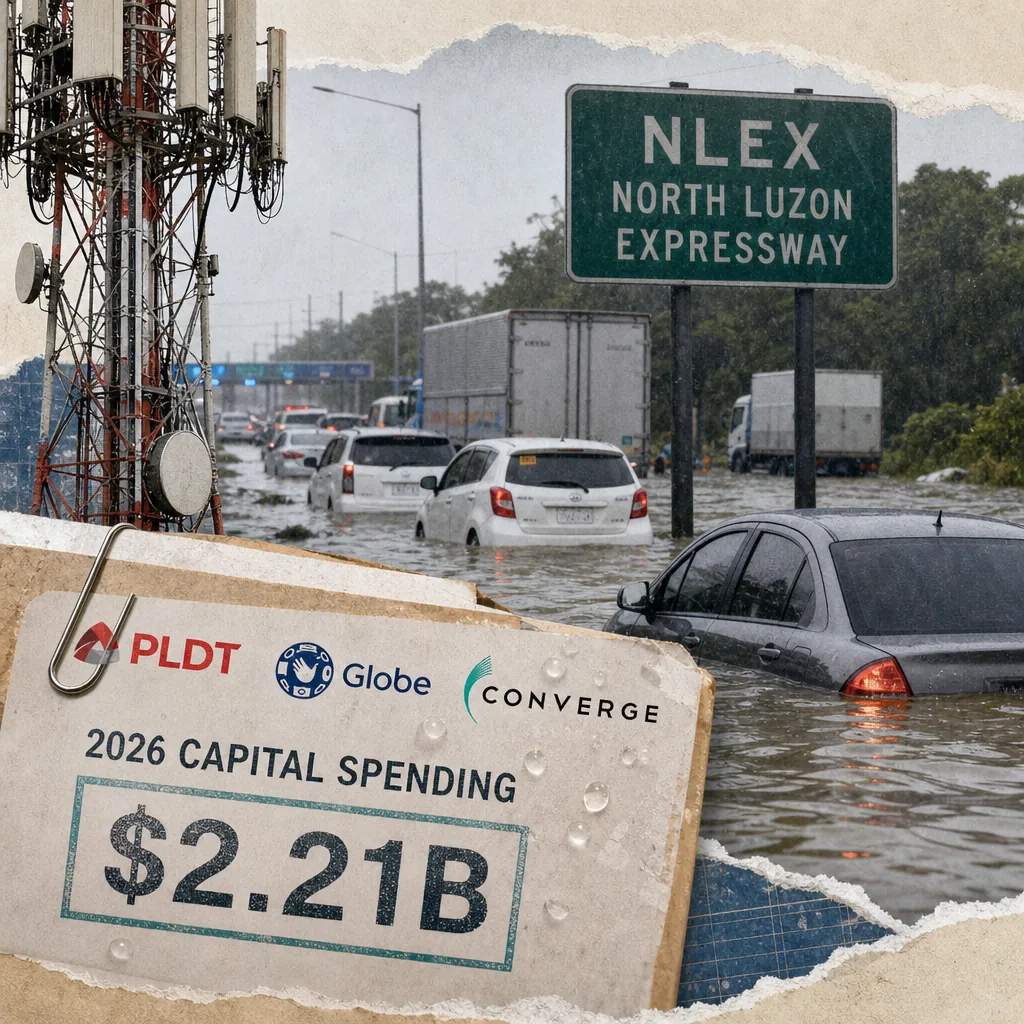
The day's most consequential development for the telecommunications sector was a spending announcement, not a service outage. PLDT Inc., Globe Telecom, and Converge ICT Solutions have lined up about $2.21 billion in combined capital expenditures for 2026, a figure the Department of Information and Communications Technology (DICT) said could rise to roughly $2.4 billion to $2.45 billion once expected investments from DITO Telecommunity and other players are included.30 The disclosure, drawn from company reports and earnings briefings as of August, signals a continued push to deepen the country's digital infrastructure. PLDT has indicated spending of about P55 billion (roughly $930 million), Globe's is expected to stay below P59.4 billion (around $950 million to $970 million), and Converge has set a range of P17 billion to P20 billion (about $310 million at the midpoint).37 DITO's 2026 investments are projected to be lower than its P15-billion-to-P18-billion spending in 2025, with the DICT estimating between $170 million and $250 million this year.37
Set against that forward-looking investment story was a more immediate, visceral infrastructure crisis. Severe flooding along the North Luzon Expressway (NLEX) in Pampanga, caused by days of southwest monsoon rains, stranded motorists for hours — some for more than a day — and dominated broadcast and online news coverage. The flooding, which began over the weekend, left portions of the major highway impassable, with small vehicles unable to cross and even large trucks struggling.1 The operator, Metro Pacific Tollways Corp. (MPTC), announced it would elevate the San Simon segment of the toll road as a permanent measure to prevent recurring floods, while also committing to raise northbound and southbound pavements in other areas.40 The human toll was captured in broadcast reports of truck drivers running out of fuel and food, and residents selling food and drinks to stranded motorists.4534
The social media conversation on August 31 was comparatively quiet on telco-specific grievances. No major service disruption complaints or billing issue narratives gained traction. Instead, the most prominent telco-related brand moment was positive but niche: the PLDT High Speed Hitters volleyball team's season-opening victory in the Premier Volleyball League (PVL) Invitational Conference, powered by Savannah Dawn Davision's 30-point performance.2 The story appeared on Facebook and Twitter with minimal engagement — one like on Facebook, 315 views on Twitter — but provided organic, non-commercial brand association. A separate thread on the NLEX flooding drew 467 views on Twitter, signaling public attention to infrastructure fragility that could feed into connectivity narratives if service interruptions follow.1 On Reddit, a broader discussion about systemic corruption in the Philippines drew 30 comments, touching on themes of rising costs and institutional failures that form the emotional backdrop for consumer sentiment toward large corporations, including telcos.4
Key themes
- Telcos commit $2.21 billion to 2026 network buildout. PLDT, Globe, and Converge have announced combined capital expenditures of about $2.21 billion for 2026, with the total potentially reaching $2.45 billion when DITO's expected investments are included, according to the DICT.3037 The spending is aimed at expanding connectivity and deepening the digital economy, but carries technology and competition risks.
- NLEX flooding strands motorists for hours, exposing infrastructure fragility. Severe flooding along the North Luzon Expressway in Pampanga left motorists stuck for up to 12 hours or more, with some entering the highway on August 31 and exiting September 1.45 The operator MPTC said it will elevate the San Simon segment as a permanent flood-prevention measure.40
- SIM cards still linked to most cybercrimes despite registration law. The Philippine National Police-Anti-Cybercrime Group (PNP-ACG) reported that almost all cybercrime in the country involves SIM cards, even after the SIM Card Registration Act took effect.79 Authorities arrested a man in Bulacan for allegedly selling pre-registered SIM cards, confiscating around 400 cards.
- PLDT volleyball victory offers rare organic positive brand moment. The PLDT High Speed Hitters' opening win in the PVL Invitational Conference, powered by Savannah Dawn Davision's 30-point performance, generated positive brand association across Facebook and Twitter, though with minimal engagement.2
- Digital inclusion barriers surface in app-based service complaints. A Reddit post about a retail loyalty app requiring live data connectivity highlighted how digital-first service models exclude tech-illiterate users and those with low-storage phones — a concern directly relevant to telco SIM registration and eSIM initiatives.3
- Systemic frustration with governance primes consumers for corporate accountability. A Reddit discussion on corruption in the Philippines drew 30 comments, with users expressing frustration over rising costs and poor public services — themes that can easily extend to telco service quality and pricing perceptions.4
- Data center growth constrained by energy security, not just connectivity. Moody's Ratings flagged energy security shortcomings as a key bottleneck for the Philippines' data center industry, which has not scaled to the extent of regional counterparts like Malaysia and Singapore.63 This directly affects the demand side of the telco network buildout.
How the narratives stack
Dominant: The telco capital expenditure announcement is the day's most significant sector development. The $2.21 billion spending commitment by PLDT, Globe, and Converge — potentially rising to $2.45 billion with DITO — represents a concrete, forward-looking investment in the country's digital infrastructure.3037 Within the captured media set, this story drew substantial coverage across business outlets including Malaya Business Insight and Newsbytes Philippines, with the combined advertising-equivalent value of the two articles estimated at over ₱440,000. The spending push signals confidence in the sector's growth trajectory even as it carries execution and competition risks.
Counter-narrative: The NLEX flooding crisis provides a stark counterpoint to the investment story. While telcos plan billions in network expansion, the physical infrastructure those networks depend on — roads, bridges, and the mobility of maintenance crews — remains vulnerable to extreme weather. The flooding stranded motorists for hours, with broadcast coverage on GMA 7 and TV5 drawing some of the highest advertising-equivalent values in the captured set, including an estimated ₱21.7 million for a GMA 7 report on the traffic ordeal.45 This narrative underscores that connectivity is only as reliable as the infrastructure that supports it.
Emerging: The SIM-card-linked cybercrime story is an emerging concern that directly implicates the telco sector. Despite the SIM Card Registration Act, the PNP-ACG reports that almost all cybercrime involves SIM cards, pointing to persistent gaps in the registration system's effectiveness.79 This could drive renewed regulatory scrutiny and public pressure on telcos to strengthen identity verification and fraud prevention.
Under-covered: The digital inclusion barrier highlighted in the Healthy Options app complaint received minimal attention — just one comment on Reddit — but represents a persistent consumer pain point that directly relates to telco digital-first strategies.3 The frustration of a user whose mother cannot access a loyalty app because it requires live data connectivity mirrors the challenges many Filipinos face with SIM registration, eSIM adoption, and app-based account management. This story placed low in the captured set but carries significant reputational risk if left unaddressed.
Platform insights
- Facebook: The PLDT volleyball victory story received minimal engagement — one like and two care reactions — indicating sports content targets a niche audience on this platform for telco brands. However, the NLEX flooding generated more substantial discussion, with netizens sharing their experiences of being stuck in traffic for hours in the Facebook group "Traffic Updates – NLEX / SCTEX / TPLEX."45 One user reported leaving La Union at 6:30 a.m. Monday and only arriving in Taguig City at 4:30 a.m. Tuesday.
- Twitter/X: Both the volleyball recap and the NLEX flooding story found audiences, with the sports story drawing 315 views and the infrastructure concern 467 views.21 The slightly higher interest in the infrastructure story suggests users on Twitter are attuned to real-world disruptions that affect daily life, including connectivity. The infrastructure post's engagement pattern indicates practical concerns resonate more than sports content on this platform.
- Reddit: The corruption thread represents Reddit's role as a platform for deeper systemic discussion, with 30 comments engaging with governance and institutional failure themes.4 The Healthy Options app complaint, while drawing only one comment, highlights the platform's function as a space for surfacing consumer pain points that may not gain traction elsewhere.3
Key voices and communities
- Volleyball fan communities and sports media. The most active telco-relevant stakeholder cluster revolves around Philippine volleyball fandom, particularly followers of the PVL. This community demonstrates cross-platform presence, with identical content appearing on both Facebook and Twitter, indicating coordinated sports media syndication.2 Engagement is modest but concentrated, suggesting a niche but dedicated audience. The primary narrative frames PLDT as a competitive sports brand defending Philippine volleyball against international competition.
- General public and consumer sentiment watchers. This group engages with content about national infrastructure issues, such as the NLEX flooding, reflecting public discourse around infrastructure reliability that contextualizes broader connectivity conversations.1 Their framing emphasizes functional disruptions in daily life — transportation, connectivity, and public services — without explicitly naming telecom providers.
- Systemic frustration voices and digital natives. A highly vocal stakeholder group consists of digitally native Filipinos expressing frustration over systemic governance failures, corruption, and public service inadequacies. Most active on Reddit, this community's grievances about rising bills and poor infrastructure directly intersect with telecom affordability and service quality perceptions.4 Their narratives can easily extend from governance failures to private sector service inadequacies.
- Consumer rights and digital literacy advocates. A smaller but distinct stakeholder group focuses on consumer accessibility issues, particularly around digital service requirements that disadvantage less tech-savvy populations.3 Their concerns about mandatory app usage and live connectivity requirements signal a need for hybrid solutions that accommodate non-digital consumers.
Narrative streams
Telco capital spending signals confidence in digital economy growth
PLDT, Globe, and Converge have committed a combined $2.21 billion in capital expenditures for 2026, according to the DICT, with the total potentially reaching $2.45 billion when DITO's expected investments are included.3037 PLDT has indicated spending of about P55 billion (roughly $930 million), Globe's is expected to stay below P59.4 billion (around $950 million to $970 million), and Converge has set a range of P17 billion to P20 billion (about $310 million at the midpoint).37 DITO's 2026 investments are projected to be lower than its P15-billion-to-P18-billion spending in 2025, with the DICT estimating between $170 million and $250 million this year.37
The spending push is aimed at expanding connectivity and deepening the country's digital economy. The DICT and an economist noted that the investments carry technology and competition risks — the sector must keep pace with rapid technological change while managing the financial burden of network expansion.30 This story drew coverage across business outlets including Malaya Business Insight and Newsbytes Philippines, with the combined advertising-equivalent value of the two articles estimated at over ₱440,000 — a measure of the space those reports occupied, not of how many people read them.
For the sector, this capital expenditure signals a continued bet on the Philippines' digital future. The investments will fund network expansion, 5G rollout, and fiber deployment, directly affecting service quality and coverage for consumers. The read for the sector is that telcos are positioning for long-term growth, but the scale of investment also raises expectations for measurable improvements in service reliability and speed.
NLEX flooding exposes physical infrastructure vulnerabilities
Severe flooding along the North Luzon Expressway in Pampanga stranded motorists for hours, with some entering the highway on August 31 and only exiting September 1.45 The flooding, caused by days of southwest monsoon rains, left portions of the major highway impassable. Broadcast reports captured the human toll: truck drivers running out of fuel and food, residents selling food and drinks to stranded motorists, and commuters missing work and classes.4534
The operator, Metro Pacific Tollways Corp. (MPTC), announced it would elevate the San Simon segment of the toll road as a permanent measure to prevent recurring floods, while also committing to raise northbound and southbound pavements in other areas.40 The company said it is working with the Department of Transportation, Toll Regulatory Board, and other agencies to assess measures to support affected motorists.
This story dominated broadcast coverage, with GMA 7 and TV5 reports drawing some of the highest advertising-equivalent values in the captured set — an estimated ₱21.7 million for a GMA 7 report on the traffic ordeal and ₱6.1 million for a TV5 segment on residents selling food to stranded motorists. These figures represent the estimated cost of buying equivalent airtime as advertising, not audience size.
For the telecommunications sector, the flooding carries indirect but significant relevance. NLEX serves as a critical artery for fiber optic cable maintenance crews and network operations personnel traveling between Metro Manila and Central Luzon. Prolonged flooding could impact network operations and necessitate proactive customer communication about service reliability. The read for the sector is that physical infrastructure fragility — roads, bridges, and tower access — remains a vulnerability that can disrupt network maintenance and service continuity during extreme weather events.
SIM cards remain central to cybercrime despite registration law
The Philippine National Police-Anti-Cybercrime Group (PNP-ACG) reported that almost all cybercrime in the country involves SIM cards, despite the SIM Card Registration Act.79 The law, signed in 2022, requires all SIM cards to be registered with their users' identities to curb scams and other illegal activities. PNP-ACG Director Police Major General Wilson Casil Asueta revealed this at a press conference after reporting the arrest of a 26-year-old man in Obando, Bulacan, for allegedly illegally selling registered SIM cards. Around 400 SIM cards were confiscated during the entrapment operation.
Asueta said that crimes involving SIM cards include scamming, online gambling, and identity exploitation. He pointed out that the SIM Card Registration Act has not fully addressed the problem, as criminals find ways to circumvent the system by selling pre-registered cards.
This story, carried by Inquirer Online with an estimated advertising-equivalent value of ₱378,756, directly implicates the telco sector. The persistence of SIM-card-linked cybercrime despite the registration law raises questions about the effectiveness of the registration system and the responsibility of telcos to verify identities and prevent fraud. The read for the sector is that telcos face continued regulatory and public pressure to strengthen identity verification and fraud prevention measures, even as they push digital-first customer service models.
PLDT volleyball victory offers organic brand moment amid quiet service landscape
The PLDT High Speed Hitters volleyball team opened its Premier Volleyball League (PVL) Invitational Conference title defense with a win over Thailand's EST Cola, powered by Savannah Dawn Davision's 30-point performance.2 The match narrative appeared on Facebook and Twitter with minimal engagement — one like on Facebook, 315 views on Twitter — but provided organic, non-commercial brand association.
This represents a notable shift from typical telco conversation patterns, where service quality complaints and network issues usually dominate. The sports-related mention provides positive brand association without any service-related context attached. However, the low engagement numbers suggest untapped potential for amplifying these stories through official channels.
The PLDT brand also appeared in sports coverage of the PVL Invitational, where Nxled swept the defending champion PLDT in a separate match.11 The team's mixed results — a win over the Thai squad and a loss to Nxled — generated coverage across multiple outlets, including Inquirer Online, Daily Tribune, and Malaya Business Insight.
For the sector, sports sponsorships represent a reputational asset that provides narrative insulation during periods when network issues dominate other channels. The read for the sector is that sports-related brand visibility offers a counterweight to service-related complaints, but the public may perceive engagement as focused on sponsorships rather than core service reliability if complaints surface concurrently.
Digital inclusion barriers surface in app-based service complaints
A Reddit post about the Healthy Options loyalty app highlighted how digital-first service models exclude vulnerable populations. The user expressed frustration that the app requires live data connectivity, which disadvantages tech-illiterate users and those with low-storage phones.3 The post received one like and one comment, indicating low visibility but representing a persistent consumer pain point.
The user's mother, described as "computer/tech illiterate" with a phone lacking storage, cannot access the loyalty app because it requires live data connectivity. The user suggested that a "physical card" would be less stressful than requiring app-based presentation. The specific quote — "Kailangan ba na yung app lagi ang ipresent tapos may data?" (Do you always have to present the app and have data?) — captures the core accessibility tension.
This concern directly parallels the digital divide discussions relevant to telco accessibility initiatives. For telecommunications providers, this highlights the challenges many Filipinos face with SIM registration, app-based account management, and the shift toward digital channels. The read for the sector is that digital-first service models risk excluding elderly and tech-limited demographics, signaling a need for hybrid solutions that accommodate non-digital consumers.
Systemic governance frustration primes consumers for corporate accountability
A Reddit discussion on systemic corruption in the Philippines drew 30 comments, with users expressing frustration over rising costs of electricity and basic services, infrastructure inadequacies, and the public's frustration with institutional failures.4 The post explored the "culture of tolerating corruption" and the difficulty of systemic change.
The author described searching TikTok for corruption content and feeling their "heart break" while watching videos about the Philippines' decline. The most engaging content combined personal testimony with structural critique, including an OJT experience at law enforcement agencies where an officer reportedly said not to vote for politicians willing to hold enforcers accountable.
While not telco-specific, this discussion touches on themes directly relevant to telecommunications consumer sentiment. The emotional weight of the post mirrors the disconnect many users feel between telco marketing promises and actual service delivery. The read for the sector is that this sentiment landscape primes audiences to respond strongly to any perceived corporate malfeasance or regulatory capture within the telecommunications sector, particularly around SIM registration enforcement, data privacy, or spectrum allocation decisions.
Conversation trajectory
- Sports sponsorship spillover into brand sentiment (observation window: ongoing PVL conference, next 2–3 weeks). The volleyball-related coverage of PLDT's team performance is generating cross-platform conversation momentum that extends beyond sports pages.2 Expect this sports-brand association to intensify during the ongoing PVL conference, creating a reputational halo effect that could partially offset any service-related complaints trending simultaneously. The team's mixed results — a win over EST Cola and a loss to Nxled — will continue to generate coverage across sports media.
- Infrastructure vulnerability narratives gaining traction (observation window: 48–72 hours, through the rainy season). The NLEX flooding report is an early indicator of how weather-related infrastructure failures can bleed into connectivity discussions, particularly in Luzon corridors where telco tower placement and fiber routes often follow highway systems.1 This conversation typically expands within 48–72 hours of weather events, shifting from traffic disruption to broader questions about network resilience during typhoon season. Track this narrative for potential crossover mentions of service interruptions in affected areas.
- Digital inclusion and accessibility concerns surfacing (observation window: next 4–6 weeks). The retail loyalty app complaint reveals an emerging conversation thread about digital dependency and the exclusion of tech-illiterate users from app-based systems.3 This conversation will likely expand as more institutions adopt app-first strategies, affecting how telco clients communicate about eSIM adoption, app-based account management, and self-service channels.
- SIM registration enforcement and cybercrime scrutiny (observation window: next 1–3 months). The PNP-ACG's revelation that SIM cards remain central to most cybercrimes despite the registration law could trigger renewed discussions about digital identity, fraud, and inclusion barriers.79 Any NPC enforcement announcements or high-profile cybercrime cases involving SIM cards could amplify this narrative.
Trigger events to watch: The ongoing PVL Invitational Conference matches (creating recurring positive brand moments through team performance coverage); the tail-end of the rainy season (which typically brings infrastructure vulnerability stories like the NLEX flooding to the forefront, with potential connectivity fallout narratives);1 and any SIM registration enforcement announcements or cybercrime cases that could trigger renewed discussions about digital identity and fraud.79
Response guidance
- Leverage sports sponsorship momentum authentically. Amplify PLDT High Speed Hitters team milestones through official channels, but avoid appearing opportunistic. The window of goodwill from the volleyball victory is typically underutilized and lasts only through the conference duration. Integrate subtle service-reliability messaging into the team's content ecosystem, associating "high speed" with both athletic performance and network capability.
- Prepare proactive weather-related service communication. Given the NLEX flooding and ongoing rainy season, prepare content that acknowledges connectivity challenges during extreme weather while emphasizing restoration efforts and alternative access options.1 Given the systemic frustration sentiment in broader governance discussions, any tone-deaf or dismissive response during weather-related outages will face amplified backlash.4 A pre-approved crisis response framework addressing both physical infrastructure and digital accessibility concerns would position telcos favorably when these narratives resurface.
- Address digital inclusion barriers in service design. Review onboarding processes for non-tech-savvy users, particularly for SIM registration and digital services.3 A targeted campaign demonstrating simplified user journeys — perhaps with physical alternatives — would counter the "systemic failure" narrative emerging in broader Philippines-related discourse.4
- Monitor the systemic corruption narrative with heightened vigilance. It serves as a silent amplifier for any future service outage or billing complaint. Proactive transparency about infrastructure investments, particularly around 5G rollout and tower deployment, could preempt the association of telcos with the broader governance failures being discussed.4
- Strengthen fraud prevention messaging around SIM registration. The PNP-ACG's report that SIM cards remain central to most cybercrimes despite the registration law presents a reputational risk.79 Communicate concrete steps taken to verify identities and prevent fraud, positioning telcos as part of the solution rather than the problem.
See the full picture behind today's signals.
This report draws from Media Meter's MediaWatch, our real-time monitoring engine tracking 2,470+ Philippine sources across print, broadcast, digital, and social. Explore how the platform turns raw coverage into decision-grade intelligence, then see how it's configured for teams like yours — whether you're in PR agencies, corporate comms, government, or marketing.
Want more? Browse our Report Library for sector and crisis intelligence, or request a demo and we'll have your brand set up before the call.
Want this kind of intelligence on your brand?
This brief is built on the same MediaWatch methodology that runs continuously across every brand we monitor. See your competitive landscape, Impact Score, and narrative trajectory in a 30-minute demo.