Digital economy at 9.8% as MSMEs lag on adoption
The Philippines' digital economy accounted for 9.8% of output in 2025, while small businesses still struggle with financing and digital adoption. The same day brought a P2.7-billion payments acquisition, a government push on cybersecurity, and a viral celebrity feud.
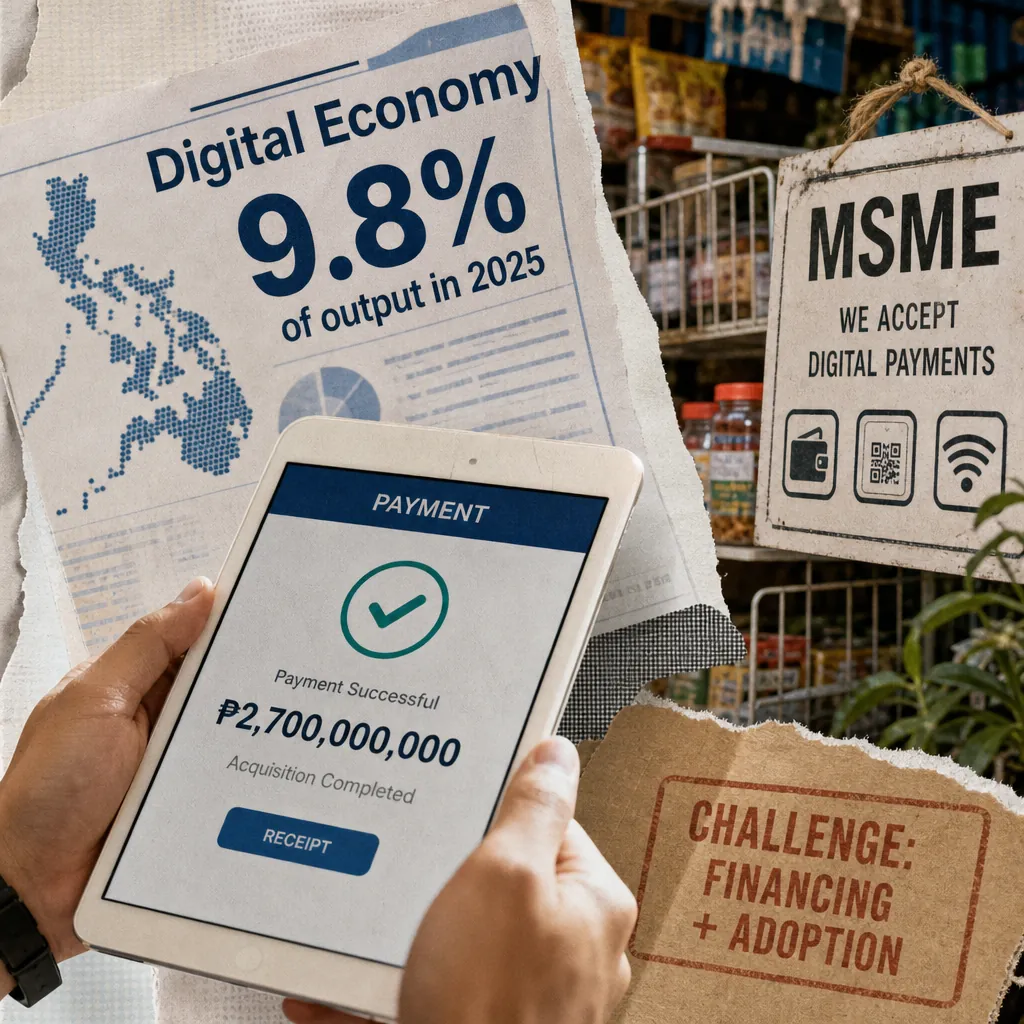
The digital economy accounted for 9.8 percent of Philippine economic output in 2025, the Philippine Statistics Authority (PSA) reported, and the businesses least equipped to capture that growth are the ones that make up more than 99 percent of all firms in the country 2. That gap — between a national economy moving online and a small-business base still working out how to follow — ran through the day's coverage of the technology sector, alongside a P2.7-billion consolidation in digital payments, a coordinated push by banks, telcos and government against online fraud, and a celebrity feud that pulled far more public reaction than any of it.
The day's most-read technology-adjacent item was not about technology at all. A post by beauty queen Imelda Schweighart aimed at the all-female pop group BINI and the all-male group SB19 drew a response from "Tawag ng Tanghalan" grand winner JM Yosures, whose re-share carried the line "Ang taong gipit, sa BINI/SB19 kumakapit" — roughly, a person with nothing left to lean on clings to BINI and SB19 1. The item ran on Manila Bulletin's online entertainment desk and, by the advertising-space measure the industry uses, was among the more heavily placed stories of the day. That contrast — a fan-war post outrunning the policy and business news — is worth noting for what it says about where public attention sits, not as a judgment on what matters.
On the business side, the day produced a completed acquisition, a government directive on cybersecurity, a state agency folding its services into a national app, and a warning from civil society about the 2027 budget. Each is a piece of the same question: whether the country's digital build-out reaches the small firms and ordinary users it is meant to serve.
Key themes
- The digital economy reached 9.8 percent of GDP in 2025, and small firms are the gap. The PSA figure covers the share of national output produced by digital activity 2. Micro, small and medium enterprises (MSMEs) — firms with fewer than 200 employees, which under Philippine law make up the overwhelming majority of registered businesses — account for more than 99 percent of enterprises and most of the workforce, according to the Philippine Chamber of Commerce and Industry (PCCI), the country's largest business membership group. The PCCI identifies limited access to financing, fragmented supply chains, low productivity and gaps in digital adoption as their main obstacles 2.
- Kayana completed a P2.7-billion buyout of Bayad Center, consolidating bill payments under Manuel V. Pangilinan. Kayana Solutions Inc., a company led by the tycoon known as MVP, bought out the remaining 90 percent of CIS Bayad Center Inc. from Manila Electric Co. (Meralco) and its subsidiary, raising its stake to 100 percent 6. Bayad Center is one of the country's largest over-the-counter and digital bill-payment networks.
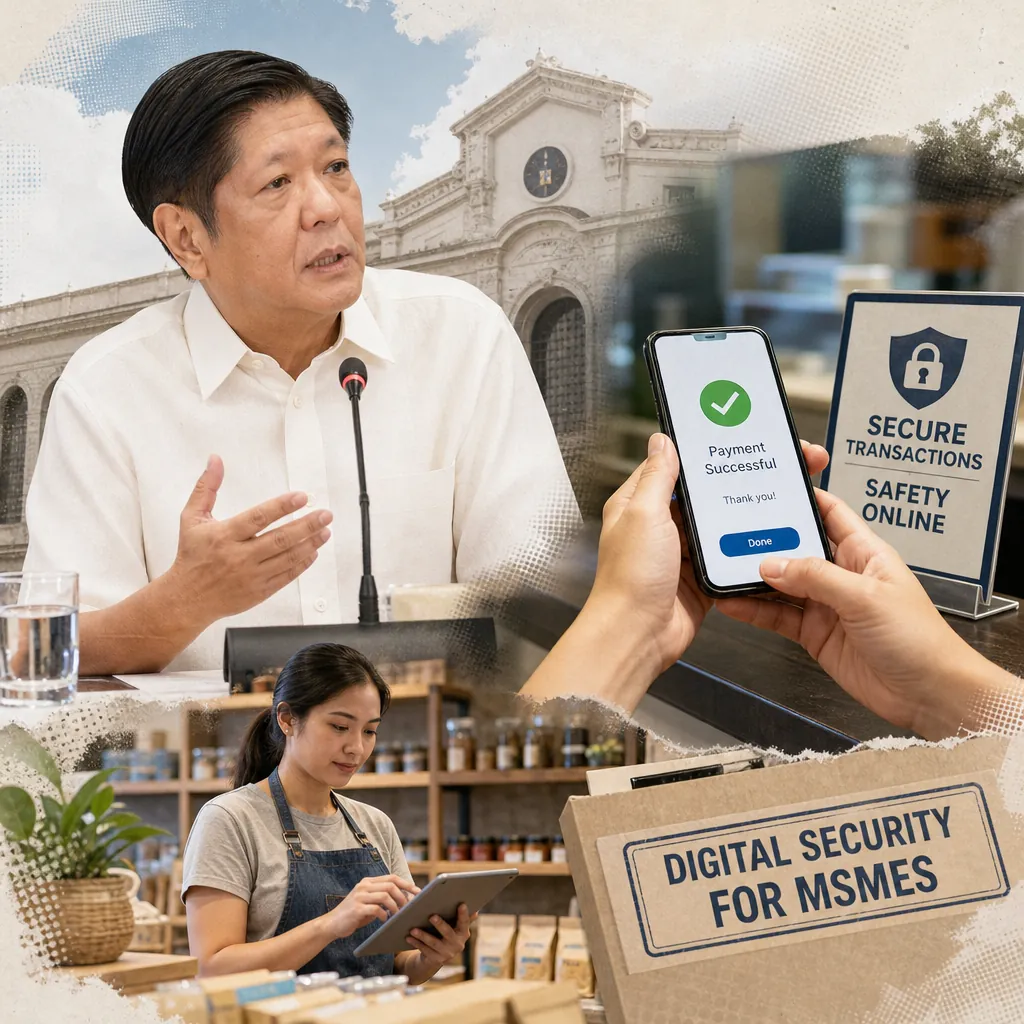
- President Marcos put cybersecurity at the center of the digital agenda. Meeting the Private Sector Advisory Council's Digital Infrastructure Sector Group at Malacañang on Tuesday, Marcos called digital security "an essential component of the country's expanding digital economy" as more Filipinos depend on internet platforms for banking, commerce, education and government transactions, according to the Presidential Communications Office 35.
- Globe, Smart and DITO are tightening network defenses as scam worry runs high. The three major telecommunications operators are strengthening network security, identity verification and suspicious-activity detection 29. The GSMA ASEAN Consumer Scam Report 2026 found 76 percent of Filipino consumers surveyed said they "absolutely worry" about being scammed — a survey share, not a count of incidents 29.
- Maya tied its anti-scam message to the Justice department's campus tour. At the University of the Philippines–Diliman, Maya's head of corporate affairs, Kristoffer Rada, said "a safer digital space needs everyone around the table," citing the Anti-Financial Account Scamming Act (AFASA) — a law that penalizes the use of bank and e-wallet accounts to commit fraud — and its implementing rules 7.
- The Social Security System is moving its member services into the eGovPH app. Under a data-sharing agreement signed Oct. 21, 2026, the SSS will put the digital MySSS Card and selected member services inside eGovPH, the government's single-app portal for public services 222834.
- Davao City is set to become the first local government to approve digital signatures itself. The City Council authorized the city on Tuesday, Nov. 3, to act as a registration authority for digital signatures, letting City Hall approve employees' applications instead of waiting months for the Department of Information and Communications Technology (DICT) 4.
- A celebrity post about BINI and SB19 drew the day's loudest public reaction. Schweighart's post and Yosures' response set off fan communities on both sides, and the story ran on Manila Bulletin's entertainment desk 1.
How the narratives stack
Dominant. The 9.8 percent digital-economy share and the MSME adoption gap carried the most consequence in the items reviewed here. The Inquirer's piece framed the question directly — can Filipino MSMEs keep up with a growing digital economy — and answered it with the PCCI's list of obstacles: financing, supply chains, productivity, digital adoption 2. This is the story with the widest reach into ordinary livelihoods, because MSMEs employ most Filipino workers. It is dominant in this set on consequence, not on volume; the set contains one substantial treatment of it.
Counter-narrative. The celebrity feud between Schweighart, Yosures and the BINI/SB19 fan bases drew the day's largest observable public response. Manila Bulletin's entertainment item documented the exchange in detail, including Yosures' re-share and a second re-share the following Wednesday night 1. Fan communities — Blooms for BINI, A'Tin for SB19 — organized the pushback. On engagement, this story outran everything else in the set; on consequence for the sector, it ranks well below the MSME gap. Both are true at once, and the gap between them is the day's most useful signal about where attention goes.
Emerging. Three threads are forming rather than settled. First, the anti-scam build-out: telcos tightening networks 29, Maya backing the DOJ's campus tour 7, and the President elevating cybersecurity 35 are separate moves pointing the same direction. Second, government service consolidation: the SSS–eGovPH integration 222834 and Davao City's digital-signature authority 4 both shift routine transactions onto digital rails. Third, payments consolidation: Kayana's completed buyout of Bayad Center 6 puts a large bill-payment network under one owner.
Under-covered. The MSME financing gap got one substantial treatment in this set 2, while the celebrity story got a full entertainment write-up and the payments deal got a business-page item 6. The financing question — how a sari-sari store or a small exporter actually gets the capital to go digital — is the one that determines whether the 9.8 percent share grows or stalls. It placed low here.
Platform insights
- Facebook. The day's most engaged technology-adjacent content lived on Facebook, and it was entertainment, not policy. Schweighart's original post about BINI and SB19 spread through fan pages, and Yosures re-shared it from a Facebook account in his name, twice — once on the evening of Nov. 3 and again on the evening of Nov. 4 1. The platform's share-and-reshare mechanics let a single post travel through two large, organized fan communities within a day. Separately, Senator Robin Padilla used a Facebook video message to ask supporters not to rally at the Department of Justice when he faces an obstruction-of-justice complaint there on Nov. 6 16 — a reminder that Facebook remains the default channel for direct public appeals by public figures.
- X. The BINI/SB19 exchange is the kind of fast-moving, quote-driven story that historically concentrates on X, where fan communities track posts in real time. The writeup documents the spread through fan groups rather than naming a platform breakdown, so the observable pattern is organized fan response, not a measured platform split 1.
- Reddit and YouTube. Neither appears in the material for this window. The technology stories — the MSME gap, the Bayad deal, the SSS integration — are being discussed in news comment sections and business pages rather than in forum threads.
Key voices and communities
Small-business advocates and the PCCI. The PCCI, the country's largest business membership organization, supplied the framing for the MSME story: more than 99 percent of firms, most of the workforce, and four named obstacles 2. This group matters because it sets the vocabulary — financing, supply chains, productivity, adoption — that government and banks respond to.
The BINI and SB19 fan communities. Blooms (BINI's fans) and A'Tin (SB19's) organized the response to Schweighart's post, turning a single remark into a multi-day story 1. These communities are large, coordinated and quick to mobilize; they function as a de facto public-relations force for the two groups.
The Pangilinan group and Meralco. Kayana's buyout of Bayad Center 6 puts the MVP-led group at the center of the bill-payment rail that MSMEs and ordinary consumers use to pay utilities, loans and government fees. Meralco, the country's largest electricity distributor, exits a business it had majority-owned through a subsidiary.
Government digital agencies. The DICT, the SSS and the Davao City government are the actors in the service-consolidation thread 2228344. DICT Secretary Robert Joseph de Claro, formerly SSS president and CEO, signed the data-sharing agreement with his successor, Victor Alfonso Limlingan 22.
The banking and fintech anti-fraud bloc. Maya 7, the three telcos 29 and the DOJ's Office of Cybercrime are converging on the same message: fraud prevention requires government, industry and consumers working together.
Narrative streams
The digital economy reached 9.8 percent of output while small firms lag on adoption
The PSA's 9.8 percent figure measures the digital economy's share of gross domestic product in 2025 — the value of goods and services produced by digital activity as a slice of everything the economy produced 2. For context, that is roughly one peso in every ten of national output, a share large enough that the performance of digital firms now moves the national number.
The Inquirer's treatment set that growth against the MSME base. MSMEs, per the PCCI, are more than 99 percent of businesses and employ a majority of the workforce, yet face limited access to financing, fragmented supply chains, low productivity and gaps in digital adoption 2. The article also pointed to the University of the Philippines' work on the question, though the excerpt captured here cuts off before detailing it 2.
The read for the sector: the 9.8 percent share will be decided less by the largest platforms than by whether the millions of small firms can get online, and the binding constraint is capital. A sari-sari store that cannot finance a point-of-sale terminal or a delivery account stays outside the digital economy no matter how many apps exist. Banks, fintechs and the DICT all have a stake in closing that gap, because each new digitized small firm is a new customer for payments, lending and government services.
Kayana completed a P2.7-billion buyout of Bayad Center
Kayana Solutions Inc., led by Manuel V. Pangilinan, completed its acquisition of the remaining 90 percent of CIS Bayad Center Inc. on Nov. 3, in separate disclosures by Meralco and PLDT Inc. on Wednesday 6. Kayana bought 504,948 common shares — 476,895 from Corporate Information Solutions Inc. (CIS), Meralco's wholly owned subsidiary, and 28,053 directly from Meralco — raising its ownership from 10 percent to 100 percent 6. Before the deal, CIS held 85 percent and Meralco 5 percent 6.
Bayad Center is a bill-payment network: the counters and digital channels where Filipinos pay electricity, water, loans, tuition and government contributions. Consolidating it under one owner matters because bill payment is the entry point through which many unbanked and underbanked Filipinos first touch a digital financial service. The read for the sector: a single owner of a large payment rail can set fees and integration terms for the merchants and utilities that depend on it, and can bundle bill payment with the group's other financial services. For MSMEs, the practical question is whether consolidation lowers the cost of accepting and making digital payments or raises it.
The government put cybersecurity at the center of the digital agenda
President Marcos told the Private Sector Advisory Council's Digital Infrastructure Sector Group on Tuesday that digital security is essential to the expanding digital economy, with the Presidential Communications Office noting that more Filipinos depend on internet platforms for banking, commerce, education and government transactions 35. The same Philstar item carried a photograph of student leaders opposing a proposed social media ban for minors, with the Student Council Alliance of the Philippines urging the government to go after predators and groomers rather than restrict learners' access 35.
The private sector moved in parallel. Globe Telecom, PLDT/Smart and DITO Telecommunity are strengthening network security, identity verification and suspicious-activity detection 29. The GSMA ASEAN Consumer Scam Report 2026 found 76 percent of surveyed Filipino consumers said they "absolutely worry" about being scammed — a survey share of respondents, not a measure of fraud volume 29. Maya, at the DOJ–Office of Cybercrime's CyberReady Campus Tour at UP–Diliman, called for continued cooperation among government, financial institutions, telcos and law enforcement, with Rada saying "a safer digital space needs everyone around the table" 7. He cited the Anti-Financial Account Scamming Act (AFASA), a law that criminalizes using financial accounts to receive or move fraud proceeds, and its implementing rules 7.
The read for the sector: fraud worry at 76 percent of surveyed consumers is a demand-side constraint on digital adoption. If a meaningful share of users hesitate to transact online, the digital economy's growth rate is capped by trust, not by technology. Telcos, banks and e-wallets that can demonstrate measurable fraud reduction — not just awareness campaigns — stand to win customers from competitors that cannot.
The SSS is moving member services into the eGovPH app
The Social Security System signed a data-sharing agreement with the DICT on Oct. 21, 2026, to put the digital MySSS Card and selected member services inside eGovPH, the government's single-app portal 222834. The agreement was signed by DICT Secretary Robert Joseph de Claro and SSS President and CEO Victor Alfonso Limlingan 2834. Limlingan said the partnership "marks a major step in making SSS services more accessible and convenient for our members" 22. Once integrated, members will be able to view the digital front of their MySSS Card, their contribution history and totals, and other membership information without switching apps or visiting an office 34.
The SSS is the state-run social insurance program that pays sickness, maternity, disability and retirement benefits to private-sector workers; its members include freelancers and online workers, who are among the hardest to reach through physical offices 34. The read for the sector: every service moved into eGovPH raises the app's value to users and lowers the cost of reaching them, but it also concentrates identity and benefit data in one government platform, which makes the security question in the previous stream more consequential, not less.
Davao City will approve digital signatures itself
The Davao City Council on Tuesday, Nov. 3, 2026, authorized the city to become a registration authority for digital signatures, making it the first local government unit to do so 4. Under the arrangement, City Hall can approve its employees' digital-signature applications directly instead of waiting months for the DICT 4. A digital signature is an electronic credential that verifies a document's signer and confirms it has not been altered — the digital equivalent of a notarized signature, used for contracts, permits and official filings.
The read for the sector: if a city government can issue and verify digital signatures locally, the months-long bottleneck that keeps small firms and local offices on paper shrinks. For businesses in Davao that deal with City Hall — permit applicants, contractors, suppliers — the practical effect is faster paperwork. The model, if it works, is one other local governments can copy, which would spread digital document handling beyond Metro Manila.
A celebrity post about BINI and SB19 drew the day's largest public response
On Tuesday, Nov. 3, Schweighart posted a remark aimed at BINI that read, in part, "Hoy BINI_ph mas mukha pang babae mga trans at bakla sa inyo -LGBTSB19" 1. The post drew pushback from Blooms and A'Tin, the fan communities of BINI and SB19 1. That evening, JM Yosures, the "Tawag ng Tanghalan" grand winner, re-shared the post from a Facebook account in his name with the caption "Ang taong gipit, sa BINI/SB19 kumakapit" 1. On Wednesday evening, Nov. 4, the account re-shared it again with the line "at naghasik na siya ulit ng" 1.
The item ran on Manila Bulletin's online entertainment desk and carried an estimated advertising-space value of about ₱269,600 — the cost of buying the same placement as paid advertising, not a count of readers 1. The read for the sector: fan communities are now a distribution channel with real reach and fast mobilization. For brands that partner with BINI or SB19, the relevant risk is not the original post but the speed at which fan bases convert an insult into a multi-day story. For media outlets, entertainment items of this kind routinely out-engage policy coverage, which shapes what gets commissioned.
Conversation trajectory
The MSME digital-adoption gap will be tested by the next PSA digital-economy release. The PSA publishes the digital economy satellite account annually; the next release will show whether the 9.8 percent share for 2025 held or moved. Watch whether the share of MSMEs selling online rises alongside the headline figure. Over the next two to three quarters, the gap between the national number and the small-firm adoption rate is the measure that matters.
The anti-scam build-out will be tested by AFASA enforcement actions. The law's implementing rules are in place 7, and the telcos have announced network-level measures 29. Watch for the first publicized prosecutions or account freezes under AFASA over the next three to six months; those will show whether the framework has teeth or remains an awareness campaign.
The eGovPH integration will be tested by adoption among freelancers and online workers. The SSS–DICT agreement was signed Oct. 21 22; watch for the launch date of the MySSS Card inside eGovPH and for usage figures among self-employed and gig workers, the group the integration is explicitly meant to reach 34.
The Bayad Center consolidation will be tested by pricing and integration announcements. Kayana now owns 100 percent of the network 6. Watch for announcements over the next quarter on merchant fees, new billers, or bundling with the group's other financial services — the signals that determine whether consolidation helps or costs small merchants.
The Davao digital-signature model will be tested by uptake and copycats. Watch whether other local government units file to become registration authorities over the next six to twelve months, and whether Davao City publishes processing times before and after the change 4.
The BINI/SB19 story will be tested by whether the groups or their labels respond. The fan response is documented 1; what is not yet known is whether BINI, SB19 or their management will issue statements. Watch the groups' official channels over the next several days. A label statement would extend the story; silence would let it fade.
Trigger events to watch. The October inflation release, which the Bangko Sentral ng Pilipinas projected at 7.1 to 8.1 percent, lands imminently and will shape consumer-confidence readings that feed digital-spending forecasts 36. The 49th ASEAN Summit in the Philippines, which Chinese Premier Li Quang will attend in place of President Xi Jinping, is a scheduled regional event with digital-economy agenda items likely on the table 41.
Response guidance
Small-business lenders and fintechs: lead with the financing constraint, not the app. The PCCI named limited access to financing first among MSME obstacles 2. Communications that lead with a new app feature miss the stated barrier. Lead with working capital, low-friction onboarding and evidence that a small firm's first digital transaction paid for itself.
Telcos and e-wallets: publish fraud-reduction numbers, not awareness campaigns. With 76 percent of surveyed consumers saying they absolutely worry about scams 29, trust is the purchase driver. Report blocked transactions, frozen accounts and recovery rates in plain numbers, and say what period they cover.
Government agencies rolling out eGovPH: explain the data-sharing terms in plain language. The SSS integration puts contribution history and identity data in one app 2234. Users will ask who can see what. A short, plain explanation of the data-sharing agreement, published alongside the launch, pre-empts the privacy objection.
Local government units considering digital signatures: publish processing times. Davao City's model works as a proof point only if residents can see the before-and-after 4. Publish average approval times and the number of applications processed.
Brands partnering with fan-driven talent: monitor fan communities, not just the talent. The BINI/SB19 episode showed how fast a single post becomes a multi-day story through organized fan bases 1. Set monitoring on the fan communities themselves, and prepare holding statements that do not require the talent to respond to every provocation.
Media outlets: keep the MSME story on the business pages. The digital-economy share is a national number, but its trajectory depends on small firms 2. Coverage that treats the 9.8 percent as a headline without the adoption gap leaves readers without the part that affects them.
All communicators: separate engagement from consequence when briefing leadership. A celebrity post and a P2.7-billion acquisition are both prominent, on different scales 16. Report each on its own measure — public reaction for the first, transaction value and market effect for the second — rather than ranking them on a single scale.
See the full picture behind today's signals.
This report draws from Media Meter's MediaWatch, our real-time monitoring engine tracking 2,470+ Philippine sources across print, broadcast, digital, and social. Explore how the platform turns raw coverage into decision-grade intelligence, then see how it's configured for teams like yours — whether you're in PR agencies, corporate comms, government, or marketing.
Want more? Browse our Report Library for sector and crisis intelligence, or request a demo and we'll have your brand set up before the call.
Want this kind of intelligence on your brand?
This brief is built on the same MediaWatch methodology that runs continuously across every brand we monitor. See your competitive landscape, Impact Score, and narrative trajectory in a 30-minute demo.