DOTr Orders Probe of inDrive Toll Dispute Driver
A viral inDrive tollway argument drew a Department of Transportation investigation order while Secretary Vince Dizon pushed reforms, a holiday supply review, and a House hearing on foreign ownership of an electric taxi fleet.
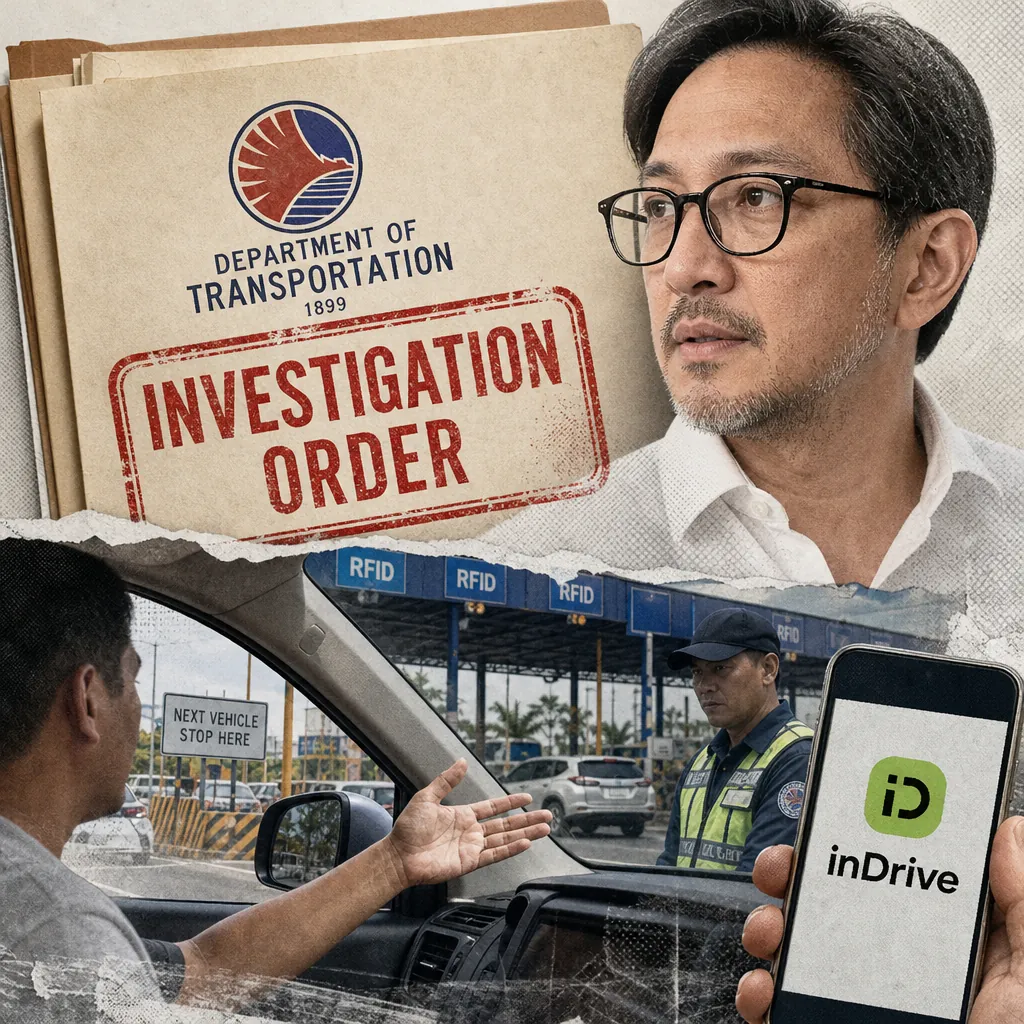
The Department of Transportation ordered an investigation into an inDrive driver whose argument with passengers over an unannounced tollway detour circulated on social media on Tuesday, Nov. 24, and the agency spent Wednesday, Nov. 25, answering for it alongside a broader reform push. Transportation Secretary Vince Dizon said he would ask the Land Transportation Franchising and Regulatory Board (LTFRB) and the Land Transportation Office (LTO) to look into the driver, who should be issued a show-cause order — a formal demand that a party explain its conduct or face sanctions 1. The dispute began when the vehicle passed through a toll road without telling the passengers first, adding a ₱39 toll fee to the trip; the argument escalated when the driver allegedly told them to get out 1.
The same day produced a dense run of transport policy news. Dizon met reporters with his newly appointed agency heads and set a supply-and-demand review of public transport ahead of the Christmas rush 54. The LTO promised to sustain reforms after the transport group Manibela warned that corruption could return following a leadership shakeup 27. A House of Representatives committee heard that a loophole in the law apparently let a Vietnamese firm operate a full electric-vehicle taxi fleet despite constitutional limits on foreign ownership 6. Lawmakers and the Department of Public Works and Highways (DPWH) put a number on the government's infrastructure spending push for the fourth quarter 40, and the Manila Times reported the department's plan to digitize frontline services to curb corruption 45.
The coverage in this set ran almost entirely through online news outlets, and the items carried substantial advertising-equivalent value — the estimated cost of buying the same space as paid advertising, not a count of readers. The House hearing report alone carried an estimated ₱937,440 in advertising-equivalent value 6, the Manibela story about ₱427,140 2, and the supply review about ₱311,472 5. Those figures describe the space the stories occupied, not how many people read them. The day's loudest public response, meanwhile, came from a single passenger complaint about a ₱39 toll — a reminder that in ride-hailing, the smallest fare line can travel further than any policy briefing.
Key themes
- A viral tollway argument put ride-hailing conduct under investigation. Dizon said the inDrive driver should be issued a show-cause order after a video showed him arguing with passengers over a toll route taken without their consent, which added ₱39 to the fare 1.
- The DOTr set a supply-and-demand review of public transport before the Christmas rush. Dizon planned to meet the LTO, the LTFRB, jeepney and bus cooperatives, motorcycle taxi operators and transport network vehicle services to check whether the number of rides matches commuter demand 5.
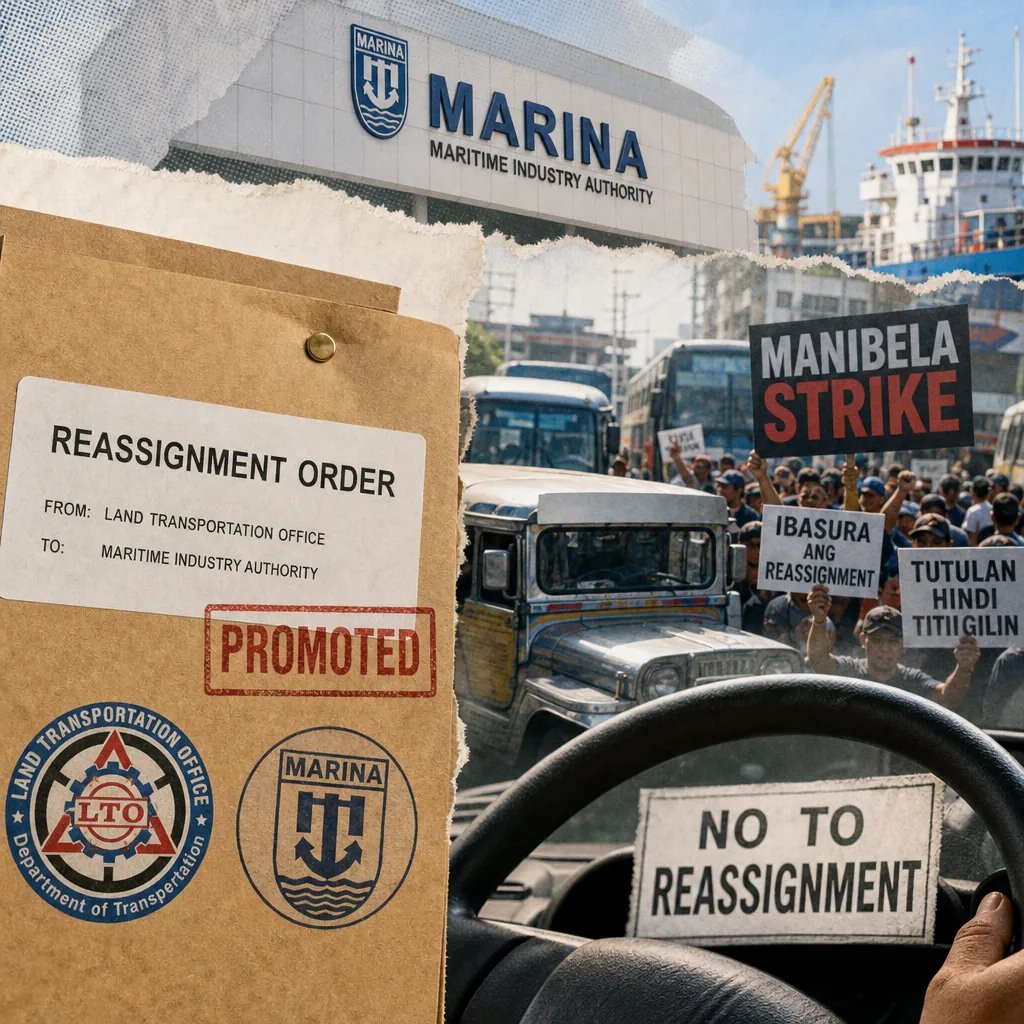
- The LTO's new leadership faced a corruption warning from Manibela. After former LTO chief Markus Lacanilao was moved to the Maritime Industry Authority (Marina), the transport group Manibela protested and its president, Mar Valbuena, condemned the “appointment of rotten individuals in the government” 27.
- A House hearing examined how a Vietnamese firm came to run an electric taxi fleet. The LTFRB and the Office of the Solicitor General told lawmakers a loophole apparently allowed the operation despite the constitutional 40 percent cap on foreign ownership in covered sectors 6.
- The DOTr committed to digitizing frontline services. Dizon directed agencies to simplify requirements and cut repeat trips for commuters, motorists and seafarers, framing the change as an anti-corruption measure 45.
- Infrastructure spending is running behind, with a fourth-quarter catch-up target. Dizon acknowledged underspending this year, attributing it to reforms after the flood-control corruption scandal, as the DPWH and DOTr targeted close to ₱200 billion in combined fourth-quarter disbursements 40.
- Road safety and enforcement drew attention outside the capital. The LTO in Western Visayas put 60 enforcers through a 13-day emergency response course and told them to measure success in lives saved rather than tickets issued 3335, while separate reports covered fatal road crashes in Ilocos Norte and Kidapawan 1929.
- Electric vehicle ambitions ran through the Philippines and the region. VinFast used its V-Creator summit to pitch cheaper EV ownership in the Philippines 20, while its parent Vingroup looked for land in India for housing and hotels 349, and MG Philippines reported a record October 46.
How the narratives stack
Dominant. The inDrive tollway dispute is the day's most consequential consumer story in this set. It is the only item that produced a direct enforcement order from the transport secretary, and it did so within a day of the video circulating 1. The story's power comes from its specificity: a ₱39 toll, a route taken without asking, and a passenger told to get out. For a riding public already sensitive to fare surprises, that is a compact grievance. The DOTr's response — routing the case to the LTFRB, which regulates ride-hailing franchises, and the LTO, which licenses drivers — signals that the department wants the incident treated as a conduct and franchise matter, not a one-off argument.
Counter-narrative. The Manibela protest and the LTO leadership change cut against the department's reform messaging. Manibela, a transport group that has repeatedly staged strikes against government transport policy, launched a transport strike and protests starting Monday, Nov. 23, including a march to the LTO main office to support Lacanilao 7. It called off the third day of protest on Wednesday because of bad weather, though the strike continued 7. Dizon's answer was that the LTO must prove the public wrong by sustaining reforms 2. The DOTr also kept free rides running in Metro Manila from 6 a.m. to 9 p.m. on routes including Quiapo–Cubao, Quiapo–Fairview and Taft–Alabang, a service it began on Monday when the strike started 63. The free rides are both a commuter relief measure and a signal that the government can absorb a strike's disruption.
Emerging. The foreign-ownership question at the House transportation committee is the most legally significant thread in the set. Lawmakers asked how a Vietnamese company was allowed to operate a taxi fleet of electric vehicles when the 1987 Constitution limits foreign ownership to 40 percent in specific sectors and reserves at least 60 percent for Filipinos 6. The LTFRB and the Office of the Solicitor General — the government's lawyer in court cases — acknowledged a loophole apparently permitted it 6. The committee was discussing amendments to Republic Act No. 11697, the Electric Vehicle Industry Development Act, the 2022 law that sets the country's EV policy framework and incentives 6. If the loophole is closed, the terms for foreign EV fleet operators change; if it is left open, the precedent widens.
Under-covered. Two stories in this set carry real safety weight but drew far less attention than the fare dispute. The first is road deaths: a 22-year-old and a 36-year-old rider died in separate motorcycle crashes in Ilocos Norte on Wednesday 19, and two people died in Kidapawan City when a speeding SUV hit a tricycle and a second vehicle struck the wreckage 29. The second is Senator Raffy Tulfo's push for mandatory comprehensive insurance on all government vehicles, filed as Senate Resolution No. 775, after complaints from victims of accidents involving uninsured or lapsed-coverage government vehicles, including a tricycle driver who lost six months of work after a barangay multicab with no insurance hit him 61. Both stories concern who pays when transport goes wrong, which is the same question the viral toll dispute raised, but neither generated the same public attention in this set.
Platform insights
- Facebook. The inDrive video spread here first, according to the Inquirer's account of a clip that “circulated on social media” on Tuesday 1. Facebook remains the main distribution channel for user-recorded disputes in the Philippines because clips can be shared into local groups and comment threads where riders swap similar experiences. The engagement pattern is argument-by-proxy: viewers relitigate the fare and the driver's tone in comments rather than organize around a demand.
- X. Transport policy announcements — the supply review, the LTO leadership change, the House hearing — are the kind of item that travels on X through news accounts and reporters' threads 526. The platform rewards the quote: Valbuena's “appointment of rotten individuals in the government” line is built for reposting 2. Expect the reform-versus-corruption framing to dominate there rather than the toll dispute itself.
- Reddit. The House hearing on foreign ownership of the EV taxi fleet is the thread most likely to draw sustained discussion on Philippine subreddits, where users tend to dig into the legal mechanics of the 40 percent foreign-ownership cap and the Electric Vehicle Industry Development Act 6. The tone is analytical rather than emotional, and the discussion tends to outlast the news cycle by a day or two.
- YouTube. Local news channels' uploads of the inDrive clip and the Dizon press conference carry the visual record 14. Comment sections on these uploads tend to focus on driver behavior and enforcement, and the format gives the story a second life after the initial Facebook share wave.
Key voices and communities
Ride-hailing passengers. The passengers in the inDrive video are the day's most effective communicators, though unintentionally. Their complaint — that the driver took a toll road without asking and added ₱39 — is a concrete, checkable grievance that any commuter can map onto their own experience 1. This group matters because ride-hailing users are the segment most likely to escalate a fare dispute into a public post, and their posts now set the DOTr's enforcement agenda.
Manibela and its president, Mar Valbuena. Manibela is a transport group that speaks for jeepney and other public utility vehicle operators and has a history of staging strikes against government transport policy. Valbuena's condemnation of the “appointment of rotten individuals in the government” framed the LTO leadership change as a corruption risk rather than a routine reshuffle 2. The group's ability to sustain a multi-day strike and draw free-ride countermeasures from the DOTr shows its continued leverage 63.
Transportation Secretary Vince Dizon. Dizon is the day's central official voice, appearing across the inDrive probe, the supply review, the LTO reform message, the digitization push and the infrastructure spending admission 1524540. His framing consistently pairs reform with accountability — “I'll be the first one to admit that, yes, there is underspending this year. But the major issue there is not because we want underspending. It's because we have to make sure that the money goes where it's supposed to go” 40.
Lawmakers on the House transportation committee. Quezon Rep. Reynante Arrogancia and colleagues pressed the LTFRB and the Office of the Solicitor General on the foreign-owned EV taxi fleet 6. Their questions turn a franchise dispute into a constitutional one, and their interest in amending the Electric Vehicle Industry Development Act gives the issue a legislative track.
LTO enforcers and regional offices. The Western Visayas LTO's 60 graduates of a 13-day emergency response program, and regional director Atty. Gaudioso P. Geduspan II's instruction that enforcers measure success in lives saved, represent a quieter but durable voice in the conversation 3335. The Panay News editorial backing the shift — “Lives saved, not tickets issued” — shows local media amplifying the message 35.
Narrative streams
A ₱39 toll detour became a national conduct case
The inDrive incident is small in money and large in signal. A driver took a toll road without informing his passengers, adding ₱39 to the trip, and the argument that followed was recorded and posted on Tuesday, Nov. 24 1. Dizon's response was procedural: ask the LTFRB and the LTO to investigate and issue a show-cause order, and restate that transport network vehicle service drivers are responsible for their passengers' safety, comfort and convenience 1. The LTFRB handles franchises and fares for ride-hailing services; the LTO handles driver licensing and vehicle registration. Routing the case to both means the driver could face franchise-level and licensing-level consequences, not just a scolding.
The read for the sector is that ride-hailing platforms now carry conduct risk that surfaces publicly within hours. A single driver's decision about a toll gate becomes a test of whether the platform's in-app fare estimate and route disclosure are adequate. Platforms that can show passengers the toll before the vehicle enters it — and that give riders a one-tap way to dispute a route change — reduce the chance that their brand appears in the next viral clip. The Inquirer report carried an estimated ₱256,284 in advertising-equivalent value, a measure of the space the story occupied rather than its audience 1.
The DOTr's reform agenda meets a strike and a corruption warning
Dizon used a Wednesday press conference to set the tempo for the remaining 18 months of the Marcos administration, telling his newly appointed officials that “there are many things that need to be done, and our time is very limited” 4. The new lineup includes Lacanilao at Marina, Noreen Bernadette San Luis at the LTO, and Jorjette Aquino as Philippine National Railways general manager 4. Dizon named the maritime sector a top priority, citing seafarers' difficulty securing documents and identification cards and recent ship accidents that raised vessel-safety concerns 4.
The reform message ran into Manibela's protest. The group had opposed Lacanilao's transfer and launched a strike and protests from Monday, Nov. 23, including a march to the LTO main office 7. Dizon's reply — that the LTO must prove the public wrong by sustaining reforms — accepts the premise that public trust is the test 2. The DOTr's free rides, running from 6 a.m. to 9 p.m. on five Metro Manila routes, kept commuters moving while the strike continued 63. The read for the sector is that the department's credibility now rests on visible service improvements — shorter queues, fewer repeat trips, cleaner transactions — because the corruption argument has been made publicly and cannot be answered with statements alone. The Manibela coverage carried an estimated ₱427,140 in advertising-equivalent value 2.
A House hearing tested the foreign-ownership limits on an EV taxi fleet
At the House committee on transportation hearing on Wednesday, lawmakers asked how a Vietnamese firm was allowed to operate a taxi fleet of electric vehicles when the 1987 Constitution limits foreign ownership to 40 percent in specific sectors and reserves at least 60 percent for Filipinos 6. LTFRB Acting Chairperson Greg Pua Jr. and the Office of the Solicitor General pointed to a loophole in the law 6. The committee was discussing proposed amendments to the Electric Vehicle Industry Development Act, the 2022 law that created the country's EV policy framework, including incentives for EV adoption and fleet electrification 6.
The read for the sector is that the legal basis for foreign-operated EV fleets is now in play. Operators that built a Philippine business on the current reading of the rules face the possibility that Congress narrows it; local franchise holders who argued they were disadvantaged gain a forum. The hearing report carried an estimated ₱937,440 in advertising-equivalent value, the highest in this set, reflecting the story's length and placement rather than its readership 6.
Supply, demand and the Christmas rush
Dizon plans to convene the LTO, the LTFRB, public utility vehicle cooperatives, operators, bus companies, motorcycle taxi operators and transport network vehicle services to compare the number of available rides against commuter demand before the Christmas rush 5. His framing was direct: “And we have to discuss supply and demand. How many people need transportation now? How much supply do we currently have across the board, from buses, public utility jeepneys (PUJs), public utilit[y vehicles]” 5. The review matters because December is the year's heaviest travel period in the Philippines, and a shortfall in authorized rides shows up as long queues and higher informal fares.
The read for the sector is that franchise decisions for the holiday period will be made on a supply count, which gives operators a reason to document their available units and gives commuter groups a number to challenge. The supply review item carried an estimated ₱311,472 in advertising-equivalent value 5.
Digitization as an anti-corruption tool
The DOTr will push to digitize frontline services and simplify transactions to eliminate unnecessary requirements and reduce opportunities for corruption, Dizon said Wednesday 45. The directive covers application and renewal procedures, documentary requirements, and the validity of permits and other documents, with the aim of sparing commuters, motorists and seafarers repeated trips to government offices 45. The Manila Times report carried an estimated ₱346,692 in advertising-equivalent value 45.
The read for the sector is that the agencies' back-office systems become the front line of the corruption fight. If licensing and registration can be completed online, the intermediary who “fixes” a transaction loses his role. The test will be whether the digitized steps actually reduce the number of office visits, which is a measurable outcome the department has now invited the public to check.
Infrastructure spending plays catch-up after the flood-control scandal
The DPWH and the DOTr are targeting close to ₱200 billion in combined disbursements in the fourth quarter of 2026, as the government seeks to boost growth through faster infrastructure spending 40. Dizon acknowledged that spending slowed this year because the government prioritized holding people accountable in the flood-control corruption scandal and introducing reforms to prevent similar abuses 40. The flood-control scandal refers to the controversy over allegedly ghost and overpriced flood-control projects that became a political flashpoint in 2025; the House has since approved House Bill 11602, which seeks a unified flood control and drainage master plan for Metro Manila to shield restored funding from ghost projects and overpricing 51.
The read for the sector is that construction and transport contractors face a tighter approval environment in the short term and a larger disbursement pipeline in the fourth quarter. Firms that can document milestones and costs cleanly will be positioned to absorb the catch-up spending; those that relied on loose documentation will find the approvals slower. The disbursement story carried an estimated ₱288,915 in advertising-equivalent value 40, and the House master-plan story about ₱358,956 51.
Road safety enforcement shifts its measure of success
Sixty LTO personnel from four regional offices and the central office completed a 13-day Specialized Law Enforcement and Emergency Response Capability Enhancement Program on Nov. 21, and Western Visayas director Atty. Gaudioso P. Geduspan II told them that “the value of training is not measured by the skills we demonstrate inside the training ground, but by the lives we protect, the emergencies we respond to, and the difference we make when our services are needed most” 33. A Panay News editorial endorsed the shift, arguing that enforcement effectiveness should be measured by accidents prevented and lives saved rather than tickets issued and fines collected 35.
The same day brought reminders of the stakes: two riders, aged 22 and 36, died in separate crashes in Ilocos Norte 19, and two people died in Kidapawan City when a speeding SUV hit a tricycle and a second vehicle struck the wreckage 29. Senator Tulfo's Senate Resolution No. 775, meanwhile, pushes mandatory comprehensive insurance for all government vehicles after complaints that victims of accidents involving uninsured government vehicles could not collect damages 61. The read for the sector is that enforcement agencies are being pushed to demonstrate outcomes — fewer crashes, faster response, compensation for victims — and that local government units, which own many of the vehicles at issue, face a new insurance cost if the resolution advances.
Electric vehicle ambitions cross borders
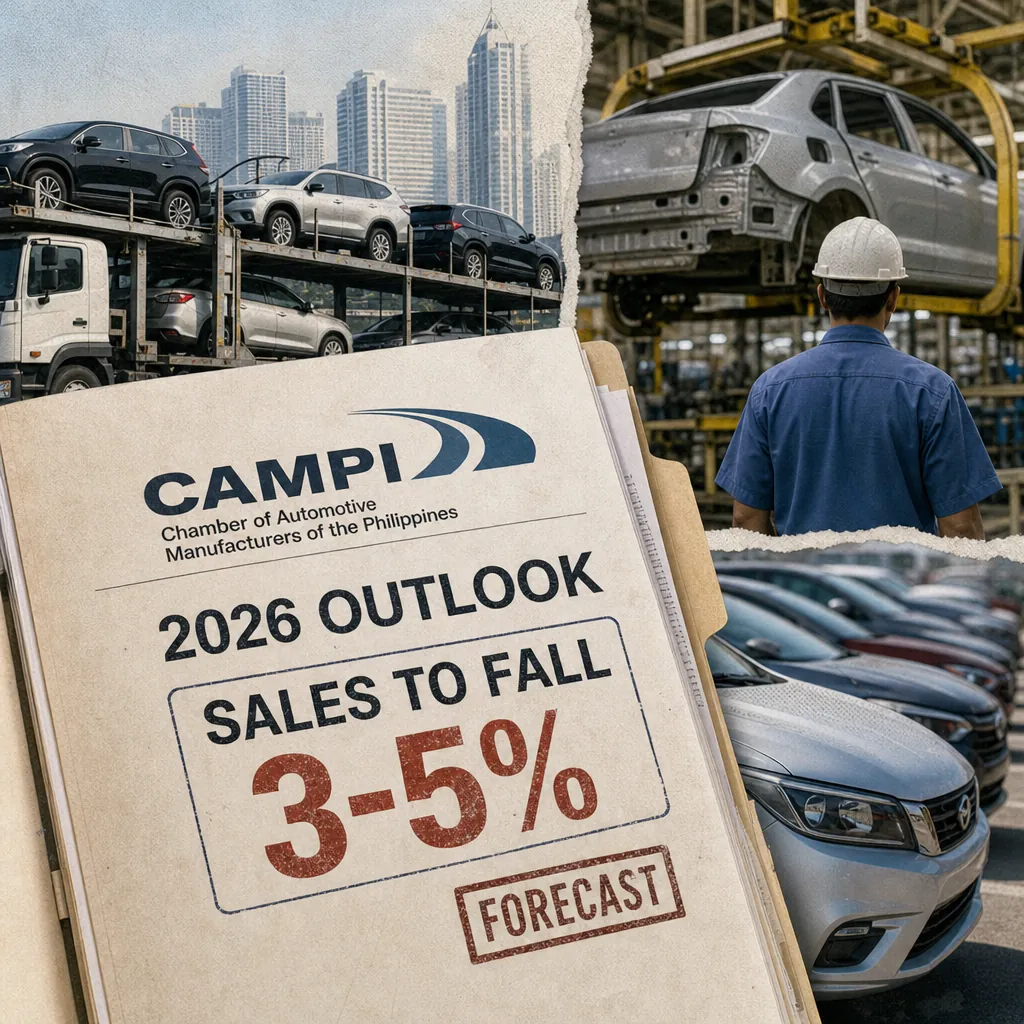
VinFast used its V-Creator All Star Summit 2026 to argue that EV ownership can be made more accessible in the Philippines, with Ateneo de Manila University economics professor Alvin Ang discussing the hidden costs of car ownership at a breakout session 20. The Philippine angle sits inside a larger corporate push: Vingroup, VinFast's parent, is negotiating with Indian state governments for land for housing, hotels and other real estate, according to VinFast Asia chief executive Tapan Ghosh, speaking at the same summit 349. Vingroup is also interested in opportunities in the Philippines and Indonesia 49. In the local market, MG Philippines reported a record 1,018 units sold in October, led by the G50 multi-purpose vehicle with 354 units, placing it sixth in the industry for the month based on Chamber of Automotive Manufacturers of the Philippines Inc. member reports 46.
The read for the sector is that EV competition in the Philippines is arriving through fleet and affordability arguments rather than luxury positioning. The foreign-ownership hearing and the EV adoption push are two sides of the same policy question: how much foreign capital the country wants in its electric transport fleet, and on what terms 620.
Conversation trajectory
The inDrive case moves to the LTFRB and LTO within one to two weeks. A show-cause order requires a response, and the agencies' findings will set a precedent for how toll-route disputes are handled. Watch for whether the LTFRB suspends or revokes the driver's franchise and whether inDrive announces a route-disclosure or toll-consent feature. The trigger is the agencies' public statement on the case.
The Manibela strike and the LTO leadership question run through the oath-taking and the holiday period. The new officials are scheduled to take their oaths before President Ferdinand Marcos Jr., and Manibela has shown it can sustain a strike for multiple days 457. Watch for whether the group resumes protests after the weather clears and whether the DOTr's free rides continue. The trigger is the next Manibela announcement or a new LTO directive.
The House committee's EV amendments move to the next legislative stage over the coming months. The committee discussed amendments to the Electric Vehicle Industry Development Act, and the foreign-ownership loophole is now on the record 6. Watch for a committee report or a substitute bill, and for any LTFRB action on the Vietnamese firm's franchise in the meantime.
The fourth-quarter disbursement target gets tested at the December spending reports. The DPWH and DOTr target close to ₱200 billion in combined fourth-quarter disbursements 40. Watch the agencies' November and December disbursement figures against that target; a shortfall would undercut the catch-up narrative.
The Christmas transport supply review produces decisions before mid-December. Dizon's meetings with operators and agencies will determine whether additional franchises or special permits are issued for the holiday period 5. Watch for LTFRB resolutions on holiday routes and for any announcement of additional bus or jeepney capacity.
Senate Resolution No. 775 and the government-vehicle insurance question advance or stall in the Senate. The resolution calls for mandatory comprehensive insurance on all government vehicles 61. Watch for a committee hearing or a bill filing; local government units would bear the cost if it moves.
Response guidance
Ride-hailing platforms: disclose tolls before the gate. Add a pre-trip confirmation for any route that includes a toll, showing the amount, and give riders a one-tap dispute path. The inDrive case shows that a ₱39 charge can become a national story when the passenger learns about it after the fact 1.
Ride-hailing platforms: prepare a conduct-response protocol. When a driver dispute goes viral, the platform's public response should state what it is doing — reviewing the trip, cooperating with the LTFRB and LTO, contacting the passenger — within the first day. Silence lets the government's version of events become the only version.
Transport operators: document capacity ahead of the supply review. The DOTr's review will compare available rides against demand 5. Operators who can present unit counts, route coverage and readiness for holiday demand will have a stronger hand in franchise discussions.
Agencies and local government units: treat digitization as a public commitment with a deadline. The DOTr's digitization push is framed as anti-corruption 45. Publishing the number of office visits each transaction requires, before and after the change, gives the public a way to verify the claim.
Government vehicle owners: audit insurance coverage now. Senate Resolution No. 775 targets uninsured and lapsed-coverage government vehicles 61. Barangays and local government units should confirm that every vehicle in their fleet carries current comprehensive coverage before a crash makes the gap public.
Communicators across the sector: separate the fare story from the reform story. The viral toll dispute and the policy agenda are different conversations with different audiences. Responding to the fare complaint with reform talking points reads as evasion; responding to the reform question with fare anecdotes reads as anecdote. Keep the messages on their own tracks.
All transport communicators: avoid amplifying unverified clips. The inDrive video is described as showing an argument, and the investigation is ongoing 1. Sharing or commenting on the clip before the agencies issue findings risks prejudging a case that could end in a license or franchise decision.
See the full picture behind today's signals.
This report draws from Media Meter's MediaWatch, our real-time monitoring engine tracking 2,470+ Philippine sources across print, broadcast, digital, and social. Explore how the platform turns raw coverage into decision-grade intelligence, then see how it's configured for teams like yours — whether you're in PR agencies, corporate comms, government, or marketing.
Want more? Browse our Report Library for sector and crisis intelligence, or request a demo and we'll have your brand set up before the call.
Want this kind of intelligence on your brand?
This brief is built on the same MediaWatch methodology that runs continuously across every brand we monitor. See your competitive landscape, Impact Score, and narrative trajectory in a 30-minute demo.