Monsoon chaos and road safety dominate PH transport talk
A snapshot of the day's conversation on Philippine transport, covering repeated number coding suspensions due to monsoon rains, road accidents, micromobility safety concerns, and industry investments.
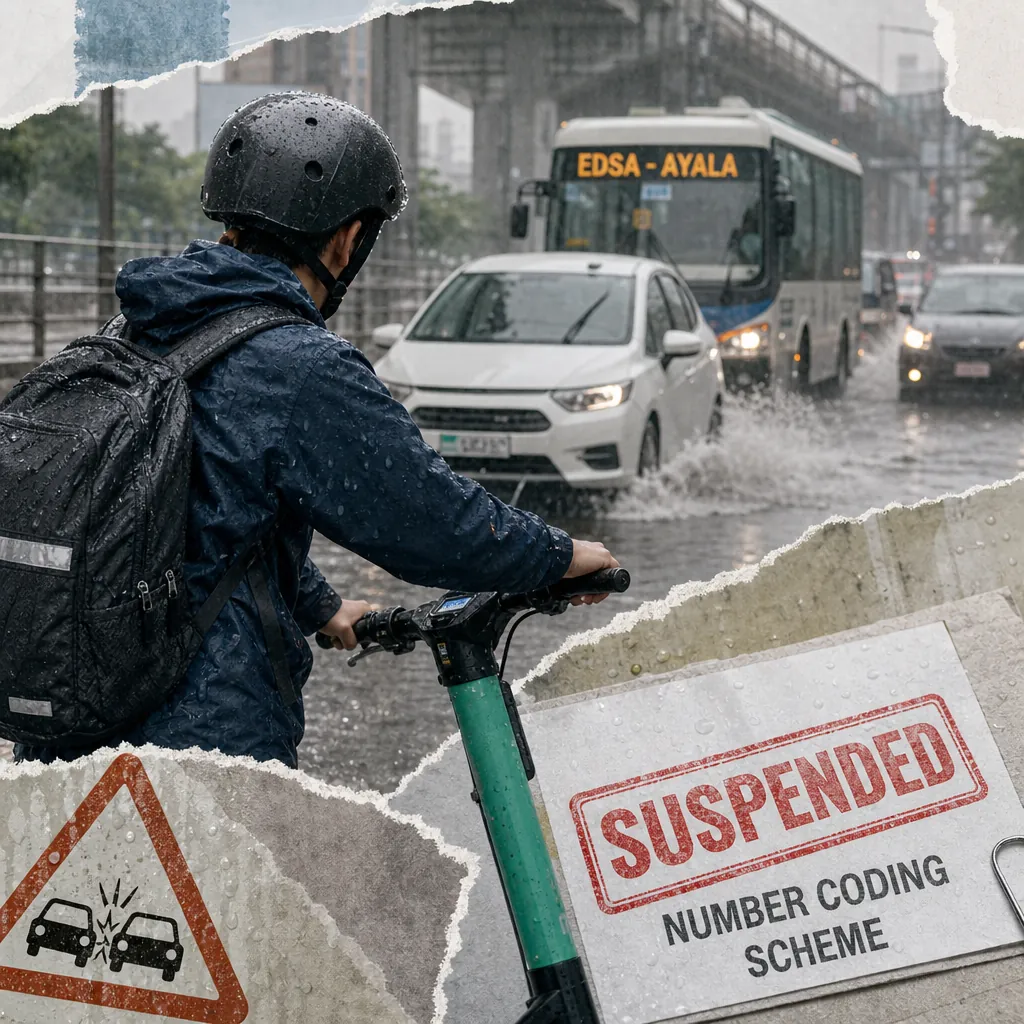
The day's conversation on Philippine roads and transport was shaped by two forces pulling in opposite directions: the weather and the wheels. On one hand, the southwest monsoon—locally known as the habagat—kept disrupting daily commutes, with the Metropolitan Manila Development Authority (MMDA) suspending the expanded number coding scheme for the afternoon of August 13, the fourth such suspension in nine days. On the other, a series of road accidents, from a tricycle crash in Capiz to a jeepney plowing into motorcycles in Cebu City, shifted public attention toward driver behavior and enforcement. Meanwhile, the automotive industry itself was busy laying down markers for the future, with Mitsubishi announcing new investments, Suzuki relaunching a dealership, and VinFast hinting at a new electric model for the Philippine market.
The MMDA's announcement, posted on Facebook at 3:52 p.m., was the day's most concrete piece of transport news. It read: "MMDA reminder: plan your trip, drive carefully, and stay tuned for important information regarding weather conditions." The advisory was picked up by major news outlets within minutes, including the Philippine Daily Inquirer, GMA News, and the Integrated State Media, and amplified on Twitter by personalities like @andronquillo, whose post drew nearly 25,000 views. The public response was pragmatic—no outrage, just a quiet acceptance that the coding scheme, which restricts vehicles by license plate number during rush hours to ease traffic, would be lifted whenever the weather turned severe. This was the fourth suspension in nine days, following similar announcements on August 5, 6, and 10, each triggered by the same monsoon system that has been dumping rain across Luzon.
The weather's toll extended beyond traffic. The Office of Civil Defense and the National Disaster Risk Reduction and Management Council reported that the combined effects of tropical cyclones "Luis" and "Maymay" and the enhanced southwest monsoon had caused P2.6 billion in infrastructure damage and P689 million in agricultural losses, affecting nearly 3.7 million people across ten regions. The Philippine National Police announced a zero-tolerance policy against price gouging and hoarding of agricultural products, a move that resonated with a public already feeling the pinch of higher fuel prices.
But the day's conversation was not solely about the weather. A series of road accidents, reported by regional news networks, brought road safety to the forefront. In Capiz, an SUV rear-ended a tricycle carrying four passengers, including a four-year-old child, and then two more vehicles struck the tricycle. The driver of the first SUV claimed, "hindi umano niya napansin na may tricycle sa kaniyang harapan" (he allegedly did not notice the tricycle in front of him). In Cebu City, a jeepney lost its brakes and plowed into five motorcycle riders, one of whom ended up underneath the vehicle. The Land Transportation Office (LTO) in Region 7 responded swiftly, suspending the jeepney driver's license for 90 days and issuing a show cause order. These incidents, captured on video and shared widely on YouTube and Facebook, fueled calls for stricter enforcement and driver education.
Amidst the chaos, the automotive industry was quietly building for the future. Mitsubishi Motors Philippines Corporation (MMPC) announced a P7-billion investment, participation in the government's Electric Vehicle Incentive Strategy (EVIS), and plans to add hybrid electric vehicle (HEV) production to its local manufacturing portfolio. Suzuki Philippines relaunched its upgraded 3S (sales, service, and spare parts) facility in Iloilo City, preparing for its growing electrified lineup, including the Suzuki e Vitara. VinFast Philippines appeared to be adding the VF 8, an all-electric crossover, to its local lineup, as the model turned up on the Department of Energy's list of approved electric vehicles. And Toyota Motor Philippines concluded its Toyota Legacy Experience, showcasing both historic and new versions of the Hilux and Land Cruiser, with the next-generation Hilux available in diesel and battery electric variants.
These industry moves, while not directly tied to the day's weather-related disruptions, signal a sector that is investing heavily in electrification and modernization, even as it navigates the immediate challenges of monsoon season and road safety concerns.
Key themes
- Monsoon-driven coding suspensions disrupt commutes: The MMDA suspended the expanded number coding scheme for the fourth time in nine days, citing heavy rains from the southwest monsoon. The repeated suspensions have become a predictable part of the rainy season, with the public relying on official announcements to plan their days.
- Road accidents highlight vulnerable road users: A tricycle crash in Capiz and a jeepney-motorcycle collision in Cebu City drew significant attention, with the latter leading to a 90-day license suspension for the driver. These incidents underscore the dangers faced by motorcyclists, tricycle passengers, and pedestrians, especially during adverse weather.
- Micromobility safety concerns from abroad resonate locally: International reports of e-scooter and e-bike fatalities, including Canadian data showing 10 child deaths in 2025, sparked debate about helmet laws and minimum age requirements. While these incidents occurred in North America, they carry lessons for the Philippines as e-bikes and e-scooters grow in popularity.
- Automotive industry invests in electrification and expansion: Mitsubishi announced a P7-billion investment and plans for hybrid production, Suzuki relaunched an upgraded dealership, and VinFast hinted at a new electric model. These moves reflect a long-term commitment to the Philippine market and the shift toward electric vehicles.
- Government pushes transport infrastructure and modernization: President Marcos ordered the fast-tracking of the Sangley Point International Airport project, and the DOTr partnered with the UK and DepEd on transit-oriented development. These initiatives aim to improve connectivity and decongest Metro Manila.
- Fuel subsidies and PUV modernization tensions persist: The LTFRB announced a P12-per-liter fuel discount for public utility vehicles starting August 15, while also addressing loan foreclosure threats for Bacolod jeepney operators. These measures highlight the ongoing challenges of the Public Transport Modernization Program.
- Enforcement and accountability dominate regional news: The LTO's swift action in Cebu, including license suspensions and show cause orders, was widely covered. A viral video of LTO-7 officers allegedly harassing a farmer-motorcyclist in Bohol drew significant engagement, raising questions about enforcement fairness.
- Weather damage and disaster response shape public discourse: The P2.6-billion infrastructure damage and P689-million agricultural losses from the recent weather disturbances were major news, with the PNP vowing to prevent price gouging. This narrative connects weather events to broader economic and social concerns.
How the narratives stack
Dominant: The dominant narrative in the captured set is the weather-driven disruption of daily mobility, specifically the repeated suspension of the number coding scheme. This story dominated both social media and news coverage, with the MMDA's announcements generating consistent, high-visibility engagement. The public response was largely informational—people wanted to know if they could drive, and they appreciated the timely advisories. This narrative is dominant within the captured set, which includes multiple posts and articles about the suspensions, but it is also a reflection of the real-world impact of the monsoon on Metro Manila commuters.
Counter-narrative: A counter-narrative emerged around road safety and enforcement, particularly the Cebu jeepney incident and the LTO's response. While the coding suspensions were about managing traffic, the accidents highlighted the human cost of unsafe driving. The LTO's swift action—suspending the driver's license and issuing a show cause order—was framed as a positive step, but it also raised questions about whether enforcement is consistent and fair, especially in light of the viral LTO-7 harassment video.
Emerging: The micromobility safety conversation, driven by international reports of e-scooter and e-bike fatalities, is an emerging narrative with local relevance. As the Philippines promotes electric vehicles and active mobility, the safety concerns raised in North America could easily migrate to local discussions. The emotional weight of these stories—particularly those involving children—makes them highly shareable and likely to persist in the conversation.
Suppressed: A story that received relatively little attention in the captured set is the broader context of the Public Transport Modernization Program (PTMP). While the LTFRB's fuel subsidy and loan relief efforts were covered, the program's long-term challenges—such as the consolidation of jeepney operators and the transition to modern vehicles—were not deeply explored. This is a significant under-covered story because it affects the livelihoods of thousands of transport workers and the daily commute of millions of Filipinos.
Platform insights
- Twitter/X: Twitter functioned as the primary alert system for coding suspensions and breaking news. Official MMDA advisories and news breakers posted rapid updates that reached users within minutes. The highest-engagement post, from @andronquillo, drew nearly 25,000 views, demonstrating the platform's role in real-time information dissemination. The platform also carried the Canadian e-scooter child death data, which drew 16,600 views, showing that even international stories can gain traction.
- Facebook: Facebook was the space for deeper engagement and sentiment, particularly around accident stories and the pediatric e-scooter data. Reaction buttons—especially Sad and Angry—provided a visible gauge of public emotion. The Canadian e-scooter post, for example, accumulated 94 likes, 166 shares, and 104 comments, with users debating helmet laws and minimum age requirements. The LTO-7 harassment video also drew significant engagement, with 267 likes, 151 shares, and 50 comments, reflecting the emotional resonance of perceived injustice.
- YouTube: YouTube served a documentary function, carrying longer-form news segments from GMA News and CP24. The Cebu jeepney accident video drew 2,125 views, with GMA News labeling the content as sensitive and urging decorum in comments. The platform's comment sections require careful moderation, especially for graphic content, but they also provide a space for more nuanced discussion.
Key voices and communities
- Metro Manila commuters and motorists: This is the most active stakeholder group, primarily engaging through Twitter and major broadcast media accounts. Their attention is driven by real-time traffic policy announcements, and they are highly responsive to official advisories. Their engagement pattern is transactional—they seek clarity on travel restrictions and value timely, authoritative communication.
- Regional news networks and provincial media: GMA Regional TV and other regional outlets play a crucial role in amplifying local transport incidents. Their coverage of the Capiz tricycle crash and the Cebu jeepney collision brought these stories to national attention. They also document enforcement actions, creating a narrative arc from incident to accountability.
- Urban safety and micromobility advocates: This group, though focused on North American incidents, signals safety narratives that could migrate to Philippine EV discussions. Their content emphasizes the surge in hospitalizations and injuries accompanying e-scooter adoption, implicitly calling for stronger regulation and helmet enforcement.
- Transport enforcement agencies and government communicators: The MMDA and LTO are the primary sources of authoritative information. Their announcements are systematically picked up by major outlets within minutes, and their crisis communication during the monsoon has been effective, with no significant backlash. The LTO-7's decisive response to the Cebu incident reinforces a zero-tolerance stance toward unsafe driving.
- Motorcycle community and rider communities: This group is reactive, engaging with news about rider safety and legal consequences. The viral LTO-7 harassment video from Bohol drew significant engagement, highlighting their sensitivity to perceived injustice. Their responses to reckless riding stunts, such as the "Superman" maneuver, tend to support strict enforcement, showing a nuanced stance.
Narrative streams
The monsoon and the coding scheme: a recurring dance
The southwest monsoon, or habagat, has been a persistent presence in the Philippines this August, and its impact on Metro Manila's traffic scheme has been profound. The MMDA's expanded number coding scheme, which restricts vehicles based on the last digit of their license plates during rush hours (7 AM to 8 PM) to reduce traffic congestion, has been suspended four times in nine days: August 5, 6, 10, and 13. Each suspension was announced via social media and quickly amplified by news outlets, creating a predictable pattern of communication.
The August 13 suspension, announced at 3:52 PM, was particularly notable because it came on a day when Malacañang had already suspended government work and classes in 12 areas due to the weather. The MMDA's advisory, posted on Facebook, reminded motorists to "plan your trip, drive carefully, and stay tuned for important information regarding weather conditions." The agency also encouraged motorists to reach out via Facebook or hotline 136 for flood monitoring.
The public response has been largely pragmatic. There is no significant criticism of the MMDA's decisions; instead, commuters appreciate the timely advisories that allow them to adjust their plans. This suggests that the MMDA has successfully managed crisis communications during weather events, a model that other agencies and brands could emulate.
For the automotive industry, the repeated suspensions have indirect implications. They signal that monsoon season creates sustained operational unpredictability for fleets, logistics providers, and commuters, which may influence vehicle purchasing patterns toward more weather-resilient models, including those with better flood tolerance. Yet, no brand has publicly capitalized on this narrative, leaving a gap in reputation-building content.
Road safety: from incident to accountability
The day's most significant road safety story was the Cebu City jeepney accident, where a jeepney lost its brakes and plowed into five motorcycle riders, one of whom was trapped underneath the vehicle. The incident was captured on video and shared widely on YouTube, drawing 2,125 views. GMA News labeled the content as sensitive and urged decorum in comments.
The Land Transportation Office (LTO) in Region 7 responded swiftly, suspending the jeepney driver's license for 90 days and issuing a show cause order. This enforcement action was reported in Cebuano-language posts across multiple Facebook pages, with one post stating, "walay lugar sa kadalanan ang kadtong mga reckless drivers" (there is no place on the road for reckless drivers). The LTO-7's decisive response was widely praised, reinforcing a zero-tolerance stance toward unsafe driving.
However, the conversation also highlighted the human cost of such accidents. In Capiz, an SUV rear-ended a tricycle carrying four passengers, including a four-year-old child, and then two more vehicles struck the tricycle. The driver of the first SUV claimed he did not notice the tricycle in front of him, a statement that drew criticism and raised questions about driver attentiveness during adverse weather.
These incidents, while tragic, present an opportunity for the automotive industry to reinforce safety messaging. Brands could proactively highlight safety features and driver training programs, aligning with the regulatory narrative of accountability. However, they must avoid appearing to exploit tragedies for commercial gain; a general road safety reminder is safer than referencing specific incidents.
Micromobility: a global cautionary tale
International reports of e-scooter and e-bike fatalities have been circulating in the Philippine conversation, and while they are geographically distant, they resonate with local two-wheeled transport realities. On August 12-13, multiple posts detailed fatal e-scooter accidents in Seattle and San Francisco, one involving a 32-year-old woman identified as Yebin Kim. Facebook posts accumulated 68 "Sad" reactions, reflecting the emotional weight of these stories.
The narrative deepened on August 13 with Canadian data showing 10 child deaths from e-scooter injuries in 2025. The story drew 16,600 views on Twitter and 104 comments on Facebook, where @TorontoSafetyAdvocate's detailed breakdown of the pediatric data sparked debate about helmet laws and minimum age requirements. The Canadian Paediatric Surveillance Program data served as a rallying point, with a comprehensive Facebook post detailing child fatalities, ICU admissions, and head injury cases attracting 94 likes, 166 shares, and 104 comments. The post explicitly questioned whether high-speed electric vehicles are being "treated like toys," illustrating the advocacy edge within this community.
For the Philippines, this conversation is a forward-looking caution. As e-bikes and e-scooters grow in Metro Manila, and as the government promotes electric vehicles through incentives like zero tariffs, stakeholders must anticipate regulatory attention to micro-mobility safety standards. The "children under 16, head injuries, and high-speed devices" framing could easily be adopted by local advocacy groups, making it essential for brands to prepare fact-based rebuttals or safety education content before incidents occur locally.
Industry investments: building for the future
Amidst the weather and safety concerns, the automotive industry was making headlines with significant investments. Mitsubishi Motors Philippines Corporation (MMPC) announced a P7-billion investment, participation in the government's Electric Vehicle Incentive Strategy (EVIS), and plans to add hybrid electric vehicle (HEV) production to its local manufacturing portfolio. MMPC Chairman Noriaki Hirakata said, "MMPC has always taken a long-term view of the Philippines. We see significant opportunities to strengthen local manufacturing, introduce new technologies, and help shape the next chapter of the country's automotive industry."
Suzuki Philippines relaunched its upgraded 3S facility in Iloilo City, with a showroom that can accommodate five vehicle display units and a service facility with six bays. The dealership is being prepared for Suzuki's growing electrified lineup, including the Suzuki e Vitara, its all-electric SUV.
VinFast Philippines appears to be adding the VF 8, an all-electric crossover, to its local lineup. The model has turned up on the Department of Energy's list of approved electric vehicles, hinting at its possible entry into the local new-energy vehicle segment. The VF 8 is equipped with a front-axle electric motor delivering 227 horsepower and 330 Nm of torque, powered by a 60.13 kWh battery.
These investments reflect a broader trend toward electrification and modernization in the Philippine automotive sector. They also align with the government's push for electric vehicles, as outlined in the Electric Vehicle Incentive Strategy (EVIS), which aims to accelerate the adoption of EVs through fiscal and non-fiscal incentives.
Government infrastructure and modernization
President Ferdinand Marcos Jr. issued Administrative Order No. 44, directing key government agencies to fast-track the development of the Sangley Point International Airport (SPIA) in Cavite. The order created a Joint Technical Working Group, co-chaired by the Department of Transportation (DOTr) and the Philippine Reclamation Authority (PRA), to address issues that could delay the project. The SPIA aims to decongest Ninoy Aquino International Airport and establish a key international aviation gateway.
The DOTr also partnered with the Department of Education (DepEd) and the British Embassy in Manila to advance sustainable urban development. The partnership follows the completion of a feasibility study for the proposed Senate-DepEd Transit-Oriented Development (SEED TOD) Project, a 13-hectare complex in Taguig City at the junction of the North-South Commuter Railway and the Metro Manila Subway Project. The project aims to integrate public transport with commercial and residential development, creating a more efficient and accessible system.
These initiatives are part of a broader push to modernize the country's transport infrastructure, but they also face challenges. The Public Transport Modernization Program (PTMP), which aims to replace old jeepneys with modern, safer, and more environmentally friendly vehicles, continues to generate friction. The LTFRB announced a P12-per-liter fuel discount for public utility vehicles starting August 15, a P2 increase from the current P10 subsidy, to help operators cope with high fuel prices. The agency also assured Bacolod jeepney operators of financial relief amid loan foreclosure threats, with Chairman Vigor Mendoza II reaching an agreement with financing institutions to adopt a "no touch" policy on units with moderately overdue payments.
Conversation trajectory
- Weather-driven transport disruption will continue: The southwest monsoon is expected to persist through September, meaning more coding suspensions are likely. This will keep weather-transport policy in the news cycle and create recurring opportunities for brands to align with mobility assistance messaging. Observation window: next 30 days.
- Enforcement and accountability discourse will intensify: The LTO's swift action in Cebu has set a precedent, and public pressure for consistent enforcement is likely to grow. Expect more coverage of reckless driving incidents and regulatory responses, particularly for commercial vehicle operators. Observation window: next 2-3 weeks.
- Micromobility safety will become a local issue: As e-bikes and e-scooters gain popularity, the international safety data could seed local discussions about regulation and helmet enforcement. Brands in the micromobility space should prepare fact-based responses to potential advocacy. Observation window: next 1-2 weeks.
- PUV modernization tensions will resurface: The LTFRB's fuel subsidy and loan relief efforts are temporary measures. As compliance deadlines approach, transport groups may challenge extension policies, leading to protests and coverage. This could impact commercial vehicle sales forecasts. Observation window: next month.
Trigger events to watch: Additional coding suspensions as the monsoon continues; the regulatory decision on the Cebu jeepney driver's license revocation; any formal LTFRB announcement on the next phase of PUV consolidation enforcement.
Response guidance
For automotive and transport stakeholders, the key is to stay agile and empathetic. During coding suspensions, brands can offer practical value by sharing real-time traffic updates and safety reminders, supplementing rather than competing with MMDA messaging. This builds goodwill and positions brands as helpful utilities.
On road safety, avoid commenting on specific incidents to prevent appearing to exploit tragedies. Instead, focus on general safety messages that reinforce the importance of caution during inclement weather. Align with regulatory messaging by supporting strict enforcement of reckless driving rules.
For micromobility, prepare a data-driven response framework that acknowledges public concern while emphasizing responsible use, helmet compliance, and alignment with local traffic laws. Avoid statistical comparisons that could be taken out of context.
Finally, monitor the LTFRB provisional authority conversation as a potential business development angle for fleet management clients. The repeated questions and tutorials circulating about legitimate compliance procedures indicate a need for clear, authoritative guidance.
See the full picture behind today's signals.
This report draws from Media Meter's MediaWatch, our real-time monitoring engine tracking 2,470+ Philippine sources across print, broadcast, digital, and social. Explore how the platform turns raw coverage into decision-grade intelligence, then see how it's configured for teams like yours — whether you're in PR agencies, corporate comms, government, or marketing.
Want more? Browse our Report Library for sector and crisis intelligence, or request a demo and we'll have your brand set up before the call.
Want this kind of intelligence on your brand?
This brief is built on the same MediaWatch methodology that runs continuously across every brand we monitor. See your competitive landscape, Impact Score, and narrative trajectory in a 30-minute demo.