Fake Cavite Campus Shooting Spurs PNP Probe
The Philippine National Police investigates the source of a fabricated mass-shooting report at a Cavite university that spread through social media and group chats. The day's other coverage spans water allocation cuts, housing milestones, and agricultural credit.
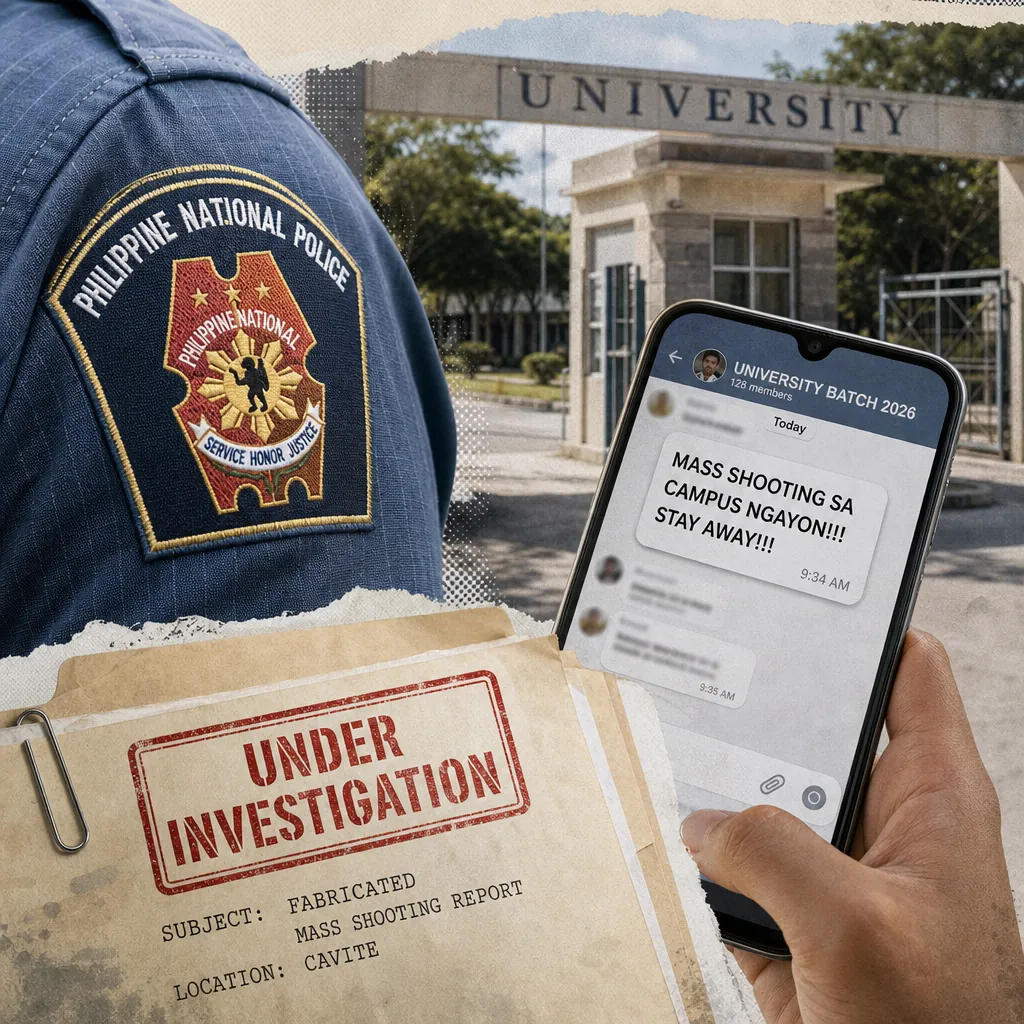
A false report of a mass shooting at De La Salle University-Dasmariñas in Cavite circulated through social media and group chats on October 1, prompting the Philippine National Police (PNP) to open an investigation into who created it and whether it was deliberately fabricated. PNP chief Police General Jose Melencio Nartatez Jr. said on Friday that the Dasmariñas Component City Police Station had verified the claim and found no factual basis for it, and that those who deliberately create or spread false information causing public alarm may face legal consequences 23956. The same statement was carried by ABS-CBN News Online, the Daily Tribune, Head Topics, and state radio DZRB, which reported that the PNP had strengthened its cyber patrol operations to trace the origin of the posts 625539. Police clarified that a person was found dead inside a vehicle on September 30 at the De La Salle Medical and Health Sciences Institute in Barangay Burol Main, a separate incident that the false posts appear to have been built around 5662. Nartatez said freedom of expression must be exercised responsibly and should never be used to mislead the public 2.
The fabricated shooting report was the most widely picked-up story in the items reviewed here, running across online news, radio, and television in both English and Filipino. It also connects to a broader thread in the day's coverage: the speed with which unverified claims move through group chats and social platforms, and the difficulty of correcting them once they have spread. The PNP's warning that spreaders could face charges is the first concrete enforcement signal in this case, though the investigation has not yet identified a source.
Separately, the National Water Resources Board (NWRB) confirmed that it has cut the allocation of water from Angat Dam to the Metropolitan Water Works and Sewerage System (MWSS) and its two concessionaires, Maynilad and Manila Water, from the usual 50 to 52 cubic meters per second down to 44 cubic meters per second starting October. NWRB Executive Director Dr. Sevillo David Jr. said in interviews with One PH and DZRB that the adjustment is a preparation measure and will not cause water shortages or service interruptions in Metro Manila households, and that the board is confident supply can hold through next year even without additional rainfall. He urged MWSS and the concessionaires to develop alternative sources including Laguna Lake, facilities in Cavite, and Upper Wawa. The Climate Change Commission, meanwhile, said the country is entering an El Niño period expected to be felt from October, and that its role is to provide the National Adaptation Plan and monitor whether climate action plans are mainstreamed across national, local, and sectoral levels.
Key themes
- PNP investigates fabricated Cavite campus shooting report. The false claim of a mass shooting at De La Salle University-Dasmariñas spread through social media and group chats on October 1, prompting a police investigation into its source and a warning that deliberate spreaders may face charges 23956.
- Angat Dam water allocation cut to 44 cubic meters per second. The NWRB reduced the allocation from the usual 50 to 52 cubic meters per second starting October as a preparation measure, saying no service interruptions are expected and urging concessionaires to find alternative sources.
- Pag-IBIG and Megawide mark first topping-off under Expanded 4PH. Two residential buildings at JAB Residences in Dasmariñas City completed their main structural works toward nearly 4,000 housing units, with each 27-square-meter unit priced at ₱1.5 million and monthly payments as low as ₱2,500 with no down payment under the government subsidy program 5361.
- House subcommittee recommends ₱20.8-billion increase for agriculture. The Budget Amendments Review Subcommittee proposed adding ₱20.8 billion to the budgets of the Department of Agriculture, National Irrigation Administration, and Department of Agrarian Reform, including ₱10 billion for the Presidential Assistance to Farmers and Fisherfolk and ₱4.9 billion for farm-to-market roads, as preparation for a possible Super El Niño.
- Sugar milling season opens under pest infestation. Several sugar centrals on Negros Island began milling on Monday amid expectations of a smaller harvest due to the red-striped soft-scale insect, which the Sugar Regulatory Administration earlier warned could cut national output by up to 150,000 metric tons 14.
- GCash IPO priced at ₱6.60 per share. The final pricing of Mynt Inc.'s initial public offering brings the entry point for 100 shares to ₱660 before fees, which a House lawmaker said could widen retail participation in the digital economy if paired with financial literacy and investor protection 24.
- Sari-sari stores fill gaps in medicine access. A qualitative study published in Acta Medica Philippina found that neighborhood variety stores serve as informal sources of common medicines in communities where pharmacies are far or residents need to buy in small quantities 10.
- Senate bill seeks to update the 54-year-old Maceda Law. Senator Francis Escudero sponsored Senate Bill No. 2504 to expand protections for homebuyers under the Realty Installment Buyer Act, arguing that a single missed payment should not wipe out years of payments 31.
How the narratives stack
Dominant: The fabricated mass-shooting report at De La Salle University-Dasmariñas dominated the items reviewed here, appearing in at least six separate outlets across online news, radio, and television, in both English and Filipino 239555662. The PNP's statement was the anchor: Nartatez condemned the spread of fake news, confirmed the report was baseless, and said the investigation would determine whether it was deliberately fabricated 239. The story's dominance within this set reflects both the seriousness of the claim and the breadth of the police response, not a measure of how many people saw any single report.
Counter-narrative: The NWRB's water allocation cut was framed by officials as a precaution rather than a shortage. David said the reduction from 50 to 52 cubic meters per second to 44 cubic meters per second is a preparation measure and that no water service interruptions are expected. This runs counter to the assumption that any cut in allocation means immediate household impact, and it places the story in the context of El Niño preparation rather than an active supply problem.
Emerging: The combination of the agriculture budget increase, the sugar pest infestation, and the El Niño advisory points to a food-security thread that is building across several stories. The House subcommittee's proposed ₱20.8-billion increase for agriculture, including ₱10 billion for farmer and fisherfolk assistance and ₱4.9 billion for farm-to-market roads, is explicitly framed as preparation for a possible Super El Niño. The sugar industry is already seeing the effects of the red-striped soft-scale insect, with the Sugar Regulatory Administration warning of a 150,000-metric-ton output loss 14. The Climate Change Commission's advisory that El Niño will be felt from October ties these threads together.
Under-covered: The sari-sari store medicine study and the Maceda Law reform bill received less attention in the items reviewed here than the shooting investigation or the water allocation cut, despite addressing everyday concerns for low-income households. The study, published in Acta Medica Philippina, found that sari-sari stores serve as informal pharmacies in communities with limited access to drugstores 10. The Maceda Law bill, sponsored by Escudero, seeks to protect homebuyers from losing years of payments over a single missed installment 31. Both stories have direct implications for household finances and health access but ran mainly in online news without the broadcast pickup that the shooting and water stories received.
Platform insights
Facebook: The fabricated shooting report spread through group chats and social media, according to the PNP, which is the clearest platform-specific detail in the day's coverage 239. The PNP's cyber patrol operations are focused on tracing the origin of posts, indicating that Facebook and messaging apps were the primary vector for the false claim. The UP Rural High School also condemned red-tagging on Facebook by accounts identified as "Emjay Chico" and "Lorraine Baddie" or Lorraine Badoy, former spokesperson of the National Task Force to End Local Communist Armed Conflict, following the school's Martial Law remembrance activity 12.
X: No specific X activity was reported in the items reviewed here. The day's social-media discussion of the shooting report was described in terms of group chats and general social media rather than a specific platform 2.
Reddit: No Reddit activity was reported in the items reviewed here.
YouTube: No YouTube activity was reported in the items reviewed here.
Key voices and communities
Philippine National Police: PNP chief Police General Jose Melencio Nartatez Jr. was the most prominent official voice in the day's coverage, condemning the spread of fake news and ordering the Dasmariñas police to investigate the source of the fabricated shooting report 23956. His statements were carried across multiple outlets and framed the police response as both an investigation and a warning about legal consequences.
National Water Resources Board and water officials: NWRB Executive Director Dr. Sevillo David Jr. appeared on One PH and DZRB to explain the Angat Dam allocation cut, emphasizing that it is a preparation measure and not a cause for alarm. His framing set the tone for the water story, which was presented as a managed adjustment rather than a crisis.
Housing and agriculture agencies: Pag-IBIG Fund, Megawide, the Department of Human Settlements and Urban Development, and the Department of Agriculture were the main institutional voices on the housing and agriculture stories. Pag-IBIG Deputy Chief Executive Officer Alex Aguilar and Megawide officials marked the topping-off of two buildings at JAB Residences 5361. The House Budget Amendments Review Subcommittee recommended the agriculture budget increase.
Senators and lawmakers: Senator Francis Escudero sponsored Senate Bill No. 2504 to reform the Maceda Law 31. Senator Raffy Tulfo urged passage of Senate Bill No. 522 to reserve 15-kilometer municipal waters for small-scale fishers 84. Representative JP Padiernos commented on the GCash IPO pricing and the need for financial literacy 24.
Student and school communities: The University of the Philippines Rural High School condemned the red-tagging of its community following its Martial Law remembrance activity, calling out posts by accounts linked to a former government task force 12. The fabricated shooting report at De La Salle University-Dasmariñas also directly affected students and parents, who were described by the PNP as among those alarmed by the false claim 2.
Narrative streams
PNP traces source of fabricated Cavite campus shooting report
The Philippine National Police is investigating who created and spread a false report of a mass shooting at De La Salle University-Dasmariñas in Cavite, a claim that circulated through social media and group chats on October 1 and prompted the Dasmariñas Component City Police Station to verify and debunk it 23956. PNP chief Police General Jose Melencio Nartatez Jr. said the investigation would determine whether the report was deliberately fabricated, and warned that those who deliberately create or spread false information causing public alarm may face appropriate legal consequences 2. "We strongly condemn the irresponsible spread of fake news on social media that causes undue panic and confusion among students, parents, and the general public," Nartatez said 3962. Police clarified that a person was found dead inside a vehicle on September 30 at the De La Salle Medical and Health Sciences Institute in Barangay Burol Main, a separate incident that the false posts appear to have been built around 5662. The PNP strengthened its cyber patrol operations to trace the origin of the posts, according to DZRB and DWIZ reports.
The read for the sector is that schools, universities, and local government units in Cavite and nearby provinces now face a concrete misinformation risk that can empty campuses and flood parents with panic calls within hours, and that the police response — verification plus a threat of charges — is the template being set for how such incidents will be handled. The case also puts pressure on social media platforms to act on false reports that spread through group chats, where content is harder to monitor and correct than on public feeds. The PNP has not yet identified a source, and it is not clear whether the false report was created maliciously or grew out of confusion over the September 30 death.
Angat Dam allocation cut to 44 cubic meters per second
The National Water Resources Board reduced the allocation of water from Angat Dam to the Metropolitan Water Works and Sewerage System and its concessionaires from the usual 50 to 52 cubic meters per second down to 44 cubic meters per second starting October, a cut of roughly 12 to 15 percent. NWRB Executive Director Dr. Sevillo David Jr. said the adjustment is a preparation measure to protect supply, particularly from Angat Dam, and will not cause water shortages or service interruptions in Metro Manila households. He urged MWSS and the concessionaires to develop alternative sources including Laguna Lake, facilities in Cavite, and Upper Wawa, and said the board is confident supply can hold through next year even without additional rainfall. The cut comes as the Climate Change Commission said the country is entering an El Niño period expected to be felt from October, with Commissioner Albert de la Cruz Sr. explaining that the commission provides the National Adaptation Plan and monitors whether climate action plans are mainstreamed across national, local, and sectoral levels.
The read for the sector is that water concessionaires and large industrial users in Metro Manila now have a narrower supply margin heading into a dry period, and that the push to develop Laguna Lake and Cavite sources will move from planning to procurement faster than previously scheduled. Households are not yet affected, but the allocation cut signals that the buffer between normal demand and available supply is thinner than in previous years. The NWRB's confidence that supply can last through next year without additional rain depends on demand staying within current levels and on the alternative sources coming online as planned.
Pag-IBIG and Megawide mark housing milestone under Expanded 4PH
Pag-IBIG Fund and Megawide marked the first topping-off milestone under their partnership on October 1, with two residential buildings at JAB Residences in Dasmariñas City, Cavite completing their main structural works toward nearly 4,000 housing units 5361. The project consists of 17 five-story buildings, with each 27-square-meter unit priced at ₱1.5 million and monthly payments as low as ₱2,500 with no down payment under the government subsidy program, according to Pag-IBIG Deputy Chief Executive Officer Alex Aguilar. The milestone coincides with the start of National Shelter Month in October and advances President Ferdinand Marcos Jr.'s Expanded Pambansang Pabahay para sa Pilipino Program, known as Expanded 4PH, which aims to bring affordable homes closer to Filipino workers 5361. Pag-IBIG also signed a separate agreement with Filinvest Land Incorporated to give qualified housing loan borrowers access to units in some residential projects with preferential pricing, under a housing loan limit raised to ₱10 million and promotional rates of 4.5 percent per year for loans up to ₱4.9 million and 5.75 percent per year for loans above ₱4.7 million up to ₱10 million.
The read for the sector is that developers and buyers now have a clearer picture of the price points and financing terms the government is willing to support under Expanded 4PH, and that the Dasmariñas project will serve as a test case for whether the ₱2,500 monthly payment and no-down-payment structure can be replicated at scale. The project's completion timeline and the pace of turnover will determine whether the program meets its housing targets or runs into the same construction and financing delays that have affected previous mass housing efforts.
House subcommittee recommends ₱20.8-billion agriculture budget increase
The House Budget Amendments Review Subcommittee recommended adding ₱20.8 billion to the budgets of the Department of Agriculture, National Irrigation Administration, and Department of Agrarian Reform, according to a DZXL report. The proposed increase includes ₱10 billion for the Presidential Assistance to Farmers and Fisherfolk and ₱4.9 billion for farm-to-market roads, and is framed as part of the House's effort to prepare the national budget for a possible Super El Niño next year. The recommendation still needs plenary approval in the House. The agriculture sector is already under pressure from the red-striped soft-scale insect, which the Sugar Regulatory Administration earlier warned could cut national sugar output by up to 150,000 metric tons, with the infestation heavily felt in Negros 14. Several sugar centrals on Negros Island began milling operations on Monday amid expectations of a smaller harvest 14.
The read for the sector is that farmers and fisherfolk in El Niño-prone provinces now have a clearer signal that additional government support is moving through the budget process, but the timing of the disbursement will determine whether it arrives before the dry period peaks. The sugar industry's pest problem and the El Niño advisory together suggest that crop losses in the coming season could exceed the 150,000-metric-ton estimate if the infestation is not contained and rainfall remains below normal.
GCash IPO pricing opens digital economy ownership to smaller investors
The final pricing of Mynt Inc.'s initial public offering at ₱6.60 per share means an investor buying 100 shares would need ₱660 before applicable fees and charges, a lower entry point than the ₱10 maximum offer price previously set 24. Representative JP Padiernos, a member of the House panel on banks and financial intermediaries, said the GCash IPO presents an opportunity to discuss how more Filipinos can participate in retail capital markets, but that expanding access must go hand in hand with financial literacy, transparent disclosures, and adequate investor protection 24. The offering could make stock-market participation more accessible to first-time investors, particularly as GCash is one of the Philippines' largest digital platforms 24.
The read for the sector is that retail investors who have never bought shares before now have a low-cost entry point into the stock market through a platform they already use for payments and remittances, which could bring a new cohort of first-time shareholders into the market. The risk is that first-time investors may not fully understand the difference between holding a stock and holding a digital wallet balance, and the lawmaker's call for financial literacy and investor protection points to that gap.
Sari-sari stores serve as informal pharmacies in underserved communities
A qualitative study published in the August 2026 issue of Acta Medica Philippina found that sari-sari stores serve as informal sources of common medicines, particularly in communities where pharmacies are far away, transportation is limited, or residents need to buy medicines in small quantities 10. The research, conducted by researchers from the University of the Philippines, Ateneo de Manila University, and Bulacan State University, drew on interviews with 14 sari-sari store owners in Bulacan, Marinduque, Quezon City, and Rizal, conducted from February to March 2025 10. The study is titled "Sari-sari Stores as Community Pharmacies? A Qualitative Exploration of Sari-sari Stores Selling Medicines in the Philippines" 10.
The read for the sector is that public health agencies and local governments now have evidence that the neighborhood variety store is already part of the medicine supply chain for low-income households, and that any effort to improve medicine access should account for these informal channels rather than assume that pharmacies are the only point of sale. The study does not measure how many sari-sari stores sell medicines or what share of household medicine purchases they account for, so the scale of the practice remains unclear.
Senate bill seeks to update the Maceda Law on homebuyer protections
Senator Francis Escudero sponsored Senate Bill No. 2504 to amend Republic Act No. 6552, the Realty Installment Buyer Act, known as the Maceda Law, which has been in force for 54 years 31. Escudero, chairperson of the Senate Committee on Urban Planning, Housing and Resettlement, said the existing law should provide stronger protection to families who purchase homes through installment arrangements, arguing that a single missed payment should not wipe out years of payments and investment 31. "One missed payment should be a setback, not the end of the road toward owning a home," Escudero said 31. The bill seeks to expand the rights and protections of buyers under the law 31.
The read for the sector is that homebuyers who have fallen behind on installment payments now have a legislative vehicle to seek stronger protections, and that developers and financing companies may face new requirements on how they handle missed payments and cancellations. The bill's prospects depend on how quickly it moves through the Senate and whether the House takes up a companion measure.
Senator Tulfo pushes bill reserving municipal waters for small fishers
Senator Raffy Tulfo urged the Senate to pass Senate Bill No. 522, the Municipal Fisherfolk Protection Act authored by Senator Loren Legarda, which would reserve the 15-kilometer municipal waters primarily for small-scale fishers and bar unauthorized commercial fishing in the zone 84. In a privilege speech, Tulfo cited declining fish production, illegal fishing, and the entry of commercial fishing vessels into municipal waters 84. "The Constitution is clear: all natural resources, including fisheries, are owned by the State, and the exploration, development, and utilization of these resources must remain under its full control and supervision," Tulfo said 84. He also called for a review of Republic Act No. 10654, the 2015 amendment to the Fisheries Code that tightened rules against illegal, unreported, and unregulated fishing 84.
The read for the sector is that small-scale fishers in coastal municipalities now have a legislative push to keep commercial vessels out of the 15-kilometer zone, which could reduce competition for catch but may also face resistance from commercial fishing operators and processors. The bill's fate depends on whether it can clear committee and floor debates in the Senate.
Energy Regulatory Commission and NGCP settle fee disputes
The Energy Regulatory Commission and the National Grid Corporation of the Philippines signed a compromise agreement on October 1, putting to rest years of litigation over NGCP's obligation to pay ERC-imposed permit fees and annual supervision and regulation fees 48. The signing was led by ERC chairperson and CEO Francis Saturnino Juan and NGCP president and CEO Anthony Almeda, and coincided with a courtesy visit by NGCP's leadership headed by Henry Sy Jr. 48. Under the Electric Power Industry Reform Act, or EPIRA, Republic Act No. 9136, the ERC regulates the electric power industry, including the review and approval of transmission projects undertaken by NGCP, the country's sole transmission network provider under its legislative franchise, Republic Act No. 9511 48.
The read for the sector is that the settlement removes a long-running legal dispute that had the potential to affect NGCP's cost recovery and, by extension, transmission charges passed on to consumers. The agreement does not change the ERC's authority to review and approve transmission projects, but it clears a source of uncertainty for the grid operator and its regulators.
First Philippine Holdings sets ₱5-billion share buyback
First Philippine Holdings Corp. said its board approved a new share buyback program giving the Lopez-led conglomerate up to ₱5 billion to repurchase its own shares over the next two years, while also declaring ₱467 million in cash dividends 83. The buyback runs from October 1, 2026 to September 30, 2028, and at the company's current market price could theoretically fund the repurchase of about 13 percent of its 424.5 million outstanding common shares 83. The company already holds 185.1 million shares as treasury stock from a similar buyback program that started in 2010 83. Lopez Holdings Inc. owns 60.7 percent of First Holdings, whose interests span power generation, real estate, manufacturing, construction services, and other businesses 83.
The read for the sector is that First Holdings is signaling confidence in its own valuation at a time when some of the country's largest listed conglomerates have seen share prices fall, and that the buyback gives the company a tool to support its stock price without committing to new capital expenditures. The dividend declaration provides a separate return to shareholders.
Sy family wealth drops by $1 billion in September
The combined wealth of the Sy family billionaires — Henry Sy Jr., Hans, Herbert, Harley, and Tessie Sy Coson — fell 13 percent in September, ending the month with an estimated $6.6 billion, down from $7.6 billion the month before, according to a Bilyonaryo News Channel report citing Forbes' real-time billionaire estimates. The drop came as shares in some of the family's biggest listed companies sold off: SM Investments fell nearly 10 percent in September, SM Prime lost more than 11 percent, and both ended the month at 12-year lows, while BDO fell about 2.6 percent. Elizabeth C., who had an estimated fortune of $1.1 billion in August, no longer appeared on Forbes' real-time billionaire tracker by the end of September. Among the 12 Filipino billionaires in the comparison, Lucio Tan was the only one to gain, adding $100 million.
The read for the sector is that the decline in the Sy family's wealth reflects the performance of SM Investments, SM Prime, and BDO, which are among the most widely held stocks in the Philippine market, and that the 12-year lows in SM Investments and SM Prime signal broader investor caution about retail, property, and banking. The movement in the Forbes tracker is a measure of paper wealth based on share prices, not of cash losses.
Senate bill seeks to update the Maceda Law on homebuyer protections
Senator Francis Escudero sponsored Senate Bill No. 2504 to amend Republic Act No. 6552, the Realty Installment Buyer Act, known as the Maceda Law, which has been in force for 54 years 31. Escudero, chairperson of the Senate Committee on Urban Planning, Housing and Resettlement, said the existing law should provide stronger protection to families who purchase homes through installment arrangements, arguing that a single missed payment should not wipe out years of payments and investment 31. "One missed payment should be a setback, not the end of the road toward owning a home," Escudero said 31. The bill seeks to expand the rights and protections of buyers under the law 31.
The read for the sector is that homebuyers who have fallen behind on installment payments now have a legislative vehicle to seek stronger protections, and that developers and financing companies may face new requirements on how they handle missed payments and cancellations. The bill's prospects depend on how quickly it moves through the Senate and whether the House takes up a companion measure.
Senator Tulfo pushes bill reserving municipal waters for small fishers
Senator Raffy Tulfo urged the Senate to pass Senate Bill No. 522, the Municipal Fisherfolk Protection Act authored by Senator Loren Legarda, which would reserve the 15-kilometer municipal waters primarily for small-scale fishers and bar unauthorized commercial fishing in the zone 84. In a privilege speech, Tulfo cited declining fish production, illegal fishing, and the entry of commercial fishing vessels into municipal waters 84. "The Constitution is clear: all natural resources, including fisheries, are owned by the State, and the exploration, development, and utilization of these resources must remain under its full control and supervision," Tulfo said 84. He also called for a review of Republic Act No. 10654, the 2015 amendment to the Fisheries Code that tightened rules against illegal, unreported, and unregulated fishing 84.
The read for the sector is that small-scale fishers in coastal municipalities now have a legislative push to keep commercial vessels out of the 15-kilometer zone, which could reduce competition for catch but may also face resistance from commercial fishing operators and processors. The bill's fate depends on whether it can clear committee and floor debates in the Senate.
Energy Regulatory Commission and NGCP settle fee disputes
The Energy Regulatory Commission and the National Grid Corporation of the Philippines signed a compromise agreement on October 1, putting to rest years of litigation over NGCP's obligation to pay ERC-imposed permit fees and annual supervision and regulation fees 48. The signing was led by ERC chairperson and CEO Francis Saturnino Juan and NGCP president and CEO Anthony Almeda, and coincided with a courtesy visit by NGCP's leadership headed by Henry Sy Jr. 48. Under the Electric Power Industry Reform Act, or EPIRA, Republic Act No. 9136, the ERC regulates the electric power industry, including the review and approval of transmission projects undertaken by NGCP, the country's sole transmission network provider under its legislative franchise, Republic Act No. 9511 48.
The read for the sector is that the settlement removes a long-running legal dispute that had the potential to affect NGCP's cost recovery and, by extension, transmission charges passed on to consumers. The agreement does not change the ERC's authority to review and approve transmission projects, but it clears a source of uncertainty for the grid operator and its regulators.
First Philippine Holdings sets ₱5-billion share buyback
First Philippine Holdings Corp. said its board approved a new share buyback program giving the Lopez-led conglomerate up to ₱5 billion to repurchase its own shares over the next two years, while also declaring ₱467 million in cash dividends 83. The buyback runs from October 1, 2026 to September 30, 2028, and at the company's current market price could theoretically fund the repurchase of about 13 percent of its 424.5 million outstanding common shares 83. The company already holds 185.1 million shares as treasury stock from a similar buyback program that started in 2010 83. Lopez Holdings Inc. owns 60.7 percent of First Holdings, whose interests span power generation, real estate, manufacturing, construction services, and other businesses 83.
The read for the sector is that First Holdings is signaling confidence in its own valuation at a time when some of the country's largest listed conglomerates have seen share prices fall, and that the buyback gives the company a tool to support its stock price without committing to new capital expenditures. The dividend declaration provides a separate return to shareholders.
Sy family wealth drops by $1 billion in September
The combined wealth of the Sy family billionaires — Henry Sy Jr., Hans, Herbert, Harley, and Tessie Sy Coson — fell 13 percent in September, ending the month with an estimated $6.6 billion, down from $7.6 billion the month before, according to a Bilyonaryo News Channel report citing Forbes' real-time billionaire estimates. The drop came as shares in some of the family's biggest listed companies sold off: SM Investments fell nearly 10 percent in September, SM Prime lost more than 11 percent, and both ended the month at 12-year lows, while BDO fell about 2.6 percent. Elizabeth C., who had an estimated fortune of $1.1 billion in August, no longer appeared on Forbes' real-time billionaire tracker by the end of September. Among the 12 Filipino billionaires in the comparison, Lucio Tan was the only one to gain, adding $100 million.
The read for the sector is that the decline in the Sy family's wealth reflects the performance of SM Investments, SM Prime, and BDO, which are among the most widely held stocks in the Philippine market, and that the 12-year lows in SM Investments and SM Prime signal broader investor caution about retail, property, and banking. The movement in the Forbes tracker is a measure of paper wealth based on share prices, not of cash losses.
Senate bill seeks to update the Maceda Law on homebuyer protections
Senator Francis Escudero sponsored Senate Bill No. 2504 to amend Republic Act No. 6552, the Realty Installment Buyer Act, known as the Maceda Law, which has been in force for 54 years 31. Escudero, chairperson of the Senate Committee on Urban Planning, Housing and Resettlement, said the existing law should provide stronger protection to families who purchase homes through installment arrangements, arguing that a single missed payment should not wipe out years of payments and investment 31. "One missed payment should be a setback, not the end of the road toward owning a home," Escudero said 31. The bill seeks to expand the rights and protections of buyers under the law 31.
The read for the sector is that homebuyers who have fallen behind on installment payments now have a legislative vehicle to seek stronger protections, and that developers and financing companies may face new requirements on how they handle missed payments and cancellations. The bill's prospects depend on how quickly it moves through the Senate and whether the House takes up a companion measure.
Senator Tulfo pushes bill reserving municipal waters for small fishers
Senator Raffy Tulfo urged the Senate to pass Senate Bill No. 522, the Municipal Fisherfolk Protection Act authored by Senator Loren Legarda, which would reserve the 15-kilometer municipal waters primarily for small-scale fishers and bar unauthorized commercial fishing in the zone 84. In a privilege speech, Tulfo cited declining fish production, illegal fishing, and the entry of commercial fishing vessels into municipal waters 84. "The Constitution is clear: all natural resources, including fisheries, are owned by the State, and the exploration, development, and utilization of these resources must remain under its full control and supervision," Tulfo said 84. He also called for a review of Republic Act No. 10654, the 2015 amendment to the Fisheries Code that tightened rules against illegal, unreported, and unregulated fishing 84.
The read for the sector is that small-scale fishers in coastal municipalities now have a legislative push to keep commercial vessels out of the 15-kilometer zone, which could reduce competition for catch but may also face resistance from commercial fishing operators and processors. The bill's fate depends on whether it can clear committee and floor debates in the Senate.
Energy Regulatory Commission and NGCP settle fee disputes
The Energy Regulatory Commission and the National Grid Corporation of the Philippines signed a compromise agreement on October 1, putting to rest years of litigation over NGCP's obligation to pay ERC-imposed permit fees and annual supervision and regulation fees 48. The signing was led by ERC chairperson and CEO Francis Saturnino Juan and NGCP president and CEO Anthony Almeda, and coincided with a courtesy visit by NGCP's leadership headed by Henry Sy Jr. 48. Under the Electric Power Industry Reform Act, or EPIRA, Republic Act No. 9136, the ERC regulates the electric power industry, including the review and approval of transmission projects undertaken by NGCP, the country's sole transmission network provider under its legislative franchise, Republic Act No. 9511 48.
The read for the sector is that the settlement removes a long-running legal dispute that had the potential to affect NGCP's cost recovery and, by extension, transmission charges passed on to consumers. The agreement does not change the ERC's authority to review and approve transmission projects, but it clears a source of uncertainty for the grid operator and its regulators.
First Philippine Holdings sets ₱5-billion share buyback
First Philippine Holdings Corp. said its board approved a new share buyback program giving the Lopez-led conglomerate up to ₱5 billion to repurchase its own shares over the next two years, while also declaring ₱467 million in cash dividends 83. The buyback runs from October 1, 2026 to September 30, 2028, and at the company's current market price could theoretically fund the repurchase of about 13 percent of its 424.5 million outstanding common shares 83. The company already holds 185.1 million shares as treasury stock from a similar buyback program that started in 2010 83. Lopez Holdings Inc. owns 60.7 percent of First Holdings, whose interests span power generation, real estate, manufacturing, construction services, and other businesses 83.
The read for the sector is that First Holdings is signaling confidence in its own valuation at a time when some of the country's largest listed conglomerates have seen share prices fall, and that the buyback gives the company a tool to support its stock price without committing to new capital expenditures. The dividend declaration provides a separate return to shareholders.
Sy family wealth drops by $1 billion in September
The combined wealth of the Sy family billionaires — Henry Sy Jr., Hans, Herbert, Harley, and Tessie Sy Coson — fell 13 percent in September, ending the month with an estimated $6.6 billion, down from $7.6 billion the month before, according to a Bilyonaryo News Channel report citing Forbes' real-time billionaire estimates. The drop came as shares in some of the family's biggest listed companies sold off: SM Investments fell nearly 10 percent in September, SM Prime lost more than 11 percent, and both ended the month at 12-year lows, while BDO fell about 2.6 percent. Elizabeth C., who had an estimated fortune of $1.1 billion in August, no longer appeared on Forbes' real-time billionaire tracker by the end of September. Among the 12 Filipino billionaires in the comparison, Lucio Tan was the only one to gain, adding $100 million.
The read for the sector is that the decline in the Sy family's wealth reflects the performance of SM Investments, SM Prime, and BDO, which are among the most widely held stocks in the Philippine market, and that the 12-year lows in SM Investments and SM Prime signal broader investor caution about retail, property, and banking. The movement in the Forbes tracker is a measure of paper wealth based on share prices, not of cash losses.
Conversation trajectory
PNP investigation into the fabricated shooting report (next 1–2 weeks). The PNP has said it is tracing the source of the false posts through cyber patrol operations, and the Dasmariñas police have been directed to maintain visibility. If the investigation identifies a source, the case could move to prosecution and set a precedent for how misinformation cases are handled. If no source is identified, the story may fade without a resolution, leaving the question of how to prevent similar false reports unanswered.
Angat Dam water supply and El Niño (next 1–3 months). The NWRB has cut the allocation to 44 cubic meters per second and said supply can hold through next year without additional rainfall. The Climate Change Commission has said El Niño will be felt from October. The next signal to watch is whether the NWRB adjusts the allocation again, and whether MWSS and the concessionaires announce concrete progress on alternative sources such as Laguna Lake and Cavite facilities.
Agriculture budget and sugar harvest (next 1–3 months). The House subcommittee's recommended ₱20.8-billion increase still needs plenary approval. The sugar milling season has begun under the red-striped soft-scale insect infestation, with the Sugar Regulatory Administration warning of a 150,000-metric-ton output loss 14. The next data point is the actual harvest volume as milling progresses, which will show whether the pest damage is as severe as feared.
GCash IPO and retail investor participation (next 1–2 weeks). The final pricing at ₱6.60 per share sets the stage for the offering, and the level of retail demand will indicate whether first-time investors are entering the market 24. The next signal is the subscription and listing performance, which will show whether the low entry point translated into broad participation.
Maceda Law and municipal waters bills (next 1–3 months). Both bills are in the Senate and will need committee and floor action to advance 3184. The next signal is whether they are scheduled for plenary debate or remain stalled in committee.
Trigger events: The PNP's next statement on the shooting investigation; the NWRB's next allocation adjustment or MWSS announcement on alternative water sources; the first sugar milling output figures; the GCash IPO listing; and any Senate action on the Maceda Law and municipal waters bills.
Response guidance
For schools and universities: Establish a rapid verification protocol for reports of campus emergencies, with a designated spokesperson who can confirm or deny claims within minutes. The De La Salle University-Dasmariñas case shows that false reports can spread through group chats faster than official channels can respond, and that parents and students will act on unverified information. Coordinate with local police before issuing statements, and use official social media accounts and text blast systems to push corrections to the same channels where the false report spread.
For water concessionaires and local governments: Communicate the Angat Dam allocation cut in terms of what it means for households — no service interruptions, no change in water pressure — rather than in technical terms about cubic meters per second. The NWRB's framing that the cut is a preparation measure is the message that needs to reach consumers, and it should be repeated as the El Niño period progresses. If alternative sources such as Laguna Lake or Cavite facilities are developed, announce the timeline and capacity so that consumers can see the plan moving.
For housing agencies and developers: Highlight the monthly payment and down payment terms of Expanded 4PH units in plain language, because the ₱2,500 monthly payment and no-down-payment structure are the details that matter most to buyers. The topping-off milestone at JAB Residences is a concrete progress point that can be used to show the program is moving, but it should be paired with a clear timeline for turnover so that buyers know when they can expect to move in.
For agriculture agencies and farmer organizations: Communicate the status of the proposed ₱20.8-billion budget increase and the El Niño preparation measures in terms that farmers and fisherfolk can act on — what assistance is available, when it will be disbursed, and how to access it. The sugar industry's pest problem is a specific case where farmers need information on treatment and compensation, and the Department of Agriculture and the Sugar Regulatory Administration should coordinate on a single message.
For financial regulators and platforms: The GCash IPO pricing at ₱6.60 per share will bring first-time investors into the market, and the message should emphasize the difference between holding a stock and holding a digital wallet balance. Financial literacy materials should be distributed through the same platform where the IPO is being offered, and investor protection mechanisms should be visible before the listing.
For social media platforms: The fabricated shooting report spread through group chats, where content moderation is limited. Platforms should consider how to flag or slow the spread of unverified emergency reports in messaging features, and should coordinate with the PNP on tracing the origin of false posts. The PNP's warning that spreaders may face charges is a signal that platforms may face pressure to act.
For communicators handling misinformation: Prepare holding statements for false reports that can be issued within minutes, and designate a single source of truth — a police statement, a school announcement, or a government advisory — that all other channels can point to. The De La Salle University-Dasmariñas case shows that the correction needs to reach the same group chats where the false report spread, not just public feeds.
See the full picture behind today's signals.
This report draws from Media Meter's MediaWatch, our real-time monitoring engine tracking 2,470+ Philippine sources across print, broadcast, digital, and social. Explore how the platform turns raw coverage into decision-grade intelligence, then see how it's configured for teams like yours — whether you're in PR agencies, corporate comms, government, or marketing.
Want more? Browse our Report Library for sector and crisis intelligence, or request a demo and we'll have your brand set up before the call.
Want this kind of intelligence on your brand?
This brief is built on the same MediaWatch methodology that runs continuously across every brand we monitor. See your competitive landscape, Impact Score, and narrative trajectory in a 30-minute demo.