Flood-Control Graft Cases Advance as PSEi Hits 10-Month Low
Former public works officials pleaded not guilty to a P77-million ghost flood control project, while the stock index fell to its lowest close since November 2025 on inflation and El Niño worries. Senators also pressed housing agencies over beneficiary favoritism and permit backlogs.
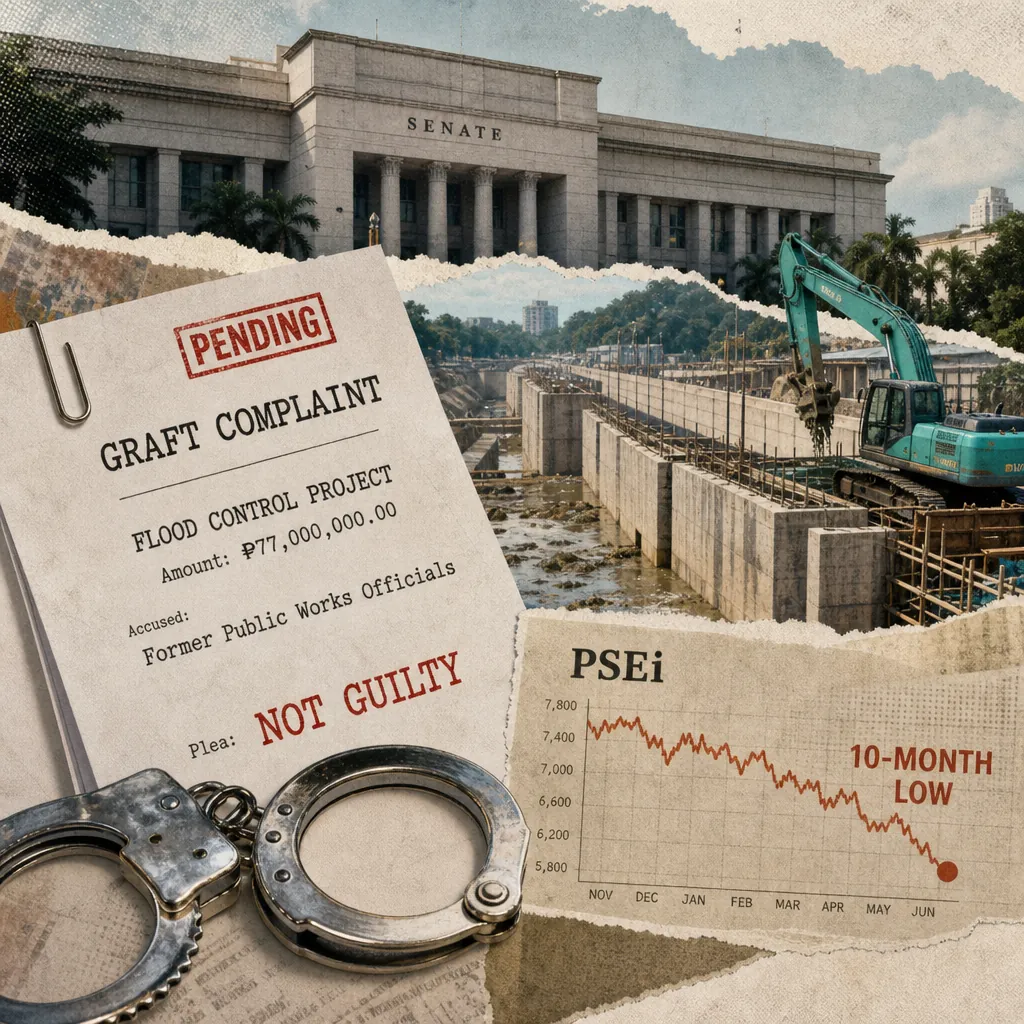
The most consequential development in the items reviewed for September 30 was a courtroom moment: seven former officials of the Department of Public Works and Highways (DPWH) — the national agency that builds and maintains roads, bridges and flood-control structures — entered not-guilty pleas at the Sandiganbayan, the special anti-corruption court that tries public officials, over an alleged ghost flood control project in Balagtas, Bulacan.3492 The case concerns a P77.2-million riverbank protection project along the Balagtas River that the Ombudsman says was declared complete in May 2025 even though an inspection found no structure at the site.34 The accused include former assistant engineer Brice Hernandez, already detained over a separate P92.8-million flood control case in Pandi, Bulacan, and six co-accused — Jaypee Mendoza, Arjay Domasig, Niño Lawrence Morales, Juanito Mendoza, Floralyn Simbulan and Christina Mae Pineda.34 Former Ako Bicol party-list representative Elizaldy “Zaldy” Co was also impleaded along with two staff members, none of whom appeared.34 The court ordered four officials on floating status to explain within 10 days why they should not be placed under preventive suspension while the case is heard.92
The same day, the flood-control inquiry produced a public quarrel between two senators. Minority Leader Alan Peter Cayetano, speaking in a Facebook livestream, mocked Sen. Panfilo Lacson as “Chief Justice Lacson,” “Prosecutor Lacson” and “DOJ Lacson,” accusing him of acting as though he controlled the Laguna Lake Development Authority, the Blue Ribbon Committee, the Department of the Interior and Local Government and the Philippine Reclamation Authority.33 Lacson responded that he was merely following the evidence.33 The exchange grew out of a dispute over Public Works Secretary Vince Dizon's statements on alleged ghost projects in Taguig City, the Cayetano family's political base.33
Markets moved in the opposite direction. The Philippine Stock Exchange Index (PSEi), the benchmark that tracks the share prices of the country's largest listed companies, fell 1.03 percent, or 58.92 points, to close at 5,679.48 — its lowest finish since November 14, 2025, when it ended at 5,584.35.9324 It was the third straight session of losses.24 The peso weakened to 62.64 against the US dollar from 62.56 a day earlier.93 Analysts attributed the slide to a Bangko Sentral ng Pilipinas (BSP) warning that inflation could accelerate to as high as 7.4 percent in September, rising US Treasury yields, and a budget official's caution that a severe El Niño — the periodic warming of the Pacific that brings drought to the Philippines — could slow public infrastructure spending early next year.2493 Foreign investors were net sellers, with outflows of P950.67 million, though net value turnover reached P7.9 billion.52
Key themes
- Seven plead not guilty in a P77-million ghost flood project. Former DPWH assistant engineer Brice Hernandez and six co-accused denied graft charges at the Sandiganbayan over a Balagtas, Bulacan riverbank protection project that the Ombudsman says was certified complete despite no structure existing at the site.3492
- Two senators trade accusations over the flood-control probe. Alan Peter Cayetano accused Panfilo Lacson of overreaching into multiple agencies; Lacson said he was following the evidence.33
- The stock index closed at its lowest level in ten months. The PSEi lost 1.03 percent to 5,679.48, its weakest finish since November 14, 2025, as the central bank flagged September inflation possibly reaching 7.4 percent.9324
- El Niño risk is now part of the market story. A Department of Budget and Management official warned that severe El Niño could slow public infrastructure spending early next year, weighing on construction and related industries.24
- Senators pressed housing agencies on favoritism and permit delays. Sen. Raffy Tulfo raised complaints of a “palakasan system” — a culture of pulling strings through connections — in government housing distribution, while Sen. Christopher “Bong” Go questioned delays in issuing licenses to sell.1531
- A consumer group filed a 928-page complaint against a water district and PrimeWater. The complaint names San Jose del Monte Water District officials and PrimeWater executives, including the Villar family, over alleged manufactured shortages and financial drain.35
- Metro Manila's water allocation will be cut starting October. The National Water Resources Board will lower the allocation to the Metropolitan Waterworks and Sewerage System to 44 cubic meters per second from the regular 50 to 53, and irrigation allocation to 20 from 30 to 35, in preparation for a possible Super El Niño.8476
- Government microloans reached more than 650,000 borrowers. The Social Security System and Government Service Insurance System have disbursed over P31.7 billion through digital microloan programs in less than two years.87
How the narratives stack
Dominant: The flood-control corruption cases dominated the day's hard-news coverage in the items reviewed. The not-guilty pleas, the Senate clash, and the broader investigation into how flood-control money was spent formed the single largest cluster of stories, spanning court reporting, Senate politics and opinion. The Manila Times carried the plea story and the Cayetano-Lacson clash; the Manila Standard ran the plea story on its news pages; Philstar ran a Filipino-language version.34339279 The coverage value of these items was substantial — the Cayetano-Lacson story alone carried an estimated P458,104 in advertising-equivalent value, the estimated cost of buying the same space as paid advertising, and the plea story carried P178,536.3334 The dominance is a property of this captured set, which was weighted toward Philippine news and business outlets.
Counter-narrative: The market story cut against the political narrative. While the flood-control cases advanced in court, the PSEi fell to a ten-month low and the peso weakened, with analysts pointing to inflation expectations and El Niño risk rather than governance concerns as the immediate drivers.9324 The two stories are not contradictory — both reflect institutional stress — but they competed for the same business-page space, and the market story carried the larger single-item coverage value in the set: the Manila Standard's market wrap carried an estimated P537,158 in advertising-equivalent value, and Philstar's version P227,943.93
Emerging: The water-supply story is building. The National Water Resources Board's decision to cut Metro Manila's allocation starting October, combined with the 928-page complaint against the San Jose del Monte Water District and PrimeWater, signals that water — supply, pricing and governance — is becoming a sustained beat rather than a one-off.8435 The complaint alleges “manufactured” water shortages and environmental sabotage, and names former senators Manuel and Cynthia Villar and their children, including Senators Mark and Camille Villar, among the private respondents.35 No findings have been made; the complaint is pending before the Ombudsman.
Under-covered: The housing agencies' budget hearings produced two distinct accountability stories — Tulfo's “palakasan” complaint and Go's questions on license-to-sell delays — but they ran mainly in the Manila Times, Daily Tribune and Philstar's Filipino-language section, with limited pickup elsewhere in the set.153185 The National Housing Authority's general manager, Joeben Tai, said the agency relies on beneficiary lists provided by local government units and national agencies, which places the screening burden downstream.85 The license-to-sell backlog matters because a license to sell is the permit a developer needs before it can legally offer housing units to buyers; delays hold up project launches and delivery.31
Platform insights
- Facebook: The most consequential Facebook activity in the set was Sen. Alan Peter Cayetano's livestream, in which he attacked Sen. Panfilo Lacson over the flood-control probe.33 The livestream format let Cayetano set the terms of the exchange — naming agencies he said Lacson controlled — and the clip was then picked up by the Manila Times, which framed it as a fresh clash between the two senators.33 The Newington Police Department in Connecticut also used Facebook to post its account of a 200-vehicle street takeover, which became a national story after a charge-sheet typo — “Breach of Peach” instead of breach of peace — appeared in 15 entries.9
- X: No X-specific engagement figures appear in the items reviewed. The platform's role in this window is inferred from the broader pattern of political and market commentary, not from measured activity in the set.
- Reddit: No Reddit activity appears in the items reviewed.
- YouTube: No YouTube-specific engagement figures appear in the items reviewed. The Manila Times headlines podcast, which summarized the Supreme Court's dismissal of petitions challenging the Senate impeachment court's two-thirds vote interpretation, is the closest item to a video/audio format in the set.7379
Key voices and communities
Anti-corruption advocates and whistleblowers. A consumer advocacy group and unnamed whistleblowers filed the 928-page complaint against the San Jose del Monte Water District and PrimeWater, alleging years of manufactured water shortages, financial drain and environmental sabotage.35 The complaint names water district officials including general manager Loreto Limcolioc and board chairman Aurelio Jose Jr., and PrimeWater owners including former senators Manuel and Cynthia Villar and their children.35 This group's framing is that water governance has been captured by private interests; the Ombudsman has not ruled on the allegations.
Senators on the budget and accountability beat. Sen. Raffy Tulfo used the Senate budget hearing on the Department of Human Settlements and Urban Development (DHSUD) and its attached agencies to raise complaints that municipal employees and people close to mayors and barangay officials were being favored in housing distribution, and that some beneficiaries already owned property or vehicles.15 Sen. Christopher “Bong” Go pressed DHSUD Secretary Jose Ramon Aliling on the backlog of licenses to sell.31 The hearing was chaired by Sen. Joseph Victor “JV” Ejercito.31
Market analysts and the central bank. Luis Limlingan, head of sales at Regina Capital Development Corp., said market sentiment remained cautious after the BSP warned inflation could reach 7.4 percent in September, weighing on confidence over monetary policy and growth.93 Philstocks Financial Inc. pointed to the El Niño warning from Budget Assistant Secretary Romeo Matthew Balanquit as a factor intensifying growth worries.24
The Villar family and PrimeWater. The complaint directly names former senators Manuel and Cynthia Villar, their children Paolo, Mark and Camille, and corporate executives Fe Rabancos, Lester Santos and Victor.35 The Villars have not responded in the items reviewed; the complaint is an allegation, not a finding.
Business and consumer advocates on the downturn. A Philstar opinion column cited a Sun Life Philippines survey finding that 64 percent of surveyed families were reducing spending on nonessential items and about 30 percent were cutting back on basic necessities, and noted that the country's largest beer maker is seeing both beer and gin sales decline simultaneously — a pattern the column called unprecedented.88
Narrative streams
Flood-control graft cases move through the courts
The Sandiganbayan Fifth Division on Wednesday arraigned seven former DPWH officials on graft charges over the P77.2-million Balagtas River project.34 All seven pleaded not guilty.34 The Ombudsman's finding — that the project was declared complete in May 2025 despite an inspection finding no structure at the site — is the core allegation.34 Hernandez is already in detention over a separate P92.8-million case in Pandi, Bulacan, which means the same official is now facing two ghost-project prosecutions.34 The court also ordered four officials on floating status to explain why they should not be suspended during trial.92 For the construction and infrastructure sector, the practical consequence is that the procurement and certification chain for flood-control projects is now under active judicial scrutiny: engineers, district offices and contractors who signed off on completion certificates face personal liability. The cases also give the Senate investigation a courtroom counterpart, which raises the cost of the political fight.
Senators fight over the shape of the flood probe
Cayetano's livestream attack on Lacson was the day's most direct political confrontation.33 Cayetano accused Lacson of acting as “Chief Justice Lacson, Prosecutor Lacson, DOJ Lacson, Secretary Lacson,” saying he was calling the shots at the Laguna Lake Development Authority, the Blue Ribbon Committee, the Department of the Interior and Local Government and the Philippine Reclamation Authority.33 The Blue Ribbon Committee is the Senate's committee that investigates alleged misconduct by public officials; the Laguna Lake Development Authority manages the country's largest inland lake; the Philippine Reclamation Authority approves land-reclamation projects.33 The dispute traces to Public Works Secretary Vince Dizon's statements about alleged ghost projects in Taguig, the Cayetanos' political base.33 For the sector, the exchange matters because it signals that the flood-control investigation is now entangled with territorial politics: the agencies named are the ones that approve and oversee the projects at the center of the probe, and the senators fighting over them sit on the committees that will write the findings.
The market falls to a ten-month low
The PSEi's 1.03 percent decline to 5,679.48 was its worst close since November 14, 2025.93 The BSP's warning that September inflation could reach 7.4 percent was the proximate trigger, compounded by rising US Treasury yields and the El Niño warning from the budget department.2493 Foreign investors sold a net P950.67 million, though turnover was strong at P7.9 billion.52 The peso closed at 62.64 to the dollar, weaker than Tuesday's 62.56.93 For businesses that borrow or import, the combination of a weaker peso and higher inflation expectations raises the cost of both. For the government, the El Niño warning is the more consequential signal: if infrastructure spending slows early next year, the construction and materials sectors that depend on public projects will feel it first, and the budget department's own revenue assumptions will come under pressure.24
Water supply and water governance come under pressure
The National Water Resources Board will cut Metro Manila's water allocation to 44 cubic meters per second starting October, down from the regular 50 to 53, and irrigation allocation to 20 from 30 to 35, in preparation for a possible Super El Niño.84 The allocation goes to the Metropolitan Waterworks and Sewerage System, which supplies Metro Manila, Cavite and Rizal through Manila Water and Maynilad.84 Separately, a consumer group and whistleblowers filed a 928-page complaint with the Ombudsman against San Jose del Monte Water District officials and PrimeWater executives, alleging manufactured shortages, financial drain and environmental sabotage.35 The complaint names former senators Manuel and Cynthia Villar and their children, including Senators Mark and Camille Villar, among the private respondents.35 For households and businesses in the affected areas, the allocation cut means the risk of lower pressure or intermittent service in the dry months ahead. For the water sector, the complaint puts the public-private partnership model under scrutiny at the same moment that supply is tightening — a combination that tends to produce both regulatory attention and consumer anger.
Housing agencies face questions on favoritism and delays
At the Senate budget hearing on DHSUD and its attached agencies, Tulfo said he had received complaints that municipal employees and people close to mayors and barangay chairmen were being favored in government housing distribution, and that some National Housing Authority beneficiaries already owned property or vehicles.15 He also raised concerns that some politicians use government housing as a reward for supporters.15 NHA General Manager Joeben Tai said the agency relies on beneficiary lists provided by local government units and national agencies.85 Go separately questioned DHSUD over delays in processing licenses to sell, asking how many applications were pending and what the department was doing about the backlog.31 For developers and buyers, the license-to-sell backlog is a direct constraint: without the permit, a project cannot be legally marketed, which delays revenue and delivery. For housing beneficiaries, the favoritism complaint raises the question of whether the screening process is independent of local political control.
The consumer squeeze shows up in spending data
A Philstar opinion column cited a Sun Life Philippines survey finding that 64 percent of surveyed families were reducing spending on nonessential items and about 30 percent were cutting back on basic necessities.88 The column also noted that the country's largest beer maker is seeing both beer and gin sales decline at the same time — a break from the usual pattern in which one category rises when the other falls.88 The column's framing was that the country is not technically in recession but that businesses dependent on discretionary spending are feeling the downturn first.88 For retailers and consumer-goods companies, the signal is that the trade-down is reaching basic categories, not just discretionary ones. For policymakers, the combination of weak consumption, high inflation expectations and a falling stock market narrows the room for maneuver on interest rates.
Government microloans reach scale
More than 650,000 Filipino workers have tapped government-backed microloan programs in less than two years, with the Social Security System and Government Service Insurance System disbursing more than P31.7 billion through digital microloan programs.87 Finance Secretary Frederick Go backed the initiatives as a way to meet workers' immediate financing needs without adding unnecessarily to their debt burden.87 The figures point to a persistent gap in the credit market: workers may need only a few thousand pesos to bridge a short-term cash crunch, but traditional lending is poorly suited to such small, urgent borrowing.87 For banks and fintech lenders, the government's entry into small-ticket digital lending at this scale is a competitive signal. For borrowers, the question is whether the programs displace informal lenders that charge substantially higher rates, or simply add another channel.
The Supreme Court clears the way for the Senate impeachment vote
The Supreme Court dismissed three separate petitions challenging the Senate impeachment court's interpretation of the constitutional requirement for a two-thirds vote to convict in an impeachment case.7379 The petitions were filed by Victor Rodriguez, Berteni Cataluña Causing and Ernesto Francisco Jr., who questioned the Senate tribunal's September 23 ruling that the phrase “all the members of the Senate” under Article XI, Section 3(6) of the Constitution refers only to senators who are legally and actually able to participate at the time of the vote.73 The ruling matters because it determines how many votes are needed to convict — a question that could decide the outcome of the impeachment case. For the political sector, the dismissal removes a procedural obstacle and shifts attention back to the Senate itself.
Conversation trajectory
Inflation data release (first half of October). The BSP has warned September inflation could reach 7.4 percent. The actual figure, due in early October, will either confirm or undercut the market's current caution. If it comes in near the top of the range, expect further pressure on the peso and renewed debate over whether the central bank can cut rates. If it comes in lower, the market's ten-month low may look oversold.93
Sandiganbayan proceedings (next 2–4 weeks). The court has given four officials on floating status 10 days to explain why they should not be suspended during trial.92 The next hearings in the Balagtas and Pandi cases will produce more detail on the procurement chain and on who signed the completion certificates. Watch for additional arraignments or plea changes.
Senate budget hearings (through October). The DHSUD and NHA hearings are part of the broader budget cycle. Expect follow-up questions on the license-to-sell backlog and on the beneficiary screening process, and watch whether the Senate writes any of the recommendations into the budget bill.3115
Water allocation and El Niño (October–early 2027). The National Water Resources Board's cut to 44 cubic meters per second takes effect in October.84 If El Niño intensifies, further cuts are possible, and the irrigation reduction to 20 cubic meters per second could affect planting schedules. Watch for statements from the Department of Agriculture and from Manila Water and Maynilad on service levels.84
Ombudsman action on the water complaint (timing uncertain). The 928-page complaint against the San Jose del Monte Water District and PrimeWater has been filed but not acted upon.35 The Ombudsman's decision on whether to docket it for investigation is the next checkable step.
Trigger events. The September inflation release, the next Sandiganbayan hearings, the Senate's budget deliberations, and any Ombudsman action on the water complaint are the near-term triggers that will determine whether the current narratives strengthen or fade.
Response guidance
For infrastructure and construction firms: Review procurement and completion-certification procedures now. The Balagtas and Pandi cases show that completion certificates signed without physical verification can become criminal evidence. Ensure that site inspections are documented independently of the project engineer's certification, and that any change orders are supported by photographic and third-party evidence.3492
For developers and housing companies: Track the license-to-sell backlog at DHSUD. If the backlog persists, project launches and revenue recognition will slip. Consider engaging with DHSUD on the specific applications pending and on what documentation is missing, rather than waiting for the Senate hearing to produce a fix.31
For water utilities and their private partners: Expect heightened scrutiny of service interruptions, billing and infrastructure spending. The San Jose del Monte complaint alleges manufactured shortages; even if the allegations are not proven, the public-relations cost of a supply cut in October will be higher in that environment. Prepare clear, specific communication on allocation volumes, reservoir levels and the reasons for any service reduction.3584
For consumer-goods and retail businesses: The spending data points to a trade-down that is reaching basic categories. Review promotional strategies and pack sizes for lower-income households, and expect continued pressure on discretionary categories.88
For financial institutions and fintech lenders: Government microloans have reached more than 650,000 borrowers and P31.7 billion in disbursements. This is now a significant channel for small-ticket credit. Assess whether your products compete with or complement the SSS and GSIS programs, and whether there is room to serve borrowers who need more than the government programs provide.87
For communicators across sectors: The day's news was dominated by accountability stories — ghost projects, favoritism, water governance — and by market stress. Messages that acknowledge specific problems and describe specific fixes will land better than general reassurances. Avoid claiming that a project is complete or a service is uninterrupted without verifiable evidence; the cost of being contradicted is now higher.343593
See the full picture behind today's signals.
This report draws from Media Meter's MediaWatch, our real-time monitoring engine tracking 2,470+ Philippine sources across print, broadcast, digital, and social. Explore how the platform turns raw coverage into decision-grade intelligence, then see how it's configured for teams like yours — whether you're in PR agencies, corporate comms, government, or marketing.
Want more? Browse our Report Library for sector and crisis intelligence, or request a demo and we'll have your brand set up before the call.
Want this kind of intelligence on your brand?
This brief is built on the same MediaWatch methodology that runs continuously across every brand we monitor. See your competitive landscape, Impact Score, and narrative trajectory in a 30-minute demo.