Fuel Hikes Hit ₱5.68/L as Excise Cut Weighed
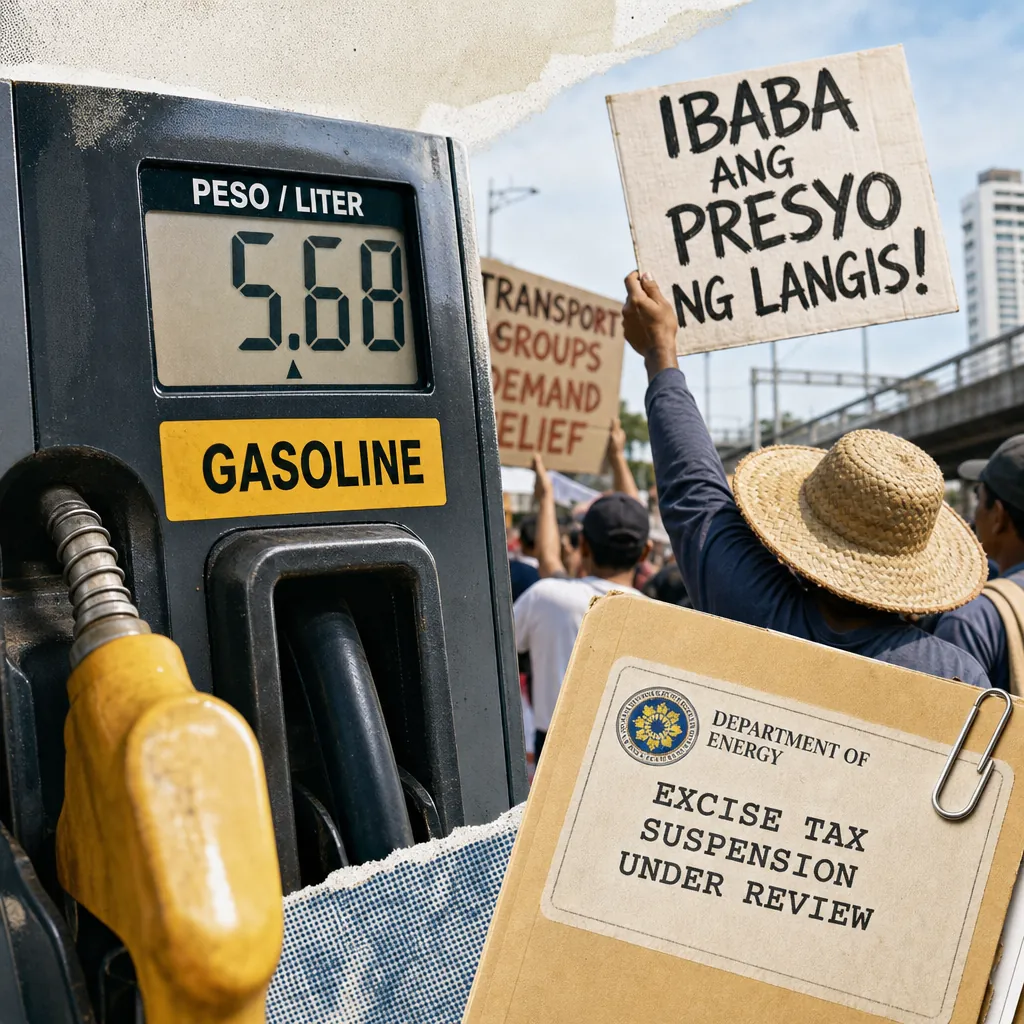
Pump prices rose for a seventh straight month on Sept. 15, 2026, with gasoline up ₱5.68 per liter, as the Energy department certified a possible excise tax suspension and transport and fisherfolk groups staged protests. Separately, the Finance department proposed extending the sweetened beverage tax to ice cream and frozen yogurt.
The Conversation
Gasoline prices rose by ₱5.68 per liter and diesel by ₱4.31 per liter on Tuesday, September 15, 2026, the latest in a run of increases that the Department of Energy (DOE) now says is unlikely to end soon because of the war in the Middle East.49 The same day, the DOE formally endorsed suspending the excise tax on petroleum products after Dubai crude — the benchmark used to price Philippine fuel imports — averaged $99.41 per barrel from August 13 to September 11, well above the $80 threshold that triggers a review under Republic Act No. 12316.60 That combination — a fresh round of pump-price pain and a live policy debate about cutting fuel taxes — set the terms for most of the day's coverage, and it is where the heaviest news value sat: a single television interview with a trade official carried an estimated ₱1.5 million in advertising-equivalent value, the largest single item in the set reviewed here.59
On social platforms, the same affordability story surfaced in three separate, low-volume threads. A Facebook post reported that the Manibela transport strike along Taft Avenue in Manila was barely felt on its first day, with the Philippine National Police describing conditions as generally orderly and jeepney operations largely unaffected; the post drew 8 likes, 1 share, 1 laugh reaction and no comments.1 A post on X amplified Speaker Faustino Dy III's call to lower electricity prices and praised the removal of the 12 percent value-added tax (VAT) on allowable system loss charges — the portion of a distribution utility's power purchases that is lost to technical and non-technical causes and passed on to consumers — drawing 92 views and no likes, shares, quotes or comments.2 The day's most conversational item was a Reddit travelogue by a first-time foreign visitor to Mindanao, which drew 18 comments by describing bread and fish trucks, mall food stops, ube custard cake and late-night delivery, and calling Foodpanda "awesome" and late-night food options "a gift from Zeus."3
That split — institutional cost-of-living news that drew little public interaction, and a personal consumption story that drew the most — is the shape of the day. The news side carried the consequence: a national price event, a pending tax decision, and protests by transport and fisherfolk groups. The social side carried the response, and it was small. The most-engaged post in the set produced 18 comments; the two policy posts produced a combined 8 likes and zero comments. Neither number suggests a public that is activated on fuel prices, even as the policy machinery around those prices moves.
Key themes
- Pump prices rose again, with gasoline up ₱5.68 per liter. The DOE confirmed increases of ₱5.68 per liter for gasoline, ₱4.31 per liter for diesel and ₱4.62 per liter for kerosene effective September 15, the latest in a run of hikes that began after the Strait of Hormuz — the narrow Gulf passage through which roughly a fifth of the world's oil and liquefied natural gas supply moves — was disrupted by conflict involving the United States, Israel and Iran.849
- The DOE certified that fuel excise taxes could be suspended. Dubai crude averaged $99.41 per barrel from August 13 to September 11, above the $80 trigger set under Republic Act No. 12316, a law that requires the government to review fuel-tax relief when crude prices stay elevated.60 The DOE has transmitted its certification to the Development Budget Coordination Committee (DBCC), the inter-agency body that sets the government's macroeconomic assumptions, which must still recommend a course to the President.59
- Transport groups split on whether to keep protesting. Manibela cancelled the second day of its strike, citing fewer students travelling because of a teachers' wellness break, while Piston pressed ahead with protests in Quezon City, Balintawak and Alabang and called on the government to act on oil prices and scrap the excise tax.4 Piston said its drivers were taking home only ₱200 to ₱300 a day and that the existing ₱12-per-liter fuel subsidy was no longer enough.5
- Fisherfolk protested the timing of the increase. Members of Pambansang Lakas ng Kilusang Mamamalakaya ng Pilipinas (Pamalakaya) staged a coastal protest in Manila Bay, saying the increase would burden small-scale fishers just as they returned to sea after more than three months of disrupted operations during the southwest monsoon, or habagat.6
- The Finance department wants to tax ice cream and frozen yogurt. At a House Committee on Ways and Means hearing on September 14, Finance Undersecretary Karlo Fermin Adriano said the department is expanding the coverage of the sweetened beverage tax to include edible ices — dairy and plant-based ice cream, ice milk, sorbets, ice lollies and flavored and unflavored frozen yogurt.1647 The proposal is part of the ProGRESS package, which the DOF frames as offsetting revenue lost to a higher income-tax threshold.47
- The peso's slide is compounding the fuel story. Economist Emmanuel Leyco said on DZMM that the peso could weaken to ₱63 against the dollar, and that because oil is paid for in dollars, a weaker currency makes imported fuel more expensive for everyone, with middle-income households feeling the squeeze.7
- A foreign visitor's food-delivery praise was the day's most-discussed social item. The Reddit travelogue drew 18 comments — more than every other post in the set combined — and singled out delivery speed, late-night availability and local staples as better than what the visitor knew in Germany.3
- Government aid caravans distributed billions in services nationwide. The "Handog ng Pangulo: Serbisyong Sapat Para sa Lahat" caravan, held across 90 locations on September 14, a day after President Ferdinand Marcos Jr.'s 69th birthday, distributed at least ₱2.83 billion in services, including rice at ₱20 per kilo from the Department of Agriculture.1418
How the narratives stack
Dominant: The fuel price increase and the possibility of excise tax relief dominated the news side of the set. The DOE's certification that Dubai crude had breached the $80 trigger, the ₱5.68-per-liter gasoline increase, and the protests that followed generated the most items and the most coverage value among the articles reviewed — including a television interview with a trade official valued at an estimated ₱1.5 million in advertising-equivalent terms and a TV5 report on Manibela's cancelled strike valued at about ₱1.3 million.594 Within the captured set, this was the story with the widest spread across outlets and mediums, from AM radio to cable television to online news. That spread is a property of the items gathered here, not proof that the story dominated all coverage that day.
Counter-narrative: The most-engaged social item of the day was not about fuel at all. A foreign visitor's Reddit post about food delivery, late-night eating and local cuisine drew 18 comments, while the fuel-strike Facebook post drew 8 likes and no comments and the electricity VAT post drew 92 views and no engagement actions.312 The contrast is real but should not be overread: 18 comments is a small number in absolute terms, and the two policy posts were institutional announcements that did not invite discussion. What the pattern shows is that consumption experience, told personally, travels further on social platforms than policy grievance stated institutionally.
Emerging: The proposal to extend the sweetened beverage tax to ice cream and frozen yogurt is the day's clearest forward-looking signal for food and beverage manufacturers. It appeared in at least two outlets in the set and is explicitly framed as part of a broader tax package tied to income-tax relief.1647 If adopted, it would add an excise tax — a tax on the production, sale or consumption of specific goods, levied on top of the 12 percent VAT — to a category that currently carries neither. The DOF has not published a rate or a timeline.
Under-covered: The Visayas power supply situation received a single item in the set. The National Grid Corporation of the Philippines (NGCP) placed the Visayas grid under red and yellow alerts on September 15, with available capacity of 2,352 megawatts against projected peak demand of 2,492 megawatts, after 12 power plants went offline.62 A red alert means supply is insufficient to meet demand and reserve requirements, so rotating brownouts are possible. This is a direct household-cost story — and it connects to the electricity VAT discussion — but it drew far less attention in the captured set than the fuel price increase.
Platform insights
- Facebook: The platform carried the day's transport-strike report, which framed the Manibela protest as a response to successive oil price increases while noting minimal disruption. The post drew 8 likes, 1 share, 1 laugh reaction and zero comments, indicating that the "business as usual" framing did not sustain discussion.1 The low interaction is consistent with a pattern in which institutional or incident-based posts about prices generate reach without conversation.
- X: The platform hosted the electricity price and VAT removal message from Speaker Faustino Dy III, a top-down policy communication that drew 92 views but no likes, quotes, shares or comments.2 The gap between views and engagement actions suggests the post was seen but not acted on — a broadcast signal rather than a participatory thread.
- Reddit: The platform produced the day's most active thread, a foreign visitor's travelogue that drew 18 comments by focusing on food delivery convenience, late-night availability and local food routines.3 The thread shifted the conversation from national price grievances to personal consumption experience, and its comment-to-post ratio was far higher than anything on Facebook or X.
- YouTube: No meaningful activity was captured on this platform in the set reviewed.
Key voices and communities
Transport advocacy groups. Manibela and Piston are the two most visible jeepney and transport organizations in the fuel-price debate. Manibela cancelled the second day of its strike, citing a teachers' wellness break that reduced student commuters, while Piston continued protests and demanded that the government act on oil prices and scrap the excise tax.4 Piston's framing is concrete: drivers take home ₱200 to ₱300 a day and the ₱12-per-liter fuel subsidy no longer covers the gap.5 These groups matter to food and beverage companies because transport costs feed directly into the cost of moving goods, and because their protests keep the affordability frame in the news.
Fisherfolk organizations. Pamalakaya staged a coastal protest in Manila Bay, arguing that the fuel increase lands hardest on small-scale fishers returning to work after the monsoon.6 Fishing costs are an input into seafood supply and prices, so this group's grievances connect to the broader food-cost picture.
Legislative and policy voices. Speaker Faustino Dy III's post on electricity prices and the VAT removal on system loss charges represents a top-down policy communication that drew 92 views and no engagement actions.2 The Bureau of Internal Revenue (BIR) confirmed the change through Revenue Memorandum Circular No. 97 of 2026, which removes VAT from the system loss charge within the cap approved by the Energy Regulatory Commission (ERC) — the agency that sets and reviews electricity rates.9 Separately, Senator Sherwin Gatchalian filed Senate Resolution No. 581 calling for an audit of fuel pass-through charges, warning that consumers could face higher electricity bills because gasoline has exceeded ₱100 per liter.10
Foreign visitors and expatriate observers. The Reddit travelogue is the clearest example of a group whose influence is qualitative rather than quantitative. The visitor's praise for delivery speed, late-night availability and local food was unprompted and specific, and it drew the most comments of any item in the set.3 These posts shape inbound perceptions of Philippine food culture and service quality.
Business and industry associations. The LPG Marketers Association, through Regasco president Arnel Ty, wrote to Energy Secretary Sharon Garin asking the government to suspend excise taxes on liquefied petroleum gas, kerosene, diesel and gasoline, estimating that a suspension could cut LPG by ₱3 per kilogram, diesel by ₱6 per liter, gasoline by ₱10 per liter and kerosene by ₱5 per liter.11
Narrative streams
Pump prices rise for a seventh month as the government weighs excise relief
The September 15 increase was the latest in a run that began after the Strait of Hormuz was disrupted in February 2026, when conflict involving the United States, Israel and Iran closed one of the world's most important maritime routes for oil and liquefied natural gas.8 Gasoline rose ₱5.68 per liter, diesel ₱4.31 per liter and kerosene ₱4.62 per liter, according to the DOE.8 Energy Secretary Sharon Garin said the crisis is unlikely to end soon: "When the war started in the Middle East, the expectation from the DOE side, based on our assessment, [was that] this would last a long time."49 She added that extreme surges are unlikely but that consumers should "brace ourselves for possible increases."60
The policy response is now in motion. The DOE has certified that Dubai crude averaged $99.41 per barrel from August 13 to September 11, above the $80 trigger under Republic Act No. 12316, and has transmitted its report to the DBCC.59 The DBCC must still recommend a course to President Marcos. If the excise tax is suspended, the DOE says all petroleum products would be covered, but there is no guarantee pump prices would fall, because global crude prices remain the dominant factor.59 The LPG Marketers Association has separately asked for a suspension covering LPG, kerosene, diesel and gasoline, with estimated price reductions of ₱3 per kilogram for LPG, ₱6 per liter for diesel, ₱10 per liter for gasoline and ₱5 per liter for kerosene.11
For food and beverage manufacturers, the read is that transport and logistics costs will stay elevated for at least the near term, and that any price adjustment they make will be judged against a public frame in which fuel, power and food costs are treated as one household burden. The excise-tax debate also sets a template: if the government can cut fuel taxes to relieve consumers, the same logic will be applied to food taxes — which is exactly what is happening with the sweetened beverage tax proposal.47
Transport and fisherfolk groups protest as the strike's visible impact stays small
Manibela cancelled the second day of its transport strike, explaining that fewer students were commuting because of a teachers' wellness break.4 Piston continued, staging protests in Quezon City, Balintawak and Alabang and saying it would keep up the pressure in Alabang in the afternoon.4 Piston's complaint is specific: drivers take home ₱200 to ₱300 a day, and the ₱12-per-liter fuel subsidy is no longer sufficient.5 The group called on President Marcos to act: "Nagdagdag na naman ang presyo ng diesel, malaking kawalan na naman sa kikitain namin. Kaya ang panawagan namin sa ating Presidente Bongbong Marcos na sana naman, bigyan kami ng pansin dito."4
On the same day, Pamalakaya held a coastal protest in Manila Bay, arguing that the fuel increase would burden small-scale fishers just as they resumed operations after more than three months of disruption from the southwest monsoon.6 The group's timing is pointed: the increase lands at the moment fishers are restarting, when their costs are already high.
The read for the sector is that transport and fishing costs are both inputs into food prices, and the groups carrying those grievances have a public-sympathy advantage. Food and beverage companies that raise prices in this environment will be asked to explain how much of the increase comes from fuel and transport rather than from their own margins. The strike's small visible impact does not neutralize the underlying grievance; it means the pressure is building without a release valve.
The Finance department proposes taxing ice cream and frozen yogurt
At a House Committee on Ways and Means hearing on September 14, Finance Undersecretary Karlo Fermin Adriano said the DOF is "expanding the coverage [of sweetened beverage tax] to include edible ices. Ito po 'yung mga ice creams and popsicles."16 The expanded coverage would include dairy and plant-based ice cream, ice milk, water-based products such as sorbets and ice lollies, and flavored and unflavored frozen yogurt.1647 Excise taxes are levied on the production, sale or consumption of specific goods and are generally added on top of the 12 percent VAT; they are mandated under the Tax Reform for Acceleration and Inclusion (TRAIN) Law.16
The proposal is part of the ProGRESS package — Promoting Growth, Revenue, and Equity towards Socio-Economic Sustainability — which the DOF describes as compensating for revenue losses from the higher income-tax threshold proposed by the President in his July State of the Nation Address.47 The DOF has not published a proposed rate or a timeline for legislative action.
The read for food manufacturers is that the tax base for sweetened products is widening, and frozen desserts are next in line. Companies in the ice cream, frozen yogurt and sorbet categories should expect to model price increases, reformulation options and packaging changes, and to prepare for the same "helping the consumer" political framing that now surrounds fuel taxes. The proposal also signals that the government is willing to use excise taxes as a revenue tool even while cutting other taxes, which raises the odds that other food categories will be reviewed.
Electricity costs move on two tracks: a VAT removal and a supply alert
The Bureau of Internal Revenue removed the 12 percent VAT on allowable system loss charges within the cap approved by the Energy Regulatory Commission, under Revenue Memorandum Circular No. 97 of 2026.9 The system loss charge remains on the electric bill, but it is no longer subject to VAT, and the BIR said consumers should expect an immediate reduction in their electricity bills.9 Speaker Faustino Dy III praised the move and called for further reductions in electricity prices.2
Separately, the National Grid Corporation of the Philippines placed the Visayas grid under red and yellow alerts on September 15, with red alert from 5 p.m. to 7 p.m. and yellow alert from 3 p.m. to 5 p.m. and 7 p.m. to 8 p.m.62 Available capacity was 2,352 megawatts against projected peak demand of 2,492 megawatts, after 12 power plants went offline, including the large coal plants Therma Visayas Inc. 1 and 2 and Panay Energy Development Corporation 3.62 A red alert means supply is insufficient to meet demand and reserve requirements, so power interruptions are possible. Senator Gatchalian also filed Senate Resolution No. 581 calling for an audit of fuel pass-through charges, noting that the Philippines has the highest average electricity rate in Southeast Asia at ₱12.43 per kilowatt-hour.10
The read for food and beverage manufacturers is that power is a direct input cost, and the combination of a VAT removal and a supply alert sends mixed signals: bills may fall slightly for consumers, but the risk of brownouts and higher pass-through charges remains. Manufacturers with cold-chain, refrigeration or processing operations in the Visayas should treat the grid alerts as an operational risk, not just a household inconvenience.
A foreign visitor's food-delivery praise becomes the day's most-discussed social item
A first-time visitor to Mindanao posted a long-form Reddit travelogue describing daily life through food: a morning bread truck alarm, a fish truck alarm, mall visits, ube custard cake, and repeated amazement at the speed and availability of food delivery compared with Germany.3 The post called Foodpanda "awesome" and late-night food options "a gift from Zeus for someone who is a night owl like me."3 It drew 18 comments, more than every other post in the set combined.3
The read for delivery platforms and quick-service restaurants is that unprompted foreign-voice content is generating credible, specific praise for delivery reliability and late-night availability. That is useful counter-programming against any domestic narrative that service quality is deteriorating. It is also a small data point: 18 comments is not a trend, and the post's reach is unknown. But the contrast with the policy posts — which drew 8 likes and zero comments, and 92 views and no engagement actions, respectively — shows that personal consumption stories travel further on social platforms than institutional price announcements.12
Government aid caravans distribute ₱2.83 billion in services nationwide
The "Handog ng Pangulo: Serbisyong Sapat Para sa Lahat" caravan was held across 90 locations on September 14, a day after President Marcos's 69th birthday, and distributed at least ₱2.83 billion in services, according to Tourism Undersecretary Stanley Ng.1418 In Negros Occidental, assistance reached at least ₱261 million, including ₱25 million from the Department of Labor and Employment through its TUPAD emergency employment program and the Special Program for Employment of Students.1266 In Pampanga, ₱118.829 million reached 2,343 beneficiaries, with the Commission on Higher Education accounting for ₱75.6 million in tertiary education subsidies.39 In Bataan, the caravan delivered ₱17.3 million in aid and services.13 In Las Piñas, about 2,000 residents attended, with the Metropolitan Manila Development Authority running a waste-for-groceries exchange.30 The Department of Agriculture offered rice at ₱20 per kilo at the Taguig satellite event.14
The read for food and beverage companies is that the government is distributing food-price relief directly — subsidized rice, livelihood aid, employment programs — which sets a benchmark consumers will use to judge retail prices. When the state sells rice at ₱20 per kilo, private-sector pricing above that level becomes harder to defend in public conversation.
Conversation trajectory
Over the next 7 to 14 days: The DBCC's recommendation on the fuel excise tax suspension is the single most consequential pending decision. If the committee recommends suspension and the President approves, pump prices could fall by the estimated amounts the LPG Marketers Association cited — ₱6 per liter for diesel, ₱10 per liter for gasoline — though the DOE has cautioned that global crude prices remain the dominant factor.1159 Watch for the next weekly oil price adjustment, typically announced on Mondays for Tuesday effectivity, as the trigger for renewed transport-group protest language.8
Over the next 2 to 4 weeks: The House Committee on Ways and Means is expected to continue hearings on the ProGRESS package, including the expanded sweetened beverage tax. The DOF has not published a rate, so the first concrete signal will be a bill text or a committee report.1647 Food manufacturers in the ice cream, frozen yogurt and sorbet categories should watch for the proposed rate and the definition of "edible ices," which will determine how broad the tax base becomes.
Over the next 4 to 6 weeks: The Regional Tripartite Wages and Productivity Board (RTWPB) for Region 2, which covers the Cagayan Valley, has completed eight sectoral consultations on a possible wage increase and is scheduled to hold a public hearing.15 The board is required to review the wage rate 60 days before the anniversary of the last wage order. A wage increase in Cagayan Valley would raise labor costs for food manufacturers and agricultural processors in the region, and it would add to the cost-of-living frame that already dominates the conversation.
Trigger events to watch: The next DOE oil price adjustment; the DBCC's recommendation on excise tax suspension; the House committee report on the ProGRESS package; the NGCP's next grid alert for the Visayas; and any new transport strike announcement from Manibela or Piston.85947624
Response guidance
On fuel-driven price questions: Prepare a one-page explanation of how fuel and transport costs flow into your product prices, with specific percentages where possible. The public frame is now "total household expense," not individual product categories, so a price increase explained only in terms of your own input costs will read as incomplete. Distinguish manufacturer pricing from transport and energy cost drivers, and do so before a price adjustment is announced rather than after.1
On the sweetened beverage tax proposal: Do not wait for a bill number to model the impact. Build scenarios for a range of excise rates on ice cream, frozen yogurt and sorbets, and identify which products could be reformulated, resized or repositioned. If the proposal advances, the public debate will be framed as "helping the consumer," so any opposition messaging should focus on consumer impact — price, availability, reformulation limits — rather than on industry revenue.1647
On transport and fisherfolk protests: Avoid positioning your brand as opposing or dismissing the groups' concerns. Public sympathy for transport workers and small-scale fishers is high, and perceived corporate indifference can shift sentiment quickly.46 If your operations are affected by a strike, communicate about delivery delays factually and without characterizing the protest as illegitimate.
On electricity costs and grid alerts: For manufacturers with Visayas operations, review contingency plans for brownouts and communicate proactively with customers about any potential supply disruption. The VAT removal on system loss charges is a genuine cost reduction for consumers, and acknowledging it — without overclaiming credit — is a low-risk way to stay in the conversation.962
On foreign-visitor food content: Monitor Reddit and other community platforms for unprompted praise of delivery reliability, late-night availability and local cuisine. This content is credible because it is not sponsored. Amplifying it carries a risk of authenticity backlash if the amplification is heavy-handed, so the safer approach is to let it circulate and to use it as internal evidence of service quality rather than as campaign material.3
On government aid caravans: Track the locations and amounts of "Handog ng Pangulo" distributions, particularly the subsidized rice program at ₱20 per kilo. These events set consumer price benchmarks and create local news cycles that can affect how your prices are perceived in the same areas.1418
On wage board activity: Monitor RTWPB consultations and public hearings in regions where you operate. A wage increase raises labor costs and adds to the cost-of-living narrative, and it may be cited by consumers as evidence that prices should not rise.15
See the full picture behind today's signals.
This report draws from Media Meter's MediaWatch, our real-time monitoring engine tracking 2,470+ Philippine sources across print, broadcast, digital, and social. Explore how the platform turns raw coverage into decision-grade intelligence, then see how it's configured for teams like yours — whether you're in PR agencies, corporate comms, government, or marketing.
Want more? Browse our Report Library for sector and crisis intelligence, or request a demo and we'll have your brand set up before the call.
Want this kind of intelligence on your brand?
This brief is built on the same MediaWatch methodology that runs continuously across every brand we monitor. See your competitive landscape, Impact Score, and narrative trajectory in a 30-minute demo.