Housing Expo Draws 80 Developers as Pag-IBIG Titling Complaint Airs
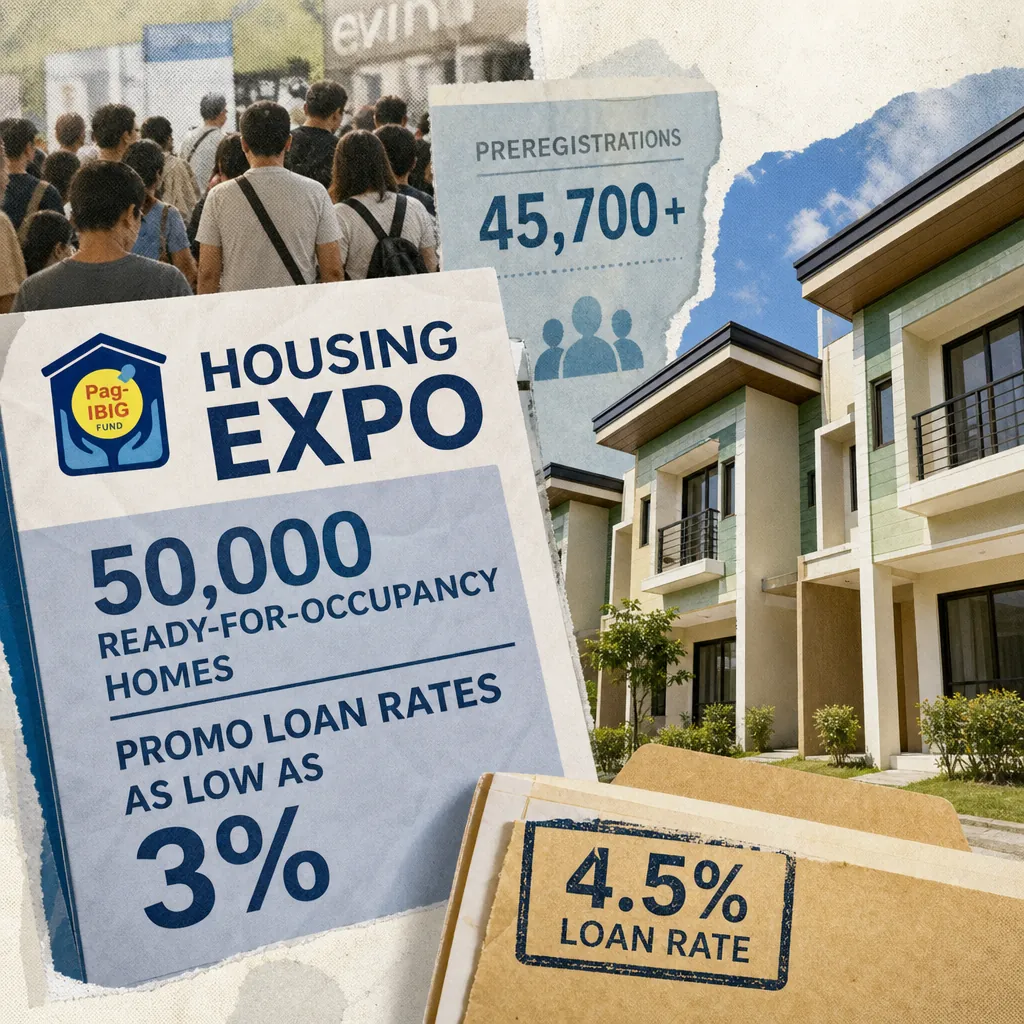
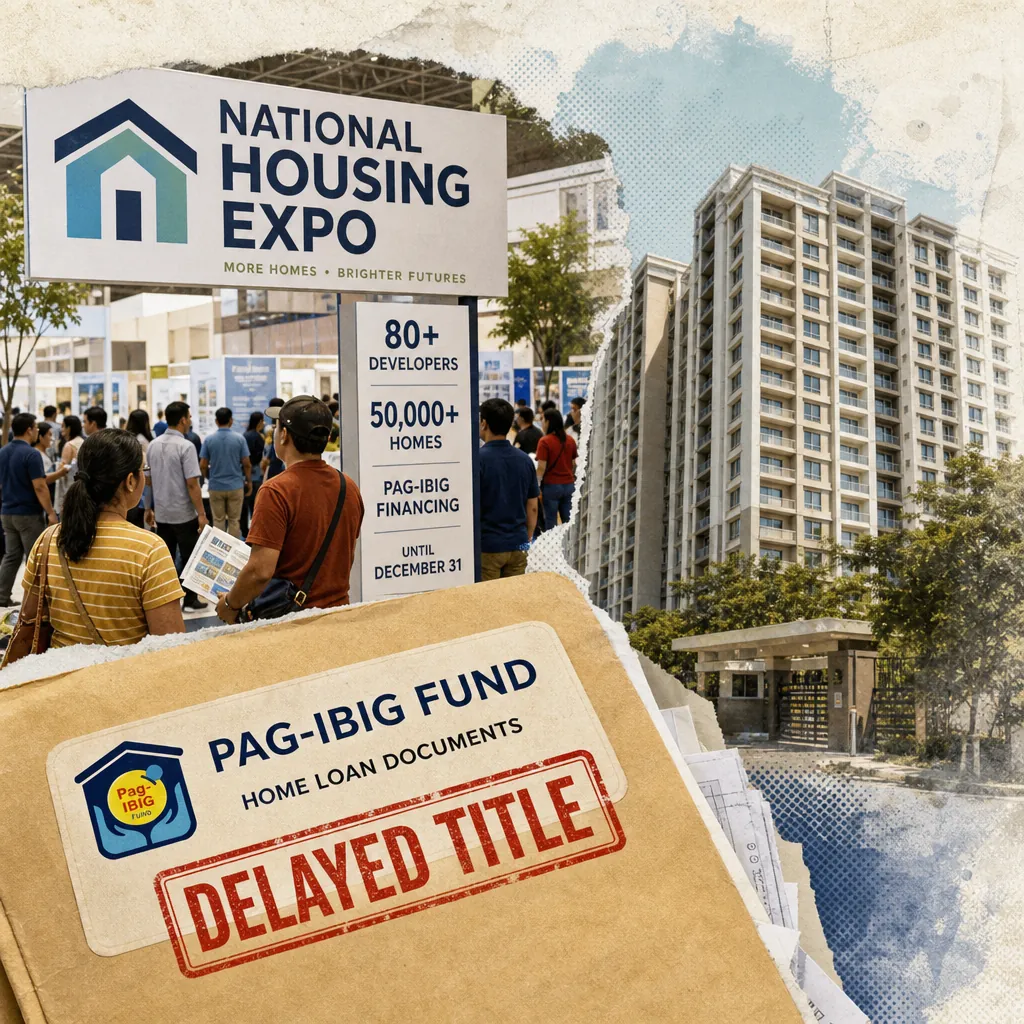
The second National Housing Expo opened with more than 80 developers offering over 50,000 homes and subsidized Pag-IBIG financing through December 31, while a buyer's delayed-title complaint against the state fund aired on GMA's 24 Oras. A Department of Justice opinion on agrarian reform and a Senate bill exempting subdivision common areas from property tax also moved through the property conversation.
The Conversation
More than 80 developers put over 50,000 homes on the floor of the SMX Convention Center in Pasay City when the Department of Human Settlements and Urban Development (DHSUD) and Pag-IBIG Fund opened the second National Housing Expo on October 19, and the financing terms attached to those units are the part that matters beyond the two-day event: a 3% subsidized rate for qualified socialized housing buyers, and promotional rates of 4.5% a year for loans up to ₱4.9 million and 5.75% for loans up to ₱10 million, both fixed for three years on applications filed from July 1 to December 31, 202610. Inquirer.net reported that more than 40,000 home seekers were expected across the run, more than double the 20,000 who attended the previous year, an organizer estimate rather than a count10. State broadcaster PTV carried the opening and the two-day figure of about 50,000 units67, ABS-CBN's TV Patrol framed the event around helping families find affordable homes8, and UNTV's October 21 report put the developer count above 809.
The same week, a Pag-IBIG buyer took a different kind of housing story to television. A member of the state housing savings agency told GMA Network's 24 Oras on October 19 that a foreclosed property he bought from Pag-IBIG in Cavite had gone years without its title being released, a complaint aired through the newscast's Kapuso Action Man segment1. The segment drew 3,034 views, 11 likes and 7 comments on GMA's YouTube channel as of that date1, and it carried no visible response from Pag-IBIG in the material reviewed.
Neither the expo nor the titling complaint generated much public interaction online. The TV Patrol upload of the expo report had 1,433 views and the UNTV report 1,477, while a separate PTV segment had 104897. The day's property conversation therefore ran mostly through institutional channels — state broadcasters, a broadsheet business page, and a network newscast's consumer-help slot — rather than through viral posts. The most consequential items in the set were policy and financing decisions whose effects will be felt in loan applications and land titles over the next several months, not in the size of any single post's audience.
Key themes
- The National Housing Expo opened with over 80 developers and about 50,000 homes on offer. DHSUD and Pag-IBIG Fund staged the second edition at the SMX Convention Center in Pasay City from October 19, with SMDC, Amaia Land, Avida Land, DMCI Homes, Filinvest Land, Megaworld Corporation, PH1 World Developers, Robinsons Land and Rockwell Land among the participants10. Organizers expected more than 40,000 home seekers across two days, double last year's 20,00010.
- Pag-IBIG's promotional rates expire for applications filed after December 31, 2026. The 4.5% rate for loans up to ₱4.9 million and the 5.75% rate for loans up to ₱10 million are fixed for three years but apply only to applications filed from July 1 to December 31, 202610. A separate 10-year 3% rate is offered to the first 30,000 borrowers under the Expanded 4PH Program16.
- A buyer's years-long wait for a Cavite title reached national television. The 24 Oras complaint aired October 19 and drew 3,034 views on YouTube1, putting state housing paperwork in the same reputational territory as developer turnover delays.
- A Department of Justice opinion opened a dispute over whether agrarian reform still applies to land transfers. Opinion No. 16, issued March 9, 2026 at the request of the Land Registration Authority, became the centre of an Inquirer analysis published October 21 on whether the Comprehensive Agrarian Reform Program (CARP) remains in force2. Farmer federations condemned the decision the same day, warning farm production could be affected3.
- A Senate bill would remove property tax on subdivision and condominium common areas. Senate Bill No. 2569, filed by Sen. Francis "Chiz" Escudero, seeks to amend Section 234 of Republic Act 7160, the Local Government Code of 1991, so that shared spaces such as hallways, lobbies and parks are no longer taxed.
- The Public Works department wants stormwater detention basins required in new developments. Secretary Vince Dizon announced the proposal after inspecting Megaworld Corp.'s 15,000-cubic-meter rainwater park in San Fernando, Pampanga, which the company plans to expand to 20,000 cubic meters.
- DHSUD awarded 160 certificates of entitlement to Cebu City families after more than two decades. Secretary Jose Ramon Aliling led the awarding to beneficiaries of the GMA Ville Lot 110 Housing Project in Barangay Carreta, under the Expanded 4PH Program60.
- Ready-for-occupancy inventory is being pushed through discounts and financing terms. An RLC Residences listing for Acacia Escalades in Pasig offered 6% and 7% discounts on 5% and 10% down payment schemes, with Pag-IBIG financing at 4.5% fixed until December 202618.
How the narratives stack
Dominant. The National Housing Expo and the financing terms attached to it dominated the captured coverage by volume and by institutional weight. It drew the most items in the set — PTV's opening report and a second segment, TV Patrol, UNTV, an Inquirer.net business article, and an ABS-CBN explainer on the Expanded 4PH Program67891012 — and it is the only story in the set with a fixed, dated consequence: the December 31 cutoff for the promotional rates10. The dominance is a property of this captured set, which leaned toward state broadcasters and business pages; the expo's own online audience was small, with the TV Patrol upload at 1,433 views and the UNTV report at 1,47789.
Counter-narrative. The Pag-IBIG titling complaint sits directly against the expo's message of accessible homeownership. A buyer told 24 Oras that a foreclosed Cavite property bought from the agency went years without its title, and the segment carried no agency response1. The complaint drew modest engagement — 3,034 views, 11 likes, 7 comments1 — but it reached a national newscast's consumer-help segment, the route by which individual grievances about state housing paperwork become a recurring story.
Emerging. Two policy threads are forming without a resolution date. The Department of Justice's Opinion No. 16 has opened a public argument over whether CARP still governs land transfers, with farmer federations warning about farm production and an opinion piece asking whether the administration had "quietly" declared the program over234. Separately, the Public Works department's proposal to require stormwater detention basins in new commercial and residential developments would change what developers must build, and it is being developed with DHSUD into standard guidelines. Neither has produced a final rule.
Under-covered. The Senate bill removing property tax from subdivision and condominium common areas appeared in a single tabloid item in this set, and the Cebu certificate awarding drew one report60. Both affect household housing costs directly — the tax bill by removing a charge that residents pay through association dues, the Cebu awarding by formalizing title rights after decades — but neither drew the coverage the expo received.
Platform insights
- YouTube. State broadcasters and network newscasts carried the housing story here, and the audience figures were small across the board: 3,034 views for the 24 Oras titling complaint1, 1,480 for PTV's Bicol land distribution report5, 1,477 for UNTV's expo report9, 1,433 for TV Patrol's8, and 104 for a separate PTV expo segment7. The pattern is that institutional video publishes reliably and travels little; the titling complaint drew more than twice the views of the expo coverage on the same platform, which suggests consumer grievance travels further than promotional housing news.
- Reddit. A single listing in r/PhilippineRealEstate offered a three-bedroom house and lot in Pulung Cacutud, Angeles City, for ₱10,000,000 cash or bank financing, with free site tripping, and drew 2 likes and 1 comment19. The subreddit functions as a classifieds board for resale and direct-seller inventory rather than a discussion forum in this set.
- Facebook. Facebook appears in the set as an advisory channel rather than a property channel: the Talisay municipal disaster office used a Facebook post at 2:45 p.m. on October 22 to advise residents on precautions as the heat index reached 41 degrees Celsius49. No property-sector Facebook post carried measurable engagement in the material reviewed.
Key voices and communities
DHSUD and Pag-IBIG Fund leadership. Secretary Jose Ramon P. Aliling, who also chairs the Pag-IBIG Fund board, framed the expo as the execution of President Ferdinand Marcos Jr.'s directive to make homes accessible: "Our biggest-ever National Housing Expo is a concrete manifestation of this shared commitment"10. Pag-IBIG Chief Executive Officer Marilene C. Acosta pitched the fund's reach: "From minimum-wage earners to middle-income families, we want more Filipino workers to have a real opportunity to own a home"10. Their framing sets the government's public position that subsidized financing is the main lever on the housing gap.
Listed developers. SMDC, Amaia Land, Avida Land, DMCI Homes, Filinvest Land, Megaworld, PH1 World Developers, Robinsons Land and Rockwell Land took part in the expo10, and Robinsons Land and Filinvest Land have separately signed on as partner developers under the Expanded 4PH Program1314. Their participation signals that the government's affordable housing program has become a sales channel for listed builders, not just a state welfare scheme.
Farmer federations and agrarian reform advocates. Farmer groups condemned the Department of Justice opinion on October 21, warning that farm production could be affected3, and an opinion piece asked whether the administration had quietly ended agrarian reform4. This community is the main organized opposition to any reading of Opinion No. 16 that narrows CARP's reach.
Consumer-help segments and individual buyers. The 24 Oras Kapuso Action Man segment gave a Pag-IBIG buyer a national platform for a titling complaint1. This is the channel through which individual property grievances become public, and it operates outside the industry's own communications.
Sen. Francis "Chiz" Escudero. As chairman of the Senate Committee on Urban Planning, Housing and Resettlement, Escudero filed Senate Bill No. 2569 to remove property tax from common areas, arguing that "Hindi kumikita ang mga lugar na ito, pero binubuwisan pa rin. Sa huli, ang mga pamilyang nakatira roon ang sumasagot sa buwis, hindi ang developer". The bill puts a cost-of-ownership argument into the Senate's housing agenda.
Narrative streams
The expo put 50,000 homes and a December 31 rate deadline in one room
The second National Housing Expo opened October 19 at the SMX Convention Center with more than 80 partner developers offering over 50,000 homes, many ready for occupancy10. PTV's October 20 report by Angelika Abrogar described thousands of housing choices being brought closer to buyers11, and ABS-CBN's Patrol ng Pilipino published an explainer on October 21 on who qualifies for the Expanded 4PH Program, presented by Andrea Taguines12. The Expanded 4PH Program — Pambansang Pabahay para sa Pilipino — is the Marcos administration's flagship housing initiative, aimed at narrowing a reported 6.5 million housing gap by 2028, with subsidized units and loan support from Pag-IBIG for informal settler families, low-income earners, government employees and overseas Filipino workers100.
The financing is the operative detail. Qualified socialized housing buyers get a 3% subsidized rate; other buyers get 4.5% a year on loans up to ₱4.9 million and 5.75% on loans up to ₱10 million, fixed for three years, on applications filed from July 1 to December 31, 202610. Pag-IBIG is also offering a 10-year 3% rate to the first 30,000 4PH borrowers16, and one report frames the subsidies as a response to a prolonged residential property downturn17. For developers holding unsold inventory, the December 31 cutoff is a deadline to convert buyers into applications; for buyers, it is the difference between a fixed promotional rate and whatever the fund offers next. Expect developer announcements to cluster ahead of the cutoff, since the rate applies only to applications filed within it10. Whether the expo's 40,000 attendance estimate holds is not yet established; no post-expo count has been published.
A buyer's years-long wait for a Cavite title reached 24 Oras
The titling complaint is the counterweight to the expo's message. A Pag-IBIG Fund member told GMA's 24 Oras that a foreclosed property he bought from the agency in Cavite had gone years without its title being released, and the segment aired October 19 through Kapuso Action Man1. The report carried no visible response from Pag-IBIG in the material reviewed1. The engagement was modest — 3,034 views, 11 likes and 7 comments on YouTube1 — but the significance is in the channel: a network newscast's consumer-help slot is where individual grievances about state housing paperwork become a recurring story, and more buyer complaints are likely to follow the same route1.
For the sector, the complaint puts Pag-IBIG's back-office performance in the same reputational territory as developer turnover delays1. Developers who market Pag-IBIG financing as a selling point inherit some of that risk: a buyer who cannot get a title from the state fund is a buyer who may hesitate on a Pag-IBIG-accredited unit. The practical response for property firms is to confirm their own title-release timelines and brief buyers on them, because the report shows buyers will take delays to television1.
A Department of Justice opinion reopened the question of whether agrarian reform still applies
Opinion No. 16, issued March 9, 2026, answered a question from the administrator of the Land Registration Authority on whether a Department of Agrarian Reform ruling still stood2. Inquirer published an analysis on October 21 placing the opinion at the centre of a debate over whether the Comprehensive Agrarian Reform Program — the decades-old land redistribution programme — remains in force2. Farmer federations condemned the decision the same day, warning that farm production could be affected, according to Bombo Radyo3. An opinion piece asked: "Did the BBM administration quietly declare that our agrarian reform program is over?"4
The same day, state broadcaster PTV reported that more than 1,000 farmers in Bicol received land of their own from the Department of Agrarian Reform, a separate development in the same agency's land distribution work; that item drew 1,480 views on PTV's YouTube channel5. The two stories sit awkwardly together: the agency is still distributing land while its legal framework is being questioned. For anyone with agricultural holdings or land-conversion plans, the opinion is a title risk — a transfer that depends on whether CARP still governs it carries uncertainty until Congress or the Department of Agrarian Reform responds, and whether either will is not established2.
A Senate bill would take property tax off subdivision and condominium common areas
Senate Bill No. 2569, filed by Sen. Francis "Chiz" Escudero, seeks to amend Section 234 of Republic Act 7160, the Local Government Code of 1991, to remove real property tax on common areas in residential subdivisions and condominiums. The current practice of taxing shared spaces such as hallways, lobbies, parks and other facilities effectively raises the cost of owning a home, Escudero argued, because the tax is passed to residents through monthly association dues rather than absorbed by the developer. "Hindi kumikita ang mga lugar na ito, pero binubuwisan pa rin. Sa huli, ang mga pamilyang nakatira roon ang sumasagot sa buwis, hindi ang developer," he said.
For developers and condominium corporations, the bill would change how common areas are carried on the balance sheet and how association dues are computed. For local government units, it would remove a small but recurring revenue line. The bill has been filed, not passed; its progress through the Senate Committee on Urban Planning, Housing and Resettlement, which Escudero chairs, is the next checkpoint.
Public Works wants stormwater detention basins built into new developments
The Department of Public Works and Highways will propose requiring private real estate developers nationwide to build stormwater detention basins under updated building and land development codes to help reduce flooding, Secretary Vince Dizon said. Dizon announced the proposal after inspecting Megaworld Corp.'s 15,000-cubic-meter rainwater park in San Fernando, Pampanga, which he said helps manage flooding in the company's Capital Town development and nearby communities; Megaworld plans to expand it by 5,000 cubic meters through an underground detention structure, bringing total capacity to 20,000 cubic meters. Dizon said stored rainwater could also be recycled for non-potable uses during dry spells, and that he had coordinated with DHSUD to develop standard guidelines requiring water-retention facilities in new commercial and residential developments. The rainwater park is being positioned as a model for public parks and open spaces nationwide, following an order from President Marcos to work with the private sector on flooding solutions.
For developers, the proposal would add a construction cost and a design requirement to new projects, and it would make stormwater capacity a selling point in flood-prone areas. For homebuyers in low-lying districts, it is the difference between a subdivision that drains and one that does not. The proposal is not yet a rule; the guidelines are still being drafted with DHSUD.
DHSUD handed 160 Cebu families certificates after more than two decades
DHSUD awarded Certificates of Entitlement to 160 urban low-income families in Cebu City on Thursday, recognizing beneficiaries of the GMA Ville Lot 110 Housing Project in Barangay Carreta after more than two decades of uncertainty60. Secretary Aliling led the awarding, organized by the DHSUD Regional Office 7 with the National Housing Authority and the Cebu City government, and said the certificates would give beneficiaries greater peace of mind and help them live with dignity60. The certificates are not land titles in the full sense; they are the state's recognition of a beneficiary's right to a lot, a step toward securing title. The story matters because it shows the same agency that is marketing new units at an expo is still clearing a backlog of old ones, and because it puts a number — 160 families, two decades — on how long that clearing takes.
Ready-for-occupancy inventory is moving on discounts and financing terms
An RLC Residences listing posted October 20 offered ready-for-occupancy units at Acacia Escalades, a two-tower condominium on Amang Rodriguez Avenue in Manggahan, Pasig City, with Pag-IBIG financing available for Tower B18. A 26.42-square-meter studio carried a total contract price of ₱5,438,000, a 32.02-square-meter one-bedroom ₱5,986,000, and a 48.02-square-meter two-bedroom ₱8,110,30018. A 5% down payment option gives a 6% discount and immediate move-in, a 10% down payment option gives a 7% discount, and a lease-to-own plan spreads the full price over 120 months with no bank financing18. The 5% scheme requires buyers to settle the 80% balance through bank or Pag-IBIG financing by the 13th month, and the 4.5% Pag-IBIG rate is stated as fixed only until December 202618. The listing drew 5 views and no comments18.
A separate Reddit listing offered a three-bedroom house and lot in Pulung Cacutud, Angeles City, Pampanga, for ₱10,000,000 cash or bank financing, on a 155-square-meter lot near the NLEX Angeles exit, with free site tripping; it drew 2 likes and 1 comment19. Both listings lean on financing terms rather than new launches, which suggests resale and ready-for-occupancy inventory is being pushed through discounts1819. For developers holding unsold stock, the tactic is likely to spread; for buyers, the discount is real but the financing deadline is not, and the 4.5% rate expires for applications after December 31, 202618.
Conversation trajectory
December 31, 2026 — the promotional rate cutoff. The 4.5% and 5.75% Pag-IBIG rates apply only to applications filed from July 1 to December 31, 202610. Watch for developer announcements and buyer inquiries to cluster in November and December, and for Pag-IBIG to signal what replaces the rates. The checkable signal is the volume of loan applications filed before the cutoff, which Pag-IBIG has not yet published.
November 2026 — the Lake County-style pattern does not apply here, but the Senate bill's committee schedule does. Senate Bill No. 2569 has been filed and referred to the Senate Committee on Urban Planning, Housing and Resettlement. A committee hearing or a counterpart House bill would be the next observable step; no schedule has been published.
First quarter of 2027 — the Department of Justice opinion's legislative response. Whether Congress or the Department of Agrarian Reform responds to Opinion No. 16 is not established2. Watch for a DAR statement, a Land Registration Authority circular, or a bill clarifying CARP's status. Any of these would resolve the title uncertainty the opinion created.
Ongoing — the titling complaint's follow-on. The 24 Oras segment aired October 19 with no Pag-IBIG response1. Watch for a second buyer complaint on the same route, or for Pag-IBIG to issue a statement on title-release timelines. A pattern of complaints would move the story from a single grievance to a service-reputation issue.
Next year — the Public Works guidelines. The stormwater detention proposal is being developed with DHSUD into standard guidelines. Watch for the draft guidelines, which would show whether the requirement applies to all new developments or only to projects above a size threshold.
Trigger events. A Pag-IBIG statement on the Cavite complaint; a DAR or Land Registration Authority circular on Opinion No. 16; a Senate committee hearing on Senate Bill No. 2569; the release of post-expo attendance and loan-application figures; and the December 31 rate cutoff itself.
Response guidance
Brief property clients on the December 31 rate cutoff now. The 4.5% and 5.75% promotional rates apply only to applications filed from July 1 to December 31, 202610. Buyers who are considering a purchase should be told the deadline and the documentation timeline, because a missed cutoff changes the cost of the loan for its full term.
Treat 4PH participation as a competitive positioning point, and confirm who has signed on. Robinsons Land and Filinvest Land have joined as partner developers1314, while others so far only exhibited at the expo10. Developers should state their 4PH status plainly in marketing, because buyers are comparing accredited projects.
Prepare a title-release answer before a buyer takes it to television. The 24 Oras complaint shows that a years-long wait for a title can reach a national newscast1. Developers and Pag-IBIG-accredited sellers should be able to state their title-release timeline and the steps a buyer can take if it slips.
On agrarian reform, avoid definitive statements until the legal position is clear. Opinion No. 16 has opened a dispute over whether CARP still applies to land transfers2, and farmer federations have condemned it3. Anyone with agricultural holdings or conversion plans should get a legal read on the opinion before marketing or transferring land.
On the common-area tax bill, frame the argument around household cost. Senate Bill No. 2569 would remove real property tax on shared spaces, which residents currently pay through association dues. Developers and condominium corporations should be ready to explain how the change would affect dues, without overstating the savings.
On stormwater requirements, get ahead of the design cost. The Public Works proposal would require detention basins in new developments. Developers should assess which projects would need them and whether the capacity can be marketed as a flood-protection feature.
On the expo's audience, do not overstate reach. The expo's online audience was small — 1,433 views for TV Patrol's report, 1,477 for UNTV's89 — and the 40,000 attendance figure is an organizer estimate10. Communications should rely on the financing terms and the developer list, not on claims of mass engagement.
See the full picture behind today's signals.
This report draws from Media Meter's MediaWatch, our real-time monitoring engine tracking 2,470+ Philippine sources across print, broadcast, digital, and social. Explore how the platform turns raw coverage into decision-grade intelligence, then see how it's configured for teams like yours — whether you're in PR agencies, corporate comms, government, or marketing.
Want more? Browse our Report Library for sector and crisis intelligence, or request a demo and we'll have your brand set up before the call.
Want this kind of intelligence on your brand?
This brief is built on the same MediaWatch methodology that runs continuously across every brand we monitor. See your competitive landscape, Impact Score, and narrative trajectory in a 30-minute demo.