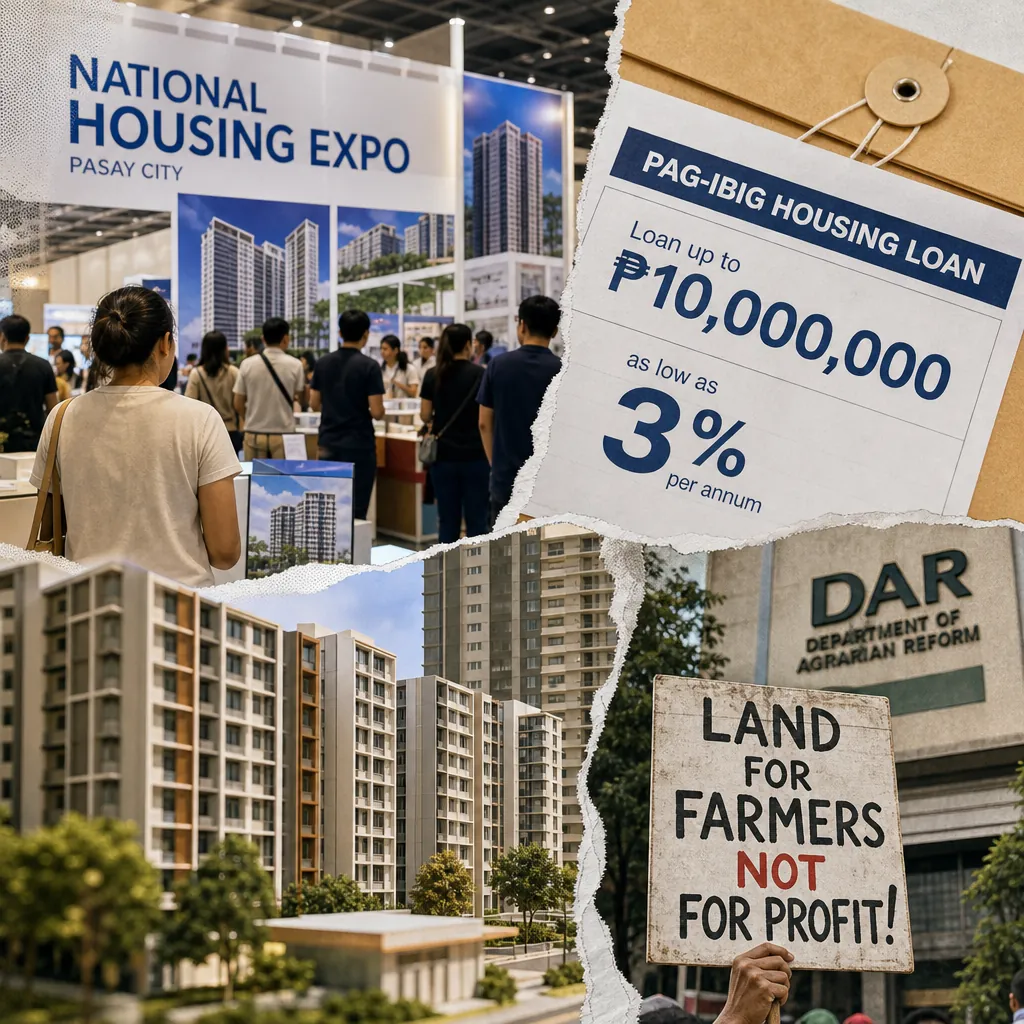
Pag-IBIG Opens Expo With 50,000 Homes, 4.5% Loans
Pag-IBIG Fund and the housing department opened a two-day expo offering about 50,000 ready-for-occupancy units and promotional loan rates as low as 3 percent, drawing more than 45,700 preregistrations. Developers are working through a pre-sales decline that S&P Global Ratings expects to last into the second half of 2027.
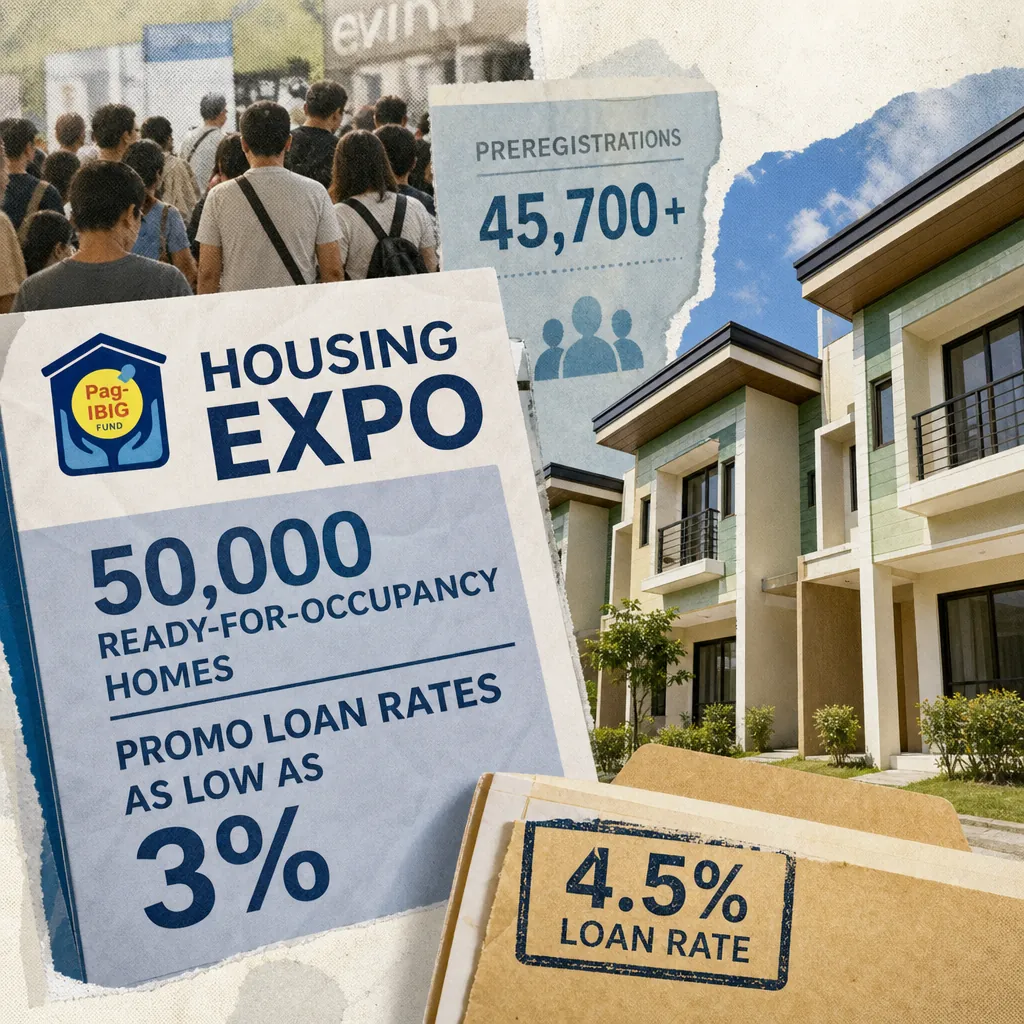
The 2nd National Housing Expo 2026 opened on October 19 at the SMX Convention Center in Pasay City with more than 80 private developers offering roughly 50,000 ready-for-occupancy units, and by the following day more than 45,700 homeseekers had preregistered for the two-day run644. That is more than double the roughly 20,000 who attended the first edition, and developer participation doubled from about 40 firms5. President Ferdinand Marcos Jr. walked the hall on opening day with Department of Human Settlements and Urban Development (DHSUD) Secretary Jose Ramon Aliling and Pag-IBIG Fund chief executive officer Marilene Acosta1. State broadcaster PTV and ABS-CBN's TV Patrol carried the opening the same day34.
The draw was the financing. Pag-IBIG, the state-run savings and home-loan institution that collects mandatory contributions from workers and their employers, put three promotional rates on the table: 3 percent for socialized housing, 4.5 percent for loans up to ₱4.9 million, and 5.75 percent for loans up to ₱10 million5. Acosta said the 4.5 and 5.75 percent tiers apply to qualified applications submitted until December 31, 20261. One featured offer was a 32-square-meter house on a 30-square-meter lot priced at about ₱800,000, with monthly amortization of around ₱2,900 over 30 years1.
The business pages on October 20 supplied the reason for the generosity. The Manila Times and the Manila Bulletin both reported that the subsidies answer a residential downturn expected to run until late 2027, citing S&P Global Ratings figures showing combined pre-sales at Ayala Land, SM Prime Holdings, Robinsons Land and Megaworld fell 7 percent year-on-year in the first half of 202678. S&P analyst Johann Tan said recovery would likely be pushed to the second half of 20277. Acosta attributed the decline to high inflation, elevated interest rates, rising material costs and an oversupply of condominium units in Metro Manila and nearby hubs, and said Pag-IBIG is also cutting prices by up to 30 percent on selected acquired assets to move unsold inventory78.
Key themes
- More than 45,700 preregistrations, double the first expo's turnout. Pag-IBIG reported the figure on October 20, up from about 20,000 attendees at the inaugural edition, with developer participation doubling to more than 80 firms65. Preregistration measures intent to attend, not purchases.
- Loan rates of 3, 4.5 and 5.75 percent carry a December 31, 2026 cutoff. The tiers cover socialized housing, loans up to ₱4.9 million and loans up to ₱10 million respectively, and the promotional rates apply only to qualified applications filed by that date15.
- Pre-sales at the four largest listed developers fell 7 percent year-on-year in the first half of 2026. The S&P Global Ratings figure covers Ayala Land, SM Prime, Robinsons Land and Megaworld, and the same analysis puts recovery in the second half of 202778.
- Pag-IBIG is discounting its own inventory by up to 30 percent. The price cuts on selected acquired assets — units the fund took back after borrowers defaulted — are a separate lever from the loan subsidies and target unsold stock directly8.
- DHSUD says licenses to sell are at their highest since 2022. Aliling's statement means new supply is still entering the market even as buyers hold back, which is the mechanism behind the oversupply Acosta described8.
- A ₱800,000 unit amortizes at about ₱2,900 a month over 30 years. The expo's featured offer puts the entry price of a Pag-IBIG-financed home below what many Metro Manila households pay in rent, which is the comparison the marketing leans on1.
- A bank and a developer moved separately to make overseas payments easier. Bank of the Philippine Islands and DMCI Homes launched a collection arrangement letting US-based buyers pay amortizations from their American bank accounts, the same week the expo courted buyers1335.
How the narratives stack
Dominant. The expo and its loan tiers carried the day across the items gathered here. Coverage ran from state broadcast (PTV) and the country's largest network (ABS-CBN's TV Patrol) to the Philippine News Agency's social accounts, the Manila Times photo desk, the Manila Bulletin, the Daily Tribune and the Philippine Star's regional and business pages3462844. The Manila Times and Manila Bulletin business stories tied the subsidies to the S&P pre-sales decline, which gave the event a policy rationale beyond a sales fair78. Within this set, the expo is the only housing story that drew both broadcast attention and front-of-business-page treatment.
Counter-narrative. The strongest qualifying note comes from Pag-IBIG's own regional office. At a Kapihan sa PIA Western Visayas session in Iloilo City on Tuesday, Western Visayas area head Atty. Stanley Alayon reported ₱4.884 billion in housing loans released across the region from January to August 2026 to 3,679 members, against 557,216 active members, and said the agency still faces "a huge gap" in persuading members to borrow79. That is a take-up problem sitting underneath a demand problem: the fund has members and money, and most of them are not borrowing.
Emerging. The payment-rail story. BPI's Overseas Collection Arrangement, with DMCI Homes as its first property-developer user, lets US-based buyers enroll their American bank accounts through a link the developer sends after contract signing, with payments debited automatically and settled to DMCI Homes13355748. The arrangement was reported by the Manila Times, the Inquirer (twice, including its PLUS business vertical) and the Daily Tribune, which is wide pickup for a collections product13355748. It matters because overseas Filipino remittances are a standing source of property demand, and the friction it removes is the recurring hassle of wiring each amortization.
Under-covered. Local government housing policy. Iloilo City signed its Comprehensive Iloilo City Local Housing Code of 2026, known as the PASILONG Code, institutionalizing the Treñas administration's Pabalay Para sa Pamilyang Ilonggo program with provisions on security of tenure, livelihood, skills training and access to education and health services56. It appeared in one provincial outlet. The same is true of the legal question of whether a mayor can order demolition of a house built without a permit, addressed in a Manila Times legal-advice column explaining that the power under the Local Government Code of 1991 is not absolute80. Both speak to the same constituency the expo is courting — households at the bottom of the market — and neither traveled beyond its original outlet.
Platform insights
- Facebook. The heaviest single engagement figure in the writeup belongs to a Pag-IBIG post on October 20 describing close to 40,000 registered buyers, which drew 19 comments1. The number is modest next to the preregistration total, which suggests the audience was consuming the announcement rather than discussing it. The government's own broadcast arms did the distribution work: the PTV-sourced ConnectV post and the RP World Service post both carried the opening, the developer count and the loan tiers, and RP World Service also carried Aliling's quote in Filipino15.
- X. The Philippine News Agency's account carried the 45,700 preregistration figure, making the platform the fastest route to the hard number on October 206. Engagement on the post is not reported in the writeup, so the platform's role here is distribution of an official statistic rather than visible public argument.
- YouTube. PTV and ABS-CBN's TV Patrol both posted their expo segments to YouTube, and a separate clip covered the expo's closing on October 20349. Video is where the visual scale of the event — the hall, the booths, the crowd — was communicated, and it is the medium most likely to reach viewers who never read a business page.
- Reddit. No Reddit activity appears in the writeup for this topic. The discussion that did form around housing policy in the captured items ran through comment threads on Facebook and through the opinion pages rather than through forum threads.
Key voices and communities
Pag-IBIG Fund and DHSUD. The two agencies set the terms of the entire conversation: the rates, the cutoff date, the inventory discounts and the framing of the expo as a national housing program rather than a trade fair. Acosta supplied the diagnosis of the downturn; Aliling supplied the supply-side statistic and the credibility argument, telling the opening that what the sector needs is "isang credible na housing program na pagtitiwalaan ng ating mga stakeholders kasama ang mga developers at homebuyers" — a credible housing program that stakeholders, including developers and homebuyers, can trust5.
The developers. More than 80 firms put units on the floor, and the four largest listed players are the ones whose numbers S&P tracks78. Their interest in the expo is straightforward: pre-sales are down 7 percent year-on-year across the group in the first half, and a subsidized rate is the cheapest demand stimulus available to them without cutting list prices.
Homeseekers and OFW buyers. The 45,700 preregistrations are the visible constituency, and the BPI–DMCI arrangement identifies a specific slice of it: Filipinos abroad paying amortizations from foreign accounts613. This group reads rate announcements in pesos-per-month terms, which is why the ₱2,900 amortization example travels further than the percentage1.
Local government units. Iloilo City's PASILONG Code and the Manila Times legal column on demolition orders represent the layer of housing policy that determines whether a family keeps a home after it buys one5680. Their absence from the national conversation is a gap in the coverage, not evidence that the layer is unimportant.
Analysts and the business press. S&P's Johann Tan and the business desks of the Manila Times and Manila Bulletin supplied the number that reframed the expo from a consumer event into a sector response78.
Narrative streams
Pag-IBIG prices its loans at 3 to 5.75 percent with a December 31 cutoff
The three-tier structure is the substance of the expo. Socialized housing — the government's category for the cheapest units, built under the Expanded Pambansang Pabahay para sa Pilipino (4PH) program, which subsidizes mass housing for low-income families — carries 3 percent44. Loans up to ₱4.9 million carry 4.5 percent, and loans up to ₱10 million carry 5.75 percent5. Acosta's statement that the promotional rates apply to qualified applications submitted until December 31, 2026 sets a hard deadline that no other element of the expo carries1.
For a buyer, the tiering matters more than the headline. Most mid-market condominium and subdivision units in Metro Manila and its surrounding provinces fall inside the ₱4.9 million bracket, which means the 4.5 percent rate is the one that applies to the largest share of the inventory on the expo floor1. The gap between 4.5 and 5.75 percent is the difference between a unit that qualifies for the middle tier and one that does not, and it is decided by list price, not by the buyer's income.
For developers, the cutoff creates a selling window of roughly ten weeks. A rate that expires is a rate that can be used to close a sale now, and the industry's marketing machinery is built to convert deadlines into reservations. Whether that produces signed loan applications or merely reservations is the open question; Pag-IBIG has not said how many expo reservations converted to actual loan applications.
Pre-sales at the four largest developers fell 7 percent, and recovery is pushed to late 2027
The S&P Global Ratings analysis reported by the Manila Times and the Manila Bulletin is the clearest statement of the problem the subsidies address. Combined pre-sales at Ayala Land, SM Prime Holdings, Robinsons Land and Megaworld — the four largest listed property developers — fell 7 percent year-on-year in the first half of 202678. Pre-sales are contracts signed for units not yet built, and they are the industry's leading indicator: they determine construction schedules, cash flow and land banking two to three years out.
Acosta's explanation names four causes: high inflation, elevated interest rates, rising material costs and an oversupply of condominium units in Metro Manila and nearby hubs7. The oversupply point is the one that connects to Aliling's statement that the sector logged its highest volume of licenses to sell since 20228. A license to sell is the Housing and Land Use Regulatory Board permit that allows a developer to market and sell units before completion; a record volume of them means new projects are still being launched into a market that is already carrying unsold stock.
S&P's Johann Tan expects recovery in the second half of 20277. That timeline sits behind the December 31 cutoff: the promotional rates are a bridge across roughly a year of weak demand, and whether they are extended past that date is the single question that determines how much of the bridge actually gets built.
Pag-IBIG discounts repossessed units by up to 30 percent to clear inventory
The price cuts on acquired assets are the least discussed and most concrete part of the package. Acquired assets are properties Pag-IBIG has taken back after borrowers defaulted — the fund's own inventory of unsold homes — and a discount of up to 30 percent on selected units is a direct markdown, not a financing incentive8.
For buyers, these units carry different risks from new-build purchases: they are finished, they can be inspected, and they are priced below the market the developers are defending. For the fund, the discount converts dead stock into cash and removes the carrying costs of maintaining vacant properties. For developers, the discount is competition at the low end of the market from a government seller with no construction cost to recover.
The two levers work in opposite directions on price. The loan subsidy supports the price developers can charge by lowering the monthly payment; the asset discount undercuts it. Pag-IBIG is running both at once, which is what a lender does when it wants the market to move rather than to hold its level.
More than 45,700 preregistrations show demand exists at the subsidized price
The turnout figure is the strongest evidence in the day's material that the constraint on the market is affordability rather than appetite. More than 45,700 homeseekers preregistered for a two-day event, against about 20,000 at the first expo, and developer participation doubled from about 40 firms to more than 8065. A Pag-IBIG post on October 20 described close to 40,000 registered buyers and drew 19 comments1.
The gap between the two figures — 45,700 preregistrations reported by the Philippine News Agency and close to 40,000 registered buyers in Pag-IBIG's own post — is not explained in the writeup, and the difference may reflect the timing of each count or a distinction between preregistration and registration on site. Either way, both numbers measure interest expressed before any loan is approved, and neither is a sale.
The read for the sector is that the demand is real but price-sensitive at a specific level. The featured ₱800,000 unit with a ₱2,900 monthly amortization is the offer that makes the arithmetic work for a household earning around the minimum wage, and it is the segment where the 3 percent socialized rate applies1. Developers holding inventory above ₱5 million are not competing for this crowd, and the expo's turnout says little about their prospects.
BPI and DMCI Homes open a payment rail for US-based buyers
The Overseas Collection Arrangement is a small product with a specific use. A buyer signs a contract with DMCI Homes and agrees an amortization schedule; the developer sends a payment link; the buyer enrolls a US bank account; payments are then debited automatically and settled to DMCI Homes, with collection and settlement reports matching payments against expected receivables13355748. DMCI Homes is the first property developer to use it13.
The friction it removes is real. A Filipino abroad paying a Philippine mortgage from a US account typically arranges each transfer separately, absorbs remittance fees and foreign-exchange spreads, and waits days for the payment to land. Automating the debit turns a monthly chore into a standing instruction and gives the developer predictable collection dates.
For the sector, the significance is that overseas buyers are being treated as a core customer segment rather than a seasonal one. The Philippine property market has long relied on Filipino workers abroad for a meaningful share of demand, and the banks that build the rails for them are positioning for the segment's next decade. Whether other developers follow DMCI Homes onto the arrangement is the indicator to watch; BPI has not said which firms are in discussion.
Local governments write their own housing rules while the national program runs
Iloilo City's PASILONG Code and the Manila Times legal column on demolition orders describe the layer of housing policy that operates after the sale. The Iloilo ordinance gives the city's Pabalay Para sa Pamilyang Ilonggo program a permanent legal framework and extends it beyond house construction to security of tenure, livelihood opportunities, skills training, community organizing and access to education and healthcare56. Mayor Raisa S. Treñas framed it in Hiligaynon: "Importante nga may ara kita sang clear policies and legal framework para sa mas maayo kag organisado nga implementation sang aton housing programs" — it matters that we have clear policies and a legal framework for better and more organized implementation of our housing programs56.
The legal column addresses the other end of the same question. A mayor has authority under the Local Government Code of 1991 to require owners of illegally constructed houses to secure permits, make modifications or demolish, but the column explains that the power is not absolute and is bounded by the law's procedures80. For a household that built without a permit — a common situation in informal settlements — the difference between a valid and an invalid demolition order is the difference between losing a home and keeping it.
These stories matter to the sector because the national program's success depends on local implementation. A family that buys a unit under a 3 percent loan still needs a local government that issues titles, provides services and does not demolish the house next door without due process. The read for developers and lenders is that local government capacity is a risk factor in any project outside the major metros, and it is rarely priced in.
Conversation trajectory
December 31, 2026 — the promotional rate cutoff. Applications for the 4.5 and 5.75 percent tiers must be submitted by this date to qualify1. Expect a concentration of loan applications in the final weeks and a corresponding rise in developer marketing around the deadline. The checkable signal is Pag-IBIG's announcement, before or after the date, of whether the rates are extended.
Fourth-quarter 2026 and first-half 2027 pre-sales reports. The S&P analysis covers the first half of 20267. The next set of developer pre-sales disclosures will show whether the subsidized rates moved contracts or merely reservations. Watch the same four developers — Ayala Land, SM Prime, Robinsons Land and Megaworld — because their combined figures are the basis of the 7 percent decline.
The next S&P or comparable rating-agency update on Philippine property. Tan's second-half-2027 recovery call is a forecast with a date attached7. A revision in either direction would reset expectations for how long the subsidies need to run.
Pag-IBIG's conversion data. The fund has not said how many expo reservations became loan applications. Any release of that figure, or of monthly housing-loan releases for the fourth quarter, will be the first hard measure of whether the expo produced borrowing rather than browsing.
BPI's next developer client for the overseas collection arrangement. DMCI Homes is the first user13. A second developer signing on would indicate the product is spreading; a long gap would suggest the integration cost is high.
Local housing ordinances through the rest of 2026. Iloilo City's PASILONG Code took effect this month56. Similar ordinances in other cities would signal that local governments are building permanent housing frameworks ahead of the national program's next phase.
Response guidance
Lead with the monthly payment, not the rate. For consumer-facing communication, the ₱2,900 amortization on an ₱800,000 unit is the figure that makes the offer legible to a household that does not calculate interest1. Pair every rate mention with the peso-per-month equivalent for a representative unit in that tier.
State the December 31 cutoff in every rate message. The deadline is the only element of the offer with a fixed expiry, and buyers who learn of it late will attribute the missed rate to the lender or developer rather than to their own timing1. Put the date in the first paragraph, not the fine print.
Separate preregistration from purchase in internal reporting. The 45,700 figure measures interest expressed before any loan approval6. Presenting it as demand fulfilled will misstate the pipeline to management and to partners; track reservations, loan applications and approvals as three distinct stages.
Prepare for the post-deadline question. Buyers will ask in January whether the rates will return. Have a holding statement ready that does not promise an extension and does not rule one out, and route the question to Pag-IBIG rather than answering it at the developer level.
Treat overseas buyers as a year-round segment. The BPI–DMCI arrangement removes the monthly friction of paying from abroad13. Communication aimed at Filipino communities in the United States should lead with the mechanics of enrollment and the elimination of per-payment remittance costs, not with lifestyle imagery.
Address the oversupply directly in investor communication. The 7 percent pre-sales decline and the record volume of licenses to sell are both public78. Investors will ask how a developer's launch schedule squares with a market carrying unsold stock; an answer that acknowledges the inventory position and explains the phasing is more credible than one that cites the expo turnout as demand evidence.
Watch the language around acquired assets. Pag-IBIG's 30 percent discounts on repossessed units compete with new-build inventory at the low end8. Developers marketing in the same price band should be ready to explain the difference in warranty, title status and unit condition without disparaging the government seller.
Keep local government engagement on the record. Iloilo's ordinance shows that city councils are writing housing rules that will govern projects for years56. Developers and lenders operating outside Metro Manila should track these ordinances as they are filed, not after they take effect.
See the full picture behind today's signals.
This report draws from Media Meter's MediaWatch, our real-time monitoring engine tracking 2,470+ Philippine sources across print, broadcast, digital, and social. Explore how the platform turns raw coverage into decision-grade intelligence, then see how it's configured for teams like yours — whether you're in PR agencies, corporate comms, government, or marketing.
Want more? Browse our Report Library for sector and crisis intelligence, or request a demo and we'll have your brand set up before the call.
Want this kind of intelligence on your brand?
This brief is built on the same MediaWatch methodology that runs continuously across every brand we monitor. See your competitive landscape, Impact Score, and narrative trajectory in a 30-minute demo.