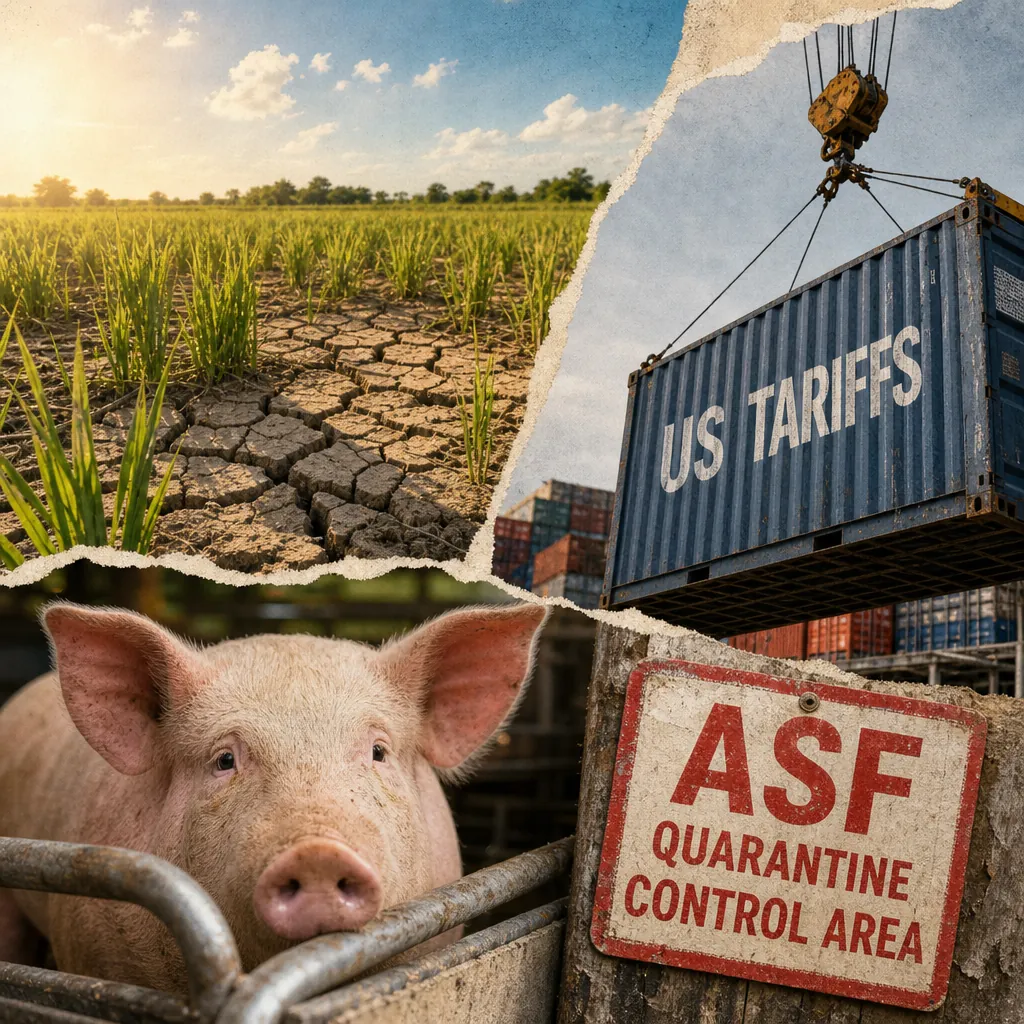
Rice safeguard duty bid stirs early policy debate
A proposed 30% safeguard duty on imported rice enters public view with minimal engagement, while Jollibee's US expansion and EV incentives dominate business coverage.
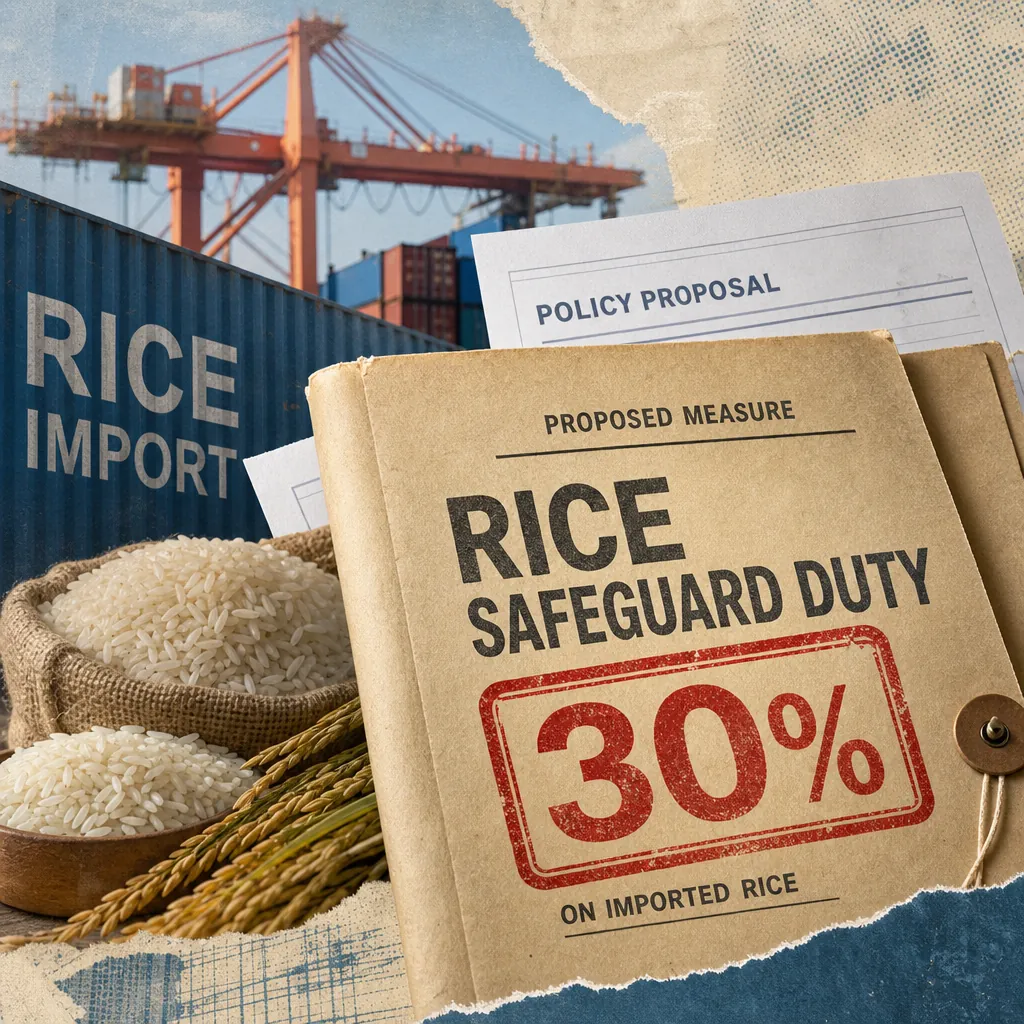
The day's conversation opened on a policy note that has yet to find its audience. A proposal by two farmers' organizations to impose an additional 30% safeguard duty on imported rice surfaced as a news share on Twitter, drawing 1,218 views but no likes, shares, or comments. The post, carrying the headline "Additional 30% tax on imported rice sought," circulated as a bare link, a one-way broadcast that generated no visible reaction. This quiet circulation marks the earliest stage of a potential policy-driven narrative: announcement, then reaction, then consumer-facing impact stories as market prices adjust. The absence of a triggering voice—no vlogger, advocacy group, or political figure had yet attached a position—left the topic suspended in an information-only phase.
Meanwhile, a separate Reddit thread, outside the food keyword scope but revealing a parallel consumer frustration pattern, captured a user's ordeal with the eGov driver's license renewal process. The user described a process that was approved only after significant delay, offered no physical delivery option within the Philippines, and still showed as expired in the LTMS portal: "I know a lot of people are not recommending to renew DL thru the eGov app but unfortunately, it was too late when I read the bad reviews." The post, carrying one like, reflects a broader trust deficit in government digital services—directly transferable to food regulatory contexts where consumers depend on FDA LTO verification, sanitary permits, and import documentation processed through official channels.
On the news-media side, the day's coverage was dominated by business and consumer stories. Jollibee's expansion in North America drew multiple articles across outlets, with the opening of a new store in downtown San Francisco highlighting the brand's growth to over 100 stores in the US and Canada. The electric vehicle incentive program, established by Executive Order 121, also received attention, with projections of 6–12% price reductions for EVs. Fuel price rollbacks, a stock market rally, and a proposed income tax exemption hike rounded out the business news. The rice safeguard duty proposal, however, was the only food-policy item in the captured set, appearing in the Inquirer and Philstar, with the Inquirer article carrying an estimated advertising-equivalent value of ₱275,940—a measure of the space it occupied, not readership.
Key themes
- Rice safeguard duty proposal enters public sphere — Two farmers' organizations, the Federation of Free Farmers (FFF) and Magsasaka party-list, filed a joint petition with the Tariff Commission seeking an additional 30% safeguard duty on imported rice, on top of the current 15% tariff. The proposal aims to curb excessive imports that have averaged 3.446 million metric tons since 2019, nearly triple pre-law levels. The story circulated on Twitter with 1,218 views but zero engagement, indicating a passive awareness stage.
- Consumer distrust in government digital services — A Reddit thread about eGov driver's license renewal highlighted frustrations with delayed approvals, inconsistent records, and unclear recourse. The user's question, "Can we even use or show the digital DL in eGov in case we get apprehended?" reflects practical anxiety that mirrors confusion consumers might feel with food safety documentation. This theme matters for food communicators because the same eGov infrastructure processes sanitary permits and food safety documentation.
- Jollibee's North American expansion accelerates — Jollibee Foods Corp. opened a new store in downtown San Francisco, bringing its North American network to over 100 stores. The company plans further expansion in California, with stores in Oxnard, Elk Grove, and Roseville. This expansion drew coverage across multiple outlets, including the Manila Times, Inquirer, Philstar, and BusinessWorld, with combined advertising-equivalent value exceeding ₱900,000.
- Electric vehicle incentives promise price cuts — President Marcos signed Executive Order 121 establishing the Electric Vehicle Incentive Strategy (EVIS) Program, offering up to ₱60 billion in fiscal support to qualified EV manufacturers. The Department of Energy projects EV prices could drop 6–12%, translating to potential savings of up to ₱200,000 per vehicle. This story appeared in Maharlika News and Panay News, with combined coverage value of about ₱373,000.
- Fuel price rollback offers relief — The Department of Energy announced a rollback in fuel prices effective August 4–10, with gasoline down ₱0.73 per liter, diesel down ₱0.60, and kerosene down ₱2.09. This follows a ₱6.80 increase in gasoline the previous week, providing some relief to consumers and transport groups. The story appeared in ZIGWHEELS with a coverage value of ₱118,863.
- Food safety recalls and investigations — Several food safety items appeared in the captured set, including a US recall of Ukrop's deli meals due to potential metal contamination, a Walmart recall of pistachio nut butter over Salmonella, and Michigan's first deaths linked to cyclosporiasis. These stories, while international, underscore the importance of food safety monitoring. The Iloilo River oil slick investigation also continued, with 10 establishments cleared but the source still unknown.
- Livestock feed safety spotlight — A feature on RDF Feed, Livestock & Foods, Inc. highlighted the company's farm-to-table commitment, with detailed coverage of its feed mill operations. This story appeared in multiple online outlets, including Adsentro, ExpertsMag, and others, with a combined advertising-equivalent value exceeding ₱3 million, indicating significant placement across the captured set.
- Cost-of-living pressures persist — A Panay News opinion piece, "Paying invisible losses," captured the quiet struggles of families adjusting to rising electricity bills, while a proposed income tax exemption hike (House Bill 10451) aimed to increase the threshold from ₱250,000 to ₱350,000. These stories reflect ongoing consumer concerns about affordability.
How the narratives stack
Dominant — Within the captured set, the Jollibee North American expansion stands as the most covered business story, appearing in at least four major outlets (Manila Times, Inquirer, Philstar, BusinessWorld) with a combined advertising-equivalent value of roughly ₱926,000. This reflects the company's strategic push into a key overseas market, with the new San Francisco store and planned openings in California signaling aggressive growth. The story's prominence in the sample suggests it was a significant business development of the day, though the monitoring scope may have favored business news.
Counter-narrative — The rice safeguard duty proposal offers a counterpoint to the corporate expansion narrative, focusing on the protection of local farmers against import surges. While it drew less coverage in the captured set (two articles), its potential impact on consumer prices and food security makes it a significant policy story. The proposal's quiet social media reception—1,218 views with zero engagement—indicates it has not yet ignited public debate, but the underlying tensions between farmer welfare and consumer affordability could escalate.
Emerging — The electric vehicle incentive program is an emerging narrative with long-term implications. Executive Order 121, signed July 29, aims to boost local EV manufacturing through fiscal incentives, with projected price reductions of 6–12%. This story appeared in two outlets (Maharlika News, Panay News) and could gain traction as the program's effects materialize. The fuel price rollback, while a separate story, complements this narrative by addressing consumer cost concerns.
Suppressed — The Iloilo River oil slick investigation, which has been ongoing since July 22, received limited coverage in the captured set (one article in Panay News). The source of the contamination remains unknown after inspections cleared 10 hotels and restaurants. This environmental story, with potential implications for food safety and tourism, may be under-covered relative to its significance. Similarly, the food safety recalls from the US (Ukrop's, Walmart, cyclosporiasis) appeared in the set but were not prominently featured in Philippine media, possibly due to their international scope.
Platform insights
- Twitter — The rice tax proposal was shared as a bare news link on Monday, August 3, with 1,218 impressions and zero engagement. This indicates that policy announcements can circulate without triggering discussion when no opinion leader has yet weighed in. This is a classic early-warning signal for a story that could break wide open if a major voice or a visible price change enters the conversation. The lack of engagement suggests the audience is still absorbing the news without an emotional anchor.
- Reddit — The eGov driver's license thread demonstrated the platform's role as a venue for individual problem-solving, with the user directly asking "Has anyone had the same case as mine?" The complete absence of replies after accumulating one like suggests the post either landed during low-traffic hours or lacked the push needed to reach users with matching experience. This pattern is notable when anticipating how similar consumer complaints about food products might or might not gain traction.
- Facebook — While not directly captured in the monitoring writeup, the Department of Energy's fuel price announcement was referenced as being posted on their Facebook page, indicating that government agencies use Facebook for official announcements. The engagement on such posts was not measured, but the platform remains a key channel for disseminating consumer-relevant information.
- YouTube — No significant YouTube activity was captured in the provided data. However, the Pepsi Extra Fizz launch event, which featured a star-studded party with influencers, likely generated video content on the platform, though this was not part of the monitored set.
Key voices and communities
- Policy and regulatory stakeholders — Government agencies and legislative offices involved in trade, agriculture, and tariff policy are the originating voice of the rice tax conversation. Their influence stems from formal authority over import duties and rice price stabilization. In this early sample, the policy signal appears as a headline-style post with minimal engagement, suggesting the conversation is still in its initial broadcast phase. Their framing centers on increasing the tax burden on imported rice as a policy objective, likely justified through food security, farmer protection, or revenue generation arguments.
- Food importers and agri-business groups — Importers, milling associations, and agricultural trade groups would be the primary economic actors affected by an additional 30% tariff on imported rice. While not directly visible in the provided sample, this stakeholder community typically responds to such proposals with cost-impact analyses and warnings about downstream consumer prices. Their influence is significant because their pricing decisions often determine public-facing retail costs for staple goods. Anticipated content would include industry position papers, price projection graphics, and media interviews explaining potential supply chain effects.
- Consumer and food-security advocates — Household budget advocates and consumer welfare groups are likely to frame the proposed rice tax as a cost-of-living concern, particularly for low-income families. Their influence on digital platforms comes from emotional resonance and the direct connection to staple food affordability. This group tends to amplify policy news through relatable budgeting examples and calls for protection against price hikes. Expect graphics comparing current rice prices with projected post-tax prices, plus user-generated stories about market purchases and family budgets.
- Corporate communicators and brand managers — For companies like Jollibee and Pepsi, the day's coverage reflects proactive brand storytelling. Jollibee's expansion announcements were framed as growth milestones, while Pepsi's Extra Fizz launch targeted Gen Z consumers with a high-energy event. These corporate voices shape consumer perceptions of affordability and value, particularly in the quick-service restaurant and beverage sectors.
- Government digital service users — The Reddit eGov thread represents a community of citizens navigating government online platforms. Their frustrations with delays, inconsistent records, and unclear recourse options reflect a broader trust deficit that could extend to food regulatory systems. This community's voice is important for communicators monitoring consumer sentiment around government services.
Narrative streams
Rice safeguard duty: A policy proposal in search of a spark
The most significant food-policy story of the day is the joint petition by the Federation of Free Farmers (FFF) and Magsasaka party-list to the Tariff Commission, seeking an additional 30% safeguard duty on imported rice. The proposal, reported by the Inquirer and Philstar, argues that the continued surge in imports is hurting local producers. The groups cite that rice imports have averaged 3.446 million metric tons since 2019, nearly triple pre-law levels, with imports in 2022 and 2024 at least 37% higher than the average in the preceding three years. Rice arrivals reached 2.9 million metric tons in the first half of 2026 alone, or nearly 83% of the annual average over the past seven years. The US Department of Agriculture expects the Philippines to import 5.2 million metric tons of rice in 2026.
The proposed safeguard duty would be on top of the current 15% tariff, effectively raising the total import tax to 45%. The groups also recommended imposing a revised minimum access volume (MAV) system—a mechanism that allows a certain quantity of a product to be imported at a lower tariff—to enable the government to more proactively regulate imports while remaining aligned with World Trade Organization rules.
The social media reception was notably quiet. The Twitter share of the Inquirer article drew 1,218 views but zero engagement, indicating that the story has not yet ignited public debate. This is typical of the early stage of a policy narrative, where the announcement circulates without a clear emotional anchor. Historically, such discussions ignite once the "presyo" (price) connection is made—when consumers begin asking what it means for the price of a kilo of rice at their local palengke (market).
The read for the sector: This proposal could become a leading food-price storyline if it gains legislative traction. For communicators, the window before prices react is crucial for proactive framing. The risk is that the tax is framed as an added burden on a staple food item, especially during a period when affordability concerns are already prominent. A clear, farmer-protection framing could help avoid the more damaging consumer-burden narrative.
Jollibee's American dream: Expansion to 100+ stores
Jollibee Foods Corp. (JFC) reinforced its North American expansion with the opening of a new store in downtown San Francisco, located at 934 Market Street near the Powell Street Bay Area Rapid Transit (BART) station. The store, which opened on July 31, brings Jollibee's North American network to more than 100 stores across the US and Canada. The company plans further expansion in California, with upcoming stores in Oxnard, Elk Grove, and Roseville, with the Roseville location scheduled to open on August 7 as the brand's third franchised store in North America.
Jollibee North America President Beth Dela Cruz said, "The Bay Area has welcomed Jollibee with open arms ever since we debuted our very first US location in Daly City nearly three decades ago, and we are absolutely thrilled to bring our joyful dining experience to the heart of downtown." She added, "This dynamic city is a milestone location for us as we continue to accelerate our growth across California."
The story drew coverage across multiple outlets, including the Manila Times, Inquirer, Philstar, and BusinessWorld, with a combined advertising-equivalent value of roughly ₱926,000—a measure of the space these articles occupied, not readership. This indicates that the expansion was a significant business story of the day.
The read for the sector: Jollibee's aggressive expansion reflects the growing global appetite for Filipino cuisine and the brand's ability to compete with international fast-food chains. For other food companies, this signals the potential of overseas markets and the importance of brand storytelling in driving growth.
Electric vehicle incentives: A green shift with consumer benefits
President Ferdinand Marcos Jr. signed Executive Order 121 on July 29, establishing the Electric Vehicle Incentive Strategy (EVIS) Program. The program offers fiscal incentives for the local manufacture of hybrid and battery electric passenger cars, commercial vehicles, and their parts and components. It aims to expand domestic EV production, create quality jobs, reduce the country's dependence on fossil fuels, and position the Philippines as a regional automotive manufacturing hub.
The Department of Energy (DOE) estimates that the program could reduce EV prices by 6–12%, translating to potential savings of up to ₱200,000 per vehicle, depending on the model. Energy Secretary Sharon Garin said, "The President has made it clear that the Philippines should not only use electric vehicles—we should build them. Executive Order 121 turns that vision into action by giving investors the confidence to..." (the quote was cut off in the source).
The program offers up to ₱60 billion in fiscal support to qualified manufacturers. Finance Secretary Frederick Go, who also chairs the Fiscal Incentives Review Board (FIRB), lauded the order as "a major step toward developing a globally competitive electric vehicle (EV) manufacturing industry in the Philippines."
The story appeared in Maharlika News and Panay News, with a combined coverage value of about ₱373,000. This is an emerging narrative with long-term implications for the automotive sector and consumer prices.
The read for the sector: The EVIS program could make EVs more accessible to Filipino consumers, potentially shifting the automotive market. For food and beverage companies, this may indirectly affect logistics costs if commercial EVs become more affordable, but the immediate impact is on the automotive industry.
Fuel price rollback: A temporary reprieve
The Department of Energy (DOE) announced a rollback in fuel prices effective August 4–10, with gasoline down ₱0.73 per liter, diesel down ₱0.60, and kerosene down ₱2.09. This follows a ₱6.80 increase in gasoline the previous week, providing some relief to consumers and transport groups. The adjustment will take place from August 4 to 10, 2026, with changes effective as early as 6 am.
The story appeared in ZIGWHEELS with a coverage value of ₱118,863. This is a consumer-relevant story that intersects with the cost-of-living narrative, as fuel prices affect transportation and food costs.
The read for the sector: While the rollback is modest, it offers a brief respite for consumers and businesses. However, transport groups are still planning a three-day strike from August 10–12 to demand a provisional fare increase, indicating that the relief may not be sufficient. This could affect food distribution costs and, ultimately, retail prices.
Food safety: Recalls and investigations
Several food safety items appeared in the captured set, though they were international in scope. The US Food and Drug Administration (FDA) and Department of Agriculture's Food Safety and Inspection Service (FSIS) announced a recall of six Ukrop's Homestyle Foods deli meals sold at retailers like Kroger, Publix, and Wegmans due to potential aluminum metal fragments. Walmart also recalled its Bettergoods Pistachio Nut Butter in 19 states after three jars tested positive for Salmonella. Additionally, Michigan reported its first two deaths linked to cyclosporiasis, a foodborne illness, with 11,234 cases and 193 hospitalizations as of August 3.
These stories, while not directly related to the Philippine market, underscore the importance of food safety monitoring. In the Philippines, the Iloilo River oil slick investigation continued, with 10 hotels and restaurants cleared of environmental violations but the source still unknown. The city government inspected establishments from July 29–31, examining grease traps and wastewater disposal systems.
The read for the sector: Food safety remains a critical concern for consumers and regulators. For Philippine food companies, these international recalls serve as a reminder of the importance of rigorous quality control and transparent communication in the event of contamination.
Livestock feed safety: A farm-to-table commitment
A feature on RDF Feed, Livestock & Foods, Inc. highlighted the company's commitment to food safety, with detailed coverage of its feed mill operations. The article, titled "Inside The Feed Mill: Food Safety First," appeared in multiple online outlets, including Adsentro, ExpertsMag, and others, with a combined advertising-equivalent value exceeding ₱3 million. This indicates significant placement across the captured set, though the repetition of the same story across many outlets suggests it was a syndicated press release.
The article describes RDF's company-owned, company-operated model, which provides full oversight from the feed mill and farms to the slaughterhouse and processing plants. The company uses two advanced corn silos to protect the primary ingredient, and each component is inspected upon arrival to ensure quality.
The read for the sector: This story highlights the importance of vertical integration and quality control in the livestock industry. For consumers, it reinforces the value of traceability and food safety in meat products.
Conversation trajectory
- Rice safeguard duty (7–14 days) — Expect a shift from policy announcement to cost-of-living narrative as consumers connect the tax to rice prices, budget meals, and sari-sari store costs. This directly affects stakeholders monitoring inflation-sensitive sentiment. Key trigger events include the formal filing or committee referral of the tax proposal, the next monthly inflation and food price index release, and the onset of the dry-season harvest.
- Jollibee expansion (30–60 days) — The company's planned store openings in Oxnard, Elk Grove, and Roseville will likely generate continued coverage, reinforcing the brand's growth narrative. This could also spark discussions about the globalization of Filipino cuisine and its economic impact.
- EV incentives (30–60 days) — As the EVIS program rolls out, expect more detailed announcements about participating manufacturers and specific price reductions. The program's success will depend on attracting investments, and any delays could lead to scrutiny.
- Fuel prices (immediate) — The rollback is temporary; transport groups are planning a strike from August 10–12, which could disrupt supply chains and draw attention to fuel costs. The LTFRB is expected to send a recommendation for an interim fare hike to Malacañang this week.
- Food safety (ongoing) — The Iloilo River oil slick investigation may continue to develop, and any new findings could attract more coverage. International recalls may also influence consumer perceptions of food safety.
Response guidance
For communicators in the food and consumer goods sector, the following guidance is relevant:
- Monitor rice price sentiment closely — The rice safeguard duty proposal is in its early stages, but it could escalate quickly. Prepare a cost-of-living communication framework now, before the legislative process accelerates, so responses to rice tax queries position your organization as attentive to consumer welfare rather than reactive to policy details.
- Frame the rice tax with balance — When addressing the policy rationale, acknowledge both the need to support local farmers and the duty to keep staple food accessible. Avoid appearing to favor one over the other. Transparency in how tax revenues will be allocated, particularly toward agricultural development, can strengthen public confidence.
- Leverage the Jollibee expansion narrative — For food brands, the Jollibee story demonstrates the power of growth and brand storytelling. Highlight milestones and community impact to build positive sentiment.
- Prepare for fuel price volatility — With transport strikes looming, consider how fuel costs affect your supply chain and pricing. Communicate any adjustments transparently, and emphasize value offerings to address consumer concerns.
- Stay vigilant on food safety — International recalls serve as a reminder to maintain rigorous quality control. If a recall occurs, respond quickly with clear, factual information and a focus on consumer safety.
- Engage with digital service frustrations — The eGov thread highlights consumer distrust in government digital services. If your organization relies on government platforms for permits or documentation, ensure you have clear communication channels to address customer concerns.
- Use plain-language messaging — Avoid technical jargon when discussing policy or pricing. Explain the intended benefits of any tax or incentive program in simple terms, and acknowledge consumer concerns without being dismissive.
See the full picture behind today's signals.
This report draws from Media Meter's MediaWatch, our real-time monitoring engine tracking 2,470+ Philippine sources across print, broadcast, digital, and social. Explore how the platform turns raw coverage into decision-grade intelligence, then see how it's configured for teams like yours — whether you're in PR agencies, corporate comms, government, or marketing.
Want more? Browse our Report Library for sector and crisis intelligence, or request a demo and we'll have your brand set up before the call.
Want this kind of intelligence on your brand?
This brief is built on the same MediaWatch methodology that runs continuously across every brand we monitor. See your competitive landscape, Impact Score, and narrative trajectory in a 30-minute demo.