Jollibee kiosk cashless works but inconsistent, consumers say
A Reddit user's positive experience with Jollibee's kiosk cashless payment highlights inconsistent implementation across branches, drawing 13 comments. Meanwhile, Jollibee's global expansion earned recognition, and other food industry news covered spicy menu trends, chicken fillet rankings, and lechon collaborations.
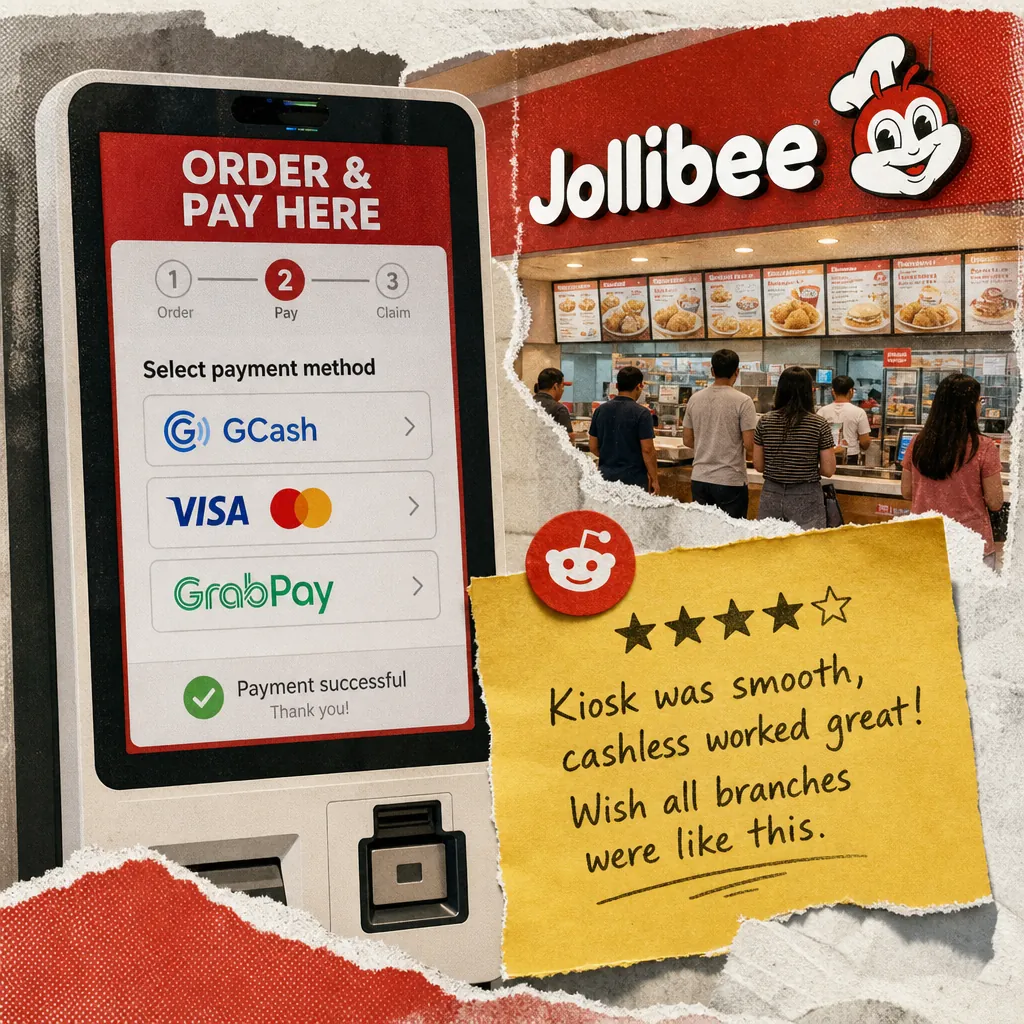
A Reddit user's surprise that a Jollibee self-service kiosk actually accepted a debit card tap has opened a window into a recurring operational inconsistency: cashless payment at kiosks works in some branches but fails in most others. The post, shared twice on August 25, drew 13 comments total, with the author framing the working terminal as a "himala" (miracle) and asking why the seamless process isn't the norm everywhere. The conversation is small but pointed, and it lands on the same day Jollibee's parent company celebrated a global growth award, underscoring the gap between the brand's international ambitions and its branch-level execution at home.
The original post, titled "So gumagana naman pala Cashless Payment ninyo sa Kiosk, Jollibee...", described the full journey: ordering at the kiosk, tapping a debit card on the attached terminal, receiving a printed receipt, and collecting the order without re-queuing. The author contrasted this against their usual experience, noting that "most of the time" the cashless option at Jollibee branches they visited did not work, forcing customers to queue at the kiosk, fail at payment, then queue again at the counter — a process they called "hassle malala" (a serious hassle). The post's rhetorical questions — "Ba't 'di niyo i-normalized sa lahat ng branch niyo?" (Why don't you normalize this in all your branches?) and "Ganyan lang pala kasimple din ng proseso, ba't hindi pa ganto yung norm?" (The process is that simple, why isn't this the norm?) — positioned the issue as an operational oversight rather than a technical impossibility.
The same content was crossposted or duplicated on the platform, accumulating a combined 13 comments across both instances within the first day. The discussion did not pivot to pricing or food quality, staying focused on service consistency. The author's detailed account — mentioning QR, credit/debit cards, Google Pay, and Apple Pay as payment options — signals a digitally literate customer base ready to adopt cashless methods, but the inconsistent availability of working terminals risks alienating these early adopters.
On the same day, Jollibee Foods Corp. (JFC) was named Global Growth Champion at the inaugural Globie Awards of the Global Restaurant Leadership Conference, beating 11 other brand nominees with more than 74 percent of votes from the awards advisory panel. The recognition came as JFC operates more than 10,700 stores and cafés across 33 countries, with a portfolio spanning 20 brands including Jollibee, Chowking, Greenwich, Red Ribbon, Mang Inasal, Smashburger, and Tim Ho Wan. The contrast between this global recognition and the local kiosk complaint frames the day's conversation: a brand scaling impressively abroad while facing questions about consistency at home.
Key themes
- Jollibee kiosk cashless payment works inconsistently across branches — A Reddit user's positive experience with a working terminal highlighted that most branches they visited had non-functional cashless options, drawing 13 comments across two postings of the same story.
- Consumers expect cashless payment to be standard, not a pleasant surprise — The author's framing of a working terminal as a "himala" (miracle) and their question "why isn't this the norm?" reflect a growing expectation that contactless payment should be reliably available.
- Jollibee named Global Growth Champion at inaugural Globie Awards — JFC beat 11 other nominees with over 74 percent of advisory panel votes, recognized for expanding to more than 10,700 stores across 33 countries.
- Jollibee's diversified portfolio spans 20 brands across owned, franchised, and invested businesses — The group operates nine wholly owned brands, five franchised brands in the Philippines, and holds controlling stakes in several others including The Coffee Bean & Tea Leaf and Compose Coffee.
- Spicy flavors gain ground in Filipino food preferences — Jollibee Philippines launched Spicy Chickenjoy with marketing framing spice as an enjoyable flavor layer, citing research that 13 percent of surveyed adult Filipinos identify spicy as a taste preference.
- McDonald's Philippines Crispy Chicken Fillet named best-tasting by consumer study — Market research firm FastForward found McDonald's chicken fillet the tastiest in the country, with the brand promoting McSavers Sulit-Busog Meals starting at P99.
- Lechon collaborations and food festivals showcase culinary innovation — Grace Park by Margarita Forés partnered with Abub's Lechon for a limited-time Lechon Remix menu, while New York City's fall food festival lineup was highlighted.
- Women-led food businesses gain visibility through trade fairs — The Women Strong Network Hybrid Trade Fair celebrated its fifth anniversary, connecting women entrepreneurs with buyers and market opportunities.
How the narratives stack
Dominant — Within the captured set, the Jollibee kiosk cashless payment complaint is the dominant consumer narrative. It is the only social media conversation captured, and it directly addresses a service quality issue that affects customer experience. The 13 comments across two postings indicate active discussion, and the author's detailed account provides a clear, relatable pain point. This narrative dominates because it is the only one that emerged organically from consumers rather than from corporate announcements or media reports.
Counter-narrative — Jollibee's global growth recognition serves as a counter-narrative to the kiosk complaint. The Globie Award and the expansion to 10,700 stores across 33 countries present a picture of a thriving, internationally competitive brand. This narrative, carried by multiple news outlets including BusinessWorld, Manila Times, and Inquirer, frames Jollibee as a success story, potentially offsetting the negative impression left by the kiosk inconsistency. The two narratives coexist in the same day's coverage, with the corporate success story receiving far more media attention than the consumer complaint.
Emerging — The spicy food trend is an emerging narrative. Jollibee's Spicy Chickenjoy launch, backed by research showing 13 percent of Filipino adults prefer spicy flavors, suggests a growing market segment. The brand's marketing explicitly frames spice as an enjoyable flavor layer rather than a test of endurance, indicating a strategic push to capture this preference. This narrative is in its early stages, with the product launch and supporting research just entering public discourse.
Under-covered — The Women Strong Network Hybrid Trade Fair received coverage in BusinessWorld and Head Topics, but the story of women-led businesses scaling to export-ready quality deserves more attention than it got. The fair's fifth anniversary and its role in connecting women entrepreneurs with buyers and market opportunities represent a significant economic development story that was overshadowed by corporate and entertainment news in the captured set.
Platform insights
- Reddit — The entirety of the observed consumer conversation occurred on Reddit, where the initial post on August 25 generated immediate engagement through comments on both the original and duplicate threads. The platform's upvote-based visibility likely amplified the post within Philippine-focused subreddits, encouraging others who experienced similar kiosk issues to share their own stories in the comments. Since no other platforms showed related activity within the provided data, Reddit served as the sole channel for this particular consumer complaint, suggesting that the topic may have been contained within a niche community rather than spreading to broader social media.
Key voices and communities
- Disaffected Jollibee customers — Frequent Jollibee patrons who actively engage with the brand's digital infrastructure and share their experiences on public forums like Reddit. They are characterized by pragmatic frustration with inconsistent service delivery, particularly regarding self-service kiosks and cashless payment functionality. Their influence lies in their ability to shape perception among undecided consumers, with the original post generating a comment thread of six to seven responses within the first day of publication. Their primary narrative is one of conditional praise tempered by criticism — acknowledging that the cashless system can work when functional, while questioning why such functionality is not standardized across branches.
- Digital payments advocates — A secondary but influential group consisting of consumers who actively promote cashless transactions and view kiosk payment failures as a barrier to broader adoption. These individuals are typically early adopters of QR payments, card taps, and mobile wallets, and they amplify frustration when physical infrastructure undermines their preferred payment methods. Their messaging emphasizes that cashless options should not require customers to queue again at the counter after using a kiosk, framing such friction as both a technological and customer-service failure. The original post's mention of Google Pay and Apple Pay specifically signals an audience with high digital literacy and expectations aligned with international QSR norms.
- QSR operations watchers — A smaller but strategically important group including individuals who monitor operational consistency across food service chains, whether as franchise observers, industry analysts, or experienced customers who compare branch performance. Their influence stems from their ability to articulate systemic patterns, as seen in the original post's reference to "lahat ng Jollibee na napuntahan ko dito sa amin" (all the Jollibee branches I've visited here). These voices frame the issue as an execution gap — not a technology failure — suggesting that the capability exists but is not being deployed consistently. Their commentary often calls for management-level intervention, such as standardizing terminal maintenance or staff training across branch networks.
- Food industry media and bloggers — A group including outlets like BusinessWorld, Manila Times, Inquirer, and blogs like The Hungry Kat and Mermaid in Stilettos that cover corporate announcements, product launches, and culinary trends. They shape the narrative around Jollibee's global growth, spicy food trends, and restaurant collaborations. Their coverage of the Globie Award and Spicy Chickenjoy launch provides the corporate counterpoint to consumer complaints, and their reach amplifies brand messaging to a wider audience.
- Women entrepreneurs and MSME advocates — A community centered on WomenBizPH and SM Supermalls' Women Strong Network Hybrid Trade Fair, celebrating its fifth anniversary. These voices highlight the growth, innovation, and resilience of women-led businesses in the Philippines, with many participating businesses having scaled to produce export-ready items. Their narrative emphasizes the economic potential of women-led enterprises and the importance of platforms that connect them with buyers and market opportunities.
Narrative streams
Jollibee kiosk cashless payment: a working feature, inconsistently deployed
A Reddit user's account of successfully using the cashless payment feature at a Jollibee self-service kiosk on August 25 exposed a systemic inconsistency: the feature works in some branches but fails in most others. The post, titled "So gumagana naman pala Cashless Payment ninyo sa Kiosk, Jollibee...", described the author's surprise when the terminal attached to the kiosk actually worked, allowing them to pay via debit card tap without needing to queue again at the counter. The author explicitly contrasted this positive experience against their usual encounters, noting that "most of the time" the cashless option at Jollibee branches they visited did not work. The post quickly attracted attention, with the same content being crossposted or duplicated on the platform, accumulating a combined 13 comments across both instances within the first day.
The dominant narrative thread revolved around the perceived lack of standardization in Jollibee's kiosk payment infrastructure. The original poster highlighted the friction of the current system, where customers often have to queue at the kiosk, attempt payment, then queue again at the counter if the cashless option fails — a process they described as "hassle malala." The author's rhetorical questions — "Ba't 'di niyo i-normalized sa lahat ng branch niyo?" and "Ganyan lang pala kasimple din ng proseso, ba't hindi pa ganto yung norm?" — positioned the problem as an operational oversight rather than a complex technical challenge. Since the technology works in at least one location, the barrier to universal implementation is likely a matter of management priority or franchisee compliance rather than hardware limitations.
The read for the sector: Quick-service restaurant chains in the Philippines face rising consumer expectations around digital payment reliability. A single positive experience framed as a "himala" (miracle) reveals that negative prior experiences have shaped customer baselines. For Jollibee and its competitors, ensuring system-wide reliability or proactively managing expectations about feature availability is no longer optional — silent inconsistencies are being publicly documented and discussed. The moderate engagement — 13 comments total — suggests this is a simmering issue rather than a full-blown crisis, but one that could escalate if customers begin sharing similar stories more widely or if competitors highlight their own seamless digital experiences.
Jollibee's global growth recognized, but local execution questioned
On the same day the kiosk complaint circulated, Jollibee Foods Corp. was named Global Growth Champion at the inaugural Globie Awards of the Global Restaurant Leadership Conference, beating 11 other brand nominees with more than 74 percent of votes from the awards advisory panel. The recognition came as JFC operates more than 10,700 stores and cafés across 33 countries, with a portfolio spanning 20 brands across owned, franchised, and invested businesses. That roster includes homegrown names Jollibee, Chowking, Greenwich, Red Ribbon, and Mang Inasal, alongside overseas bets such as Smashburger and Tim Ho Wan. JFC also holds stakes in The Coffee Bean & Tea Leaf, Compose Coffee, Shabu All Day, and Milksha, among others.
Jollibee Group Global Chief Marketing Officer and Head of Digital Marketing David Beal said, "Growing across markets requires more than opening stores; it takes brands that are relevant to local customers, strong operating teams, committed franchisees and partners, and the ability to execute consistently across different geographies. That is the foundation we continue to build as we grow Jollibee Group into a truly global restaurant company." The coverage of this award appeared in multiple outlets including BusinessWorld, Manila Times, and Inquirer, with the BusinessWorld item carrying an estimated advertising-equivalent value of about ₱277,000 and the Manila Times item about ₱281,000.
The read for the sector: Jollibee's global expansion is a genuine success story, but the kiosk complaint highlights that "executing consistently across different geographies" — a phrase from the company's own marketing chief — is precisely where the brand faces challenges at home. For a company that prides itself on consistent customer experience, the gap between announced digital capabilities and actual branch-level execution could affect brand trust metrics. The contrast between international recognition and local operational friction is a reminder that global scale does not automatically translate to uniform service quality.
Spicy flavors gain ground in Filipino food preferences
Jollibee Philippines launched Spicy Chickenjoy, a spicy variant of its signature fried chicken, with marketing that frames spice as an enjoyable flavor layer rather than a test of endurance. "Spiciness should not simply be about tolerating the heat. It should be about enjoying what the spice brings to the overall flavor experience. With Spicy Chickenjoy, we want Filipinos to discover that spicy can be exciting, flavorful and, most importantly, delicious," said Dorothy Ching, vice president for marketing of Jollibee Philippines. The move comes as spicy flavors continue to gain a place among Filipino food preferences. According to research cited in the coverage, 13 percent of surveyed adult Filipinos, or roughly one in eight, identified spicy as a taste preference.
The read for the sector: The spicy food trend represents a growing market segment that quick-service restaurants can tap. Jollibee's framing of spice as an enjoyable flavor layer rather than a challenge suggests a strategic effort to broaden its appeal beyond traditional flavor profiles. For competitors and suppliers, this signals an opportunity to develop spicy variants of popular items and to market them in ways that emphasize enjoyment rather than endurance. The 13 percent figure, while a minority, represents a meaningful consumer segment that brands are beginning to court.
McDonald's chicken fillet named best-tasting, intensifying QSR competition
Market research firm FastForward found McDonald's Philippines Crispy Chicken Fillet to be the country's best-tasting chicken fillet, according to a consumer study. Building on the recognition, McDonald's is promoting its McSavers Sulit-Busog Meals, with a choice of Extra Rice or Extra Ulam meals starting at just P99. First introduced to Filipino customers in 2004, McDonald's Crispy Chicken Fillet helped pioneer the quick-service restaurant chicken fillet category. More than 20 years later, the product continues to set the standard, now recognized as the Philippines' best-tasting chicken fillet.
The read for the sector: The chicken fillet category is a competitive battleground in Philippine quick-service restaurants. McDonald's leveraging a consumer study to claim the "best-tasting" title puts pressure on competitors, particularly Jollibee, whose Chickenjoy is a flagship product. The P99 price point for McSavers meals also signals a value-oriented strategy that could intensify price competition. For brands in this space, product quality recognition and value pricing are both critical levers in a crowded market.
Lechon collaborations and culinary innovation showcase Filipino cuisine
Grace Park by Margarita Forés partnered with Abub's Lechon for Lechon Remix, a limited-time collaboration menu available from August 13 to September 15, 2026. The menu features five original dishes centered around Abub's Lechon's charcoal-roasted spicy lechon and Grace Park's interpretations of one of the country's most iconic Filipino dishes. The collaboration is available at both Gateway Mall and One Rockwell branches of Grace Park. Grace Park is one of the many restaurant concepts created by the late Margarita Forés, awarded as Asia's Best Female Chef in 2016 and one of the country's most talented and well-loved chefs and restaurateurs.
The read for the sector: Collaborations between established restaurants and specialty producers are a growing trend in the Philippine dining scene, offering limited-time experiences that generate buzz and attract food enthusiasts. For the broader food industry, such partnerships demonstrate the value of culinary innovation and cross-brand collaboration in driving customer interest. The lechon collaboration also highlights the enduring appeal of traditional Filipino dishes when reimagined by creative chefs.
Women-led food businesses gain visibility through trade fairs
The Women Strong Network Hybrid Trade Fair, hosted by WomenBizPH and SM Supermalls, celebrated its fifth anniversary, marking a milestone in female entrepreneurship. The event connected women entrepreneurs with buyers, industry leaders, and market opportunities through both physical and digital platforms. Many participating businesses have successfully scaled to produce export-ready items that comfortably stand alongside international brands. The fair's first leg ran August 10-12 at the Fashion Hall, SM Megamall in Mandaluyong City, and its second leg ran August 14-16 at SM City Cebu's The Atrium.
The read for the sector: Women-led businesses are a growing force in the Philippine food and consumer goods sector, with platforms like the Women Strong Network providing crucial market access. The fair's fifth anniversary and the export-readiness of participating businesses signal that women entrepreneurs are scaling beyond local markets. For the broader industry, this represents both a source of new products and competition, and a demographic whose economic potential is increasingly recognized.
Conversation trajectory
- From isolated complaint to consistency audit (1-2 weeks): The initial Reddit post frames the issue as a branch-level inconsistency, with the user explicitly noting that most Jollibee locations they visited had non-functional cashless options at kiosks. The duplicate posting across the same platform, with a slightly higher comment count on the second instance, suggests the topic is resonating beyond a single account and may be generating organic discussion about service standardization. Expect this to evolve into broader service quality comparisons across QSR brands within the next 1-2 weeks, particularly if other users share similar "it worked this time" or "still broken" anecdotes across different branches.
- Operational friction as a reputational risk vector (3-4 weeks): The user's detailed account of having to queue twice — once at the kiosk and again at the counter — when cashless fails, directly connects to convenience expectations in the Philippine QSR space. This practical pain point, rather than a food quality or price complaint, signals that digital infrastructure reliability is becoming a visible brand attribute in food conversations. Within the next 3-4 weeks, expect this narrative to merge with broader discussions about digital payment adoption in food retail, especially as competitors like McDonald's Philippines or local players push their own self-service and cashless initiatives in the same period.
- "Why isn't this the norm?" framing as a corporate responsiveness test (5-7 days): The post ends with a direct challenge to the company: "Ba't 'di niyo i-normalized sa lahat ng branch niyo?" This interrogative framing invites public response and amplifies the reputational stakes. This pattern — a single successful experience contrasted against repeated failures — creates a "proof of concept" criticism that is harder to dismiss than generic complaints. Historically, this type of post accelerates into follow-up threads asking for official explanations, with users tagging corporate social channels or leaving comments on official pages, typically within 5-7 days of the original post.
- Cross-brand digital service comparisons gaining traction (ongoing): While the initial focus is on Jollibee's kiosks, the underlying theme — digital convenience in food service — has direct relevance for other players in the sector. The language used (QR, CC/Debit, Google Pay, Apple Pay) mirrors the digital payment vocabulary frequently appearing in broader financial and e-wallet discussions, suggesting this post may be one node in a larger conversation about cashless adoption across industries.
Trigger events to watch: The upcoming quarterly earnings announcements for major QSR players, where service innovation and store experience metrics are often highlighted and could invite commentary on whether digital infrastructure commitments match consumer experience; the holiday season surge in QSR foot traffic starting in late Q3, which typically brings renewed attention to convenience bottlenecks like kiosk and payment terminal functionality; and any official Jollibee social media response or public statement about kiosk upgrades, which would either validate or defuse the current narrative.
Response guidance
- Acknowledge the operational inconsistency constructively: The post's core sentiment is not anger but a mix of surprise and mild frustration that a working cashless kiosk experience exists only in some branches. A branded response should validate the observation, confirm that the experience described is the intended standard, and signal that ongoing branch-level rollouts are being actively pursued. This positions the brand as listening and committed to consistency without getting defensive about the gap.
- Leverage the positive discovery moment: The user explicitly notes the process was "simple" and fast once the terminal worked. This is an organic testimonial that can be amplified by a response that frames the kiosk cashless payment as the target experience, while acknowledging that not all locations have fully aligned yet. The tone should be appreciative and forward-looking rather than apologetic, turning a complaint into a shared goal.
- Avoid defensive or metric-focused replies: The comment thread (with 6-7 comments) suggests community discussion, not a coordinated attack. A response that cites branch counts or technical specs would feel dismissive. Instead, the focus should be on the tangible user experience described — tap, print, wait, collect — and a commitment to replicating that across the network. This keeps the conversation human and actionable.
- Initiate an internal audit of kiosk cashless payment functionality: The post is a leading indicator of a potential brand-consistency problem across multiple branches. The next step is to verify the extent of the issue and identify which specific locations or franchise groups require immediate attention. This is an internal operational response that can be triggered solely by this post but should be broadened to a regular quality check.
- Develop a standard operating response for "positive feature discovery" posts: The tone of this post is not a crisis; it is an opportunity to reinforce brand standards. Creating a playbook for how community managers respond to users who highlight a feature working correctly (versus a defect) will standardize future interactions, ensuring they are appreciative, informative, and do not over-promise an immediate network-wide fix.
- Monitor cross-platform amplification: Prioritize tracking whether this kiosk cashless conversation spreads from Reddit to other social channels (Facebook, X, TikTok) within the next 7-10 days, as cross-platform amplification of a single operational complaint is the most reliable early warning of a crisis-level narrative in food and beverage monitoring.
- Prepare a sector-wide brief on kiosk and cashless payment reliability: A brief on kiosk and cashless payment failure mentions across all major QSR brands by the end of the month will be more valuable than a single brand snapshot. The sector-wide pattern will inform client strategies and crisis preparedness.
See the full picture behind today's signals.
This report draws from Media Meter's MediaWatch, our real-time monitoring engine tracking 2,470+ Philippine sources across print, broadcast, digital, and social. Explore how the platform turns raw coverage into decision-grade intelligence, then see how it's configured for teams like yours — whether you're in PR agencies, corporate comms, government, or marketing.
Want more? Browse our Report Library for sector and crisis intelligence, or request a demo and we'll have your brand set up before the call.
Want this kind of intelligence on your brand?
This brief is built on the same MediaWatch methodology that runs continuously across every brand we monitor. See your competitive landscape, Impact Score, and narrative trajectory in a 30-minute demo.