93% of vape brands unregistered as DTI weighs tax harmonization
The Department of Trade and Industry reported that 93% of vape brands in the Philippines are unregistered, prompting lawmakers to consider a unified excise tax. Other developments include price freezes in calamity areas, MSME financing gaps, and digital notarization reforms.
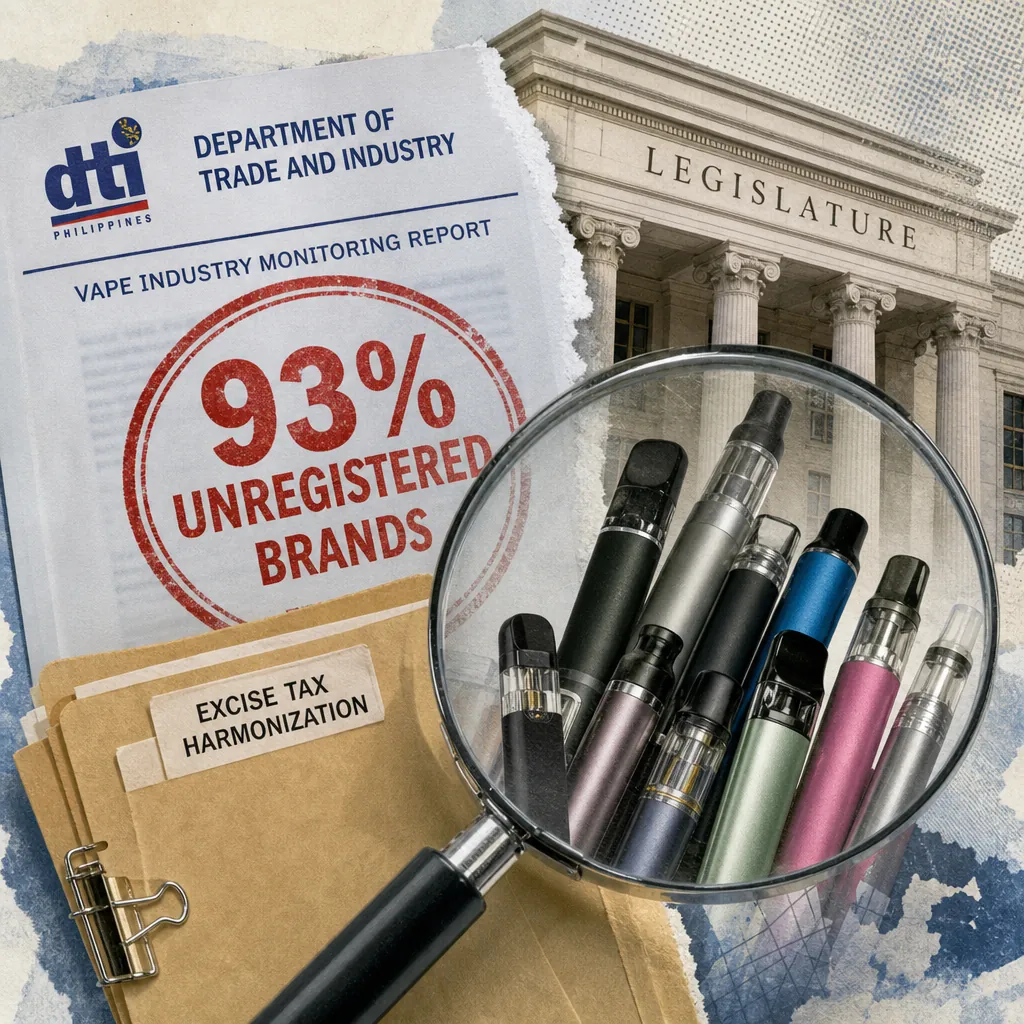
The Department of Trade and Industry (DTI) told a congressional hearing that 93 percent of vape brands sold in the Philippines are unregistered, a disclosure that is pushing lawmakers toward a single-tier excise tax on vapor products. Trade Assistant Secretary Marcus Valdez II said the agency's monitoring found 313 vape brands in circulation, of which 292 were not registered with the DTI. The revelation came during a House Committee on Ways and Means hearing on excise taxes for tobacco and vapor products, where legislators and regulators called for tougher enforcement and harmonized taxes. Valdez noted that the DTI had allowed a compliance period, but some brands continued selling without registering, and formal charges are now being prepared. Two of the 18 previously registered brands, Shift and Chillax, face cancellation, consistent with findings from the Bureau of Customs. The hearing underscores a persistent enforcement gap in a market that has grown rapidly since the passage of the Vape Law in 2022, which transferred regulatory oversight of e-cigarettes from the Food and Drug Administration to the DTI. The proposed single-tier tax would replace the current multi-tier system that taxes devices and liquids differently, aiming to reduce the price gap between registered and unregistered products that fuels the illicit trade. For the retail sector, the high rate of noncompliance signals a market where legitimate businesses face unfair competition from unregistered players, and where consumers may be exposed to unregulated products. The DTI's move to file charges and impose penalties after the compliance deadline suggests a tougher stance, but the effectiveness of enforcement remains to be seen. The read for the sector is that vape retailers and importers who have not registered face imminent legal and financial risk, while those who are compliant may benefit from a leveling of the playing field if the tax harmonization proceeds. The hearing also highlighted the challenge of regulating a product category that straddles consumer goods and public health, with the Department of Health and other agencies likely to weigh in on the tax structure. The outcome of the legislative process will determine whether the market consolidates around registered brands or continues to be undermined by illicit sellers. The DTI's data, drawn from its own monitoring, provides a baseline for measuring progress in the coming months. The agency's willingness to name specific brands facing cancellation signals a shift from passive compliance periods to active enforcement. For communicators in the retail and consumer goods space, the key message is that registration and compliance are not optional, and that the government is moving to close the loopholes that have allowed unregistered products to flourish. The hearing also drew attention to the broader issue of excise tax evasion, which costs the government revenue and undermines public health objectives. The proposed single-tier tax, if enacted, would simplify the tax structure and make it harder for unregistered brands to undercut compliant ones. The read for the sector is that the regulatory environment for vapes is tightening, and businesses should prepare for stricter oversight and potential tax changes. The DTI's announcement also has implications for consumers, who may face higher prices for registered products if taxes are harmonized, but who would also gain assurance of product safety and quality. The balance between public health, revenue generation, and business viability will be the central tension in the legislative debate. The hearing's outcome is uncertain, but the direction is clear: the era of lax enforcement in the vape market is ending. The DTI's data, drawn from its own monitoring, provides a baseline for measuring progress in the coming months. The agency's willingness to name specific brands facing cancellation signals a shift from passive compliance periods to active enforcement. For communicators in the retail and consumer goods space, the key message is that registration and compliance are not optional, and that the government is moving to close the loopholes that have allowed unregistered products to flourish. The hearing also drew attention to the broader issue of excise tax evasion, which costs the government revenue and undermines public health objectives. The proposed single-tier tax, if enacted, would simplify the tax structure and make it harder for unregistered brands to undercut compliant ones. The read for the sector is that the regulatory environment for vapes is tightening, and businesses should prepare for stricter oversight and potential tax changes. The DTI's announcement also has implications for consumers, who may face higher prices for registered products if taxes are harmonized, but who would also gain assurance of product safety and quality. The balance between public health, revenue generation, and business viability will be the central tension in the legislative debate. The hearing's outcome is uncertain, but the direction is clear: the era of lax enforcement in the vape market is ending.
Key themes
- 93% of vape brands unregistered, prompting calls for unified excise tax — The DTI reported that 292 of 313 vape brands are unregistered, leading lawmakers to consider a single-tier tax to curb illicit trade.
- Price freeze in two Mindoro towns under state of calamity — The DTI enforced a price freeze on nine basic commodities in Paluan and Sablayan, Occidental Mindoro, following calamity declarations due to weather disasters.
- MSME financing gap persists as Skyro backs 5,000+ SMEs — Only 4.48% of bank lending goes to MSMEs, highlighting a financing gap that fintech companies like Skyro are trying to fill.
- Digital notarization takes effect, removing barrier to e-commerce — The Supreme Court accredited three electronic notarization facilities, enabling end-to-end digital transactions for the first time.
- UPLIFT cash aid reaches 5.57 million households — The DSWD distributed cash assistance to poor and near-poor households to cushion rising prices.
- Megaworld expands hospitality portfolio, targeting 12,000 rooms by 2032 — The property developer is reorganizing its hotel business and adding properties in Palawan and Ilocos Norte.
- Konu snack brand grows from pandemic hobby to global export — Founder Denise Caranto leveraged TikTok to build a nationwide snack brand now sold in Canada and Korea.
- Community kitchens and disaster response highlight resilience — Volunteer-led initiatives like Art Relief Mobile Kitchen provide hot meals during calamities, underscoring the role of grassroots efforts.
How the narratives stack
Dominant — The vape registration issue dominates the captured set, with two major online news outlets (Inquirer and Manila Times) covering the DTI's disclosure and the legislative response. The story's prominence reflects its regulatory and public health implications, as well as the significant advertising-equivalent value of the coverage (₱685,692 and ₱240,124 respectively). The narrative is driven by the government's enforcement push and the potential for new taxes, which directly affects retailers and consumers.
Counter-narrative — The price freeze in Mindoro and the UPLIFT cash aid program offer a counterpoint to the regulatory crackdown, focusing on consumer protection and social safety nets. These stories emphasize the government's role in mitigating the impact of disasters and inflation, rather than policing markets. They also highlight the ongoing challenges of climate-related disruptions and poverty, which are less visible in the vape debate.
Emerging — The digital notarization reform is an emerging story with long-term implications for e-commerce and government transactions. The Supreme Court's accreditation of electronic notarization facilities removes a legal barrier that has hindered full digitalization for 25 years. This could enable faster, cheaper transactions for businesses and individuals, but its adoption is still in early stages.
Under-covered — The MSME financing gap, highlighted by Skyro's press release, is a critical issue that receives limited media attention. While the data on bank lending to MSMEs is stark, the story is largely told through a corporate press release rather than independent reporting. The lack of coverage may reflect the complexity of the issue and the absence of a dramatic event, but it remains a significant structural challenge for the economy.
Platform insights
- Facebook — The vape registration story and price freeze updates are likely to generate discussion among consumer groups and small business owners. Facebook's community groups and pages dedicated to vape enthusiasts and local trade may amplify the news, with users sharing opinions on regulation and tax fairness. The platform's broad demographic reach makes it a key space for public sentiment on government policies.
- X (formerly Twitter) — The hashtag #VapeTax and related terms could trend as lawmakers and advocates debate the proposed excise tax. X is a hub for policy discussions, with journalists, industry insiders, and public health advocates weighing in. The platform's real-time nature allows for rapid reactions to hearing developments, and the DTI's data may be shared widely with commentary.
- Reddit — Subreddits like r/Philippines and r/electronic_cigarette may host detailed discussions on the vape registration issue, with users sharing personal experiences and opinions on product quality and regulation. Reddit's anonymity allows for candid conversations about the illicit market and the effectiveness of enforcement. The platform's upvote system can surface the most compelling arguments, shaping the narrative.
- YouTube — Video content from news outlets and vape reviewers may cover the hearing and its implications. YouTube's long-form format allows for in-depth analysis, and creators may produce explainers on the proposed tax and its impact on consumers. The platform's comment sections often reflect a mix of support and criticism, providing a window into public sentiment.
Key voices and communities
- Department of Trade and Industry (DTI) — As the regulator, the DTI is the primary source of data on vape registration and enforcement. Assistant Secretary Marcus Valdez II's testimony sets the agenda, and the agency's actions will determine the credibility of the crackdown.
- House Committee on Ways and Means — Lawmakers on this committee are the key decision-makers on the proposed excise tax. Their statements and votes will shape the regulatory landscape, and their engagement with industry stakeholders and public health advocates will influence the final legislation.
- Vape retailers and importers — The business community directly affected by the registration and tax changes. Their compliance or resistance will determine the effectiveness of the new measures, and their associations may lobby for or against the proposed tax.
- Consumer advocacy groups — Organizations focused on public health and consumer protection are likely to support stricter regulation and higher taxes on vapes. Their voices add moral weight to the debate and may influence public opinion.
- Fintech companies like Skyro — In the MSME financing narrative, fintech firms are emerging as key players, offering alternative lending solutions to bridge the gap left by traditional banks. Their success stories and data-driven approaches are shaping the conversation on financial inclusion.
Narrative streams
Vape registration and tax harmonization
The DTI's revelation that 93% of vape brands are unregistered has ignited a legislative push for a unified excise tax. The hearing on August 25, 2026, brought together regulators, lawmakers, and industry representatives to address the widespread noncompliance. Assistant Secretary Valdez reported that the DTI had identified 313 brands, with only 21 registered, and that two of those, Shift and Chillax, face cancellation due to issues flagged by the Bureau of Customs. The proposed single-tier tax would replace the current system that taxes devices and liquids at different rates, simplifying compliance and reducing the incentive for illicit sales. The read for the sector is that vape businesses must prioritize registration and compliance to avoid penalties and potential closure, while the tax change could reshape the market's competitive dynamics. The coverage of this story, with an estimated advertising-equivalent value of ₱685,692 for the Inquirer article and ₱240,124 for the Manila Times article, reflects its significance in the business and regulatory news cycle. The DTI's enforcement actions, including formal charges against non-compliant brands, signal a shift from leniency to strict enforcement. The legislative process will be closely watched by industry stakeholders, and the outcome will have lasting implications for the vape market's legitimacy and growth.
Price freeze and disaster response
In response to weather-related disasters, the DTI enforced a price freeze on nine basic commodities in Paluan and Sablayan, Occidental Mindoro, both under states of calamity. The freeze, mandated by the Price Act of 1992, will last for up to 60 days or until the calamity conditions are lifted. This measure aims to protect consumers from price gouging during emergencies, ensuring that essential goods remain affordable. The read for the sector is that retailers in calamity areas must comply with the freeze or face penalties, while the broader retail industry should prepare for similar measures in other disaster-prone regions. The story also highlights the government's role in disaster response, complementing the UPLIFT cash aid program that has reached over 5.57 million households. The UPLIFT program, which provides ₱2,000 to eligible families, is part of a broader effort to cushion the impact of rising prices and prevent vulnerable households from falling deeper into poverty. These measures reflect a proactive approach to disaster and inflation management, but their effectiveness depends on timely implementation and adequate funding. The coverage of the price freeze, with an estimated advertising-equivalent value of ₱202,608, underscores its relevance to consumers and businesses alike.
MSME financing gap and fintech solutions
Skyro, a fintech company, announced that it has backed over 5,000 small and medium enterprises (SMEs), highlighting the critical role of accessible financing in helping these businesses grow. The company's press release cites data from the Bangko Sentral ng Pilipinas showing that only 4.48% of the banking industry's ₱12.8-trillion lending portfolio went to MSMEs as of end-June, underscoring the financing gap. MSMEs make up about 99% of businesses in the Philippines and support around 63% of employment, making their access to credit a key economic issue. The read for the sector is that traditional banks are not adequately serving MSMEs, creating an opportunity for fintech lenders to fill the void. However, the sustainability of these alternative lenders and the cost of their loans remain concerns. The story, covered by LionhearTV with an estimated advertising-equivalent value of ₱165,852, brings attention to a structural problem that often goes unnoticed. For communicators, the narrative should emphasize the importance of financial inclusion and the potential of fintech to drive economic growth, while also acknowledging the need for regulatory oversight to protect borrowers.
Digital notarization and e-commerce
The Supreme Court's accreditation of three electronic notarization facilities (ENFs) on August 5, 2026, marks a significant step toward full digitalization of transactions. The Rules on Electronic Notarization, issued in 2025, allow documents to be notarized electronically, removing the requirement for physical presence and paper-based processes. This reform, which has been 25 years in the making, addresses a long-standing barrier to e-commerce and government transactions. The read for the sector is that businesses can now complete transactions entirely online, reducing costs and delays. However, the adoption of eNotarization will depend on the availability of accredited facilities and the willingness of institutions to accept electronic documents. The story, published by Inquirer Plus with an estimated advertising-equivalent value of ₱322,016, highlights a quiet but transformative change in the legal and business landscape. For communicators, this is an opportunity to educate stakeholders about the new process and its benefits, while also addressing potential concerns about security and fraud.
Hospitality expansion and tourism growth
Megaworld Corp. is accelerating its hospitality expansion, targeting nearly 12,000 hotel rooms by 2032, with new properties in Palawan and Ilocos Norte. The company is reorganizing its hospitality business under Megaworld Global Hotels and Resorts (MGHR), which will oversee two groups: Megaworld Hotels & Resorts (MHR) for existing properties in Metro Manila, Boracay, Batangas, and Cebu, and Megaworld Global Hospitality (MGH) for new properties, including Mövenpick Manila Bay Westside and hotels in Palawan and Iloilo. This expansion reflects confidence in the tourism sector's recovery and growth potential. The read for the sector is that major developers are betting on increased domestic and international travel, creating opportunities for suppliers and service providers. The story, covered by Manila Times with an estimated advertising-equivalent value of ₱332,852, signals a positive outlook for the hospitality industry. For communicators, the narrative should highlight the economic benefits of tourism development, while also considering the environmental and social impacts of large-scale projects.
Entrepreneurial success stories
Denise Caranto's journey from corporate marketer to founder of Konu, a snack brand, illustrates the power of small beginnings and social media marketing. Konu, which started during the pandemic, gained popularity through TikTok and is now sold nationwide and exported to Canada and Korea. The story, featured on the RJ Ledesma Podcast and covered by Business World Online with an estimated advertising-equivalent value of ₱706,352.4, resonates with aspiring entrepreneurs. The read for the sector is that digital platforms can level the playing field for small businesses, but success requires creativity, persistence, and a deep understanding of consumer trends. The narrative also highlights the importance of storytelling in building a brand. For communicators, this is a compelling example of how to leverage social media to achieve scale, and it may inspire other entrepreneurs to pursue their ventures.
Conversation trajectory
- Vape tax legislation (4-6 weeks) — The House Committee on Ways and Means is expected to deliberate on the proposed single-tier excise tax in the coming weeks. The outcome will depend on input from the DTI, Bureau of Customs, and public health advocates. A unified tax could reduce the price gap between registered and unregistered products, but may face opposition from industry groups concerned about higher costs. Trigger events: committee hearings, draft bill release, and public consultations.
- Price freeze duration (up to 60 days) — The price freeze in Paluan and Sablayan will remain in effect until the calamity conditions are lifted or the 60-day period expires. The DTI will monitor compliance and may extend the freeze if needed. Trigger events: lifting of state of calamity, DTI monitoring reports, and any reports of violations.
- MSME lending data (quarterly) — The BSP's next release of banking sector lending data will show whether the share of MSME loans is improving. Fintech companies like Skyro may also release updates on their portfolios. Trigger events: BSP quarterly report, fintech earnings, and policy announcements on MSME financing.
- eNotarization adoption (6-12 months) — The accreditation of ENFs is the first step, but widespread adoption will depend on the number of facilities, integration with government systems, and public awareness. The Supreme Court may issue additional guidelines. Trigger events: new ENF accreditations, government agency adoption, and legal challenges.
- Hospitality expansion milestones (2026-2032) — Megaworld's hotel projects in Palawan and Ilocos Norte will progress over the next few years, with construction milestones and opening dates. The company's reorganization under MGHR will be closely watched by investors. Trigger events: project announcements, construction updates, and hotel openings.
Response guidance
- Vape retailers and importers — Ensure all products are registered with the DTI immediately. Monitor legislative developments on the proposed excise tax and prepare for potential changes in pricing and compliance requirements. Communicate transparently with customers about product registration and safety.
- Retailers in calamity areas — Comply with the price freeze and maintain clear records of pricing. Coordinate with DTI and local government units to ensure smooth implementation. Communicate with customers about the freeze and its duration.
- MSMEs and fintech lenders — Highlight the importance of accessible financing in business growth. Use data to demonstrate the impact of lending on job creation and economic activity. Address concerns about interest rates and responsible lending practices.
- Businesses and legal professionals — Educate stakeholders about the new eNotarization process and its benefits. Ensure compliance with the Rules on Electronic Notarization and work with accredited facilities. Communicate the security and efficiency advantages of digital transactions.
- Hospitality and tourism stakeholders — Emphasize the economic benefits of hotel expansion and tourism growth. Address potential environmental and social impacts proactively. Communicate the long-term vision and job creation potential of new developments.
- Entrepreneurs and small business owners — Leverage social media platforms like TikTok to build brand awareness. Focus on storytelling and authentic engagement with consumers. Seek mentorship and resources to navigate the challenges of scaling a business.
See the full picture behind today's signals.
This report draws from Media Meter's MediaWatch, our real-time monitoring engine tracking 2,470+ Philippine sources across print, broadcast, digital, and social. Explore how the platform turns raw coverage into decision-grade intelligence, then see how it's configured for teams like yours — whether you're in PR agencies, corporate comms, government, or marketing.
Want more? Browse our Report Library for sector and crisis intelligence, or request a demo and we'll have your brand set up before the call.
Want this kind of intelligence on your brand?
This brief is built on the same MediaWatch methodology that runs continuously across every brand we monitor. See your competitive landscape, Impact Score, and narrative trajectory in a 30-minute demo.