LTFRB Data Leak Claim Draws Scrutiny of DICT
A transport coalition's call for a probe into an alleged 16-million-record breach at the Land Transportation Franchising and Regulatory Board puts the Department of Information and Communications Technology's handling of cyber incidents and online harms back under scrutiny.
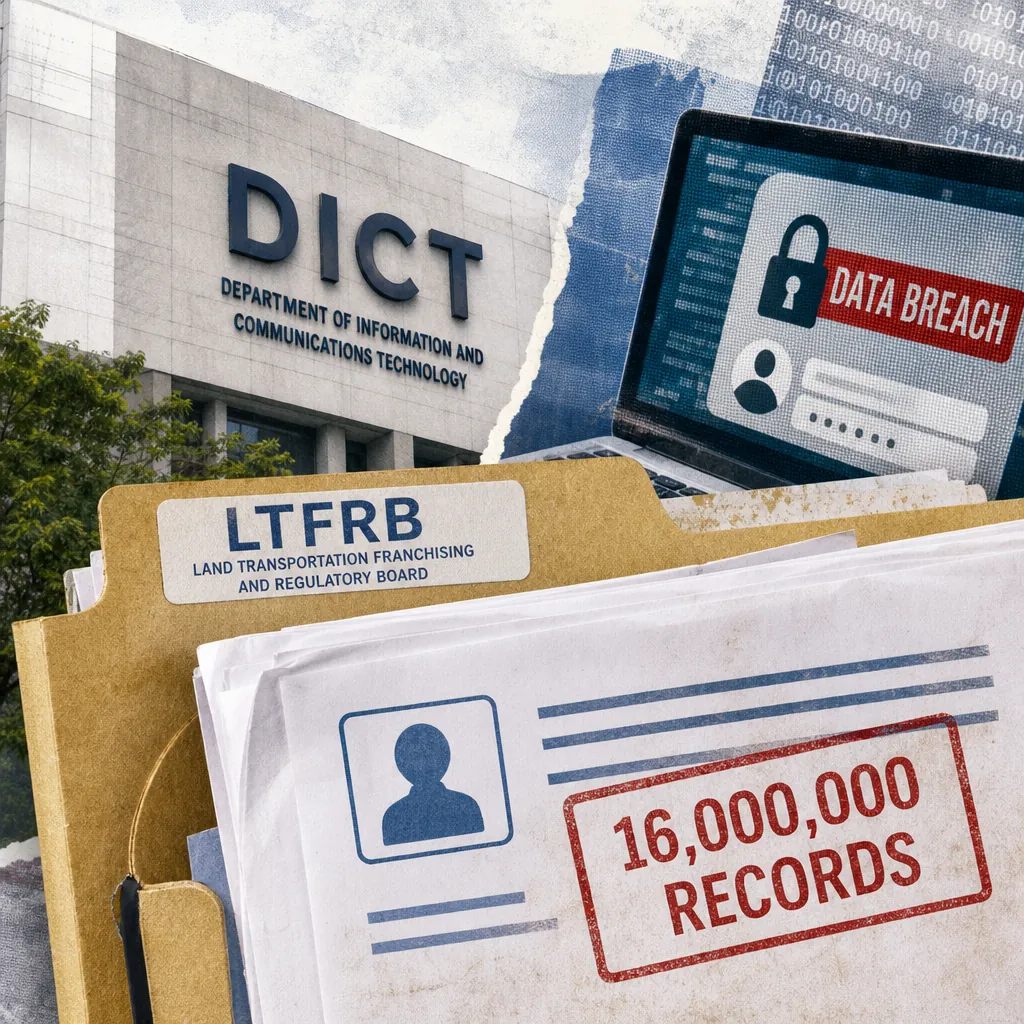
A coalition of transport groups asked the Department of Transportation and the Land Transportation Franchising and Regulatory Board on Friday to produce a technical report on two alleged cybersecurity incidents, the larger of which a threat actor claimed exposed 16 million records.2 The claim, first reported by cybersecurity news site Deep Web Konek on September 12, involves a user going by the handle "core849" who said they had obtained 7.7 gigabytes of data from the LTFRB — personnel records, vehicle registration data, and franchise and operator records among them.2 Neither the intrusion nor the authenticity of the data has been independently confirmed, and the coalition, Coalition 169, noted the claim followed an earlier alleged incident in August involving a group calling itself "Quantum Security Group."2
The same day's coverage put the Department of Information and Communications Technology (DICT), the agency responsible for the country's cybersecurity and digital policy, under pressure on two other fronts. Newsbytes Philippines reported that a shooting at Banga National High School in South Cotabato — the third deadly school shooting in the country since June — has renewed questions about how the DICT polices violent content online, after investigators said they were looking into the 16-year-old gunman's activity in an online "true crime" community and posts idolizing school shooters.4 Separately, the Office of the Ombudsman said it had uncovered what it called "ghost internet": contracts in which network providers supplied substandard or fake software to government agencies while charging full price, with the DICT named as the main focus of the investigation.11 And at the DICT's budget hearing, lawmakers pressed the agency on its difficulty retaining information and communications technology staff, who leave for private firms and overseas employers because government pay is lower.27
Those four stories — a possible breach, a school shooting, procurement anomalies, and a staffing shortfall — are separate events, but they converge on one institution and one question: whether the DICT has the people, the tools, and the verification procedures to do the job it is being asked to do. The coverage in this set ran almost entirely through online news outlets, and the items captured here are a monitored selection rather than a full record of the day's publishing.
Key themes
- A 16-million-record breach claim at the LTFRB is unverified but specific. A threat actor using the name "core849" claimed to hold 7.7 gigabytes of LTFRB data including personnel files, vehicle registrations, and franchise records; Coalition 169 wants the DOTr and LTFRB to say publicly what happened.2
- The DICT faces a third round of questions about harmful online content. Investigators are examining the South Cotabato gunman's participation in an online true crime community and his posts idolizing school shooters, the third such shooting since June.4
- The Ombudsman has named a procurement scheme it calls "ghost internet." Assistant Ombudsman Mico Clavano said providers installed cheaper, outdated, or fake software while charging the government full price, and that the overpricing goes undetected because nobody verifies software after hardware is approved.11
- Government ICT pay is driving specialists out. Legislators at the DICT budget hearing raised the disparity between government and private-sector compensation as the reason the agency struggles to recruit and retain the developers and programmers who would write anti-cybercrime and digital policy.27
- Free television's decline is now being discussed by the people who make its content. Vice Ganda signed a content partnership with MediaQuest Holdings, which owns TV5 and Cignal TV, and said the industry needs ABS-CBN, GMA, and TV5 to work together; ABS-CBN announced the retrenchment of 200 employees on September 15.14
- The peso, inflation, and foreign investment are all moving against the economy, yet companies still want to list. The peso closed at ₱62.73 to the dollar on September 17, headline inflation reached 6.1 percent last month, and foreign direct investment net inflows fell to their lowest monthly level in more than 11 years, while Mynt Inc. and VITRO REIT pursue initial public offerings.18
- The Public Relations Society of the Philippines held its 33rd National PR Congress. About 300 delegates gathered at Solaire Resort North on September 17 and 18 under the theme "Steward the Story: From Clout to Legacy," with sessions on media fragmentation and artificial intelligence.7
- A parody song about always coming up short is circulating widely. Michael V. wrote "Eh Kulang," based on the band Nobita's "Ikaw Lang," for the Sunday variety show Bubble Gang, describing Filipinos who constantly feel something is missing.910
How the narratives stack
Dominant. The LTFRB data-leak claim is the day's most consequential technology story because of its scale and its subject: a government agency that holds the personal records of millions of drivers, operators, and franchise holders. The claim is specific — 7.7 gigabytes, 16 million records, a named handle — but unverified, and the coalition's request is procedural rather than accusatory: issue a technical report.2 What makes it dominant is not the volume of coverage, which in this set is a single item, but the fact that it is the only story here that could directly affect ordinary Filipinos' personal data. The Ombudsman's "ghost internet" findings, reported the same day, reinforce the theme from a different angle: government technology procurement is not being verified after delivery.11
Counter-narrative. The DICT's defenders would point out that the agency is being blamed for outcomes that sit partly outside its control. The school shooting in South Cotabato involves a minor's access to his father's 9-mm pistol, kept in a vault at home, and his exposure to online communities that the DICT can flag but not erase.4 The ICT staffing problem is a compensation issue set by the broader government salary structure, not by the DICT alone.27 And the alleged LTFRB breach, if confirmed, would be an LTFRB system failure as much as a national cybersecurity failure. The counter-narrative is not that the DICT is blameless; it is that the day's coverage assigns the agency responsibility for problems whose causes are distributed across families, agencies, and budget decisions.
Emerging. The clearest emerging pattern is that the DICT is being asked to do more with fewer people. The budget hearing produced a concrete number: government developers and programmers are offered entry-level pay under the Salary Grade system that cannot compete with private and overseas employers.27 If the agency cannot hire, the verification failures the Ombudsman described — nobody checks the software after the hardware is approved — become more likely, not less.11 That link between staffing and procurement integrity is not stated explicitly in any single item, but it is the connective tissue across the day's DICT stories.
Under-covered. Two stories in this set received little attention relative to their subject matter. The first is the fertility decline: the Commission on Population and Development has warned that if the country's low fertility rate continues, there will be fewer workers and taxpayers to support pensions, health insurance, and other benefits for an aging population. The fertility rate fell to 1.7 children per woman in 2025 from 1.9 in 2022, below the 2.1 replacement level, while 7.4 million Filipinos were aged 65 and above in 2024.21 The second is the Department of Transportation's admission that it has no funding for fuel subsidies or the EDSA Busway in 2027, with Acting Secretary Giovanni Lopez telling a Senate finance subcommittee that a ₱5-billion fuel subsidy request was not included in the National Expenditure Program and that ₱1.7 billion is being sought for the busway.20 Both stories describe structural problems that will outlast the news cycle, and both appeared in this set as single items.
Platform insights
Facebook. The day's most-shared items in this set are consumer and entertainment stories rather than policy ones. Michael V.'s parody song "Eh Kulang" — a take on Nobita's "Ikaw Lang" about Filipinos who always feel something is missing — moved through Facebook via GMA News Online and Head Topics, carried by the comedian's own framing: "Ako si Juan Dela Cruz, ang magsisilbing boses ng mga Pilipino sa panahon ngayon."910 The song's premise, that ordinary life is defined by shortage, gives it a political edge without naming a policy, which is why it travels further on Facebook than the day's regulatory stories.
X. The LTFRB breach claim and the Ombudsman's "ghost internet" remarks are the kind of items that circulate on X among technology and governance watchers, where a named threat actor handle and a specific data volume give the story a concrete hook. The claim's unverified status is itself part of the conversation: Coalition 169's request for a technical report is a demand for confirmation, and until the DOTr or LTFRB responds, the discussion stays in the realm of allegation.2
Reddit. The school shooting in South Cotabato is likely to generate discussion in Philippine subreddits around two questions: how a 16-year-old obtained a firearm kept in a home vault, and what responsibility online platforms bear for communities that idolize school shooters.4 The DICT's role in moderating harmful content is the policy angle that Reddit threads tend to push toward, even when the original news item is a crime report.
YouTube. The parody song and the free television story both have natural video life. "Eh Kulang" is a performance piece written for Bubble Gang, and its lyrics are the kind that get clipped and re-uploaded.9 Vice Ganda's remarks about free TV — "May iniinda ngayon yung industriya. So, yung mga may kakayahan, kailangang magsanib-puwersa talaga" — are the kind of quote that circulates as a short clip, and the underlying story, ABS-CBN's retrenchment of 200 employees, gives the clip a news peg.14
Key voices and communities
Cybersecurity and transport-sector advocates. Coalition 169 is the group pressing the DOTr and LTFRB for a technical report, and its framing is procedural: confirm or deny, and explain what happened.2 This community's influence comes from its willingness to keep an unverified claim alive until an agency responds, which is how data-breach stories move from rumor to official acknowledgment.
Government oversight bodies. The Office of the Ombudsman, through Assistant Ombudsman Mico Clavano, introduced the phrase "ghost internet" into the procurement debate, describing providers who "install cheaper, outdated, or even fake software while still charging the government full price for the real thing."11 The Ombudsman's involvement raises the stakes because it can pursue administrative and criminal cases, not just publish findings.
Legislators on the finance and budget committees. The Senate subcommittee hearings on the 2027 budget produced two of the day's concrete numbers: the DICT's inability to retain ICT staff because of low entry-level pay, and the DOTr's missing fuel subsidy and EDSA Busway funding.2720 These hearings are where agencies are forced to state, on the record, what they do not have.
The creative and entertainment industry. Vice Ganda's partnership with MediaQuest Holdings and Michael V.'s parody song represent two different responses to the same audience: one institutional, one satirical. Vice Ganda's call for ABS-CBN, GMA, and TV5 to "join hands" is a statement about industry survival; Michael V.'s "Eh Kulang" is a statement about what audiences feel.149
The public relations profession. The Public Relations Society of the Philippines convened about 300 delegates for its 33rd National PR Congress, with Miko David, president of David and Golyat, arguing that lasting audience impact requires engaging people across social media, podcasts, and physical experiences.7 This community matters here because it is the group that will interpret and amplify the day's technology and governance stories for corporate clients.
Narrative streams
The LTFRB breach claim and the limits of confirmation
The claim at the center of the day's technology coverage is unusually specific for an unverified breach: a threat actor called "core849" said they obtained 7.7 gigabytes of data from the LTFRB, including personnel records, vehicle registration data, and franchise and operator records.2 The report was published by Deep Web Konek on September 12, and Coalition 169's September 18 statement asks the DOTr and LTFRB to issue a technical report on both this incident and an August incident attributed to a group calling itself "Quantum Security Group."2 The coalition's language is careful: "At this stage, it has not been independently confirmed whether unauthorized access to or acquisition of data occurred."2
For the sector, the significance is not only whether the breach happened but how the government responds to the claim. A technical report would establish what systems were affected, what data was actually taken, and what notifications are owed to the people whose records may be involved. The LTFRB holds franchise and operator records for the country's public transport system, and vehicle registration data touches millions of vehicle owners. If the claim is accurate, the affected population is large enough that the response — notification, remediation, and any identity-protection measures — would itself be a major undertaking. If the claim is false, the absence of a public denial leaves the allegation standing. Either way, the coalition's request puts the burden on the agencies to say something definitive.
The DICT's three-front pressure: content, procurement, and people
The DICT's day was defined by three separate problems that all point at the same capacity question. First, the South Cotabato school shooting — the third deadly school shooting since June — has investigators examining the 16-year-old gunman's online activity, including his participation in an online "true crime" community and posts idolizing school shooters.4 The shooting killed two 14-year-old students and wounded at least eight others before the gunman turned the weapon on himself; four of the injured were reported in critical condition, and the gunman allegedly used a 9-mm pistol belonging to his father, a Department of Education employee, which he obtained by breaking into a secured vault at home.4 The DICT's role here is content governance: flagging and limiting access to violent material, a task that is technically difficult and legally contested.
Second, the Ombudsman's "ghost internet" investigation describes a procurement pattern in which network providers delivered substandard equipment and fake software to government agencies while charging full price. Clavano's explanation is precise about the failure point: "Because nobody verifies the software after the hardware is approved, the overpricing goes undetected. It only comes out when the system breaks down or when someone digs deeply enough to find it."11 The investigation focuses mainly on the DICT, which means the agency responsible for the country's digital infrastructure is also the agency being examined for how it bought that infrastructure.11
Third, at the DICT's budget hearing, legislators raised the compensation gap that drives ICT talent to private firms and overseas employers. Government developers and programmers are offered entry-level pay under the Salary Grade system that cannot match private-sector offers, leaving the agency short of the specialists who would develop anti-cybercrime and digital policy.27 The three problems compound: an agency that cannot hire cannot verify procurement, and an agency that cannot verify procurement cannot assure the public that its systems are secure.
Free television's shrinking room
Vice Ganda's partnership agreement with MediaQuest Holdings Inc. is an attempt to produce content that helps revive free television, and his public framing is that the network wars should end because the industry as a whole is losing ground to digital platforms.14 MediaQuest, led by Manuel V. Pangilinan, owns TV5 and Cignal TV, so the partnership places one of the country's most prominent comedians inside the Pangilinan media group.14 The context is a retrenchment: ABS-CBN announced on September 15 that it was letting go of 200 employees.14 Vice Ganda's quote — "May iniinda ngayon yung industriya. So, yung mga may kakayahan, kailangang magsanib-puwersa talaga—ABS, GMA, TV5, and other platforms, di ba?" — is a call for cooperation among competitors.14
The counterweight in the same item is that television remains a dominant mass medium in the Philippines. Philippine Statistics Authority data cited in the report shows household and individual exposure historically ranging above 75 percent to over 90 percent depending on demographic and region.14 The read for the sector is that free TV's problem is not that people have stopped watching but that advertising and production economics have shifted toward streaming, and the retrenchment at ABS-CBN shows that even a dominant reach figure does not protect a broadcaster's payroll. For content producers, the practical question is whether partnerships like Vice Ganda's generate enough revenue to offset the decline, or whether they are a holding action.
The economy's mixed signals and the companies still lining up to list
The Philippine economy is sending contradictory signals, and the day's business coverage captured both sides. The peso closed at ₱62.73 to the dollar on September 17, headline inflation reached 6.1 percent last month, and foreign direct investment net inflows fell to their lowest monthly level in more than 11 years; the Philippine Stock Exchange index closed at 5,958.64 on September 17, with higher oil prices and the peso's weakness expected to weigh further on investor sentiment.18 Against that backdrop, companies are still pursuing initial public offerings — the process by which a private company sells shares to the public for the first time — including Mynt Inc., the parent company of GCash, and VITRO REIT of PLDT, with at least five other companies considering listings.18
The read for the sector is that the IPO pipeline is a bet on the medium term rather than the current quarter. Companies that list raise capital for expansion, and their willingness to do so while the peso is weak and inflation is above the central bank's target range suggests they expect the conditions to improve or that they need the capital regardless. For ordinary investors, the relevant fact is that a weak peso makes peso-denominated assets cheaper for foreign buyers, which can support demand for new listings even when domestic sentiment is poor.
The PR profession confronts fragmentation and artificial intelligence
The Public Relations Society of the Philippines held its 33rd National PR Congress at Solaire Resort North on September 17 and 18, drawing about 300 delegates from the public and private sectors, civil society, and academe, with eight speakers and 22 panelists across sessions on brand reputation, corporate advocacy, and strategic decision-making.7 The theme, "Steward the Story: From Clout to Legacy," frames the profession's central anxiety: that the metrics of online attention do not translate into durable reputation. Miko David, president of David and Golyat, told a session on fragmented media that lasting audience impact requires engaging people across social media, podcasts, and physical experiences where their attention naturally lies.7
The read for the sector is that the tools communicators use to measure success are being questioned by the practitioners themselves. If attention is spread across platforms and formats, then a single campaign's reach figure tells you less than it used to, and the profession's value proposition shifts from placement volume to sustained engagement. The congress's focus on artificial intelligence reflects the same pressure from the production side: tools that generate content cheaply make the judgment and relationships that PR firms sell more important, not less.
The fertility decline and who pays for an aging population
The Commission on Population and Development has warned that if the country's low fertility rate continues, there will be fewer workers and taxpayers to support pensions, health insurance, and other benefits for an aging population.21 The fertility rate fell to 1.7 children per woman in 2025 from 1.9 in 2022, below the 2.1 replacement level — the rate at which a population replaces itself from one generation to the next.21 In 2024, 7.4 million Filipinos were aged 65 and above, and 11.42 million were aged 60 and above.21
The read for the sector is that this is a fiscal story before it is a demographic one. Pension and health insurance systems are funded by current workers, so a shrinking workforce relative to retirees means either higher contributions, lower benefits, or larger government subsidies. The editorial framing in the Philippine Star's Pilipino Star Ngayon asked the question directly: who will support the Philippines in the future?21 For businesses, the implication is a smaller domestic labor pool and a larger market for health and elder-care services; for government, it is a budget problem that compounds every year the fertility rate stays below replacement.
The DOTr's missing 2027 funds
Acting Transportation Secretary Giovanni "Banoy" Lopez told a Senate finance subcommittee that the Department of Transportation has no funding for fuel subsidies or the EDSA Busway in 2027, and appealed to Congress to restore a ₱5-billion fuel subsidy request that was not included in the National Expenditure Program.20 The EDSA Busway, a dedicated bus lane along Metro Manila's main thoroughfare, would need about ₱1.7 billion, which the department is also seeking from the Senate.20 Lopez said the fuel subsidy is timely given rising petroleum prices caused by worsening tensions in the Middle East.20
The read for the sector is that transport subsidies are a price-stability tool as much as a welfare program. Fuel subsidies for public transport operators are intended to keep fares from rising when oil prices spike, and the EDSA Busway is meant to move commuters faster along the country's busiest corridor. If neither is funded, the costs show up as higher fares for commuters and slower trips, which in turn affect labor productivity and household budgets. The department's appeal to the Senate is a reminder that the budget process is where policy promises become either funded programs or unfunded intentions.
Conversation trajectory
The LTFRB breach claim will be resolved by an official statement or by silence, over the next two to four weeks. Coalition 169 has asked for a technical report, and the DOTr and LTFRB have not yet responded publicly. If a report is issued, expect follow-on coverage about what data was affected and what notifications are owed; if no report is issued, the claim will likely resurface with each new government data incident. The August "Quantum Security Group" incident gives the story a second data point that investigators can compare against.2
The DICT's budget hearing will produce more specific numbers on staffing and procurement, over the next two to six weeks. The Senate subcommittee process continues through the budget season, and the compensation gap raised at the DICT hearing is the kind of issue that generates follow-up questions and possibly a proposed fix in the budget bill.27 Watch for whether the Ombudsman's "ghost internet" investigation produces named agencies or contractors, which would move it from a description of a pattern to a case.11
The South Cotabato shooting will keep online content moderation in the news through the investigation. The third deadly school shooting since June creates pressure for a policy response, and the DICT is the agency that will be asked to provide one. The specific detail — the gunman's participation in an online true crime community and posts idolizing school shooters — gives legislators a concrete example to cite in hearings.4
Free television's restructuring will continue through the fourth quarter. ABS-CBN's retrenchment of 200 employees and Vice Ganda's partnership with MediaQuest are both responses to the same shift, and the next signal will be whether other networks announce similar moves or new content partnerships.14
The IPO pipeline will be tested by market conditions over the next one to two quarters. Mynt Inc. and VITRO REIT are already underway, and at least five other companies are considering listings. The trigger events to watch are the next inflation print, the peso's movement against the dollar, and any central bank policy decision that changes borrowing costs.18
The fertility decline will get more attention when the next population data is released. The Commission on Population and Development's warning is based on a trend that has been visible since at least 2022, and the next official estimate will either confirm the decline or show a reversal. The fiscal implications — fewer taxpayers supporting more retirees — are the reason this story will keep returning.21
Response guidance
For technology and cybersecurity communicators: prepare for the confirmation question. The LTFRB claim is unverified, and the appropriate posture is to state what is known, what is being checked, and when an update will come. Avoid confirming or denying specifics before a technical assessment is complete; the coalition's request is for a report, and a report is the right deliverable.2
For government agencies handling personal data: treat notification as a planning exercise, not a contingency. The LTFRB holds records for millions of vehicle owners and transport operators. If a breach is confirmed, the notification process — who is told, how, and what they are advised to do — will be judged on speed and clarity. Agencies should have that process documented before they need it.2
For the DICT and its oversight committees: connect the staffing shortfall to the procurement failures. The compensation gap that drives ICT specialists to private firms and the verification gap that lets substandard software go undetected are the same problem viewed from two ends. A budget request that addresses pay is also a procurement-integrity measure, and that framing is more persuasive than either argument alone.2711
For platforms and content moderators: expect scrutiny of communities that glorify violence. The South Cotabato investigation has put online true crime communities and school-shooter idolization in the news. Platforms should be able to describe what their policies prohibit and how they enforce them, in plain language, before they are asked.4
For broadcasters and content producers: the free TV conversation is now about cooperation, not competition. Vice Ganda's call for ABS-CBN, GMA, and TV5 to work together reflects the economics of a shrinking advertising market. Producers should expect partnership models — shared content, joint productions, cross-platform distribution — to become more common, and should plan for them.14
For business and financial communicators: the IPO story is a medium-term bet, and the messaging should match. Companies pursuing listings while the peso is weak and inflation is elevated need to explain why the timing makes sense, whether that is expansion capital, market position, or a view that conditions will improve. Investors will ask.18
For public relations practitioners: the congress's theme is the message. "From Clout to Legacy" is a statement that attention metrics are not enough. Practitioners should be prepared to show clients how sustained engagement differs from a spike in impressions, and to explain what they are measuring instead.7
For agriculture and food-security communicators: the Calamba distribution is a template for local-government messaging. The city distributed 10 kilograms of rice each to 5,000 farmers and fisherfolk and 2,076 sacks of fertilizer to local farmers, under the national government's Bawat Bayang Makikinabang program, with Mayor Ross Rizal framing it as continued support for food producers.6 The lesson for communicators is that program names and specific quantities — 5,000 recipients, 2,076 sacks — make assistance tangible in a way that general statements do not.
See the full picture behind today's signals.
This report draws from Media Meter's MediaWatch, our real-time monitoring engine tracking 2,470+ Philippine sources across print, broadcast, digital, and social. Explore how the platform turns raw coverage into decision-grade intelligence, then see how it's configured for teams like yours — whether you're in PR agencies, corporate comms, government, or marketing.
Want more? Browse our Report Library for sector and crisis intelligence, or request a demo and we'll have your brand set up before the call.
Want this kind of intelligence on your brand?
This brief is built on the same MediaWatch methodology that runs continuously across every brand we monitor. See your competitive landscape, Impact Score, and narrative trajectory in a 30-minute demo.