LTO Enforcement Actions Dominate Transport Coverage
The Land Transportation Office issued a show-cause order over a fatal bus incident in Quezon, suspended an SUV driver's license for 90 days, and drew public support for a leadership change, while the LTFRB's P555.75-million fine on Move It PH and airport modernization moves rounded out the day's transport news.

The Land Transportation Office (LTO) moved on three separate enforcement fronts on Saturday, and taken together the actions sketch an agency under pressure to show it can police the road. Its largest single action was a show-cause order against the driver and operator of a passenger bus whose engine cover detached while the vehicle was moving and struck a pedestrian waiting for a ride to Manila, killing her 1416. The same day, the LTO suspended for 90 days the license of an SUV driver linked to the death of a 23-year-old online phone seller along EDSA in Mandaluyong on November 1 33. And a road-safety group publicly endorsed a career transport official, Atty. Noreen San Luis, to take the agency's top post amid complaints about delays in its online services 407.
The enforcement news arrived alongside a business-page column on the Land Transportation Franchising and Regulatory Board's (LTFRB) P555.75-million fine against ride-hailing app Move It PH for carrying far more motorcycle riders than its government allocation allows 37. The LTFRB is the agency that sets fares and franchise terms for public road transport, including the motorcycle-taxi pilot program under which Move It operates. Separately, the Department of Transportation (DOTr) said it would pursue more public-private partnership (PPP) projects with the Civil Aviation Authority of the Philippines (CAAP) before President Marcos leaves office in 2028 34, and the Manila International Airport Authority (MIAA) formally handed operational control of more than 2,100 closed-circuit television cameras at Ninoy Aquino International Airport (NAIA) to the private concessionaire New NAIA Infra Corp. (NNIC) 41.
No social-media monitoring writeup accompanied this set of items, so the picture here rests on the published coverage alone. Across the items captured, the LTO's enforcement actions and the questions about its leadership carried the most weight, and the fatal bus case drew the widest pickup: the GMA News Online report and a Head Topics aggregation of the same LTO release both ran the story 1416. The Move It fine, at P555.75 million, is the largest single peso figure in the set and the one with the clearest consequences for commuters and drivers.
Key themes
- A detached engine cover killed a pedestrian and the LTO summoned the bus operator. The bus was traveling the Maharlika Highway in Atimonan, Quezon, at about 5 a.m. on November 5 when its engine cover came loose and hit a woman standing by the roadside; she was declared dead on arrival at Doña Marta Hospital 1416.
- The LTO suspended an SUV driver's license for 90 days over a fatal EDSA incident. The driver is accused of running over a 23-year-old online phone seller who had arranged to meet a buyer for a unit worth more than P50,000; the LTO ordered the license surrendered to its Intelligence and Investigation Division while the investigation continues 33.
- A road-safety group backed Atty. Noreen San Luis to head the LTO. Roadsafe Philippines cited her service as regional director in Bicol, Calabarzon and the National Capital Region and her work on the Students Today, Road Users Tomorrow (STRUT) program and the Single Ticketing System 40.
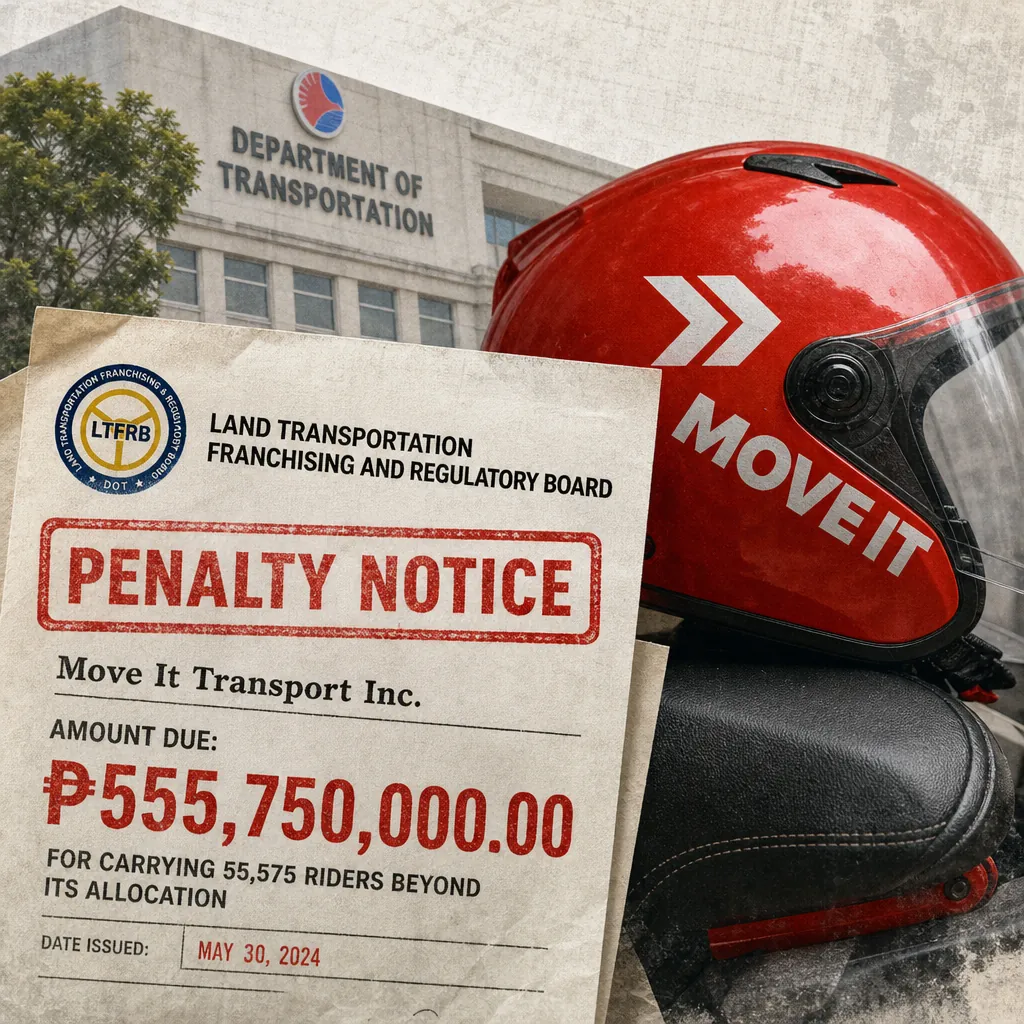
- The LTFRB fined Move It PH P555.75 million for exceeding its rider allocation. The board counted 73,321 active Move It riders as of May against an authorized allocation of 17,746 under the Motorcycle Taxi Pilot Program, and imposed P10,000 for each of the 55,575 riders over the cap 37.
- The DOTr plans more PPP projects with the aviation regulator. Secretary Vince Dizon said he had spoken with CAAP about potential projects and would announce details the following week, adding that fares would not rise much because the government would absorb costs 34.
- MIAA handed NAIA's camera network to the private concessionaire. Control of more than 2,100 CCTV cameras passed to NNIC under the NAIA PPP concession agreement, with MIAA retaining its regulatory and oversight role 41.
- The Bureau of Immigration backed wider use of electronic gates at NAIA. Commissioner Joel Anthony Viado said expanding e-Gates to all arriving and departing passengers would cut queues, speed processing and strengthen border security, aligning with President Marcos's directive to digitalize government services 5.
How the narratives stack
Dominant. The LTO's enforcement actions dominate the items captured here. The fatal bus case ran in at least two outlets 1416, the SUV license suspension drew its own report 33, and the leadership question produced both a news story and a blog commentary 407. This is dominance within the captured set, which skews toward Philippine online news; the LTO's visibility reflects both the seriousness of the incidents and the agency's habit of issuing news releases that outlets pick up quickly.
Counter-narrative. The Move It PH fine tells a different story about the same transport bureaucracy: not an agency responding to accidents, but a regulator enforcing franchise limits against a private operator. The Philstar business column frames the fine as a matter of arithmetic rather than interpretation, noting that the company's internal classification of riders as full-time, part-time, online or offline did not change the number it was authorized to carry 37. The counter-narrative to the LTO's enforcement push is that the LTFRB's own rules, not road conditions, are what is squeezing motorcycle-taxi supply.
Emerging. The airport modernization thread is the least developed but the most forward-looking. The MIAA-to-NNIC camera transfer 41, the DOTr's planned PPP announcements with CAAP 34, and the immigration bureau's e-Gate expansion 5 all point to a shift of NAIA operations toward private management and automated processing. None of these items reports a completed outcome yet; the PPP details are promised for next week and the e-Gate expansion is a proposal the BI has endorsed, not a finished rollout.
Under-covered. The clearest under-covered story in this set is the human cost behind the enforcement numbers. The Atimonan victim was a woman waiting for a ride to Manila when a piece of a passing bus killed her 1416; the EDSA victim was a 23-year-old phone seller who had arranged to meet a buyer 33. Both deaths are reported as incident details, and neither item examines why an engine cover detached or what inspection regime might have caught it. The coverage reports the LTO's response but not the maintenance failures that produced the fatalities.
Platform insights
- Facebook. The LTO's own Facebook page is the source of the photo accompanying the GMA News Online report on the Atimonan bus case, which indicates the agency is using its page to distribute enforcement announcements directly to the public 14. The LTO's social presence functions as a press-release channel as much as a public-safety feed.
- X. No post-level engagement data appears in the items captured, so the volume and tone of conversation on X cannot be characterized from this set.
- Reddit. No discussion threads from Reddit appear in the items captured.
- YouTube. No YouTube content appears in the items captured.
Key voices and communities
The LTO and its enforcement divisions. The agency is the loudest voice in this set, issuing the show-cause order, the license suspension and the news releases that generated most of the coverage 1433. Its framing is procedural: identify the driver and operator, serve the order, open an investigation.
Roadsafe Philippines. The road-safety advocacy group endorsed Atty. San Luis for the LTO top post, citing her regional experience and her role in the STRUT program and the Single Ticketing System 40. The Single Ticketing System is a scheme to unify traffic-violation fines and procedures across Metro Manila's local governments, which had previously each enforced their own rules. The group's endorsement matters because it signals that road-safety advocates see the LTO's leadership as part of the problem.
The LTFRB. The board's P555.75-million fine against Move It PH is the set's clearest statement of regulatory authority over the motorcycle-taxi sector 37. Its position is that the authorized allocation is a hard number, not a guideline.
The DOTr and its attached agencies. Secretary Dizon, the BI and the MIAA all appear in the set pushing modernization and private-sector partnership 34541. Their framing is that automation and private management will improve service without raising fares much.
Commuters and road users. They appear in this set mainly as victims and as the audience for the LTO's warnings. The Atimonan pedestrian and the EDSA phone seller are the two named cases, and the coverage treats them as the reason for enforcement rather than as participants in the story 1433.
Narrative streams
A bus part came loose on a highway and killed a woman waiting for a ride
The LTO's show-cause order against the bus driver and operator followed an incident at about 5 a.m. on November 5 along the northbound lane of the Maharlika Highway in Barangay Tagbakin, Atimonan, Quezon. According to a police report cited by the LTO, the bus was moving when its engine cover suddenly detached and struck a pedestrian standing by the roadside waiting for a ride to Manila. She sustained serious injuries and was rushed to Doña Marta Hospital, where she was declared dead on arrival 1416.
A show-cause order is the LTO's formal demand that a driver or operator explain why the agency should not suspend or revoke their registration or license. It is a first step in an administrative case, not a criminal charge. The LTO said it identified both the driver and the operator and formally served them with the order 14. The GMA News Online report carried a photo from the LTO's Facebook page, which suggests the agency publicized the action itself 14.
For bus operators, the case raises the question of maintenance liability. An engine cover is a body panel, and its detachment while the vehicle is moving points to either a mechanical failure or a failure to secure the panel during inspection. The LTO's order puts the operator, not just the driver, in the frame, which matters because operators hold the franchise and the maintenance budget. For commuters, the case is a reminder that the danger on provincial highways is not only collision but debris from vehicles already in motion.
The LTO suspended an SUV driver's license for 90 days over a fatal EDSA encounter
The second enforcement action concerns a November 1 incident along EDSA in Mandaluyong. According to police records cited by Philstar, a 23-year-old online cellphone seller named Mohammad Sheikdugar had arranged to meet a buyer for a phone worth more than P50,000. The suspect allegedly told the victim to remove a barrier at a bank parking area, then suddenly accelerated. The victim tried to stop the vehicle and was dragged along the side or stepboard from Ortigas before the vehicle fled 33.
The LTO suspended the driver's license for 90 days, ordered it surrendered to the agency's Intelligence and Investigation Division, and flagged the SUV in its records while the investigation continues 33. A 90-day suspension is an administrative precaution, not a finding of guilt; it keeps the driver off the road while the case is built. The case has drawn attention because it combines a violent crime with a road-safety enforcement action, and because the victim was a young online seller meeting a stranger for a transaction.
For the LTO, the case is a test of whether its administrative process can move faster than the criminal courts. For online sellers, the incident is a reminder that meet-up transactions carry risks that no platform policy fully covers. The coverage does not say whether the driver has been charged criminally.
A road-safety group wants Atty. Noreen San Luis to run the LTO
Roadsafe Philippines publicly supported the possible appointment of Atty. Noreen San Luis as LTO chief, citing her experience as regional director for Bicol, Calabarzon and the National Capital Region, and her involvement in road-safety programs including STRUT and the Single Ticketing System 40. A separate blog commentary made the case in more detail, describing her as a lawyer, registered nurse and Career Executive Service Officer (CESO) Rank V with more than 12 years in land transportation governance, including a stint as director of the LTO's Traffic Adjudication Service 7.
The push for a leadership change follows complaints about the LTO's online services, particularly delays affecting vehicle registration and driver's license renewal 40. Those delays matter because the LTO's digital systems are the front door for millions of vehicle owners and drivers; when they stall, the backlog moves to physical offices and fixers fill the gap. The endorsement is a signal that road-safety advocates see the agency's management, not just its enforcement, as the weak point.
For the LTO's staff and regional offices, a change at the top would mean a new set of priorities. For the public, the practical question is whether a new chief can fix the online systems that generate the most daily frustration. The coverage does not say whether an appointment is imminent or who else is under consideration.
The LTFRB fined Move It PH P555.75 million for carrying too many riders
The largest peso figure in the set comes from the LTFRB's fine against ride-hailing app Move It PH. The board found that Move It had 73,321 active riders across Metro Manila, Cebu and Cagayan de Oro as of May, against an authorized allocation of 17,746 under the Motorcycle Taxi Pilot Program. It imposed a P10,000 administrative fine for each of the 55,575 rider-partners over the cap, producing the P555.75-million total, and flagged the company for disregarding a one-year moratorium on onboarding new riders 37.
The Motorcycle Taxi Pilot Program is the government's controlled trial of motorcycle taxis as public transport, which caps how many riders each operator may field while regulators study safety and fare issues. Move It argued that its internal classification of riders as full-time or part-time, online or offline, and those working more or fewer than eight hours a day, should affect the count. The LTFRB rejected that reasoning, holding that the authorized number is the authorized number 37.
For Move It's riders, the fine could mean tighter onboarding rules and fewer slots for new drivers. For commuters, it could mean longer waits if the company is forced to shed riders. For the broader motorcycle-taxi sector, the case sets a precedent that the LTFRB will enforce the cap with per-rider penalties, which raises the cost of over-hiring substantially.
The DOTr is planning more PPP projects with the aviation regulator
Transportation Secretary Vince Dizon said the DOTr would pursue more public-private partnership projects with the Civil Aviation Authority of the Philippines before President Marcos's term ends in 2028. He said he had spoken with CAAP about potential projects but did not give details, and that announcements would come the following week. He also said the partnerships would not significantly raise transport fares, because the government rather than the private operator would absorb cost increases 34.
A PPP is a long-term contract in which a private company finances, builds or operates public infrastructure in exchange for fees or revenue, while the government retains ownership or regulatory control. CAAP is the agency that regulates civil aviation and operates many of the country's airports outside the major international gateways. The DOTr's PPP push fits with the broader shift of NAIA operations to a private concessionaire 41.
For airlines and airport users, more PPP projects could mean faster upgrades to provincial airports and air-traffic systems. For the government, the risk is that PPP contracts lock in fees or revenue guarantees that outlast the administration. The coverage does not name the projects under discussion.
NAIA's camera network moved to the private concessionaire
The Manila International Airport Authority formally handed operational control of more than 2,100 CCTV cameras at NAIA to New NAIA Infra Corp. under the NAIA PPP concession agreement. MIAA said it retains its regulatory and oversight functions, ensuring NNIC complies with performance standards and service-quality requirements, and that it continues to work with the DOTr, NNIC and other airport stakeholders 41.
The transfer is part of the broader handover of NAIA operations and maintenance to NNIC, the private consortium that won the concession to run and upgrade the airport. CCTV control matters because camera coverage is central to security, crowd management and incident investigation at the country's main gateway. For travelers, the practical test is whether security screening and terminal management improve. For MIAA, the challenge is to regulate a concessionaire that now controls the systems MIAA once operated directly.
The immigration bureau wants e-Gates open to all NAIA passengers
Bureau of Immigration Commissioner Joel Anthony Viado endorsed Transportation Secretary Dizon's proposal to expand electronic immigration gates to all arriving and departing passengers at NAIA. Viado said the expansion would reduce queues, speed passenger processing, strengthen border security and support the bureau's mandate against human trafficking and cross-border crime, and that it aligns with President Marcos's directive to digitalize government services 5.
An e-Gate is an automated immigration checkpoint that scans a passenger's passport and biometrics and clears them without a manual counter interview. The gates are currently used for selected passenger categories; expanding them to all travelers would change the staffing model at NAIA's immigration counters and shift more screening to automated systems. For frequent travelers, the change could shorten arrival and departure processing. For the BI, it means fewer officers at counters and more reliance on data-matching systems, which raises the stakes on system reliability.
Conversation trajectory
Next week's PPP announcement (observation window: one week). Secretary Dizon said the DOTr would announce additional PPP projects with CAAP the following week 34. Watch for the named projects, the contract terms and whether fare guarantees appear. If the announcement includes airport projects, it will connect the DOTr's aviation agenda to the NAIA concession handover.
The LTO leadership question (observation window: two to four weeks). Roadsafe Philippines' endorsement of Atty. San Luis 40 and the blog commentary on her record 7 suggest a decision is being discussed. Watch for an official appointment, a denial, or continued silence from the Palace. A change at the top would likely bring a review of the online registration and licensing systems that prompted the complaints.
The Atimonan bus case (observation window: two to four weeks). The show-cause order requires the driver and operator to respond 1416. Watch for the LTO's ruling, any criminal charges, and whether the operator's other buses are inspected. The case could produce a broader review of bus maintenance standards on provincial highways.
The Move It fine (observation window: two to four weeks). The P555.75-million penalty is the largest in the set 37. Watch for whether Move It appeals, pays, or reduces its rider roster, and whether the LTFRB applies the same per-rider formula to other motorcycle-taxi operators.
The EDSA SUV case (observation window: two to four weeks). The 90-day license suspension runs while the investigation continues 33. Watch for criminal charges and for whether the LTO extends the suspension or revokes the license.
Trigger events. The DOTr's promised PPP announcement, any Palace statement on the LTO chief, the LTO's ruling on the Atimonan operator, and Move It's response to the fine are the four events most likely to move this story forward.
Response guidance
Bus operators: audit body panels and secure engine covers. The Atimonan fatality involved a detached engine cover, a component that should be checked in every pre-trip inspection 1416. Operators should document inspection routines and be ready to show them to the LTO if a show-cause order arrives.
Ride-hailing and motorcycle-taxi companies: reconcile rider counts against the authorized allocation before the regulator does. The LTFRB's per-rider penalty formula turned a headcount gap into a P555.75-million liability 37. Companies should publish their compliance numbers and avoid internal classifications that regulators have already rejected.
LTO and its regional offices: communicate the status of online services. The complaints about registration and license-renewal delays are the backdrop to the leadership question 40. Regular public updates on system status and backlog clearing would address the frustration directly.
Airport and aviation agencies: explain what the private concessionaire now controls. The CCTV handover to NNIC 41 and the e-Gate expansion 5 change who operates the systems travelers encounter. Clear signage and public explanations of the new processes will reduce confusion at counters and gates.
Road-safety advocates: keep the focus on maintenance and enforcement outcomes. The endorsements and commentary around the LTO leadership 407 are useful, but the public case is strongest when tied to specific failures, such as the detached engine cover and the EDSA dragging, and to what inspection or enforcement change would prevent them.
Communicators across the transport sector: avoid treating enforcement announcements as routine. Each LTO news release in this set involves a death 1433. Messaging that leads with the agency's process rather than the victim's circumstances reads as bureaucratic; acknowledging the loss first and the enforcement action second is the more credible order.
See the full picture behind today's signals.
This report draws from Media Meter's MediaWatch, our real-time monitoring engine tracking 2,470+ Philippine sources across print, broadcast, digital, and social. Explore how the platform turns raw coverage into decision-grade intelligence, then see how it's configured for teams like yours — whether you're in PR agencies, corporate comms, government, or marketing.
Want more? Browse our Report Library for sector and crisis intelligence, or request a demo and we'll have your brand set up before the call.
Want this kind of intelligence on your brand?
This brief is built on the same MediaWatch methodology that runs continuously across every brand we monitor. See your competitive landscape, Impact Score, and narrative trajectory in a 30-minute demo.