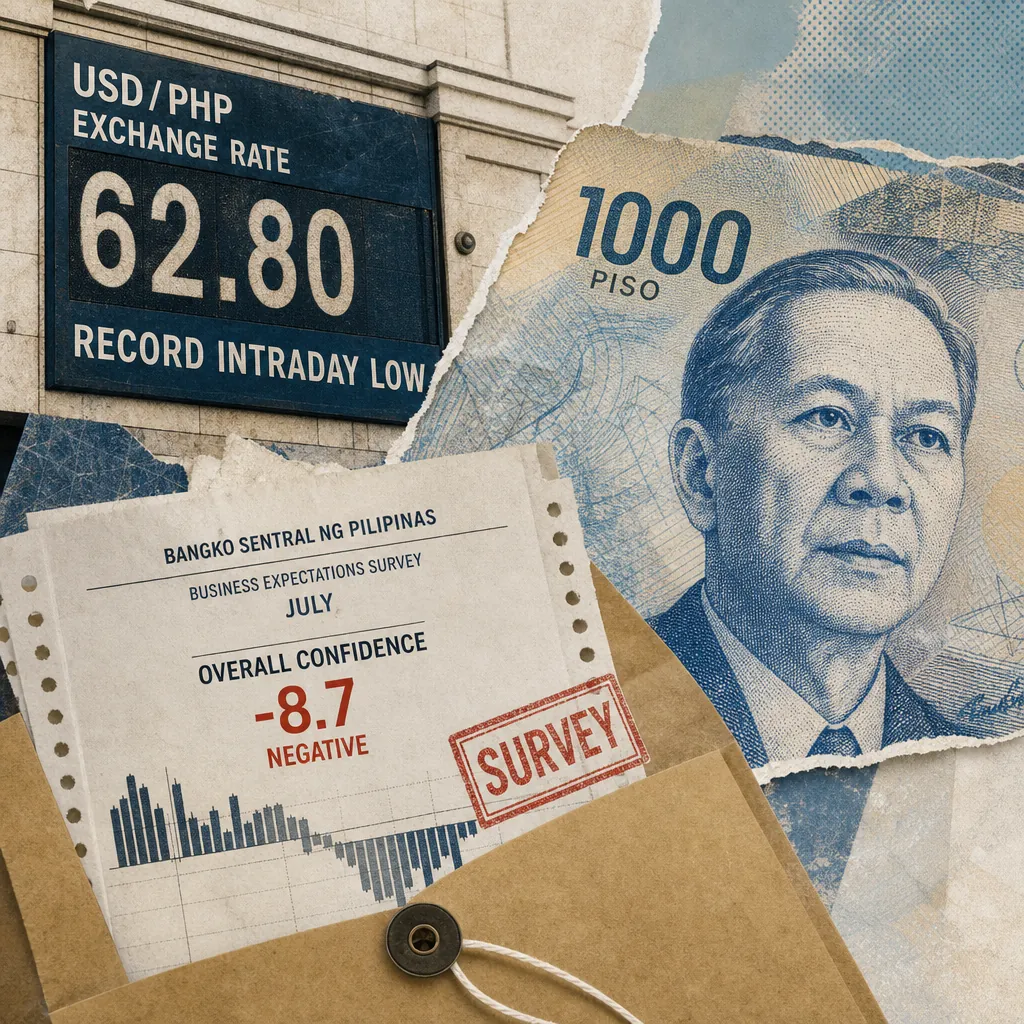
Peso hits record low P62.40 as trade gap weighs
The Philippine peso closed at a fresh record low of P62.40 against the US dollar on September 1, driven by a wide trade deficit, high oil prices, and global jitters. Central bank officials and analysts weighed in on the currency's slide, while other financial developments included new digital banking initiatives and corporate moves.
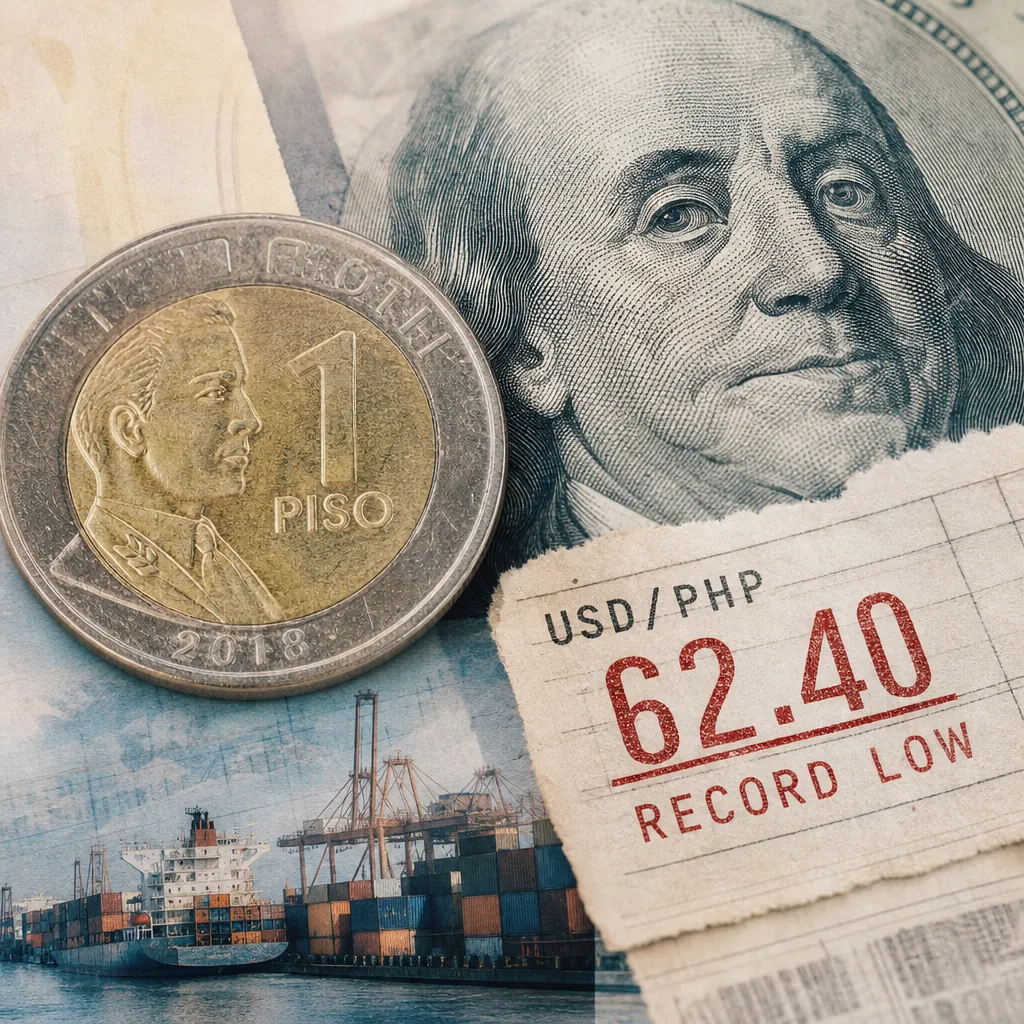
The Philippine peso slid to a fresh record low of P62.40 against the US dollar on Tuesday, September 1, extending its decline for a third straight trading session as renewed dollar strength, high oil prices, and the country's persistent trade deficit weighed on the currency 3542. The closing rate surpassed the previous record low of P62.265 logged on August 28, with the peso losing 13.5 centavos in a single day 2581. Financial markets were closed on Monday for the National Heroes Day holiday, so Tuesday's trading followed Friday's session 42. The peso opened at P62.25 before weakening through the day to close at its session low 2581.
Bangko Sentral ng Pilipinas (BSP) Governor Eli Remolona Jr. acknowledged the difficulty of defending the currency, telling a Senate budget panel that the country's trade deficit — running at about 13 percent of gross domestic product — makes it hard to prevent the peso from weakening 4. "It is difficult to stop the peso's fall. The BSP can slow the peso's depreciation, but it cannot fix the exchange rate. We will run out of reserves," Remolona said 81. He pointed to initiatives such as Pax Silica, a US-led initiative on artificial intelligence and supply-chain security that the Philippines joined in April, and the Luzon Economic Corridor as potential ways to strengthen exports 4.
Analysts offered a range of explanations for the peso's slide. Jonathan Ravelas, senior adviser at Reyes Tacandong & Co., said safe-haven demand lifted the dollar amid renewed Middle East tensions and ahead of Federal Reserve Chair Warsh's Jackson Hole remarks 35. Michael Ricafort, chief economist at Rizal Commercial Banking Corp., noted the peso has weakened in five of the past six trading sessions 42. Former BSP deputy governor Diwa Guinigundo suggested the peso's weakness could signal that markets are not convinced the central bank is doing enough to bring down inflation, which remains above the BSP's target range 2571.
Key themes
- Peso closes at record low P62.40 per dollar — The Philippine currency weakened for a third straight session on September 1, closing at P62.40 against the US dollar, down 13.5 centavos from its previous record low of P62.265 set on August 28 3542. The decline reflects safe-haven demand for the dollar amid Middle East tensions, high oil prices, and the country's wide trade deficit 3581.
- Trade deficit and weak exports drive currency pressure — BSP Governor Eli Remolona Jr. said the country's trade deficit of about 13 percent of GDP makes it difficult to prevent the peso from weakening, as exports remain insufficient 481. The merchandise trade deficit widened to $37.34 billion in the first seven months from $28.91 billion a year earlier 66.
- Negative real interest rates flagged as economic risk — Former BSP deputy governor Diwa Guinigundo warned that with a nominal policy rate of 5 percent and inflation above 6 percent, the real cost of money remains negative, meaning the purchasing power lost to inflation exceeds the return earned on money 71. This could undermine the central bank's efforts to control inflation.
- BSP offers rural banks free three-year cloud banking subscription — The central bank is providing eligible rural banks with a free three-year subscription to a cloud-based core banking system under its Rural Bank Strengthening Program, aimed at accelerating digital transformation, improving cybersecurity, and enhancing customer service 350.
- QR Ph integration with Alipay+ opens international payments — Filipino merchants using QR Ph can now accept payments from international consumers through their home e-wallets and banking apps, following an integration between Philippine Payments Management Inc. and Alipay+ 31. The arrangement benefits micro, small, and medium enterprises serving foreign travelers.
- GSIS returns P19 billion to government workers through Balik Ginhawa — The Government Service Insurance System has returned more than P19 billion in loan payment relief to over 700,000 government workers, suspending loan amortizations for up to six months under its Balik Ginhawa program 87. The program covers nearly 1.3 million loan contracts as of August 31 87.
- SSS expands lending with solar energy loans and microloan program — The Social Security System announced plans for a P40 billion Energy Sustainability Loan Program for renewable energy projects, with loans up to P400,000, and reintroduced its SSS LoanLite microloan program that does not require employer certification 45. The pension fund also projects investment income of P71.4 billion this year 37.
- Corporate moves signal confidence despite currency weakness — Security Bank unveiled a three-year growth strategy focused on wealth management and entrepreneur banking 2, former finance secretary Carlos Dominguez joined Megaworld's board as lead independent director 3685, and PNB Holdings saw first-half profit surge 85.3 percent ahead of a planned stock market listing 51.
How the narratives stack
Dominant — The peso's slide to a record low dominated the day's financial news, drawing coverage across multiple outlets and mediums. The story appeared in broadsheet and online business publications including Business Mirror, Malaya Business Insight, and BusinessWorld, as well as on television news programs 3542616681. The narrative centered on the currency's third straight day of decline, the trade deficit's role in weakening the peso, and the central bank's limited ability to intervene. Within the captured set, this story drew the most sustained attention, with multiple articles and broadcast segments devoted to the peso's fall and its implications for the economy 25354281.
Counter-narrative — Despite the peso's weakness, Philippine stocks surged on Tuesday, with the Philippine Stock Exchange index jumping 2.31 percent to close at 6,093.89 on bargain hunting and improved manufacturing data 61. This was the PSEi's best one-day performance since June 15. The University of Asia and the Pacific also said the economy could return to above-4 percent growth in the fourth quarter, backed by record employment, stronger exports, and an expected rebound in infrastructure spending 66. This counter-narrative suggests that while the currency faces pressure, other economic indicators point to resilience.
Emerging — Digital banking and financial inclusion initiatives are gaining momentum. The BSP's offer of free cloud-based core banking systems to rural banks 350, the QR Ph integration with Alipay+ 31, and GCash's GStocks PH now serving over 2 million users and accounting for over 50 percent of all online retail stock market accounts 23 all point to accelerating digital transformation in the financial sector. These developments could help expand financial access and support the central bank's financial inclusion goals.
Under-covered — The arrest of an illegal pre-registered SIM card seller in Bulacan received relatively limited coverage despite its significance for cybersecurity and financial crime prevention 1284. The suspect was selling registered SIM cards for P10 each and admitted to registering cards using other individuals' identities. This story connects to broader concerns about SIM registration compliance and the potential for financial fraud, yet it placed lower in the day's news cycle compared to the peso story.
Platform insights
- Facebook — The peso's decline generated discussion among Filipino users, with posts sharing news articles and expressing concerns about rising prices and the cost of imports. The SIM card seller arrest also circulated on the platform, where the suspect had been offering registered SIM cards for P10 each 84. Facebook remains the primary venue for Filipinos to share and comment on financial news affecting household budgets.
- X (formerly Twitter) — Financial analysts and economists used the platform to share their views on the peso's slide, with commentary on the trade deficit, interest rates, and the central bank's policy options. The platform served as a real-time forum for interpreting the currency's movement and its implications for inflation and economic growth.
- YouTube — Television news segments on the peso's record low and related economic stories were shared on the platform, extending the reach of broadcast coverage. GMA 7's report on the peso closing at P62.40 and the GSIS Balik Ginhawa program were among the items that appeared in video form 87.
- News websites and blogs — Business publications including Business Mirror, Malaya Business Insight, and BusinessWorld provided detailed analysis of the peso's decline, the trade deficit, and interest rate dynamics. Technology and lifestyle blogs covered consumer-facing financial stories such as the Samsung Galaxy S26 FE launch and Metrobank's home and car loan fest, indicating the breadth of financial content reaching different audiences 677.
Key voices and communities
- Bangko Sentral ng Pilipinas officials — Governor Eli Remolona Jr. emerged as the central voice explaining the peso's decline, attributing it to the trade deficit and insufficient exports 481. His statements that the BSP cannot fix the exchange rate without running out of reserves framed the central bank's position and set expectations for limited intervention.
- Bank economists and analysts — Jonathan Ravelas of Reyes Tacandong & Co., Michael Ricafort of Rizal Commercial Banking Corp., and Ruben Carlo Asuncion of Union Bank provided market analysis attributing the peso's weakness to safe-haven demand, oil prices, and global tensions 3542. Former BSP deputy governor Diwa Guinigundo offered a critical perspective on negative real interest rates 71.
- State pension funds — The Government Service Insurance System (GSIS) and Social Security System (SSS) announced programs aimed at easing financial burdens on members, including the P19 billion Balik Ginhawa loan relief and the P40 billion solar energy loan initiative 4587. These institutions positioned themselves as responsive to members' needs amid rising costs.
- Banks and financial institutions — Security Bank unveiled its three-year growth strategy 2, RCBC highlighted its employee-focused retail strategy 52, and CIMB Bank Philippines received recognition for pioneering embedded finance 57. These corporate announcements signaled confidence in the banking sector's prospects despite currency headwinds.
- Business and policy advocates — The Philippine Chamber of Cooperatives announced plans for a National Leadership Congress focused on translating the cooperative sector's economic strength into political voice 1. The World Trade Center Association highlighted opportunities for Philippine economic zones to capture data center investment 49.
Narrative streams
Peso slides to record low as trade deficit and global pressures mount
The Philippine peso closed at P62.40 against the US dollar on September 1, a fresh all-time low that extended its decline for a third straight trading session 3542. The currency lost 13.5 centavos from its August 28 close of P62.265, with trading ranging between P62.25 and P62.40 42. The decline came as financial markets reopened after the National Heroes Day holiday on Monday 42.
BSP Governor Eli Remolona Jr. told a Senate budget panel that the country's trade deficit — about 13 percent of gross domestic product — makes it difficult to prevent the peso from weakening 4. "Our exports are far too low, so it is difficult to prevent the peso from weakening," he said, adding that initiatives such as Pax Silica and the Luzon Economic Corridor could help strengthen exports 4. Pax Silica is a US-led initiative focused on artificial intelligence and supply-chain security that the Philippines joined in April alongside 23 other signatories 4.
Analysts attributed the peso's slide to multiple factors. Jonathan Ravelas of Reyes Tacandong & Co. cited safe-haven demand for the dollar amid renewed Middle East tensions and ahead of Federal Reserve Chair Warsh's Jackson Hole remarks 35. Michael Ricafort of Rizal Commercial Banking Corp. noted the peso has weakened in five of the past six trading sessions 42. Former BSP deputy governor Diwa Guinigundo suggested the peso's weakness could indicate markets are not convinced the central bank is doing enough to control inflation 25.
The peso's decline has direct consequences for Filipino consumers and businesses. A weaker currency makes imports more expensive, contributing to inflation pressures. The trade deficit widened to $37.34 billion in the first seven months from $28.91 billion a year earlier, according to the Philippine Statistics Authority 66. The University of Asia and the Pacific said short-term pressures from oil volatility and trade deficits could push the peso toward P63 per dollar, though it expects economic growth to surpass 4 percent in the fourth quarter 66.
For the financial sector, the peso's weakness creates both challenges and opportunities. Banks with dollar-denominated assets may benefit, while those with significant import exposure face margin pressure. The central bank's limited ability to intervene means businesses must plan for continued currency volatility. The read for the sector is that the peso's slide reflects structural issues — insufficient exports and a persistent trade deficit — that monetary policy alone cannot resolve, requiring businesses to hedge currency risk and policymakers to focus on export promotion.
Negative real interest rates raise concerns about monetary policy effectiveness
Former BSP deputy governor Diwa Guinigundo warned that the Philippine economy is operating with a negative real interest rate, a situation where the nominal interest rate is lower than the inflation rate 71. With a policy rate of 5 percent and inflation above 6 percent, the real cost of money remains negative, meaning the purchasing power lost to inflation exceeds the return earned on money 71.
Guinigundo explained that a nominal policy rate of 5 percent "may sound restrictive," but when inflation exceeds 6 percent, the real cost of money is negative 71. This means borrowers effectively pay less in real terms, while savers lose purchasing power. The situation complicates the BSP's efforts to control inflation through interest rate policy.
The BSP has raised interest rates in response to inflation pressures, with the central bank making a preemptive quarter-point rate hike 46. However, Guinigundo's analysis suggests these measures may not be sufficient if inflation continues to outpace the policy rate. The BSP projects August inflation could reach 6.5 percent 46.
For the financial sector, negative real interest rates create distortions. Banks face pressure on their net interest margins, as the return on loans may not keep pace with inflation. Savers are incentivized to seek alternative investments that offer better real returns, potentially driving demand for stocks, real estate, or foreign currency assets. The read for the sector is that monetary policy faces a difficult balancing act — raising rates enough to control inflation without choking economic growth — and that negative real rates could persist if inflation remains elevated.
BSP accelerates rural bank digitalization with free cloud banking subscriptions
The Bangko Sentral ng Pilipinas is offering eligible rural banks a free three-year subscription to a cloud-based core banking system as part of its Rural Bank Strengthening Program 350. The initiative aims to help rural banks automate and streamline operations, improve cybersecurity and operational resilience, enhance customer service, and comply with regulatory requirements 50.
The core banking platform will operate under a Software-as-a-Service (SaaS) model through an external provider, with assistance also covering preparations for system adoption 3. Eligible recipients must demonstrate commitment to strengthening their operations under the program and comply with applicable regulations 3.
BSP Governor Eli Remolona Jr. said the initiative aims to help rural banks become stronger, more competitive, and better equipped to serve communities, particularly in rural areas 350. "Rural banks are a vital partner of the BSP in driving growth, especially in rural communities," Remolona said 50.
Rural banks play a crucial role in providing financial services to underserved communities across the Philippines. Many operate with outdated systems that limit their ability to offer digital services, process transactions efficiently, and compete with larger banks and fintech companies. The BSP's program addresses this gap by providing access to modern banking technology at no cost for three years.
For the financial sector, this initiative could accelerate digital transformation across the rural banking network, expanding financial inclusion and enabling rural banks to better serve their communities. The read for the sector is that the BSP is using its resources to level the playing field, helping smaller banks compete in an increasingly digital financial landscape while strengthening the overall resilience of the banking system.
QR Ph integration with Alipay+ opens Philippine merchants to international payments
Filipino merchants using QR Ph can now accept payments from international consumers through their home e-wallets and banking apps, following an integration between Philippine Payments Management Inc. (PPMI) and Alipay+ 31. The arrangement allows users of Alipay+ partner services to scan existing QR Ph codes and pay participating merchants in the Philippines without requiring businesses to install a separate payment system 31.
The integration could particularly benefit micro, small, and medium enterprises serving foreign travelers, as payments from Alipay+ users will be processed through the merchants' existing QR Ph setup 31. PPMI General Manager Carmelita "Melit" Araneta said the partnership extends connectivity beyond Philippine borders, enabling international consumers to pay seamlessly 31.
QR Ph is the national standard for QR code payments in the Philippines, developed to create an interoperable digital payments ecosystem. The integration with Alipay+ — a network of e-wallets and banking apps used across Asia — means international visitors can pay at Philippine merchants using the payment apps they already use at home.
For the financial sector, this development expands the reach of the Philippine digital payments infrastructure and positions the country as a more accessible destination for international travelers. The read for the sector is that interoperability — both domestically and internationally — is becoming a key competitive advantage in digital payments, and Philippine payment providers are actively building connections to global networks.
GSIS returns P19 billion to government workers through loan relief program
The Government Service Insurance System (GSIS) has returned more than P19 billion in loan payment relief to over 700,000 government workers through its Balik Ginhawa program 87. As of August 31, the program has covered nearly 1.3 million loan contracts, giving government workers immediate financial relief 87.
The program suspends loan amortization payments for up to six months, with payments made during the covered period refunded to members 87. For a government employee paying P20,000 a month in loan amortizations, the six-month moratorium could free up as much as P120,000 in spending money 87. GSIS President and General Manager Wick Veloso said the program is designed to ease financial burdens without requiring members to take out new loans 87.
"Balik Ginhawa is about putting money back into the hands of our members and letting them decide where their families need it most," Veloso said 87. Eligible members can still apply for the enhanced Balik Ginhawa 2 until October 31 87.
GSIS is the pension fund for government workers in the Philippines, managing their retirement savings and providing various loan programs. The Balik Ginhawa program represents a significant financial intervention aimed at supporting government employees amid rising costs and economic pressures.
For the financial sector, the program injects liquidity into the economy by putting money back into the hands of consumers. The read for the sector is that state pension funds are playing an active role in supporting their members' financial well-being, which could have positive spillover effects on consumer spending and economic activity.
SSS expands lending programs with solar energy loans and microloan initiative
The Social Security System (SSS) announced plans for a P40 billion Energy Sustainability Loan Program, which would allow members to borrow up to P400,000 for renewable energy projects over 4-7 year terms 45. SSS President and CEO Robert Joseph de Claro said the program aims to help members amortize the cost of solar panels and save on electricity 45.
"Since the life of a solar panel is from 10 to 15 years, you'll recover your investment," de Claro said 45. The program is still being crafted, with the SSS seeking to create a sustainable facility that addresses members' needs without causing difficulty in monthly amortization payments 45.
The SSS also reintroduced its SSS LoanLite microloan program, which allows qualified members to apply for short-term micro loans through mobile applications and digital platforms without requiring employer certification 87. The program aims to provide a safer alternative to informal and predatory lenders, commonly known as loan sharks 87. Four participating financial institutions are included in the first phase of implementation 87.
The SSS is the state pension fund for private sector employees in the Philippines. The agency reported a net income of P55.5 billion as of July 2026, up from P48 billion a year earlier, and projects investment income of P71.4 billion by year-end 37. Government securities account for about half of the pension fund's P1.271 trillion investment portfolio 37.
For the financial sector, the SSS's expanded lending programs represent a significant source of credit for members, potentially competing with commercial banks and fintech lenders. The read for the sector is that state pension funds are becoming more active lenders, using their scale to offer affordable credit options that could pressure other lenders to become more competitive on rates and terms.
Corporate moves signal confidence despite currency headwinds
Several corporate developments on September 1 signaled confidence in the Philippine economy despite the peso's weakness. Security Bank Corp. unveiled a three-year growth strategy focused on wealth management, entrepreneur banking, and corporate and institutional banking 2. The bank reported P6.1 billion in net income and P34.9 billion in revenues for the first half of 2026 2.
"As we mark our 75th year, we're looking ahead with clarity and confidence," Security Bank President and CEO Victor Lee said. "We know where the opportunities are. We know the strengths we bring to them. Our direction is clear." 2
Former finance secretary Carlos "Sonny" Dominguez III joined the board of property giant Megaworld Corp. as lead independent director 3685. Megaworld Chairman Andrew Tan said Dominguez's background in government, finance, and business will be valuable as the company expands across key economic and tourism hubs 85. Dominguez served as finance secretary from 2016 to 2022 and has more than four decades of experience spanning banking, power, aviation, agriculture, mining, hospitality, real estate, and investments 36.
PNB Holdings Corp., the LT Group's property company, saw its first-half profit surge 85.3 percent to P209.9 million, with revenue up 26 percent to P634.3 million 51. The company is preparing for a planned stock market listing 51. PNB Financial Center and PNB Makati Center remained the biggest revenue contributors 51.
These corporate moves suggest that while the currency faces pressure, businesses are positioning for growth. The read for the sector is that companies are looking past short-term currency volatility to invest in long-term opportunities, betting on the Philippine economy's fundamentals despite current headwinds.
Conversation trajectory
Peso movement (next 1-2 weeks) — The peso is likely to remain under pressure in the near term, with analysts expecting the dollar-peso rate to trade between P62.25 and P62.50 42. The University of Asia and the Pacific said short-term pressures could push the peso toward P63 per dollar 66. Key factors to watch include Federal Reserve Chair Warsh's Jackson Hole remarks, Middle East tensions, and oil price movements. A sustained move above P62.50 could trigger further depreciation concerns.
Inflation data (next 1-2 weeks) — The BSP projects August inflation could reach 6.5 percent 46. The release of August inflation data will be a critical test for monetary policy. If inflation comes in above expectations, the BSP may need to consider further rate hikes despite concerns about negative real interest rates. The central bank has already made a preemptive quarter-point rate hike 46.
Rural bank digitalization (next 3-6 months) — The BSP's offer of free cloud-based core banking systems to rural banks will unfold over the coming months as eligible banks apply and begin implementation. The program's success will depend on rural banks' capacity to adopt new systems and the external provider's ability to deliver reliable service. Watch for announcements about participating banks and implementation timelines.
QR Ph international integration (next 3-6 months) — The Alipay+ integration is expected to benefit merchants serving foreign travelers. As international tourism recovers, the volume of cross-border QR payments could grow significantly. Watch for data on transaction volumes and the expansion of Alipay+ partnerships to additional markets.
SSS and GSIS programs (next 6-12 months) — The SSS's solar energy loan program is targeted for rollout in 2027 45, while the GSIS Balik Ginhawa 2 application period runs until October 31 87. The SSS LoanLite microloan program is in its first phase with four participating financial institutions 87. Watch for announcements on the solar loan program's terms and the expansion of LoanLite to more institutions.
Trigger events — The release of August inflation data, Federal Reserve policy signals, and developments in Middle East tensions could all trigger further peso movement. The BSP's next policy meeting will be closely watched for any shift in interest rate stance. Corporate earnings reports and economic growth data for the third quarter will provide further signals about the economy's trajectory.
Response guidance
Currency and inflation messaging — For financial institutions communicating about the peso's decline, focus on explaining the structural factors — trade deficit, oil prices, global dollar strength — rather than speculating on future levels. Acknowledge the impact on consumers and businesses while providing context on the central bank's policy approach. Avoid language that could amplify panic or encourage speculative behavior.
Digital banking initiatives — The BSP's rural bank digitalization program and QR Ph international integration offer opportunities for financial institutions to highlight their role in expanding financial inclusion. Communicate concrete benefits for customers — faster transactions, better security, broader acceptance — rather than abstract technology features. Emphasize how these initiatives make banking more accessible to underserved communities.
Consumer lending programs — The GSIS Balik Ginhawa and SSS lending initiatives demonstrate how state institutions are responding to members' financial needs. For banks and lenders, these programs signal competitive pressure on consumer lending rates and terms. Communicate the value proposition of formal lending channels versus informal and predatory lenders, emphasizing transparency, fair terms, and consumer protection.
Corporate confidence messaging — Despite currency weakness, corporate announcements from Security Bank, Megaworld, and PNB Holdings signal confidence in long-term growth prospects. For companies communicating during this period, balance acknowledgment of short-term challenges with a clear articulation of long-term strategy and opportunities. Avoid dismissive language about currency concerns while providing a forward-looking perspective.
Sensitive topics — The peso's decline and its impact on prices is a sensitive issue for consumers facing rising costs. Avoid celebratory or overly optimistic framing of currency movements. When discussing trade deficits and export promotion, be careful not to assign blame or oversimplify complex economic relationships. Focus on factual information and constructive solutions rather than political narratives.
See the full picture behind today's signals.
This report draws from Media Meter's MediaWatch, our real-time monitoring engine tracking 2,470+ Philippine sources across print, broadcast, digital, and social. Explore how the platform turns raw coverage into decision-grade intelligence, then see how it's configured for teams like yours — whether you're in PR agencies, corporate comms, government, or marketing.
Want more? Browse our Report Library for sector and crisis intelligence, or request a demo and we'll have your brand set up before the call.
Want this kind of intelligence on your brand?
This brief is built on the same MediaWatch methodology that runs continuously across every brand we monitor. See your competitive landscape, Impact Score, and narrative trajectory in a 30-minute demo.