Peso hits 23rd record low; banks, fintech adapt
The Philippine peso slid to a fresh record low of P62.625 against the US dollar, its 23rd such low in 2026, driven by oil price spikes and a widening trade deficit. Meanwhile, banks and fintech firms pushed digital lending and scam-fighting initiatives, and the impeachment trial of Vice President Sara Duterte advanced.

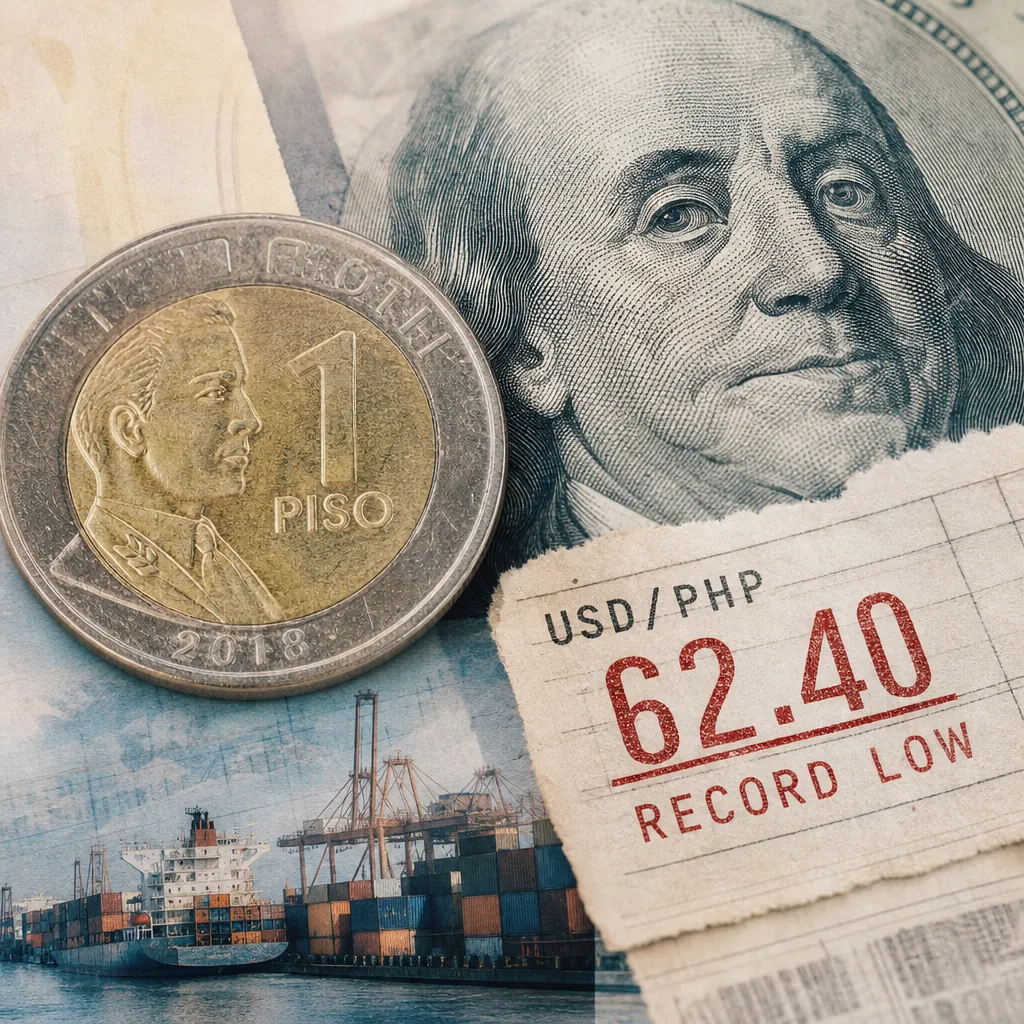
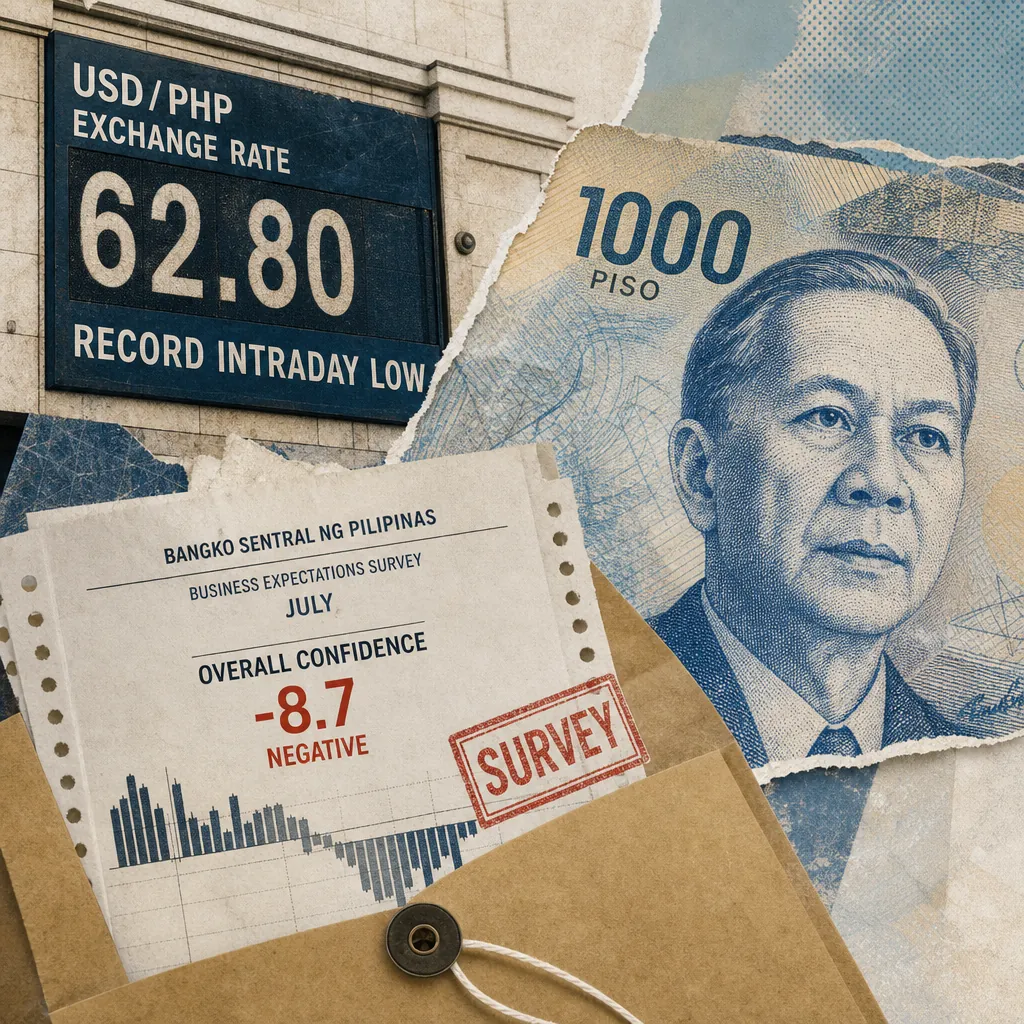
The Philippine peso slid to a fresh record low of P62.625 against the US dollar on September 8, its 23rd record low of 2026, as higher global oil prices and a widening trade deficit piled pressure on the currency 39. The peso opened stronger on September 9 at P62.50, but the broader trend remained downward 20. The slide drew heavy coverage across business pages and broadcast, with economists and industry groups explaining the drivers and warning of inflation risks 202939.
While the currency story dominated the macro narrative, the day's financial-sector conversation also featured a wave of digital banking and fintech developments. GCash launched GSukli, a feature that lets customers receive loose change directly into their e-wallets 5. The Social Security System (SSS) rolled out LoanLite, a digital microloan facility, through UnionDigital Bank 75678. Maya and Salmon pushed consumer campaigns, and CIMB Bank Philippines won awards for embedded finance 1823. These developments signal a sector actively expanding digital financial services even as the macroeconomic environment tightens.
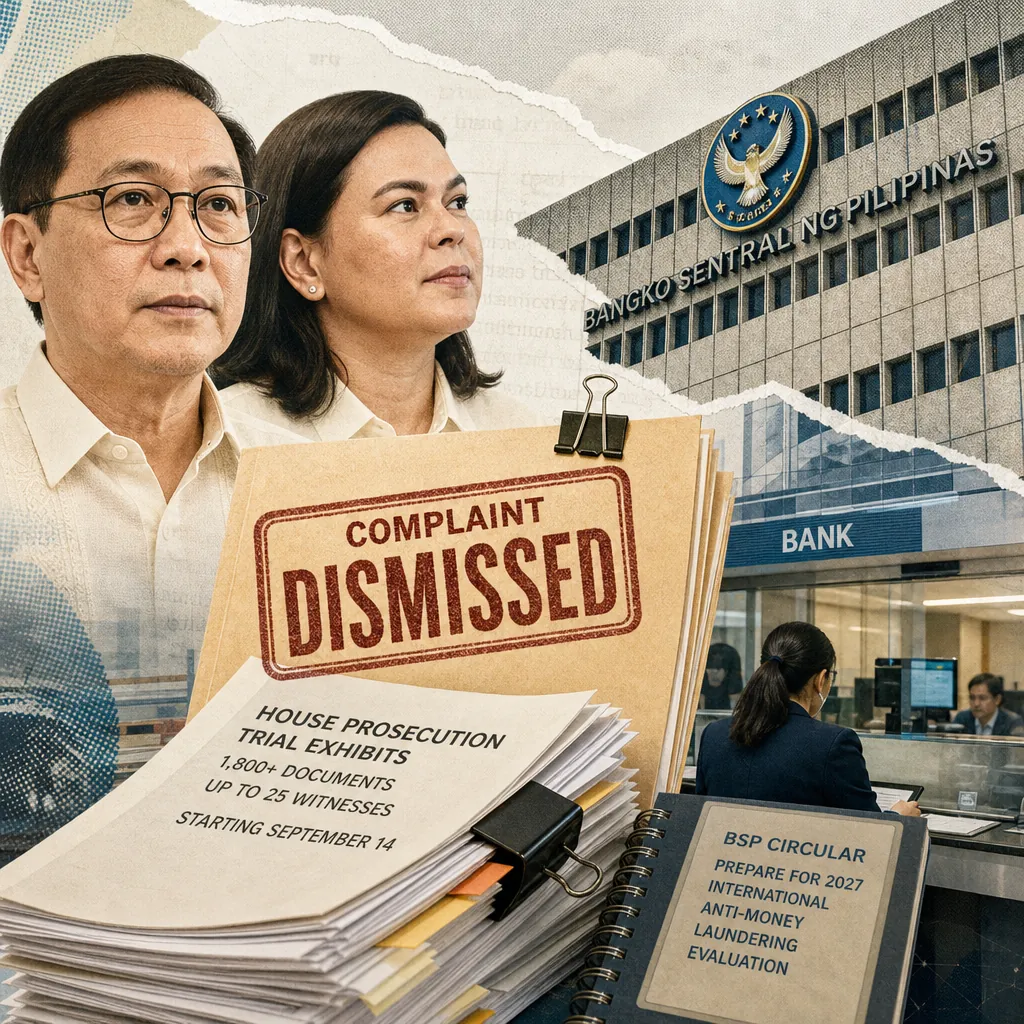
Separately, the impeachment trial of Vice President Sara Duterte advanced, with prosecutors dropping 15 witnesses and signaling they want to call Duterte herself to testify on alleged misuse of confidential funds 3360. The trial's financial dimensions—bank records, Anti-Money Laundering Council (AMLC) reports, and unexplained wealth allegations—kept banking and financial regulation in the news cycle 1367.
Key themes
- Peso hits 23rd record low of 2026 at P62.625 per dollar — The currency closed at its weakest level ever on September 8, surpassing the previous record set just days earlier. The slide reflects higher oil prices from Middle East tensions and a trade deficit that grew faster than exports 3920.
- Oil shock and trade gap drive currency weakness — Federation of Philippine Industries chair Elizabeth Lee said the immediate trigger is geopolitical—renewed Iran conflict and Strait of Hormuz tensions—but the structural cause is that imports grow faster than exports 2029.
- GCash launches GSukli to digitize loose change — The fintech's new feature lets customers receive change of P199.99 or less directly into their GCash wallets after cash payments, starting with fashion brand Bench branches 5.
- SSS LoanLite microloans go digital via UnionDigital Bank — Qualified SSS members can now borrow P1,000 to P20,000 through the UnionDigital app without employer approval, at 8% annual interest, repayable in 15 to 90 days 75678.
- Scam protection becomes a corporate priority — GCash promoted its GInsure protection, Whoscall held its first Anti-Scam Executive Meet-Up, and a government cybercrime official discussed rising scam incidents on radio 4836.
- Impeachment trial shifts to unexplained wealth phase — Prosecutors dropped 15 witnesses on confidential fund misuse and signaled they want Vice President Sara Duterte to testify, with the unexplained wealth article set to begin September 14 336067.
- Bank lending grows 10.4% in July despite rate hikes — Business lending accelerated to 9.8% year-on-year, while consumer credit growth slowed to 17.1%, reflecting subdued consumer sentiment 71.
- HMO industry profits surge 42% in first half — Philippine health maintenance organizations posted P2.09 billion in net income, up from P1.47 billion a year earlier, as revenues grew 20% to P56.43 billion 477.
How the narratives stack
Dominant — The peso's slide to a record low dominated the day's financial news across print, online, and broadcast. The story drew heavy coverage worth an estimated P2.5 million in advertising-equivalent value across the captured items, with multiple outlets explaining the drivers and implications 202939. The narrative is consequential because a weaker peso raises import costs, fuels inflation, and affects everything from fuel prices to foreign debt payments.
Counter-narrative — Despite the currency weakness, the banking and fintech sector showed active expansion. GCash launched new features, SSS rolled out digital microloans, and banks reported accelerating business lending 5771. This counter-narrative suggests the financial sector is adapting to the challenging macro environment through digital innovation and credit expansion.
Emerging — Scam protection is emerging as a significant theme, with GCash, Whoscall, and government agencies all pushing anti-fraud initiatives 3648. The government's cybercrime chief appeared on radio to warn about rising scam incidents, indicating this is becoming a mainstream concern that financial institutions must address 32.
Under-covered — The HMO industry's strong first-half performance received relatively limited coverage compared to its significance. The 42% profit surge and 20% revenue growth suggest a healthy sector, but the story appeared mainly in one outlet and a German-language news site 477.
Platform insights
- Facebook — Financial literacy and scam awareness content appeared to resonate, with GCash and other fintechs using the platform to promote security features and new services. The platform's broad reach makes it a primary channel for consumer education on digital finance.
- X (formerly Twitter) — Business news and economic commentary dominated, with economists and industry leaders sharing analysis of the peso's slide. The platform served as a real-time forum for market reaction and expert opinion.
- YouTube — Broadcast news clips and financial education content drew viewership, particularly around the peso story and impeachment trial developments. The platform's video format suits explainer content on complex financial topics.
- Reddit — Personal finance communities discussed practical implications of the peso's weakness and digital banking options, with users sharing tips on saving and investing in a challenging environment.
Key voices and communities
- Industry groups and economists — Federation of Philippine Industries chair Elizabeth Lee and economists like Michael Ricafort of RCBC provided authoritative commentary on the peso's slide, explaining both immediate triggers and structural causes 2029.
- Fintech companies — GCash, Maya, Salmon, and CIMB Bank Philippines drove the digital banking narrative through product launches, ambassador announcements, and award recognitions 51823.
- Government financial agencies — The Bangko Sentral ng Pilipinas (BSP), Social Security System (SSS), and Anti-Money Laundering Council (AMLC) featured prominently, with the BSP releasing lending and reserve data and the SSS launching LoanLite 77163.
- Legal and political figures — The impeachment trial of Vice President Sara Duterte brought lawyers, prosecutors, and lawmakers into the financial conversation, particularly around bank records and alleged unexplained wealth 133367.
- Consumer advocates and scam awareness groups — Whoscall and government cybercrime officials emerged as voices warning about digital scams, targeting both businesses and individual users 3648.
Narrative streams
Peso slides to record low as oil shock meets trade deficit
The Philippine peso closed at P62.625 against the US dollar on September 8, its 23rd record low of 2026, according to data from the Bankers Association of the Philippines 39. The currency had started the year at P59.355 on January 7, meaning it has lost about 5.5% of its value in eight months 39. The immediate trigger is geopolitical: renewed fighting involving Iran and fresh tensions around the Strait of Hormuz have pushed oil prices higher, affecting economies like the Philippines that rely heavily on imports 20. Federation of Philippine Industries chair Elizabeth Lee explained that the country is more exposed than its neighbors because imports grow faster than exports, and the BSP has signaled it will not spend reserves to defend a fixed exchange rate 20. The peso's slide drew heavy coverage across the captured items, worth an estimated P2.5 million in advertising-equivalent value, with outlets like the Daily Tribune, Manila Standard, and Astig.ph all running detailed analyses 202939. The read for the sector is that a weaker peso raises the cost of imported goods and fuel, which feeds into inflation and affects consumer spending power—pressuring banks' consumer lending and potentially prompting further central bank rate hikes.
GCash expands digital finance with GSukli and scam protection
GCash launched GSukli, a feature that allows customers to receive loose change directly into their e-wallets after paying in cash 5. The service, available for change of P199.99 or less, launched at fashion brand Bench branches and will expand to other stores under Bench parent Suyen Corporation 5. GCash said the feature converts "barya" (loose change) into accessible digital wallet value for everyday transactions 5. The launch drew coverage worth an estimated P120,000 in advertising-equivalent value from ABS-CBN News 5. Separately, GCash promoted its GInsure scam protection feature, noting that phishing and smishing account for over 80% of reported digital fraud in the Philippines 48. A Gogolook report cited by GCash found malicious link attacks nearly quadrupled in 2025 48. The read for the sector is that fintech companies are competing on convenience features while simultaneously investing in security—a dual strategy to attract users and retain their trust in an environment where scams are increasingly sophisticated.
SSS LoanLite brings digital microloans to workers
The Social Security System (SSS) launched LoanLite, a digital microloan facility available through UnionDigital Bank's mobile app 756. Qualified SSS members can borrow from P1,000 to P20,000, depending on their recent contributions, at an 8% annual interest rate, repayable in 15, 30, 60, or 90 days 778. The program removes the need for employer approval, streamlining the application process 78. UnionDigital is the first of four participating financial institutions to offer the service digitally 56. SSS President Robert Joseph de Claro said the program makes short-term financial assistance more convenient and secure 56. The launch drew coverage across multiple outlets, including Manila Bulletin, YugaTech, and Central Luzon Gazette, with combined advertising-equivalent value exceeding P400,000 75678. The read for the sector is that government pension funds are embracing digital channels to reach workers who might otherwise turn to informal lenders or high-cost online lending apps, potentially expanding the formal credit market.
Impeachment trial turns to bank records and unexplained wealth
The impeachment trial of Vice President Sara Duterte advanced as prosecutors dropped their remaining 15 witnesses on alleged misuse of P612.5 million in confidential funds and signaled they want to call Duterte herself to testify 3360. Private prosecutor Lorna Kapunan said the prosecution had originally listed 27 witnesses for Article 1, which covers alleged misuse of confidential funds at the Office of the Vice President and the Department of Education 33. The prosecution may call 20 to 25 witnesses for the unexplained wealth article, depending on whether the defense agrees to stipulate the authenticity of thousands of financial records 13. The trial's financial dimensions—bank records, AMLC reports, and BIR records—kept banking and financial regulation in the news cycle 1367. The read for the sector is that the trial's focus on financial records and anti-money laundering processes highlights the importance of robust compliance systems in Philippine banking, as these records become central to high-profile legal proceedings.
Bank lending grows despite rate hikes, consumer credit slows
Philippine banks' lending grew 10.4% year-on-year in July, accelerating from 9.8% in June, according to BSP data 71. Business lending drove the expansion, growing 9.8%, with increased credit to energy, wholesale and retail trade, manufacturing, and financial services 71. Consumer credit grew at a slower 17.1%, with demand for credit cards and auto loans softening amid subdued consumer sentiment 71. The lending growth came despite the BSP's second interest rate hike in June 71. The read for the sector is that businesses remain confident enough to borrow for operations, but consumers are pulling back on discretionary credit—a divergence that suggests the economy is slowing at the household level even as corporate activity holds up.
HMO industry profits surge as revenues grow
The Philippine health maintenance organization (HMO) industry posted P2.09 billion in net income in the first half of 2026, up 42.3% from P1.47 billion a year earlier, according to Insurance Commission data 477. Revenues grew 20% to P56.43 billion, driven by a 19.71% increase in membership fee collections to P54.82 billion 77. HMOs paid out P41.23 billion in benefits and claims, up 13.62% from a year earlier 77. The Insurance Commission said the industry maintained a strong financial position despite higher payouts 77. The read for the sector is that HMOs are benefiting from rising membership while keeping claims growth below revenue growth—a favorable dynamic that could attract more competition and regulatory attention.
Conversation trajectory
- Peso movement (next 1–2 weeks) — The peso's trajectory depends on oil prices and Middle East tensions. If the Iran conflict escalates further, the peso could test new lows; if tensions ease, a modest recovery is possible. The BSP's next policy meeting and any intervention signals will be key markers 2039.
- SSS LoanLite expansion (next 1–3 months) — Three more participating financial institutions are expected to offer LoanLite on their platforms. Watch for announcements from these institutions and early uptake data, which will indicate whether digital microloans gain traction among workers 56.
- GCash GSukli rollout (next 1–3 months) — The feature will expand from Bench to other Suyen Corporation brands. Watch for announcements about partnerships with other retailers, which would signal broader adoption of cash-to-digital conversion 5.
- Impeachment trial proceedings (next 1–2 months) — The unexplained wealth article begins September 14. The prosecution's decision on whether to call Vice President Duterte to testify, and the defense's response, will shape the trial's trajectory and keep financial records in the spotlight 67.
- Bank lending data (monthly) — The BSP releases lending data monthly. Watch whether business lending growth sustains above 10% and whether consumer credit continues to slow, which would signal diverging corporate and household confidence 71.
- Trigger events — A further escalation of Middle East tensions, a BSP rate decision, the start of the unexplained wealth trial phase, and the next round of SSS LoanLite partner announcements are the key events to watch.
Response guidance
- Address currency weakness head-on — Financial institutions should communicate clearly how a weaker peso affects customers' loans, savings, and investments. Provide practical guidance on managing foreign-currency exposure and avoiding panic-driven decisions.
- Highlight digital convenience features — With GCash, SSS, and others launching new digital services, communicators should emphasize how these features make financial management easier and more accessible, particularly for underserved populations.
- Reinforce scam awareness — Given the rise in phishing and smishing, financial institutions should regularly remind customers about security best practices and promote available protection features. Use plain language and real-world examples to make warnings actionable.
- Frame lending products around business needs — With business lending growing strongly, communicators should position credit products as tools for operational expansion and working capital management, not just consumer spending.
- Prepare for impeachment trial coverage — Financial institutions named in the trial's proceedings should have clear communication protocols for responding to inquiries about bank records and compliance processes, emphasizing their role in lawful financial regulation.
- Use multiple platforms for financial literacy — The conversation spanned Facebook, X, YouTube, and Reddit, suggesting communicators should tailor financial education content to each platform's audience and format, from short videos to detailed explainers.
See the full picture behind today's signals.
This report draws from Media Meter's MediaWatch, our real-time monitoring engine tracking 2,470+ Philippine sources across print, broadcast, digital, and social. Explore how the platform turns raw coverage into decision-grade intelligence, then see how it's configured for teams like yours — whether you're in PR agencies, corporate comms, government, or marketing.
Want more? Browse our Report Library for sector and crisis intelligence, or request a demo and we'll have your brand set up before the call.
Want this kind of intelligence on your brand?
This brief is built on the same MediaWatch methodology that runs continuously across every brand we monitor. See your competitive landscape, Impact Score, and narrative trajectory in a 30-minute demo.