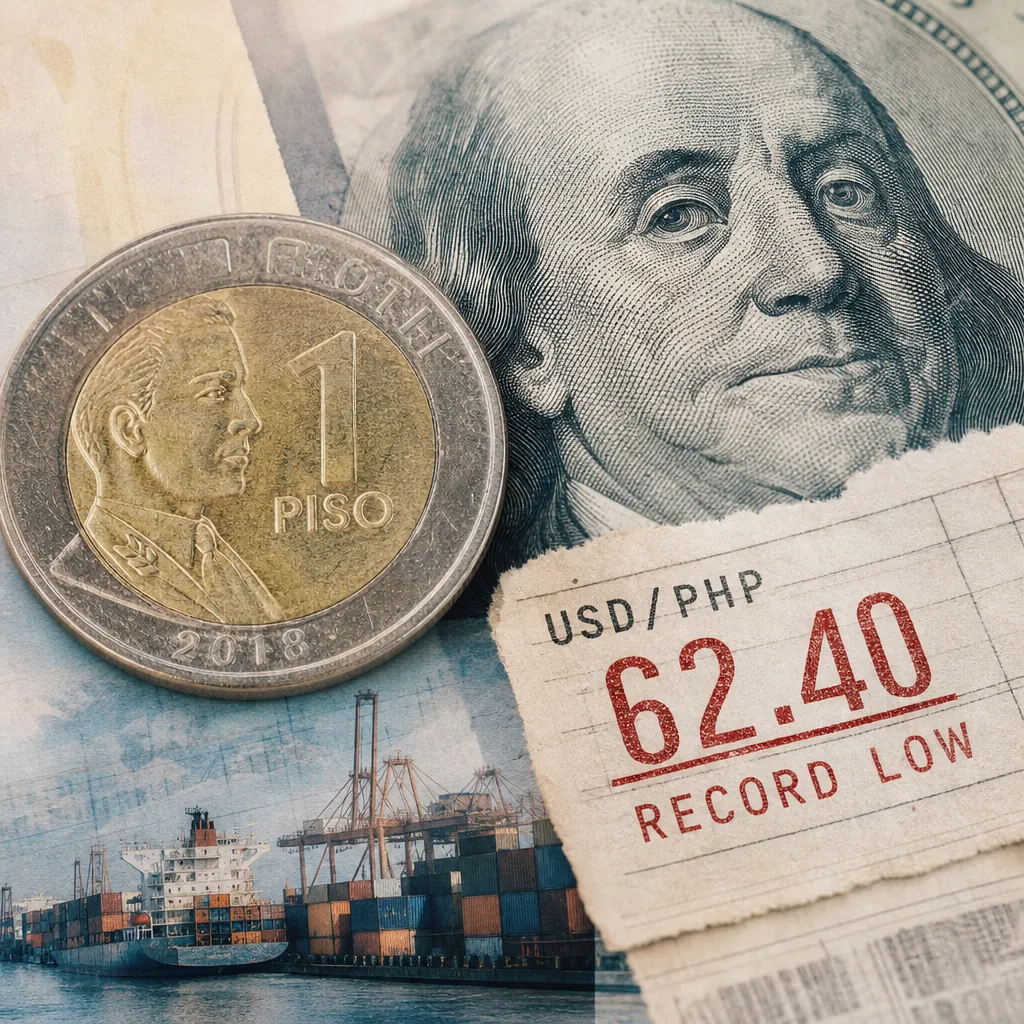
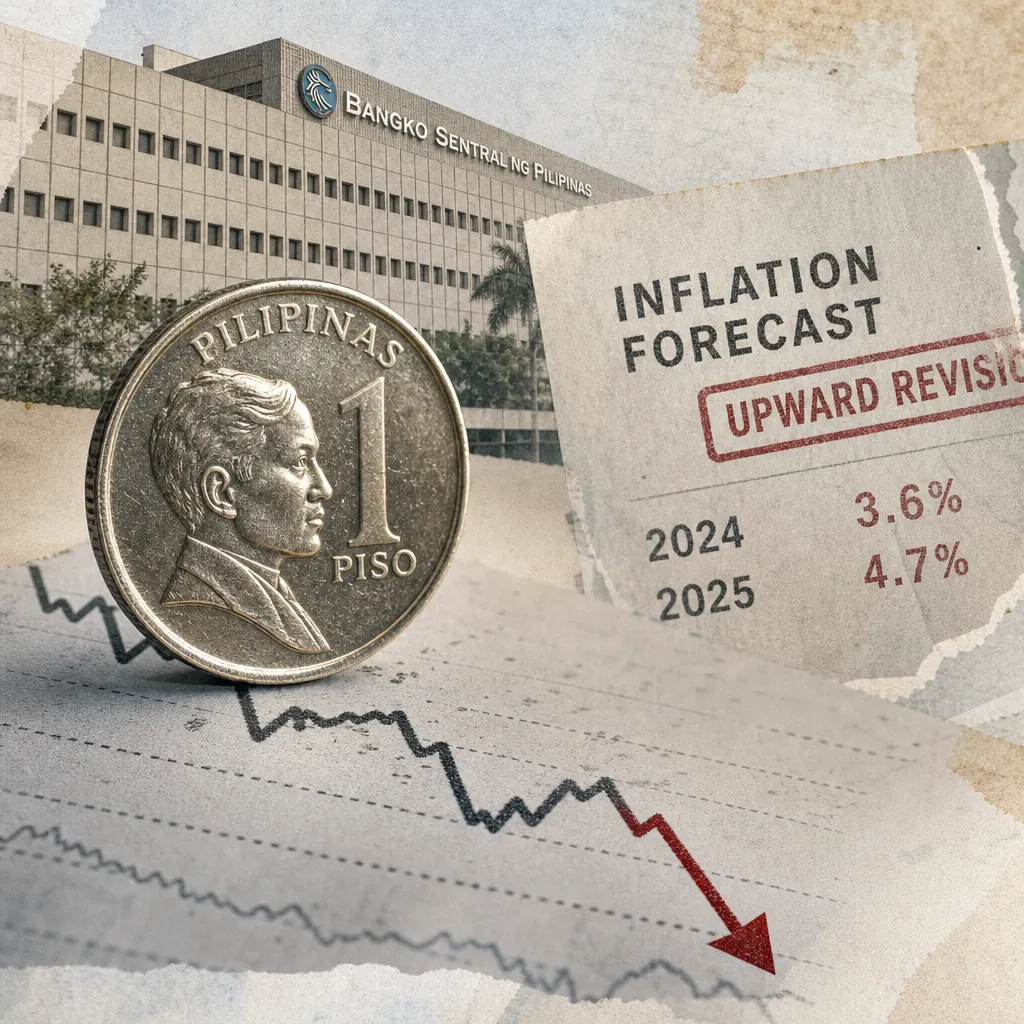
Peso hits record low, business confidence turns negative
The Philippine peso slid to a record intraday low near 62.80 to the dollar, while a central bank survey showed business confidence turned sharply negative in July. Analysts warn the currency's rapid fall could reignite inflation and weigh on the broader economy.
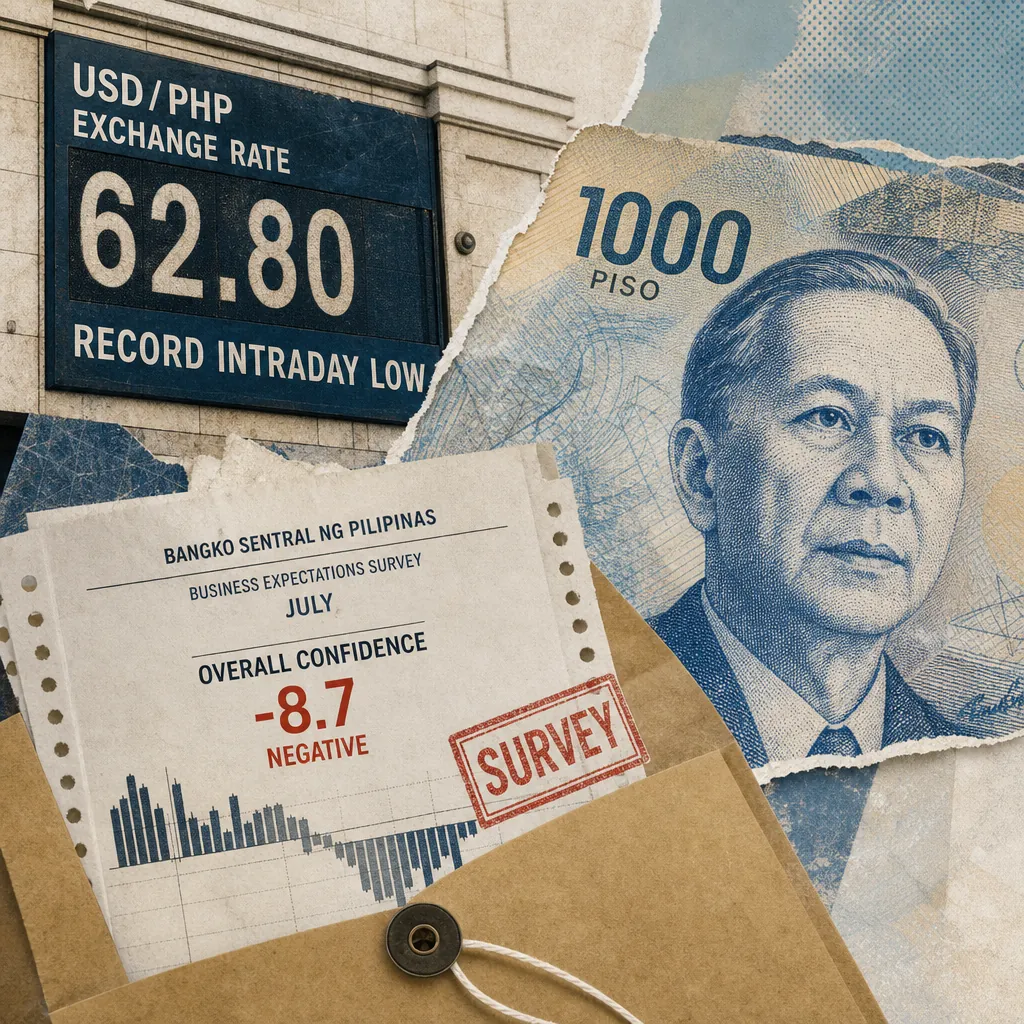
The Philippine peso plunged to a record intraday low near 62.80 against the US dollar on Monday, capping a slide that analysts described as both "sharp" and "fast" by historical standards 19. The currency weakened about 3 percent between August 3 and September 7, a move that economists at Union Bank of the Philippines and Reyes Tacandong & Co. flagged as unusually large for such a short period 19. The peso's fall comes alongside a separate central bank survey showing business confidence turned sharply negative in July, with the confidence index dropping to negative 20.3 percent from a flat zero in June 44. Together, the two developments paint a picture of an economy under compounding pressure: a weakening currency that threatens to push up import costs and inflation, and business owners who have lost faith in a quick recovery.
The peso's slide reflects several forces. Analysts pointed to renewed tensions in the Middle East, higher oil prices amid disruptions to fuel shipments through the Strait of Hormuz, and persistent inflationary pressures 44. The local stock market also slipped, with the benchmark PSEi falling 0.11 percent to 6,083.68, as investors weighed peso volatility and expectations of further US Federal Reserve rate hikes 38. Foreign investors remained net sellers, disposing of a net 311.05 million pesos in shares 38. The currency's weakness has become a central concern for economists, who fear it could reignite inflationary pressures and affect market sentiment and the broader economy 19.
These developments carry immediate consequences for ordinary Filipinos. A weaker peso makes imported goods more expensive, from fuel to food to consumer electronics. If inflation resurges, the central bank may need to raise interest rates, which would make loans and mortgages more costly. For businesses, the pessimistic outlook means less hiring and investment, which could slow job creation. The ADB said the Philippine economy can still grow by 3.8 percent this year, but that forecast hinges on a strong second-half recovery in project execution and household consumption 92.
Key themes
- Peso hits record low near 62.80, weakening 3% in five weeks The Philippine peso slid from 60.93 in early August to an intraday low of nearly 62.80 on Monday, a decline of about 3 percent that analysts called "relatively rapid" and "sharp" by historical standards 19. The currency's persistent weakness has become a major worry for economists, who fear it could reignite inflation and affect the broader economy 19.
- Business confidence turns negative for first time in months The Bangko Sentral ng Pilipinas' Business Expectations Survey showed the confidence index fell to negative 20.3 percent in July, a sharp turn into pessimistic territory from the flat neutral reading in June 44. A negative index means pessimistic business owners outnumber those with an optimistic outlook 44. Firms cited renewed tensions in the Gulf region, higher oil prices, and persistent inflationary pressures 44.
- Inflation risks building as oil prices spike above forecasts Japan-based Nomura Global Markets Research warned that inflation may resurge before year-end, with Brent crude oil averaging $95.4 per barrel in September, well above its assumption of $72 per barrel for the second half of 2026 16. Nomura also flagged the potential impact of a strong El Niño episode later in the year 16.
- Government borrowing costs rise as investors expect rate hikes The Bureau of the Treasury fell short of its planned borrowings in Monday's auction of Treasury bills as yields spiked, with the 182-day yield jumping 48.4 basis points to 5.622 percent 62. Investors are demanding higher returns on government debt because they expect further rate hikes from monetary officials amid sticky inflation 62.
- Philippines falls behind in race for foreign investments BDO Capital president Eduardo Francisco said global investors are increasingly overlooking the Philippines, as weak economic growth and political noise erode the country's appeal 45. The country's relatively small weight in global investment benchmarks has made it easier for foreign fund managers to reduce their exposure 45.
- ADB sees 3.8% growth still possible but hinges on public investment rebound ADB president Masato Kanda said the Philippine economy can still grow by 3.8 percent this year, but public investment must rebound after spending was hit by the flood control corruption scandal 92. An updated report is scheduled for release on September 23 92.
- Borrowing costs to rise slightly with upper-middle-income status The Asian Development Bank said the Philippines could face a slight increase in borrowing costs for very long-term loans after three years under its new upper-middle-income country status 59. The increase would be around 0.1 percent, which ADB Philippines Country Director Andrew Jeffries described as "very slight" 59.
- Digital financial inclusion advances despite economic headwinds Amid the macroeconomic gloom, several initiatives pushed digital financial inclusion forward. UnionDigital Bank became the first participating financial institution to roll out SSS LoanLite, offering micro-loans to qualified SSS members including overseas Filipino workers 60. GCash for Business equipped over 200 Filipino artisans with digital payment tools at the Designers' Holiday Bazaar 54.
How the narratives stack
Dominant The dominant narrative is the peso's rapid slide and its implications for inflation and the broader economy. The currency's fall from 60.93 to nearly 62.80 in just over a month drew heavy coverage in the business press, with analysts warning the move could reignite inflationary pressures 19. This story anchors the day's economic conversation because it touches everything else: inflation expectations, interest rates, government borrowing costs, and business confidence. The peso's weakness is not just a financial market story; it affects the cost of imported goods, fuel prices, and the purchasing power of ordinary Filipinos.
Counter-narrative A counter-narrative emphasizes that the Philippine economy can still meet its growth target despite the headwinds. ADB president Masato Kanda said the 3.8 percent growth forecast for 2026 is "possible, achievable," but hinges on a strong second-half recovery in project execution and household consumption 92. This view acknowledges the risks but pushes back against the gloomier picture painted by the business confidence survey and the peso's slide. The ADB's updated outlook, due September 23, will be a key test of whether this more optimistic view holds.
Emerging An emerging narrative centers on the Philippines falling behind in the race for foreign investments. BDO Capital president Eduardo Francisco said global investors are "not really looking at the Philippines anymore," citing the country's small weight in global benchmarks and political noise 45. This story is still developing, but it connects to the peso's weakness and the stock market's underperformance. If foreign investors continue to reduce their exposure, it could compound the currency's problems and make it harder for the government to fund its projects.
Under-covered A story that placed low in the day's coverage but carries real weight is the slight increase in borrowing costs the Philippines will face as an upper-middle-income country. The ADB said the change would add about 0.1 percent to very long-term loans, but only after the Philippines maintains its status for three consecutive years 59. This is a modest cost, but it signals a shift in the country's relationship with multilateral lenders as it moves up the income ladder. The story deserves more attention than it received because it affects the government's long-term borrowing strategy.
Platform insights
- Facebook Facebook carried the bulk of the conversation around the peso's slide and business confidence, with users sharing news articles and expressing concern about rising prices and the cost of living. The platform's demographic skews older and more news-oriented, making it the natural home for economic anxiety. Posts from major news outlets like BusinessMirror and GMA News drew significant engagement as readers commented on how the weak peso would affect their daily expenses.
- X (formerly Twitter) X was the platform where economists, analysts, and financial professionals weighed in on the peso's record low. The platform's real-time nature made it the first place where intraday currency movements were discussed, with users posting updates on the peso's level and speculating about central bank intervention. Financial journalists and market commentators used X to share their analysis of the business confidence survey and what it meant for the economy.
- YouTube YouTube carried broadcast coverage of the economic developments, with news channels like GMA and PTV providing video reports on the peso's slide and the business confidence survey. The platform's longer-form content allowed for more detailed analysis of the economic situation, including interviews with economists and market experts. Cable news channel Bilyonaryo also produced a segment on the risks facing the economy, noting the "large" dangers highlighted by the business sentiment data.
- Reddit Reddit's Philippine finance and investing communities discussed the peso's slide and its implications for personal finances. Users shared strategies for protecting savings against currency depreciation, debated whether to move money into dollar-denominated assets, and discussed the impact of rising interest rates on loans and mortgages. The platform's anonymous format encouraged candid discussion of financial anxiety.
Key voices and communities
- Economists and market analysts Economists at Union Bank of the Philippines, Reyes Tacandong & Co., and Nomura Global Markets Research provided the analytical backbone of the day's coverage. Their assessments of the peso's slide as "sharp" and "fast," and their warnings about inflation risks, gave the story its authority 1916. These voices matter because they shape how investors and policymakers interpret economic data.
- Business leaders and executives BDO Capital president Eduardo Francisco and ADB Philippines Country Director Andrew Jeffries represented the business and institutional perspective. Francisco's blunt assessment that foreign investors are "not really looking at the Philippines anymore" captured the mood of the business community 45. Jeffries' more measured view that growth is still achievable offered a counterpoint 92.
- Government and regulatory officials The Bangko Sentral ng Pilipinas, through its Business Expectations Survey, provided the official data on business confidence 44. The Bureau of the Treasury's auction results showed the government's borrowing costs rising 62. These official voices anchor the narrative in verifiable data.
- Financial journalists Reporters at BusinessMirror, Malaya Business Insight, and GMA News translated complex economic developments into accessible stories for the public. Their coverage of the peso's slide, the business confidence survey, and the ADB's growth forecast shaped how ordinary Filipinos understood the day's economic news.
- Digital financial inclusion advocates A separate community of voices focused on digital financial inclusion, with companies like UnionDigital Bank, GCash, and Globe announcing initiatives to bring financial services to underserved populations 605442. These voices offered a more optimistic narrative about the economy's future, emphasizing innovation and access.
Narrative streams
Peso's record low sparks inflation fears
The Philippine peso's slide to a record intraday low near 62.80 against the US dollar on Monday drew immediate concern from economists, who warned the currency's rapid depreciation could reignite inflationary pressures 19. The peso weakened about 3 percent between August 3 and September 7, a move that Ruben Carlo Asuncion, chief economist at Union Bank of the Philippines, called "relatively large over a short period" 19. Jonathan Ravelas, senior adviser at Reyes Tacandong & Co., said the slide "can already be considered both sharp and fast by historical standards" 19.
The peso's weakness is not an isolated phenomenon. Analysts pointed to renewed tensions in the Middle East, higher oil prices amid disruptions to fuel shipments through the Strait of Hormuz, and persistent inflationary pressures as contributing factors 44. The currency's fall has direct consequences for ordinary Filipinos: a weaker peso makes imported goods more expensive, from fuel to food to consumer electronics. If inflation resurges, the central bank may need to raise interest rates, which would make loans and mortgages more costly.
Nomura Global Markets Research warned that inflation may resurge before year-end, with Brent crude oil averaging $95.4 per barrel in September, well above its assumption of $72 per barrel for the second half of 2026 16. Nomura also flagged the potential impact of a strong El Niño episode later in the year, which could disrupt agricultural production and push up food prices 16. The investment bank noted that while the moderation in headline inflation since May supports the view that inflation has already peaked, "newly emerging upside risks suggest a potential resurgence in coming months" 16.
The read for the sector: businesses that rely on imported inputs face higher costs, and consumers will feel the pinch through higher prices. Financial institutions may need to adjust their inflation and interest rate forecasts, while the central bank faces a delicate balancing act between supporting the currency and nurturing economic growth.
Business confidence turns negative as Middle East tensions weigh
A central bank survey showed business confidence in the Philippines turned sharply negative in July, with the confidence index dropping to negative 20.3 percent from a flat zero in June 44. The Business Expectations Survey, conducted by the Bangko Sentral ng Pilipinas, measures how business owners view current and future economic conditions. A negative index indicates that pessimistic business owners outnumber those with an optimistic outlook 44.
Firms cited renewed tensions in the Gulf region, higher oil prices amid disruptions in fuel shipments through the Strait of Hormuz, and persistent inflationary pressures as reasons for their pessimism 44. The survey also showed that confidence in economic conditions three months from now has weakened, suggesting businesses do not expect a quick recovery 44.
The survey results paint a picture of an economy under compounding pressure. The Middle East conflict has driven up oil prices, which increases costs for businesses across the board. Higher energy costs feed into transportation, manufacturing, and ultimately consumer prices. With inflation already above the central bank's target range, businesses are bracing for continued cost pressures.
The read for the sector: businesses are hunkering down for a difficult period, which could mean reduced hiring, delayed investments, and cautious inventory management. The pessimistic outlook also has implications for the government's growth target, as business investment is a key driver of economic expansion.
Government borrowing costs rise as investors demand higher yields
The Bureau of the Treasury fell short of its planned borrowings in Monday's auction of Treasury bills as yields spiked, reflecting investor expectations of further rate hikes 62. The Treasury raised 38.690 billion pesos out of a 45-billion-peso program, as total demand reached 60.032 billion pesos 62. The average rate on the 91-day securities rose by 17.8 basis points to 5.214 percent, while the 182-day yield jumped by 48.4 basis points to 5.622 percent 62.
Treasury bills are short-term government debt instruments that the government sells to raise money for its operations. When yields rise, it means the government must pay more to borrow, which increases its debt servicing costs. The higher yields reflect investor expectations that the central bank will raise interest rates to combat inflation, which would make all borrowing more expensive.
The auction results show that investors are demanding higher compensation for the risk of holding Philippine government debt. This is partly a reflection of the peso's weakness, which erodes the value of peso-denominated investments for foreign investors, and partly a reflection of inflation expectations.
The read for the sector: the government faces higher borrowing costs, which could constrain its ability to fund infrastructure projects and social programs. Banks and financial institutions that hold government securities will see the value of their portfolios affected by rising yields.
Philippines falls behind in race for foreign investments
BDO Capital president Eduardo Francisco delivered a blunt assessment of the Philippines' position in global investment markets: "Foreign investors are not really looking at the Philippines anymore. We're so small. We're really negligible as part of the overall index" 45. Francisco said Philippine companies continued to perform well, with many surpassing their earnings guidance, but the country's relatively small weight in global investment benchmarks has made it easier for foreign fund managers to reduce their exposure 45.
The comments came as the Philippine stock market slipped on Monday, with the benchmark PSEi falling 0.11 percent to 6,083.68 38. Foreign investors remained net sellers, disposing of a net 311.05 million pesos in shares 38. The stock market's underperformance reflects broader concerns about the economy, including the peso's weakness, elevated oil prices, and expectations of US Federal Reserve rate hikes 38.
The Philippines' small weight in global indices means that when foreign fund managers rebalance their portfolios, the country is often the first to be cut. This creates a self-reinforcing cycle: reduced foreign investment leads to a weaker peso and lower stock prices, which makes the country even less attractive to foreign investors.
The read for the sector: Philippine companies may need to rely more on domestic investors and find new ways to attract foreign capital. The government may need to address the "political noise" that Francisco cited as a factor eroding the country's appeal 45.
ADB sees growth possible but warns of risks
Asian Development Bank president Masato Kanda said the Philippine economy can still grow by 3.8 percent this year, but public investment must rebound after spending was hit by the flood control corruption scandal 92. "We think reaching the 3.8% forecast for 2026 is possible, achievable, but it hinges on a strong second half recovery in project execution and household consumption," Kanda told reporters 92.
The ADB's July Asian Development Outlook forecast 3.8 percent growth for the Philippines in 2026, and an updated report is scheduled for release on September 23 92. Kanda noted that as public spending normalizes, the economy should recover, but he also acknowledged the risks: "On the other hand, there are many positive things we can foresee but all of them are rather uncertain so we are very much vigilant on the development of not only the economics but the geopolitical things as well" 92.
The flood control corruption scandal, which involves former Speaker Ferdinand Martin Romualdez and a 7.4-billion-peso kickback scheme, has disrupted public spending on infrastructure projects 34. The Sandiganbayan, the Philippines' anti-graft court, ordered Romualdez's arrest on Monday hours after he was charged with plunder 34. The scandal has cast a shadow over the government's infrastructure program and raised questions about the efficiency of public spending.
The read for the sector: the government must demonstrate that it can execute projects efficiently and transparently to restore confidence in public investment. The ADB's September 23 report will be a key indicator of whether the 3.8 percent growth target remains achievable.
Digital financial inclusion advances despite economic headwinds
Amid the macroeconomic gloom, several initiatives pushed digital financial inclusion forward. UnionDigital Bank, the digital banking arm of Union Bank of the Philippines, became the first participating financial institution to roll out SSS LoanLite, a micro-loan program from the Social Security System 60. The program, integrated into the UnionDigital Bank app, offers qualified SSS members, with a strong emphasis on overseas Filipino workers, convenient access to funds for urgent financial needs 60.
GCash for Business equipped over 200 Filipino artisans with digital payment tools at the Designers' Holiday Bazaar, which runs across three major Ayala Malls 54. The initiative, carrying the theme "Sinag," aims to help local makers and small businesses thrive in the digital economy by making payments easier and customer transactions faster 54.
Globe, through its Senior Digizen program, partnered with the National Housing Authority to equip 65 senior citizens in Valenzuela City with practical digital skills, from communicating with family and managing payments to accessing government services 42. Participants learned how to use GlobeOne, GCash, eGovPH, and Google Maps, and how to recognize suspicious links and potential scams 42.
These initiatives represent a counterpoint to the gloomy macroeconomic narrative. While the peso weakens and business confidence falls, efforts to bring financial services to underserved populations continue. Digital financial inclusion is seen as a way to empower individuals and small businesses, potentially cushioning the impact of economic headwinds.
The read for the sector: digital financial services providers see opportunity in expanding access, even during economic downturns. By reaching new customers and building financial literacy, they are laying the groundwork for long-term growth.
Conversation trajectory
Peso movement (next 1-2 weeks): The peso's slide to near 62.80 could prompt the central bank to intervene in the foreign exchange market to stabilize the currency. Watch for statements from Bangko Sentral ng Pilipinas officials and any signs of intervention. If the peso continues to weaken, expect increased pressure on the central bank to raise interest rates.
Inflation data (next 1-2 weeks): The Philippine Statistics Authority is scheduled to release August inflation data in early October. The data will show whether the upside risks flagged by Nomura are materializing. A higher-than-expected inflation reading would strengthen the case for rate hikes and could push the peso lower.
ADB outlook update (September 23): The ADB will release its updated Asian Development Outlook on September 23. The report will show whether the multilateral lender still sees 3.8 percent growth as achievable for the Philippines in 2026. A downward revision would add to the gloomy picture.
Business Expectations Survey (quarterly): The BSP's next Business Expectations Survey, due in October, will show whether the negative sentiment recorded in July has persisted or deepened. A further decline would signal that businesses are bracing for a prolonged downturn.
US Federal Reserve policy (September 16-17): The Federal Reserve's next policy meeting is scheduled for September 16-17. If the Fed raises rates, it would put further pressure on the peso and could trigger another round of capital outflows from emerging markets like the Philippines.
Trigger events to watch: A breach of the 63-peso level against the dollar; central bank intervention in the currency market; an interest rate hike by the Bangko Sentral ng Pilipinas; a downward revision to the ADB's growth forecast; and any escalation of Middle East tensions that drives oil prices higher.
Response guidance
Macroeconomic messaging: For financial institutions and businesses communicating about the peso's slide and inflation risks, lead with plain-language explanations of what the numbers mean for consumers. Avoid jargon like "basis points" without explanation. Acknowledge the anxiety that rising prices and a weak currency create, and provide practical guidance on how consumers can manage their finances.
Business confidence: For companies responding to the negative business confidence survey, focus on what they are doing to navigate the challenging environment. Concrete examples of cost management, efficiency improvements, and investment in growth areas will resonate more than general statements about resilience.
Digital financial inclusion: For companies promoting digital financial services, emphasize the tangible benefits for underserved populations. The UnionDigital Bank SSS LoanLite rollout and GCash's support for artisans are good examples of how digital tools can empower individuals and small businesses. Highlight the human stories behind the technology.
Government borrowing and fiscal policy: For government agencies and their partners, communicate clearly about the reasons for rising borrowing costs and what it means for public spending. Transparency about the flood control corruption scandal and steps taken to prevent similar issues will be important for restoring confidence.
Foreign investment: For business groups and economic development agencies, address the perception that the Philippines is falling behind in the race for foreign investment. Highlight the country's strengths, including its young workforce and growing digital economy, while acknowledging the challenges. Avoid defensive messaging that dismisses legitimate concerns.
Sensitive topics: The flood control corruption scandal and the impeachment trial of Vice President Sara Duterte are politically sensitive topics that require careful handling. Stick to the facts and avoid speculation. For businesses, focus on the economic implications rather than the political dimensions.
Crisis communication: Given the "crisis_watch" nature of the peso's slide, communicators should be prepared for rapid developments. Have holding statements ready, designate spokespersons, and monitor social media for misinformation. Coordinate messaging across channels to ensure consistency.
See the full picture behind today's signals.
This report draws from Media Meter's MediaWatch, our real-time monitoring engine tracking 2,470+ Philippine sources across print, broadcast, digital, and social. Explore how the platform turns raw coverage into decision-grade intelligence, then see how it's configured for teams like yours — whether you're in PR agencies, corporate comms, government, or marketing.
Want more? Browse our Report Library for sector and crisis intelligence, or request a demo and we'll have your brand set up before the call.
Want this kind of intelligence on your brand?
This brief is built on the same MediaWatch methodology that runs continuously across every brand we monitor. See your competitive landscape, Impact Score, and narrative trajectory in a 30-minute demo.