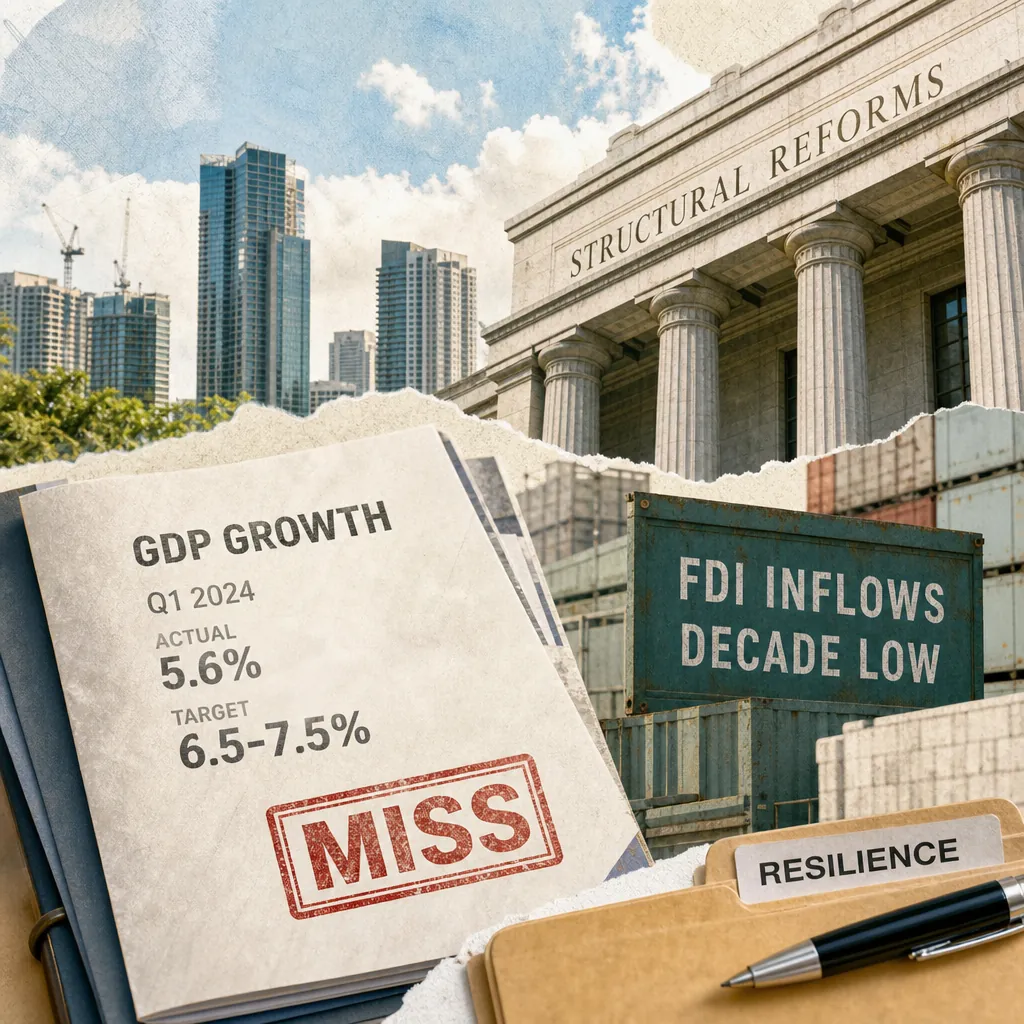
Philippine banks balance growth, scams, and rate policy
A daily snapshot of Philippine banking and finance conversations, covering scam awareness drives, earnings reports, and BSP rate signals.
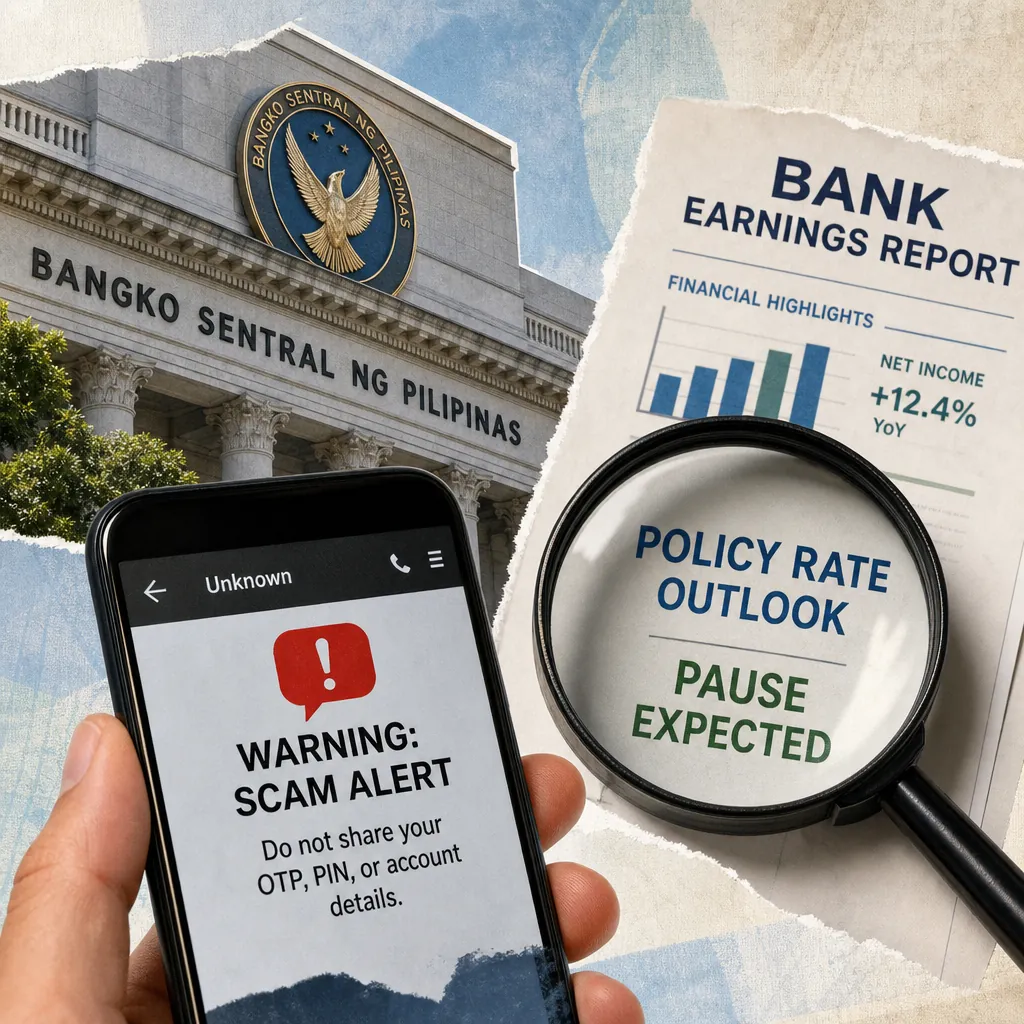
The day's conversation in Philippine banking and finance ran on two tracks that rarely touched: the cautious, data-driven world of monetary policy and corporate earnings, and the more personal, protective messaging around fraud and consumer safety. On August 14, the Bangko Sentral ng Pilipinas (BSP) — the country's central bank — signaled it would hold off on aggressive interest rate hikes, while banks like BDO and Metrobank pushed anti-scam campaigns, and Security Bank and GT Capital reported first-half results that reflected a slowing economy. On social media, the loudest responses were not to profit figures but to institutional milestones and scam warnings, with a notable undercurrent of skepticism toward government bank messaging.
Key themes
- BSP signals a cautious hand on rates: Governor Eli Remolona Jr. said the central bank can be "less aggressive" in raising interest rates because economic growth is weak, but needs to see a clearer downward trend in inflation before easing. This balances the need to control prices against supporting a struggling economy.
- Scam awareness becomes a competitive differentiator: BDO expanded its fraud education drive for senior citizens, and Metrobank rolled out new anti-fraud app features. These moves respond to a rise in phishing and unauthorized transactions, positioning banks as protectors of vulnerable customers.
- Earnings season reflects a slowing economy: Security Bank's first-half profit rose 4% to P6.1 billion, while GT Capital's net income fell 11% to P16.41 billion, both citing weaker economic activity. These results underscore the challenge of growing profits when the broader economy is underperforming.
- Institutional milestones draw mixed reactions: LandBank's 63rd anniversary posts generated engagement on Facebook, but the presence of "haha" reactions hinted at public skepticism toward self-congratulatory messaging from a government bank.
- High-net-worth families plan wealth but rarely act: A new study by UnionBank Private and Lombard Odier found that affluent Filipino families recognize the importance of succession planning but often lack formal frameworks, a gap that wealth managers can address.
- Government financial institutions face reputational scrutiny: The impeachment trial of Vice President Sara Duterte drew banks into the spotlight as they complied with subpoenas for financial records, highlighting the intersection of banking and politics.
- Digital finance partnerships expand: Fuso Philippines teamed up with BPI for truck financing, and in Vietnam, FPT Retail and Techcombank signed a deal to develop digital payment solutions, showing how banks are embedding themselves in consumer and business ecosystems.
How the narratives stack
Dominant: The dominant narrative of the day was the BSP's monetary policy stance, as articulated by Governor Remolona at the Economic Journalists Association of the Philippines forum. This story dominated the business pages, with multiple outlets covering his remarks on interest rates, inflation, and the negative output gap. The central bank's cautious approach — neither aggressively hiking nor cutting rates — reflects a delicate balancing act that affects borrowing costs, savings rates, and overall economic activity. Within the captured set, this story drew the most coverage, with articles in the Philippine Daily Inquirer, Philstar, and other major outlets, collectively worth an estimated ₱1.5 million in advertising-equivalent value.
Counter-narrative: Running against the macro-focused policy story was the consumer-centric narrative of scam awareness and fraud prevention. BDO's expansion of its senior citizen education drive and Metrobank's new anti-fraud features positioned banks as proactive protectors, not just profit-driven institutions. This narrative resonated on social media, where BDO's scam post drew 1,347 views on Twitter, and it offers a counterpoint to the impersonal world of interest rates and earnings reports.
Emerging: An emerging narrative is the growing scrutiny of banks' role in political processes, as seen in the impeachment trial of Vice President Sara Duterte. All banks subpoenaed by the Senate impeachment court complied with requests for financial records, a development that could raise questions about privacy, due process, and the intersection of banking and politics. This story is still developing but has the potential to shape public perception of banks' neutrality and compliance.
Suppressed: A story that received relatively little attention in the captured set is the broader economic slowdown and its impact on ordinary Filipinos. While GT Capital's earnings decline and the BSP's growth concerns were covered, the human dimension — job losses, reduced consumer spending, and the struggle to make ends meet — was largely absent. This under-covered angle is crucial for understanding the real-world effects of the policies and corporate results dominating the headlines.
Platform insights
- Facebook: The platform showed the most varied engagement, with the LandBank anniversary post drawing 24 likes, 4 "haha" reactions, and 2 shares. The presence of humor reactions on a celebratory post suggests a segment of the audience views institutional messaging with irony or detachment. BDO's scam awareness post received modest engagement (3 likes, 2 shares), indicating that while the topic is important, the content format may not be maximizing its potential.
- Twitter: Functioned primarily as a news distribution channel, with all three major stories appearing as link posts from institutional accounts. Security Bank's profit announcement drew the highest viewership at 1,588 views, but generated no comments or shares, suggesting a passive consumption pattern. BDO's scam drive drew 1,347 views, while LandBank's anniversary post managed only 84 views, highlighting the disparity in organic reach between consumer-protection and institutional-milestone content.
- YouTube: No significant banking-related activity was observed on YouTube in the captured set, though the platform remains a potential venue for educational content, such as scam awareness videos or explainers on financial products.
Key voices and communities
- Official bank communications teams: The most visible voices are the banks' own social media accounts and media relations arms, which distribute corporate announcements. Their influence lies in authority rather than engagement volume, as they are the primary sources that journalists and financial analysts monitor.
- Business media and financial press: Outlets like the Philippine Daily Inquirer, Philstar, and Manila Times amplify bank announcements, providing third-party validation and wider reach. Their coverage decisions determine whether a story stays contained or goes mainstream.
- Engaged public audiences: Everyday Facebook and Twitter users who interact with bank posts, signaling public sentiment and trust levels. Their reactions — likes, shares, and comments — provide early-warning signals on how consumers are responding to bank messaging.
- Senior citizen advocacy and consumer protection groups: Though not directly visible in the raw posts, the scam awareness drive targeting seniors implies an underlying community of pensioner groups, consumer advocates, and family caregivers who share and discuss such content within their networks. Their influence is outsized relative to their visibility because they represent a high-vulnerability demographic that regulators and media pay close attention to.
Narrative streams
BSP's cautious rate path: balancing inflation and growth
The Bangko Sentral ng Pilipinas (BSP) — the Philippines' central bank, which manages monetary policy to keep inflation stable and support economic growth — signaled on August 14 that it would take a less aggressive approach to raising interest rates. Governor Eli Remolona Jr., speaking at a forum organized by the Economic Journalists Association of the Philippines, said the economy is operating below its potential, with a "negative output gap" indicating weak demand and spare capacity. This means the central bank can afford to be less aggressive in taming inflation, but it still needs to see a more convincing downward trend in consumer price increases before it can relax policy.
The context: the Philippine economy grew just 2.3% in the second quarter, the weakest quarterly growth in 16 years outside the pandemic, and well below the government's revised target of 3.5% to 4.5% for 2026. Inflation remains above target, driven partly by volatile oil prices. Remolona's remarks suggest the BSP is walking a tightrope — it cannot hike rates too aggressively for fear of further stifling growth, but it also cannot cut rates while inflation is still elevated.
This story dominated the business pages, with coverage in the Philippine Daily Inquirer, Philstar, and other outlets. The estimated advertising-equivalent value of this coverage — the cost of buying the same space as ads — was substantial, reflecting the story's importance to financial audiences. For ordinary Filipinos, the BSP's rate decisions affect everything from mortgage rates to the interest earned on savings accounts, so this is a story with real-world consequences.
Scam awareness: banks as protectors
BDO Unibank, one of the Philippines' largest banks, expanded its fraud awareness campaign targeting senior citizens, holding a session in partnership with Barangay Bel-Air in Makati. The program focused on helping participants identify common fraud tactics, such as phishing and unauthorized transactions, and protect their personal and financial information. BDO urged participants to avoid clicking on suspicious links, sharing account credentials or one-time PINs, and to verify requests through official channels.
This initiative is part of a broader fraud prevention strategy that combines security technology, customer protection measures, and public education. The bank's message: "Fraud prevention is a shared responsibility." On social media, the announcement drew 1,347 views on Twitter, indicating meaningful organic reach, though engagement was modest.
Metrobank also rolled out four new anti-fraud features on its mobile app: Cooling-Off Period, Money Lock, Geolocation, and Payee Verification. These features give customers greater control over their accounts, such as automatically disabling transactions for 24 hours after critical security settings are changed, and allowing users to lock part or all of their balance. The move comes as social engineering attacks — including phishing, account takeovers, and identity theft — accounted for 76% of reported cyber fraud losses in 2025, according to the BSP.
This narrative positions banks as proactive protectors of vulnerable customers, a reputation play that resonates with regulators and the public alike. It also reflects a shift from reactive compliance to proactive brand-building, as scam awareness becomes a competitive differentiator.
Earnings season: a mixed bag amid economic slowdown
Security Bank Corp. reported a 4% rise in first-half net income to P6.1 billion, supported by stronger revenues and improved operating efficiency. Second-quarter net income climbed 11% year-on-year and 25% quarter-on-quarter to P3.4 billion. The bank's cost-to-income ratio improved to 55.7% from 59.6% a year earlier, and its gross non-performing loan ratio eased to 3.04% from 3.16%, indicating better asset quality.
In contrast, GT Capital Holdings, a conglomerate with interests in banking, autos, and power, saw its consolidated net income fall 11% to P16.41 billion in the first half, citing weaker economic activity, high inflation, and softer consumer confidence. Its banking arm, Metrobank, remained resilient with a P24.9-billion net income.
These results reflect the broader economic slowdown, with GDP growth easing to 2.3% in the second quarter. For investors, the mixed earnings underscore the importance of diversification and operational efficiency in a challenging environment. On social media, Security Bank's profit announcement drew the highest viewership of the day at 1,588 views, but generated no comments or shares — a pattern of high visibility with zero interaction that suggests pure financial metrics no longer spark conversation without strategic context.
LandBank's anniversary: institutional pride meets public skepticism
LandBank, the state-owned bank that focuses on serving farmers and rural communities, celebrated its 63rd anniversary with posts highlighting its recognition for financial inclusion, digital banking, and sustainable finance. The posts appeared on both Facebook and Twitter, but the reception differed sharply by platform. On Twitter, the post drew only 84 views, while on Facebook it garnered 24 likes, 4 "haha" reactions, and 2 shares.
The presence of "haha" reactions on a celebratory post is a subtle but meaningful signal. It suggests that a segment of the Facebook audience views the institutional messaging with irony or detachment, possibly reflecting skepticism toward government bank self-promotion. This divergence is a cautionary note for government-linked financial institutions: audiences may process institutional praise with a degree of cynicism, especially in a tight economic climate.
For LandBank, the challenge is to shift from achievement-focused messaging toward more relatable, human-centered storytelling that connects financial inclusion to tangible community benefits. The current approach is being seen but not felt, and amplifying customer success stories could generate stronger emotional resonance.
Wealth management: planning for legacy, but not acting
UnionBank Private, the wealth management arm of Union Bank of the Philippines, and Lombard Odier, a Swiss private bank, released a study titled "The Wealth Blueprint: Building Wealth, Sustaining Legacy." Based on insights from over 390 high-net-worth individuals across the Asia-Pacific region, the study found that while affluent families recognize the importance of preserving wealth for future generations, most have not translated their intentions into action. They lack formal succession plans or family discussions to align priorities and values.
This "paradox" presents an opportunity for wealth managers to offer structured guidance on succession planning, legacy preservation, and investment strategies. For the broader banking sector, it highlights the growing importance of wealth management services as a revenue stream and a way to deepen client relationships.
Banks in the political spotlight: impeachment trial subpoenas
All banks and financial institutions subpoenaed by the Senate impeachment court complied with orders to submit records related to the trial of Vice President Sara Duterte. The court issued subpoenas for financial records on July 20, and the remaining documents were submitted on Thursday, August 13. The Bureau of Internal Revenue and the Anti-Money Laundering Council also submitted certified true copies.
This development places banks at the intersection of finance and politics, raising questions about privacy, due process, and the role of financial institutions in legal proceedings. While the banks' compliance was procedural, the story drew significant coverage, with the Manila Times and other outlets reporting on it. For banks, this underscores the importance of robust compliance and legal frameworks to handle such requests.
Conversation trajectory
- Scam awareness campaigns will proliferate: Over the next 4-6 weeks, expect competing banks to launch similar initiatives, shifting the conversation from individual bank responses to industry-wide comparisons of scam prevention effectiveness. This narrative has strong potential for sentiment shifts and competitive differentiation.
- Earnings reports will continue to draw passive viewership: As the next quarterly reporting cycle approaches, financial performance announcements will likely generate high viewership but low engagement on social media. Banks should pair metrics with strategic storytelling to spark meaningful discourse.
- BSP policy decisions will remain a key watch item: The central bank's next moves on interest rates will be closely monitored, especially as inflation and growth data evolve. Any shift in tone could trigger market reactions and broader economic commentary.
- Wealth management will become a more prominent theme: As the UnionBank-Lombard Odier study suggests, succession planning and legacy preservation are under-addressed needs among affluent families. Expect more banks to market wealth management services, potentially leading to a more competitive landscape.
- Political scrutiny of banks may intensify: The impeachment trial's subpoena compliance could set a precedent for future requests, and banks may face increased public scrutiny regarding their role in such proceedings. Monitoring this trend is essential for reputation management.
Trigger events to watch: The BSP's next policy meeting, the release of Q2 GDP data, the rollout of new scam awareness campaigns by other banks, and any developments in the impeachment trial that involve financial records.
Response guidance
For communicators in the banking and finance sector, the day's conversation offers several actionable insights:
- Lead with consumer protection: Scam awareness content generates meaningful emotional engagement and positions banks as protectors. Develop campaigns targeting vulnerable demographics, such as senior citizens, and pair them with actionable tips and easy-to-understand materials.
- Humanize institutional milestones: Instead of celebrating anniversaries with self-congratulatory posts, share customer success stories and showcase how your services help everyday Filipinos. This approach generates stronger emotional resonance and reduces skepticism.
- Contextualize financial results: When announcing earnings, frame the numbers within a broader narrative about digital transformation, customer experience, or market positioning. Acknowledge the economic environment and clarify how profitability enables job security, credit availability, and technological upgrades.
- Prepare for political scrutiny: Ensure compliance and legal frameworks are robust to handle subpoenas or other requests. Communicate transparently about your role in legal proceedings to maintain public trust.
- Leverage platform-specific strategies: On Facebook, engage with positive sentiment and respond to comments with appreciative acknowledgments. On Twitter, use threads and visuals to break down complex topics, and consider quote-tweeting announcements with humanized insights.
- Monitor sentiment for early warning signs: Pay attention to reaction types (e.g., "haha" vs. "love") as signals of audience skepticism or appreciation. Adjust messaging accordingly to build trust and credibility.
See the full picture behind today's signals.
This report draws from Media Meter's MediaWatch, our real-time monitoring engine tracking 2,470+ Philippine sources across print, broadcast, digital, and social. Explore how the platform turns raw coverage into decision-grade intelligence, then see how it's configured for teams like yours — whether you're in PR agencies, corporate comms, government, or marketing.
Want more? Browse our Report Library for sector and crisis intelligence, or request a demo and we'll have your brand set up before the call.
Want this kind of intelligence on your brand?
This brief is built on the same MediaWatch methodology that runs continuously across every brand we monitor. See your competitive landscape, Impact Score, and narrative trajectory in a 30-minute demo.