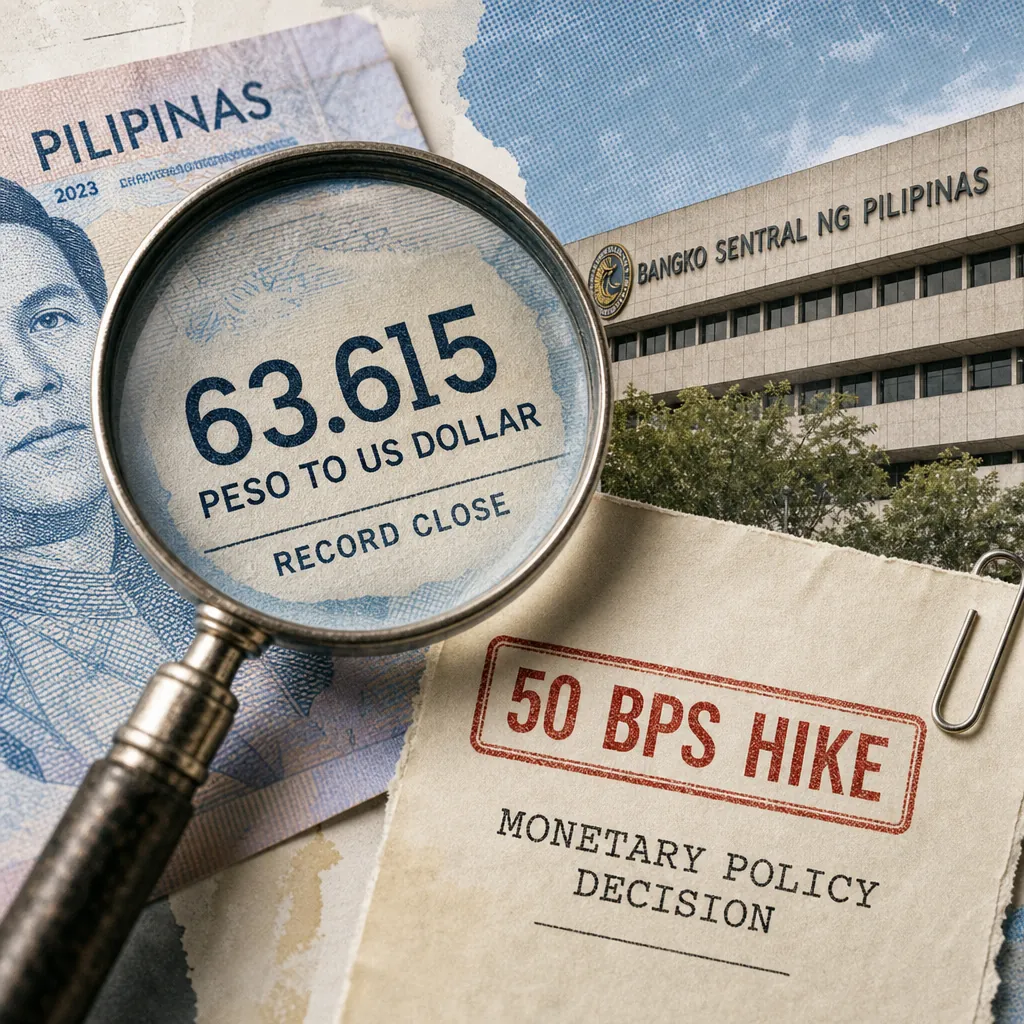
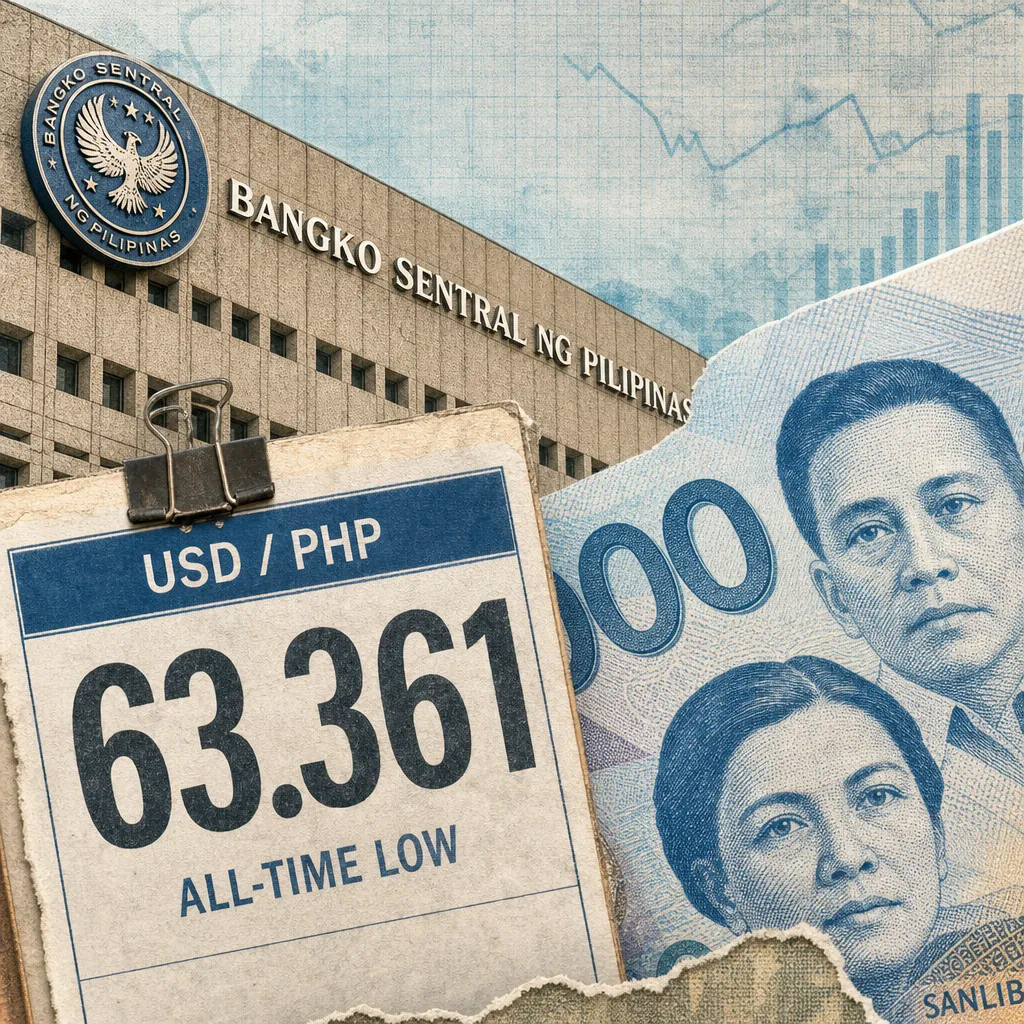
Peso hits record P63.615 as BSP signals more hikes
The peso closed at a record low of P63.615 to the dollar for a fourth straight day while the stock index fell, and economists expect the central bank to keep raising interest rates into 2027. Coverage also tracked Revolut's bid for a Philippine digital bank license and a consumer group's push to treat digital trust as a business asset.
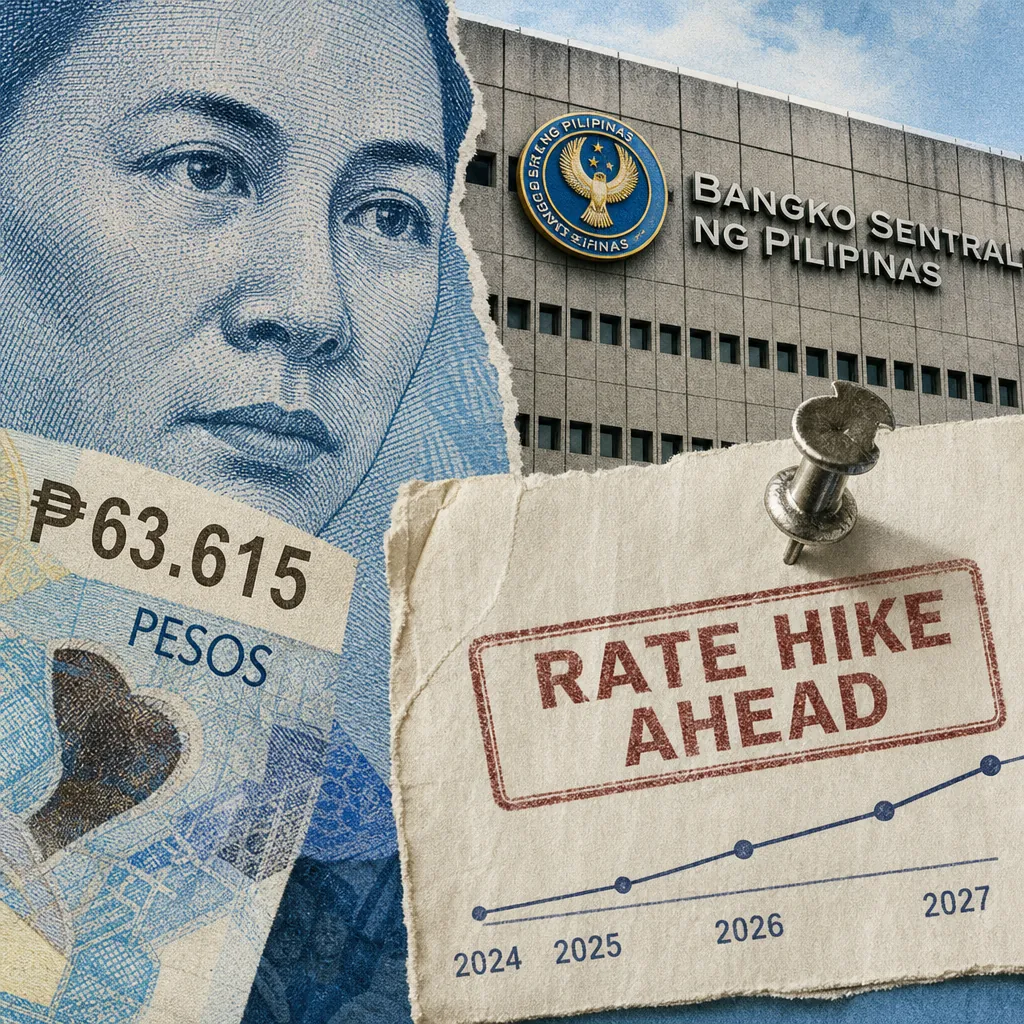
The peso closed at ₱63.615 to the US dollar on Friday, its fourth consecutive record low, after the Bangko Sentral ng Pilipinas (BSP) raised its benchmark interest rate by half a percentage point the day before — double what the market had expected429. The Philippine Stock Exchange index (PSEi) fell 51.10 points, or 0.88 percent, to 5,728.63, its second straight decline4. The two moves together set the tone for the day's financial coverage: a central bank tightening faster than expected, a currency that keeps falling anyway, and analysts now pushing their forecasts for both further into next year.
The peso's slide is the sharper story. It has lost more than seven percent against the dollar since January, making it the second-worst performer among 16 Asia-Pacific currencies tracked by BMI, a unit of Fitch Solutions — ahead of only the Indonesian rupiah38. Security Bank chief economist Angelo Taningco put the decline at 7.4 percent since January38. A currency trader told reporters that the BSP's statement that it does not target a specific exchange rate had added to the weakness, as speculators tested how much depreciation the central bank would tolerate4.
The rate outlook moved in the same direction. Nomura Global Markets Research said it expects another 50-basis-point hike at the December monetary board meeting, citing forecasts of headline inflation near 7 percent over the next two months27. BMI forecast the key rate ending the year at 5.75 percent, up from its earlier 5.50 percent projection3. China Banking Corp. economists said monetary easing may not begin until late 2027 or even early 2028 if the BSP's inflation outlook holds14. The BSP has now raised rates by 125 basis points since April29.
Key themes
- The peso set a fourth straight record low at ₱63.615 per dollar. The close surpassed Thursday's ₱63.545 and extended a decline of more than seven percent since January, the second-steepest among 16 Asia-Pacific currencies BMI monitors438.
- The BSP's surprise 50-basis-point hike pushed the benchmark rate to 5.5 percent. The move was double the 25 points the market expected and brought total tightening since April to 125 basis points29. Analysts at Nomura and BMI now expect another 50-point increase in December273.
- Inflation may approach 8 percent in October, up from 7.2 percent in September. Economist Alyssa Nuñez cited higher transport fares, fuel costs, El Niño climate risks and the weaker peso; September's reading had already matched the peak set in April31.
- The stock index fell 0.88 percent to 5,728.63 as the rate decision sank in. Trading turned sour on Thursday after the jumbo hike, and most sub-indices declined except Holding Firms, which gained 6.72 points to 4,259.55294.
- Revolut is in active talks with the BSP for a digital bank license. Deputy Governor Lyn Javier said the British fintech remains interested and discussions are ongoing, with no timeline set; the country currently has seven digital banks after MariBank's conversion1536.
- Maya may pursue a dual listing in Manila and overseas. PSE President Ramon Monzon said the digital bank wants to list locally but its private equity backer appears to favor an overseas venue, and no timetable has been set2.
- CitizenWatch Philippines called digital trust a business asset. Co-convenor Atty. Kit Belmonte tied consumer confidence in digital services to the sector's growth, noting the digital economy contributed ₱2.74 trillion in gross value added in 2025, or 9.8 percent of GDP1.
- Scam recruitment has persisted a year after the ban on Philippine offshore gaming operators. Former anti-organized-crime spokesperson Winston Casio said scamming has become an employable skill recruited through messaging platforms, with activity peaking from September to December28.
How the narratives stack
Dominant: The peso and the rate path dominated the items captured here. At least eight of the articles reviewed deal directly with the currency, the central bank's tightening, or the market's reaction — from the record close itself4 to the December hike forecasts327, the delayed prospect of rate cuts14, the peso's regional ranking38, the stock market's weekly decline29 and its outlook ahead of the US Federal Reserve meeting39. The coverage value attached to these items is substantial: the peso story alone carried an estimated ₱139,138 in advertising-equivalent value, the rate-forecast piece ₱620,916 and the peso-ranking analysis ₱551,232, measured as the estimated cost of buying the same space as paid advertising rather than as a count of readers. The dominance is a property of this captured set, which skews toward business and online news; it is not a census of everything published on the day.
Counter-narrative: Two stories push against the dominant gloom. HSBC senior Asean economist Aris Dacanay argued the weaker peso is reviving Philippine manufacturing, making exports more competitive and nudging consumers toward locally made goods, while overseas Filipino workers' families get more pesos per dollar sent home16. Separately, the BSP welcomed the Japan Credit Rating Agency's assessment that the country's foreign exchange reserves are sufficient to meet foreign debt obligations, pay for essential imports and manage currency volatility30. Both are partial correctives rather than refutations: HSBC itself said curbing inflation and logistics costs is crucial to sustaining the gains16.
Emerging: Digital banking competition is taking shape on two fronts. Revolut's licensing talks with the BSP are active but without a timetable1536, and Maya's possible dual listing signals that local digital banks see the PSE as one option among several for raising capital2. The Mynt initial public offering — ₱60.9 billion, the largest maiden offering in the exchange's history, trading under the ticker GCASH since Oct. 20 — is the reference point both stories are measured against226.
Under-covered: The consumer-protection side of digital finance drew comparatively little space in this set. CitizenWatch's call to treat digital trust as a business asset1 and Casio's account of scam recruitment persisting after the Pogo ban28 each appeared once, against a dozen or more items on rates and the currency. That imbalance reflects the business-news weighting of the items gathered here; it does not establish that consumer-protection coverage was thin across all outlets.
Platform insights
The monitoring writeup for this window did not accompany the article set, so there is no social engagement data — likes, shares, views or comments — to report for any platform. What follows is drawn from the published items only, and no engagement figures are inferred.
- Facebook: No post-level data was captured. The only Facebook reference in the set is incidental: a wedding feature noting that the couple's relationship began over Facebook Messenger during the pandemic32.
- X: No activity was captured in the items reviewed.
- Reddit: No activity was captured in the items reviewed.
- YouTube: No activity was captured in the items reviewed.
Key voices and communities
The BSP and its governor. Governor Eli Remolona Jr. is the central figure in the rate story, and the institution's communications carry weight beyond the announcement itself: its affirmation that it does not target a specific exchange rate was cited by a trader as a factor in the peso's slide4. Deputy Governor Lyn Javier speaks for the bank on digital licensing, confirming the Revolut talks1536.
Bank economists and research houses. Nomura, BMI (a Fitch Solutions unit), China Banking Corp., Security Bank's Angelo Taningco and independent economist Alyssa Nuñez are setting the expectations that markets trade on. Their forecasts — 5.75 percent by December3, 6 percent by February27, easing possibly deferred to 202814 — matter because they shape borrowing costs for businesses and households before any official decision.
Digital banks and fintech entrants. Revolut, Maya and Mynt/GCash represent three different relationships with Philippine capital and regulation: a foreign entrant seeking a license36, an incumbent weighing where to list2, and a newly public market leader whose ₱60.9 billion offering is now the benchmark26.
Consumer advocates and anti-crime officials. CitizenWatch Philippines, through former legislator Kit Belmonte, frames digital trust as commercial self-interest rather than compliance1. Winston Casio, former spokesperson of the Presidential Anti-Organized Crime Commission, brings an enforcement perspective on scam operations28.
Real estate and housing advocates. The Chamber of Real Estate and Builders Associations Inc. (CREBA) proposed an interest subsidy program through the Home Development Mutual Fund, or Pag-IBIG Fund, as an alternative way to meet socialized housing obligations, with developers making nonrecoverable contributions that Pag-IBIG would use to subsidize loans for qualified borrowers20. Higher rates make this more urgent: every increase in the benchmark rate raises the cost of the mortgages such a program would subsidize.
Narrative streams
The peso falls for a fourth day despite the biggest rate hike in months
The sequence matters. On Thursday the BSP raised its benchmark rate by 50 basis points to 5.5 percent, double the 25 points the market had assumed29. On Friday the peso closed at ₱63.615 per dollar, a record low and its fourth consecutive one, and the PSEi fell 0.88 percent to 5,728.634. A currency trader attributed part of the weakness to the BSP's reaffirmation that it does not target a specific exchange rate level, which encouraged speculators to test its tolerance4. The peso has now depreciated more than seven percent since January, ranking second-worst among 16 Asia-Pacific currencies in BMI's monitoring, ahead of only the Indonesian rupiah38.
Manila Bulletin's analysis points to shrinking foreign exchange buffers as the constraint on the BSP's ability to defend the currency38. That is where the Japan Credit Rating Agency's assessment becomes relevant: JCR found the Philippines has sufficient reserves to withstand external shocks, meet foreign debt obligations and pay for essential imports30. The two readings are not contradictory — reserves can be adequate in absolute terms while still limiting how aggressively the central bank intervenes — but they point to different conclusions about how much room the BSP has.
For households and businesses, the peso's level is not abstract. It raises the peso cost of imported fuel, food and raw materials, which feeds directly into the inflation the BSP is trying to contain. Importers and manufacturers dependent on foreign inputs face higher costs; exporters and families receiving remittances from overseas Filipino workers benefit from the same move16. The read for the sector: banks and corporates with unhedged dollar obligations should expect the currency to stay volatile while the BSP refrains from defending a level, and borrowers should plan for the possibility that rates stay elevated well into 2027 rather than easing in the near term.
Forecasters push the next rate hike to December and the first cut to 2027 or later
The BSP's own framing shifted. China Banking Corp. noted that while the central bank had previously described its hike as pre-emptive, its latest assessment suggests growing concern about persistent inflation and the risk of falling behind the curve14. Nomura expects another 50-basis-point increase in December, citing headline inflation near 7 percent over the next two months and rising core inflation that the BSP will likely read as second-round effects27. BMI sees the key rate at 5.75 percent by year-end3. BusinessMirror reported that think tanks and financial institutions now pencil in additional hikes until early 2027, potentially bringing the key rate to at least 6 percent by February27.
Inflation itself is the driver. September's consumer price index rose 7.2 percent, matching the peak set in April and snapping four consecutive months of moderating price growth that had brought the rate to 6.1 percent in August31. Nuñez expects October to come in near 8 percent, driven by the full impact of higher transport fares, rising fuel costs, El Niño climate risks and the weakened currency31. El Niño is the periodic warming of the Pacific that brings drier conditions to the Philippines and pressures food prices.
The consequence for ordinary borrowers is direct: a policy rate at 5.5 percent and rising feeds through to mortgage, car loan and business lending rates. China Banking Corp.'s view that easing may not begin until late 2027 or early 202814 means variable-rate borrowers should not count on relief next year. For banks, the margin picture improves on new lending but credit demand and loan quality come under pressure as borrowers absorb higher payments. The read for the sector: lenders should stress-test portfolios against a 6 percent policy rate and plan communications around a longer high-rate period rather than a single hike.
The stock market absorbs the hike and looks to the Fed
The PSEi's weekly decline of 54.07 points to 5,728.63 masked a split week: the index was up on the first three days, including Tuesday when Mynt Inc., the operator of GCash, listed on the main board, before turning sour on Thursday after the rate decision29. Most sub-indices fell except Holding Firms, which gained 6.72 points to 4,259.5529. For the coming week, Unicapital head of research Wendy Estacio-Cruz expects thin trading ahead of the US Federal Reserve's policy meeting, followed by US growth and personal consumption expenditures inflation data, and said investors may reorganize portfolios before the Undas break39. Undas is the Philippine observance of All Saints' Day and All Souls' Day in early November, a period when trading volumes typically thin out.
The Mynt listing remains the reference event. It raised ₱60.9 billion, the largest initial public offering in the exchange's history, and began trading Oct. 20 under the ticker GCASH226. PSE President and CEO Ramon Monzon said the exchange would watch how the debut performed as it tries to persuade more companies to list locally2. The read for the sector: the exchange's pitch to prospective issuers now rests on whether GCASH holds its value through a rising-rate cycle, and a weak aftermarket would undercut the case for other candidates weighing a Manila listing.
Digital banks compete for licenses and listings
Revolut's Philippine ambitions are alive but unscheduled. BSP Deputy Governor Lyn Javier said the British fintech "is still interested" and described an "ongoing and very active discussion," with timing dependent on compliance with licensing requirements and the BSP's assessment process3615. The country has seven digital banks: UNO Digital Bank, UnionDigital Bank, GoTyme Bank, Tonik Digital Bank, Maya Bank, Overseas Filipino Bank (the digital arm of state-owned Land Bank) and MariBank, which converted from a rural bank15. The BSP has also tightened rules on digital-centric banks, which shapes what an entrant like Revolut would need to demonstrate15.
Maya's plans are less settled. Monzon said Maya wants to list on the Philippine bourse but its private equity backer appears to favor an overseas listing, and quoted the company as saying "At the very worst, Maya said it wants dual listing. I want it listed in the Philippines."2 No timetable exists2.
For consumers, more licensed digital banks mean more competition on deposit rates, fees and app features. For incumbents, a Revolut entry would bring a well-capitalized foreign competitor into a segment already crowded with seven licensed players. The read for the sector: digital banks should expect licensing scrutiny to tighten rather than loosen, and the PSE's ability to attract Maya will depend on how the GCASH listing trades over the coming months.
Consumer trust and scam recruitment draw attention as the digital economy grows
CitizenWatch Philippines called on companies and government agencies to strengthen protections against online scams, with co-convenor Atty. Kit Belmonte arguing that "Digital trust is not only a cybersecurity concern; it is a business asset."1 He added that "Customers are more likely to use digital services when they believe their data and transactions are protected."1 The group anchored the argument in the digital economy's size: ₱2.74 trillion in gross value added in 2025, or 9.8 percent of GDP1. Gross value added is the contribution of an industry to the economy after subtracting the cost of its inputs.
The enforcement picture is less encouraging. Winston Casio, former spokesperson of the Presidential Anti-Organized Crime Commission, said scamming has become an employable technical skill, with recruitment through messaging platforms, a year after the government banned Philippine offshore gaming operators (Pogo) — the gaming firms that were licensed to serve overseas bettors and were shut down over their links to crime and fraud28. "They never left. Dumami sila ngayon dahil nagtatago na sila," Casio said, which translates roughly to: they never left, and they have multiplied now because they are in hiding28. He said scam activity peaks from September to December, partly because schemes capitalize on major sporting events, while pig butchering scams — frauds that build a relationship with a victim before persuading them to invest in a fake platform — run year-round28. Casio was invited by the US government to discuss Philippine efforts and will speak at the International Association of Chiefs of Police conference in Orlando from Oct. 24 to 2728.
The read for the sector: banks, e-wallets and telecoms carry a commercial interest, not just a compliance duty, in reducing scam losses, because each high-profile case erodes the willingness to transact digitally that their growth depends on. The fourth quarter is when the pressure is highest.
Housing developers propose subsidized mortgages as rates rise
At its 53rd national convention in Cebu City from Oct. 21 to 23, the Chamber of Real Estate and Builders Associations Inc. (CREBA) proposed a Direct Beneficiary Interest Subsidy Program under which developers would make nonrecoverable contributions to the Home Development Mutual Fund, or Pag-IBIG Fund — the state-run savings and housing loan system funded by member contributions — which would administer interest subsidies for qualified socialized housing borrowers20. CREBA president Noel "Toti" Cariño presented the proposal alongside changes to balanced housing requirements, the rules obliging developers to build or fund low-cost housing as a condition of larger projects, and to regulations governing preselling proceeds20.
The timing is not incidental. With the policy rate at 5.5 percent and forecasters expecting 6 percent by February27, the monthly payment on any housing loan rises, and socialized housing buyers — the lowest-income segment — are the most sensitive to that increase. The read for the sector: developers are effectively asking government to absorb part of the rate increase on behalf of buyers, and the case becomes stronger for them the longer the BSP keeps tightening.
A former finance secretary warns of another economic storm
Margarito "Gary" Teves, who led the Department of Finance through the 2008–2009 global financial crisis, sees similar warning signs building in the Philippine economy and is spelling out what he believes must be done to avert another one17. The profile recounts that then Finance Secretary Carlos Dominguez III described Teves as having led the department "when the world was crumbling."17 Teves' career spans three terms in the House of Representatives for Negros Oriental's third district from 1987 to 1998, banking and the Cabinet17.
The read for the sector: a former finance chief publicly drawing parallels to 2008 adds a credibility-weighted voice to the case for pre-emptive fiscal measures, and his specific prescriptions — which the profile does not detail in the excerpt captured here — are worth tracking as the 2027 budget debate takes shape.
Conversation trajectory
The December monetary board meeting (observation window: through December 2026). Nomura expects a 50-basis-point hike and BMI expects the key rate to end the year at 5.75 percent273. The trigger to watch is the October and November inflation releases from the Philippine Statistics Authority; if headline inflation prints near 8 percent as Nuñez forecasts31, a December hike becomes the base case rather than a forecast.
The US Federal Reserve meeting and US data this week (observation window: the coming week). Estacio-Cruz expects thin trading ahead of the Fed decision and the subsequent US growth and personal consumption expenditures inflation releases39. A hawkish Fed outcome would add pressure on the peso and narrow the BSP's room to pause.
The peso's next record (observation window: the next two to four weeks). With the BSP declining to defend a level4 and reserves described as adequate but not unlimited3038, further record lows are plausible. Watch whether the BSP changes its language on the exchange rate; any shift toward expressing concern about the pace of depreciation would be the signal that intervention has resumed.
Revolut's license application (observation window: the next one to two quarters). Javier's description of "ongoing and very active discussion" without a timeline36 means the next checkable event is either a formal BSP announcement or a public statement from Revolut. The BSP's tightened rules on digital banks set the bar15.
Maya's listing decision (observation window: through the first half of 2027). Monzon said there is no target timetable2. The trigger is the GCASH aftermarket performance over the next two quarters; a stable or rising share price strengthens the PSE's case, while a decline gives Maya's private equity backer more reason to look overseas.
The scam season (observation window: through December 2026). Casio said scam activity peaks from September to December28. Watch for enforcement announcements from the Presidential Anti-Organized Crime Commission and for any new BSP or Securities and Exchange Commission advisories on investment fraud.
The October inflation release (observation window: early November 2026). This is the first official test of the near-8-percent forecast31 and will shape both the December rate decision and the peso's direction.
Response guidance
Banks and lenders: prepare customer communications for a 6 percent policy rate. Loan repricing notices and variable-rate disclosures should be drafted now for a scenario in which the benchmark reaches 6 percent by February27. Explain in plain terms what a policy rate change does to a monthly payment, and give borrowers a concrete date by which they will know their new payment.
Digital banks and e-wallets: treat scam prevention as a product feature. CitizenWatch's argument that trust is a business asset1 and Casio's account of persistent scam recruitment28 point the same way. Publish loss figures and recovery rates where you can, and put fraud warnings inside the transaction flow rather than in a help-center page.
Foreign entrants: address the licensing bar publicly. Revolut's talks are characterized as active but unscheduled36. Any entrant should expect questions about local capital, consumer protection and data handling, and should prepare a public explanation of how it will meet the BSP's tightened digital bank rules15 before, not after, a license is granted.
Listed companies and the exchange: manage expectations around the GCASH listing. The Mynt IPO's ₱60.9 billion raise is now the benchmark26. Issuers weighing a Manila listing should be ready to explain how they perform in a rising-rate environment, since the exchange's pitch rests on the aftermarket2.
Real estate developers: put a number on the subsidy proposal. CREBA's Pag-IBIG interest subsidy idea20 will be judged on cost. Publish the estimated per-borrower subsidy and the number of households it would reach, and tie it explicitly to the rate increases now underway.
All financial institutions: separate the peso story from the rates story in customer messaging. The currency's decline and the policy rate affect different customers differently — importers versus remittance recipients16, savers versus borrowers. Messages that merge them into a single "tough economy" line will not help anyone decide what to do.
Sensitive topic: do not present the peso's weakness as unambiguously bad or good. HSBC's manufacturing argument16 and the reserve adequacy assessment30 are genuine counterweights, but they are conditional. Acknowledge both effects and name who gains and who loses.
See the full picture behind today's signals.
This report draws from Media Meter's MediaWatch, our real-time monitoring engine tracking 2,470+ Philippine sources across print, broadcast, digital, and social. Explore how the platform turns raw coverage into decision-grade intelligence, then see how it's configured for teams like yours — whether you're in PR agencies, corporate comms, government, or marketing.
Want more? Browse our Report Library for sector and crisis intelligence, or request a demo and we'll have your brand set up before the call.
Want this kind of intelligence on your brand?
This brief is built on the same MediaWatch methodology that runs continuously across every brand we monitor. See your competitive landscape, Impact Score, and narrative trajectory in a 30-minute demo.