Peso hits 34th record low as BSP weighs 50-bp hike
The peso closed at a record ₱63.361 to the dollar on its 34th all-time low this year, a day before the central bank decides whether to raise rates by a quarter point or half. GCash parent Mynt's record IPO drew 140,000 retail buyers but closed flat, and Moody's flagged stress in small-business and consumer lending.
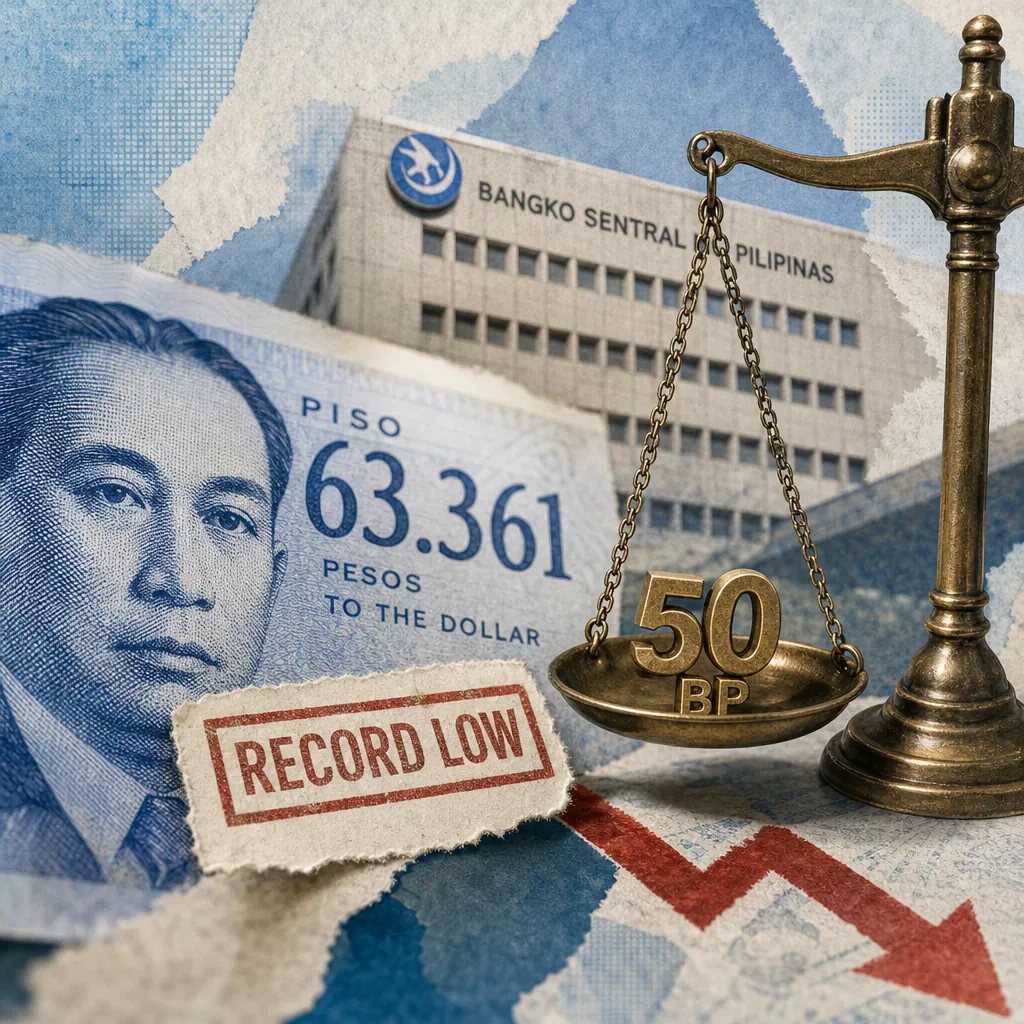
The peso closed at ₱63.361 to the dollar on Wednesday, October 21, the weakest finish on record and the 34th time this year the currency has set a new low 61104. It has now lost ₱4.571, or 7.21%, against the dollar since the end of 2025, when it finished the year at ₱58.79. The move came the day before the Bangko Sentral ng Pilipinas (BSP), the country's central bank, was due to announce its policy rate, with a New York think tank publicly pressing it to raise rates by half a percentage point rather than the quarter point most economists expect 63103.
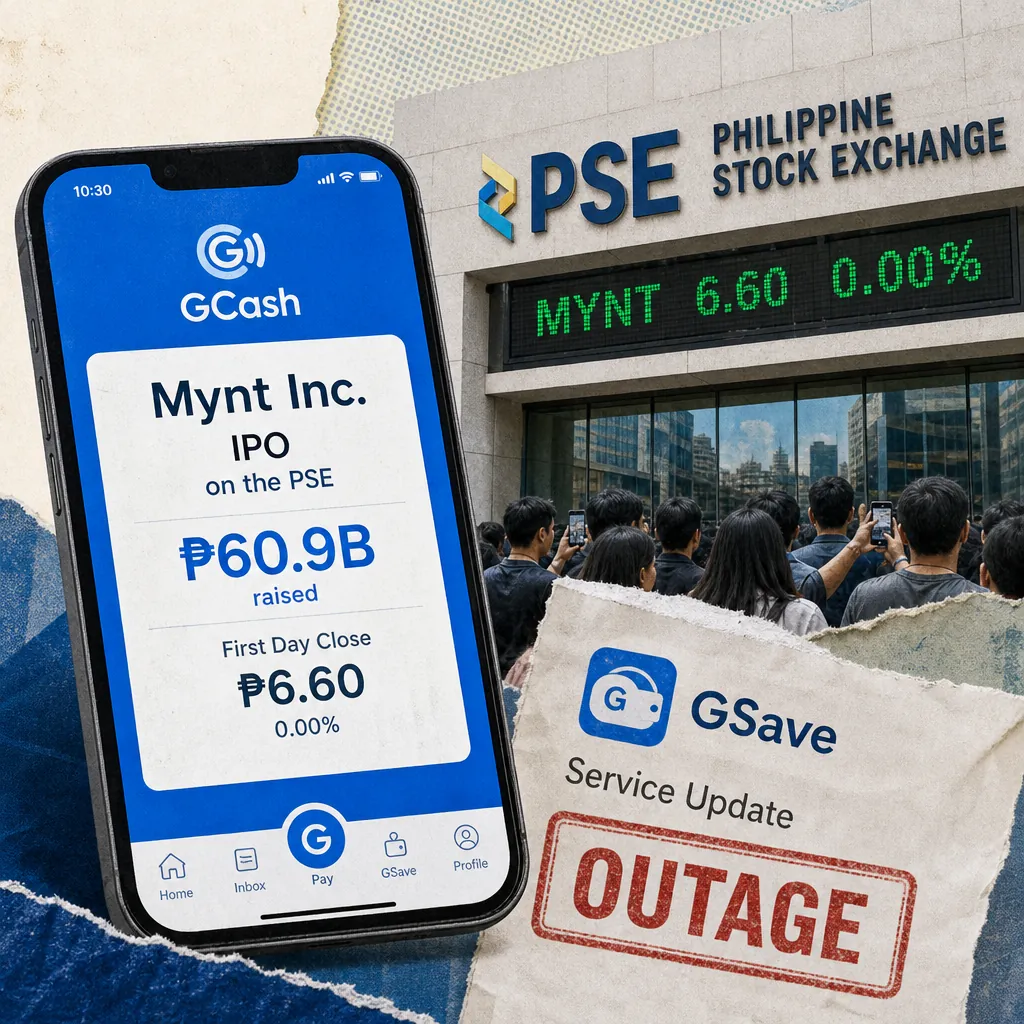
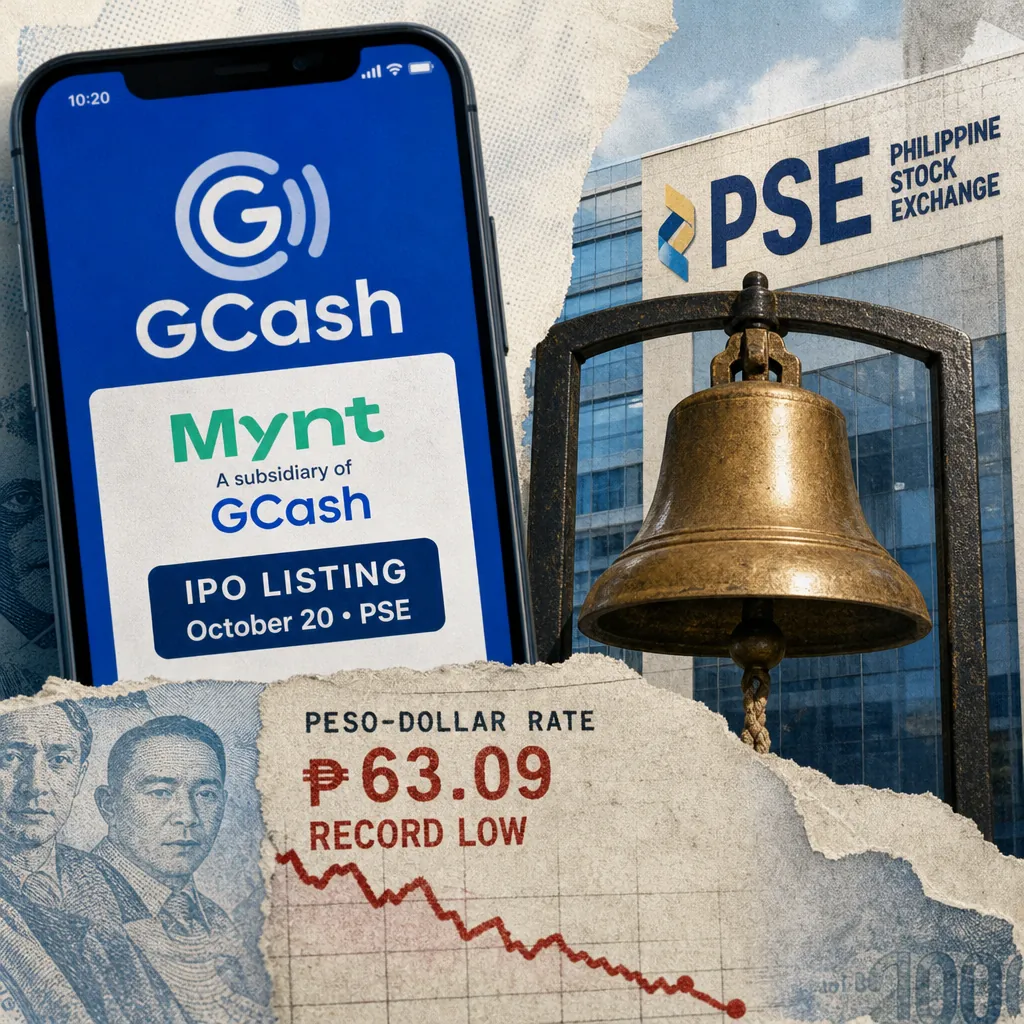
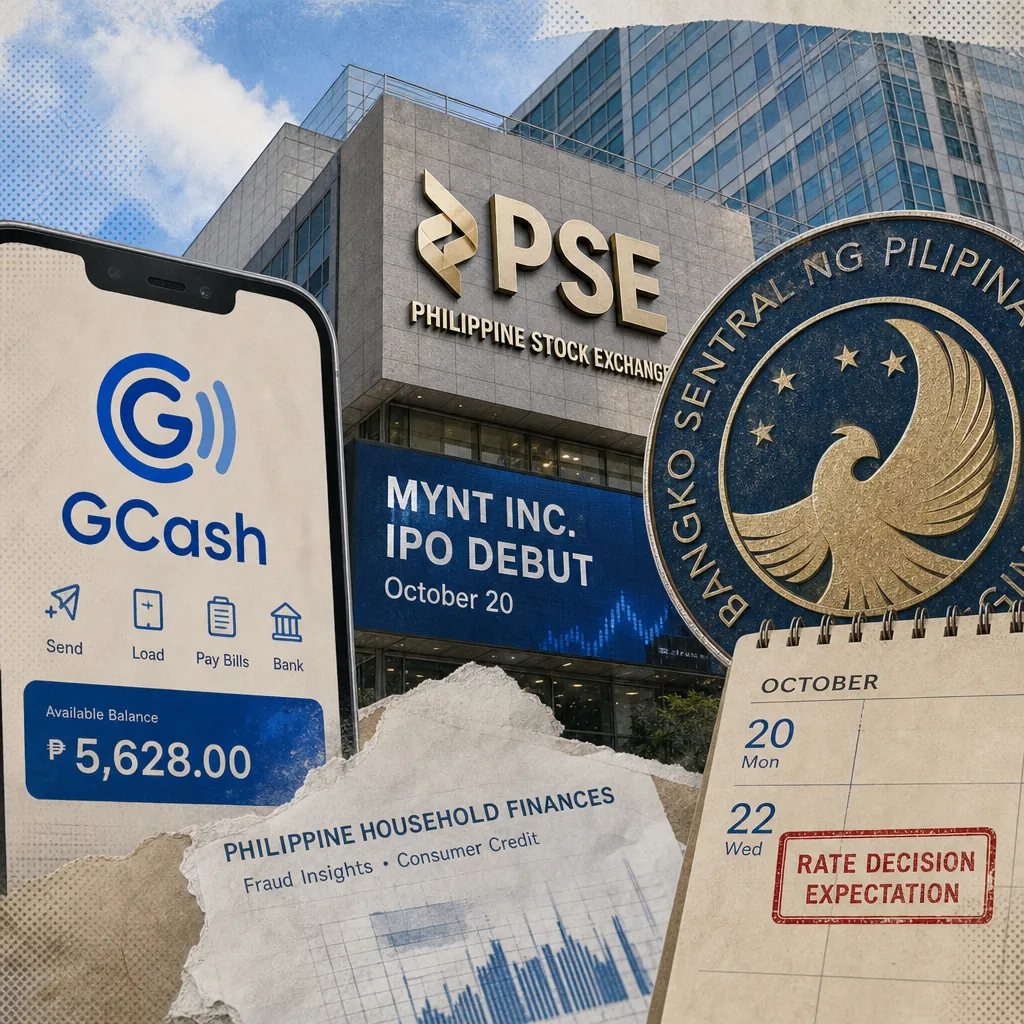
That currency story ran alongside a second, quieter one about the same institution: Mynt Inc., the parent of the GCash e-wallet, completed the largest initial public offering in Philippine history on October 20, raising about ₱60.9 billion, and its shares closed flat at the ₱6.60 offer price on day one before slipping to ₱6.59 on day two 1194. More than 140,000 ordinary app users bought in through a stock-trading feature inside GCash itself, placing nearly ₱1.1 billion in orders 1330. The listing drew the President, a pledge of market reforms, and a wave of explainer content aimed at first-time investors 152725.
On social platforms the loudest financial content of the day was neither of those. It was a GCash birthday giveaway — free rides on Metro Rail Transit Line 3 (MRT-3) from October 20 to 23, ₱10 chicken meals, a motorbike raffle — pushed through digital-bank and budget-travel Facebook communities, where a plain post about which three debit cards to carry for travel drew 124 likes and 43 shares, more than any promo post that day 16. Engagement on the bank-sponsored posts themselves was thin: a Metrobank car-loan post drew 3 likes and 1 angry reaction 7. The day's financial news was heavy; the day's financial conversation was light and promotional.
Key themes
- The peso set its 34th record low of 2026 at ₱63.361 to the dollar. The currency fell 27.1 centavos from Tuesday's previous record of ₱63.09 and touched an intraday low of ₱63.373, also a record 61. Year to date it has weakened 7.21% from ₱58.79 on December 29, 2025.
- A former central bank deputy governor is publicly arguing for a half-point rate hike. GlobalSource Partners analysts Diwa Guinigundo and Wilhelmina Mañalac said a 50-basis-point increase — half a percentage point — merits "serious consideration" at the October 22 Monetary Board meeting, which would lift the benchmark rate to 5.5% from 5% 63103. A BusinessWorld poll of 22 economists found 20 expecting a quarter-point move instead.
- Moody's Ratings reported stress in Philippine consumer and small-business lending. The credit rating agency said inflation and tighter monetary policy have squeezed borrowers' ability to repay, with problems showing up in "pockets" rather than across the whole loan book 87.
- Mynt's record IPO closed flat and slipped on day two. The GCash parent raised about ₱60.9 billion, the largest Philippine listing ever, but the stock ended its first session at the ₱6.60 offer price and traded at ₱6.59 the next day 1194. Broker Abacus Securities attributed the flat debut to underwriter price stabilization 94.
- More than 140,000 GCash users bought shares through the app. Orders placed through GStocks PH, the trading service run by AB Capital Securities inside GCash, totaled nearly ₱1.1 billion, at a minimum of 100 shares or ₱660 1330.
- GCash marked its 22nd birthday with free MRT-3 rides and cheap meals. The promo ran October 20 to 23 and required riders to pay with a GCash QR code, tap-to-pay, or a GCash Visa card while keeping at least ₱14 in balance 1. Gizguide framed it around pakain, palibre and pamigay — feeding, treating and giving 3.
- At least six banks are competing for the same card applicants on the same community pages. Metrobank, RCBC, Security Bank, UnionBank, BDO and Salmon all pushed cashback and travel offers through digital-bank and budget-travel Facebook groups on October 21 10.
- The stock market rose for a fifth straight session despite the currency's slide. The Philippine Stock Exchange index (PSEi) gained 0.26%, or 15.34 points, to 5,821.51, helped by bargain hunting and a 2.38% rally in port operator International Container Terminal Services Inc. 79104.
How the narratives stack
Dominant. The peso's record low and the rate decision that follows it dominated the business pages in the items reviewed here. BusinessWorld's front page led with the 34th record low and the year-to-date 7.21% decline; Manila Standard ran the same close under a front-page headline; the Manila Times and Inquirer both carried the story with the same 27.1-centavo move 6149. The coverage converged on one explanation: expectations of further rate increases by the US Federal Reserve have strengthened the dollar, while oil prices near $110 a barrel amid Middle East tensions have raised the Philippines' import bill 91. Ateneo de Manila University economist Leonardo Lanzona told BusinessMirror the peso could stay weak until early 2027 and may reach ₱65 to the dollar, which would raise the cost of fuel, power, transport, fertilizer, medicines and imported food inputs such as wheat and feed grains 91.
Counter-narrative. The stock market told the opposite story on the same day. The PSEi rose for a fifth consecutive session, gaining 0.26% to 5,821.51, even as the currency fell to a record 104. Philstocks Financial research manager Japhet Tantiangco credited a 2.38% rally in index heavyweight ICTSI, while noting market breadth stayed negative — 92 advancers against 83 decliners and 73 unchanged — which he read as investors waiting for the central bank's decision rather than committing 79. Bank stocks fell: BDO Unibank lost 0.59% to ₱117.80, Bank of the Philippine Islands 0.81% to ₱98.35, and Metrobank 1.37% to ₱61.10 93. The split is real and worth stating plainly: equity investors were buying bargains while currency traders were selling the peso, and both were waiting on the same Thursday announcement.
Emerging. Credit quality in household and small-business lending is the story that has not yet reached the front pages in force. Moody's Ratings assistant vice-president Clarabelle Tan said in an email interview with BusinessWorld that asset quality in retail and micro, small and medium enterprise (MSME) lending "has been under pressure even before the Middle East war erupted in late February," partly because loans made during three years of rapid credit growth are now maturing. She described "pockets of stress, particularly in SME and retail lending" rather than broad deterioration. Separately, MediCard Philippines chief executive Julian Mengual said the health maintenance organization (HMO) industry's combined net income fell 42.29% year on year to ₱2.094 billion as of end-June, per Insurance Commission data, which he linked to Filipinos using fewer healthcare services and to economic pressure from the prolonged Middle East conflict. Both point the same direction: household balance sheets are absorbing the inflation the central bank is trying to fight.
Under-covered. The peso's effect on ordinary household costs got less space than its effect on traders. Lanzona's warning that a weaker currency raises the price of fuel, power, transport, fertilizer, medicines and imported food ran in BusinessMirror but not on the front pages that led with the trading level 91. The same gap applies to the practical question of what a 5.5% policy rate does to a mortgage or a small-business loan; the coverage explained the rate mechanics but not the household consequence in comparable detail.
Platform insights
- Facebook. The day's measurable engagement sat almost entirely in Facebook community pages rather than brand accounts. Digital Banks PH Community's post on the GCash birthday offer drew 32 likes and 13 shares 1; its post recommending three debit cards for travel — GCash, MariBank or RCBC Hexagon as primary, GoTyme Bank as backup — drew 124 likes and 43 shares, the highest of any promo post that day 6. A cashback compilation covering UnionBank, Metrobank, RCBC, Security Bank and BDO drew 38 likes and 30 shares 10. Brand-posted offers performed far worse: Metrobank's hybrid car loan post drew 3 likes and 1 angry reaction 7. The pattern is that third-party curation travels further than the bank's own page.
- X (formerly Twitter). Activity was thin and mostly relayed from newsrooms. Interaksyon posted the flat first-day close 14; NewsWatch Plus posted the exchange's confirmation of the flat close 29; Bitpinas asked followers whether they planned to invest and framed the debut as a first taste of share ownership for many Filipinos 25. The platform carried the listing's facts to an audience already following business news rather than generating its own discussion.
- YouTube. The heaviest video coverage came from business broadcasters and the exchange itself. ANC's Market Edge carried PSE president Ramon Monzon saying more than 140,000 GCash users invested about ₱1.1 billion 30; COL Financial ran an analyst episode weighing the listing's valuation against a 34% fall in Meralco shares and the coming rate decision 23; Bilyonaryo interviewed BDO Capital president Ed Francisco on whether the debut could revive a struggling market 24. State broadcaster PTV carried the listing ceremony as a presidential event 28. Retail-facing creators posted how-to explainers on buying through GStocks PH at the ₱660 minimum 33.
- Reddit. No Reddit activity appears in the material for this window.
Key voices and communities
Mynt and GCash executives. President and CEO Martha Sazon framed the listing as a beginning: "Today marks a defining milestone for Mynt and the beginning of our next chapter as a public company. Our focus now is on deepening engagement across the GCash ecosystem, investing in technology-enabled growth, and translating our scale into sustainable value creation" 13. Chairman Ernest Cu said the responsibility is "to build on that position with strong governance, disciplined execution and a long-term perspective" 20. Sazon also stressed that nearly 90% of GCash customers come from low- to middle-income households, which the company uses to argue the offer widened share ownership 21. This group sets the tone for the whole listing story.
Financial analysts and market commentators. GlobalSource's Guinigundo and Mañalac are the most quoted voices on the rate question, arguing that "the objective is not to choose between price stability and economic growth" but "to prevent the erosion of purchasing power and confidence from becoming another drag on an already struggling economy". Guinigundo added that delaying a response "could allow inflation to persist, eventually producing possible demand destruction as households cut consumption because their real incomes can no longer keep pace with prices" 95. On the listing, Abacus Securities cautioned that "the risk of a disappointment is higher" when Mynt reports third-quarter results through parent Globe Telecom next month, given the hype and a second-quarter decline 94.
Retail investors and personal-finance creators. This is the audience the IPO was built to reach. Their posts walk followers through the ₱660 minimum board lot and warn that prices can fall; one tracked the second trading day at ₱6.59, down ₱0.01 18. Bitpinas explained board lots and growth strategy after the listing 42. Their framing is access — how to buy, what it costs, whether it will rise — rather than valuation.
President Ferdinand Marcos Jr. and the exchange. Marcos led the bell-ringing at the PSE Tower in Bonifacio Global City alongside Cu and Sazon, said GCash had become part of daily life with the phrase "I-GCash mo na lang" (just use GCash), and pledged market reforms 152627. PSE president Monzon called the IPO a statement of confidence in the Philippine economy and said the exchange is now hunting for the next big listing, naming toll operators as likely candidates once a merger between the two big toll-road companies is finalized 17102.
Digital-bank and budget-travel communities. These Facebook groups are where bank promotions actually circulate. Their curators decide which offers get seen, and their picks — a three-card travel setup, a cashback roundup — outperform the banks' own posts by an order of magnitude in likes and shares 610.
Narrative streams
The peso's 34th record low puts the central bank's next move at the center of the week
The peso's close of ₱63.361 was not a single bad day but the latest in a sequence: the 34th record low this year and the fifth in October alone. It opened Wednesday slightly stronger at ₱63.01, touched ₱63.00, then slid to ₱63.373 before closing down 27.1 centavos. Trading volume slipped to $1.34 billion from $1.36 billion the day before. A trader told Manila Standard the decline reflected oil at $110 a barrel amid Middle East tensions and positioning ahead of the BSP meeting, adding that "tomorrow, all eyes [will be] on [the] BSP decision, where hawkish stance may cause some pullback near the 63 handle, while lack of any hawkish statements from the Governor may encourage buyers to resume the dollar-peso climb to 63.50".
The policy context matters for readers outside finance. The BSP's Monetary Board sets a benchmark interest rate that anchors what banks charge on loans and pay on deposits. Raising it makes borrowing more expensive, which is meant to cool inflation by reducing demand; it also tends to support a currency by making local assets yield more. The Board was scheduled to meet October 22, with 20 of 22 economists in a BusinessWorld poll expecting a quarter-point hike to 5.25% — a fourth straight increase of that size 61. GlobalSource argued for double that, to 5.5%, which would be the highest rate since February 2025. The peso's slide is the strongest argument for the larger move: a weaker currency makes imports dearer, and the Philippines imports much of what it consumes, so the currency itself feeds the inflation the rate is meant to fight 91.
For banks and their customers, the practical consequence is that loan pricing is likely to rise again regardless of which size the Board chooses, and that consumer and small-business borrowers already under stress will feel it first. The peso story also reached the term deposit market: the BSP's seven-day term deposit facility drew ₱111.112 billion in bids against ₱100 billion offered, but the central bank awarded only ₱85.702 billion after rejecting some higher-yielding bids, and the weighted average accepted yield edged up to 5.0065% from 5.0061%.
Mynt's record listing raises ₱60.9 billion and closes flat
The numbers behind the listing are large and worth separating. Mynt sold 8,027,409,600 shares at ₱6.60 each for a base offer of about ₱53.0 billion, plus up to 1,204,111,400 secondary shares; with the overallotment option — an extra block underwriters may sell if demand is strong — fully exercised, the total reaches about ₱60.9 billion, or roughly US$967 million 1311. That surpasses Monde Nissin's 2021 offering as the largest in Philippine history 102. The offer period ran October 6 to 12 at a price Mynt set on October 2 after what it called strong institutional demand 3334.
The trading performance is a separate fact from the size. Shares closed at ₱6.60 on day one, flat against the offer price, after climbing as much as 2.4% at one point during the session 1138. On day two they slipped to ₱6.59 94. Abacus Securities said the flat opening "suggests active price stabilization by the offerings underwriters," but added that selling pressure appeared limited, with offer volumes staying below half of total bid volume through most of the session: "local buyers seemed willing to absorb whatever foreigners were selling" 94. The broker also warned that the risk of disappointment is higher when Mynt reports third-quarter results through Globe Telecom next month, given the hype and a second-quarter decline 94.
Where the money goes shapes the competitive picture. Mynt said it will put most net proceeds into its Digital Financial Services business, covering CreditTech (technology-driven lending) and WealthTech (digital investment tools) 13. One Facebook post said about ₱10.6 billion in gross proceeds from primary shares is expected, with 60% for the credit business, 20% for product development and 20% for general purposes 16. Bilyonaryo reported Mynt is weighing acquisitions and a digital bank license 35. For the banks that compete with GCash for deposits and loans, that is the number to watch: a well-capitalized lender with 40 million-plus monthly users moving into credit is a different competitor from a payments app. Mynt reported ₱43.3 billion in revenue and ₱10.8 billion in net income for the first half of 2026 32, and the central bank's own survey found half of Filipino adults still had no formal account 31 — the market the company says it is built to serve.
Retail investors bought in through the app, and the explainers followed
The listing's most distinctive feature is who bought. More than 140,000 users placed orders through GStocks PH, the stock trading service run by AB Capital Securities inside the GCash app, worth nearly ₱1.1 billion, at a minimum board lot of 100 shares or ₱660 1330. Individual orders were capped at 1,500 shares per user from day three of the offer onward to spread the allocation across as many retail investors as possible 13. Mynt said 80% of its workforce became shareholders on listing day 13.
The content that followed was instructional. A YouTube explainer listed the offer price, the minimum board lot and the steps to buy through GStocks PH, then asked followers "Are you planning to invest in GCash?" 33. Bitpinas explained board lots and growth strategy to retail investors after the listing 42. Business Inquirer ran a piece on three ways the debut could benefit Filipinos through investing and financial education 41. Reyes Tacandong & Co. senior adviser Jonathan Ravelas said GCash could make stock market investing more accessible by letting users buy shares and other financial products through its platform 40.
For the sector, the read is that a first-time investor base now exists at a scale the brokerage industry has not had before, and it was acquired through a payments app rather than a broker's office. That base will judge the market on its first experience: a stock that closed flat and then slipped is a mild lesson in price risk, and the how-to creators were careful to say prices can fall 33. Whether those 140,000 buyers stay engaged after the hype fades is the open question, and Mynt's third-quarter results next month are the first checkpoint 94.
The central bank's inflation dilemma, argued in public
The rate debate is unusually public this cycle. GlobalSource's Guinigundo, a former BSP deputy governor, and Mañalac, also a former central bank official, published a commentary arguing the BSP "cannot afford to wait 'til risks have materialized" because monetary policy works with a lag 95. A half-point hike, they wrote, "would send a stronger signal that the [BSP] is determined to prevent temporary supply shocks from becoming a lasting feature of the inflation environment" 95. They acknowledged the limits of monetary policy against supply-side pressures — the oil and import costs driving prices are not caused by Philippine demand — but argued the alternative is worse 63.
The counterweight is that economic activity is already weak and below potential, which is why a quarter-point move is the consensus 63. The Nobel Prize context is not incidental: this year's economics award went to Robert Hall and Michael Woodford, whose work established that the effectiveness of monetary policy depends not only on the rate a central bank sets today but on what households, businesses and markets expect it to do next 100. That is precisely the argument GlobalSource is making — that the signal matters as much as the size — and it explains why a 50-basis-point move is being debated in public rather than assumed.
For lenders, the read is that whichever size the Board chooses, the direction is settled: rates are going up again, and the cost of funds will follow. For households, the consequence is that variable-rate loans and new borrowing get more expensive at the same moment the currency is raising the price of imported goods. Moody's Tan's observation that stress is concentrated in SME and retail lending rather than broad-based is the detail that matters most for banks' loan books.
GCash's birthday giveaway carried the brand into everyday conversation
The 22nd-birthday campaign is the day's clearest example of a financial brand buying attention through daily-life costs rather than product features. Free MRT-3 rides ran October 20 to 23 for riders paying with GCash Commute QR, tap-to-pay, or a GCash Visa card while keeping at least ₱14 in balance; no fare was deducted during the promo 1. Gizguide described the effort as bringing Filipino traditions of pakain (feeding others), palibre (treating others) and pamigay (giving away) to users, and listed ₱10 chicken meals alongside the free rides 3. SunStar and the Manila Times ran stories on what they called a nationwide "pasalamat" (thanksgiving) blowout 45.
BusinessMirror carried a separate GCash announcement the same day: GCrypto, the app's crypto trading feature powered by the Philippine Digital Asset Exchange (PDAX), a local crypto exchange, lets users open an account in as fast as 30 seconds and trade up to 55 cryptocurrencies 2. Pairing a mass giveaway with a crypto onboarding pitch is the strategic detail worth noting; the two messages ran in the same news cycle.
The engagement numbers show where the campaign actually landed. The community post about the free rides drew 32 likes and 13 shares 1; the post about which three debit cards to carry for travel drew 124 likes and 43 shares 6. The lesson for banks and telecoms is that practical, comparative advice travels further in these communities than any single brand's offer. The birthday subsidy ends October 23, after which the free-ride angle drops out of coverage. A second wave is already timed: a Security Bank Mastercard airline promo code runs until November 14, 2026, with travel until April 30, 2027, and registration closing November 30, 2026 9.
Digital payments keep growing, and the next step is machines paying
The Philippines' shift to electronic payments has reached a scale where the next question is automation. InstaPay, the central bank's instant interbank transfer network, processed a record 4.7 billion transactions in 2025, while QR Ph person-to-merchant payments reached 2.5 billion 101. Eng Sheng Guan, chief executive of Southeast Asian payment technology provider Fiuu, said the next challenge is ensuring the ecosystem can support automated purchases — artificial intelligence initiating payments on a consumer's behalf — without compromising control, security or trust 101.
That future is arriving alongside older-fashioned fraud concerns. The BSP's Visayas regional director, Anna Clara Oville, stepped up warnings against counterfeit banknotes ahead of the Christmas shopping season, promoting the central bank's "Feel-Look-Tilt" method — a three-step check of a bill's texture, appearance and shifting security features — to help consumers and merchants spot fakes 78. Cebuana Lhuillier, which operates more than 3,500 branches nationwide, introduced Cash Accepting Machines developed with ECPay that let customers cash in, load phones, pay bills and top up at branch locations 71. Copperstone Lending co-sponsored CyberConvergence 2026 at the University of Makati, a summit on online scams, digital impersonation and financial fraud under the theme "A Whole-of-Nation Approach in Building a Resilient Cyberspace" 83.
The regional dimension is significant. Interior Secretary Jonvic Remulla opened the 20th ASEAN Ministerial Meeting on Transnational Crime in Makati, citing a UN Office on Drugs and Crime estimate that online scam operations in parts of Southeast Asia are associated with potential annual economic losses of about US$114 billion, and describing criminal networks that now run on "corporate-style franchising" with shared fraud and money-laundering networks 46. For payment providers and banks, the read is that growth in digital transactions expands the surface for fraud at the same rate it expands revenue, and the institutions that invest in consumer protection early will carry less reputational risk when a scam wave hits their own user base.
Conversation trajectory
October 22, the Monetary Board decision. The single most consequential near-term event. A quarter-point hike to 5.25% is the consensus; a half-point move to 5.5% would surprise markets and likely strengthen the peso from its record low. Watch the peso's close on the day and the governor's language on whether further increases are coming. The decision also sets the tone for bank lending rates and for how the Mynt story is read by investors.
Through late October, the peso's next record. The currency has set a record 34 times this year and five times in October alone. A trader identified ₱63.50 to the dollar as the next resistance level 49. If the peso breaches it, expect a fresh round of front-page coverage and renewed pressure on the central bank to act more aggressively.
November, Mynt's third-quarter results. Mynt reports through parent Globe Telecom next month, and Abacus Securities has already flagged a higher risk of disappointment given the hype and a second-quarter decline 94. The result is the first real test of whether the 140,000 retail buyers stay engaged. Watch the share price around the release and whether the company gives detail on how it will deploy the CreditTech allocation.
October 23 to November 30, the promo calendar. GCash's free-ride subsidy ends October 23. The Security Bank Mastercard airline promo runs to November 14 with registration closing November 30 9. At least six banks are competing for the same card applicants on the same community pages, so watch whether competitors answer GCash's giveaway with matching offers and whether any launch lands inside a rival's promotional window 10.
November 1 to December 23, the roadworks moratorium. The Metropolitan Manila Development Authority (MMDA) will suspend road excavations from November 1 until midnight December 23 to limit disruption during preparations for the 49th ASEAN Summit on November 16–18 and the Christmas season 81. The MMDA will also deploy 2,419 personnel from October 24 to November 3 for Undas, the All Saints' Day observance, with a no-day-off policy for traffic field staff on October 29–30 99. For banks and payment providers, the summit and holiday period are peak transaction windows; any service disruption during them will be amplified.
Trigger events to watch. A half-point BSP hike; a peso close above ₱63.50; Mynt's third-quarter release; any competitor matching GCash's giveaway; and the next Financial Inclusion Survey data from the central bank, which last found half of Filipino adults without a formal account 31.
Response guidance
Rate-decision messaging. Prepare two versions of any customer communication before October 22: one for a quarter-point hike and one for a half-point. Both should state plainly what changes for a borrower — which loan products reprice, when, and by how much on a sample balance — rather than describing the decision in policy language. The half-point scenario needs the more careful wording, because it will be read as the central bank acting against inflation that has not yet shown up in most households' paychecks.
Peso exposure. For clients with import costs, dollar-denominated debt, or overseas Filipino worker remittance flows, publish a short, concrete explainer on what a ₱63 to ₱65 range means for fuel, power, transport, fertilizer, medicines and imported food inputs 91. Avoid forecasting the exchange rate; state the range economists are discussing and what the business does at each level.
Credit-stress disclosure. Banks should get ahead of the Moody's finding rather than react to it. If retail or SME loan books show rising delinquency, say so with the segment and the trend, and pair it with what the bank is doing — restructuring, payment holidays, early contact — before a rating agency or regulator frames it first.
IPO and retail-investor communications. For brokerages and banks with retail investing products, the Mynt listing has created a first-time investor base of more than 140,000 people who bought through an app 13. Communications to that group should lead with price risk and the mechanics of a falling share price, not with the size of the offering. The flat debut and the day-two slip are the teaching moment; use them.
Promotional timing. Any bank or telecom planning a cashback, travel or onboarding offer should check its launch date against the GCash birthday window (through October 23) and the Security Bank travel promo (through November 30) 9. Community pages reward practical comparison content — the three-card travel post outperformed every brand post that day — so budget for community curation and comparison-friendly formats rather than brand-page announcements alone 6.
Fraud and scam awareness. With the holiday season approaching and the BSP warning on counterfeit notes, refresh consumer education on the "Feel-Look-Tilt" check and on online investment scams 78. The ASEAN ministerial meeting's US$114 billion estimate for regional scam losses gives the message scale; keep the guidance practical and specific to the channels customers actually use 46.
Digital-payment reliability. The ASEAN Summit (November 16–18) and the Christmas season are peak transaction periods, and the MMDA's roadworks moratorium signals official concern about disruption 81. Confirm uptime and customer-support staffing for those windows, and prepare a plain-language status message for any outage that names what failed, who is affected, and when service returns.
See the full picture behind today's signals.
This report draws from Media Meter's MediaWatch, our real-time monitoring engine tracking 2,470+ Philippine sources across print, broadcast, digital, and social. Explore how the platform turns raw coverage into decision-grade intelligence, then see how it's configured for teams like yours — whether you're in PR agencies, corporate comms, government, or marketing.
Want more? Browse our Report Library for sector and crisis intelligence, or request a demo and we'll have your brand set up before the call.
Want this kind of intelligence on your brand?
This brief is built on the same MediaWatch methodology that runs continuously across every brand we monitor. See your competitive landscape, Impact Score, and narrative trajectory in a 30-minute demo.