Peso Hits 37th Record Low at P63.95 per Dollar
The peso closed at a record P63.95 to the dollar on Monday, its 37th all-time low this year, as oil prices and stagflation fears weighed on the currency and the stock index fell to 5,641.18. Banks pressed ahead with bond offers and lending even as economists debated how much more the central bank will tighten.
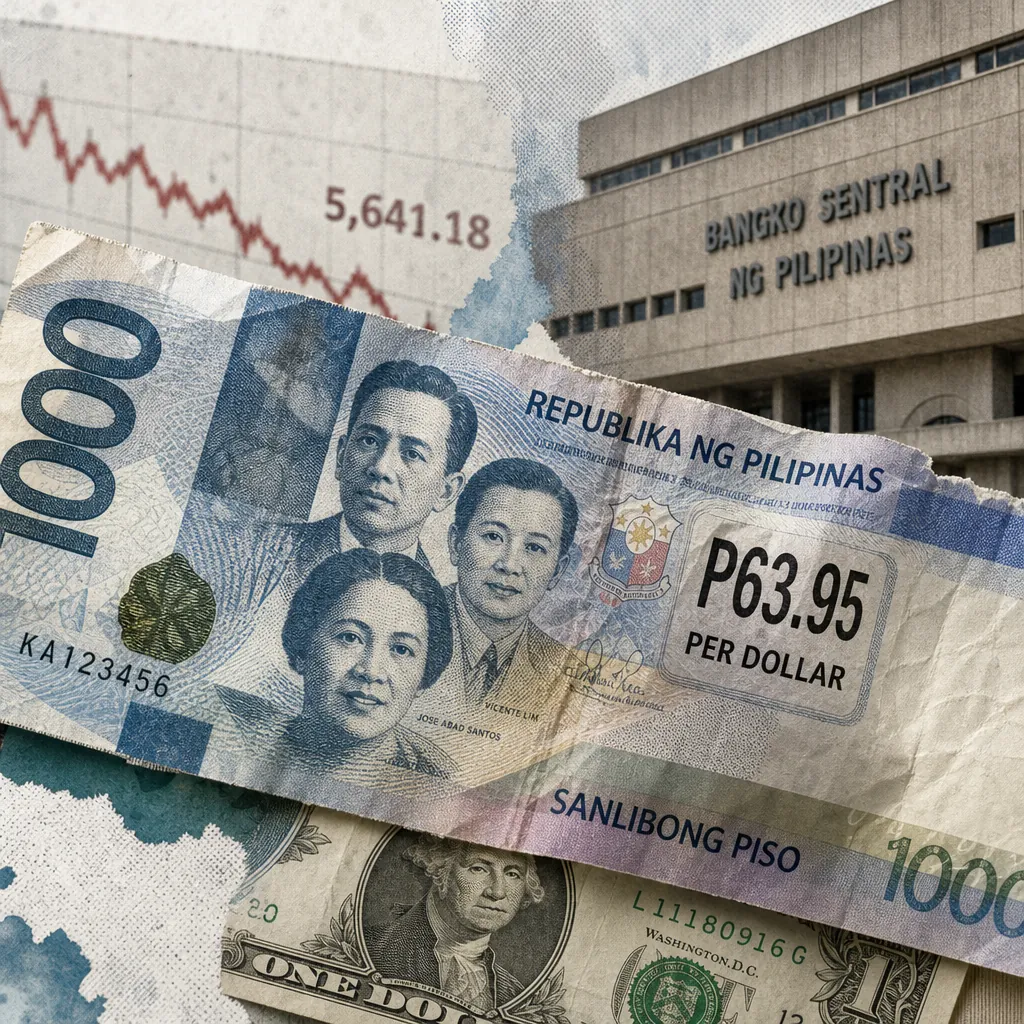
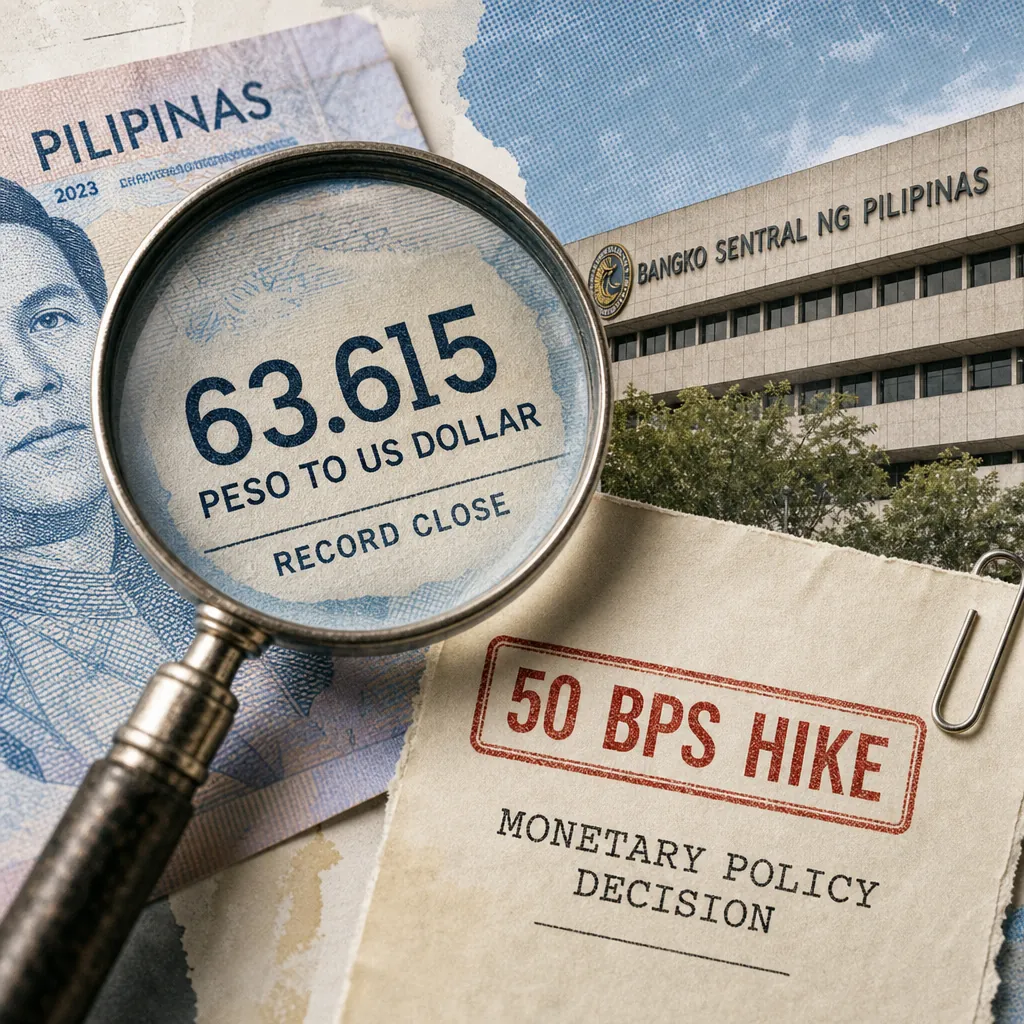
The peso closed at P63.95 to the dollar on Monday, its weakest finish on record and the sixth straight trading day it had set a new low, according to Bankers Association of the Philippines data cited by BusinessWorld1. That is the 37th record low of 2026 and the sixth in October alone, and it leaves the currency down P5.16, or about 8.1%, from its P58.79 close on Dec. 29, 20251. The Manila Times put the year-to-date decline at 8.78%2, a reminder that even the arithmetic of a currency slide depends on which day's baseline you pick. Dollars traded rose to $1.649 billion from $1.285 billion on Friday, meaning more sellers than usual were moving out of the peso1.
The currency story pulled the rest of the financial system's news along with it. The Philippine Stock Exchange index (PSEi) — the benchmark for the country's 30 largest listed companies — fell 1.53%, or 87.45 points, to 5,641.18, its lowest close in almost two weeks3. Treasury bill yields, the interest the government pays on short-term borrowings, climbed to their highest in nearly three years after the central bank's half-point rate hike last Thursday4. And the Bangko Sentral ng Pilipinas (BSP), the country's central bank, disqualified five money-changing businesses for operating without its registration5.
Against that, the banks kept doing business. Bank of the Philippine Islands (BPI) and Bank of Commerce (BankCom) each opened offers to raise at least P5 billion from bonds67, LandBank committed P11.68 billion to solar projects in Batangas8, and a Mastercard executive said four more banks will switch on Apple Pay in November9. The day's coverage in this set ran heavily through online business desks, with the peso and rate stories repeated across Manila Times, Inquirer, Philstar, BusinessWorld and BusinessMirror; the bond and lending stories also appeared in the broadsheets, where the peso story alone carried an estimated P305,000 in advertising-equivalent value in BusinessWorld's front page and P407,000 on Philstar Online110.
Key themes
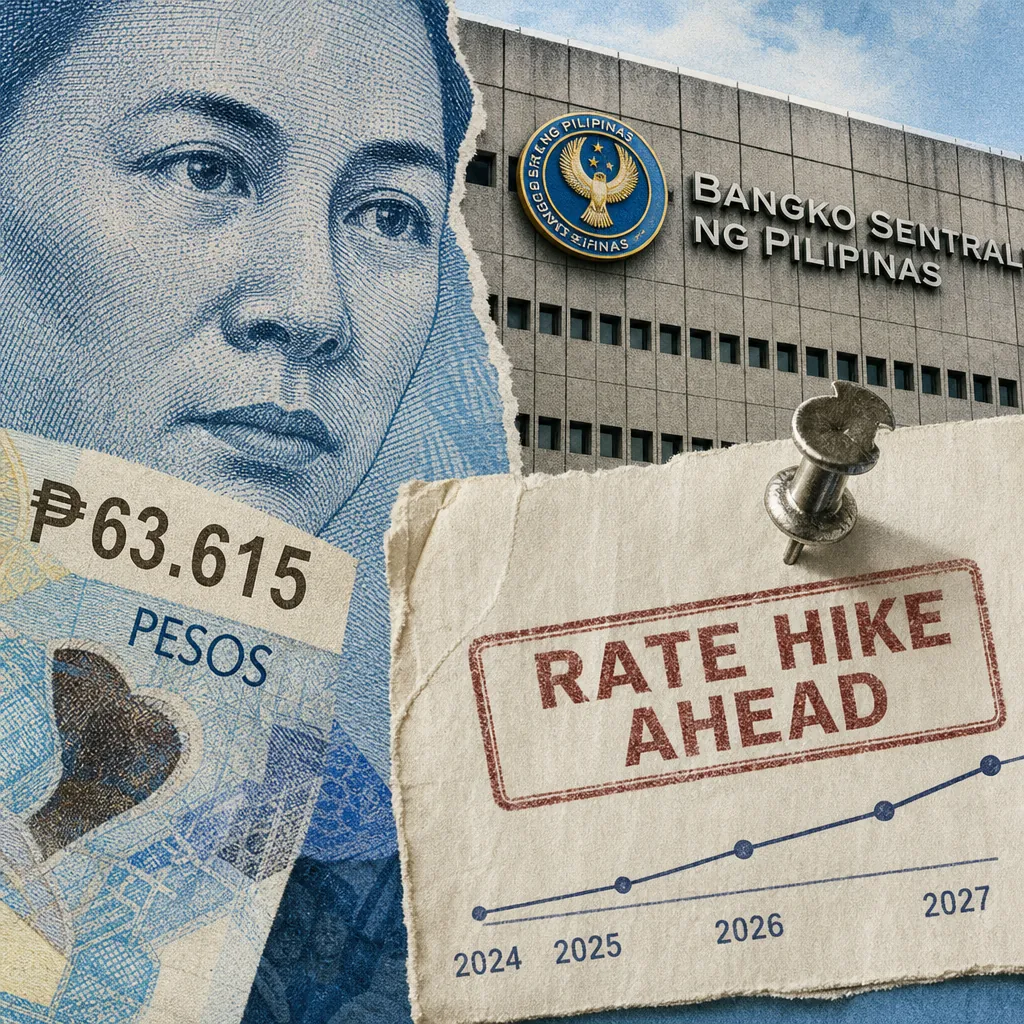
- The peso set its 37th record low of 2026 at P63.95:$1. The close beat Friday's P63.615 and came on heavier volume of $1.649 billion, up from $1.285 billion1. The currency has now lost about 8% of its value against the dollar since the end of 2025.
- Deutsche Bank expects the BSP to hold rates in December and hike again in February 2027. The German lender penciled in a 25-basis-point increase at the February Monetary Board meeting, after the board's half-point hike to 5.5% last week1112. Citi is reported to see a terminal rate of 6.0%13.
- BPI will raise at least P5 billion from sustainability bonds while setting aside more money for bad loans. The bank's Sibol bonds, due 2028, carry a 1.75-year tenor tied to its 175th anniversary and will be offered Nov. 23 to Dec. 4614. Separately, BPI booked P19.9 billion in provisions in the first nine months, up 69.2% from a year earlier15.
- BankCom opened a dual-tranche bond offer at 6.9882% and 7.6563%. The San Miguel affiliate is selling 1.5-year Series E and three-year Series F bonds, with a minimum investment of P100,000, as the fourth tranche of its P80-billion program716.
- LandBank is lending P11.68 billion for 900 megawatts-peak of Citicore solar capacity. The loan is part of a P35.014-billion syndicated facility split equally with BPI and the Development Bank of the Philippines817.
- Four more banks will support Apple Pay in November. Mastercard Philippines country manager Jason Crusto said adoption among the banks already live has been "very encouraging" since Apple Pay launched in the country in August9.
- A strong El Niño puts farm output and hydropower at risk, with knock-on effects for prices. Fitch Solutions unit BMI said the Philippines is among the Southeast Asian countries most exposed to drought damage, and the state weather bureau expects the episode to last until the first quarter of 202718.
- The BSP disqualified five unregistered money service businesses. The Monetary Board named Shara-P Money Changing Services, Downtown Money Changer, Ponio Money Changing Services, Jamelah-Arham Gift Shop and JNJ Money Changing Services, barring their owners from running other sole proprietorships5.
How the narratives stack
Dominant. The peso's record close is the day's dominant story within this set, carried by at least six outlets and leading the front pages of both BusinessWorld and the Manila Times121019. The framing is consistent: oil prices, Middle East tension and fears of stagflation — a combination of weak growth and rising prices — are pushing the currency down faster than the central bank's rate hikes can offset. Chinabank chief economist Domini Velasquez tied the move to weekend oil price increases and US President Donald Trump's remarks about possible renewed military action against Iran, which strengthened the dollar19. BusinessWorld's front-page story carried an estimated P305,000 in advertising-equivalent value, the cost of buying the same space as paid advertising, and Philstar's online version carried about P407,000110.
Counter-narrative. Two counterweights ran alongside the peso story. The first is that a weak peso is not uniformly bad: HSBC senior Asean economist Aris Dacanay argued in Panay News that the slide makes Philippine exports more competitive and encourages consumers to buy locally made goods, and that 2026 marked the first year since 2018 of meaningful, sustained growth in manufacturing20. The second is the argument, made in a BusinessMirror editorial, that the currency is a symptom rather than the disease. The editorial quoted BSP Governor Eli Remolona Jr. saying "We're not hiking the policy rate to defend the peso," and argued that dollar demand, oil prices and a widening balance-of-payments deficit are structural problems that rate policy cannot fix21.
Emerging. The clearest emerging story is the shape of the BSP's next moves. Deutsche Bank's note, reported by both the Manila Times and the Inquirer, expects a pause at the Dec. 17 meeting and a resumption in February once January inflation data is in hand1112. Head Topics reported that Citi sees a terminal rate of 6.0%, citing El Niño, fuel prices and base-effect inflation as drivers13. That is a forecast, not a decision, and the Monetary Board has not committed to it publicly.
Under-covered. The El Niño warning got a single front-page slot in this set. BMI's report says the Philippines faces one of the highest risks in Southeast Asia of disruption to agricultural production and hydropower, and the state weather bureau, the Philippine Atmospheric, Geophysical and Astronomical Services Administration, has said a strong to very strong El Niño is active and will last until the first quarter of 202718. That matters for food prices, which feed directly into the inflation the BSP is fighting, and it received far less attention than the daily currency close.
Platform insights
- Facebook. The most-quoted voice in the day's coverage came through Facebook Messenger: Alain Jomarie G. Santos, chairman of the University of Santo Tomas Department of Economics, gave BusinessWorld his explanation of the rate debate in a message, saying "higher interest rates are like taking bitter medicine now, so we don't end up in the ICU later" and calling inflation "a silent thief because it steals the value of your paycheck every time you buy groceries"22. The platform served as a channel for expert commentary aimed at ordinary readers rather than a site of argument.
- X. The only engagement figure in the set belongs to a non-financial story: a video of Catholic bishops praying around US President Donald Trump at the White House, which Archbishop Jeffrey Grob said was posted without the bishops' consent and which drew more than 1.8 million views on X23. No peso-related post in this set carried a comparable public response, which suggests the currency story moved through news sites and messaging apps rather than through viral social debate.
- Reddit and YouTube. Neither platform appears in the material gathered here, so there is no basis to describe activity on them for this window.
Key voices and communities
Central bank watchers and foreign banks. Deutsche Bank and Citi set the terms of the rate debate, with Deutsche Bank's call for a December pause and a February hike repeated across at least three outlets111213. Their notes matter because they shape what borrowers and investors expect before the Monetary Board meets.
Local economists explaining the trade-off. Santos of UST and Velasquez of Chinabank gave the day its plain-language framing: higher rates hurt borrowers now but protect purchasing power later, while oil and geopolitics drive the currency in the short run2219.
Bank treasury and corporate finance teams. BPI, BankCom and LandBank all made funding or lending announcements on the same day, and their pricing — 6.9882% for 1.5 years at BankCom, 7.6563% for three years — tells borrowers what money costs in a rising-rate environment7.
Energy and climate analysts. BMI's El Niño report and the LandBank-Citicore financing put the energy transition and climate risk into the same conversation as inflation188.
Payments and consumer finance. Mastercard's Apple Pay update and the BSP's disqualification of unregistered money changers both concern how money moves at the retail level, one through new technology and one through enforcement95.
Narrative streams
The peso's sixth straight record close brings 64:$1 into view
The peso opened Monday at P63.535, touched an intraday best of P63.5, and closed at its weakest point of the day, P63.951. That pattern — opening stronger and closing at the low — indicates selling pressure built through the session rather than easing. The previous record, P63.615, had been set on Oct. 231. Philstar reported the currency was flirting with P64 despite the BSP's recent rate hikes, and quoted Velasquez saying the peso's weakness "also reflects eroding" confidence beyond the oil story19.
The read for the sector is that importers, dollar-denominated borrowers and anyone pricing goods against the dollar face higher costs immediately, while exporters and families receiving remittances from overseas Filipino workers get more pesos per dollar. HSBC's Dacanay made exactly that point, noting that remittance-receiving households benefit and that local manufacturers gain an edge over foreign rivals20. The peso's slide is not a single-direction event for the economy; it redistributes costs and gains across sectors.
Deutsche Bank sees a December pause and a February hike
The BSP's Monetary Board raised its benchmark rate by half a percentage point last Thursday to 5.5%, an unusually large move that Governor Remolona said left the bank "open to further interest rate hikes"4. Deutsche Bank's note, reported Monday, expects the board to hold at its Dec. 17 meeting and then raise by a quarter point in February 2027, when January inflation data will show whether "the anticipated pickup in price pressures is materializing"12. Head Topics reported that Citi also expects further tightening, with a terminal rate of 6.0%13.
The read for the sector is that borrowers should plan for money to stay expensive into 2027. A terminal rate of 6.0% would be half a point above today's level, and every step raises the cost of car loans, mortgages and business credit. Santos's framing captures the trade-off: higher rates slow the economy now but protect paychecks from inflation later22. The uncertainty is real — the February hike is a forecast, not a commitment, and the board has not said publicly that it will pause in December.
BPI raises P5 billion for green projects while bracing for consumer strain
BPI's Sibol bonds will be offered from Nov. 23 to Dec. 4, with issuance and listing on the Philippine Dealing & Exchange Corp. scheduled for Dec. 166. The Securities and Exchange Commission authorized the "ASEAN Sustainability Bond" label on Oct. 20, meaning the proceeds must fund projects meeting the Association of Southeast Asian Nations' standards for green and social investment6. The bank's president and CEO, Jose Teodoro K. Limcaoco, said separately that high inflation, fuel and food prices are "causing some strain on the consumer" and that BPI will set aside more provisions as a result15. Provisions are money banks hold back against loans that may not be repaid; BPI's P19.9 billion for the first nine months was up 69.2% from a year earlier15.
The read for the sector is that banks are simultaneously funding long-term green projects and preparing for short-term consumer distress. Lenders that have not yet raised their loan-loss buffers may face pressure to do so if inflation keeps eating into household budgets.
BankCom prices its bonds at 6.99% and 7.66%
BankCom's offer runs until Nov. 4, with listing on Nov. 11, and carries an oversubscription option1624. The Series E bonds due 2028 pay 6.9882% and the Series F bonds due 2029 pay 7.6563%, both quarterly, with a minimum investment of P100,0007. ING Bank, Philippine Commercial Capital, Security Bank Capital and Standard Chartered are joint lead arrangers16.
The read for the sector is that these rates set a benchmark. A three-year corporate bond at 7.66% tells companies what they will pay to borrow, and it sits above the central bank's 5.5% policy rate, reflecting both the bank's own risk and the market's expectation that rates will rise further.
LandBank finances 900 MWp of solar in Batangas
LandBank's P11.68 billion loan to Citicore Renewable Energy Corp. is part of a P35.014-billion syndicated facility split equally among LandBank, BPI and the Development Bank of the Philippines817. The five projects — three 100-MWp solar farms with battery storage and two 300-MWp farms — will add 900 MWp of solar capacity and 120 megawatt-hours of storage, and are expected to generate about 1,300 gigawatt-hours of renewable electricity a year once fully commercialized17. LandBank president and CEO Lynette V. Ortiz said expanding renewable capacity is "vital to building a more secure and sustainable future for Filipinos"25.
The read for the sector is that state and private banks are putting large sums into energy transition projects even as the currency weakens, because these are long-term peso-denominated assets backed by power purchase agreements. For Citicore, the financing moves its five-gigawatt pipeline forward; for the grid, it adds storage capacity that helps manage the intermittency of solar.
Four more banks will switch on Apple Pay in November
Apple Pay went live in the Philippines in August with China Banking Corp. and GoTyme among the launch banks9. Mastercard's Crusto said four banks are live now, another four will follow around November, and a third phase will come in the first quarter of 20279. He said adoption among live banks has been "very encouraging" and that transaction growth should pick up next year as more consumers and issuers join9.
The read for the sector is that mobile wallet competition is about to widen. Banks that add Apple Pay gain a reason for customers to keep their cards top of wallet; those that delay risk losing transaction volume to rivals. The BSP's separate disqualification of five unregistered money changers shows the same regulator policing the other end of the payments market5.
El Niño threatens farm output and hydropower into 2027
BMI's report says the Philippines is among the countries most affected by El Niño, with a significantly larger share of agricultural land exposed to severe drought18. The state weather bureau has said a strong to very strong El Niño is active, expected to peak before the end of the year and last until the first quarter of 202718. El Niño typically brings severe dry conditions that strain agriculture and water supply, and hydropower depends on rainfall.
The read for the sector is that food and electricity prices face upward pressure just as the central bank is trying to bring inflation down. That is the mechanism Deutsche Bank and Citi are watching when they forecast further rate hikes1113.
Conversation trajectory
Dec. 17, 2026 — BSP Monetary Board meeting. Deutsche Bank expects a pause here12. Watch whether the board's statement repeats Remolona's "open to further interest rate hikes" language or softens it. A pause would confirm the forecast; a hike would signal the board sees inflation spreading faster than expected.
Nov. 4–11 — BankCom bond offer closes and lists. The offer runs until Nov. 4 with listing on Nov. 1116. Demand for the bonds, and whether the oversubscription option is exercised, will show how much investors are willing to lend at 7.66% for three years.
Nov. 23–Dec. 4 — BPI Sibol bond offer. The offer period and the Dec. 16 listing will test appetite for sustainability-labeled debt at a time when the bank is also raising provisions615.
November — Apple Pay phase two. Four more banks are expected to go live9. Watch which banks they are and whether transaction volumes grow as Crusto expects.
First quarter of 2027 — El Niño peak and inflation data. The weather episode is expected to last through the first quarter, and January inflation data will be the first read on whether food and energy prices are feeding through1812. That data release is the trigger Deutsche Bank has named for the February rate decision.
Ongoing — oil prices and Middle East tension. Velasquez tied Monday's peso move to weekend oil price increases and Trump's remarks on Iran19. Any escalation or de-escalation in the Middle East will move the peso before domestic policy does.
Response guidance
Borrowers and treasury teams: lock in funding costs now. BankCom's three-year bonds price at 7.6563% and BPI's 1.75-year bonds are being offered next month76. Companies with refinancing needs in 2027 should consider whether to raise before the February meeting Deutsche Bank expects to bring another hike12.
Retail investors: read the minimums and the tenor. Both bank offers require at least P100,000, with increments of P50,0007. The yields are attractive relative to deposit rates, but the money is locked up for 1.5 to three years, and rates could rise further.
Importers and dollar payers: hedge or reprice. The peso has fallen about 8% against the dollar since December 20251. Businesses with dollar-denominated costs should review contracts and consider forward cover rather than waiting for the currency to recover.
Exporters and remittance recipients: the weak peso is a tailwind. HSBC's Dacanay noted that exporters gain competitiveness and remittance families get more pesos per dollar20. Communicate the benefit plainly to customers and beneficiaries rather than letting the headline "record low" dominate.
Banks communicating with consumers: address loan provisions directly. BPI's Limcaoco said provisions are rising because of consumer strain15. Lenders should explain to borrowers what higher provisions mean for credit standards and repayment terms before customers discover it at the branch.
Payments providers: prepare for Apple Pay phase two. Four more banks go live in November9. Merchants and acquirers should test contactless acceptance and train staff before the volume arrives.
Agricultural and energy communicators: put El Niño on the calendar. The drought episode runs through the first quarter of 202718. Farmers, cooperatives and hydropower operators should plan for water shortages now, and lenders with agricultural exposure should review their portfolios.
All financial communicators: avoid treating the daily record as the whole story. The peso has set 37 record lows this year1. Reporting each one as a fresh crisis wears out the audience; explaining what each close means for prices, jobs and borrowing costs serves them better.
See the full picture behind today's signals.
This report draws from Media Meter's MediaWatch, our real-time monitoring engine tracking 2,470+ Philippine sources across print, broadcast, digital, and social. Explore how the platform turns raw coverage into decision-grade intelligence, then see how it's configured for teams like yours — whether you're in PR agencies, corporate comms, government, or marketing.
Want more? Browse our Report Library for sector and crisis intelligence, or request a demo and we'll have your brand set up before the call.
Want this kind of intelligence on your brand?
This brief is built on the same MediaWatch methodology that runs continuously across every brand we monitor. See your competitive landscape, Impact Score, and narrative trajectory in a 30-minute demo.