Pet crematorium shut after 29 pets dumped in Bulacan
Bacoor City closed a pet crematorium after the remains of 29 dogs and cats were found dumped in San Jose del Monte, Bulacan, drawing calls from senators, lawmakers and animal welfare groups for a nationwide audit of the pet aftercare industry.
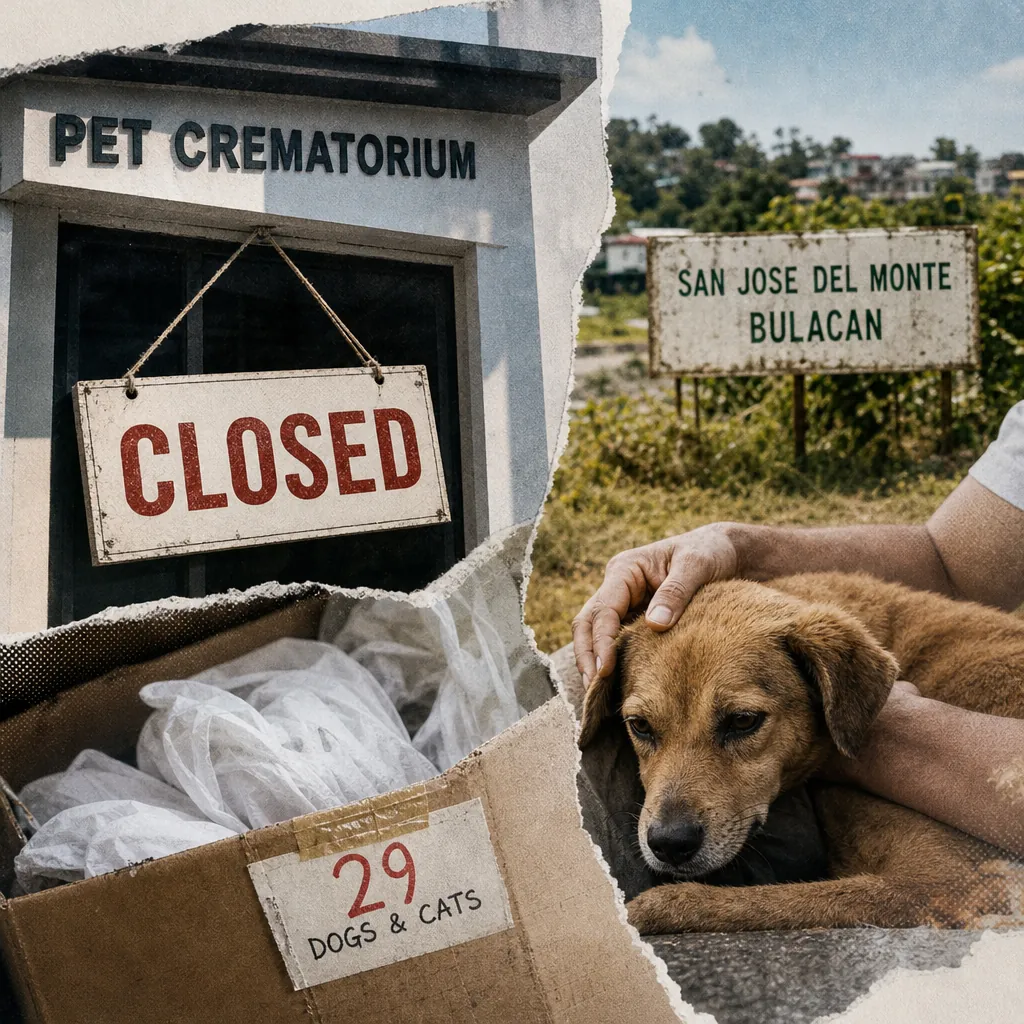
The remains of 26 dogs and three cats, sealed in plastic bags and left on a vacant lot along New Town Street in Barangay Minuyan Proper, San Jose del Monte City, Bulacan, were found late on Friday, October 30. By Sunday, November 1, the fallout had reached the national government: Bacoor City Mayor Strike Revilla ordered the closure of Ahjay Paws Aftercare Pet Crematorium, the establishment in his city that pet owners say took their money and returned nothing but a promise3570. Senate President Sherwin Gatchalian called for inspections and audits of all pet service providers, including crematoriums, and Rep. Leila de Lima urged Congress to tighten the country's animal welfare laws228.
The discovery was made public by the animal rescue group Luna and Furry Siblings, which posted about it on social media and set off the outrage that carried the story through the weekend28. The Philippine Animal Welfare Society (PAWS), a long-standing animal protection organization, asked agencies to investigate not just the Bacoor establishment but pet crematoria operating elsewhere in the country, and told the pet owners they have grounds to sue for estafa, the criminal offense of swindling by deceit4647. The story ran across Inquirer, GMA News Online, Philstar, Manila Bulletin, Manila Times and Daily Tribune, and the coverage in this set was heavy: the Manila Times report on the closure order carried an estimated ₱624,184 in advertising-equivalent value, the cost of buying the same space as paid advertising, and the Manila Bulletin's Filipino-language report on the owner's inability to confirm the remains were his carried ₱376,640359.
The pet story was the loudest item in a day otherwise dominated by the Undas holiday, the All Saints' Day and All Souls' Day observance when Filipino families visit cemeteries. Expressways stayed light, bus terminals reported no fully booked trips, and the Department of Public Works and Highways said two Metro Manila flyovers would reopen ahead of schedule53632. Alongside those, a cluster of business and policy stories ran through the Sunday papers: Japanese investors questioned a new energy and environment department rule on asset handover, the government approved advisory funding for two big rail projects, and a new report showed nearly seven in ten foreign-funded infrastructure projects running behind schedule2262798075. The pet crematorium story is the one with a live regulatory response and a public demanding answers.
Key themes
- Bacoor closes a pet crematorium after 29 animals are found dumped in Bulacan. Mayor Strike Revilla ordered the closure of Ahjay Paws Aftercare Pet Crematorium on Saturday, October 31, after meeting more than 30 pet owners, and directed the city legal office, the business permits office, the environment office and the city veterinary office to investigate935. The owner, Jonathan Legaspi, could not confirm at the initial meeting whether the dumped remains came from his facility9.
- Senate President Gatchalian wants every pet service provider inspected and audited. Gatchalian called on local government units and the Bureau of Animal Industry, the national agency under the Department of Agriculture that regulates animal health and welfare, to check that pet businesses are licensed, environmentally compliant and observe clear standards2. He described the dumping as "a blatant violation of environmental and sanitation laws" and said grieving owners "paid for a decent final farewell for their beloved companion animals, only for them to be dumped like garbage on a roadside"2.
- PAWS tells owners to sue for estafa and asks for a nationwide probe. The animal welfare group said pet parents paid for a service that was supposed to provide a dignified farewell, and that telling them the animals had been cremated when they had not "constitutes estafa by means of deceit"46. It also asked agencies to look into other crematoria, saying the discovery "raised serious concerns about the integrity of pet cremation services in the country"47.
- A lawmaker says the Animal Welfare Act does not reach this case. Rep. Leila de Lima, a House deputy minority leader, called for comprehensive and stricter animal welfare legislation, saying "this kind of violence should never be tolerated" and "it will not be the last unless we implement comprehensive and stricter laws"28. PAWS noted the same gap from the other direction: the animals were already dead when turned over, so the Animal Welfare Act, which protects living animals from cruelty, does not directly cover the dumping46.
- An earlier dumping at the same site raises the question of a pattern. Philstar's editorial said two animal welfare groups reported a similar incident in May, when 14 dead dogs were allegedly found in the same place71. If confirmed, that would mean the practice predates the case now under investigation and that oversight of the pet aftercare industry has been absent for months.
- The closure order came with a request for evidence. Revilla asked complaining pet owners to identify their dogs so the case can be strengthened, saying "we need complainants, we need evidence"70. He also asked the Philippine National Police to investigate the owner and pursue appropriate charges70.
- The story ran on a holiday weekend, when the national conversation was on cemeteries and family. Traffic on the North Luzon Expressway and South Luzon Expressway stayed light through Sunday evening, and the Parañaque Integrated Terminal Exchange reported no fully booked trips on its routes through November 3536. The dumping story cut against the mood of the holiday: families were visiting graves while other families learned their pets' remains had been thrown away.
- Business and policy stories filled the rest of the Sunday papers. The Japanese Chamber of Commerce and Industry of the Philippines questioned a joint order by the energy and environment departments requiring operators to surrender assets when contracts expire2262. The government approved $1 million in advisory support to restructure the Light Rail Transit Line 1 concession and opened the search for a ₱313-million independent consultant for the North-South Commuter Railway8079. A planning department report found 47 of 68 ongoing foreign-funded projects behind schedule at the end of 202575.
How the narratives stack
Dominant. The pet crematorium case dominated the captured set by both item count and coverage value. At least a dozen items across six outlets covered it, from the initial discovery through the closure order, the Senate President's call, the PAWS statement and the editorial pages. The Manila Times closure story alone carried an estimated ₱624,184 in advertising-equivalent value, and the Manila Bulletin's report on the owner's uncertain answers carried ₱376,640359. The dominance is a property of the items gathered here, which were weighted toward Philippine news outlets covering a live national story; the case also had the ingredients that keep a story running: identifiable victims, a named business, a mayor acting on camera, and a senator calling for audits.
Counter-narrative. The strongest counter-current was procedural caution. Revilla's own statements stressed that the investigation is ongoing and that the case needs complainants and evidence70. The owner could not confirm the remains were his9. PAWS framed the case as one of fraud against pet owners rather than animal cruelty, because the animals were dead when handed over46. That framing matters: it moves the legal question from animal welfare, where the law is thin, to consumer protection and the Revised Penal Code, where estafa carries real penalties. The counter-narrative does not weaken the story; it tells you which charges are likely to stick.
Emerging. The nationwide audit is the emerging thread. Gatchalian's call covers all pet service providers, not just crematoriums, and PAWS wants other crematoria investigated247. No agency has yet announced a nationwide inspection, and the Bureau of Animal Industry has not issued a public statement in the items reviewed. The May incident reported by Philstar's editorial, if verified, would turn a single case into a pattern and give the audit its justification71.
Under-covered. The pet aftercare industry itself is the under-covered story. The items describe a business with a valid permit, grieving customers and no visible standards for what happens to remains after pickup9. Nobody in the captured coverage can say how many crematoria operate in the country, how they dispose of remains, or who inspects them. Philstar's editorial asked the question directly: who is watching the pet aftercare industry71. That question has no answer in the record yet.
Platform insights
- Facebook. The case began as a Facebook post by Luna and Furry Siblings and spread through shares by pet owners and animal welfare groups28. Mayor Revilla announced the closure and the investigation on his own Facebook page, and the Manila Bulletin built its report from that post942. Facebook is where the emotional weight of the story sits: photos of the dumped animals, owners identifying their pets, and local officials speaking directly to constituents. The platform's role here is closer to a public notice board than a debate forum.
- X. The story moved on X mainly through news outlets and reporters posting links to breaking updates, which is how the closure order and the Senate President's statement reached national attention within hours. The items reviewed do not include engagement figures for individual X posts, so the size of the response there cannot be measured from this set.
- Reddit and YouTube. Neither platform appears in the items reviewed. Discussion of the case in forums and video commentary may exist, but nothing in this set documents it.
Key voices and communities
Pet owners and fur parents. More than 30 owners met with Bacoor officials on October 31, and the complainants are the ones who can identify their animals and supply the evidence for charges970. Their framing is personal: they paid for a dignified farewell and got a roadside dump. This group carries the moral force of the story and the legal burden of building the case.
Animal welfare organizations. PAWS and Luna and Furry Siblings are driving the accountability demand. Luna and Furry Siblings broke the story; PAWS supplied the legal theory, the estafa angle and the call for a nationwide probe4647. PAWS is a known organization with years of advocacy behind it, which gives its statements weight with agencies and the press.
Local government and national officials. Revilla acted within a day of the complaints, ordering the closure and asking police to investigate3570. Gatchalian and de Lima moved the issue to the national level, one through regulatory pressure on agencies, the other through legislation228. The speed of the local response and the national politicians' interest suggest the case will stay on the agenda past the weekend.
The pet aftercare industry. Crematorium operators are the group with the most at stake and the least public voice in the coverage. The Bacoor establishment had a valid business permit, which means the regulatory failure, if there is one, sits in the gap between permitting and operations9. Other operators now face the prospect of inspections they may not have experienced before.
Narrative streams
A Bacoor crematorium is closed after 29 pets are found in plastic bags
The discovery was made late on Friday, October 30, when the remains of 26 dogs and three cats were found sealed in plastic bags on a vacant lot in San Jose del Monte, Bulacan4770. The animals had name tags, which is how owners were able to identify them76. Luna and Furry Siblings posted about the find, and by Saturday the story had reached Bacoor, where the crematorium is based. Mayor Revilla met more than 30 pet owners that day and ordered the city legal office, the business permits and licensing department, the city environment service department and the city veterinary office to lead an investigation9. On Saturday night he announced the closure order on Facebook: "Ipinasaara na natin ang crematorium"42.
The initial meeting produced a detail that shaped the coverage: the owner, Jonathan Legaspi, could not confirm whether the dumped remains came from his facility9. The establishment had a valid business permit9. Revilla then asked the complainants to identify their dogs and provide evidence, and asked the Philippine National Police to investigate the owner and pursue charges70. The Manila Times report on the closure carried an estimated ₱624,184 in advertising-equivalent value, the highest in the captured set for this story, and Philstar's report carried ₱314,3213570.
For the pet care sector, the read is that the permitting system did not catch this and the closure order is the remedy of last resort. Crematorium operators across the country now face the possibility that local governments will audit their operations, and pet owners have a template for what to demand: receipts, identification of remains, and proof of cremation. Businesses that cannot produce that proof are exposed.
PAWS frames the case as estafa and asks for a nationwide investigation
PAWS issued a statement on Saturday saying the owners should sue for estafa by means of deceit46. Its reasoning is precise: the crematorium told pet parents their animals had been cremated, that statement was false, and the owners paid because of it46. PAWS also acknowledged the limit of animal welfare law in this case, noting the animals were already dead when turned over, so the Animal Welfare Act does not directly apply46. The group then widened the demand, asking agencies to investigate the establishment involved and other pet crematoria operating elsewhere in the country47.
GMA News Online's report on the PAWS statement carried an estimated ₱264,516 in advertising-equivalent value, and the Inquirer Plus report on the estafa call carried ₱303,9204746. The estafa framing gives prosecutors a path that does not depend on proving cruelty to a dead animal. Estafa under the Revised Penal Code punishes swindling, and the penalty scales with the amount defrauded, so the number of owners who join the complaint matters.
The read for the sector is that pet aftercare businesses are now consumer-protection targets as much as animal-welfare ones. Any operator that takes payment for cremation without documenting the process is exposed to criminal complaints from every customer who paid. The practical response for legitimate operators is documentation: chain of custody, identification, and proof of cremation delivered to the owner.
Gatchalian and de Lima push the issue into national policy
Senate President Gatchalian called on local government units and the Bureau of Animal Industry to inspect and audit all operating pet service providers, including crematoriums, and to ensure they are licensed, environmentally compliant and observe clear standards of integrity2. His statement tied the case to environmental and sanitation law, calling the dumping "a blatant violation" and contrasting the owners' payment for a decent farewell with the animals being "dumped like garbage on a roadside"2. The Inquirer report on his call carried an estimated ₱153,468 in advertising-equivalent value2.
Rep. de Lima, the second-ranking minority lawmaker in the House, called for comprehensive and stricter animal welfare legislation28. Her statement, carried by Inquirer with an estimated ₱230,580 in advertising-equivalent value, framed the case as one of violence that will recur without stronger law28. The two officials approach the same problem from different angles: Gatchalian wants enforcement within existing agencies, de Lima wants new legislation. The Bureau of Animal Industry, which Gatchalian named, sits under the Department of Agriculture and is the agency with the mandate to regulate animal health and welfare, but its capacity to inspect pet crematoria is not described in the coverage.
The read for the sector is that national attention has arrived and the regulatory question is now open. Pet care businesses should expect inspections and should expect the rules to be clarified, possibly through legislation. The industry's best interest is to participate in setting those standards rather than waiting for them.
An earlier dumping at the same site suggests the practice was not new
Philstar's editorial, published in Filipino, reported that two animal welfare groups said a similar incident occurred in May, when 14 dead dogs were allegedly found in the same place71. The editorial asked who is watching the pet aftercare industry and noted that when a family entrusts the remains of a pet to a crematorium, there is an expectation of dignity that the law does not currently enforce71. The editorial carried an estimated ₱258,335 in advertising-equivalent value71.
The May report is attributed to animal welfare groups and has not been independently confirmed in the items reviewed. If it holds, it changes the shape of the case from a single rogue operator to a practice that went unaddressed for months. That would put pressure on the local government of San Jose del Monte, where the dumping happened, as well as on Bacoor, where the crematorium operated.
The read for the sector is that the reputational damage will spread beyond one business. If the public concludes that dumping is common, every crematorium will be suspected until the industry can show standards and inspections. Operators with clean practices have an interest in a visible audit regime.
The holiday weekend set the emotional frame for the story
The case broke during Undas, the Filipino observance of All Saints' Day and All Souls' Day, when millions of families visit cemeteries to remember their dead4071. The timing sharpened the contrast: while families lit candles for departed relatives, other families learned their pets had been thrown away. The Bataan environmental groups Young Bataeños for Environmental Advocacy Network and the Nuclear-Free Bataan Movement held a candle vigil in Limay to mourn trees cut along Roman Highway, an unrelated environmental protest that nonetheless shared the weekend's language of mourning and remembrance1.
The holiday also shaped the news flow. Traffic on the North Luzon Expressway and South Luzon Expressway stayed light through Sunday evening, and the Parañaque Integrated Terminal Exchange reported no fully booked trips on its routes through November 3, with Bicol the busiest route at 32.56 percent booked for November 1536. The Department of Public Works and Highways said the Pasig Boulevard-C5 Flyover and the C5 Boni Serrano Flyover would reopen ahead of schedule, with the northbound lane of the first passable on Monday evening32. These stories filled the holiday pages while the pet story ran alongside them.
The read for the sector is that the calendar amplified the story. A dumping case in an ordinary week would have been a local scandal; during Undas, it became a national conversation about how the country treats its dead, animal and human alike. Pet care businesses should expect the story to stay alive through the holiday week and into the resumption of work and classes.
Business and policy stories carried the rest of the Sunday papers
The Japanese Chamber of Commerce and Industry of the Philippines submitted a position paper dated October 30 to the Department of Energy questioning Joint Administrative Order No. 2026-01, issued with the Department of Environment and Natural Resources, which requires existing operators to turn over assets when contracts expire2262. The chamber said the rule raises questions about its legal basis, its consistency with existing contracts and its implications for private asset ownership and investor confidence62. The Business Mirror report carried an estimated ₱441,084 in advertising-equivalent value, and the Inquirer report carried ₱228,3126222. The order comes ahead of bidding for coal mine sites, and the chamber's intervention signals that foreign investors are watching how the government treats existing contracts.
The government also moved on rail. The Public-Private Partnership Center said its Project Development and Monitoring Facility Committee approved $1 million in advisory support to restructure the Light Rail Transit Line 1 extension operations and maintenance concession agreement8084. Separately, the Department of Transportation began searching for an independent consultant, budgeted at about ₱313 million for the first three years, to monitor the North-South Commuter Railway ahead of its turnover to a private operator79. The Manila Bulletin reports carried estimated advertising-equivalent values of ₱380,160 and ₱270,336 respectively8079.
On the fiscal side, the Department of Economy, Planning, and Development reported that 47 of 68 ongoing foreign-funded projects, or 69.12 percent, were behind schedule at the end of 2025, with some delayed by more than a decade75. The Manila Bulletin report carried an estimated ₱738,496 in advertising-equivalent value75. The same outlet reported that national government debt servicing fell 11.7 percent to ₱1.65 trillion in the first nine months of 2026 from ₱1.87 trillion a year earlier, driven by a high base effect from 2025 bond maturities74.
The read for the sector is that the investment climate is the common thread. The Japanese chamber's complaint, the rail advisory funding and the delayed projects report all point to the same concern: whether the government can deliver predictable rules and on-time infrastructure. For businesses in any sector, including pet care, that predictability determines whether they invest in compliance or wait.
Conversation trajectory
The investigation's first findings, within one to two weeks. The Bacoor city legal office, the business permits office and the police are investigating, and Revilla has asked complainants to identify their animals70. Watch for charges being filed and for the Bureau of Animal Industry to say whether it will inspect other crematoria. The trigger is any announcement from Bacoor or the police on the results of the initial investigation.
The May incident, within the same window. Philstar's editorial attributes the May report to two animal welfare groups71. If those groups publish documentation or the San Jose del Monte government confirms it, the story moves from a single case to a pattern. The trigger is a statement from the groups or the local government.
Legislative action, over the next four to six weeks. De Lima's call for stricter animal welfare legislation needs a bill and committee action to become real28. Watch for a filing in the House and for Gatchalian's Senate to schedule hearings on pet service regulation. The trigger is a committee hearing notice.
Industry response, over the next month. No crematorium association or industry group appears in the items reviewed. If operators organize to set standards or defend themselves, that would be a signal that the sector is treating the case as a turning point. The trigger is a public statement from any operator other than the one under investigation.
The holiday news cycle, through November 3. Classes and work resume on November 3, and the terminal exchange expects travel to taper36. The pet story will compete with the return-to-work news for attention. The trigger is the first post-holiday news conference or agency briefing.
Response guidance
Pet care operators: document every cremation and give owners proof. The estafa theory rests on a false statement that the animal was cremated46. Operators should be able to show chain of custody from pickup to ash, identify remains at intake, and give owners a certificate or video record. This is the single change that separates a compliant business from an exposed one.
Local government units: audit permits against operations. The Bacoor establishment had a valid permit, which means the permit did not capture what happened after pickup9. Cities with pet crematoria should check not just licensing but disposal practices, and should coordinate with the Bureau of Animal Industry on standards.
Animal welfare groups: publish the evidence for the May incident. The claim that 14 dogs were found at the same site in May is the strongest argument for a nationwide audit71. Documenting it with dates, photos and agency responses would move the demand from allegation to record.
Communicators in the pet sector: avoid defending the industry as a whole. The public anger is directed at one establishment, and blanket statements that most operators are responsible will read as evasion. Speak to specific practices, specific standards and specific remedies.
Agencies: say what the rules are. Gatchalian named the Bureau of Animal Industry as the agency that should inspect and audit2. The agency has not publicly explained what standards apply to pet crematoria or how many exist. A clear statement of the regulatory framework would answer the question Philstar's editorial raised71.
Pet owners: keep receipts and identification records. The complainants who can identify their animals and show payment are the ones who can build the estafa case70. Owners who used any crematorium should keep their paperwork and ask for proof of cremation.
See the full picture behind today's signals.
This report draws from Media Meter's MediaWatch, our real-time monitoring engine tracking 2,470+ Philippine sources across print, broadcast, digital, and social. Explore how the platform turns raw coverage into decision-grade intelligence, then see how it's configured for teams like yours — whether you're in PR agencies, corporate comms, government, or marketing.
Want more? Browse our Report Library for sector and crisis intelligence, or request a demo and we'll have your brand set up before the call.
Want this kind of intelligence on your brand?
This brief is built on the same MediaWatch methodology that runs continuously across every brand we monitor. See your competitive landscape, Impact Score, and narrative trajectory in a 30-minute demo.