Banks Hold Credit Steady as Peso Rebounds
Philippine banks expect lending standards to stay largely unchanged in the fourth quarter of 2026, while the peso strengthened for a third straight session and the stock index slipped ahead of the long Undas weekend. Smuggled-cigarette seizures and an Ombudsman suspension of five public works engineers rounded out the day's coverage.

Most Philippine banks expect to keep their lending rules where they are through the last three months of 2026, and a growing share of them expect borrowers to come asking for more money. That finding, from the central bank's quarterly poll of loan officers, anchored a Friday of business coverage that also carried a third straight day of peso gains, a stock market that slipped ahead of the long Undas weekend, and a corporate earnings report showing a property developer's overseas hotels now bring in most of its revenue.
The Bangko Sentral ng Pilipinas (BSP), the country's central bank, released the results of its Senior Bank Loan Officers Survey (SLOS) on Friday. The survey asks the people who approve loans at Philippine banks whether their institution's credit standards — the rules on who qualifies for a loan and on what terms — have tightened, eased, or stayed the same, and how they expect them to move in the coming quarter. The latest round drew responses from 55 of 60 banks between September 2 and October 6, 2026, a 91.7 percent response rate covering universal and commercial banks, thrift banks, and rural banks 69. The headline numbers: 80.8 percent of respondents expect enterprise credit standards to remain unchanged in October to December, and 85.7 percent expect the same for household loans 143760. Both figures are higher than the third-quarter readings of 71.2 percent and 77.1 percent, which the BSP read as a shift toward more stable lending standards 60.
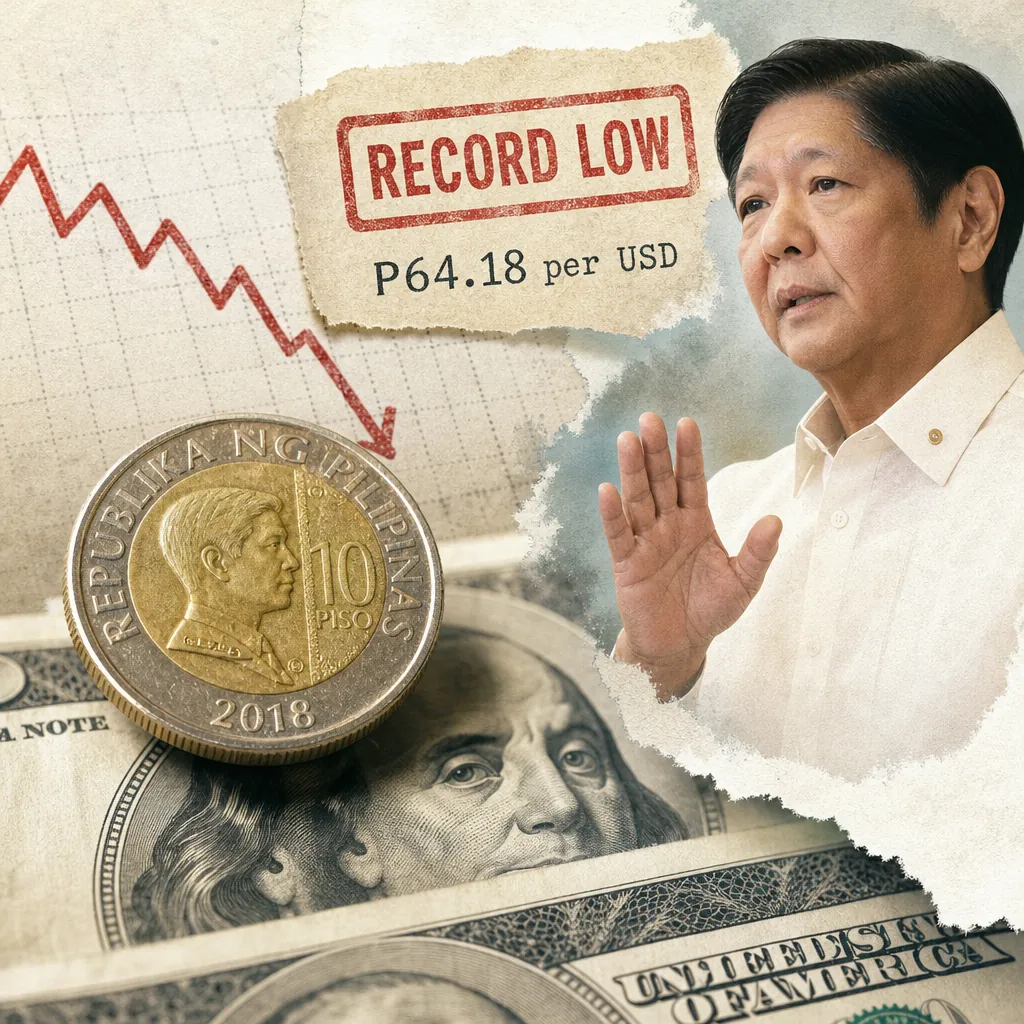
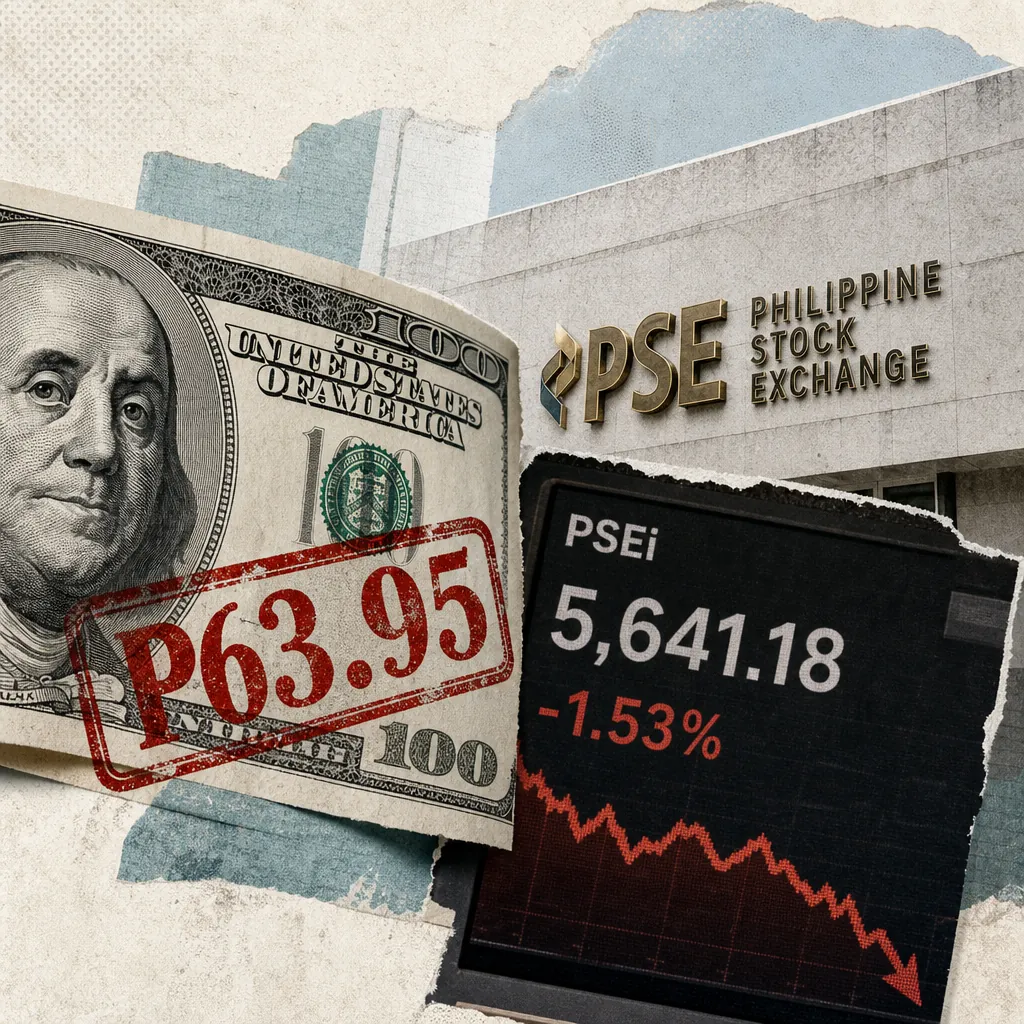
Around those two numbers sat the rest of the day's business news. The peso closed at ₱63.74 to the US dollar on Friday, 11 centavos stronger than Thursday's ₱63.85, its third consecutive day of gains and its strongest close since October 23 15. The Philippine Stock Exchange index (PSEi), the benchmark for the country's main listed companies, fell 25.23 points, or 0.44 percent, to 5,680.35, with all sectors ending lower and mining and oil leading the decline at 1.19 percent 4876. DoubleDragon Corp., the listed property company founded by Tony Tan Caktiong and Edgar Sia II, reported core net income of ₱3.91 billion for January to September, up 253.59 percent from ₱1.1 billion a year earlier, on core revenues of ₱20.78 billion 285279.
Away from the markets, the Office of the Ombudsman ordered the preventive suspension of five Department of Public Works and Highways (DPWH) engineers in Bulacan over three flood control projects worth ₱188.9 million, and police in Iligan City and the Zamboanga Peninsula reported separate seizures of suspected smuggled cigarettes 32484132. The day's coverage, as captured in the items reviewed here, ran heavily to online news items; the banking survey was the one story that several outlets picked up independently, which is the clearest signal in the set of what editors judged worth repeating.
Key themes
- 80.8% of banks expect unchanged credit standards for business loans in Q4. The BSP's loan officers survey found the share of banks expecting no change in enterprise lending rules rose from 71.2 percent in the third quarter to 80.8 percent for October to December, and the share expecting no change for household loans rose from 77.1 percent to 85.7 percent 1460.
- The peso gained for a third session to ₱63.74 per dollar. Friday's 11-centavo rise followed Thursday's close of ₱63.85 and put the currency at its strongest level since October 23, still well below the intraday record of ₱64.20 reached on October 27 15.
- The PSEi fell 0.44 percent to 5,680.35 as oil prices rose. Brent crude climbed 1.49 percent to $116.59 a barrel on Friday, and the index's mining and oil sector fell 1.19 percent, the steepest drop among sectors 4876.
- DoubleDragon's nine-month core profit rose 253.59 percent to ₱3.91 billion. Foreign currency revenues accounted for 59.03 percent of third-quarter core revenues, the first time overseas operations supplied the majority, driven by the Hotel101 Global expansion and a 680-room Madrid hotel 285279.
- The Ombudsman suspended five DPWH engineers over ₱188.9 million in Bulacan flood control projects. The five face charges of grave misconduct, serious dishonesty, and gross neglect of duty over 2024 projects in Baliwag, and were suspended without pay for up to six months 32484.
- Police seized about ₱18.45 million in suspected smuggled cigarettes in two separate operations. An Iligan City checkpoint yielded roughly ₱800,000 worth of cigarettes from a barangay rescue vehicle, while operations across the Zamboanga Peninsula netted ₱17.65 million 132.
- The Department of Education drew praise from a Harvard education dean over 2025 PISA results. Nonie Lesaux of the Harvard Graduate School of Education commended the Philippines' improvement at a forum in Bonifacio Global City, where Education Secretary Sonny Angara said the results affirm the department's policy direction 1680.
How the narratives stack
Dominant. The BSP loan officers survey is the story that traveled furthest in the items reviewed here. Four separate outlets — The Manila Times, Sunstar, BusinessMirror, and Daily Guardian — carried versions of the same set of figures, each with slightly different emphasis but the same core numbers 14376069. That repetition is the clearest marker of editorial weight in the set: a central bank survey is routine, scheduled, and easy to write from a press release, and outlets treat it as a reliable business-page staple. The peso and stock market stories also ran in multiple outlets, with The Manila Times, Daily Tribune, and Inquirer Plus each carrying a version of Friday's close 154876. Within the captured set, the financial-markets cluster is the largest single block of coverage.
Counter-narrative. The Ombudsman's suspension of the five DPWH engineers ran in three outlets — Inquirer, The Manila Times, and Philstar — and carried the most concrete accountability detail of the day: named officials, a peso figure, specific barangays, and specific charges 32484. It sits against the broader run of infrastructure and governance coverage, and it is the story in the set with the clearest consequence for ordinary people, since flood control projects in Bulacan protect communities that flood. It did not draw the same volume of pickup as the banking survey, but its details are more specific and its stakes are more direct.
Emerging. The smuggled-cigarette seizures in Iligan and Zamboanga are a recurring enforcement story rather than a one-day event. The Iligan interception involved a vehicle reportedly used for barangay rescue operations, which is the detail that makes it notable: a vehicle associated with emergency response was carrying contraband 1. The Zamboanga operation netted 102 master cases and 500 reams of illicit tobacco products across the peninsula 32. Both stories point to the same underlying trade, and both involve coordination with the Bureau of Customs, the agency responsible for collecting duties on imports and policing smuggling.
Under-covered. The escrow rule dispute between the Chamber of Real Estate and Builders Associations Inc. (CREBA) and the Department of Human Settlements and Urban Development (DHSUD) appeared in a single item in the set, a Cebu-datelined Philstar story 78. CREBA is warning that a new DHSUD requirement to place buyer payments in escrow — a locked account that holds money until conditions are met — could restrict developers' working capital and delay housing projects. The story has direct consequences for anyone buying a home, and it drew one item in the captured set. The DTI investment figures, which showed the Board of Investments approving ₱900.06 billion in investments from January to September, up 53.05 percent from the same period last year, also appeared in a single item 74.
Platform insights
The monitoring writeup for this window did not accompany the article set, so this section is limited to what the published items themselves show about how the stories traveled.
- Online news portals. Every item in the set ran online, and the banking survey was the only story that multiple outlets picked up independently, which suggests it was distributed through a shared press release or wire and rewritten by each outlet 14376069. The peso and stock market stories followed the same pattern, with three outlets carrying near-identical closing figures 154876.
- Specialist and regional outlets. Sunstar, a regional outlet, carried the banking survey with a Davao dateline, and Daily Guardian, a regional online publication, carried a version with more methodological detail, including the 55-of-60 response rate 3769. The CREBA escrow story ran in Philstar's Cebu business section, which is where regional property coverage tends to sit 78.
- Sports and lifestyle sections. The PBA Governors' Cup quarterfinals generated three separate game stories — Ginebra's 126-99 win over San Miguel, Converge's 130-125 win over Rain or Shine, and a Manila Times column on CPR training that used a Rain or Shine community event as its hook 427. The Michelin Guide Philippines awards generated two items, one on Helm retaining two stars and one on the wider 127-restaurant selection 1763.
Key voices and communities
Bank loan officers and the BSP. The survey is the central bank's own instrument, and the respondents are the loan officers who set credit standards at 55 of the country's 60 banks 69. Their collective view — that standards will hold steady and demand will strengthen — is the closest thing to a forward-looking read on credit access that the day produced. For a household or business thinking about borrowing in the last quarter of the year, the survey is the best available signal on whether the door is likely to stay open.
Property developers and CREBA. CREBA president Noel "Toti" Cariño argued that the escrow requirement is impractical because developers have already committed capital to land, permits, and architectural plans before applying for a license to sell 78. The group's framing is that the rule would tie up money developers need to build, and the counter-framing — that escrow protects buyers from developers who use their payments for other projects — is implicit in the DHSUD rule itself.
The Ombudsman and DPWH. The Ombudsman's statement named the five engineers and the charges, and the DPWH has not publicly responded in the items reviewed here 32484. The Ombudsman is the independent constitutional body that investigates and prosecutes public officials accused of wrongdoing, and a preventive suspension is not a finding of guilt — it removes an official from the post while the case proceeds, to prevent interference with the investigation.
Education officials and international assessors. Education Secretary Sonny Angara and Harvard Graduate School of Education dean Nonie Lesaux are the two named voices in the PISA story 1680. The Programme for International Student Assessment (PISA) is a global test of 15-year-olds in reading, mathematics, and science run by the Organisation for Economic Co-operation and Development; the Philippines has historically scored near the bottom, and the 2025 results showed the country as the fastest-improving nation in reading 80.
Narrative streams
Banks expect steady credit standards and stronger loan demand in Q4
The BSP's survey found that 80.8 percent of respondent banks expect enterprise credit standards to remain unchanged in October to December, up from 71.2 percent in the third quarter, and 85.7 percent expect household standards to hold, up from 77.1 percent 1460. Among the banks that do expect changes, the bias toward tightening has moderated, and a small share expects to ease standards 37. On the demand side, 69.2 percent of banks expect enterprise loan demand to remain steady or strengthen, and the survey's diffusion indexes — a measure that nets the share of banks expecting an increase against the share expecting a decrease — show that banks still lean toward tighter rules even as demand strengthens 69. Respondents cited uncertainty over the economic outlook, deterioration in borrower profiles, and lower risk tolerance as factors that could push standards tighter 37.
The read for the sector: for a business or household planning to borrow in the last quarter of 2026, the survey suggests the door is unlikely to close further, but it also suggests banks are not about to open it wide. The moderation in tightening bias matters most for borrowers on the margin — those with thinner credit histories or smaller collateral — because they are the ones most affected by small shifts in bank appetite. The survey is a poll of expectations, not a record of what banks actually did; the BSP's next round, covering the first quarter of 2027, will show whether the expectations held.
The peso gains for a third day while the stock index slips
The peso closed at ₱63.74 to the dollar on Friday, 11 centavos stronger than Thursday's ₱63.85, its third straight day of gains and its strongest close since October 23 15. The currency had hit an intraday record of ₱64.20 on October 27, so Friday's close is a recovery from that low, not a return to earlier levels 15. Michael Ricafort, chief economist at Rizal Commercial Banking Corp., attributed the recovery partly to reassurances from President Ferdinand Marcos Jr. 15. The BSP has said it is ready to intervene in the foreign exchange market to curb excessive volatility 15.
The stock index moved the other way. The PSEi fell 25.23 points, or 0.44 percent, to 5,680.35, with all sectors lower and mining and oil down 1.19 percent 48. Philstocks Financial Inc. attributed the retreat to higher oil prices amid fears of renewed US attacks on Iran after next week's US midterm elections, and to Houthi attacks on Saudi Arabia and incidents involving tankers struck by mines in the Strait of Hormuz 76. Brent crude rose 1.49 percent to $116.59 a barrel 48. Luis Limlingan, head of sales at Regina Capital Development Corp., said investors took profits after Thursday's gains and reduced exposure ahead of the long weekend 76. Turnover reached ₱12.73 billion, with foreign investors posting net outflows of ₱4.49 million 48.
The read for the sector: a stronger peso lowers the cost of imported fuel and goods, which is good news for consumers and for companies that buy inputs abroad, but the stock market's decline shows that investors are pricing in higher oil prices and geopolitical risk rather than celebrating the currency's recovery. For ordinary Filipinos, the more direct channel is fuel prices: Brent at $116.59 a barrel, if sustained, works its way into transport fares and electricity costs within weeks.
DoubleDragon's overseas hotels now supply most of its revenue
DoubleDragon reported core net income of ₱3.91 billion for January to September 2026, up 253.59 percent from ₱1.1 billion in the same period last year, on core revenues of ₱20.78 billion, up 143.65 percent 2852. Consolidated revenues rose 98.76 percent, and the company said the figures included no revaluation gains — meaning the profit came from operations, not from marking properties up in value 28. For the third quarter alone, net income was ₱1.13 billion, more than six times the ₱183.67 million recorded a year earlier 28. Foreign currency revenues accounted for 59.03 percent of quarterly core revenues, the first time overseas operations supplied the majority 5279. The company attributed the surge to Hotel101 Global, whose 680-room Madrid hotel opened fully sold out 5279.
The read for the sector: DoubleDragon's results are the clearest example in the day's coverage of a Philippine property company earning most of its money abroad, which insulates it from domestic interest rates and the peso but exposes it to the economies where its hotels operate. For investors, the absence of revaluation gains is the detail that matters — it means the profit is cash-generating rather than accounting-driven. For the broader property sector, the results show that the overseas hotel model is producing revenue at scale, which is the test the company's earlier promises had not yet met.
The Ombudsman suspends five DPWH engineers over Bulacan flood control projects
The Office of the Ombudsman ordered the preventive suspension without pay of five DPWH engineers assigned to the Bulacan First District: Irene Ontingco, Kevin Geronimo, John Michael Ramos, Bernardo Villafuerte, and Michelle Cruz 32484. The suspension runs for up to six months while administrative cases proceed 3. The charges are grave misconduct, serious dishonesty, and gross neglect of duty in connection with three flood control projects undertaken in 2024 — reinforced concrete slope revetments in Barangays Piel, San Roque, and Sulivan in Baliwag, worth ₱188.9 million 2484. The Ombudsman's investigation stemmed from allegations that the engineers falsified documents covering project implementation, inspection, acceptance, billing, and payment to make it appear that contractual and legal requirements had been met 24.
The read for the sector: flood control projects are the government's first line of defense for communities that flood every rainy season, and the allegation here is that the paperwork showing the work was done properly was falsified. A preventive suspension is not a conviction; it removes the officials from their posts while the case proceeds. For residents of the three barangays, the practical question is whether the revetments were built to specification, and the Ombudsman's investigation is the process that will answer it. For the DPWH, the case adds to a run of suspensions that have made the agency's project documentation a recurring subject of scrutiny.
Smuggled cigarettes seized in Iligan and Zamboanga
Police in Iligan City intercepted a white Hyundai H-100 at a checkpoint on Macapagal Highway in Barangay Suarez at about 4:55 p.m. on Thursday, October 29, after noticing the vehicle had no front license plate 1. The vehicle was reportedly being used for barangay rescue operations, and officers found around ₱800,000 worth of suspected smuggled Cannon cigarettes inside 1. The occupants were hesitant to say what they were carrying, which prompted the inspection 1. In a separate set of operations across the Zamboanga Peninsula on Wednesday, October 28, police netted ₱17.65 million worth of suspected smuggled cigarettes — 102 master cases and 500 reams — following tightened checkpoints and coordination with the Bureau of Customs 32.
The read for the sector: the two seizures point to the same trade moving through different routes — one through a checkpoint in Lanao del Norte, the other through the Zamboanga Peninsula — and the Iligan case is notable because the vehicle was associated with emergency response. For legitimate tobacco retailers and for the government, which collects excise tax on cigarettes, every case that moves through informal channels is revenue lost and a price advantage handed to sellers who skip the tax. The Bureau of Customs is the agency that assesses duties on imports; its coordination with police is what turns a checkpoint stop into a smuggling case.
DepEd draws international praise for PISA improvement
Harvard Graduate School of Education dean Nonie Lesaux praised the Philippines' 2025 PISA results at a forum organized by the Harvard Club of the Philippines Global at the Manila House Private Club in Bonifacio Global City 1680. The 2025 results showed the country as the world's fastest-improving nation in reading performance and among the top improvers overall, with scores rising across reading, mathematics, and science 80. Education Secretary Sonny Angara, who earned a Master of Laws degree from Harvard Law School, said: "We deeply appreciate Dean Lesaux and the global education community noticing the significant victories we are achieving on the ground. This recognition and our progress in the 2025 PISA affirm that our policy directions are starting to bear fruit" 16. He also said: "We see this as a clear mandate to work harder. Our goal is to ensure that every Filipino child is actually learning, comprehending and thriving" 80.
The read for the sector: PISA scores are a lagging indicator — they measure what 15-year-olds learned over years of schooling — so the 2025 improvement reflects changes that began well before the current administration. The praise is a morale boost for teachers and a talking point for the department, but the scores remain below the OECD average, and the gap between the fastest-improving nation and the top performers is still wide. For parents, the more useful question is whether the improvement shows up in day-to-day learning, which PISA cannot answer on its own.
A housing group warns that an escrow rule could delay projects
The Chamber of Real Estate and Builders Associations Inc. (CREBA) urged the government to reconsider a new DHSUD requirement that developers place buyer payments in escrow as a condition of a temporary license to sell (TLS) 78. CREBA president Noel "Toti" Cariño called the condition impractical, arguing that developers have already committed substantial capital to land acquisition, permits, and architectural plans before applying for authority to sell 78. "When you apply for a license to sell, it means you are already committed to the project," he said 78. The TLS is the permit that allows a developer to start selling units before a project is finished; escrow is a locked account that holds buyer money until the developer meets agreed conditions.
The read for the sector: the rule is a consumer-protection measure aimed at preventing developers from using buyer payments to fund other projects or to cover cost overruns, which is what happened in several high-profile housing failures. CREBA's objection is that the rule would tie up the working capital developers need to build. For homebuyers, the trade-off is between faster project delivery and protection against a developer who runs out of money; the DHSUD's revised guidelines are the mechanism that will decide where that balance lands.
Conversation trajectory
The BSP's next loan officers survey, due in the first quarter of 2027. The current survey measures expectations for October to December 2026; the next round will show whether banks actually held standards steady or tightened them despite saying they would not. Watch the enterprise figure in particular: if the share expecting unchanged standards falls back below 80 percent, it would suggest the moderation in tightening bias was temporary. Observation window: January to March 2027.
The peso's path against the dollar through the rest of the year. Friday's close of ₱63.74 was a third straight day of gains from the October 27 intraday record of ₱64.20 15. The BSP has said it will intervene to curb excessive volatility, and the central bank's next policy meeting and any statements on intervention will be the triggers to watch. A sustained move below ₱63.50 would suggest the recovery has legs; a return above ₱64 would suggest the record was a turning point rather than a spike. Observation window: the next four to six weeks.
Oil prices and the stock market. Brent at $116.59 a barrel is the variable most likely to move the PSEi in the near term, and the US midterm elections next week are the event that Philstocks Financial identified as the trigger for renewed concerns about Iran 76. Watch the mining and oil sector, which fell 1.19 percent on Friday, for signs of whether the decline is a one-day profit-taking move or the start of a longer slide. Observation window: the week of November 2 to 6.
The Ombudsman's investigation into the Bulacan flood control projects. The five engineers are suspended for up to six months, and the administrative cases will proceed during that period 324. The next signal will be whether the Ombudsman files formal charges or clears the engineers, and whether the DPWH announces a review of the three projects' actual construction. Observation window: the next three to six months.
The DHSUD escrow rule. CREBA's objection is the first public pushback on the revised guidelines, and the next signal will be whether the DHSUD adjusts the rule or holds firm 78. Watch for statements from DHSUD and from other developer groups; if more groups join CREBA, the rule could become a broader industry fight. Observation window: the next four to eight weeks.
Smuggled-cigarette enforcement. The Iligan and Zamboanga seizures are part of a continuing campaign, and the next signal will be whether the Bureau of Customs and police report additional interceptions in the same corridors 132. A run of seizures in a short period would suggest the trade is being disrupted; a quiet period would suggest the seizures were isolated. Observation window: the next four to six weeks.
Response guidance
Bank communicators: explain what steady standards mean for borrowers. The survey's headline is that most banks expect no change, which is easy to misread as "no credit available." The accurate message is that the door is not closing further and that demand is expected to strengthen. Pair the 80.8 percent enterprise figure with the 69.2 percent demand figure so the story reads as stability rather than stagnation 1469.
Property developers: address the escrow rule with specifics, not adjectives. CREBA's objection is that escrow ties up working capital, and the argument is stronger with numbers — how much capital is committed before a license to sell is granted, and how long escrow would hold buyer payments. Developers who explain the mechanics of project financing will be more persuasive than those who call the rule impractical 78.
DPWH and local government communicators: separate the suspension from the construction question. A preventive suspension is a personnel action, not a finding that the revetments are defective. Residents of the three Bulacan barangays will want to know whether the flood control structures are sound, and that is a separate question from the administrative case. Answer it directly 324.
Education communicators: pair the PISA praise with the remaining gap. The fastest-improving nation in reading is a genuine achievement, and it is also a statement about the starting point. Communications that lead with the improvement and then name the distance still to close will be more credible than either the praise alone or the caveat alone 80.
Police and customs communicators: give the seizure totals context. The Iligan and Zamboanga operations are separate cases, and presenting them as a single total without explaining the different routes and dates would overstate the connection. The Zamboanga figure of ₱17.65 million covers multiple operations across the peninsula on October 28; the Iligan figure of ₱800,000 is a single checkpoint stop on October 29 132.
Market communicators: keep the peso and the stock index in separate frames. The peso's third day of gains and the PSEi's 0.44 percent decline are not contradictory — they reflect different drivers, with the currency responding to central bank reassurance and the index to oil prices and geopolitical risk 1576. Presenting them as a single "markets" story would blur both.
See the full picture behind today's signals.
This report draws from Media Meter's MediaWatch, our real-time monitoring engine tracking 2,470+ Philippine sources across print, broadcast, digital, and social. Explore how the platform turns raw coverage into decision-grade intelligence, then see how it's configured for teams like yours — whether you're in PR agencies, corporate comms, government, or marketing.
Want more? Browse our Report Library for sector and crisis intelligence, or request a demo and we'll have your brand set up before the call.
Want this kind of intelligence on your brand?
This brief is built on the same MediaWatch methodology that runs continuously across every brand we monitor. See your competitive landscape, Impact Score, and narrative trajectory in a 30-minute demo.