Philippine bank and fintech users face service cuts, scams, and technical failures
A weekend of intense online discussion reveals growing frustration with credit card devaluations, digital banking outages, BNPL harassment, and fraud, as users seek community advice and weigh switching providers.
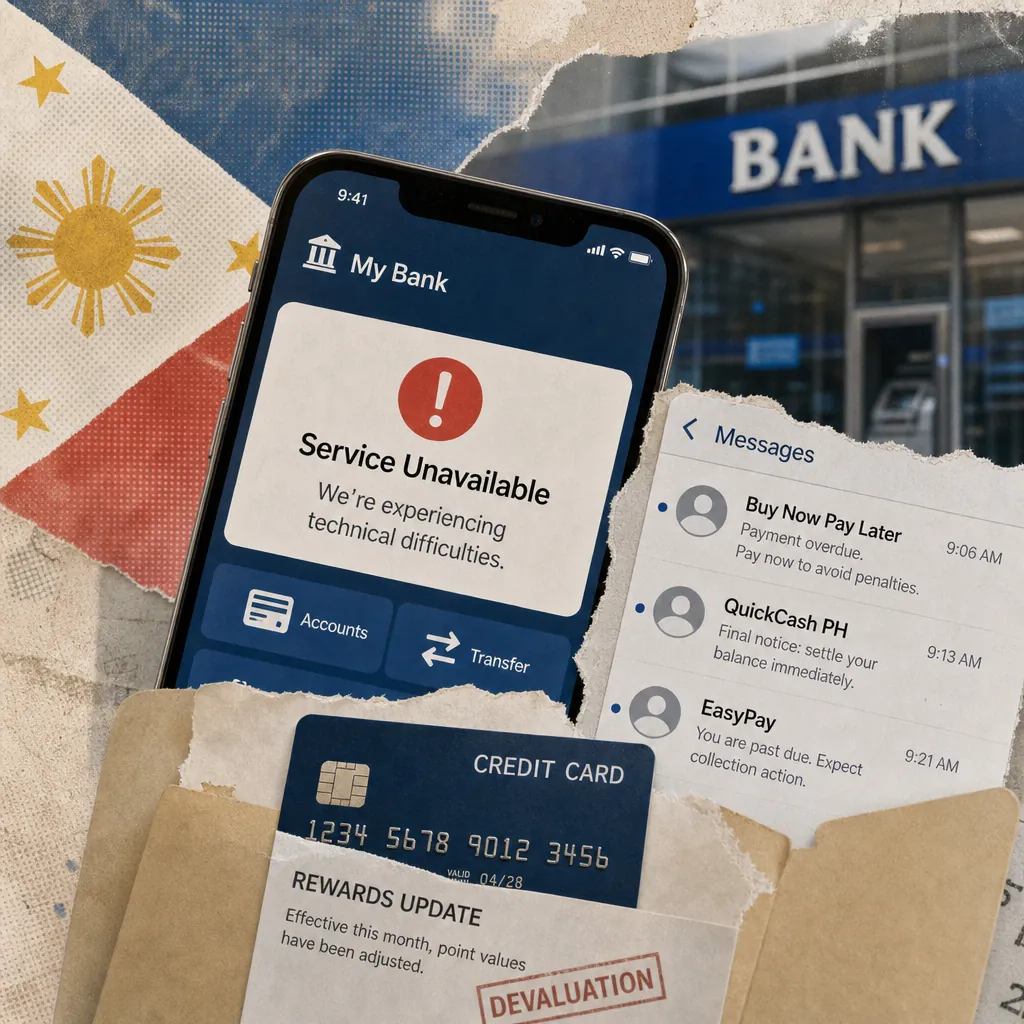
Over the weekend of June 20–21, 2026, Philippine bank and fintech users took to social media to share a wave of grievances, from credit card rewards cuts and failed transfers to aggressive debt collection and security breaches. The conversation, concentrated on Reddit and Facebook, reflected a deepening distrust in both traditional banks and digital financial services, as users compared experiences and sought advice on protecting their money.
The weekend’s catalyst was a post on the Facebook page kaskasanbuddies announcing that BDO Unibank would halve the air miles conversion rate for its American Express Platinum card starting July 1, 2026. The post quickly accumulated 38 likes, 11 shares, and six sad reactions, as cardholders realized their accumulated points would lose half their value for most airline partners. This sparked a broader discussion about credit card rewards and the value of banking perks, with users across Facebook and Reddit weighing in on whether to redeem now or reconsider their card strategy. By Sunday, the narrative had expanded into broader questions about priority banking benefits, alternative digital savings accounts, and growing frustrations with customer service and fraud incidents across multiple institutions.
Conversation snapshot. The weekend’s conversation was driven by a handful of high-engagement posts. The BDO AmEx devaluation post on Facebook drew 38 likes and 11 shares, with six sad reactions indicating genuine user distress. On Reddit, a post about a UnionBank credit card activation failure—where the user could not receive one-time passwords (OTPs) or reach a live agent—received 13 upvotes and 17 comments, with many echoing frustrations about automated support. A positive post showing a user’s collection of digital bank cards (GCash, MariBank, GoTyme) garnered 113 upvotes and 20 comments, celebrating the “adulting” milestone. However, a thread about repeated BIN attacks on GoTyme accounts earned 10 upvotes and 5 comments, with users sharing experiences of unauthorized deductions. Posts about Atome buy-now-pay-later (BNPL) debt and aggressive collection threats attracted 3 likes but 21 comments, indicating high engagement around a sensitive topic. Overall, Reddit was the primary platform for in-depth discussion, while Facebook served as an announcement channel with lower engagement.
Key themes
- Credit card rewards devaluation and program changes — The BDO AmEx points cut dominated early conversation, with users expressing urgency to redeem before the July 1 deadline. This triggered broader scrutiny of loyalty programs across issuers, with users comparing perks and questioning the long-term value of holding premium cards.
- Digital banking strategies and savings allocation — Users actively compared digital banks (Maya, GoTyme, MariBank) for emergency funds and savings, seeking the best interest rates and features. Positive posts about achieving savings goals contrasted with concerns about security and reliability.
- Escalating BNPL and loan collection issues — Atome and GGives users reported overdue debts, aggressive collection calls, and threats of field visitation. Many felt trapped by high interest and opaque terms, seeking community advice on how to handle collectors and repair credit scores.
- Banking outages, transfer failures, and customer service breakdowns — Multiple reports of failed transfers between Maya, BDO, GCash, and BPI to MariBank highlighted systemic reliability issues. Users also complained about rigid bank policies, such as Security Bank closing a debit account after a single missed payment due to delayed salary.
- Fraud and security warnings — GoTyme users reported repeated BIN attacks (where fraudsters use automated tools to guess card details) and unauthorized deductions. A separate post about a woman losing RM6,000 to an online scam had limited engagement but added to the atmosphere of caution.
- Regulatory and policy signals — The Bangko Sentral ng Pilipinas (BSP) extended relief to banks hit by bond yield surges, waiving mark-to-market requirements for government securities held until maturity. The Securities and Exchange Commission (SEC) called for balanced rules that promote innovation while protecting consumers. These developments signal a regulatory environment attentive to both industry stability and consumer protection.
- Macroeconomic pressures — The Philippines’ balance of payments swung to a surplus in May, but the year-to-date deficit remained wide. Inflation stayed elevated, with Cebu posting the highest rate at 13.6%. The BSP is expected to continue hiking rates, with some analysts forecasting two more 25-basis-point increases this year.
How the narratives stack
Dominant narrative — The weekend’s dominant story is that Philippine bank and fintech users are increasingly frustrated with service cuts, technical failures, and poor customer support. The BDO AmEx devaluation served as a flashpoint, but the conversation quickly expanded to encompass a broader sense that both traditional banks and digital financial services are failing to meet user expectations. Users are actively comparing options and seeking community advice, indicating a market in flux where loyalty is eroding.
Counter-narrative — Despite the grievances, there is a persistent undercurrent of optimism about digital banking. Posts celebrating savings goals and the convenience of multiple digital wallets show that many users are enthusiastic about the possibilities of digital finance. The excitement about GCash’s potential initial public offering (IPO) and the positive sentiment around new features like Google Pay integration for PNB cards suggest that innovation still attracts attention and goodwill.
Emerging narrative — A growing focus on fraud and security is emerging as a major concern. The GoTyme BIN attack reports and the broader discussion about unauthorized transactions indicate that users are becoming more aware of digital risks and are demanding better protection. This narrative is likely to intensify as more users share their experiences and seek guidance on securing their accounts.
Suppressed narrative — The role of regulatory and macroeconomic factors in shaping the user experience is under-covered in the conversation. While the BSP’s rate hikes and the balance of payments data are reported in the news, users rarely connect these macro forces to the specific service issues they face, such as transfer failures or card devaluations. The link between inflation, interest rates, and bank profitability—and how that trickles down to rewards cuts and fee increases—remains largely unexplored in user discussions.
Platform insights
Facebook — The weekend’s conversation started here with the BDO AmEx devaluation post, which served as the initial catalyst. However, Facebook engagement remained relatively low, with only a handful of posts and limited comment threads—mostly questions about scam legitimacy and basic account queries. The platform served as an announcement channel rather than a discussion hub. The emotional reactions (sad, haha) on the BDO post indicate that Facebook users express sentiment through reactions more than comments.
Reddit — Reddit became the primary arena for in-depth analysis and personal experience sharing across multiple subreddits. The timeline shows a clear evolution from Saturday’s excitement over digital banking strategies to Sunday’s growing concerns about BNPL debt, security breaches, and customer service failures. Reddit users provided detailed, emotionally charged accounts that shaped the narrative’s trajectory, with high upvote counts on positive posts about savings goals (113 upvotes) contrasting with frustrated threads about bank policies (13–26 upvotes). The platform’s threaded comment structure allowed for extended discussions and community advice-giving.
Twitter — The platform saw minimal activity, limited to a single user query about GCash quit claim forms and a generic automated reply from GCash’s official account. This suggests that Twitter is not a significant venue for these conversations among this dataset, or that the content captured was only a small slice. The lack of real-time customer service engagement on Twitter is notable, given that many brands use it as a support channel.
Key voices and communities
- Traditional bank credit card holders — This community is highly active on Reddit and Facebook, with discussions focusing on rewards programs, customer service failures, and application experiences. Posts about BDO’s Amex points devaluation garnered 38 likes and 11 shares, while a thread on BPI’s shared credit limit received 5 likes and 14 comments, indicating strong engagement around policy changes and service gaps. The group also surfaces complaints about UnionBank’s inability to activate cards due to OTP failures and PNB’s weeks-long application silences, reflecting widespread frustration with onboarding processes. Primary narrative: These users compare perks across banks and prioritize rewards optimization, yet many express disillusionment with opaque terms and poor support when issues arise.
- Digital banking and e-wallet users — Across Reddit, Twitter, and Facebook, this diverse community discusses savings strategies, transfer failures, service outages, and security concerns related to GCash, Maya, GoTyme, and MariBank. A thread comparing digital banks for emergency funds drew 0 likes but 9 comments, while a user’s frustration over a 3-day BPI-to-MariBank transfer glitch generated 1 like and 5 comments. The group also reports BIN attacks on GoTyme accounts, with 10 upvotes and comments urging account closure as a protective measure. Primary narrative: Users juggle multiple digital wallets to maximize interest rates and cash-in limits, but transaction reliability issues and scam vulnerabilities undermine confidence.
- Buy Now Pay Later (BNPL) debtors and concerned users — Posts about Atome and GGives dominate this emotionally charged sub-community, with users sharing experiences of overdue balances, aggressive collection calls, and forced payment plans. An Atome overdue thread garnered 3 likes but 21 comments, while another about a 1-year-old 3k peso debt seeking advice on credit recovery had 1 like and 2 replies. These users often feel trapped by high interest and opaque terms, with some plotting to delete the app and stop payments altogether. Primary narrative: Many entered BNPL agreements without full awareness of penalties, and now face harassment from collectors—including threats of field visitation—while struggling to regain financial control.
- Fraud and scam awareness seekers — A cross-platform group of scam victims and cautious users share warnings about BIN attacks, unauthorized transactions, and phishing attempts targeting digital banks and cards. A GoTyme user reporting recurring unauthorized deductions even after not funding the account received 10 upvotes and 5 comments, while a Facebook post about a woman losing RM6,000 to an online scam garnered 8 likes and shares. These conversations often lack resolution, with victims seeking procedural guidance that banks rarely provide publicly. Primary narrative: Users feel ill-equipped to protect themselves and frequently blame both scammers and platform security gaps, calling for more proactive alerts and easier account freezing mechanisms.
Narrative streams
BDO AmEx points devaluation sparks rewards scrutiny
The weekend’s conversation began with a Facebook post from kaskasanbuddies revealing that BDO would halve the air miles conversion rate for its American Express Platinum card starting July 1, 2026. The post detailed the new rates: for most airline partners, the conversion would drop from 1:1 to 2:1, meaning cardholders would need twice as many points to get the same miles. The post also noted that hotel rewards and lounge access would remain unchanged. The announcement triggered immediate urgency, with users asking how to redeem points before the deadline and whether the card was still worth keeping. The post accumulated 38 likes, 11 shares, and six sad reactions, indicating genuine user distress. This sparked a broader discussion on Reddit about credit card rewards, with users comparing the value of different cards and questioning the long-term viability of loyalty programs. The conversation highlighted a growing expectation that banks must communicate changes transparently and offer clear guidance on how to maximize benefits before they are cut.
Digital banking reliability and security concerns
A recurring theme throughout the weekend was the reliability of digital banking services. Multiple users reported failed transfers between platforms: one user asked “IS GCASH DOWN?” after transfers from Maya and BDO to GCash failed, while another shared that their BPI-to-MariBank transfer had been stuck for three days, with the app showing no progress and nearby ATMs also down. These posts, though low in likes, generated comments from users sharing similar experiences, indicating a systemic issue with interbank transfers during the weekend. Security concerns were also prominent: a Reddit user reported repeated BIN attacks on their GoTyme account, saying they ignored them because they didn’t keep money in the account, but when they did deposit, funds were automatically deducted. This post earned 10 upvotes and 5 comments, with users sharing their own experiences and advising account closure. The juxtaposition of excitement about digital banking (a post showing a user’s collection of digital bank cards received 113 upvotes) with these security and reliability issues created a complex narrative of both opportunity and risk.
BNPL debt and aggressive collection practices
Discussions around Atome and GGives were overwhelmingly negative and escalated throughout the weekend. On Saturday, a user posted about being overdue on their Atome card for one month, noting that spam calls and texts had suddenly stopped, which made them “overthink kung bat di na sila nag cocontact.” By Sunday, another user reported receiving a “field visitation” threat from Atome over a 1,200 peso debt, asking for advice on how to handle them. A third user admitted to being one year overdue on a 3,000 peso Atome debt, now interested in fixing their credit score. The thread revealed a pattern: users perceive BNPL providers as aggressive and stressful, and many are looking for a way out. A separate incident involving GGives—where a user accidentally made a duplicate payment at a store due to a floating transaction—added to the sentiment that digital lending features are unreliable. These stories attract rapid comment threads (10–20 responses each) with shared experiences and advice, signaling a growing community demand for stricter regulation of lending apps.
Macroeconomic and regulatory backdrop
While user conversations focused on personal experiences, the broader macroeconomic and regulatory context shaped the environment in which these issues occurred. The Bangko Sentral ng Pilipinas (BSP) extended relief to banks hit by bond yield surges, waiving mark-to-market requirements for government securities held until maturity. This move helps banks manage paper losses but also signals that the central bank is attentive to financial stability risks. The Securities and Exchange Commission (SEC) called for balanced rules that promote innovation while protecting consumers, emphasizing that financial inclusion requires a regulatory environment that allows legitimate institutions to innovate while ensuring consumer protection. Meanwhile, the Philippines’ balance of payments swung to a surplus in May, but the year-to-date deficit remained wide at $7.28 billion. Inflation stayed elevated, with Cebu posting the highest rate at 13.6%, driven by food prices. The BSP is expected to continue hiking rates, with some analysts forecasting two more 25-basis-point increases this year, bringing the policy rate to 5.25%. These macro factors—higher interest rates, inflation, and geopolitical tensions—directly impact bank profitability and, by extension, the rewards and fees they offer to consumers.
Conversation trajectory
The weekend’s conversation signals several developing trends that will shape the Philippine digital finance landscape over the coming weeks and months.
Shift from rewards accumulation to devaluation backlash (next 2–3 weeks): The BDO AmEx points conversion rate cut, effective July 1, 2026, has triggered immediate urgency among cardholders to redeem before the deadline. The high emotional engagement (multiple “sad” reactions and shares) indicates this topic will fuel broader scrutiny of loyalty program value across all issuers. Expect discussion to expand to other banks’ reward structures within 2–3 weeks, creating pressure on brands to justify their programs or announce improvements.
Intensification of BNPL harassment and regulatory call-outs (next 30–45 days): Atome-related posts about overdue payments, aggressive collection tactics (field visits, spam calls), and unauthorized auto-enrollment into payment plans are proliferating across Reddit. These stories attract rapid comment threads (10–20 responses each) with shared experiences and advice, signaling a growing community demand for stricter SEC enforcement on lending apps. This trend will likely peak within 30–45 days as more users share collection experiences, especially if a high-profile case gains media traction.
Technical reliability fatigue driving multi-wallet diversification (next quarter): Multiple reports of GCash transaction failures—floating payments, failed transfers from Maya and BDO, and app glitches—are eroding trust in single-wallet dependency. Concurrently, users are actively comparing digital banks (GoTyme, MariBank) for savings and emergency funds, with emerging debate on transfer issues between BPI and MariBank. Over the next quarter, expect a measurable shift toward spreading balances across 2–3 platforms to mitigate outage risk and optimize interest rates.
Security concerns moving from phishing to account-level fraud (next 1–2 months): The persistence of GoTyme BIN attacks and unauthorized deductions, along with a reported RM6,000 online scam, is pushing conversations from general awareness to specific account closure procedures. Users are increasingly sharing steps to close accounts and disputing unauthorized transactions, which will likely accelerate demand for stronger e-KYC and real-time fraud alerts from all digital finance providers within the next 1–2 months.
Key trigger events that will reshape this conversation include: the BDO AmEx conversion deadline on July 1, 2026, which could spark a last-minute redemption frenzy and post-devaluation complaints; the upcoming BSP circular on fair debt collection practices (expected Q3), which may amplify calls for regulatory action on BNPL lenders; and any major GCash or Maya service outage coinciding with a payday cycle, which would severely test user loyalty and accelerate multi-wallet adoption.
Response guidance
For communicators in the Philippine financial sector, the weekend’s conversation offers clear signals on how to navigate user frustrations and build trust.
Platform approaches: On Facebook, proactively communicate upcoming policy changes with clear, plain-language infographics and deadline reminders, as demonstrated by the BDO AmEx points devaluation post which generated high engagement and emotional reactions. Provide a direct link to a dedicated FAQ page and offer a one-on-one chat support option for cardholders with accumulated points. Monitor and rapidly respond to scam-related posts by sharing official scam advisories and tagging authoritative sources like the BSP or PNP Anti-Cybercrime Group. Use a non-alarmist tone that reinforces user vigilance without blaming victims. On Reddit, establish a verified official account (e.g., “BPI_Cares” or “GCash_Help”) to engage directly in threads about service failures and product confusion. Focus on acknowledging the issue, providing a timeline, and moving sensitive details to DMs. Create a stickied megathread titled “Digital Bank Comparison & Tips” to consolidate recurring questions about GoTyme vs. Maya vs. MariBank for savings, emergency funds, and credit cards. For posts about BNPL delinquency and collection practices, respond with empathy and clear steps for restructuring or hardship programs—avoid confrontational or threatening language. On Twitter, maintain a dedicated support handle that replies publicly to common issues like app force closes or missing quit claim forms. Keep responses brief, actionable, and include direct links to help articles or ticket submission. Use pinned tweets or a status page to communicate real-time service disruptions with estimated resolution times.
Key messages: “We are committed to transparent communication about changes that affect your rewards or fees, and we provide clear instructions and timelines so you can make informed decisions.” “Your security is our priority. If you encounter suspicious transactions or BIN attacks, report immediately—we have zero-liability policies and dedicated response teams to resolve issues quickly.” “We hear your frustration about customer service wait times and automated loops. We are actively expanding live agent channels and simplifying verification processes to get you help faster.” “When comparing digital banks vs. traditional banks, consider your goals: high-interest savings for emergency funds, convenient daily transactions, and relationship-building for future loans. No single option fits all needs.” “Responsible borrowing includes understanding repayment terms. If you face financial hardship, contact us early—we offer flexible payment arrangements before collections escalate.”
Sensitive topics to navigate: Customer service accessibility is a major pain point—many users report being stuck in automated menus or unable to reach a live agent. Avoid generic apologies; instead, acknowledge specific pain points and share concrete improvements underway (e.g., callback feature, expanded chat hours). Debt collection practices are another sensitive area—threads about Atome OD and field visitation indicate that users feel harassed and fear escalation. Responses must balance legal collection rights with compassion—do not threaten or shame, and always provide clear options for repayment negotiation. Shared credit limits and double annual fees are also a concern—a BPI 2nd card user discovered shared limits only after a declined merchant transaction, causing embarrassment. Any communication about multiple cards should prominently disclose shared limits and annual fee structures upfront, not buried in fine print.
Response priorities: First, address the BDO AmEx Platinum points devaluation proactively. Issue an official statement with a simple comparison table (current vs. new rates) and step-by-step redemption guide before July 1. Timely action prevents negative viral sentiment and positions the bank as user-focused. Second, fix the first-time credit card activation and OTP delivery gaps. UnionBank and PNB applicants are stuck without a working activation channel. Prioritize a manual override process (e.g., video call verification) and update out-of-date contact emails. This directly reduces negative social media volume. Third, launch a security awareness campaign around BIN attacks and phishing. Multiple GoTyme users reported unauthorized deductions and account closures. Create a multilingual microsite with “STOP. THINK. CONFIRM.” checklist and integrate it into the app’s login flow.
See the full picture behind today's signals.
This report draws from Media Meter's MediaWatch, our real-time monitoring engine tracking 2,470+ Philippine sources across print, broadcast, digital, and social. Explore how the platform turns raw coverage into decision-grade intelligence, then see how it's configured for teams like yours — whether you're in PR agencies, corporate comms, government, or marketing.
Want more? Browse our Report Library for sector and crisis intelligence, or request a demo and we'll have your brand set up before the call.
Want this kind of intelligence on your brand?
This brief is built on the same MediaWatch methodology that runs continuously across every brand we monitor. See your competitive landscape, Impact Score, and narrative trajectory in a 30-minute demo.