Philippine banks face fraud fears, rate hike dilemma
A day when a viral phishing scam warning on Reddit collided with central bank signals on interest rates, weak foreign investment data, and bank earnings reports, revealing a sector balancing consumer protection with growth.
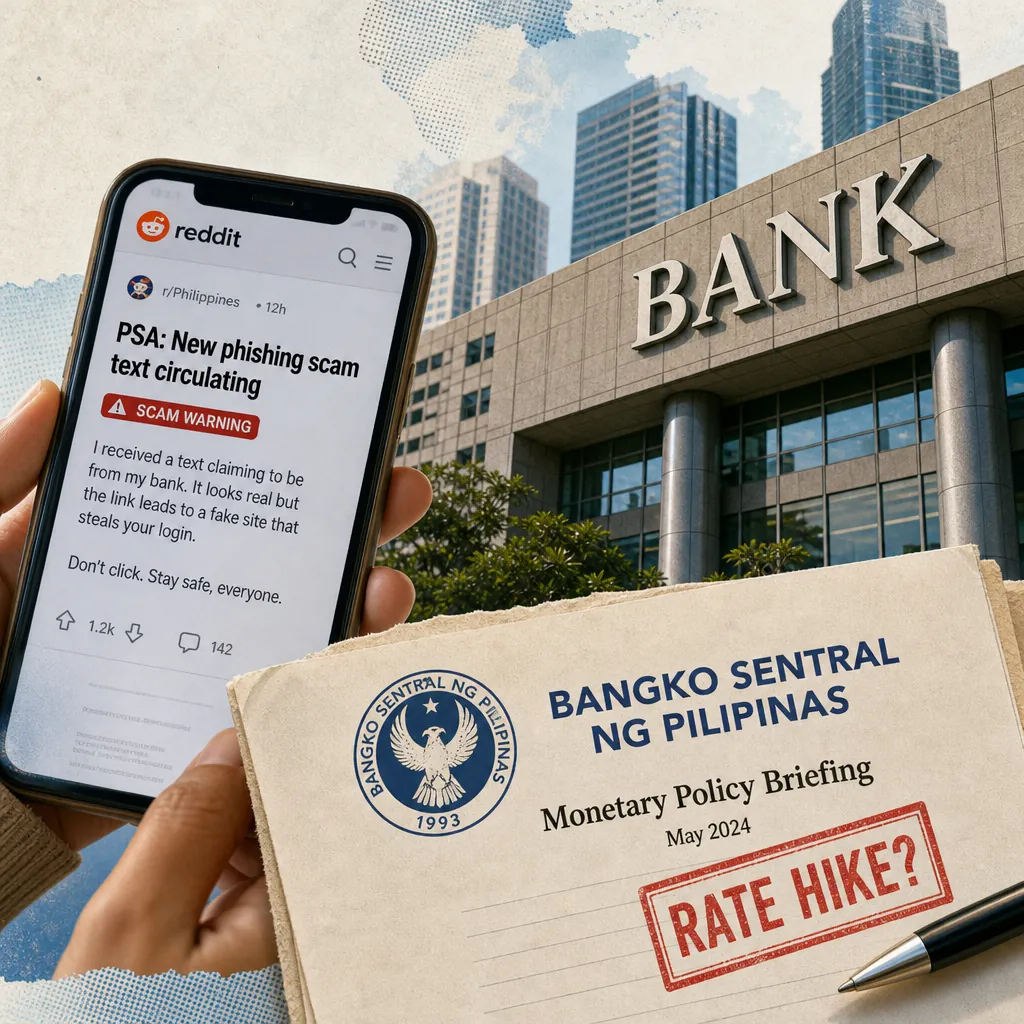
The day's conversation in [Philippine banking](https://media-meter.com/report-library/fitch-flags-rising-bad-loans-at-philippine-banks "Fitch warns of rising bad loans as bsp tightens digital security and gcash ipo l") and finance was a study in contrasts. On one side, a detailed Reddit post about a sophisticated phishing scam—a fake MMDA website demanding a traffic violation payment—drew 26 comments as users shared their own near-misses and warned about the dangers of entering one-time passwords (OTPs) without checking the amount. On the other, the Bangko Sentral ng Pilipinas (BSP) signaled it might hold off on further interest rate hikes after weak economic growth, while state-run Landbank projected modest income growth despite fee waivers, and foreign direct investment (FDI) inflows hit an 11-year low. The juxtaposition was stark: consumers were anxious about digital security, while institutions were navigating a fragile economic recovery and trying to project stability.
The Reddit post, which appeared twice on the platform, described how a user was directed to a fraudulent website mimicking the Metropolitan Manila Development Authority (MMDA), the government agency that handles traffic enforcement. The site requested a Php 1,000 payment for a supposed traffic violation, then prompted for an OTP that would have authorized a transaction of HKD 37,752 (about Php 270,000). The user caught the discrepancy in the OTP message—the amount was in Hong Kong dollars, not pesos—and immediately blocked their credit card and reported the incident. The post's 26 comments reflected a community eager for practical advice on verifying OTP details and recognizing phishing sites. This consumer-driven narrative generated far more organic engagement than any institutional announcement that day, underscoring a growing public concern about the safety of digital payments.
Meanwhile, the news media was dominated by a different set of stories. The BSP's Governor Eli Remolona Jr. told reporters that the weaker-than-expected second-quarter GDP growth (2.3%, down from 2.8% in Q1) had reduced the pressure to raise interest rates, though he kept all options on the table for the August 27 Monetary Board meeting. This was a significant shift, as inflation had been running above target, prompting two rate hikes earlier in the year. At the same time, data showed FDI net inflows plunged 64.7% year-on-year to $210 million in May, the lowest since March 2015, reflecting investor caution amid geopolitical tensions and domestic uncertainties. These stories, covered extensively across major outlets like the Inquirer, BusinessWorld, and Manila Times, painted a picture of an economy struggling to gain momentum.
In the corporate sphere, Bank of Commerce (BankCom) reported a 13% rise in first-half net income to P2.11 billion, driven by strong core lending and foreign exchange gains. Landbank, the state-owned lender, saw its net income fall 10.21% to P24.21 billion in the first half, but its president, Lynette Ortiz, said the bank was aiming for low single-digit growth by year-end, partly by expanding loans to farmers and micro, small, and medium enterprises (MSMEs). The bank also noted it was absorbing the impact of waiving fees on person-to-person transfers via InstaPay and PESONet, a move aligned with the BSP's push for financial inclusion. These earnings reports offered a counterpoint to the broader economic gloom, suggesting that individual institutions were still finding ways to grow.
The day's conversation, therefore, was not a single story but a convergence of several: consumer anxiety about fraud, central bank policy dilemmas, weak investment flows, and resilient corporate earnings. For an ordinary reader, the key takeaway is that Philippine banking is at a crossroads—trying to protect customers from increasingly sophisticated scams while also navigating an economic environment that is both inflationary and slow-growing. The Reddit scam, in particular, highlighted a vulnerability that could undermine trust in digital banking if not addressed proactively.
Key themes
- Phishing scams targeting government portals: A Reddit user's detailed account of a fake MMDA website demanding payment for a traffic violation, which nearly led to a fraudulent HKD 37,752 charge, dominated social conversation. The post's 26 comments showed high engagement and a community eager for fraud prevention tips.
- BSP rate hike dilemma: Governor Eli Remolona Jr. said weak Q2 GDP growth (2.3%) had eased pressure to raise interest rates, but he kept all options open for the August 27 meeting. Inflation at 6.2% in July remained above the 2-4% target, complicating the decision.
- Foreign direct investment at 11-year low: Net FDI inflows fell to $210 million in May, down 64.7% year-on-year, the lowest since March 2015. Analysts attributed the decline to geopolitical tensions, trade uncertainties, and domestic policy concerns.
- Bank earnings resilience: BankCom reported a 13% rise in H1 net income to P2.11 billion, while Landbank saw a 10.21% decline but aimed for growth by year-end. These results showed that some banks were weathering the economic headwinds.
- Landbank's fee waiver balancing act: The state bank waived fees on InstaPay and PESONet transfers starting July 7, cutting into income, but it is expanding lending to farmers and MSMEs to offset the loss. This reflects a tension between developmental mandates and profitability.
- Consumer complaints on the rise: The BSP reported a 72.6% increase in consumer complaints in 2025, reaching over 120,000, driven by greater awareness and digital platform use. This trend underscores the need for stronger consumer protection.
- AI in banking: The BSP held its AI Summit 2026, with Governor Remolona emphasizing the need for strong governance to manage AI risks while harnessing its benefits for fraud detection and credit scoring.
- Digital payments growth: GCash's GLoan campaign won awards at the YouTube Works Awards, highlighting the growing role of digital lending and the importance of user engagement in financial services.
How the narratives stack
Dominant: The dominant narrative in the captured set is the economic slowdown and its implications for monetary policy. The BSP's signals on rate hikes, the weak GDP data, and the FDI plunge were covered extensively across major news outlets, with multiple articles on each topic. This narrative is dominant because it has the most significant consequences for the broader economy and financial sector, affecting borrowing costs, investment, and consumer confidence. Within the captured set, these stories account for a substantial share of the coverage value, reflecting their prominence in the news cycle.
Counter-narrative: The counter-narrative is the resilience of individual banks. BankCom's profit growth and Landbank's efforts to expand lending despite fee waivers offer a more optimistic view, suggesting that well-managed institutions can still thrive even in a challenging environment. This narrative is present in the earnings reports and provides a balance to the gloomy macroeconomic headlines.
Emerging: The emerging narrative is the rising threat of digital fraud and the need for consumer protection. The Reddit scam post, while not heavily covered in traditional media, generated significant social engagement and points to a growing public concern that could shape regulatory and corporate priorities. The BSP's data on rising consumer complaints and its emphasis on AI for fraud detection are early signals of this trend.
Suppressed: The under-covered story is the impact of the Middle East crisis on the Philippine economy. While mentioned in passing in several articles, the full extent of how the Strait of Hormuz dispute and rising oil prices are affecting inflation, trade, and investment is not deeply explored. This is a significant omission, as geopolitical tensions are a key driver of the economic uncertainty that dominates the day's news.
Platform insights
- Reddit: The platform was the epicenter of consumer fraud discussions. The phishing scam post, appearing twice, drew 26 comments, with users sharing personal experiences and advice. The threaded format allowed for in-depth dialogue, making Reddit the go-to space for detailed security concerns. This contrasts sharply with the low engagement on institutional posts elsewhere.
- Facebook: Institutional news, such as Landbank's income growth projection, received minimal engagement—just a few 'love' reactions and likes, with no comments or shares. Branded content like BDO Life's Father's Day post also struggled, getting only one like and one share. This suggests that Facebook users are not actively engaging with corporate announcements, possibly due to algorithm changes or audience fatigue.
- Twitter: The Landbank news tweet garnered 1,652 views but zero engagement, indicating passive readership. Twitter's real-time nature means that breaking news like the FDI data or BSP comments might have generated more discussion, but the captured set shows little interaction on institutional posts. This platform may be more useful for monitoring sentiment than for driving engagement.
- YouTube: While not directly part of the day's social monitoring, the YouTube Works Awards highlighted GCash's successful GLoan campaign, which used a catchy jingle to promote free health insurance. The campaign's metrics—daily active users up 14.5%, disbursements up 36.7%—show the power of video content in driving financial product adoption, a lesson for other institutions.
Key voices and communities
- Retail banking consumers and fraud victims: This group, active on Reddit, is the most influential in shaping the fraud narrative. Their firsthand accounts of scams and their calls for vigilance resonate deeply with peers, making them critical early-warning signals for emerging threats. They are not organized but are highly reachable through community platforms.
- State-owned financial institution commentators: These are industry watchers and analysts who track the performance of government banks like Landbank. They operate on Twitter and Facebook, framing institutional credibility and public confidence. Their conversations are more corporate and less emotional, focusing on growth projections and strategic outlooks.
- Insurance and wealth-building content promoters: Brands like BDO Life use Facebook to push aspirational messaging that ties family values to financial planning. While their engagement is low, they represent a channel for reinforcing brand trust and emotional connection with consumers, particularly around life insurance and legacy building.
- Economic analysts and market commentators: Figures like Jonathan Ravelas of Reyes Tacandong & Co. and Ruben Carlo Asuncion of UnionBank provide expert commentary on FDI and economic trends. Their quotes are widely used in news articles, shaping the narrative around investor caution and policy uncertainty.
- Central bank officials: Governor Eli Remolona Jr. is a key voice, as his statements on rate hikes and AI governance are closely followed. His remarks are often the lead in financial news, and his tone—cautious but open—sets the market's expectations.
Narrative streams
The phishing scam that exposed digital payment vulnerabilities
The Reddit post about the fake MMDA website was the day's most engaging social story, and it carries significant implications for the banking sector. The scam's design—mimicking a government agency and offering multiple payment methods including online banking, GCash, and credit cards—exploits the convenience that digital payments advertise. The victim's near-miss, where the OTP revealed a HKD amount instead of pesos, became a teachable moment. Commenters emphasized that legitimate transactions always show the expected amount in the OTP message, and the user's decision to block the card and report the incident was praised as best practice.
For banks, this story is a double-edged sword. On one hand, it highlights the reputational risk of having their payment channels used in scams. On the other, the victim's account praised the bank's handling—the transaction did not push through, and the card was permanently blocked—offering a positive example of fraud response. The lack of negative comments toward the bank suggests that consumers differentiate between the scammer's deception and the bank's protective measures. This is an opportunity for banks to amplify their fraud prevention protocols and educate customers on verifying OTP details.
The story also points to a broader trend of cross-border fraud attempts, as the fraudulent charge was in Hong Kong dollars. This suggests that scammers are targeting Filipino consumers with international transactions, which may require enhanced monitoring and customer education. The BSP's data on rising consumer complaints—up 72.6% in 2025—indicates that such incidents are becoming more common, and the central bank's efforts to promote financial literacy and consumer protection are timely.
BSP's rate hike dilemma: balancing inflation and growth
The BSP's monetary policy is at a critical juncture. Inflation slowed to 6.2% in July, easing for a third straight month after hitting a three-year high of 7.2% in April. This prompted the BSP to raise rates twice this year. However, GDP growth slowed to 2.3% in Q2, well below the government's revised target of 3.5-4.5% for 2026. Governor Remolona's comments on Monday—that the weak growth had reduced pressure to hike—signal a possible pause at the August 27 meeting.
This is a delicate balancing act. Raising rates further could dampen an already sluggish economy, but not raising them risks letting inflation stay above the 2-4% target. Remolona noted that core inflation, which strips out volatile items, showed some moderation, but he cautioned that one data point does not make a trend. The market's reaction was mixed: the PSEi slipped 0.02% to 6,289.21, while the peso strengthened to P60.705 per dollar, helped by a weaker US dollar after soft US jobs data.
The Treasury's successful T-bill auction, where rates dropped across all tenors, reflected investor expectations of a less aggressive BSP. The government raised P58.8 billion, more than the P42 billion offered, as demand was robust. This suggests that the market is pricing in a pause, which could support economic activity. For businesses and consumers, a pause would mean borrowing costs stabilize, potentially aiding investment and consumption.
FDI plunge: a symptom of deeper investor unease
Net FDI inflows fell to $210 million in May, down 64.7% year-on-year, the lowest since March 2015. This was driven by a collapse in intercompany borrowings, which fell 92.1% to $35 million, while equity capital placements actually increased. Analysts attribute the decline to heightened geopolitical tensions, trade uncertainties, and volatile financial markets, leading firms to delay or scale back investment decisions.
Domestically, investors are looking for clearer signals on policy execution, infrastructure rollout, power costs, and ease of doing business. The Philippines continues to post respectable growth, but the slowdown in Q2 and the ongoing Middle East crisis are weighing on sentiment. The BSP's full-year projection of $7 billion in net FDI now looks challenging, as the first five months only brought in $2.18 billion, about 31% of the target.
This is a concern for the economy, as FDI is a key source of jobs and capital. The decline could also reflect broader regional trends, as investors are cautious about emerging markets amid global uncertainty. For the banking sector, lower FDI could mean reduced demand for corporate loans and investment banking services, though remittances and domestic consumption may provide some buffer.
Bank earnings: resilience amid headwinds
BankCom's 13% rise in H1 net income to P2.11 billion, driven by a 19% increase in net interest income to P6.11 billion, shows that core banking operations can still thrive. The bank's net interest margin reached a record 4.68%, helped by lower funding costs. Other income of P785.38 million offset trading losses from market volatility. This performance is notable given the
See the full picture behind today's signals.
This report draws from Media Meter's MediaWatch, our real-time monitoring engine tracking 2,470+ Philippine sources across print, broadcast, digital, and social. Explore how the platform turns raw coverage into decision-grade intelligence, then see how it's configured for teams like yours — whether you're in PR agencies, corporate comms, government, or marketing.
Want more? Browse our Report Library for sector and crisis intelligence, or request a demo and we'll have your brand set up before the call.
Want this kind of intelligence on your brand?
This brief is built on the same MediaWatch methodology that runs continuously across every brand we monitor. See your competitive landscape, Impact Score, and narrative trajectory in a 30-minute demo.