PSEi Falls 2% to Six-Year Low as Protests Meet ASEAN Summit
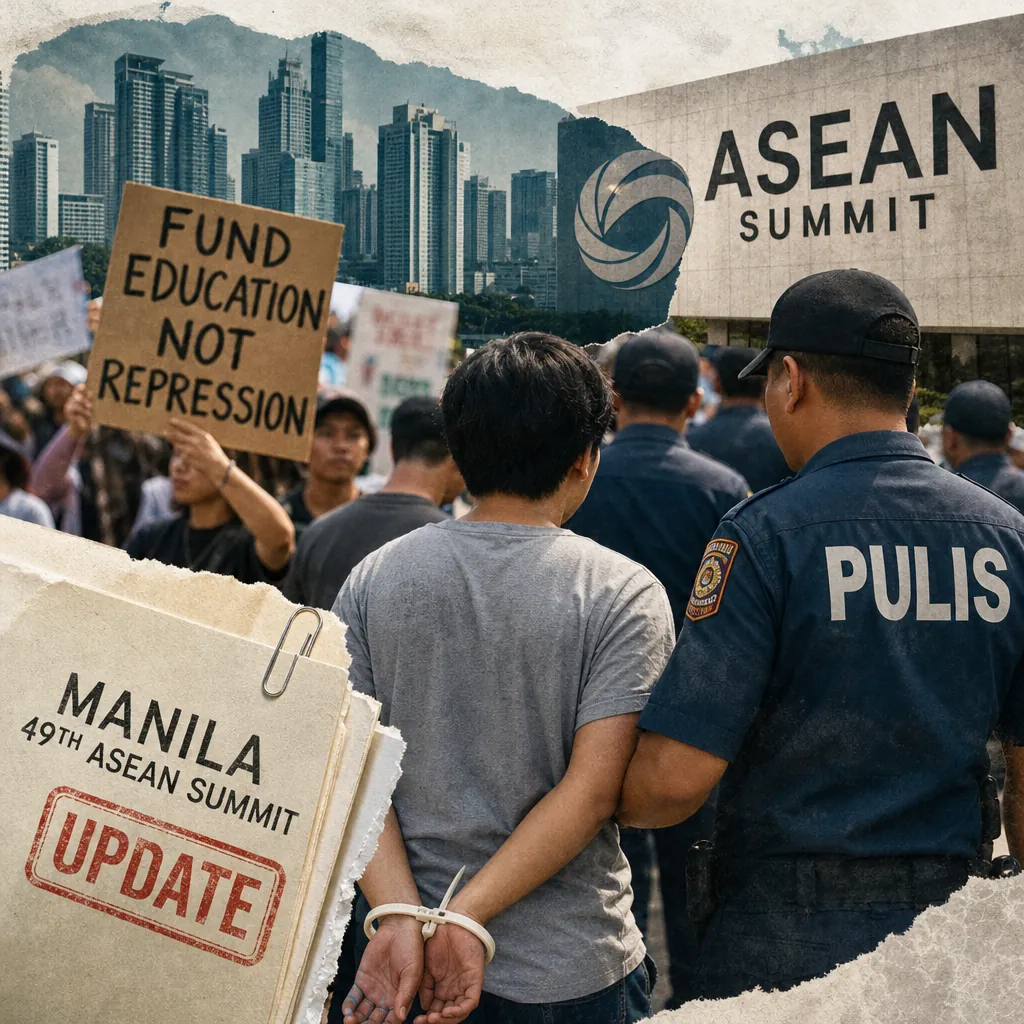
Philippine stocks closed at 5,481.88 on Nov. 16, their weakest finish since May 2020, as stagflation fears spread across the market. Protests against the Pax Silica AI initiative and Donald Trump's visit drew arrests in Manila and rallies in Baguio and Cebu during the ASEAN Summit.
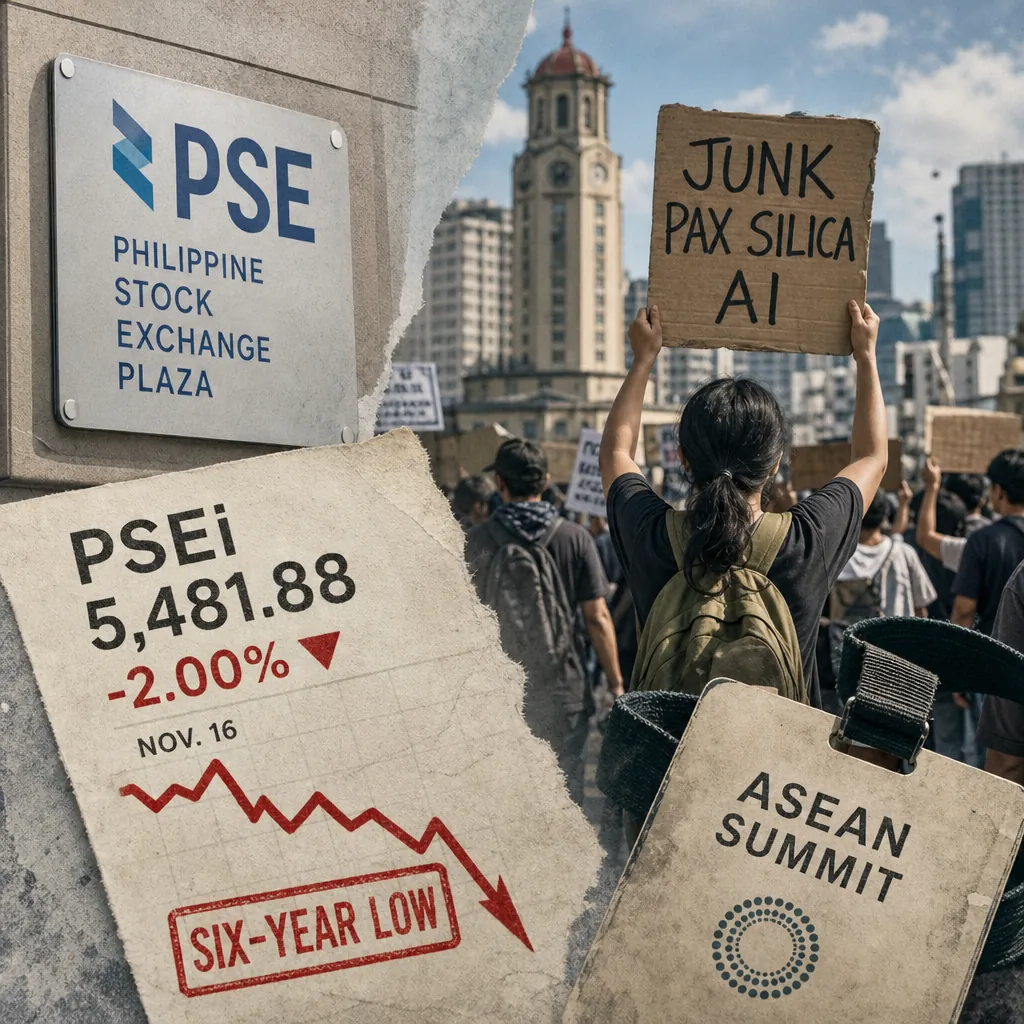
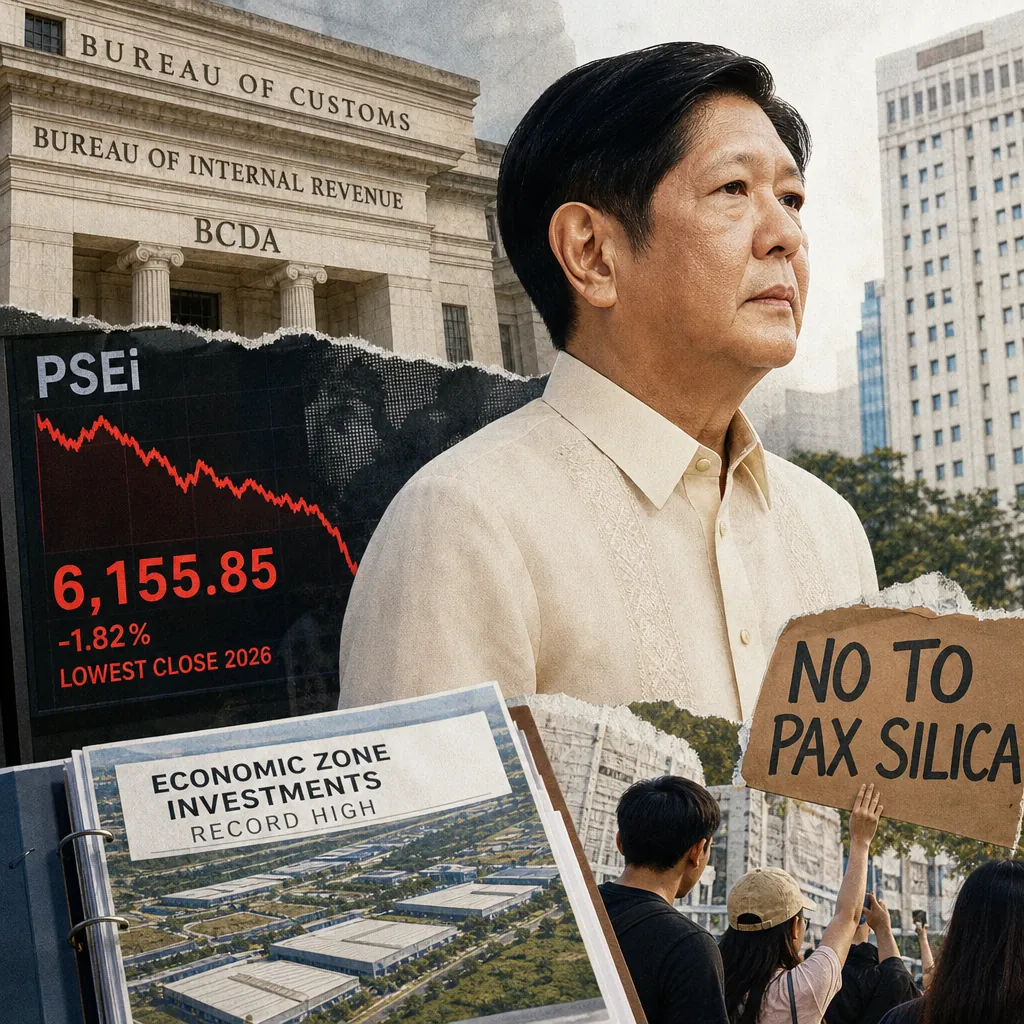
The Philippine Stock Exchange Index (PSEi) — the benchmark basket of the country's 30 largest listed companies — closed at 5,481.88 on Monday, Nov. 16, down 111.61 points or 2 percent, its lowest finish since May 18, 2020, when pandemic lockdowns had frozen the economy542. The index ended the session just 2.53 points above that 2020 trough, and the peso weakened in the same session18. Philstocks Financial, a local brokerage, attributed the drop to "stagflation risks" — the combination of rising prices and slowing growth that leaves central banks with no comfortable lever to pull5. First Metro Securities pointed to weak global cues as well, including disappointing Japanese gross domestic product data and soft Chinese retail sales64.
The market story ran alongside a diplomatic one. The 49th Association of Southeast Asian Nations (ASEAN) Summit opened in Pasay City the same week, with President Ferdinand Marcos Jr. calling on regional leaders to unite against human trafficking, cybercrime, online scams and maritime security threats43. Outside the venue, the reception was less cordial. Police arrested more than 200 protesters who tried to march on the Philippine International Convention Center (PICC) on Sunday, and the National Capital Region Police Office (NCRPO) defended the arrests on Monday29. On Monday afternoon, Indigenous groups, students and veteran activists gathered at Igorot Park in Baguio City to protest the Pax Silica initiative — a United States-led program to build semiconductor and critical-mineral supply chains — and to condemn the earlier arrests1. In Cebu City, about 450 protesters marched from the Archbishop Reyes Avenue flyover toward the US Consulate, and two policemen were injured when the rally turned chaotic along Colon Street73.
Away from the protests, the day's business pages carried a cluster of corporate and policy stories: Bloomberry Resorts Corp. narrowed its quarterly net loss to ₱445.2 million from ₱1.7 billion a year earlier359; the Department of Agriculture declared Manila and Laguna free of bird flu2617; the Bases Conversion and Development Authority (BCDA) outlined ambitions to turn New Clark City into an industrial hub competing with Singapore's Jurong and South Korea's Pangyo4; and Colliers Philippines reported nearly 9,000 condominium buyer cancellations in the first nine months of 20261550.
Key themes
- The PSEi closed at 5,481.88, its weakest finish in more than six years. The 2 percent drop, or 111.61 points, left the index 2.53 points above its May 18, 2020 close of 5,479.35518. All sectoral indices fell, with mining and oil among the laggards18. The decline was the index's third consecutive loss64.
- Stagflation fears drove the selloff. Philstocks Financial cited elevated inflation and slowing economic growth; Regina Capital's Luis Limlingan said investor sentiment stayed subdued on concerns that the Bangko Sentral ng Pilipinas (BSP) — the country's central bank — may have limited room to cut interest rates further542. Stagflation is the combination of stagnant growth and persistent inflation, a mix that leaves policymakers unable to stimulate the economy without worsening prices.
- More than 200 protesters were arrested near the ASEAN Summit venue. The NCRPO said it would not allow anyone to undermine police responsibility for keeping Metro Manila safe during the summit; confrontations at Liwasang Bonifacio, Muntinlupa and Taguig injured 15 policemen and led to eight arrests there, while 211 more were arrested elsewhere29.
- Pax Silica drew protests in Baguio and Cebu. In Baguio, activist Joel Capulong said "Trump the war criminal is not welcome in this country"1. In Cebu, about 450 protesters marched without a permit; police said they exercised maximum tolerance but two officers were hurt73.
- Bloomberry narrowed its third-quarter net loss to ₱445.2 million. Earnings before interest, taxes, depreciation and amortization (EBITDA) — a measure of operating profit that strips out financing and accounting costs — rose 64 percent to ₱3.1 billion, while gross gaming revenue rose 5 percent to ₱15.3 billion359. For the nine months to September, the company still posted a net loss of ₱915.5 million, against net income of ₱160.1 million a year earlier7.
- Manila and Laguna were declared free of bird flu. Agriculture Secretary Francisco Tiu Laurel Jr. signed Memorandum Circulars 57 and 58 on Nov. 9; the department posted them Monday2. Manila had recorded one case in game fowl in January 2023; Laguna had 19 cases, mostly on backyard duck farms2.
- Nearly 9,000 condo buyers cancelled purchases in the first nine months of 2026. More than half of the cancellations came at turnover, when buyers shift from pre-selling installments of as little as ₱10,000 a month to bank amortizations of ₱30,000 to ₱40,000, according to Colliers Philippines Research Director Joey Roi Bondoc1550.
- New Clark City is being positioned as a competitor to Asia's industrial hubs. Newly appointed BCDA President and CEO Ariel Nepomuceno said he wants a "self-sustaining ecosystem" generating 200,000 manufacturing jobs by 2030, particularly in semiconductor production and artificial intelligence4.
How the narratives stack
Dominant. The stock market decline dominated the business pages in this set. The PSEi's six-year low was covered by Inquirer, Philstar, Manila Times and the blog Astig Ph, with the same core figures repeated across outlets: 5,481.88, down 111.61 points or 2 percent, the weakest close since May 18, 20205426418. The breadth of that pickup reflects how central the index is to Philippine business reporting; a six-year low is a headline number that writes itself. The coverage value of the individual items varied — the Inquirer's market story carried an estimated ₱221,508 in advertising-equivalent value, the Philstar version ₱271,932 — but the repetition across outlets is the signal, not any single item's price564.
Counter-narrative. The protest story ran against the summit's official framing. Marcos told ASEAN leaders the summit would shape how the region "meets the challenges of today, seizes the opportunities of tomorrow, and prepares the region for the coming generations"43. Outside, police justified arresting more than 200 people29, and in Baguio and Cebu the protests continued173. The Cebu rally drew the heaviest coverage value in this set among protest items, at an estimated ₱886,978 in advertising-equivalent terms73. The counter-narrative did not displace the official one; it ran alongside it, in separate stories, often in separate sections of the same outlets.
Emerging. The condominium cancellation story is the quietest but potentially most consequential item in the set. Colliers' Bondoc reported nearly 9,000 cancellations in nine months, with more than half occurring at turnover15. The mechanism is straightforward: buyers who could afford pre-selling installments of ₱10,000 a month found themselves unable to sustain bank amortizations of ₱30,000 to ₱40,00015. Developers are responding by selling existing inventory rather than launching new projects, and by offering discounts, rent-to-own schemes and government-backed loans to clear roughly 80,000 unsold units50. That is a demand problem that will not resolve quickly.
Under-covered. The Semirara Mining and Power Corp. (SMPC) dispute with the Department of Energy (DOE) received a single item in this set, despite its implications for the coal auction and for the investment climate the government is trying to advertise during ASEAN week62. SMPC said the DOE's expanded asset-turnover rule requires it to surrender not only trucks, heavy equipment and proprietary know-how but also its power plants and pier to qualify for the coal auction, and that its affiliates would have to waive legal and constitutional rights62. The company called the agency an embarrassment to the Marcos administration and said the rule sends the wrong message to investors attending the summit62. A single item in a monitored set is not proof the story was ignored elsewhere, but within this collection it placed well below the market and protest stories.
Platform insights
- Facebook. The day's most-shared protest content came through Facebook-native organizing: the Baguio rally at Igorot Park was announced and documented on the platform, and the Cebu march was covered through photos distributed by the Philippine Movement for Climate Justice Cebu Chapter and the RECLAIM Coalition173. Student groups used Facebook to coordinate walkouts, and the Nov. 13 campus demonstrations were described as spreading "quickly online"58. The platform's role here is logistical as much as expressive — it is where the rally is called and where the aftermath is shown.
- X. The market story travelled on X through the trading day, with brokerage commentary and index levels circulating in short posts. The 2 percent drop and the 5,481.88 close were the kind of discrete, quotable figures that move quickly on the platform, and the comparison to May 2020 gave the story a ready-made frame518. Protest footage from Liwasang Bonifacio and Muntinlupa also circulated, though the arrest figures were confirmed mainly through police statements reported by mainstream outlets29.
- Reddit. Discussion of the Pax Silica initiative and the New Clark City hub drew threads on Philippine subreddits, where the debate focused on the terms of the master agreement, which is still being negotiated and not public33. The Manila Times column noting that "the master agreement is still being negotiated" and "the terms are not public" was widely referenced in these discussions33. Reddit users also picked apart the BCDA's jobs projection, questioning how 200,000 manufacturing jobs would be reached by 20304.
- YouTube. Long-form commentary and vlog coverage of the ASEAN Summit and the protests drew views, though the engagement was smaller than on Facebook or X. The platform carried explainer content on what Pax Silica is — an economic and security initiative to bolster the AI supply chain by investing in chip manufacturing and mineral extraction, joined by more than 20 partner nations including the Philippines13.
Key voices and communities
Student and youth groups. Students from the University of the Philippines, Ateneo, La Salle, UST, PUP, SLU, UB and other schools walked out of classes on Nov. 13 to oppose Pax Silica and Trump's visit58. Their framing is intergenerational: the hub is presented as a long-term commitment made without public scrutiny. A Daily Guardian column by Herman M. Lagon captured the mood: "I would normally worry when students walk out of their classes... And I find myself cheering them on. Well, not entirely. But you get the point."58 The students matter because they are the constituency most likely to sustain the issue beyond the summit week.
Indigenous peoples and local residents. In Baguio, Indigenous groups joined the rally at Igorot Park1. In Tarlac, residents near the proposed hub are worried about losing homes and being cut off from natural sites, according to a Freeman opinion piece: "The individuals living in the area of the proposed hub in Tarlac are more than worried about losing their homes. It is also about being cut off from a natural site where they grew up, an intangible connection that cannot simply be separated from them."72 This group's concerns are land and livelihood, not geopolitics, and they are the least likely to be satisfied by any negotiated outcome.
Police and government security officials. NCRPO acting director Brig. Gen. Christopher Abrahano defended the arrests, warning that policemen will be firm against lawlessness29. The police framing is public order during a high-profile diplomatic event; the protesters' framing is the right to assemble. Both were reported, and the gap between them is the story.
Business and market analysts. Philstocks Financial, Regina Capital and First Metro Securities provided the market commentary that shaped the day's business coverage564. Their language — "stagflation risks," "subdued sentiment," "limited room" — set the tone for how the decline was understood. Colliers' Bondoc did the same for real estate, translating cancellation data into a story about affordability15.
The Marcos administration's economic team. Trade Secretary Cristina A. Roque pointed to a 39 percent rise in approved investments to ₱1.40 trillion in the first nine months of 2026 as evidence of continuing confidence57. That figure sits awkwardly beside the market's six-year low and the protest coverage, and the administration's challenge this week is to keep the investment narrative in view.
Narrative streams
The PSEi's six-year low puts stagflation at the center of the investment story
The index's 2 percent decline to 5,481.88 was the third consecutive loss and left it 2.53 points above the May 18, 2020 close of 5,479.3551864. The selloff was broad: all sectoral indices fell, with mining and oil among the weakest18. Philstocks Financial said elevated inflation and slowing growth had weighed on sentiment, while Regina Capital's Limlingan said the BSP "may have limited room" to cut rates542. First Metro Securities added that weak global cues — disappointing Japanese GDP and soft Chinese retail sales — compounded the domestic picture64.
The read for the sector is that the cost of capital is not coming down soon. For companies planning to raise money or refinance debt, a six-year-low index means equity issuance is expensive and lenders will price risk higher. For the government, which is trying to sell the Philippines as an investment destination during ASEAN week, the market's verdict is a complication. The 39 percent rise in approved investments to ₱1.40 trillion is a forward-looking commitment figure, not money already spent; the gap between approvals and construction is where the risk sits57.
Context matters here. The May 2020 comparison is not casual: that was the pandemic lockdown trough, when economic activity had stopped. Returning to that level six and a half years later, with the economy open, is a measure of how much ground has not been recovered. The index has now given back the gains of the post-pandemic reopening.
Protests against Pax Silica and Trump's visit spread from Manila to Baguio and Cebu
The arrests near the PICC on Sunday set the tone for the week. Police said 211 protesters were arrested in Muntinlupa and Taguig, and eight more at Liwasang Bonifacio, where 15 policemen were injured29. On Monday, the NCRPO's Abrahano warned that police would be firm against anyone intending to hold rallies at the PICC29. In Baguio, the rally at Igorot Park drew veteran activists, Indigenous groups and students, and the strongest criticism was reserved for Trump's scheduled visit: "Trump the war criminal is not welcome in this country," said activist Joel Capulong1. In Cebu, about 450 protesters marched from the Archbishop Reyes Avenue flyover to the Waterfront Cebu City Hotel and Casino near the US Consulate; police said the rally had no permit and that two officers were injured when it turned chaotic along Colon Street73.
Pax Silica is the substance beneath the slogans. It is a US-led economic and security initiative to bolster the artificial intelligence supply chain by investing in chip manufacturing and mineral extraction; more than 20 partner nations joined last year, including the Philippines13. A proposed AI data center hub in New Clark City, Tarlac, is the Philippine anchor, and in July Marcos said the hub would "strengthen the Philippines' position in the global AI" economy13. The master agreement is still being negotiated and its terms are not public33.
The read for the sector is that the investment case for New Clark City now carries a political risk premium. Technology firms evaluating the hub will weigh the protests, the unresolved land questions and the absence of a published agreement. The BCDA's 200,000-job target by 2030 depends on tenants signing; tenants sign when the terms are clear and the local reception is predictable4. Neither condition is settled.
Bloomberry's narrowing loss shows gaming revenue recovering while the balance sheet still bleeds
Bloomberry Resorts Corp., the operator of Solaire Resort Entertainment City and Solaire Resort Quezon City, reported a third-quarter net loss of ₱445.2 million, down from ₱1.7 billion a year earlier3. EBITDA rose 64 percent to ₱3.1 billion from ₱1.9 billion, and net revenues grew 9 percent to ₱13.8 billion3. Gross gaming revenue rose 5 percent to ₱15.3 billion, helped by higher hold rates in the VIP and electronic gaming machine segments — meaning the casino retained a larger share of what players wagered359. Cash operating expenses were trimmed 1 percent to ₱10.6 billion3.
For the nine months to September, the picture is less flattering. Bloomberry posted a net loss of ₱915.5 million, against net income of ₱160.1 million a year earlier, when the bottom line got a ₱2.9-billion one-time boost from refinancing a ₱40-billion syndicated loan7. This year's results included a ₱403-million gain from the sale of the Jeju Sun gaming license in South Korea7. Solaire Resort Quezon City's nine-month net loss widened to ₱2.35 billion from ₱228 million despite a 6 percent rise in gross gaming revenue to ₱14.54 billion, while Solaire Resort Entertainment City posted net profit of ₱1.49 billion, up from ₱934 million7.
The read for the sector is that the Philippine gaming market is bifurcated. The Entertainment City property is profitable and improving; the Quezon City property is losing money at a widening rate. For investors, the question is whether the QC losses are a ramp-up cost or a structural problem. For the broader gaming industry, the VIP hold-rate improvement is a reminder that revenue growth can come from margin rather than volume, which is less durable.
Manila and Laguna regain bird flu-free status as the DA works through a backlog of declarations
The Department of Agriculture declared Manila and Laguna free of highly pathogenic avian influenza (HPAI) subtype H5N1, the virus commonly called bird flu26. Agriculture Secretary Tiu Laurel signed Memorandum Circulars 57 and 58 on Nov. 9, and the department posted them Monday2. Manila had recorded one case in game fowl in January 2023; Laguna had 19 cases, mostly on backyard duck farms, with 13 detected in 2022 across San Pedro, Victoria, Los Baños and Pangil, and six in 2023 in Santa Cruz and Lumban2. The declaration followed RT-PCR testing — a laboratory technique that detects the virus's genetic material — and compliance with World Organization for Animal Health protocols17.
The read for the sector is that poultry and egg producers in these areas can resume normal movement and sales, and the DA's list of recovered provinces now includes Rizal, Ilocos Sur, Batangas, Capiz, Aurora, Ilocos Norte, Sultan Kudarat, Leyte, Cagayan, Camarines Norte, Camarines Sur, Bataan, Bulacan, Davao del Sur, South Cotabato, Cotabato and Quezon6. Bird flu outbreaks raise the cost of production and restrict trade; each declaration removes a barrier. The risk is that the declarations lag behind the actual disease situation, and the DA's surveillance requirements after a declaration are the mechanism that catches any recurrence.
Condo cancellations expose the affordability gap between pre-selling and bank financing
Colliers Philippines reported nearly 9,000 buyer cancellations in the first nine months of 2026, with more than half occurring at turnover15. The mechanism is a payment cliff: buyers who paid as little as ₱10,000 a month during pre-selling faced bank amortizations of ₱30,000 to ₱40,000 once financing began15. Developers are responding by shifting focus to selling existing inventory rather than launching new projects, and by offering heavy discounts, rent-to-own schemes and government-backed loans to clear roughly 80,000 unsold units50. Pre-selling launches and net take-up have fallen by more than 70 percent50.
The read for the sector is that the Philippine condominium market is working through a demand correction that will take years to clear. For developers, the cancellation wave means revenue already booked is being reversed and inventory is aging. For banks, it means mortgage books are exposed to buyers who qualified on paper but could not sustain payments. For buyers, it is a warning that pre-selling prices are not the full cost of ownership. The government-backed loan programs are a bridge, but they do not close the gap between ₱10,000 and ₱40,000 a month.
New Clark City's industrial ambitions meet the reality of a contested project
The BCDA's new president, Ariel Nepomuceno, said he wants New Clark City in Tarlac to compete with Singapore's Jurong, South Korea's Pangyo and Japan's Tsukuba Science City4. He envisions a "self-sustaining ecosystem" integrating logistics and manufacturing, generating 200,000 manufacturing jobs by 2030, particularly in semiconductor production and artificial intelligence4. The BCDA posted the fastest investment-approval growth among the three major promotion agencies, with approvals climbing 142.5 percent to ₱145.46 billion from ₱59.96 billion57.
The read for the sector is that the BCDA's ambitions are now tied to the Pax Silica controversy. The same New Clark City site that the BCDA is promoting as an industrial hub is the site protesters are targeting131. The investment approvals are real, but they are commitments, not construction. The 200,000-job target requires tenants to commit, and tenants will read the protest coverage. The BCDA's challenge is to publish enough detail about the hub's terms to reassure investors without inflaming the opposition.
Conversation trajectory
The PSEi's next close (observation window: the next five trading sessions). The index closed 2.53 points above its May 2020 low18. A break below 5,479.35 would put it at its weakest level since the pandemic, a headline that would intensify the stagflation narrative. Watch the BSP's next policy meeting and any inflation data release for signals on whether rate cuts are possible. The reasoning: the market's decline is being driven by expectations about inflation and growth, and those expectations will be updated by data.
The Pax Silica master agreement (observation window: the next four to six weeks). The terms are still being negotiated and not public33. If the agreement is published or signed during or after the ASEAN Summit, the protest movement will have a concrete document to respond to. If it remains unpublished, the opposition will continue to frame the project as secretive. The reasoning: the protests are currently about a proposal; a signed agreement would change the terms of the debate.
The ASEAN Summit's outcomes (observation window: through the summit's close). The summit's theme is "Navigating Our Future, Together," and the signing of the ASEAN Digital Economy Framework Agreement last Saturday was one concrete result7043. Watch for announcements on the digital economy, maritime security and the AI supply chain. The reasoning: summit outcomes give the administration deliverables to point to, which could shift coverage away from the protests.
Condo cancellation data (observation window: the next quarterly Colliers briefing). The 9,000 cancellations figure covers the first nine months of 202615. The fourth-quarter data will show whether the cancellation rate is accelerating or stabilizing. The reasoning: the payment cliff at turnover is a structural feature of pre-selling, and the rate of cancellations will indicate whether buyers are adjusting to it or being pushed out.
Bird flu surveillance (observation window: the next six months). The DA's declarations for Manila and Laguna follow a testing protocol17. Any new outbreak in these areas would test the surveillance system and the credibility of the declarations. The reasoning: the virus persists in the region, and the declarations are only as good as the monitoring behind them.
Trigger events. The BSP's next policy rate decision; the publication or signing of the Pax Silica master agreement; the ASEAN Summit's closing statements; Colliers' fourth-quarter property briefing; and any new bird flu case in Manila or Laguna.
Response guidance
Market communications. For companies with investor-relations functions, the six-year-low index is a moment to be precise about exposure. If your company has debt to refinance or equity to raise, say plainly what the current market means for your cost of capital and your timeline. Avoid optimistic framing that the market data contradicts; investors are reading the same numbers.
Pax Silica messaging. For firms with operations or plans in New Clark City, the protest coverage is a signal that the project's social license is not settled. Publish what you can about local hiring, land arrangements and community consultation. The absence of public terms is the protesters' strongest argument; filling that gap, where possible, is the most credible response.
ASEAN Summit communications. For companies using the summit as a platform, the official program and the protest coverage are running in parallel. Do not assume the summit's positive framing will dominate the news cycle. Prepare for questions about the arrests and the Pax Silica opposition, and answer them directly rather than deflecting to the summit's economic agenda.
Real estate communications. For developers, the cancellation data is a trust issue. Buyers who cancelled at turnover are a cautionary tale for the next cohort. Be explicit about the full monthly cost of ownership at turnover, not just the pre-selling installment. Rent-to-own and government-backed loan programs are useful, but they do not change the underlying affordability math.
Agricultural communications. For poultry and egg producers in Manila and Laguna, the bird flu-free declaration is a marketing opportunity. Communicate the testing and surveillance behind the declaration, and be prepared to respond quickly if a new case emerges. The DA's list of recovered provinces is a useful reference for trade partners.
Gaming communications. For Bloomberry and its competitors, the quarterly results show a market where margin improvement is doing the work that volume growth is not. Be clear with investors about which properties are profitable and which are in ramp-up. The Quezon City losses will draw questions; have a specific answer about the path to profitability.
Protest coverage. For communicators across sectors, the arrests and the rallies are a reminder that the summit week's news cycle is not controlled by the official program. Monitor the protest movement's demands and be prepared to respond to them if your company is named. The students and Indigenous groups driving the protests are not a fringe; they are a constituency with staying power.
See the full picture behind today's signals.
This report draws from Media Meter's MediaWatch, our real-time monitoring engine tracking 2,470+ Philippine sources across print, broadcast, digital, and social. Explore how the platform turns raw coverage into decision-grade intelligence, then see how it's configured for teams like yours — whether you're in PR agencies, corporate comms, government, or marketing.
Want more? Browse our Report Library for sector and crisis intelligence, or request a demo and we'll have your brand set up before the call.
Want this kind of intelligence on your brand?
This brief is built on the same MediaWatch methodology that runs continuously across every brand we monitor. See your competitive landscape, Impact Score, and narrative trajectory in a 30-minute demo.