Undas 2026: LTFRB, LTO, NLEx Brace for 1.9M Travelers
Philippine transport agencies issued fare warnings, activated road-safety operations, and prepared expressways for the Undas 2026 travel peak, while motorcycle taxi riders pressed for legal recognition and Tacloban airport set a 2027 completion target.
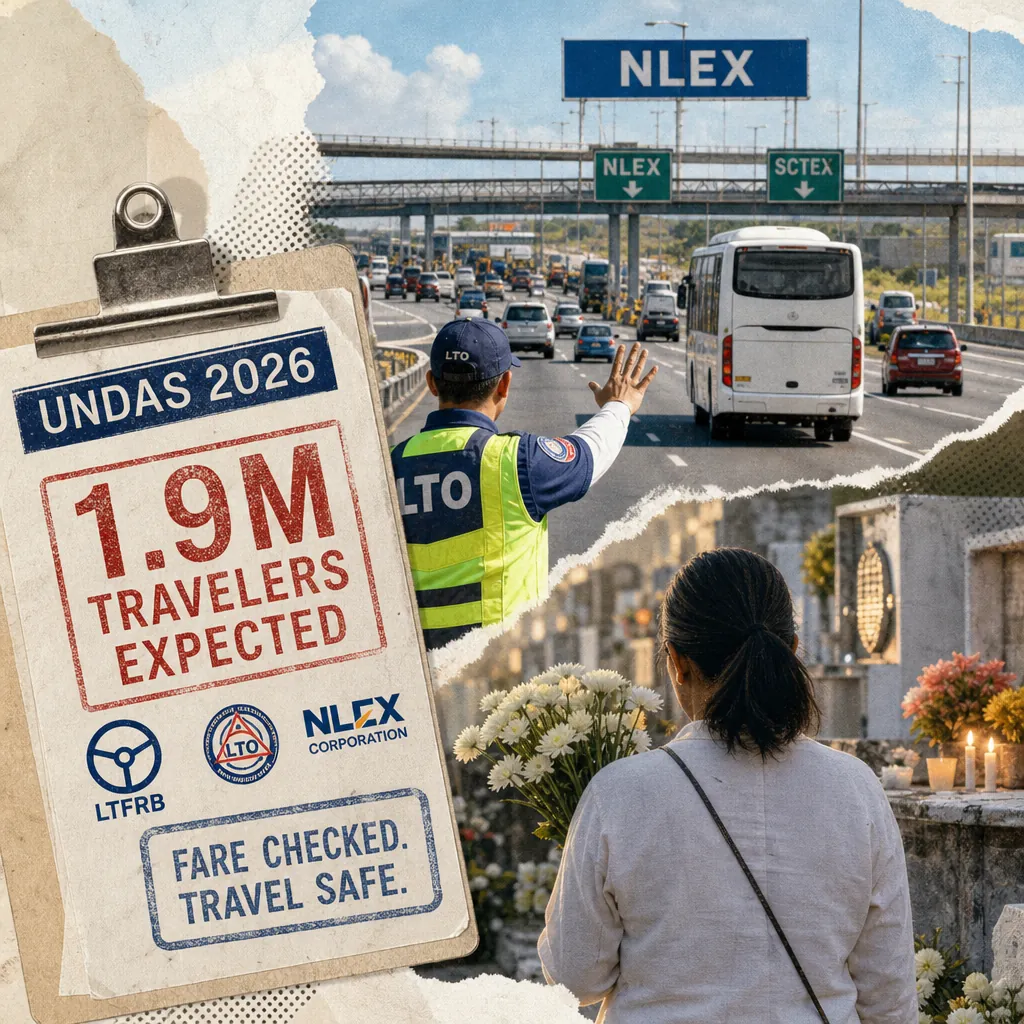
The Land Transportation Franchising and Regulatory Board (LTFRB) expects about 1.9 million passengers to pass through bus terminals in Quezon City, Manila, Pasay, Caloocan and Muntinlupa and other transport hubs as Filipinos travel to the provinces for Undas, the annual observance of All Saints' Day and All Souls' Day34. Acting LTFRB Chairman Greg Pua Jr. used that projection to issue a public warning to taxi operators on Saturday, October 24: overcharging, refusing passengers and disrespecting commuters can cost them their Certificate of Public Convenience (CPC), the franchise that gives a operator the legal right to run a public transport service934.
The warning was one of several Undas-related moves by transport agencies that day. The Land Transportation Office (LTO) activated "Oplan Biyaheng Ayos–Undas 2026," a safe-travel campaign built around terminal inspections, planned driver drug tests and personnel deployment along major roads and expressways, running in two phases: October 23–27 and October 28–November 41217. The North Luzon Expressway (NLEx) Corp. said it is preparing for a 3 percent to 5 percent rise in motorists on NLEx, the Subic-Clark-Tarlac Expressway (SCTEx) and the Mindanao Avenue Connector between October 29 and November 3, deploying 1,500 personnel across three daily shifts13. And a group of motorcycle taxi riders asked the LTFRB for a path to legal operation after being onboarded onto platforms that had exceeded their authorized rider allocations1832.
Separately, the Department of Transportation set February 2027 as the target for completing the expansion of Daniel Z. Romualdez Airport in Tacloban City, timed for the Holy Week travel season1. The day's coverage in this set was dominated by the Undas travel build-up, with the LTFRB warning picked up by at least five outlets in English and Filipino693334. The airport story and the motorcycle taxi appeal each drew single items, but both carry consequences that outlast the holiday weekend.
Key themes
- LTFRB projects 1.9 million bus-terminal passengers for Undas. The estimate covers terminals in five Metro Manila cities plus other hubs, and it is the basis for the agency's pre-emptive warning to taxi operators34.
- Taxi franchises are on the line for overcharging. Pua said violations of fare rules, passenger snubbing and disrespect can lead to suspension or cancellation of a CPC, the authority to operate a public transport route934.
- The LTO's Oplan Biyaheng Ayos runs in two deployment phases. The first covers October 23–27 and the second October 28–November 4, spanning travel before and after the holiday itself12.
- Twenty-seven bus terminals passed inspection. The LTO conducted the checks with the Philippine Coast Guard and said driver drug testing forms part of the plan1217.
- NLEx Corp. expects 3–5 percent more motorists and is fielding 1,500 staff. On a normal day about 340,000 motorists use NLEx, 77,000 use SCTEx and 20,000 use the Mindanao Avenue Connector13.
- Motorcycle taxi riders want to legalize, not exempt themselves. METRO lead convenor Jayson Luna said affected riders were onboarded without knowing their platforms had exceeded authorized allocations, and are asking for the chance to comply1832.
- Tacloban airport expansion targets February 2027. Transportation Secretary Giovanni Lopez said President Ferdinand Marcos Jr. ordered the project accelerated so more passengers and tourists can use it by next year's Holy Week1.
How the narratives stack
Dominant: The Undas travel build-up is the clear lead across the items captured here. The LTFRB warning alone ran in Manila Bulletin, the Inquirer, Philstar (in both English and Filipino) and appeared in a second Philstar national item, giving it the widest pickup of any transport story in this set693334. The LTO operation and the NLEx preparation add operational detail to the same story: agencies are moving people and equipment into place before the holiday rush. The dominance is a property of this captured set, which skews toward Philippine online news outlets covering the holiday; it is not a claim about all coverage published that day.
Counter-narrative: The motorcycle taxi riders' appeal complicates the picture of a transport system simply managing holiday volume. Their argument is that they were placed on platforms that had already exceeded government-set rider caps, and that they are now being penalized for a situation they say they did not create1832. Luna framed the request as one for compliance, not exemption: "We are not asking for special treatment or exemption"18. This story ran in The Manila Times and Philstar's Filipino-language section, a narrower footprint than the LTFRB warning but a more consequential one for the riders involved.
Emerging: The Tacloban airport expansion sets a February 2027 completion target, more than a year out1. It is a single item in this set, but it signals that the Department of Transportation is sequencing major regional airport projects around holiday travel peaks. The Holy Week deadline gives the project a hard date against which progress can be checked.
Under-covered: The LTO's planned driver drug tests received only a passing mention in the items captured here, folded into the broader Oplan Biyaheng Ayos description1217. How many drivers will be tested, at which terminals, and what happens to those who test positive are not specified in the coverage reviewed. That is a gap worth watching as the operation unfolds.
Platform insights
- Facebook: The LTFRB released its warning through its social media page on Saturday, October 24, according to the Manila Bulletin report6. The agency used its own page to reach commuters directly, bypassing the need for media pickup to get the message out. The warning was framed in Filipino in the Bulletin's account, matching the language of the commuters most likely to encounter taxi overcharging.
- X (formerly Twitter): No posts from X appear in the items captured here. The transport stories in this set moved through news websites and one agency Facebook page, not through social media conversation that the monitoring recorded.
- Reddit: No Reddit activity appears in the items captured here.
- YouTube: No YouTube activity appears in the items captured here.
The absence of social-platform conversation in this set is itself informative: the Undas transport story is being driven by government agencies issuing statements and news outlets reporting them, not by viral posts or public complaints that monitoring picked up. That may reflect the monitoring scope, or it may reflect that the story is still in its announcement phase, before travelers actually hit the terminals and roads.
Key voices and communities
The LTFRB under Acting Chairman Greg Pua Jr. Pua is the most-quoted official in this set. His warning was direct: "This early, we are giving a fair warning to all taxi operators to behave and stick to the rules and regulations of the authority to operate issued to them"9. He tied the warning to President Marcos Jr.'s instruction to ensure comfortable and hassle-free travel through strict enforcement of public transport rules633. The LTFRB is the agency that issues CPCs, so its warning carries the weight of franchise revocation behind it.
The LTO under chief Markus Lacanilao. Lacanilao inspected passenger buses in Cubao, Quezon City, and at the Parañaque Integrated Terminal Exchange (PITX) on Saturday before announcing that Oplan Biyaheng Ayos was in effect17. The LTO is the agency responsible for driver licensing and vehicle registration, and its terminal inspections and drug-test plans are the enforcement arm of the holiday travel plan.
Motorcycle Taxi Rider Association (METRO) and lead convenor Jayson Luna. METRO held a peaceful rally and was invited to a dialogue by the LTFRB on Friday, October 2318. Luna's framing is careful: the riders want to comply with requirements, not escape them. "We are not asking for special treatment or exemption," he told The Manila Times18. The group represents riders who are earning a living on platforms that the government says have more riders than their allocations allow.
NLEx Corp. and traffic operations assistant vice president Robin Ignacio. Ignacio provided the operational numbers: 340,000 daily motorists on NLEx, 77,000 on SCTEx, 20,000 on the connector, and a plan to implement counterflows to speed traffic13. His comments give the clearest picture of what the expressway operator expects in terms of volume and how it plans to handle it.
Transportation Secretary Giovanni Lopez. Lopez announced the February 2027 Tacloban airport target after an inspection on Friday, October 23, and relayed the President's instruction to accelerate construction1. His statement is the only item in this set that looks beyond the holiday window to a multi-year infrastructure timeline.
Narrative streams
LTFRB warns taxi operators as 1.9 million passengers head to terminals
The LTFRB's warning is the most widely reported transport story in this set, appearing in Manila Bulletin, the Inquirer, Philstar's English and Filipino editions, and a second Philstar national item693334. The agency's estimate of 1.9 million bus-terminal passengers covers terminals in Quezon City, Manila, Pasay, Caloocan and Muntinlupa, plus other transport hubs34. That figure is a projection of passenger volume through bus terminals, not a count of all travelers; it does not include people using private vehicles, taxis, ride-hailing services or motorcycles.
The enforcement mechanism is the CPC. A CPC is the franchise the LTFRB grants to transport operators, and without it an operator cannot legally run a public service. Pua said violations of fare rules, passenger snubbing and disrespect could lead to suspension or cancellation of that franchise, plus other penalties934. The warning is pre-emptive: it comes before the travel peak, not after complaints have piled up. Pua said the agency expects more passengers heading to bus terminals and major transport hubs starting next week6.
The read for the sector is that taxi operators face a real financial risk if their drivers overcharge during Undas. A suspended or cancelled CPC takes a vehicle off the road and cuts off its operator's income, so the warning is aimed at operators as much as at drivers. For commuters, the practical effect depends on enforcement: the LTFRB has said what the penalties are, but the items captured here do not describe how many enforcers will be deployed or where. The Parañaque Integrated Terminal Exchange (PITX), one of the country's largest bus terminals, separately said it expects up to 1.9 million passengers, according to the Philstar Filipino report33.
LTO activates Oplan Biyaheng Ayos with terminal inspections and drug tests
The LTO's Oplan Biyaheng Ayos–Undas 2026 combines terminal inspections, planned driver drug tests and personnel deployment along major roads and expressways12. The agency said 27 bus terminals passed inspections conducted with the Philippine Coast Guard, and that deployment runs in two phases: October 23–27 and October 28–November 412. The two-phase structure covers travel before and after All Saints' Day and All Souls' Day, which fall on November 1 and 2.
Lacanilao inspected buses in Cubao and at PITX on Saturday before announcing the operation was in effect17. He said personnel would be deployed at tollways, major transport corridors and expressway entry and exit points17. The drug-test component is notable because it extends the LTO's safety checks beyond vehicle roadworthiness to driver fitness. The items captured here do not specify how many drivers will be tested or what the consequences of a positive result would be.
The read for the sector is that bus operators should expect inspections at terminals and on the road through early November, and drivers should expect to be tested. For the LTO, the operation is a test of whether pre-holiday inspections can prevent breakdowns and accidents that would otherwise clog the travel corridors. The Philippine Coast Guard's involvement in terminal inspections is unusual for a maritime agency, but it reflects the government's practice of pooling agencies for large-scale holiday operations.
NLEx prepares for 3–5 percent more motorists and deploys 1,500 staff
NLEx Corp. expects a 3 percent to 5 percent increase in motorists on NLEx, SCTEx and the Mindanao Avenue Connector from October 29 to November 313. To put that in context, Ignacio said about 340,000 motorists travel via NLEx on a daily basis, 77,000 on SCTEx and 20,000 on the connector13. A 3–5 percent rise on those baselines means roughly 10,000 to 17,000 additional vehicles per day on NLEx alone during the peak window.
The company is deploying 1,500 personnel across three shifts daily as patrols, toll tellers, emergency response teams, traffic managers, technology support staff and security aides13. Ignacio said NLEx is ready to implement counterflows to speed up traffic and has increased motorcycle patrols13. Counterflow operations redirect traffic into lanes normally used by oncoming vehicles, a technique used on toll roads during heavy-volume periods.
The read for the sector is that motorists using NLEx and SCTEx during Undas should budget extra time and expect lane changes near toll plazas and interchanges. For the expressway operator, the holiday peak is an operational stress test: the 1,500-person deployment and counterflow plan are the measures it is putting in place, and their adequacy will be visible in travel times over the October 29–November 3 window.
Motorcycle taxi riders ask LTFRB for a path to legal operation
A group of motorcycle taxi riders under the Motorcycle Taxi Rider Association (METRO) pressed the LTFRB for legal recognition, holding a peaceful rally and then meeting the agency in a dialogue on Friday, October 2318. Luna told The Manila Times that the riders were delighted to be invited to the dialogue18. The core of their complaint is that they were onboarded onto platforms without knowing those platforms had exceeded their authorized allocations1832.
Motorcycle taxis, commonly called habal-habal in some regions, are two-wheeled ride-hailing services. The government regulates them through a system of authorized rider allocations per platform, a cap on how many riders each company may field. Riders who joined platforms that exceeded those caps are now in a legal gray area: they are earning a living, but their operations may not be covered by the platform's allocation. Luna said the affected riders are not seeking exemptions from government regulations but rather the chance to comply with the requirements needed to continue earning legally18.
The read for the sector is that the LTFRB faces a choice between enforcement and accommodation. Cancelling or suspending riders who were onboarded in good faith would take income away from workers who say they did not know the platforms were over their caps. Letting them continue without compliance would weaken the allocation system. The dialogue on October 23 is the first step; the items captured here do not say what the LTFRB told the riders or whether a resolution is near. For platform operators, the episode is a reminder that rider recruitment beyond authorized allocations creates legal exposure for the riders themselves.
Tacloban airport expansion targets February 2027 completion
The Department of Transportation is targeting February 2027 for completion of the expanded Daniel Z. Romualdez Airport in Tacloban City, ahead of the Holy Week travel season1. Transportation Secretary Giovanni Lopez announced the target on Friday, October 23, after an inspection of the rehabilitation and expansion project1. He said President Marcos Jr. ordered the project accelerated so more passengers and tourists can benefit by next year's Holy Week1.
Tacloban is the capital of Leyte and a gateway to Eastern Visayas. The airport expansion is intended to improve passenger capacity and strengthen air connectivity in the region1. The Holy Week deadline is significant because it is one of the country's heaviest travel periods, when demand for flights to the provinces peaks. Completing the expansion before that window would allow the airport to handle more passengers during the rush.
The read for the sector is that airlines serving Tacloban should plan for increased capacity and passenger throughput by early 2027, and travelers to Eastern Visayas should see a larger terminal and more flights once the project is complete. The February 2027 target is more than a year away, and the items captured here do not include a project cost, a contractor, or a detailed scope of works. The announcement establishes the deadline; the delivery against it will be the measure.
Conversation trajectory
October 28–November 4 (LTO second deployment phase): The LTO's second phase of Oplan Biyaheng Ayos runs through this window, covering the post-holiday return travel12. Watch for reports of terminal inspections, drug-test results and any enforcement actions against bus operators. The first phase, October 23–27, covers the outbound rush; the second covers the return.
October 29–November 3 (NLEx peak window): NLEx Corp. expects 3–5 percent more motorists on its expressways during this period13. Travel times on NLEx, SCTEx and the Mindanao Avenue Connector will show whether the 1,500-person deployment and counterflow plan are sufficient. Watch for congestion reports and any incidents that disrupt traffic.
Undas weekend (November 1–2): The holiday itself falls on a weekend this year, which may spread travel across more days rather than concentrating it on a single peak. The LTFRB's 1.9 million passenger projection covers bus terminals in five Metro Manila cities plus other hubs34. Actual terminal throughput after the holiday will show how close the projection came.
Next few weeks (motorcycle taxi dialogue follow-up): The LTFRB met METRO on October 2318. Watch for a statement from the agency on whether riders who were onboarded beyond platform allocations will be given a compliance path, and for any action against the platforms that exceeded their caps.
February 2027 (Tacloban airport target): The Department of Transportation has set this as the completion date for the Daniel Z. Romualdez Airport expansion1. Progress reports and any slippage in the target will indicate whether the Holy Week 2027 deadline is realistic.
Trigger events: A major accident or fare-overcharging controversy during Undas would intensify scrutiny of the LTFRB and LTO operations. A government announcement on motorcycle taxi allocations would resolve the riders' legal status. A missed Tacloban airport deadline would raise questions about the Department of Transportation's project management.
Response guidance
Taxi and bus operators: Brief drivers on the LTFRB's fare rules before the Undas peak and document the briefing. The agency has said overcharging, passenger snubbing and disrespect can lead to suspension or cancellation of a CPC934. Operators should also prepare for LTO terminal inspections and driver drug tests under Oplan Biyaheng Ayos1217.
Expressway users and logistics companies: Plan routes and schedules around the October 29–November 3 peak on NLEx, SCTEx and the Mindanao Avenue Connector, when NLEx Corp. expects 3–5 percent more motorists and will implement counterflows13. Allow extra time for toll plaza queues and lane changes.
Motorcycle taxi platforms and rider groups: The LTFRB has opened a dialogue with METRO18. Platforms should review their rider counts against authorized allocations and communicate clearly with riders about their legal status. Rider groups should keep the framing on compliance rather than exemption, as Luna did18.
Airlines and regional tourism operators: The Tacloban airport expansion targets completion by February 2027, ahead of Holy Week1. Carriers serving Eastern Visayas should plan capacity increases and coordinate with airport authorities on the transition to the expanded facility.
Government communicators: The Undas transport story is being driven by agency statements, not by social media conversation in the items captured here. Agencies should continue issuing plain-language advisories through their own channels, as the LTFRB did on Facebook6, and should be prepared to answer questions about enforcement numbers and drug-test results once the operations are underway.
See the full picture behind today's signals.
This report draws from Media Meter's MediaWatch, our real-time monitoring engine tracking 2,470+ Philippine sources across print, broadcast, digital, and social. Explore how the platform turns raw coverage into decision-grade intelligence, then see how it's configured for teams like yours — whether you're in PR agencies, corporate comms, government, or marketing.
Want more? Browse our Report Library for sector and crisis intelligence, or request a demo and we'll have your brand set up before the call.
Want this kind of intelligence on your brand?
This brief is built on the same MediaWatch methodology that runs continuously across every brand we monitor. See your competitive landscape, Impact Score, and narrative trajectory in a 30-minute demo.