Reputation Asset Measurement When the Asset Outlives Reach
Three Philippine institutions just funded assets built to last years. Why reputation asset measurement needs a multi-year baseline, not a two-week reach curve.

Reputation asset measurement breaks when an asset built to last years gets reported on a campaign window. Three Philippine organisations funded durable assets in a single week, and global survey data shows almost no PR team reports on an annual cycle at all. The fix is a baseline opened at launch: coverage breadth, re-citation events and sentiment, read over years.
A two-volume corporate history usually gets filed as heritage marketing, which is how it ends up in a quarterly review as one photograph and one reach figure. The more interesting version is that BPI has just handed its agency a measurement problem with a 175-year denominator, and the reporting template sitting on the shelf runs for a fortnight.
Two more Philippine organisations funded durable assets in the same week, which puts reputation asset measurement on a client services director's desk as a commercial problem before a creative one. The missing deliverable is not a new data source. It is a new window, and the first row of it has to be written in launch week or it does not exist.
A 175-Year Archive Reported on a Two-Week Curve
Start with what the asset actually is. BPI's Building a Better Philippines runs two volumes and seven chapters, written by business journalist Roel Landingin and edited by Jose "Butch" Dalisay, PhD, tracing the bank from the founding of Banco Español-Filipino de Isabel II in 1851 through to 2026, with Volume 1 closing in the early 1970s and Volume 2 opening in the Martial Law era. adobo Magazine's report on the launch runs the chapter titles, from "The First Globalization" to "Banking in the New Millennium", and the archival research, photographs and firsthand accounts from former executives behind them. President and CEO TG Limcaoco put the purpose plainly: "History is rarely written by those who lived it. Rather, legacies continue with those who choose to remember." Chairman Jaime Augusto Zobel de Ayala described the bank as "a constant presence in the economy" across those periods.
What the coverage does not carry is a distribution plan. Nobody has yet defined what "working" would look like for this asset after launch week, which is the first question reputation asset measurement has to answer.
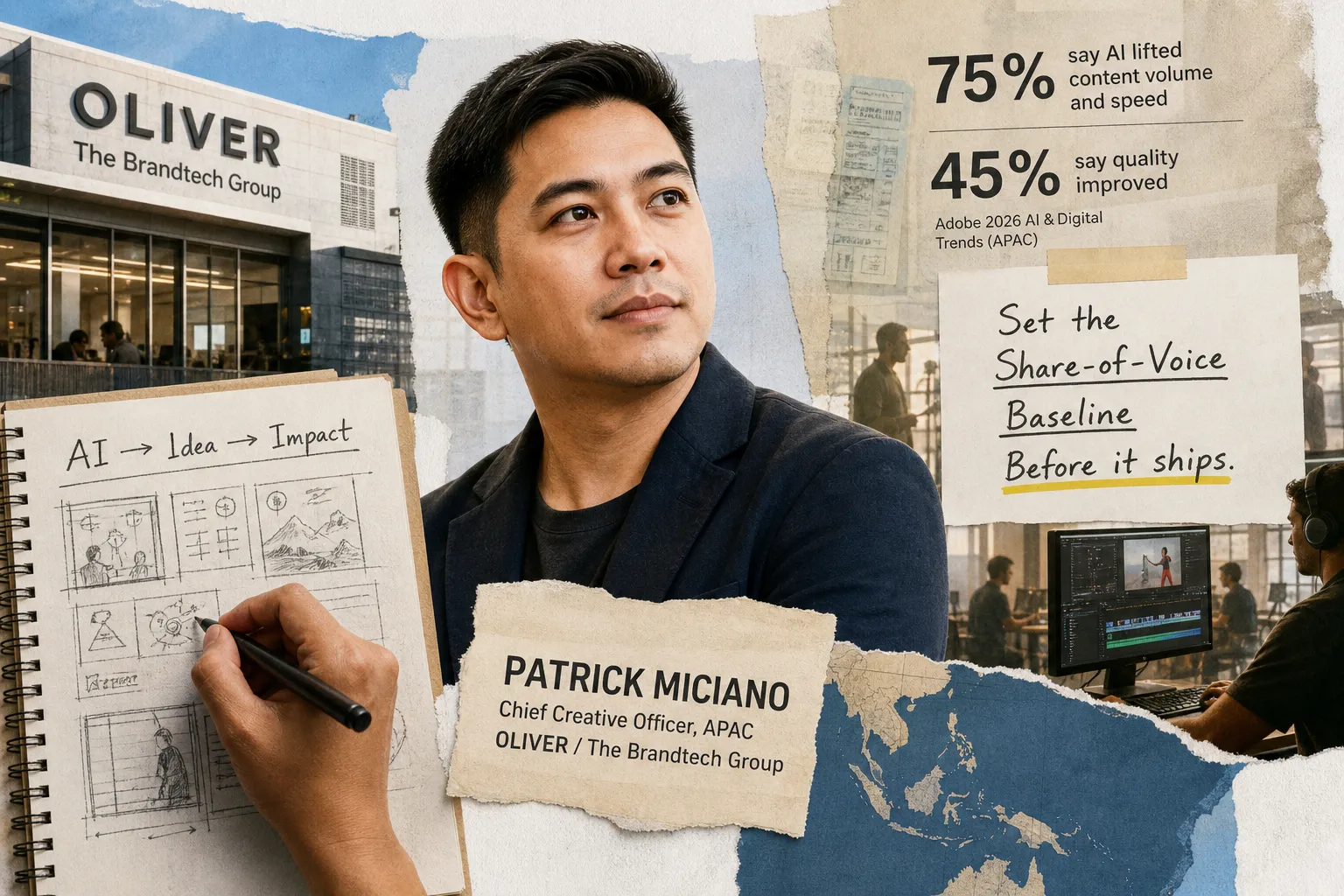
Reporting cadence is where the mismatch becomes measurable. PR teams report on short cycles and almost nobody runs an annual one: asked how often they measure and report, practitioners answered monthly 34%, weekly 19%, on an as-needed basis 14%, quarterly 13% and annually just 1%, in Muck Rack's State of PR Measurement 2025, based on 912 responses collected 1 to 29 September 2025 and cleaned to 832 qualified respondents, with a stated margin of error of ±3.4%. Reporting up to the executive team runs on the same clock, monthly for 35% and annually for 3%. Muck Rack sells PR software, so this is vendor research inside the category Media Meter competes in, and the sample is global and US-heavy rather than Philippine.
Then there is the asset's first eight days. Targeted searches on 11 November across ten mainstream Philippine news domains, from BusinessWorld and the Inquirer to GMA, Rappler and the Philippine News Agency, surfaced no coverage of the book at all. Mainstream coverage of the 175th anniversary does exist, including an August column on the bank's thanksgiving mass, but it covers the anniversary and the Do More Philippines campaign rather than the archive. All three of this week's assets reach Philippine readers through adobo Magazine and, on this cycle's search, nowhere else. Read that as an observation from one set of searches rather than proof that no coverage exists anywhere. Read it also as the first row of a reputation asset measurement baseline: a launch-week breadth figure that only exists if somebody records it on day one.
What Jury Composition Proves That a Reach Number Cannot
SINESPECTRUM 2026 gives you the cleanest example of a property that survives launch week. The Misfits Camp ran the student film competition inside The Sense of Care Fundraising Exhibit at Sine Pop Cinema in Cubao, Quezon City on 29 and 30 October, for World Sensory Awareness Month, giving film students one month and one brief: make the invisible disability of autism visible in five minutes. Ten shortlisted films screened and three took prizes, as adobo Magazine's account of the competition records. "REVERSE" by A3 Studio of Bulacan State University took PHP 30,000, "KALEIDOSCOPE" by Chroma Productions of the same university PHP 10,000, and "ALIENATED" by Group Lightyear of the University of Asia and the Pacific PHP 5,000.
The jury is the part worth reporting. Merlee Jayme, founder of Jayme Headquarters and The Misfits Camp, sat with RJ Espartinez (Creative Director, Jayme Headquarters), Sam Alapan and James Bernardo (Creative Mentors, The Misfits Camp), Cesca Atienza (Divergent Creative, Jayme Headquarters), Grant Javier (Director, Project Inclusion PH) and the filmmaker John Rogers, because the films were judged on storytelling and cinematic quality and on "sensitivity, authenticity, and representation of autism". Neurodivergent creative talent sat inside the evaluation rather than being consulted after it.
In reputation asset measurement, treat composition as the asset's serial number. A reach figure describes one week of attention and then expires; a named, verifiable jury stays checkable for as long as anyone cares to check it, which is exactly the kind of property a long-window report can carry.
The industry already reads it that way. Coverage of the Gerety Awards 2026 Grand Jury places Jayme among ten Asian women creative leaders on an all-female Grand Jury, alongside Abi Aquino, Chief Creative Officer of TREYNA Group, with the Gerety structure separating an international executive jury that shortlists from the Grand Jury that judges. Fran Palines of VML Manila took a Cannes Lions 2026 audio and radio jury seat in the same year, and Filipino practitioners also sat on The One Show 2026 APAC and ONE Asia Creative Awards 2026 juries. Two appointments for one practitioner are not cause and effect, and this piece does not claim they are. They do tell you that jury design is read as evidence by the bodies handing out the awards your client wants.
Reputation Asset Measurement on a Multi-Year Baseline
The industry outlawed the wrong thing and left the window alone. AVE is finished as a measure, and the bodies say so in writing: AMEC's 2026 Awards entry rules state that "Any entry using AVEs/PR value as a measure will result in a zero score", repeated in both the Effectiveness of Assignment and Campaign Effectiveness sections. That line took years to earn, since around a decade after the Barcelona Principles almost half of PR industry leaders globally still used AVE, with Latin America at 74% and the UK at 16%, in YouGov's reporting of the ICCO World PR Report. Treat that as a 2019 to 2020 figure with no respondent count published, and carry the industry position with it: AMEC and the Barcelona Principles reject AVE outright, and no current authoritative share could be confirmed.
The window got no such treatment. The same AMEC rules set an eligibility period of 14 February 2025 to 20 July 2026, roughly 17 months, and the 2026 category list accepts "one-off or ongoing" work with no stated minimum duration. The only explicit time requirement anywhere in the categories is ten years of senior experience, which applies to a person rather than a programme.
Locally the ceiling is lower. The PRSP's published sustained-programme definition, from the launch of the 58th ANVIL Awards, required a programme to have run for at least 24 months by the 31 October 2022 cutoff and counted anything earlier only as background: "Judges will evaluate what is new: the innovations, new standards, or results that occurred within the eligibility period." That rulebook is four years old and the 62nd call for entries could not be located, so read it as the published definition rather than today's rule. Either way, two years is the ceiling the country's own PR body puts on "sustained". A 175-year archive has no category.
Nor does the sector have the habits for a longer window. Almost nobody works to a formal measurement framework: 61% of Muck Rack's respondents picked "none of the above" and 29% used something proprietary, leaving 7% on the Barcelona Principles and 4% on AMEC's Integrated Evaluation Framework. Measurement hours are thin too, with 90% spending under four a week on it.
What the shelf template measures compounds the problem. Stories placed leads the metric set at 86% and reach or impressions follows at 79%, against sentiment at 43% and share of voice at 41%, and trust lags use: only 49% believe reach or impressions accurately measure their efforts. Meltwater's 2026 State of PR research, published by AMEC lands in the same place from a separate sample of more than 1,100 communications professionals, with over a third of teams reporting monthly, 21% weekly and 10% only around major campaigns, and placement volume and reach rated the two most important measures of success. Meltwater is a monitoring vendor publishing its own survey through the standards body, not research the body audited, and AMEC's own framing is the line worth keeping: reporting frequency does not help if the reporting stays on outputs.
So what goes in the longer window of reputation asset measurement? Re-citability, which is the property a campaign burst does not have. A two-volume history, a jury roster and an open-ended artist platform can each be referenced again, by somebody else, months or years later, and the question to track is how often, by whom, and in what sentiment. That is analysis rather than a sourced benchmark, because the benchmark does not exist. No published research measures the coverage longevity or re-citation life of a heritage or anniversary asset, in the Philippines or internationally. The nearest confirmed work measures attention instead of assets, finding average half-lives of 20 hours for in-depth articles and eight hours for news across 606 Al Jazeera English articles first visited in October 2012, against an earlier power-law mean of 36 hours. That is a 2013 pageview finding, not a coverage measure. The absence is the argument: if no body publishes a longevity standard, the baseline has to start inside your own reporting.
Silver Print's Zero-Risk Model and the Claims It Invites
Silver Print's Spotlight opened on 7 November at Shutterspace Studios on Katipunan Avenue with original work by Filipino photographers including Fourth Barleta, Neal Oshima, Jilson Tiu and MM Yu. The studio absorbs all marketing, print-production and programme costs, so photographers take no financial risk and hold no inventory, per adobo Magazine's write-up of the launch. Crate Editions sit in crates visitors flip through like records. Fine-art prints come on acid-free Hahnemühle paper, hand-signed, with a certificate of authenticity, from PHP 1,700 for Print Only, and the platform has no closing date. The precedent the studio offers is its 2020 Shelter Fund, which it says sold more than 2,000 prints for close to 300 local artists.
That last figure is the studio's own account, the peso figures are list prices rather than sales data, and none of the three cases this week carries a published method. They are evidence that the investment is being made and nothing further, which is why an agency should not let a "zero-risk" claim or a 2,000-print precedent travel into a reputation asset measurement report without its basis attached.
Why these assets are funded now does have sourced evidence behind it, and it points at displacement. Photographers report losing commissioned work to generative AI at scale: the Association of Photographers' Copyright and AI member survey, fielded in January 2026, found 58% of responding members saying they had lost commissioned work to generative AI, unchanged from the previous round, with commissioned images licensed down 65% per member and the average reported annual loss roughly doubling to about £35,000. Around 600 members responded, roughly 20% of the AOP's professional membership, the losses are self-reported, and these are a UK trade body's own members rather than a Philippine or global figure. The survey sits inside a joint report from five UK creator-led bodies described as built on evidence from more than 10,000 creators.
The Philippine evidence runs through different trades. Creative-economy output grew while employment did not: PSA figures reported in BusinessMirror's account of automation in the creative economy put the sector at PHP 2.12 trillion in 2025, up 6.9% and worth 7.6% of GDP, while creative-industry employment slipped 0.4% to 8.71 million. Agencies there generate jingle concepts with AI and then ask production houses to recreate them, and voice artist Ericka Peralejo puts her voice-work income at about 30% of usual annual earnings, her own estimate and explicitly not an industry figure. That covers voice and audiovisual work rather than photography, so it supports the direction of travel and not the specific displacement.
Demand is moving too, in places a campaign dashboard never looks. An r/Philippines thread with roughly 4,000 upvotes and more than 530 comments went after AI-generated food posters from local businesses, with commenters saying the images were "not even remotely close to what they're selling" and a Sagada visitor saying AI signage and menus had made shops look generic, as Interaksyon reported in September. Hand-signed prints with a certificate of authenticity answer exactly that reaction, and Zomato's 2024 ban on AI-generated food images shows the authenticity position has precedent. For reporting purposes the surface matters as much as the sentiment: a monitored community thread is not a survey, and it is the kind of place competitive intelligence drawn from social data picks up a reaction long before coverage does.
Build the QBR Slide Before the Next Anniversary Year
The commercial read for an agency is that this is a retainer extension rather than a new scope. You already monitor the client's mention stream. Re-cutting that same stream on a long baseline, with sentiment and Story Value in place of a campaign curve, is the answer a client services director gets asked for when clip counts stop satisfying the CMO, and a custom multi-year reporting cut is a named deliverable you can take into the next review.
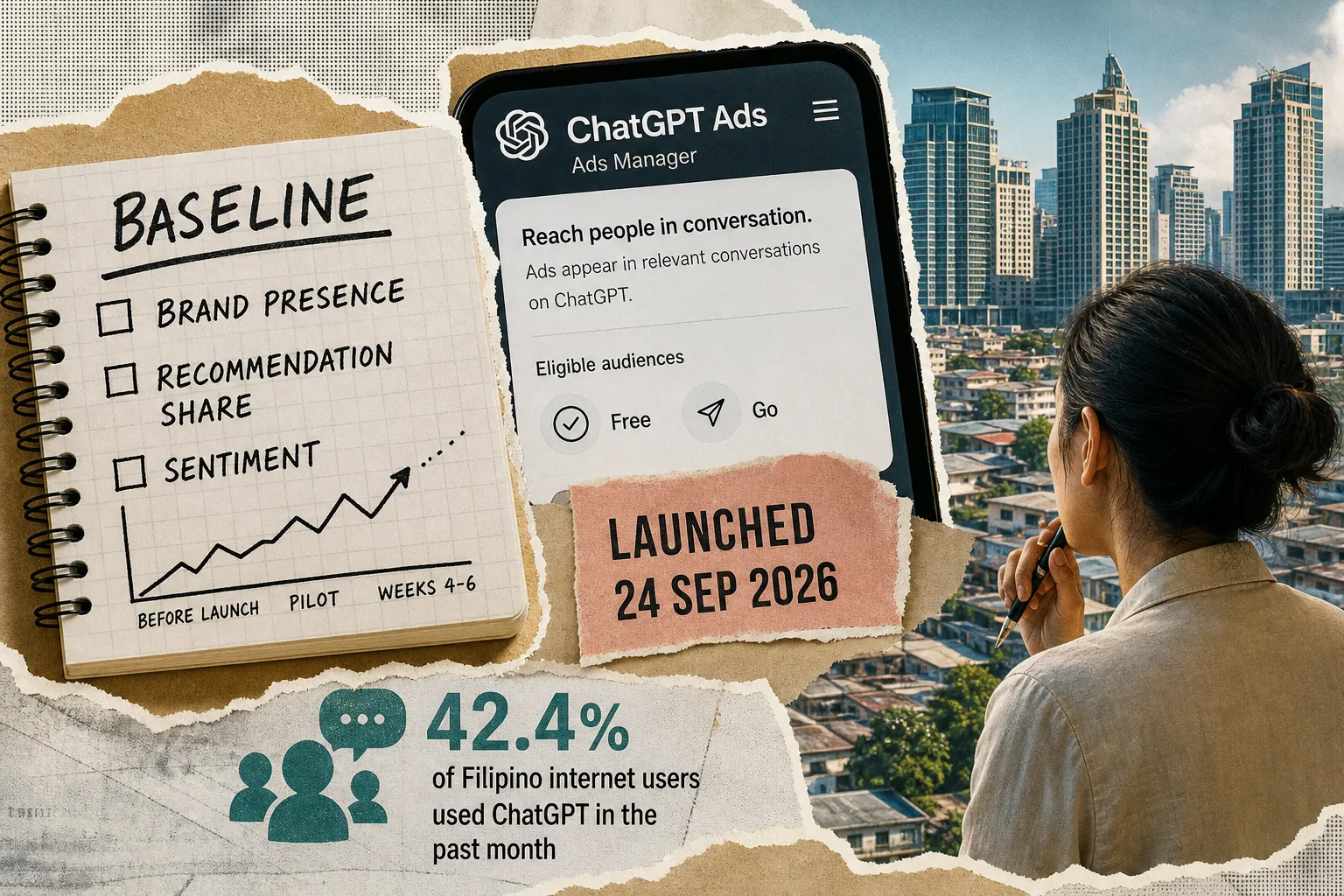
Five rows carry a reputation asset measurement slide. The asset itself. Its launch baseline, taken in launch week: coverage breadth, outlets, languages. Re-citation events, meaning every later occasion the asset gets referenced again and by whom. The sentiment trend across those references, read as directional rather than precise, because automated sentiment across Filipino, Taglish and the vernaculars in between remains a trend indicator rather than a settled measure. And the question the board actually asked, in the board's own words, so the slide answers something real.
Cut it by region and language or it will flatter Metro Manila. Provincial reporting capacity is thin enough that the government is addressing it: PCO Secretary Lino Cayetano has said his office is exploring regional media hubs offering workspaces, internet and basic tools to correspondents and stringers outside Metro Manila, Metro Cebu and Metro Davao, with Ilocos, Panay and Bicol under consideration. That is an announced plan rather than coverage data, and it says nothing about this week's three assets. What it tells you is that a Manila-launched "built for the whole country" claim needs its own evidence before it goes in a report, which is the job monitoring across national, provincial and vernacular media does. The same discipline applies to long-run trend reading generally, and the hidden signal inside monitoring data is a worked example of what a patient window surfaces.
One honest caveat for Philippine teams. No local survey figure on agency reporting windows, measurement horizons or AVE use could be confirmed for this piece, and Marketing-Interactive reports no locally adopted Philippine measurement standard without citing supporting data, so the cadence numbers above are global practitioner data and the Philippine default is an observation rather than a statistic. Worth pairing with the argument Meltwater's Dino Delic makes for AMEC on 2026 USC Annenberg Global Communication Report data: measurement that starts after publication describes, while measurement that starts before planning decides. Run that outward in time as well as forward and the launch-week baseline becomes the cheapest row in the whole report. Client services teams at integrated agencies are the ones who get asked for it first.
Key takeaways
- Open the baseline in launch week. Coverage breadth by outlet and language is the one row that cannot be reconstructed later, and on this cycle's searches the BPI archive registered in a single trade title eight days after launch.
- Track re-citation ahead of reach: how often the asset gets referenced again, by whom, and in what sentiment. No published research measures heritage-asset longevity, so whoever starts the record owns the only version of it.
- Report composition where you have it. A named jury, an authored archive and a signed print stay verifiable for years, which a one-week reach figure does not.
- Sell it as a retainer extension. The same mention stream re-cut on a longer window is a new deliverable without a new data source.
- Keep the basis attached to organiser and company claims. Zero-risk models, 2,000-print precedents and list prices evidence that an investment was made, never that it worked.
About Media Meter
Clip counts do not survive a boardroom, and neither does a two-week reach curve. Media Meter builds decision-grade reporting on AMEC-aligned methodology, calibrated for the Philippine media landscape and for the window the asset actually needs.