ASEAN Summit in Manila Draws Leaders, Protests
The 49th ASEAN Summit and related meetings in Manila brought Chinese, Japanese, Korean, and US leaders into a single day of diplomacy, while the Philippine stock index closed at its lowest level since May 2020 and protests over the Pax Silica initiative continued in Baguio.
The Conversation
Manila hosted the busiest diplomatic day of its 2026 chairmanship of the Association of Southeast Asian Nations (ASEAN) on Monday, November 16, with Chinese Premier Li Qiang, Japanese Prime Minister Sanae Takaichi, South Korean leaders, and United Nations Secretary-General Antonio Guterres all in the capital for summit sessions, while US President Donald Trump departed Washington for the same meetings54175112. The day's most pointed exchange came not from heads of state but from a Chinese academic and a Philippine Coast Guard officer, who clashed publicly over the Second Thomas Shoal, known in the Philippines as Ayungin and in China as Renai Jiao, at a side event called the Manila Dialogue on the South China Sea1.
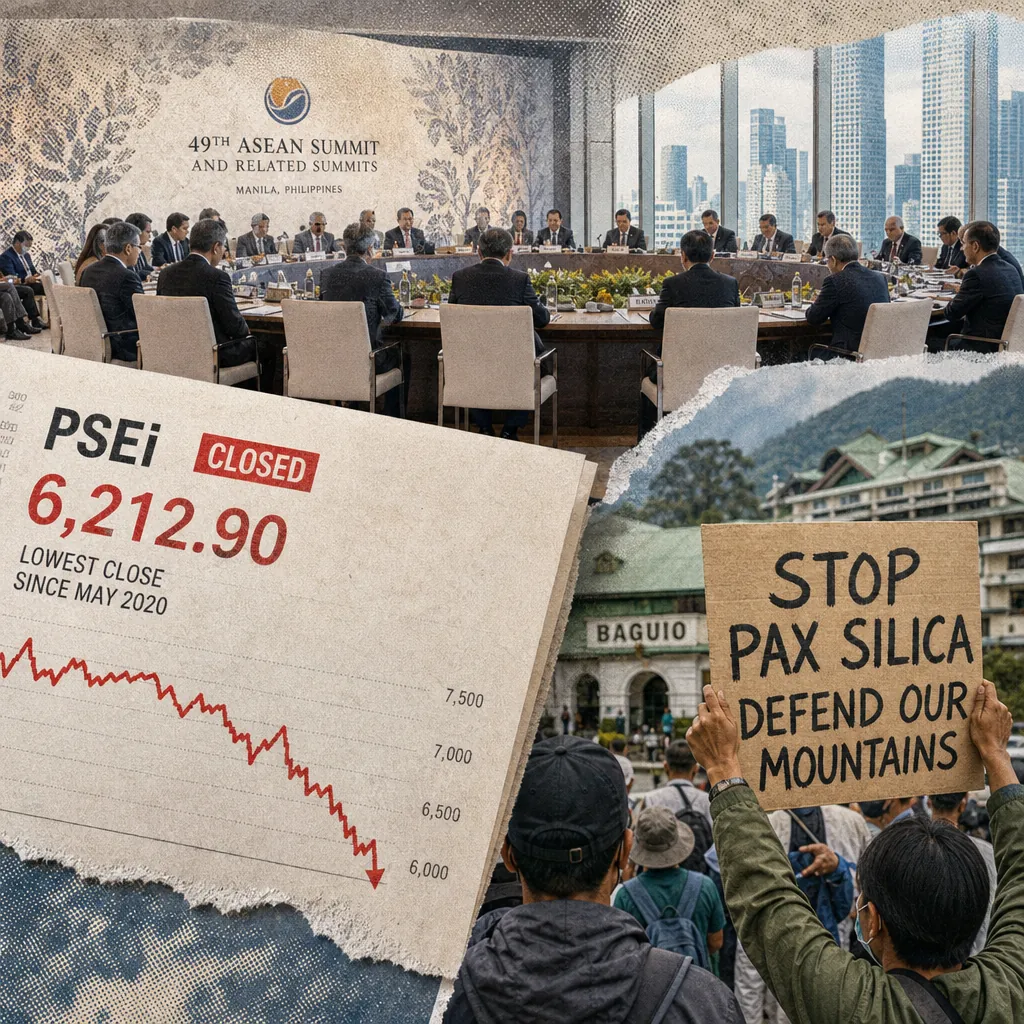
Away from the summit venues, the Philippine Stock Exchange Index (PSEi) — the benchmark that tracks the 30 largest companies listed in Manila — fell 2 percent, or 111.61 points, to close at 5,481.88, its weakest finish since May 18, 2020, when pandemic lockdowns had frozen the economy4296. The same session saw the peso weaken, and analysts attributed the selling to stagflation fears — the combination of slow growth and persistent inflation that erodes household purchasing power while limiting a central bank's room to cut interest rates42. Moody's Analytics, the non-ratings research arm of Moody's Corporation, cut its 2026 growth forecast for the Philippines to 2.4 percent from 3 percent, citing weak domestic demand and a third-quarter gross domestic product expansion of 2.1 percent year-on-year, slower than the upwardly revised 2.4 percent of the prior quarter34.
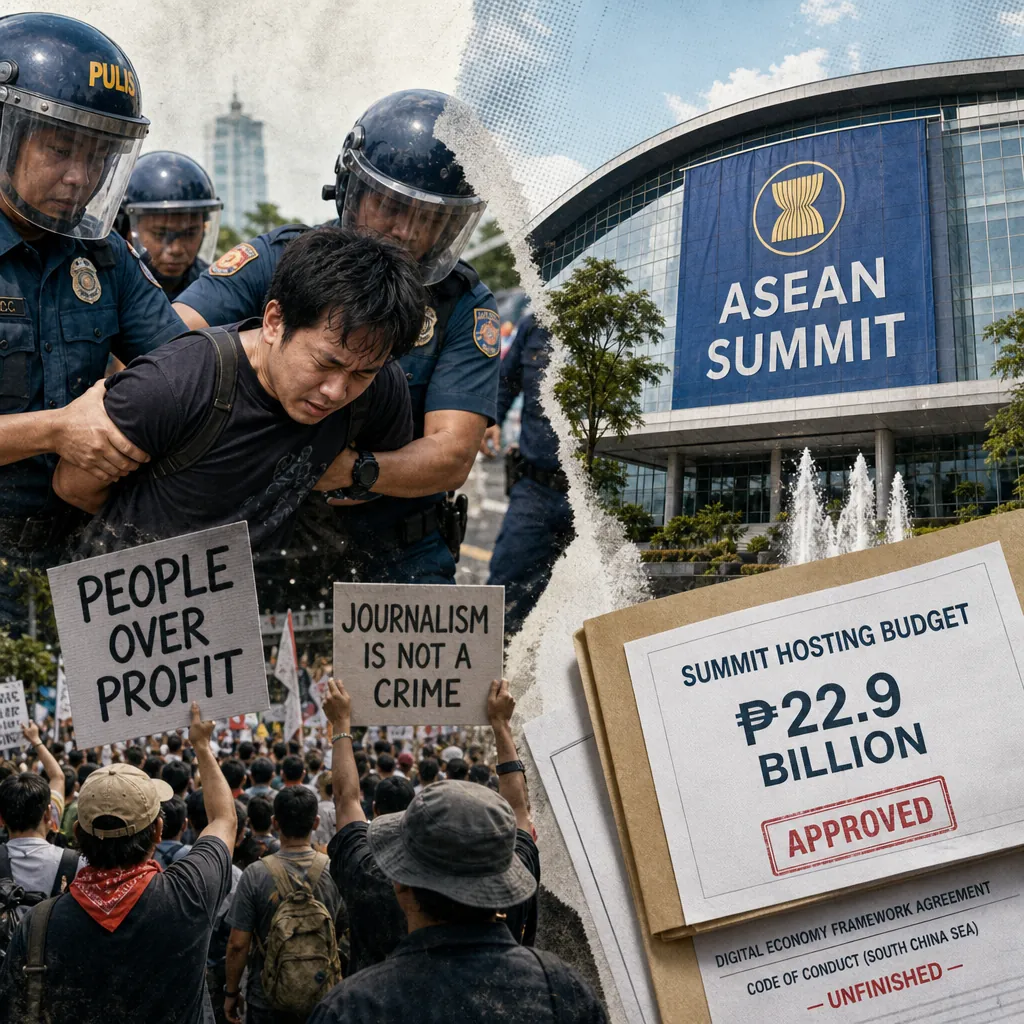
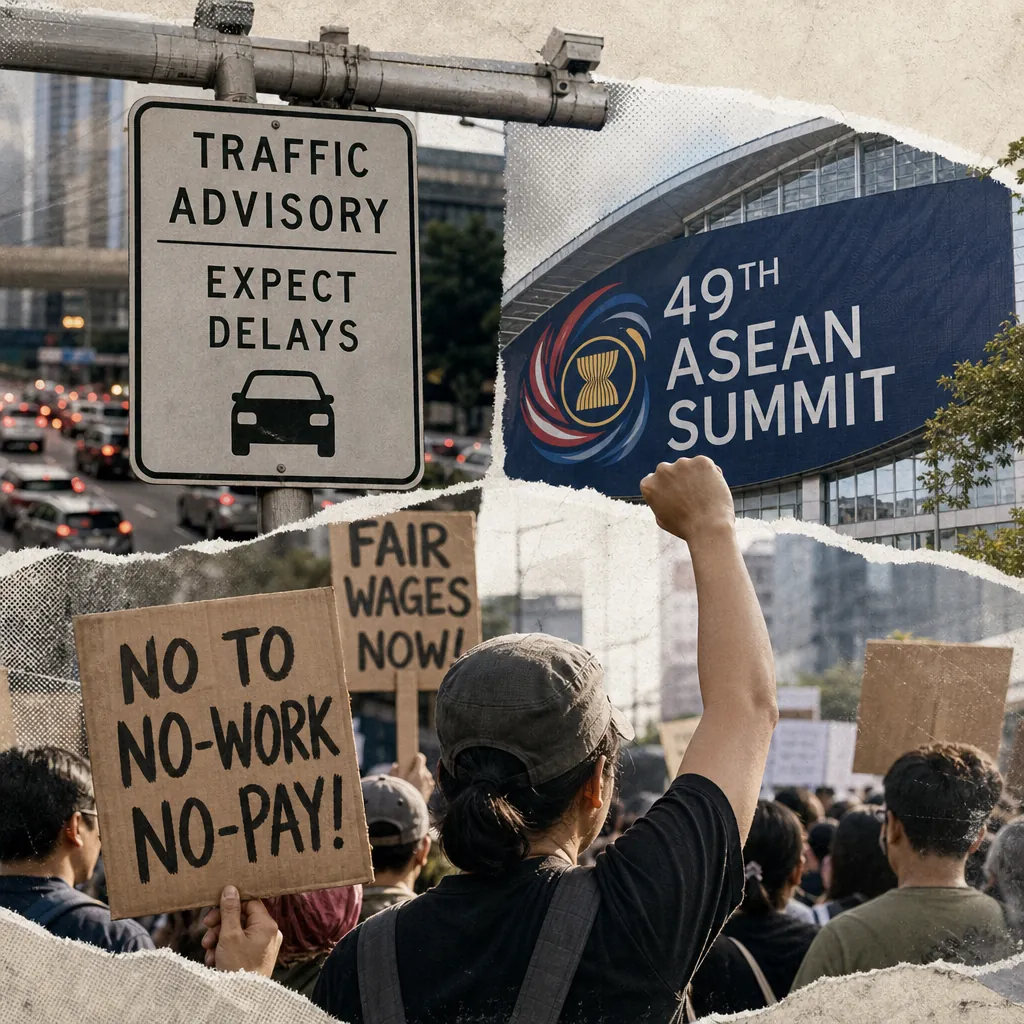
In Baguio City, several hundred activists, Indigenous peoples groups, and students gathered at Igorot Park on Monday afternoon to protest the Pax Silica initiative, condemn the dispersal of a protest caravan and the arrest of its participants in Muntinlupa City a day earlier, and oppose Trump's scheduled visit4. Newsweek reported that more than 300 people were arrested in Manila and Muntinlupa on Sunday as they prepared to march toward the ASEAN gathering63. The day's coverage, across the items captured here, ran along three tracks: the summit's diplomatic output, the Philippine economy's weak footing, and the domestic friction that the summit has brought to the surface.
Key themes
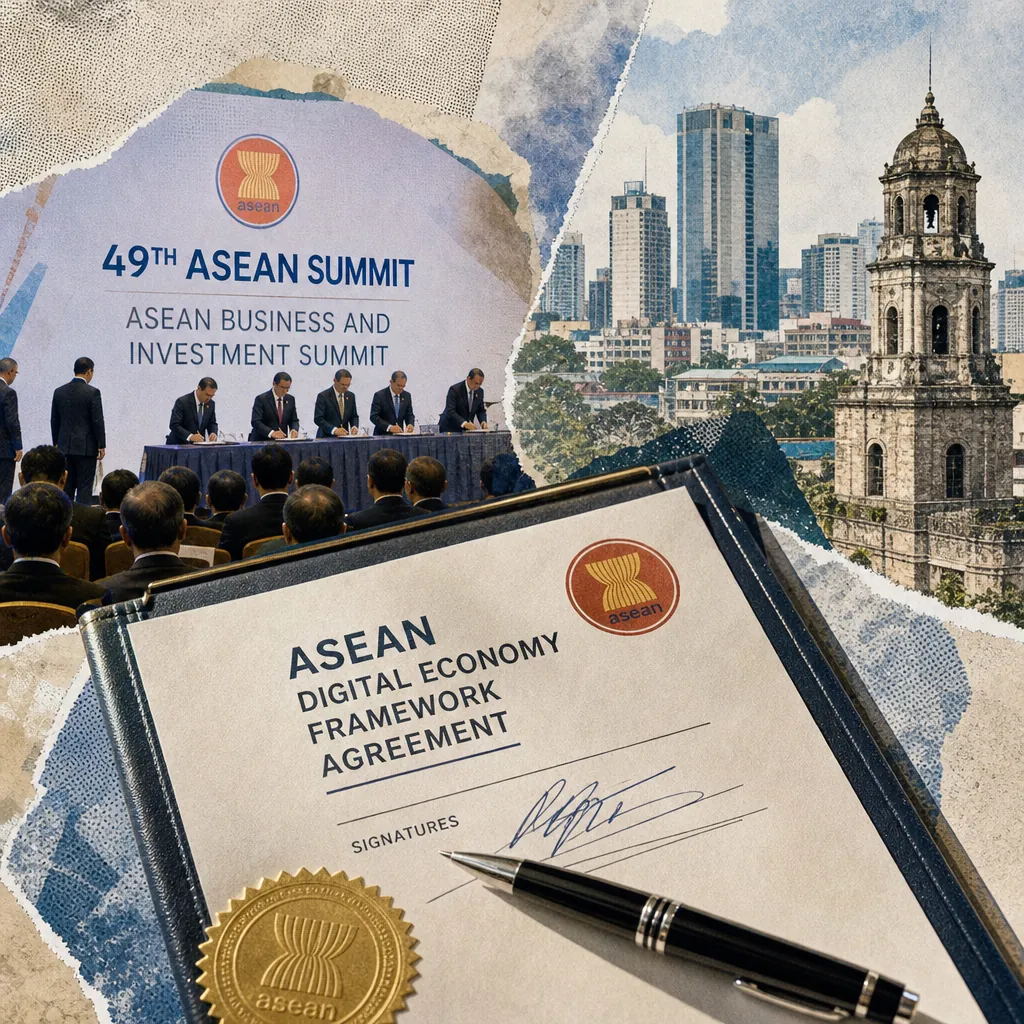
- ASEAN and China signed off on a digital trade pact set for 2027 rollout. Trade Secretary Cristina Roque said the Digital Economy Framework Agreement (DEFA), signed Saturday under the Philippine chairship, will establish common rules on digital trade, electronic payments, cross-border data flows, and cybersecurity, with concrete implementation expected once Singapore takes the chair next year38.
- All 11 ASEAN members have now signed the enhanced memorandum for a $764-billion regional power grid. The Department of Energy said the ASEAN Power Grid (APG) plan, which aims to link electricity systems across the bloc, has cleared its final signature hurdle, with the ASEAN Secretariat estimating in October 2025 that $764 billion is needed for transmission and generation components47.
- The PSEi closed at 5,481.88, its lowest since May 2020. The 2 percent drop came as Moody's Analytics cut its 2026 Philippine growth forecast to 2.4 percent from 3 percent, and as ING said the Philippines could lead Asia in rate cuts next year once inflation subsides423431.
- A Chinese academic proposed paid fishing permits inside the Philippine exclusive economic zone. Shen Dingli of the Beijing-based Grandview Institution floated the idea at the Manila Dialogue on the South China Sea, acknowledging he had not consulted his own government2.
- A Philippine Coast Guard rear admiral rejected a Chinese scholar's account of the Second Thomas Shoal. Rear Adm. Jay Tarriela pushed back after Zheng Zhihua of Shanghai Jiaotong University said China had shown restraint by using only water cannons against what he called Chinese territory1.
- Protests over Pax Silica and Trump's visit continued in Baguio. Activists, Indigenous groups, and students gathered at Igorot Park, with activist Joel Capulong saying, "Trump the war criminal is not welcome in this country"4.
- ASEAN adopted a Philippine-led declaration on foundational learning. The ASEAN Declaration on Foundational Learning (ADFL), developed under the Department of Education's leadership, makes literacy, numeracy, and socio-emotional skills a shared regional priority67.
- Bohol moved toward a state of calamity as El Niño crop damage reached P360.8 million. The Provincial Disaster Risk Reduction and Management Council recommended the declaration after prolonged dry conditions affected more than 15,000 farmers11.
How the narratives stack
Dominant. The ASEAN Summit and its related meetings dominated the day's coverage in the items captured here, with more than a dozen separate stories covering the China-ASEAN summit, the ASEAN-Republic of Korea summit, the ASEAN-Japan bilateral, the UN Secretary-General's remarks on Myanmar, and the various declarations adopted1791191267. Within that cluster, the most consequential single development was the DEFA signing and its 2027 implementation timeline, which Trade Secretary Roque described as "the first in the world"38. The summit also produced a record investment figure: foreign direct investment into Southeast Asia reached $246 billion in 2025, the first time in nearly four decades that the bloc attracted a larger share than East Asia, according to the ASEAN Investment Report 202645.
Counter-narrative. The Philippine economy's weak footing ran as a parallel story through the business pages. The PSEi's 2 percent drop to 5,481.88, its lowest close since May 2020, was the sharpest single data point, but it sat alongside Moody's Analytics' cut to 2.4 percent growth, ING's forecast that the Philippines could lead Asia in rate cuts next year, and Socioeconomic Planning Secretary Arsenio Balisacan's warning that delays in infrastructure flagship projects targeted for completion by 2028 could hamper the recovery in public investment42343146. Remittances provided one offsetting note: cash sent home through banks rose 2.6 percent year-on-year to $3.2 billion in September, the fastest pace in eight months, and the nine-month total of $26.6 billion was 2.3 percent higher than the same period in 202541.
Emerging. The South China Sea exchange at the Manila Dialogue produced two distinct proposals that had not been part of the formal summit agenda. Shen Dingli's suggestion that Chinese boats be allowed to fish inside the Philippine exclusive economic zone in exchange for a fee was framed by its author as a compromise, and he acknowledged the political risk: "I may offend my government by proposing the following idea without consulting with my government"2. Separately, Defense Secretary Gilberto Teodoro Jr. said the Philippines and its security partners are now "better prepared" to respond to any potential crisis, and expressed confidence that the United States would come to Manila's aid should a conflict arise, while noting that any decision to intervene would rest with each ally93.
Under-covered. Several domestic stories with direct consequences for ordinary Filipinos drew only single items in the captured set. Bohol's recommendation for a state of calamity, with P360.8 million in crop damage and more than 15,000 farmers affected, was reported once11. The dengue outbreak in Rosario town, Agusan del Sur, where health authorities have recorded 858 cases and five deaths since January, with 37 cases still active as of Friday, was reported once18. The killing of Judge Joseph Wee Sit of the Isabela City Regional Trial Court Branch 2 in Zamboanga City on November 12 drew several follow-up items — the Supreme Court's vow to hold both gunmen and masterminds accountable, police denials that suspect sketches had been released, and the filing of murder charges against three suspects — but none of these led the day's coverage10650.
Platform insights
- Facebook. The ASEAN 2026 Philippines account carried the summit's official programming, including the Leaders Interface with Representatives of ASEAN Youth at the Philippine International Convention Center, and the Inquirer's coverage drew on Facebook posts from the Presidential Communications Office and the Integrated Bar of the Philippines for photographs and statements161910. The platform served mainly as a distribution channel for official imagery rather than as a site of debate.
- X (formerly Twitter). The DepEd's procurement of 172,654 Apple MacBook Neo units for public school teachers and staff drew skepticism on X, according to a technology blog's account, which noted that "whenever government procurement and Apple appear in the same headline, X.com and Threads naturally light up with skepticism"52. The same post referenced the 2021 DepEd laptop controversy as the reason public reaction was primed for doubt.
- Threads. The MacBook Neo discussion also ran on Threads, per the same account, with users questioning the choice of an Apple product for a mass public-school rollout52.
- Video-driven virality. A video of a tanker carrying 10 Thai nationals crashing into the embankment at Taman Esplanade Marina Wing in Lumut, Malaysia, went viral on social media on Monday, prompting Manjung district police to confirm they had detected the incident after the video circulated21. Photos and videos of items left on the Atugan Bridge in Impasugong, Bukidnon, after a man died in an alleged leap also circulated rapidly on social media that afternoon14.
Key voices and communities
ASEAN heads of state and their delegations. President Ferdinand Marcos Jr. chaired the summit under the theme "Navigating Our Future, Together," and used a gala dinner speech to remind fellow leaders that "governments change, leaders change, the circumstances before us, they change. But the relationships that sustain ASEAN are carried from one generation on to the next"15. Chinese Premier Li Qiang used the China-ASEAN summit to warn against "a growing trend of unilateralism and protectionism" and called on both sides to "jointly opposing external interference and safeguarding regional peace and stability"17. Singapore Prime Minister Lawrence Wong said the strong bonds between China and ASEAN "show another way forward that is based on cooperation and win-win partnership"23.
Philippine security officials. Rear Adm. Tarriela and Defense Secretary Teodoro represented the Philippine government's harder line on maritime disputes. Tarriela's exchange with Zheng Zhihua at the Manila Dialogue was the day's sharpest public disagreement, and Teodoro's remarks on allied readiness framed the Philippines' position ahead of Trump's arrival193.
Civil society and protest groups. Social Watch Philippines led more than 40 Southeast Asian civil society organizations in calling on ASEAN member states to adopt reforms ensuring sustainable public financing and equitable access to universal health care, arguing that the Philippines' Universal Health Care law's "core principles are being bastardized by the state's chronic underfunding, budget diversions, vulnerability to corporate interests, and a fundamental lack of understanding of the role of social health insurance"16. In Baguio, Indigenous groups and students protested Pax Silica and Trump's visit4.
Business and industry groups. Semirara Mining and Power Corp. (SMPC) issued a second strongly worded statement against the Department of Energy's asset-surrender rule, saying the "confiscatory" regulation could scare away investors and that "Pax Silica could be aborted in the womb"33. The statement came days after the DOE conducted its prebid conference and as the Philippines hosted the summit.
Chinese academics. Shen Dingli and Zheng Zhihua, both speaking at the Manila Dialogue, offered a window into how Chinese scholars are framing the maritime dispute. Shen's paid-fishing-permit proposal and Zheng's water-cannon defense of China's position were the two most-quoted remarks from the side event21.
Narrative streams
ASEAN-China summit produces a digital trade pact and competing visions of regional order
The 29th ASEAN-China Summit, held Monday in Manila, brought Chinese Premier Li Qiang together with leaders of the 11-member bloc, and produced both a concrete economic deliverable and a pointed geopolitical message1724. The Digital Economy Framework Agreement, signed Saturday under the Philippine chairship, establishes common rules covering digital trade, electronic payments, cross-border data flows, cybersecurity, and competition policy, and Trade Secretary Roque said implementation would begin in 2027 when Singapore takes the chair38. "This is the first in the world, so we need to get it going as soon as possible," Roque said at a briefing38. The pact matters for ordinary consumers because it aims to eliminate cross-border barriers to payments and online commerce, which could lower the cost of buying goods and services from neighboring countries and make it easier for small businesses to sell across borders.
Li's remarks at the summit were read as a swipe at the United States, coming as Trump traveled to Manila for the same meetings1754. Vietnamese Prime Minister Le Minh Hung used the same session to propose three strategic priorities for ASEAN-China ties, including an early conclusion of a Code of Conduct in the East Sea, Vietnam's term for the South China Sea, in accordance with international law and the 1982 United Nations Convention on the Law of the Sea24. The competing emphases — Li on opposing "external interference," Hung on a binding code of conduct — reflect the different priorities member states bring to the same forum.
The read for the sector: the DEFA's 2027 rollout timeline gives businesses a concrete date to plan around, but ratification by each ASEAN member is still required, and Roque's own framing — "all of us now, in each and every ASEAN country, are going to make sure that we get it ratified" — signals that the hard work is ahead38. Companies that depend on cross-border payments, data transfers, or e-commerce should begin mapping their operations against the pact's expected rules now, because the first movers will shape how the rules are interpreted in practice.
The Manila Dialogue on the South China Sea exposes the gap between Track 1 and Track 2 diplomacy
The Manila Dialogue on the South China Sea, a side event running alongside the summit, produced the day's most direct exchange on the maritime dispute. Zheng Zhihua of Shanghai Jiaotong University argued that China had shown restraint by using only water cannons to defend what he called its territorial integrity, citing the Second Thomas Shoal as an example: "China think[s] the Philippines has occupied Second Thomas Shoal, [a] Chinese territory for more than 27 years. And China only use[s] water cannon[s] as a bigger power"1. Rear Adm. Tarriela pushed back, and the exchange was sharp enough that the Inquirer framed it as "underscoring the tensions surrounding the South China Sea dispute"1.
The Second Thomas Shoal is the site of the BRP Sierra Madre, a Philippine Navy ship deliberately grounded there in 1999 as a military outpost, and it has been the scene of repeated confrontations between Philippine resupply missions and Chinese coast guard vessels. The shoal sits within the Philippines' exclusive economic zone, the 200-nautical-mile area in which a coastal state has special rights to explore and use marine resources under the United Nations Convention on the Law of the Sea.
Shen Dingli's paid-fishing-permit proposal added a second dimension. The Grandview Institution academic suggested allowing Chinese boats to fish inside the Philippine exclusive economic zone in exchange for a fee, framing it as a compromise that accounts for China's large population and food needs, and acknowledging that he had not consulted his own government2. The proposal has no official standing, but it is notable that a Chinese scholar floated a market-based mechanism at a Philippine-hosted event.
The read for the sector: the exchange matters less for what it produced than for what it revealed about the state of the dispute. Track 2 diplomacy — informal dialogue among academics and former officials — is running well ahead of Track 1, the formal government-to-government negotiations, and the gap between the two is where misunderstandings accumulate. Philippine fishing communities in the West Philippine Sea, the term Manila uses for the parts of the South China Sea within its exclusive economic zone, are the group most directly affected by any permit scheme, and they have had no seat at either table.
The Philippine economy's weak footing collides with the summit's investment narrative
The PSEi's 2 percent drop to 5,481.88 on Monday was the day's most concrete economic data point, and it landed in the middle of the Philippines' biggest diplomatic week in years4296. Philstocks Financial traced the decline to a market that had already been sliding, and Regina Capital's Luis Limlingan said investor sentiment remained subdued amid concerns that the Bangko Sentral ng Pilipinas (BSP), the country's central bank, may have limited room to cut rates42. The index closed just 2.53 points above its May 18, 2020 level of 5,479.35, when pandemic lockdowns had frozen the economy96.
Moody's Analytics' cut to 2.4 percent from 3 percent added a second data point, and the firm's reasoning was blunt: "Philippine third-quarter GDP extended the disappointment of the previous quarter, prompting us to trim our forecast for the year"34. ING's Deepali Bhargava offered a countervailing view, saying moderating inflation could give most Asian central banks scope to ease policy in the second half of 2027, with Australia and the Philippines offering the strongest cases for rate cuts to support growth31. Balisacan's warning about infrastructure delays added a third dimension: delays in flagship projects targeted for completion by 2028 could hamper the recovery in public investment that the government is counting on46.
The read for the sector: the gap between the summit's investment narrative — record $246 billion in foreign direct investment into Southeast Asia in 2025 — and the Philippine market's six-year low is the tension that businesses operating in the country will have to navigate45. Companies planning capital expenditure in the Philippines should build in a slower growth path than the government's original projections assumed, and should watch the BSP's rate decisions in the first half of 2027 for signals on when borrowing costs might ease.
Protests over Pax Silica and Trump's visit test the summit's public-facing legitimacy
The Pax Silica initiative, an economic and security agreement that aims to bolster the artificial intelligence supply chain by investing in chip manufacturing and mineral extraction, has drawn more than 20 partner nations including the Philippines63. A proposed AI data center hub in New Clark City, Tarlac, is the Philippine component, and Marcos said in July that the hub would "strengthen the Philippines' position in the global AI" economy63. But the initiative has become a lightning rod for broader grievances. In Baguio on Monday, activists, Indigenous peoples groups, and students gathered at Igorot Park to protest Pax Silica anew and to condemn the dispersal of a protest caravan and the arrest of its participants in Muntinlupa City a day earlier4.
The scheduled visit of Trump on Tuesday drew the strongest criticism. "Trump the war criminal is not welcome in this country," activist Joel Capulong said4. Newsweek reported that more than 300 people were arrested in Manila and Muntinlupa on Sunday as they prepared to march to the ASEAN gathering, and that the groups protesting Trump's arrival were focused on the impacts of Pax Silica in addition to opposition to the war in Iran63.
The read for the sector: the protests matter for technology and energy companies considering the New Clark City hub because they signal that the social license for the project is not settled. Indigenous communities in particular have a legal right to free, prior, and informed consent over projects on their ancestral lands under the Indigenous Peoples' Rights Act, and the Baguio gathering suggests that the consultation process has not satisfied them. Companies should expect the permitting process to be contested and should build community engagement into their timelines rather than treating it as a public-relations afterthought.
ASEAN's economic integration agenda advances on power, investment, and health
Beyond the China summit, Monday produced a cluster of ASEAN integration developments. The Department of Energy said all members have now signed the enhanced memorandum of understanding on the ASEAN Power Grid, a $764-billion plan to link electricity systems across the bloc47. The ASEAN Investment Report 2026 showed foreign direct investment into Southeast Asia reached a record $246 billion in 2025, with intangible-related activities accounting for 56 percent of investment projects45. The ASEAN-Republic of Korea Summit opened with both sides looking to expand cooperation in artificial intelligence and cultural and creative industries91. And the ASEAN Declaration on Foundational Learning, developed under the Department of Education's leadership, was adopted, making literacy and numeracy a shared regional priority67.
Separately, the Department of Budget and Management issued National Budget Circular No. 581-A, allowing government agencies to program counterpart funding for foreign-assisted projects even before the loan agreement is finalized, in an effort to address bottlenecks involving site availability, right-of-way acquisition, procurement, and funding flows39. The Japan International Cooperation Agency (JICA) released P8 billion, equivalent to 20 billion Japanese yen, under its Post-Disaster Standby Loan Phase 3 to support recovery from Typhoons Tino and Uwan40.
The read for the sector: the power grid agreement is the most consequential of these for energy companies, because it creates a framework for cross-border electricity trading that could open new markets for Philippine generators. But the $764-billion figure is an estimate of total needed investment, not committed capital, and the gap between the two will determine how quickly the grid becomes operational. Companies in the power sector should watch for the first cross-border transmission projects to be tendered, likely in 2027.
Domestic security and disaster stories run beneath the summit coverage
Away from the summit, several domestic stories with direct consequences for ordinary Filipinos ran through the day's coverage. In Bohol, the Provincial Disaster Risk Reduction and Management Council recommended a state of calamity after El Niño-driven drought damaged crops worth an estimated P360.8 million and affected more than 15,000 farmers11. Gov. Erico Aristotle Aumentado said the recommendation would facilitate the release of funds and the delivery of assistance11. In Rosario town, Agusan del Sur, health authorities recorded 858 dengue cases and five deaths since January, with 37 cases still active as of Friday18.
In Zamboanga City, the Supreme Court condemned the November 12 killing of Judge Joseph Wee Sit as "a direct assault on judicial independence and the rule of law" and said it was closely monitoring the investigation10. Police Regional Office 9 and the Zamboanga City Police Office denied releasing cartographic sketches of the suspects, warning the public against sharing unverified materials online6. Three suspects were charged with murder before the Zamboanga City Prosecutors Office on Saturday, and all were still being hunted as of Monday50. In Maguindanao del Norte, unidentified motorcycle-riding gunmen ambushed and killed a retired soldier, Danny Alif Lakim, 68, in Datu Odin Sinsuat7. In the Bangsamoro Autonomous Region in Muslim Mindanao (BARMM), a warrant of arrest was issued against a municipal mayor and eight others over an alleged plot to kill a vice mayor, and a barangay chair and two others were wounded in a separate ambush2948.
The read for the sector: these stories matter for any organization operating in Mindanao or the Visayas because they signal that security and disaster risks remain elevated even as the national government's attention is focused on the summit. Companies with operations in Bohol should prepare for possible water and power disruptions as the drought persists, and those with staff in Zamboanga City should monitor the investigation into the judge's killing for signs of wider instability.
Conversation trajectory
The DEFA ratification process (observation window: next 6–12 months). The Digital Economy Framework Agreement was signed Saturday, but each ASEAN member must ratify it before the 2027 rollout can begin38. Watch for the first countries to deposit their instruments of ratification, likely Singapore and the Philippines, and for any member state that signals hesitation. The reasoning: Roque's own framing put the onus on national governments, and the pact's novelty — "the first in the world" — means there is no precedent for how quickly ratification will proceed.
The PSEi's next support level (observation window: next 2–4 weeks). The index closed at 5,481.88, just 2.53 points above its May 2020 low of 5,479.3596. A close below that level would mark a new multi-year low and could trigger further selling. Watch the BSP's next policy meeting and any fourth-quarter GDP release for signals on whether the stagflation fears that drove Monday's decline are confirmed or eased.
Trump's visit and its aftermath (observation window: November 17–19). Trump is scheduled to arrive in Manila on Tuesday, November 17, and protests are expected to continue454. Watch for the size of the demonstrations, any arrests, and the content of Trump's bilateral meetings with Marcos. The reasoning: the Pax Silica protests have already produced more than 300 arrests, and the arrival of the US president is the event that the protest groups have been organizing around.
The Basilan judge killing investigation (observation window: next 4–6 weeks). Three suspects have been charged, but all were still being hunted as of Monday50. Watch for arrests and for any indication that the masterminds have been identified. The Supreme Court's statement that "no judge should have to fear for their life for performing their duties" signals that the judiciary is treating the case as a test of its ability to protect its own10.
Bohol's state of calamity declaration (observation window: next 1–2 weeks). The provincial board must act on the PDRRMC's recommendation11. Watch for the declaration and for the release of funds. The reasoning: the damage figure of P360.8 million and the 15,000 affected farmers give the provincial government a clear basis for action, and the national government's disaster response funds are typically released quickly once a declaration is made.
Trigger events to watch. The APEC CEO Summit in Shenzhen on November 17–18, where Chinese President Xi Jinping will deliver a keynote and where Trump may meet Russian President Vladimir Putin and North Korean leader Kim Jong Un5854. The ASEAN-ROK Summit's follow-through on AI cooperation91. The next Moody's Analytics or ING forecast update on the Philippines3431. And the BSP's next rate decision, which will signal whether the central bank sees room to ease.
Response guidance
For companies with cross-border digital operations, begin mapping DEFA compliance now. The pact's rules on data flows, payments, and cybersecurity will apply to any business that moves data or money across ASEAN borders, and the 2027 timeline gives roughly a year to prepare. Identify which of your operations touch cross-border data transfers and which payment systems you use, and flag any that would need to change under a common-rules regime.
For investors and lenders exposed to the Philippines, stress-test against a 2.4 percent growth scenario. Moody's Analytics' cut from 3 percent to 2.4 percent is the most pessimistic of the major forecasts, but it is consistent with the third-quarter GDP print of 2.1 percent34. Build in a slower recovery than the government's original projections assumed, and watch the BSP's rate path for signals on when borrowing costs might ease.
For technology and energy companies considering the New Clark City hub, treat community consent as a gating issue. The Baguio protests and the Muntinlupa arrests signal that the social license for Pax Silica is contested463. Indigenous communities have legal rights over ancestral lands, and the consultation process should be documented and public. A project that proceeds without visible community support will face permitting delays and reputational risk.
For organizations operating in Mindanao, monitor the Basilan judge killing and the BARMM arrests for signs of wider instability. The Supreme Court's statement and the filing of murder charges signal that the judiciary is treating the case as a priority, but the suspects remain at large1050. Security teams should review travel protocols for staff in Zamboanga City and the BARMM, and should coordinate with local police on any planned movements.
For companies with operations in Bohol, prepare for water and power disruptions. The drought has already damaged P360.8 million in crops and affected more than 15,000 farmers, and a state of calamity declaration would free up funds for response11. Businesses that depend on agricultural supply chains should identify alternative sources, and those with significant water needs should review conservation measures.
For communicators covering the summit, distinguish between the diplomatic output and the domestic friction. The DEFA signing, the power grid agreement, and the investment report are the concrete deliverables, while the protests and the stock market decline are the domestic context384745442. Both are real, and neither cancels the other. Avoid framing the summit as either a success or a failure until the ratification process and the investment follow-through are clearer.
See the full picture behind today's signals.
This report draws from Media Meter's MediaWatch, our real-time monitoring engine tracking 2,470+ Philippine sources across print, broadcast, digital, and social. Explore how the platform turns raw coverage into decision-grade intelligence, then see how it's configured for teams like yours — whether you're in PR agencies, corporate comms, government, or marketing.
Want more? Browse our Report Library for sector and crisis intelligence, or request a demo and we'll have your brand set up before the call.
Want this kind of intelligence on your brand?
This brief is built on the same MediaWatch methodology that runs continuously across every brand we monitor. See your competitive landscape, Impact Score, and narrative trajectory in a 30-minute demo.