Bohol's P1,650 Pompano Sparks Tourism Pricing Debate
A viral complaint about a P1,650 pompano dish in Panglao pushed Bohol's governor to call for fair tourism pricing, while the Philippines courted Indian investment and direct flights. The captured coverage also tracked oil price volatility, coconut exports to China, and AI's arrival in Philippine workplaces.
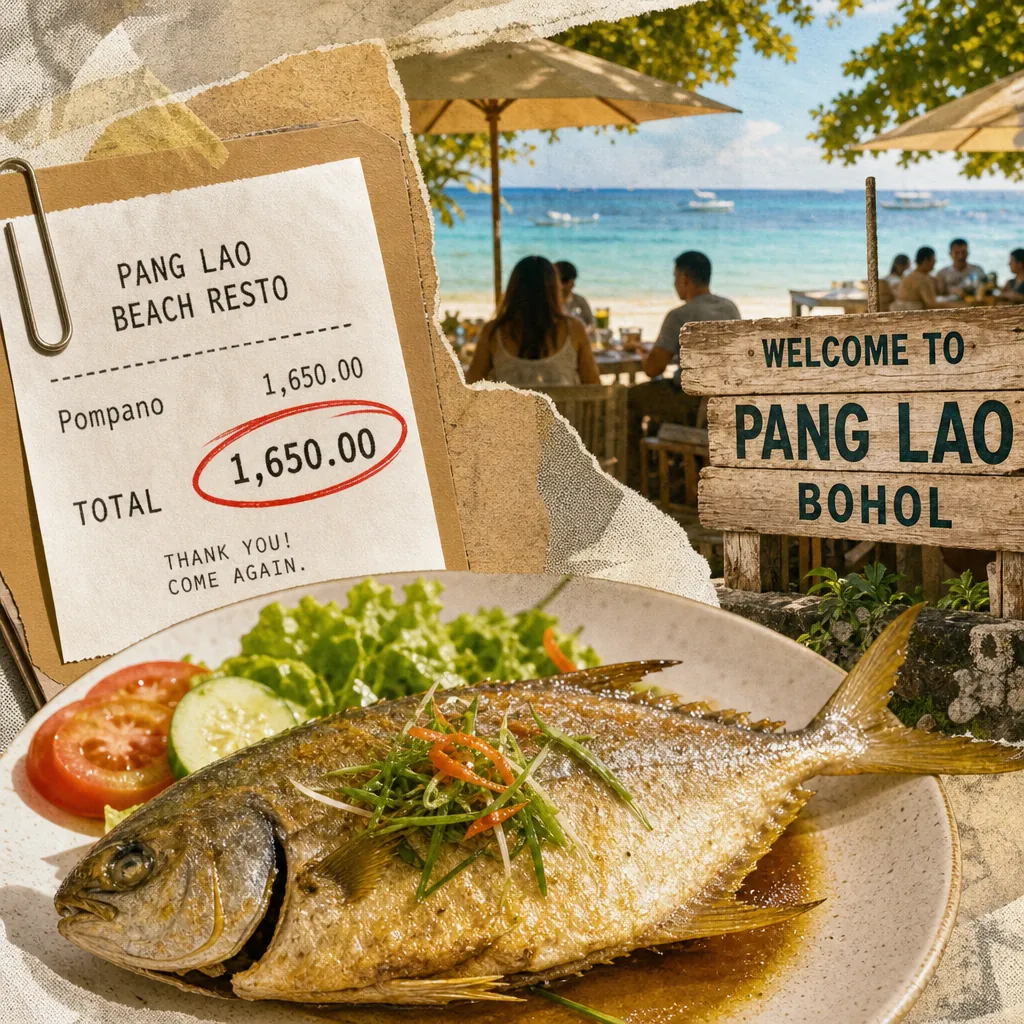
A single fried pompano fish, priced at P1,650 at a resort restaurant in Panglao, Bohol, set off the loudest tourism conversation of the day. The complaint, posted online over the weekend by a Bohol resident, drew agreement from netizens who noted that pompano is abundant in Bohol waters and typically sells for P200 to P300, and that the prepared dish was likely priced at roughly twice what it should have cost 37. By Tuesday, Sept. 15, the story had moved from social feeds to the governor's office: Bohol Gov. Erico Aristotle "Aris" Aumentado issued a statement calling on tourism operators to ensure fair pricing, better service, and sustainable development, saying the province's growing tourism industry should benefit ordinary Boholanos and not only large establishments 1.
The pricing complaint anchored one of two distinct storylines in the day's captured coverage. The other was a government push to deepen economic ties with India: the Department of Trade and Industry (DTI) confirmed it is working with Indian conglomerate InterGlobe Enterprises, parent of IndiGo, India's largest airline, to open direct flights between the two countries, with a Mumbai-Manila route under initial evaluation and Cebu connections to Mumbai and New Delhi to follow 616. The same engagement produced a pledge of $66.78 million in potential Indian investments across technology, manufacturing, and digital services 1755.
Both storylines ran across the items captured for this window, which skewed heavily toward online news and broadsheet business pages. The pompano story generated the most visible public reaction, while the India investment and aviation stories carried the most coverage value in the set. The two are not competing for the same headline; they reflect different parts of the same sector — one about what tourists pay at the destination, the other about how they arrive and what business the country attracts.
Key themes
- A P1,650 fish dish became a national tourism pricing story. The viral complaint about a single pompano at a Panglao resort drew widespread agreement online, with commenters noting the fish typically costs P200 to P300 in Bohol and that the prepared meal was likely priced at roughly double its reasonable cost 37. The Manila Times editorial framed it as a question of whether the Philippines is pricing itself out of the tourism market 37.
- Bohol's governor responded with a call for inclusive tourism. Gov. Aumentado said attracting tourists was only part of the government's responsibility, and that tourism should become a source of opportunities, jobs, and livelihood for Boholanos 1. His statement came on Sept. 15, the same day the pricing debate resurfaced.
- The Philippines is courting direct flights from India. InterGlobe Enterprises, parent of IndiGo, has applied to the Civil Aeronautics Board (CAB) for authority to operate scheduled air services in the Philippines, initially evaluating a Mumbai-Manila route 616. Trade Secretary Cristina Roque met InterGlobe executives in New Delhi on Sept. 12 to discuss the proposal 41.
- Indian firms pledged $66.78 million in potential Philippine investments. The commitments, presented during a roundtable between President Marcos and Indian business leaders, include a $10 million to $50 million electronics assembly and testing facility from VVDN Technologies that could create about 500 manufacturing jobs, and a $6 million plan from Hinduja Global Solutions 17. The expansion is expected to create 3,000 to 5,000 new jobs over three years, with possible sites in Tarlac, Clark, Cagayan de Oro, Dumaguete, and Urdaneta 55.
- Oil price volatility is expected to continue. Energy Secretary Sharon Garin said the Middle East conflict is pushing crude oil prices upward on global markets and that the situation will not end anytime soon, seven months into the conflict 23. The Department of Energy's earlier assessment had been that the scenario would be short-lived.
- Davao coconut processors are targeting China's dairy-alternative market. Coconut processors in the Davao Region are positioning to export coconut milk and coconut water to China, driven by rising demand for dairy alternatives, with the DTI working to overcome certification and logistics hurdles 2227. The Philippines is the country of honor at this year's China-ASEAN Expo, and DTI aims to bring 100 micro, small, and medium enterprises to exhibit 27.
- AI adoption is raising labor and consumer-protection questions in the Philippines. BusinessWorld published pieces on reconciling AI adoption with job security under Philippine labor law 54, on an AI platform helping MSMEs navigate tax rules 57, and on a frustrating customer-service encounter with an AI agent that pretended to be human 52.
- The Philippines is bringing its largest delegation to the China-ASEAN Expo. A 313-strong national delegation, including 73 high-value export enterprises, will attend the 23rd CAEXPO in Nanning, Guangxi, from Sept. 17 to 21, with the Philippines designated as this year's Country of Honor for the second time since 2013 59.
How the narratives stack
Dominant: The pompano pricing complaint and the governor's response. The viral post about a P1,650 pompano dish at a Panglao resort generated the most visible public reaction in the captured set, drawing agreement from netizens who shared their own experiences of being overcharged in Bohol and other destinations 37. The Manila Times editorial, which carried an estimated P543,220 in advertising-equivalent value — the notional cost of buying the same column space as paid advertising — framed the issue as a question of whether the Philippines is pricing itself out of the tourism market 37. Gov. Aumentado's statement on Sept. 15 gave the story an official response, calling for fair pricing and better service while emphasizing that tourism should benefit ordinary Boholanos 1. The Inquirer Online item on the governor's statement carried an estimated P353,052 in advertising-equivalent value 1.
Counter-narrative: The India investment and aviation push. While the pompano story dominated public reaction, the India engagement carried the most coverage value in the captured set. The Manila Times broadsheet item on the Mumbai flights carried an estimated P270,070 in advertising-equivalent value 6, and the Inquirer Online version carried P238,140 16. The investment story carried P239,652 in Inquirer Online 17 and P270,861 in the Manila Times broadsheet 55. The Daily Guardian also covered the flights push, noting that the proposed routes could reduce the cost and time of connecting journeys while improving access for tourism, trade, investment, and air cargo 41. Sunstar Online reported that the investments could generate as many as 7,500 jobs, citing DTI Secretary Roque's statement that the Create More Act — a law that cuts red tape and improves tax incentives for investors — and the government's Green Lanes are making it easier for Indian companies to set up in the Philippines 55.
Emerging: Oil price volatility and its downstream effects. Energy Secretary Garin's statement that volatile fuel prices will continue carried an estimated P521,088 in advertising-equivalent value in Business Mirror Online 23. The story is emerging rather than dominant because it is a forward-looking assessment rather than a discrete event, but its implications for tourism, transport, and consumer prices are direct. Garin noted that even countries that subsidize their oil are considering reducing or cutting back on those subsidies because their subsidy funds are running low 23.
Under-covered: The Davao coconut industry's China ambitions. The coconut export story appeared in two items in the captured set — Head Topics Online and Sunstar Online — with combined advertising-equivalent value of about P650,000 2227. It placed lower than the tourism and investment stories but carries significance for the agriculture sector: the Philippines is the country of honor at this year's China-ASEAN Expo, and DTI is targeting 100 MSMEs for the event 27. Maria Victoria Placer, Davao del Sur provincial director of the DTI and regional coordinator for the Coconut Farmers and Industry Development Plan, said coconut milk and coconut water have particularly strong potential in the Chinese market 27.
Platform insights
Facebook. The pompano pricing complaint originated as a social media post and spread through shares and comments, with netizens sharing their own experiences of being overcharged in Bohol and other destinations 37. The platform served as the primary venue for consumer grievances about tourism pricing, and the volume of agreement suggests the issue resonated beyond the original poster's circle.
X. The platform carried political and policy reactions, including Sen. Bong Go's questions about the absence of naturalized players from the Gilas Pilipinas roster at the 2026 Asian Games 5. The discussion there focused on accountability and the consequences of roster decisions rather than consumer complaints.
Reddit and forums. While the captured writeup does not detail specific Reddit threads, the pattern of online debate about tourism pricing and the cost of doing business in the Philippines suggests these platforms hosted longer-form discussions. The Daily Guardian blog post about the difficulty of doing business in the Philippines, which quoted an MSME owner saying "Ang hirap mag-negosyo sa Pilipinas" during a Senate hearing, reflects the kind of sentiment that circulates in these communities 40.
YouTube. The platform carried entertainment and sports content, including coverage of the Century Tuna Superbods 2026 finals and the Gilas Pilipinas Asian Games elimination 337. Engagement there was driven by event coverage rather than the day's policy stories.
Key voices and communities
Bohol tourism stakeholders and local government. Gov. Aumentado's statement positioned the provincial government as a mediator between tourism operators and ordinary Boholanos, calling for fair pricing and better service while emphasizing that tourism should benefit local livelihoods 1. The governor's framing — "What we want is not simply to attract more tourists to Bohol, but to ensure that tourism becomes a source of opportunities, jobs and livelihood for Boholanos" — set the tone for the official response 1.
National economic managers and the DTI. Trade Secretary Cristina Roque led the engagement with InterGlobe executives in New Delhi on Sept. 12, and the DTI's subsequent announcements about the Mumbai flights and the $66.78 million in Indian investments positioned the agency as the lead driver of the India economic push 161741. Finance Secretary Frederick Go also attended the roundtable with Indian business leaders 17.
Energy sector regulators. Energy Secretary Sharon Garin's assessment that volatile oil prices will continue gave the public a clear signal that fuel costs are unlikely to stabilize in the near term 23. Her statement that "oil prices go up, Filipinos feel it immediately; this is the harsh reality we are facing" framed the issue in direct consumer terms 23.
Davao coconut processors and the DTI regional office. Maria Victoria Placer's comments about the Chinese market opportunity for coconut milk and coconut water positioned the Davao Region as a potential export hub for dairy alternatives 27. The DTI's target of 100 MSMEs for the China-ASEAN Expo reflects the agency's broader export promotion strategy 27.
AI and labor policy commentators. BusinessWorld published multiple pieces on AI's impact on Philippine workplaces, including an analysis of how AI adoption intersects with job security under Philippine labor law 54 and a first-person account of a frustrating encounter with an AI customer-service agent 52. These voices represent a growing community of professionals grappling with the practical implications of AI adoption.
Narrative streams
The pompano complaint and the politics of tourism pricing
The complaint that started it all was simple: a Bohol resident took her family to a restaurant in Panglao and was charged P1,650 for a dinner consisting of one small fried pompano fish 37. She considered the price grossly excessive, and many netizens agreed, pointing out that pompano is abundant in Bohol and typically costs P200 to P300, and that the prepared meal was probably twice what it should have cost 37. Other commenters, some natives of Bohol and others who had visited the island province, shared their own stories of being overcharged 37.
The Manila Times editorial, which carried an estimated P543,220 in advertising-equivalent value, framed the issue as a question of whether the Philippines is pricing itself out of the tourism market 37. The editorial noted that price-gouging of tourists does happen — or is at least perceived to happen — and that it is an issue that needs to be firmly addressed 37. The piece also referenced a similar complaint about Boracay, where a returning visitor complained that prices of hotel accommodations, food, and basic services had gone much higher 42.
Gov. Aumentado's response came on Sept. 15, the same day the pricing debate resurfaced. In a statement, he said attracting tourists was only one part of the government's responsibility, and that the province wants tourism to become a source of opportunities, jobs, and livelihood for Boholanos 1. The Inquirer Online item on his statement carried an estimated P353,052 in advertising-equivalent value 1.
The read for the sector: tourism operators in Bohol and other destinations face growing public scrutiny over pricing, and the provincial government is now positioned as an active mediator. Establishments that rely on tourist spending will need to demonstrate that their prices are fair and that the benefits of tourism reach beyond large resorts. The governor's statement signals that the provincial government is willing to intervene in pricing discussions, which could lead to more formal guidelines or monitoring in the coming months.
India as a source of flights, investment, and jobs
The DTI's engagement with InterGlobe Enterprises, parent of IndiGo, India's largest airline, produced two concrete developments. First, InterGlobe has applied to the Civil Aeronautics Board (CAB) — the government agency that regulates air transport services in the Philippines — for authority to operate scheduled air services, initially evaluating a Mumbai-Manila route 616. The proposed services would connect the Philippines to IndiGo's extensive domestic network and routes to the Middle East, positioning Manila and Cebu as onward-connection points for Indian business travelers, tourists, and cargo 6.
Second, the same engagement produced a pledge of $66.78 million in potential Indian investments. The largest potential investment would come from VVDN Technologies, which is finalizing plans to spend between $10 million and $50 million on an electronics assembly and testing facility that could create about 500 manufacturing jobs 17. The company is considering Subic, First Philippine Industrial Park, or Laguna for the facility 17. Hinduja Group outlined a $6 million investment plan through Hinduja Global Solutions 17. The expansion is expected to create 3,000 to 5,000 new jobs over three years, with possible sites in Tarlac, Clark, Cagayan de Oro, Dumaguete, and Urdaneta 55.
Trade Secretary Roque said the government is making it easier and faster for Indian companies to set up and scale in the Philippines through the Create More Act — a law that cuts red tape and improves tax incentives — and the government's Green Lanes, which fast-track approvals 55. The Manila Times broadsheet item on the Mumbai flights carried an estimated P270,070 in advertising-equivalent value 6, and the Inquirer Online version carried P238,140 16. The investment story carried P239,652 in Inquirer Online 17 and P270,861 in the Manila Times broadsheet 55.
The read for the sector: the Philippines is actively courting Indian investment and aviation links, and the success of these efforts will depend on regulatory approvals and the speed of implementation. For the tourism sector, direct flights from India could open a new source market, but the country will need to ensure that its infrastructure and services can accommodate the additional visitors. For the labor market, the promised jobs in IT-BPM, cybersecurity, digital engineering, and electronics manufacturing would provide high-value employment opportunities in regions outside Metro Manila.
Oil price volatility and the cost of everything
Energy Secretary Sharon Garin said on Tuesday that the country will continue to experience volatile fuel prices as the conflict in the Middle East intensifies 23. "Why is this happening? The Middle East crisis is pushing crude oil prices upward on global markets not just here in the Philippines," she said. "Even other countries that subsidize their oil are considering reducing or cutting back on those subsidies. Because the problem has dragged on, their subsidy funds are running low. So, it is not only the Philippines experiencing this, but many countries around the world. Oil prices go up, Filipinos feel it immediately; this is the harsh reality we are facing" 23.
The DOE's earlier assessment had been that the scenario would be short-lived. Seven months into the conflict, Garin shared the agency's latest assessment: "Based on what is happening in the Middle East….It doesn't look like it will end anytime soon. The conflict there has escalated. So, prices [will continue to be volatile]" 23. The Business Mirror Online item carried an estimated P521,088 in advertising-equivalent value 23.
The read for the sector: oil price volatility affects every part of the economy, from transport costs to food prices to tourism. For tourism operators, higher fuel costs mean higher operating expenses, which could put further pressure on pricing — the very issue that sparked the Bohol complaint. For consumers, the statement from the energy secretary signals that relief is not imminent, and businesses will need to plan for continued uncertainty in fuel costs.
Davao coconut processors target China's dairy-alternative market
Coconut processors in the Davao Region are turning their attention to China as a promising market for coconut milk and coconut water, buoyed by rising demand for dairy alternatives 2227. Maria Victoria Placer, Davao del Sur provincial director of the DTI and regional coordinator for the Coconut Farmers and Industry Development Plan, said the region has an opportunity to tap China's huge consumer market 27. "We see a large potential for coconut products in the Chinese market, considering the large population for this year in the CAExpo, which is the China-Asean Expo. For this year, the Philippines will be the country of honor. DTI has a target of 100 MSMEs, and we are expected to bring 100 MSMEs to have their exhibits in China. Last year, we also brought different coconut products to Shanghai, and we had positive results that time," Placer said 27.
She said coconut milk and coconut water have particularly strong potential in the Chinese market 27. The Head Topics Online item carried an estimated P336,921 in advertising-equivalent value 22, and the Sunstar Online item carried P313,488 27.
The read for the sector: the Davao coconut industry is positioning itself to capture a share of China's growing demand for dairy alternatives, but it faces certification and logistics hurdles. The Philippines' designation as country of honor at the China-ASEAN Expo provides a platform for exporters to showcase their products, and the DTI's target of 100 MSMEs reflects the agency's broader export promotion strategy. For coconut farmers and processors in Davao, the opportunity could mean higher incomes and expanded production, but success will depend on meeting Chinese regulatory requirements and building reliable supply chains.
AI adoption raises labor and consumer-protection questions
BusinessWorld published multiple pieces on AI's impact on Philippine workplaces. One analysis examined how AI adoption intersects with job security under Philippine labor law, noting that because House and Senate bills on AI are still pending, no legislation directly addresses the adoption of AI 54. The piece drew a historical parallel to the 19th-century textile workers who destroyed weaving machines to oppose mechanization, and noted that sectors involved in Business Process Outsourcing (BPO) and Information Technology (IT) are experiencing unprecedented technological change 54. The item carried an estimated P493,575 in advertising-equivalent value 54.
Another piece profiled DocTax, a tax guidance platform using AI to help micro, small, and medium enterprises (MSMEs) navigate Philippine tax rules. DocTax Managing Director Jay Olos said most MSMEs don't have the right resources or expertise to navigate their finances, including taxation, and that most accountants hired by MSMEs are for tax compliance only 57. MSMEs accounted for more than 99% of the country's 1.2 million business establishments in 2024, according to DTI data 57. The item carried an estimated P274,983 in advertising-equivalent value 57.
A third piece, a first-person account, described a frustrating encounter with an AI customer-service agent that pretended to be human. The author's wife repeatedly asked to speak with a human representative, but the AI kept trying to continue the conversation, leading to a 10-minute back-and-forth 52. The item carried an estimated P859,831 in advertising-equivalent value 52.
The read for the sector: AI adoption is advancing faster than the regulatory framework, leaving both employers and workers in uncertain territory. For businesses, the lack of clear rules on AI and job security creates compliance risk. For workers, the prospect of AI-driven displacement is real, particularly in BPO and IT sectors. For consumers, the frustration of dealing with AI agents that pretend to be human is a growing pain point that companies will need to address.
The Philippines brings its largest delegation to the China-ASEAN Expo
The Philippines is bringing its largest delegation to this year's China-ASEAN Expo (CAEXPO), in line with its aim to grow exports, according to the Center for International Trade Expositions and Missions (CITEM) 59. Designated as this year's Country of Honor, the Philippines is being represented by a 313-strong national delegation, including 73 high-value export enterprises, at the 23rd CAEXPO being held at the Nanning International Convention and Exhibition Center in Guangxi, China, from Sept. 17 to 21 59. This is the second time the Philippines has been named CAEXPO's Country of Honor, following its designation in 2013 59.
Carrying the theme "The Philippines is Programmed for Business and Growth," the country's 73 exhibitors include enterprises in agrifood, lifestyle, home and fashion, personal care and allied services, tourism, banking, and pharmaceuticals 59. The Philstar Online item carried an estimated P382,304 in advertising-equivalent value 59.
The read for the sector: the Philippines' participation in CAEXPO is part of a broader push to expand exports to China and other ASEAN markets. For exporters, the event provides a platform to showcase products and build relationships with Chinese buyers. For the coconut industry in Davao, the expo is a direct opportunity to test the Chinese market for coconut milk and coconut water. The success of the delegation will be measured in deals signed and partnerships formed, not just in attendance.
Conversation trajectory
Over the next 2–4 weeks: Bohol tourism pricing guidelines. The provincial government's response to the pompano complaint could lead to formal guidelines or monitoring of tourism pricing in Panglao and other destinations. Watch for statements from the Bohol provincial government or the Department of Tourism on pricing standards. The trigger event would be any announcement of a price monitoring mechanism or a meeting between tourism operators and local government officials.
Over the next 4–8 weeks: CAB decision on InterGlobe's application. The Civil Aeronautics Board will review InterGlobe's application to operate scheduled air services in the Philippines. A decision could come within weeks, and approval would set the stage for the launch of Mumbai-Manila flights. Watch for announcements from the CAB or the DTI on the status of the application. The trigger event would be a public hearing or a decision from the CAB.
Over the next 1–3 months: Implementation of Indian investment commitments. The $66.78 million in potential investments from Indian companies will need to move from pledges to actual projects. Watch for announcements from VVDN Technologies on the location of its electronics assembly and testing facility, and from Hinduja Global Solutions on its expansion plans. The trigger event would be a signed investment agreement or a groundbreaking ceremony.
Over the next 3–6 months: Oil price trajectory. The Department of Energy's assessment that volatile oil prices will continue means consumers and businesses should prepare for sustained uncertainty. Watch for monthly oil price adjustments and any statements from the DOE on the duration of the volatility. The trigger event would be a significant escalation or de-escalation of the Middle East conflict.
Over the next 2–4 weeks: China-ASEAN Expo outcomes. The Philippines' participation in CAEXPO from Sept. 17 to 21 will produce deals and partnerships that could shape export performance in the coming months. Watch for announcements from CITEM or the DTI on sales generated and agreements signed during the event. The trigger event would be the conclusion of the expo and the release of initial results.
Over the next 6–12 months: AI regulation in the Philippines. The pending House and Senate bills on AI will shape how companies adopt the technology and how workers are protected. Watch for legislative hearings or committee reports on the AI bills. The trigger event would be a committee vote or a floor debate on the legislation.
Response guidance
Tourism operators: Audit your pricing and communicate value. The pompano complaint has put tourism pricing under a national spotlight. Operators in Bohol and other destinations should review their menu prices and service charges to ensure they are defensible, and be prepared to explain the value behind their pricing — whether it is the quality of ingredients, the location, or the experience. Proactive communication about pricing rationale can help defuse criticism before it escalates.
Local government units: Engage tourism stakeholders before the next complaint. The Bohol governor's response was swift, but the underlying issue — the perception that tourists are being overcharged — is not new. Local governments in tourism-dependent areas should convene tourism operators, consumer groups, and community representatives to discuss pricing standards and dispute-resolution mechanisms. A formal channel for complaints can prevent individual grievances from becoming viral stories.
Businesses courting Indian investment: Highlight job creation and regional spread. The $66.78 million in potential Indian investments is a positive story, but its impact will be measured in jobs created and regions benefited. Companies should communicate clearly about the number and location of jobs, and about their plans to train and hire locally. The DTI's emphasis on the Create More Act and Green Lanes provides a policy context that businesses can reference when explaining their investment decisions.
Energy-intensive businesses: Plan for continued fuel price volatility. The energy secretary's statement that volatile oil prices will continue means businesses should factor fuel costs into their budgeting and pricing decisions. Companies in transport, logistics, and tourism should consider hedging strategies or efficiency measures to mitigate the impact of price swings. Communicating these plans to customers can help manage expectations about price adjustments.
Exporters targeting China: Prepare for certification and logistics requirements. The Davao coconut industry's push into China highlights the opportunities and challenges of exporting to the Chinese market. Exporters should invest in meeting Chinese certification requirements and building reliable logistics chains. The China-ASEAN Expo provides a platform to test the market and build relationships, but success will depend on follow-through after the event.
Employers adopting AI: Develop clear policies on job security and customer service. The BusinessWorld pieces on AI adoption highlight two risks: the displacement of workers and the frustration of customers dealing with AI agents. Employers should develop clear policies on how AI will be used, how workers will be retrained or redeployed, and how customers can reach human representatives when needed. Transparency about AI use can build trust with both employees and customers.
Communicators in the tourism sector: Monitor social media for pricing complaints. The pompano complaint originated as a social media post and spread quickly. Tourism businesses and local governments should monitor social media for similar complaints and respond promptly and transparently. Acknowledging the issue and explaining what is being done to address it can prevent a single complaint from becoming a national story.
See the full picture behind today's signals.
This report draws from Media Meter's MediaWatch, our real-time monitoring engine tracking 2,470+ Philippine sources across print, broadcast, digital, and social. Explore how the platform turns raw coverage into decision-grade intelligence, then see how it's configured for teams like yours — whether you're in PR agencies, corporate comms, government, or marketing.
Want more? Browse our Report Library for sector and crisis intelligence, or request a demo and we'll have your brand set up before the call.
Want this kind of intelligence on your brand?
This brief is built on the same MediaWatch methodology that runs continuously across every brand we monitor. See your competitive landscape, Impact Score, and narrative trajectory in a 30-minute demo.