Oil Price Hikes Drive Fuel Tax, Fare Review
A third straight week of pump-price increases pushed the Philippine government to weigh suspending fuel excise taxes and to order a fare-hike review, while a separate study warned that African swine fever threatens the Palawan bearded pig.
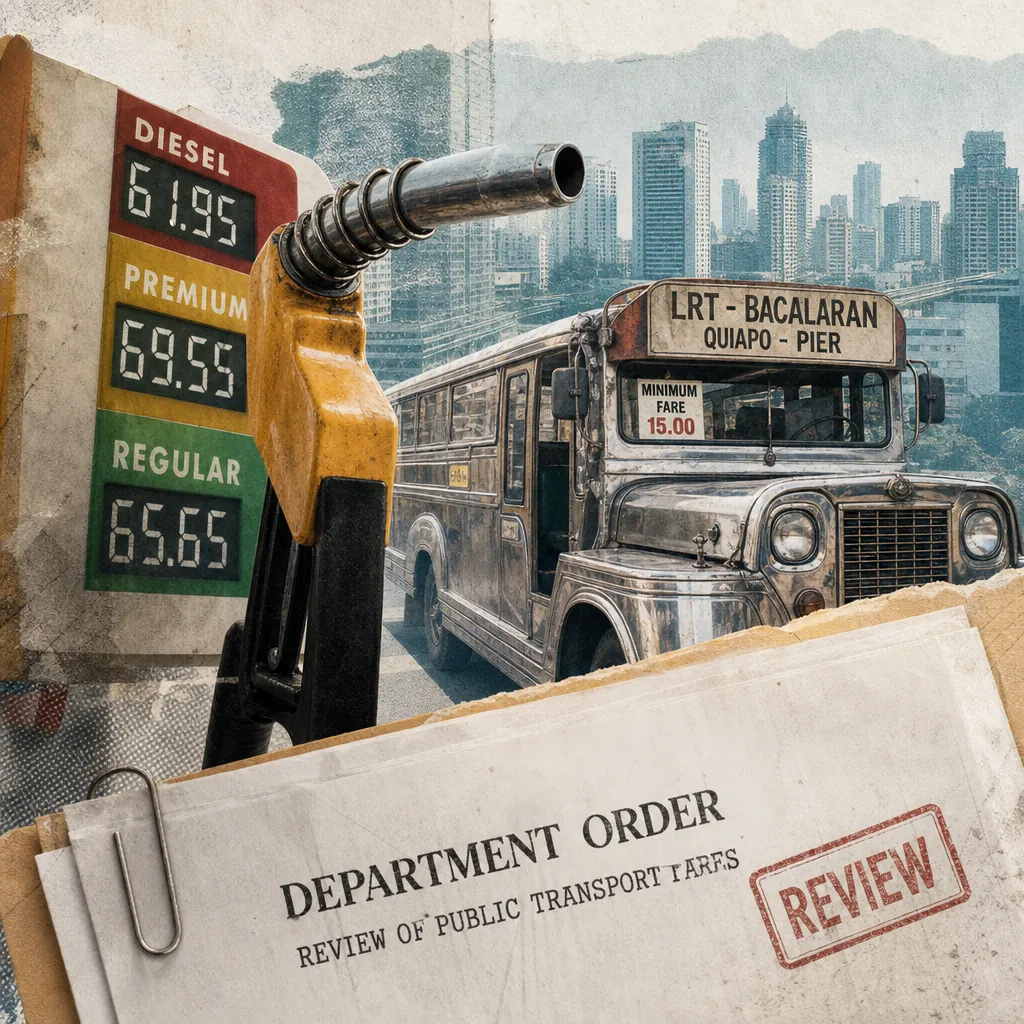
A third consecutive week of pump-price increases has put the Philippine government's fuel-tax and transport-fare machinery into motion, with the Department of Energy certifying that world oil prices have crossed the threshold that allows the President to suspend or cut excise taxes on petroleum products, and the Department of Transportation giving the Land Transportation Franchising and Regulatory Board until October to decide on fare-hike petitions.2432 The same oil pressure is being felt across the region: in Syria, a government decree raised diesel prices by 40 percent and petrol by 28 percent overnight, triggering protests that blocked the M4 highway and stranded hundreds of oil tankers.20 In the Philippines, the conversation is less about street protest than about how quickly relief can be delivered through tax policy and subsidies.
The day's coverage was dominated by broadcast and radio items tracking the excise-tax question and the fare-review deadline, with Malacañang repeatedly saying it is waiting for a formal recommendation from the Development Budget Coordination Committee (DBCC) before President Ferdinand Marcos Jr. acts.2464 The DBCC is the inter-agency body that sets the government's macroeconomic assumptions and budget targets; under Republic Act No. 12316, signed in March 2026, the President may suspend or reduce excise taxes on petroleum products once Dubai crude exceeds $80 per barrel for a defined period.24 The Department of Energy has submitted a certification that the threshold has been breached, but the DBCC has not yet issued its recommendation.24
On the transport side, Transportation Secretary Giovanni Lopez gave the LTFRB a one-month deadline to issue a recommendation on pending fare-hike petitions, while also floating an expansion of fuel subsidies for public utility vehicles.32 The LTFRB is the agency that sets fares and franchise rules for buses, jeepneys, and UV Express vans. Acting LTFRB Chairperson Greg Pua said the board may recommend raising the diesel discount for jeepney and UV Express operators to ₱20 per liter from the current ₱12, which the government estimates saves operators up to ₱1,800 per week.32 Some drivers interviewed by DZMM Teleradyo said the discount is not enough and that they would prefer a wage increase instead.37
Key themes
- Oil prices are set to rise for a third straight week. Based on the first two days of trading in the Mean of Platts Singapore benchmark, diesel may increase by ₱9.50 to ₱10 per liter and gasoline by ₱4 to ₱4.50 per liter next week, according to industry sources cited by Manila Standard.24 The Mean of Platts Singapore is the pricing benchmark used by oil importers in the region.
- The government's fuel-tax relief hinges on a DBCC recommendation. Malacañang has said it is waiting for the DBCC's formal assessment before President Marcos decides whether to suspend or reduce excise taxes on petroleum products, even though the Department of Energy has already certified that Dubai crude has exceeded the $80-per-barrel trigger under Republic Act No. 12316.24
- The LTFRB has until October to decide on fare hikes. Transportation Secretary Giovanni Lopez gave the LTFRB a one-month deadline to issue a recommendation on pending fare-hike petitions, while the government studies expanded fuel subsidies for public utility vehicle operators.32
- A fuel subsidy increase to ₱20 per liter is under consideration. Acting LTFRB Chairperson Greg Pua said the board may recommend raising the diesel discount for jeepney and UV Express operators to ₱20 per liter from ₱12, and may seek additional funding from the Department of Transportation to sustain the discount through the end of 2026.37
- Malacañang says fuel supply remains sufficient. Palace Press Officer Claire Castro said the government's UPLIFT program is helping cushion the impact of the Gulf crisis, and that the President does not want the country to run out of crude oil.64 UPLIFT is a government program that provides fuel discounts and assistance to transport workers and other affected sectors.
- A new study warns that African swine fever threatens the Palawan bearded pig. A roadmap published in Nature Reviews Biodiversity on September 15 says ASF has caused near-total mortality in some wild pig populations in Asia and could drive several island-endemic species to extinction within a single generation.3 The study documents confirmed infections in four wild pig species and suspected infections in two others across 20 Asia-Pacific countries since 2018.3
- The Department of Agriculture is studying a ₱210-per-kilo floor price for live hogs. Agriculture Secretary Francisco Tiu Laurel Jr. said the DA will ask buyers to follow the proposed price because the agency has no legal power to enforce it, as farm-gate prices have fallen to ₱120 to ₱150 per kilo, below the break-even level for many raisers.42
- The Energy Regulatory Commission's price cap for Visayas and Mindanao is expected to cut spot-market electricity prices. The Department of Energy supports the ERC's secondary price cap, which took effect in the August 2026 billing period; simulations show average prices in the Wholesale Electricity Spot Market could fall by 54 percent in Visayas and 56 percent in Mindanao.5
How the narratives stack
Dominant: The excise-tax and fare-hike story dominated the captured coverage, with more than a dozen broadcast, radio, and online items tracking the DBCC's pending recommendation and the LTFRB's October deadline.243237 The story's dominance within this set reflects both the breadth of the monitoring and the genuine public interest in fuel prices, which affect transport costs, food prices, and household budgets. The Department of Energy's certification that Dubai crude has exceeded $80 per barrel is the clearest signal that relief may be coming, but the DBCC's silence so far means the timing remains uncertain.24
Counter-narrative: The African swine fever study published in Nature Reviews Biodiversity offers a counterpoint to the day's economic focus, warning that the disease's impact on wild pig populations could be irreversible.3 The Palawan bearded pig, a species found only in the Philippines, is among those the study says should be prioritized for emergency protection. The study's authors say ASF has spread to 20 countries in the Asia-Pacific region since it was first detected in China in 2018, and that some island-endemic species could be driven to extinction within a single generation.3 This story ran mainly in online news outlets and did not receive the same broadcast attention as the fuel-price story.
Emerging: The Department of Agriculture's proposed ₱210-per-kilo floor price for live hogs is an emerging intervention in the pork supply chain, where farm-gate prices have fallen to ₱120 to ₱150 per kilo, below the break-even level for many raisers.42 The DA's admission that it lacks legal power to enforce the price means the proposal depends on voluntary compliance from buyers, which makes its impact uncertain. Pork imports reached 510,000 metric tons in the first seven months of 2026, up 10 percent from the same period in 2025, adding pressure on domestic raisers.42
Under-covered: The Energy Regulatory Commission's secondary price cap for Visayas and Mindanao received less attention than the fuel-tax story, even though the Department of Energy says it could cut average spot-market electricity prices by more than half in those regions.5 The cap is designed to protect consumers from sudden price spikes when supply is tight, and its impact on household electricity bills could be significant for consumers in the Visayas and Mindanao. The story ran mainly on radio and online news outlets, with limited broadcast coverage.5
Platform insights
Facebook: The day's most-shared items on Facebook were broadcast clips from GMA News and DZMM Teleradyo about the excise-tax question and the fare-hike deadline, with comment threads dominated by complaints about the cost of living and calls for faster government action.2437 The platform's role was mainly as a distribution channel for broadcast content rather than a source of original reporting.
X: Discussion on X focused on the political dimensions of the fuel-price crisis, with users debating whether the government's response has been too slow and whether the excise-tax suspension should be automatic once the $80 threshold is breached.24 The platform's fast-moving format made it a venue for real-time reactions to the DBCC's pending recommendation.
Reddit: A thread on r/Philippines discussed the practical impact of the fare-hike review on commuters, with users sharing personal experiences of rising transport costs and debating whether the fuel subsidy increase to ₱20 per liter would be enough to prevent a fare increase.37 The thread's tone was more analytical than the Facebook comment sections, with users citing the LTFRB's budget constraints and the government's fiscal position.
YouTube: Broadcast clips from GMA News and Net 25 about the oil price hike and the FAO's warning on global food supply received moderate view counts, with comment sections reflecting concern about the broader economic impact of the Middle East conflict.2433 The platform's longer-form format allowed for more detailed explanations of the excise-tax mechanism and the DBCC's role.
Key voices and communities
Transport groups and drivers: Jeepney and UV Express operators are the most directly affected by the fuel-price increases, and their petitions for fare hikes have set the LTFRB's October deadline in motion.32 Drivers interviewed by DZMM Teleradyo said the ₱12-per-liter discount is insufficient and that they would prefer a wage increase, reflecting the gap between the government's subsidy approach and the sector's demand for higher fares.37
Government economic managers: The DBCC, the Department of Energy, the Department of Transportation, and the LTFRB are the key decision-makers in the fuel-tax and fare-review process, and their recommendations will determine whether relief reaches consumers before the end of the year.2432 The DBCC's pending assessment is the main bottleneck, as Malacañang has said it will not act without a formal recommendation.24
Agriculture sector: Hog raisers and the Department of Agriculture are the main voices in the pork supply story, with the DA proposing a ₱210-per-kilo floor price to help raisers cope with falling farm-gate prices.42 The DA's lack of enforcement power means the proposal's success depends on voluntary compliance from buyers, which makes the sector's outlook uncertain.
Conservation scientists: The authors of the African swine fever study published in Nature Reviews Biodiversity are the key voices in the wildlife conservation story, warning that ASF could drive several island-endemic wild pig species to extinction.3 Their roadmap calls for emergency protection measures for species like the Palawan bearded pig, which is found only in the Philippines.
Energy regulators: The Energy Regulatory Commission and the Department of Energy are the main voices in the electricity price-cap story, with the ERC's secondary price cap for Visayas and Mindanao expected to cut spot-market prices by more than half in those regions.5 Energy Secretary Sharon Garin said consumers in Visayas and Mindanao should not bear the burden of excessive price increases when supply is tight.5
Narrative streams
Fuel tax suspension awaits DBCC recommendation
The Department of Energy has certified that Dubai crude oil has exceeded the $80-per-barrel threshold required under Republic Act No. 12316 for the President to suspend or reduce excise taxes on petroleum products, but the DBCC has not yet issued its formal recommendation.24 The law, signed in March 2026, was designed to give the President a faster tool to respond to oil price spikes than the previous deregulated regime, which required three consecutive months of average prices above $80 before any action could be taken.24 Palace Press Officer Claire Castro said the President will act quickly once the DBCC submits its recommendation, but that no final assessment has been made.24 The delay matters for consumers because excise taxes on petroleum products add several pesos per liter to pump prices, and suspending them could provide immediate relief. The read for the sector is that oil importers and transport operators should prepare for either outcome: if the DBCC recommends suspension, pump prices could fall within weeks; if it does not, the fare-hike petitions before the LTFRB will become the main channel for relief.24
LTFRB given October deadline on fare hikes
Transportation Secretary Giovanni Lopez gave the LTFRB a one-month deadline to issue a recommendation on pending fare-hike petitions, saying the agency should continue hearings while the government studies other ways to help transport groups.32 The LTFRB is considering raising the diesel discount for jeepney and UV Express operators to ₱20 per liter from ₱12, and may seek additional funding from the Department of Transportation to sustain the discount through the end of 2026.37 Lopez said the government must balance helping operators with protecting commuters from fare increases that could worsen inflation.32 Some drivers said the discount is not enough and that they would prefer a wage increase, reflecting the sector's view that subsidies are a temporary fix.37 The read for the sector is that transport operators should expect a decision by October, but the form of relief—whether a fare increase, a higher subsidy, or both—remains uncertain, and commuters should prepare for the possibility of higher fares if the LTFRB approves the petitions.32
Malacañang says fuel supply is sufficient
Palace Press Officer Claire Castro said the government's UPLIFT program is helping cushion the impact of the Gulf crisis, and that the President does not want the country to run out of crude oil.64 UPLIFT is a government program that provides fuel discounts and assistance to transport workers and other affected sectors. Castro said the Department of Energy has confirmed that supply remains sufficient, and that the government is monitoring the situation closely.64 The assurance comes amid concerns that the closure of Saudi Arabia's oil export routes—the Strait of Hormuz, Bandar al Mandab, and the East-West Pipeline—could disrupt global supply.42 The read for the sector is that fuel supply is not currently at risk, but the government's ability to maintain supply depends on the duration of the Middle East conflict and the effectiveness of alternative sourcing arrangements.64
African swine fever threatens wild pig species
A roadmap published in Nature Reviews Biodiversity on September 15 warns that African swine fever has caused near-total mortality in some immunologically naive wild pig populations in Asia and could drive several island-endemic species to extinction within a single generation.3 The study documents confirmed infections in four wild pig species and suspected infections in two others across 20 Asia-Pacific countries since 2018, when the disease was first detected in China.3 The Palawan bearded pig, a species found only in the Philippines, is among those the study says should be prioritized for emergency protection.3 The read for the sector is that conservation groups and government wildlife agencies should prepare for the possibility that ASF could spread to more wild pig populations, and that emergency protection measures—such as vaccination programs or habitat isolation—may be needed to prevent extinctions.3
DA studies floor price for live hogs
Agriculture Secretary Francisco Tiu Laurel Jr. said the Department of Agriculture is studying a proposal to set a ₱210-per-kilo floor price for live hogs to help raisers cope with falling farm-gate prices, which have dropped to ₱120 to ₱150 per kilo, below the break-even level for many raisers.42 The DA will ask buyers to follow the proposed price because the agency has no legal power to enforce it.42 Pork imports reached 510,000 metric tons in the first seven months of 2026, up 10 percent from the same period in 2025, adding pressure on domestic raisers.42 The read for the sector is that hog raisers should not expect immediate relief from the floor price unless buyers voluntarily comply, and that the DA's limited enforcement power means the proposal's impact will depend on market cooperation.42
ERC price cap to cut electricity costs in Visayas and Mindanao
The Department of Energy supports the Energy Regulatory Commission's secondary price cap for Visayas and Mindanao, which took effect in the August 2026 billing period to protect consumers from sudden electricity price spikes when supply is tight.5 Simulations by the ERC show average prices in the Wholesale Electricity Spot Market could fall by 54 percent in Visayas, from ₱18.59 per kilowatt-hour to ₱8.47, and by 56 percent in Mindanao, from ₱19.56 per kilowatt-hour to ₱8.69.5 Energy Secretary Sharon Garin said consumers in Visayas and Mindanao should not bear the burden of excessive price increases when supply is short.5 The read for the sector is that electricity consumers in Visayas and Mindanao could see lower bills in the coming months if the price cap is sustained, but the cap's long-term impact depends on whether it encourages new investment in generation capacity or discourages it.5
Conversation trajectory
Over the next one to two weeks: The DBCC is expected to issue its recommendation on the excise-tax suspension, which will determine whether pump prices fall before the end of September. The Department of Energy has already certified that the $80-per-barrel threshold has been breached, so the main question is whether the DBCC recommends a full suspension, a partial reduction, or no action.24 Watch for the DBCC's announcement and any statement from Malacañang on the timing of relief.
By October 2026: The LTFRB is expected to issue its recommendation on fare-hike petitions, which could lead to higher fares for jeepneys, buses, and UV Express vans. The board is also considering raising the diesel discount to ₱20 per liter, and may seek additional funding from the Department of Transportation to sustain the discount through the end of 2026.32 Watch for the LTFRB's decision and any reaction from transport groups and commuter organizations.
Over the next four to six weeks: The African swine fever study's authors are calling for emergency protection measures for wild pig species, and conservation groups may push for government action. The study's publication in a peer-reviewed journal gives it credibility, but the pace of government response is uncertain.3 Watch for any announcements from the Department of Environment and Natural Resources or wildlife agencies on protection measures.
Trigger events: A formal DBCC recommendation on the excise-tax suspension; an LTFRB decision on fare-hike petitions; any new oil price hike announcements from local retailers; and any government action on the African swine fever study's recommendations.24323
Response guidance
For transport operators: Prepare for the possibility of a fare increase by October, but do not assume it will be approved. The LTFRB's decision will depend on its assessment of fuel prices, operator costs, and commuter impact. Operators should document their fuel expenses and passenger volumes to support their petitions, and should also apply for the expanded fuel subsidy if it becomes available.32
For commuters: Expect the possibility of higher fares in the coming months, but also watch for the excise-tax suspension, which could lower pump prices and reduce pressure for a fare increase. Commuters can check the LTFRB's website for updates on fare-hike hearings and can participate in public consultations if they wish to oppose the petitions.32
For oil importers and retailers: Monitor the DBCC's recommendation on the excise-tax suspension, as it will affect pricing and demand. If the suspension is approved, importers should prepare for lower retail prices and potentially higher demand. If it is not approved, importers should prepare for continued price increases and possible government pressure to absorb some of the cost.24
For hog raisers: The DA's proposed floor price of ₱210 per kilo is not enforceable, so raisers should not rely on it as a guaranteed price. Raisers should explore other ways to reduce costs, such as improving feed efficiency or coordinating with buyers to secure better prices. The DA's AGRI-RECOVER program, which provides loans to farmers affected by flooding, may also be available to hog raisers affected by ASF.42
For conservation groups: The African swine fever study provides a scientific basis for emergency protection measures for wild pig species. Conservation groups should use the study's findings to advocate for government action, including vaccination programs, habitat isolation, and monitoring of wild pig populations. The Palawan bearded pig is a priority species because it is found only in the Philippines and has already been affected by habitat loss.3
For energy consumers in Visayas and Mindanao: The ERC's secondary price cap could lower electricity bills in the coming months, but consumers should monitor their bills to ensure the cap is being applied correctly. Consumers can also check the ERC's website for updates on the price cap and can file complaints if they believe they are being overcharged.5
See the full picture behind today's signals.
This report draws from Media Meter's MediaWatch, our real-time monitoring engine tracking 2,470+ Philippine sources across print, broadcast, digital, and social. Explore how the platform turns raw coverage into decision-grade intelligence, then see how it's configured for teams like yours — whether you're in PR agencies, corporate comms, government, or marketing.
Want more? Browse our Report Library for sector and crisis intelligence, or request a demo and we'll have your brand set up before the call.
Want this kind of intelligence on your brand?
This brief is built on the same MediaWatch methodology that runs continuously across every brand we monitor. See your competitive landscape, Impact Score, and narrative trajectory in a 30-minute demo.