BSP Adds Time Deposits to PERA Retirement Options
The Bangko Sentral ng Pilipinas expanded PERA retirement savings to include time deposits, while Moodys affirmed the Philippines' investment-grade rating and OCBC cut its GDP forecast, signaling mixed economic signals.
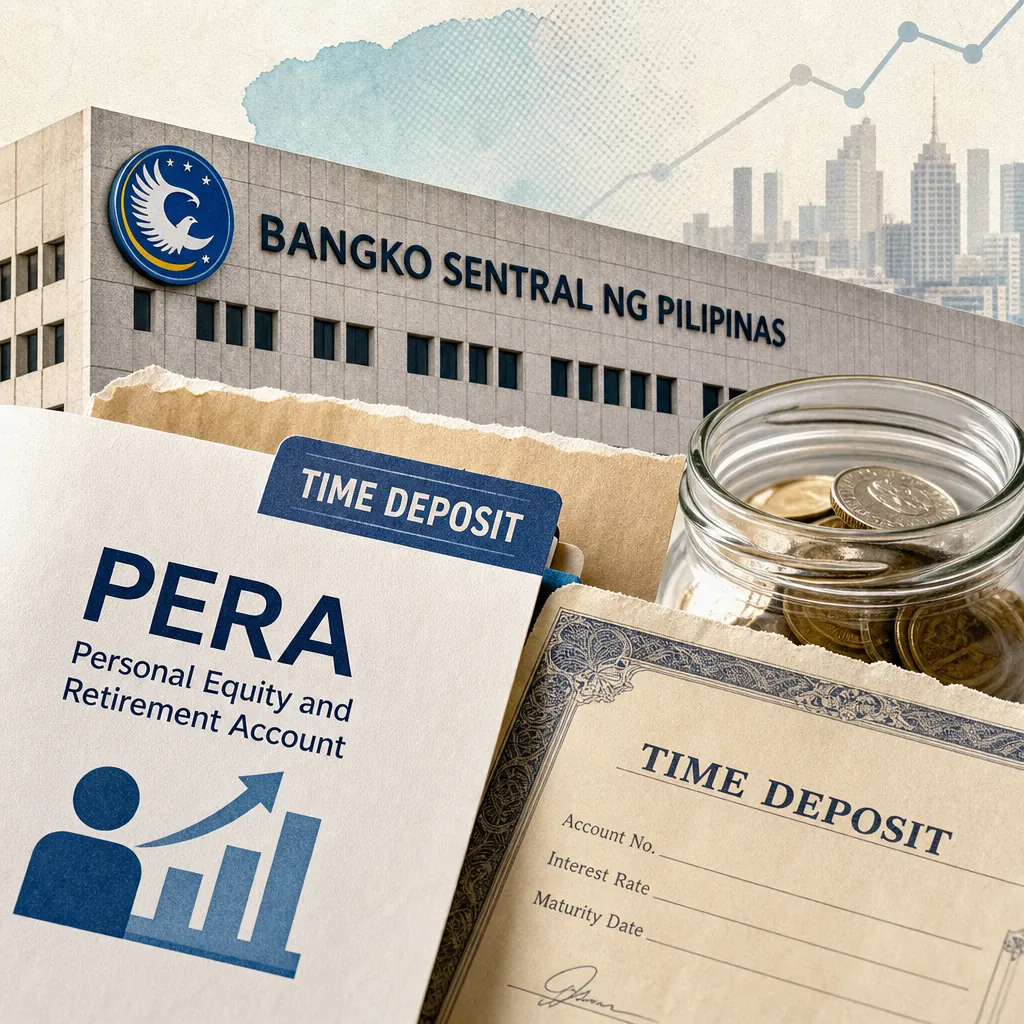
The Bangko Sentral ng Pilipinas (BSP) on Tuesday added time deposits to the list of investment products allowed under the Personal Equity and Retirement Account (PERA), a government-backed voluntary retirement savings program. The move, announced through Memorandum No. M-2026-044, lets qualified banks offer time deposits with a minimum maturity of 30 days as PERA investments. Upon maturity, the proceeds stay within the PERA account and can be rolled over, transferred, or reinvested in other accredited PERA products, based on the saver's instructions. BSP Deputy Governor Lyn I. Javier said the change is meant to make retirement planning "simple, accessible, and within reach of every Filipino," adding that time deposits are a product "they already understand and trust." 123
Financial institutions that want to offer PERA-eligible time deposits must meet the BSP's prudential criteria and obtain accreditation from the Bureau of Internal Revenue. After a bank's board approves its PERA time deposit program, the bank has ten banking days to submit a notification letter, a corporate secretary's certificate, and a certificate of compliance to the BSP. 4
The announcement came on a day when the Philippine economy was in the spotlight for both good and worrying reasons. Moodys Ratings affirmed the country's investment-grade credit rating of "Baa2" with a stable outlook, a decision welcomed by the Department of Finance (DOF) and the BSP. Finance Secretary Frederick Go said the affirmation "confirms our strong macroeconomic fundamentals, and that the reforms we've put in place are working." 5 But on the same day, Singapore-based Oversea-Chinese Banking Corp. (OCBC) cut its 2026 gross domestic product (GDP) growth forecast for the Philippines to 3.2% from 3.8%, projecting the country to be the second-slowest growing economy in the ASEAN-5 region through 2027. 6[^7](https://minio-s3.media-meter.com/mediameter/uploads/archive/Broadsheet/2026/08/26/BusinessWorld/Front Page/S1-1/1_mp_procs.pdf) Moodys itself said the Philippines' medium-term growth is unlikely to top 6%, citing slow investment recovery and vulnerability to climate shocks. 8
These developments frame a broader conversation about the country's financial health and the tools available to ordinary Filipinos to secure their financial future. The PERA expansion is a concrete step to broaden retirement savings options, but the growth forecasts raise questions about whether the economy can generate enough income for Filipinos to save in the first place.
Key themes
- PERA expands to include time deposits, giving savers a familiar retirement option The BSP's move allows banks to offer time deposits as PERA investments, with a minimum maturity of 30 days. This adds a low-risk, well-understood product to the retirement menu, potentially attracting savers who are wary of stocks or mutual funds. 123
- Moodys affirms Philippines' Baa2 rating with stable outlook, citing resilience The credit rating agency kept the country two notches above minimum investment grade, citing expectations that fiscal metrics will stabilize. Finance Secretary Frederick Go welcomed the decision, saying it reflects the economy's strength despite global headwinds. 59
- OCBC slashes Philippine GDP forecast to 3.2%, projecting second-slowest ASEAN-5 growth The bank's revised forecast marks a sharp slowdown from 2025's 4.4% growth, citing weakened public construction and the lingering impact of the Middle East energy crunch. This would put the Philippines ahead of only Thailand in the region. 6[^7](https://minio-s3.media-meter.com/mediameter/uploads/archive/Broadsheet/2026/08/26/BusinessWorld/Front Page/S1-1/1_mp_procs.pdf)
- Moodys sees medium-term growth below pre-pandemic 6% pace The debt watcher said the Philippines' growth potential is likely to settle below the near-6% rate recorded before the pandemic, as investment recovers only gradually and the economy remains exposed to natural disasters and climate shocks. 8
- Life insurance premiums jump 18% in first half, payouts grow faster The Insurance Commission reported total premiums rose to P229.98 billion from January to June, up 17.91% year-on-year. Benefit payments climbed 19.57% to P69.21 billion, while net income rose 3.42% to P21.42 billion. 10
- Government bond auction oversubscribed, yields drop on strong demand The Bureau of the Treasury borrowed P30 billion through reissued seven-year bonds, with tenders reaching P62.886 billion, more than twice oversubscribed. The average yield fell to 6.825%, reflecting investor appetite for shorter tenors ahead of the BSP policy meeting. 1112
- Supreme Court rules banks cannot recover funds lost to their own negligence The Court denied a bank's petition to recover P76,000 withdrawn by a depositor after the bank failed to follow clearing procedures, reinforcing consumer protection in banking disputes. 13
- Financial literacy initiatives gain ground, from credit education to forex awareness KasKasan Buddies became a founding partner of CIBI U, a credit education initiative, while Cebuana Lhuillier promoted foreign exchange literacy for OFW families. These efforts aim to help Filipinos make better financial decisions. 1415
How the narratives stack
Dominant The dominant narrative of the day is the BSP's expansion of PERA to include time deposits. This is a concrete, policy-driven development that directly affects the retirement savings options available to every Filipino worker. It drew coverage across multiple outlets, including the Inquirer, BusinessWorld, and Head Topics, and it speaks to the broader theme of financial inclusion and retirement preparedness. The move is significant because it adds a low-risk, familiar product to a program that has historically been underutilized. 123
Counter-narrative Running against the positive policy news is the sobering economic outlook from OCBC and Moodys. OCBC's forecast of 3.2% GDP growth for 2026 positions the Philippines as a regional underperformer, while Moodys' statement that growth is unlikely to top 6% in the medium term tempers any optimism about the rating affirmation. This counter-narrative highlights the structural challenges—slow investment recovery, climate vulnerability, and the lingering effects of the energy crunch—that could undermine the government's fiscal and growth targets. 6[^7](https://minio-s3.media-meter.com/mediameter/uploads/archive/Broadsheet/2026/08/26/BusinessWorld/Front Page/S1-1/1_mp_procs.pdf)8
Emerging An emerging narrative is the growing focus on financial literacy and consumer protection. The Supreme Court ruling that banks cannot recover funds lost to their own negligence, the launch of CIBI U for credit education, and Cebuana Lhuillier's push for forex awareness all point to a broader societal shift toward empowering individuals with financial knowledge. These stories are less prominent than the macro-economic news but signal a long-term trend. 131415
Under-covered The life insurance industry's strong first-half performance received relatively little attention compared to the macro stories. Premiums grew nearly 18%, and payouts grew even faster, indicating both industry health and increased claims. This is a significant data point for the financial sector but was overshadowed by the PERA and GDP news. 10
Platform insights
- Facebook Facebook likely served as the primary platform for sharing news articles from outlets like Inquirer and BusinessWorld. Posts about the PERA expansion and Moodys rating affirmation probably generated shares and comments from financial literacy groups and personal finance communities. The engagement would center on practical implications for retirement planning.
- X (formerly Twitter) On X, financial analysts and economists likely weighed in on the OCBC GDP forecast and the BSP's policy move. The platform's real-time nature makes it a hub for quick reactions to economic data and central bank announcements. Expect threads dissecting the implications of the growth slowdown and the PERA expansion.
- YouTube YouTube may have seen content from financial vloggers and news channels discussing the PERA time deposit option, explaining how it works and whether it's a good retirement vehicle. Videos comparing PERA to other investment options could gain traction among viewers seeking practical advice.
- Reddit Subreddits like r/phinvest likely had active discussions about the PERA expansion, with users debating the pros and cons of time deposits versus other PERA-eligible products. The OCBC forecast might also be a topic, with users sharing their views on the economy's direction.
Key voices and communities
- Bangko Sentral ng Pilipinas (BSP) As the central bank, the BSP is the primary authority on monetary and financial policy. Its decision to expand PERA is a direct intervention in the retirement savings landscape, and its statements carry significant weight in shaping public understanding.
- Department of Finance (DOF) The DOF, led by Secretary Frederick Go, is the government's economic planning arm. Its response to the Moodys rating affirmation reinforces the administration's narrative of economic resilience and reform.
- Credit rating agencies (Moodys, OCBC) These institutions provide independent assessments of the country's economic health. Their forecasts and ratings influence investor confidence and government policy, making them key voices in the conversation.
- Financial literacy advocates Groups like KasKasan Buddies, CIBI U, and Cebuana Lhuillier are pushing for better financial education. Their initiatives aim to equip Filipinos with the knowledge to navigate credit, forex, and retirement planning.
- Insurance Commission (IC) The IC's data on life insurance premiums and payouts provides a snapshot of the industry's health. Its statements highlight the sector's resilience and its role in providing financial security to Filipinos.
Narrative streams
BSP expands PERA to include time deposits, broadening retirement options
The Bangko Sentral ng Pilipinas (BSP) has allowed qualified banks to offer time deposits as investment products under the Personal Equity and Retirement Account (PERA), a voluntary retirement savings program that offers tax incentives to encourage Filipinos to save for their golden years. The move, detailed in Memorandum No. M-2026-044, requires time deposits to have a minimum maturity of 30 days. Upon maturity, the proceeds remain within the PERA account and can be rolled over, transferred, or reinvested in other accredited PERA products, based on the saver's instructions. 123
BSP Deputy Governor Lyn I. Javier emphasized that the goal is to make retirement planning "simple, accessible, and within reach of every Filipino." By adding time deposits—a product that many Filipinos already use and trust—the BSP hopes to attract more savers to PERA, which has historically had low participation rates. Financial institutions seeking to offer PERA-eligible time deposits must meet the BSP's prudential criteria and obtain accreditation from the Bureau of Internal Revenue. After a bank's board approves its program, the bank has ten banking days to submit the necessary documents to the BSP. 4
This expansion is part of a broader effort to deepen the country's retirement savings culture. PERA was established in 2008 but has struggled to gain traction, with many Filipinos relying on government pension systems or informal savings. By adding a low-risk, familiar product, the BSP is lowering the barrier to entry for conservative savers who may be intimidated by stocks or mutual funds.
The read for the sector: Banks now have a new product to offer within the PERA framework, potentially expanding their retirement-related business. For savers, it means a safe, predictable way to grow their retirement funds with tax benefits. The challenge remains to increase overall PERA participation, which will require continued education and marketing efforts.
Moodys affirms Philippines' Baa2 rating, but growth outlook remains subdued
Moodys Ratings affirmed the Philippines' investment-grade credit rating of "Baa2" with a stable outlook, a decision that the Department of Finance (DOF) and the Bangko Sentral ng Pilipinas (BSP) welcomed as a vote of confidence in the economy's resilience. The rating is two notches above the minimum investment grade, indicating that the country is considered a relatively safe borrower. 59
Finance Secretary Frederick Go said the affirmation "confirms our strong macroeconomic fundamentals, and that the reforms we've put in place are working." He acknowledged the "real headwinds" facing the global economy, including the energy shock and slowdown in public infrastructure spending, but expressed confidence in the country's ability to weather them. 5
However, Moodys also offered a sobering assessment of the medium-term growth outlook. In a statement, the debt watcher said the Philippines' GDP growth is expected to hover below its pre-pandemic level of around 6% over the medium term. It cited slow investment recovery and vulnerability to climate-driven shocks as key constraints. "We expect medium-term potential to settle somewhat below the near-6% pace recorded before the pandemic, as investment recovers only gradually and the economy remains exposed to recurrent natural disasters and climate-related shocks," Moodys said. 8
The affirmation is significant because it provides stability for government borrowing and investor confidence. But the growth outlook suggests that the country may struggle to achieve the 6-7% growth targets set by the Development Budget Coordination Committee. This could have implications for job creation, poverty reduction, and the government's ability to fund social programs.
The read for the sector: The stable rating is a positive signal for investors, but the subdued growth outlook means businesses should temper expectations for rapid expansion. For the government, it underscores the need to accelerate infrastructure spending and address climate vulnerabilities to boost long-term growth potential.
OCBC cuts Philippine GDP forecast to 3.2%, projecting second-slowest ASEAN-5 growth
Singapore-based Oversea-Chinese Banking Corp. (OCBC) Group Research slashed its 2026 gross domestic product (GDP) growth forecast for the Philippines to 3.2% from 3.8%, positioning the country as the second-slowest growing economy in the ASEAN-5 region, ahead of only Thailand. The ASEAN-5 includes the Philippines, Indonesia, Malaysia, Thailand, and Vietnam. 6[^7](https://minio-s3.media-meter.com/mediameter/uploads/archive/Broadsheet/2026/08/26/BusinessWorld/Front Page/S1-1/1_mp_procs.pdf)
The revision marks a sharp slowdown from the 4.4% expansion recorded in 2025. OCBC cited weakened public construction and the lingering impact of the Middle East-era energy crunch as key drags on growth. The bank also noted that the Philippines is the only country in the group expected to face a sharp slowdown this year. In contrast, OCBC raised Vietnam's growth forecast to 8.2% from 7.3%, highlighting the divergence in regional performance. 6
If OCBC's projections are realized, the Philippines would grow at a pace well below the 5-6% target range set by the Development Budget Coordination Committee for the next decade. This could have significant implications for employment, poverty reduction, and the government's fiscal position.
The OCBC forecast is more pessimistic than those of other institutions, but it aligns with Moodys' view that medium-term growth will be subdued. The combination of slow investment recovery, climate vulnerability, and external shocks is weighing on the economy's potential.
The read for the sector: Businesses should prepare for a slower growth environment, which may mean weaker consumer demand and tighter margins. For policymakers, the forecast underscores the urgency of addressing structural bottlenecks, such as infrastructure gaps and energy costs, to revive investment and boost productivity.
Life insurance premiums jump 18% in first half, payouts grow faster
The life insurance industry in the Philippines posted strong growth in the first half of the year, with total premiums rising 17.91% to P229.98 billion from P195.05 billion in the same period last year, according to data from the Insurance Commission (IC). Benefit payments grew even faster, climbing 19.57% to P69.21 billion from P57.88 billion a year earlier. Net income rose 3.42% to P21.42 billion. 10
The IC said the figures "indicate the continued stability and resilience of the life insurance industry," noting that it demonstrated its capacity to withstand financial shocks while meeting its obligations to policyholders and beneficiaries. The faster growth in payouts suggests that more policyholders are claiming benefits, which could be due to increased maturity claims or a rise in claims events.
The growth in premiums indicates that more Filipinos are purchasing life insurance, reflecting a growing awareness of the need for financial protection. This is a positive sign for the industry, which has been expanding its product offerings and distribution channels.
The read for the sector: The strong premium growth suggests a healthy demand for life insurance products. However, the faster growth in payouts means insurers must manage their claims reserves carefully. The industry's resilience is good news for policyholders, but it also highlights the importance of prudent underwriting and investment management.
Supreme Court rules banks cannot recover funds lost to their own negligence
In a decision that reinforces consumer protection in banking, the Supreme Court ruled that banks cannot recover money withdrawn by depositors when the loss resulted from the bank's own gross negligence in processing a check. The case involved a depositor who withdrew P76,000 after a bank teller mistakenly treated a regional check as a local check, releasing the funds after three banking days instead of the required seven. 13
The bank later received a stop-payment order and demanded the depositor return the money. When she refused, the bank withheld her remaining balance and filed an estafa complaint. The Regional Trial Court acquitted the depositor, and the Supreme Court denied the bank's petition, ruling that the bank's failure to follow established clearing procedures barred it from recovering the funds. 13
The decision is a significant win for consumer rights, as it holds banks accountable for their own errors. It also serves as a warning to banks to adhere strictly to clearing procedures to avoid similar losses.
The read for the sector: Banks must ensure their staff are properly trained and that internal controls are robust to prevent negligence. For consumers, the ruling provides a measure of protection against unfair recovery attempts. It also underscores the importance of understanding banking procedures and one's rights as a depositor.
Financial literacy initiatives gain ground, from credit education to forex awareness
Several initiatives launched or highlighted on Tuesday underscore a growing emphasis on financial literacy in the Philippines. KasKasan Buddies, a financial education platform, was named a founding partner of CIBI U, a new initiative designed to help Filipinos understand credit scores, credit reports, and responsible borrowing. CIBI U was launched on August 18 at CIBI iMPACT 2026 in Makati City, under the theme "Securing Trust in an Uncertain World." It carries the tagline "Aware today. Smarter tomorrow." 14
KasKasan Buddies joins Digital Pinoys, FinTech Alliance PH, the Credit Card Association of the Philippines (CCAP), and the Credit Information Corporation (CIC) as founding partners. The initiative will focus on practical credit education, including how credit scores and reports work and how borrowing behavior affects a person's credit standing. 14
Meanwhile, Cebuana Lhuillier MoneyXchange highlighted the importance of foreign exchange literacy for Filipinos, particularly those with overseas Filipino workers (OFWs) in their families. The Department of Migrant Workers recorded 1.58 million OFWs and seafarers deployed as of June 2025, underscoring the scale of Filipinos whose livelihoods extend beyond the country. For these families, understanding exchange rates is crucial to maximizing the value of remittances. 15
These initiatives reflect a broader societal push to equip Filipinos with the knowledge to make better financial decisions. From credit management to forex awareness, the goal is to empower individuals to navigate an increasingly complex financial landscape.
The read for the sector: Financial literacy is becoming a key differentiator for financial institutions. By investing in education, companies can build trust and loyalty among customers, while also reducing the risk of defaults and fraud. For consumers, these initiatives provide valuable tools to improve their financial well-being.
Conversation trajectory
- BSP policy meeting this week (within days): The market is looking ahead to the BSP's policy decision, which could influence interest rates and bond yields. The outcome will be a key signal for the economy's near-term direction. 11
- Government bond auction results (next few weeks): The strong demand for the reissued seven-year bonds suggests investor confidence, but future auctions will reveal whether this trend continues. 11
- Q3 GDP data (late 2026): The OCBC forecast of 3.2% growth for 2026 will be tested against actual data. A significant deviation could prompt further forecast revisions. 6
- Insurance Commission quarterly data (next quarter): The life insurance industry's performance will be tracked to see if the first-half momentum continues. 10
- PERA implementation (ongoing): The BSP's new guidelines will take effect as banks apply for accreditation. The uptake of PERA time deposits will be a key indicator of the program's success. 1
Trigger events: A BSP rate cut or hike, a major natural disaster, or a significant shift in global energy prices could alter the growth trajectory and prompt revisions to forecasts.
Response guidance
- For banks and financial institutions: Highlight the new PERA time deposit option in communications with clients, emphasizing its safety and tax benefits. Use plain language to explain how it works and who can benefit.
- For policymakers: Address the growth concerns raised by OCBC and Moodys by communicating concrete plans to boost investment and infrastructure spending. Reassure the public that the government is committed to fiscal consolidation.
- For financial educators: Leverage the momentum of CIBI U and similar initiatives to promote credit literacy. Create content that explains credit scores and responsible borrowing in simple terms.
- For insurers: Use the strong premium growth data to reinforce the value of life insurance. Emphasize the industry's resilience and its role in providing financial security.
- For communicators: Be transparent about the mixed economic signals. Acknowledge the challenges while highlighting the positive steps being taken, such as the PERA expansion and the stable credit rating.
See the full picture behind today's signals.
This report draws from Media Meter's MediaWatch, our real-time monitoring engine tracking 2,470+ Philippine sources across print, broadcast, digital, and social. Explore how the platform turns raw coverage into decision-grade intelligence, then see how it's configured for teams like yours — whether you're in PR agencies, corporate comms, government, or marketing.
Want more? Browse our Report Library for sector and crisis intelligence, or request a demo and we'll have your brand set up before the call.
Want this kind of intelligence on your brand?
This brief is built on the same MediaWatch methodology that runs continuously across every brand we monitor. See your competitive landscape, Impact Score, and narrative trajectory in a 30-minute demo.