BSP's fee waiver mandate reshapes banking landscape as security concerns mount
A regulatory push by the Bangko Sentral ng Pilipinas to eliminate interbank transfer fees has triggered a wave of zero-fee announcements from major banks, generating widespread consumer celebration. However, a parallel surge in phishing and SMS spoofing incidents threatens to undermine trust in digital banking channels.
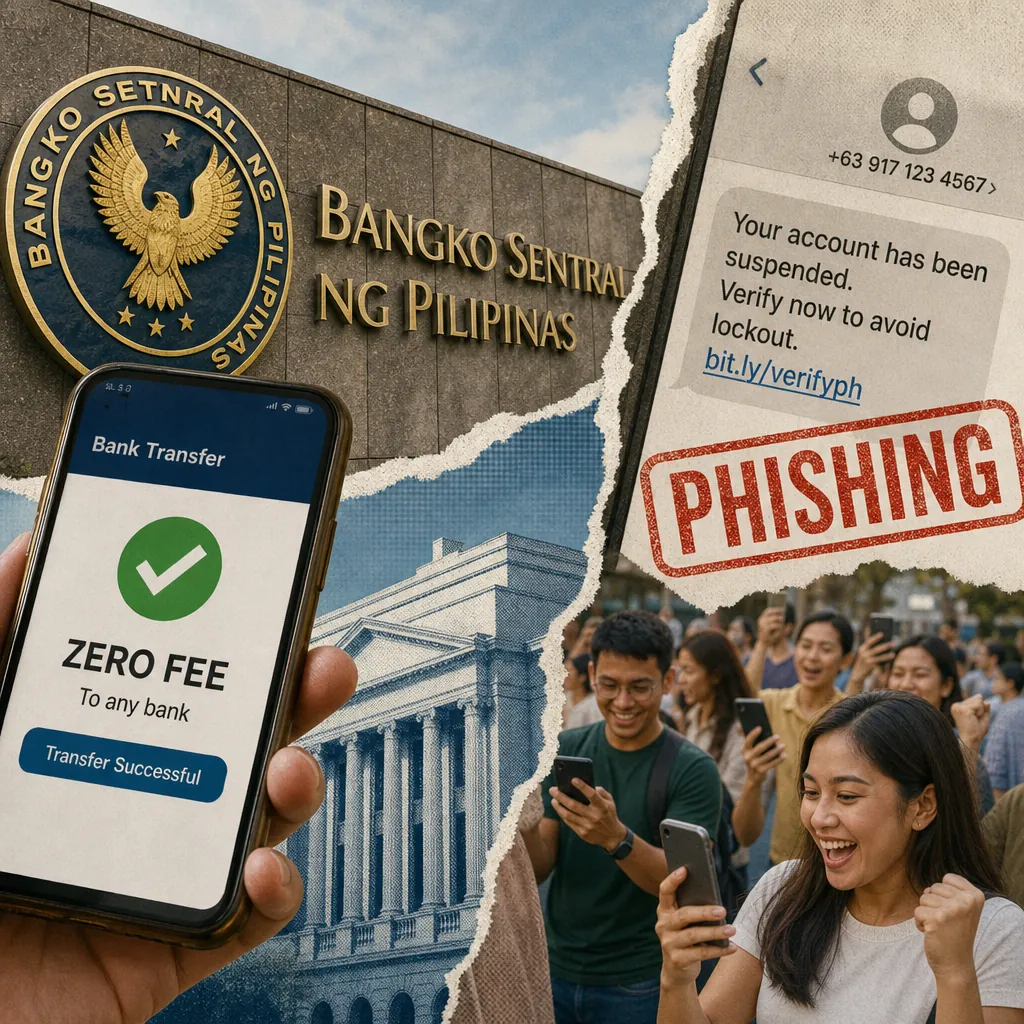
The conversation around digital banking in the Philippines took a decisive turn this week as the Bangko Sentral ng Pilipinas (BSP) successfully pushed through a regulatory overhaul that eliminated interbank transfer fees across nearly all major banks. The shift, driven by BSP Circular No. 1238 and Memorandum No. M-2026-025, lifted a five-year freeze on digital transfer fees while mandating that charges reflect actual costs and that micro-merchants earning under ₱250,000 monthly pay zero fees. The result was a cascade of announcements from BPI, BDO, Metrobank, Security Bank, and others, each waiving InstaPay and PESONet fees within a two-week window starting July 1. Social media erupted in celebration, with posts tracking the "race to zero" garnering thousands of reactions and shares. Yet even as consumers cheered the savings, a darker narrative was unfolding: reports of phishing SMS messages spoofing official bank sender IDs, including BPI's, and a detailed account of a possible fake cell tower near Davao Airport used for SMS interception. These security incidents, amplified on Reddit and Twitter, injected a note of caution into what might otherwise have been an unqualified victory for financial inclusion.
Key themes
- Regulatory mandate triggers industry-wide fee waivers: BSP Circular No. 1238, issued June 17, 2026, lifted the moratorium on InstaPay and PESONet fee increases while requiring that fees be "reasonable and fair market-based." The circular also mandated zero fees for micro-merchants. Within weeks, every major bank—BPI, BDO, Metrobank, Chinabank, PSBank, Security Bank, PNB, RCBC, EastWest, and others—announced free transfers. The speed of compliance surprised many consumers, who had grown accustomed to paying ₱10–₱25 per transaction.
- Consumer euphoria meets skepticism about sustainability: Initial joy over free transfers quickly gave way to questions about long-term viability. A Reddit user asked, "Which bank gonna increase instapay fees next few years?" predicting banks would seek replacement revenue through loans that could hurt non-performing loan ratios. A Facebook post asking "What other bank fees do you think are unjustified?" drew 256 comments, signaling that consumers are now primed to scrutinize all banking charges.
- Phishing and SMS spoofing surge alongside fee waivers: Multiple users across platforms reported receiving phishing SMS messages that appeared to come from official BPI sender IDs. One Reddit user described a possible fake cell tower (IMSI catcher) near Davao Airport used for SMS spoofing. Another detailed a call from a scammer who already knew the last digits of their BPI credit card and expiry date, raising fears of an "inside job." These incidents threaten to erode trust in digital banking just as fee waivers are building goodwill.
- Digital banks gain ground: GoTyme Bank announced it had reached 10 million users as of July 2026, with deposits exceeding ₱53 billion. The digital bank credited its growth to wider service use and expansion of physical kiosks. Meanwhile, GCash parent Mynt is reportedly eyeing a $1.5 billion IPO, and a Twitter analysis noted coordinated messaging positioning MariBank as "the new GCash," suggesting intensifying competition among digital-native players.
- BSP pushes employer-sponsored retirement savings: The central bank held a forum on July 8 urging companies to offer Personal Equity and Retirement Accounts (PERA) as a workplace benefit. Established under Republic Act No. 9505, PERA is a voluntary retirement savings program that has reached only a small fraction of Filipino workers. The BSP hopes payroll enrollment and employer contributions can expand its reach.
- SEC reopens digital lending registration: The Securities and Exchange Commission lifted a five-year moratorium on new online lending platforms through Memorandum Circular No. 20, Series of 2026. The new framework imposes stricter rules on data privacy, debt collection, and transparency, aiming to curb predatory practices that plagued the sector.
- Net FDI plunges to near 10-year low: Foreign direct investment net inflows fell to $250 million in April 2026, the lowest since June 2016, down 58.8% year-on-year. UnionBank chief economist Ruben Carlo Asuncion attributed the decline to a pullback in intercompany borrowings amid global uncertainties, including trade tensions and geopolitical risks.
- Cybersecurity must be embedded in corporate strategy: The Information Security Officers Group (ISOG) emphasized that cybersecurity is now a leadership responsibility, not just a technical function. The call comes amid worsening threats to ICT infrastructure, including the SMS spoofing incidents targeting banks.
How the narratives stack
Dominant: The BSP-driven elimination of interbank transfer fees is the clear dominant narrative within the captured set. It generated the highest engagement across social media and extensive news coverage, with multiple outlets reporting on the "race to zero." The story is a clear policy win for the BSP and a reputational opportunity for early movers like BPI, which announced fee waivers on July 1 and received over 1,100 combined reactions on Facebook. The narrative is overwhelmingly positive, though early skepticism about sustainability is emerging.
Counter-narrative: The surge in phishing and SMS spoofing incidents provides a counter-narrative that tempers the celebration. While fee waivers build goodwill, security concerns threaten to undermine trust in digital banking channels. BPI, in particular, faces a reputational challenge as users report scam messages appearing under its official sender ID. The counter-narrative is amplified by high engagement on scam-related posts and news coverage of cybersecurity threats.
Emerging: The growth of digital banks and the reopening of digital lending registration signal an emerging narrative around the future of digital finance in the Philippines. GoTyme's 10-million-user milestone and the SEC's new framework for online lending platforms suggest that the sector is evolving beyond traditional banking. The BSP's push for employer-sponsored PERA also points to a broader financial inclusion agenda.
Suppressed: The sharp decline in net FDI inflows received significant news coverage but generated little social media engagement. The story is a macroeconomic concern that may have implications for the banking sector's growth prospects, but it is largely absent from the consumer-focused conversation about fee waivers and security.
Platform insights
- Facebook: Dominated by viral shareability of free transfer announcements. The most engaging posts revolved around confirmation of zero fees, with BDO's announcement attracting over 2,000 reactions (987 loves alone) and 99 comments. A post asking "What other bank fees do you think are unjustified?" drew 256 comments, indicating that Facebook hosts nuanced consumer demands for further fee scrutiny. Facebook also saw high engagement on scam awareness content, including BPI's cybersecurity tips post with 193 likes and 135 shares.
- Reddit: Served as the analytical backbone of the conversation. Users compiled detailed timelines of bank announcements (e.g., "PH Banks Race to Zero Transfer Fees"), shared scam experiences with step-by-step accounts, and debated long-term implications for bank revenue models. The "BDO Waives Instapay Transfer Fee!!!" thread earned 694 upvotes, the highest raw engagement on the platform. Reddit also hosted the most detailed security incident reports, including the Davao Airport spoofing account.
- Twitter: Acted as the real-time news wire, with official bank accounts and media outlets breaking each announcement. BDO's zero-fee tweet reached 12,764 views, while Security Bank's similar announcement exploded to 21,056 views. Twitter also became the primary channel for scam complaints against BPI, where users directly tagged @TalktoBPI and @BangkoSentral, creating public pressure for accountability.
Key voices and communities
- Personal finance influencers and community educators: This group includes content creators like Jax Reyes (u/JaxReyes_), co-founder of the Kaskasan Buddies community, who produce comprehensive guides and explainers on digital banking features and regulations. Their posts routinely generate hundreds of comments and thousands of views, demonstrating strong trust among cost-conscious Filipino consumers. They frame the fee waiver wave as a major consumer victory and serve as watchdogs, pointing out lingering fee disparities between banks and e-wallets.
- Security-conscious consumers and scam whistleblowers: A vocal and rapidly growing segment that shares first-hand experiences of phishing, SMS spoofing, and fraudulent calls. Their posts generate high engagement, particularly when they identify spoofing near specific landmarks or expose sophisticated social engineering techniques. They hold banks responsible for security lapses and demand faster resolution and better safeguards. This group creates urgency for enhanced security communications and demonstrates the reputational risk when customers feel unprotected.
- Official bank and regulatory communications: Institutional accounts from banks, news outlets, and the BSP drive the authoritative narrative by announcing policy changes, issuing advisories, and providing official explanations. Bank-specific posts about free transfers receive massive engagement: BDO's announcement on Facebook alone garnered over 500 likes and 300 shares. The BSP itself was directly credited in a Facebook post that read "Personal finance content creator Jax Reyes commended the Bangko Sentral ng Pilipinas (BSP) for taking a strict stance."
- Macroeconomic analysts and economists: Voices like UnionBank chief economist Ruben Carlo Asuncion provide context for the FDI decline and its implications for the banking sector. Their analysis is primarily carried by news outlets rather than social media, but it shapes the broader narrative about the investment climate.
Narrative streams
The race to zero: How BSP Circular 1238 reshaped digital banking
The story of how the Philippines' major banks eliminated interbank transfer fees in under two weeks is a case study in regulatory effectiveness. BSP Circular No. 1238, issued June 17, 2026, lifted a five-year moratorium on InstaPay and PESONet fee increases while introducing new rules requiring that fees be "reasonable and fair market-based" and reflect actual costs. The circular also mandated zero fees for person-to-person transfers to micro-merchants earning under ₱250,000 monthly. BPI was the first to act, announcing on July 1 that it would waive InstaPay and PESONet fees via its app and VYBE. The announcement on Facebook received 683 likes and 414 love reactions, positioning BPI as a proactive market leader. Over the next ten days, a cascade of zero-fee announcements followed: LandBank and UnionBank on July 7; BDO, Metrobank, Chinabank, and PSBank on July 9; Security Bank and PNB on July 10; and RCBC and EastWest by July 15. A Reddit timeline post captured the competitive momentum, showing how nearly every major bank scrapped fees within two weeks. The coverage of this wave was extensive, with outlets like Manila Bulletin Online, Tech And Lifestyle Journal, and Daily Tribune Online reporting on the developments. The Manila Bulletin article, worth an estimated ₱194,044 in advertising-equivalent value, explained the regulatory background, noting that the BSP indicated digital transfer fees should be significantly lower than traditional face-to-face bank transfers. The narrative is overwhelmingly positive, but early skepticism is emerging. A Reddit user asked, "Which bank gonna increase instapay fees next few years?" predicting banks would seek replacement revenue through loans that could hurt non-performing loan ratios. A Facebook post asking "What other bank fees do you think are unjustified?" drew 256 comments, signaling that consumers are now primed to scrutinize all banking charges. For the sector, the fee waiver wave is a double-edged sword: it builds goodwill and drives digital adoption, but it also pressures banks to find new revenue streams, potentially through lending or other fees.
Security in the spotlight: Phishing and SMS spoofing threaten trust
While the fee waiver story dominated, a parallel thread of security fears intensified. On July 9, a Reddit user reported a phishing SMS spoofed as BDO near Davao Airport, warning "I strongly suspect this is an SMS spoofing attack, and it's also possible that a fake GSM/cell tower (IMSI catcher) was used." BPI customers had been complaining since May about phishing texts from the official BPI sender ID—one user tweeted "@TalktoBPI lol BPI why are you guys sending phishing links." On July 10, BPI published its own cybersecurity tips explaining text hijacking via IMSI catchers. The post, part of the #BPIcybersecuriTips campaign, received 193 likes and 135 shares on Facebook. However, the volume of scam reports suggests the campaign is not yet reaching enough vulnerable account holders. A Reddit user detailed a call from a scammer who already knew the last digits of their BPI credit card and expiry date, leading the user to question whether it was an "inside job." Another user on Twitter explicitly demanded "@BangkoSentral this bank really needs to be investigated and deemed untrustworthy to provide financial services." The security narrative is amplified by broader cybersecurity concerns. The Information Security Officers Group (ISOG) emphasized that cybersecurity must be embedded in corporate strategy, not treated solely as a technical function. The Business Mirror article covering ISOG's call, worth an estimated ₱188,800 in advertising-equivalent value, noted that "organizations that prioritize cyber resilience are better positioned to protect their operations, customers, and long-term growth." For the banking sector, the security narrative is a critical counterweight to the fee waiver euphoria. If consumers do not feel safe using digital channels, the gains from free transfers could be undermined. Banks must invest in SMS authentication, consumer education, and collaboration with telcos to combat spoofing.
Digital banks gain momentum: GoTyme hits 10 million users
GoTyme Bank, backed by the Gokongwei Group, announced it had reached 10 million users as of July 2026, just over three years after its launch. Customer deposits have grown to more than ₱53 billion. The Inquirer article covering the milestone, worth an estimated ₱214,312 in advertising-equivalent value, quoted CEO Nate Clarke: "Reaching 10 million users is an important milestone on our journey to become the Philippines' largest and most loved bank, but for us, it's really about the trust that millions of Filipinos place in GoTyme Bank every day." The digital bank credited its growing customer base to wider use of its services and the expansion of its physical touchpoints, including more than 600 kiosks in Robinsons Retail outlets and SM Stores. The milestone signals that digital-native banks are capturing consumer trust even as traditional banks abolish fees. Meanwhile, GCash parent Mynt is reportedly eyeing a $1.5 billion IPO, and a Twitter analysis noted coordinated messaging positioning MariBank as "the new GCash," suggesting intensifying competition among digital players. For traditional banks, the rise of digital banks means they must compete not only on fees but also on user experience, security, and innovation.
SEC reopens digital lending with stricter rules
The Securities and Exchange Commission lifted a five-year moratorium on new online lending platforms through Memorandum Circular No. 20, Series of 2026. The moratorium, imposed in 2021, was a response to predatory debt collection practices, data privacy violations, and troubling opacity in loan terms. The new framework requires stricter compliance with data privacy, fair debt collection, and transparent pricing. The Daily Tribune article covering the development, worth an estimated ₱190,944 in advertising-equivalent value, noted that "the lifting of the moratorium is not deregulation—it is the beginning of a more mature, more accountable digital lending ecosystem." The move is significant for the banking sector as it opens the door to new competitors in the digital lending space, potentially increasing pressure on traditional banks' consumer lending businesses.
FDI slump raises macroeconomic concerns
Foreign direct investment net inflows fell to $250 million in April 2026, the lowest since June 2016, down 58.8% year-on-year. The decline was driven by a sharp pullback in intercompany borrowings, which fell by more than 90% year-on-year. UnionBank chief economist Ruben Carlo Asuncion attributed the weakness to "lingering global uncertainties, including trade tensions, geopolitical risks, and episodes of financial market volatility." The story received extensive news coverage, with articles in the Inquirer, Manila Times, Business Mirror, and Philstar, collectively worth over ₱1.3 million in advertising-equivalent value. For the banking sector, the FDI slump is a concern because it signals a cautious investment climate that could dampen loan demand and economic growth. However, the story generated little social media engagement, suggesting it is not yet a consumer-facing concern.
Conversation trajectory
- Consumer euphoria shifting toward sustainability scrutiny (4–6 weeks): The initial wave of celebration over free transfers will likely give way to questions about how banks will replace lost fee income. Expect public attention to pivot from gratitude to demanding further cost reductions, particularly if banks introduce compensating charges elsewhere. Banks should proactively communicate how fee waivers are funded (e.g., through cross-selling loans or merchant services) to preempt skepticism.
- Security concerns intensifying alongside convenience gains (2–3 months): As more consumers adopt digital transfers, scam reports will rise proportionally. The SMS spoofing incidents using official bank sender IDs create a credibility gap that will likely widen. Banks and telcos must coordinate SMS security improvements, such as implementing sender ID verification and educating consumers about IMSI catchers. The Manila Tech Summit 2026 (July 28–29) could be a platform for announcing joint anti-spoofing initiatives.
- Digital bank growth and competitive repositioning (6–12 months): GoTyme's 10-million-user milestone and the potential Mynt IPO signal that digital-native players are capturing momentum. Traditional banks that were slow to waive fees faced reputational pressure, while early movers like BPI received outsized positive sentiment. The conversation will increasingly compare which institutions offer more than just free transfers—interest rates, security features, and customer service will become the next battleground.
- Regulatory ripple effects on e-wallets and cross-border payments (3–6 months): BSP Circular No. 1238 explicitly targets bank fees but has already sparked calls for GCash and Maya to follow suit. The looming Manila Tech Summit, where ASEAN Digital Economy Framework discussions will include cross-border payments, signals that the fee waiver conversation will expand beyond domestic transfers to remittance costs. OFW-sending platforms like Wise and Western Union PH could face similar scrutiny.
Key trigger events: Manila Tech Summit 2026 (July 28–29); potential GCash parent Mynt IPO; first quarterly earnings reports from banks post-fee-waiver (likely August–September 2026); any major security breach or regulatory action on SMS spoofing.
Response guidance
- For banking clients: Capitalize on leadership position by proactively communicating security upgrades—particularly SMS authentication improvements—within the next 30 days to counterbalance the scam narrative while public goodwill is still high. Consider bundling the free transfer announcement with a transparent breakdown of how fee waivers are funded to preempt sustainability skepticism. Use the personal finance influencer community to amplify positive narratives and security education.
- For telecom clients (PLDT/Smart): The fake cell tower reports near Davao Airport directly involve telecom infrastructure security. Proactively collaborate with banks and the BSP on a joint anti-spoofing campaign—ideally before the Manila Tech Summit—to position telcos as enablers of secure digital finance rather than passive infrastructure providers.
- For Malacañang/economic communications: The fee waiver wave aligns perfectly with financial inclusion narratives. Highlight the administration's support for BSP Circular No. 1238 as a pro-consumer, pro-MSME policy. With the ASEAN chairship and the Manila Tech Summit on the horizon, frame this as a Philippine-led regional model for affordable digital payments. Announce supporting initiatives or commend banks publicly within the next two weeks to ride the positive sentiment wave.
- Sensitive topics to navigate: Avoid confirming or denying internal breaches in response to phishing reports; instead, explain that scammers use IMSI catchers outside the bank's control and emphasize partnership with telcos and the BSP. Do not promise permanent zero fees; instead, point to the BSP's cost-justification requirement. Frame security measures as a trade-off: a brief lockout is better than unauthorized access.
See the full picture behind today's signals.
This report draws from Media Meter's MediaWatch, our real-time monitoring engine tracking 2,470+ Philippine sources across print, broadcast, digital, and social. Explore how the platform turns raw coverage into decision-grade intelligence, then see how it's configured for teams like yours — whether you're in PR agencies, corporate comms, government, or marketing.
Want more? Browse our Report Library for sector and crisis intelligence, or request a demo and we'll have your brand set up before the call.
Want this kind of intelligence on your brand?
This brief is built on the same MediaWatch methodology that runs continuously across every brand we monitor. See your competitive landscape, Impact Score, and narrative trajectory in a 30-minute demo.