Diesel Falls P1.30, Gasoline Rises P1.93 as Truckers Strike
The Philippines' first October fuel adjustment splits diesel and gasoline, and the Confederation of Truckers Association of the Philippines halts operations the same day. Exporters project record merchandise exports while economists caution that domestic constraints may limit gains from a Philippines-European Union free trade agreement.
The Conversation
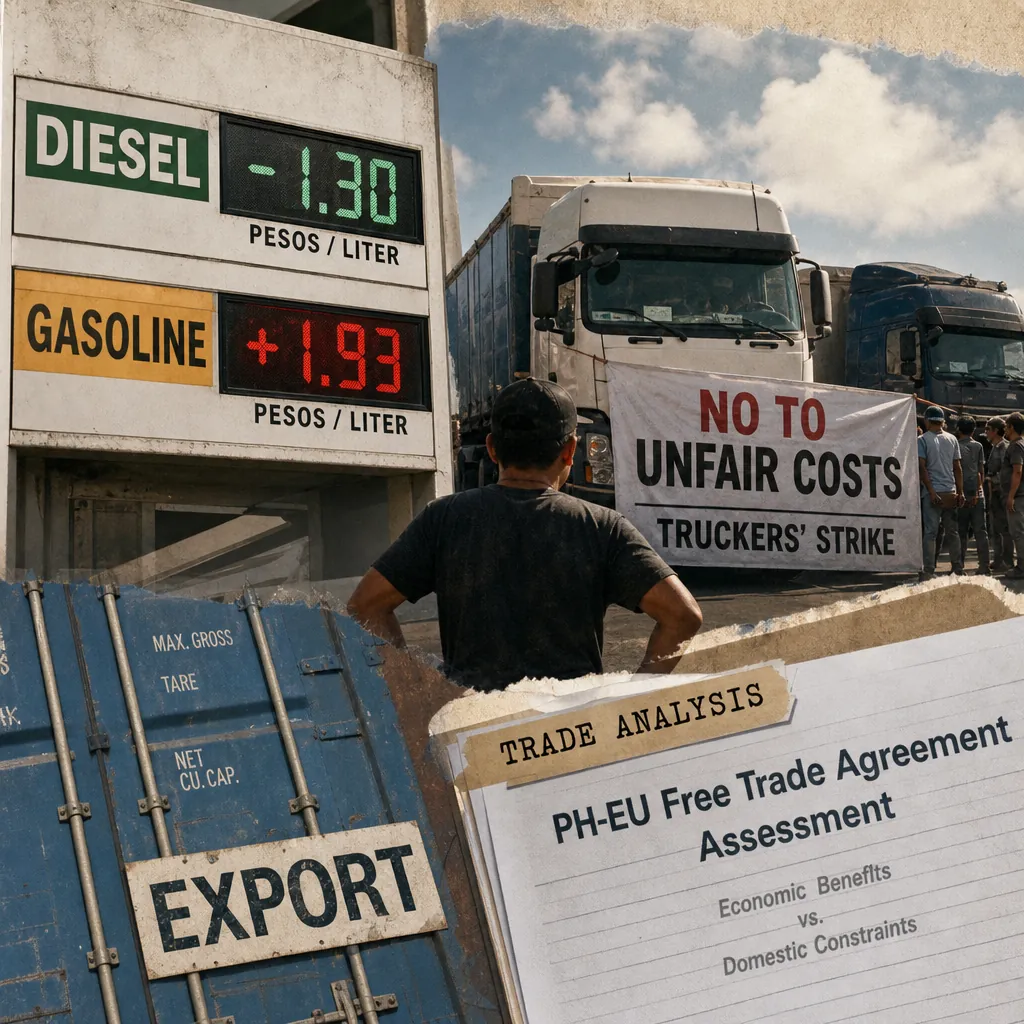
The first confirmed fuel price movement of October 2026 lands on Tuesday, October 6: diesel drops by ₱1.30 per liter while gasoline rises by ₱1.93 per liter, according to the Department of Energy (DOE), the agency that publishes the weekly oil price adjustment schedule.76 The split matters because transport costs move first on diesel, and the delivery fleets of GrabFood, foodpanda, and quick-service restaurant supply chains run on it.8 The same week, crude in the global market reached almost $100 per barrel, and a proposal to suspend excise tax on petroleum products has been pushed in response.45
The near-term risk sits with the truckers' strike scheduled for October 6 by the Confederation of Truckers Association of the Philippines (CTAP), a haulage group whose president, Mary Zapata, confirmed the action over the oil price increase.1 Earlier calls for government to act on oil prices, including a demand to roll back the oil deregulation law, came from PISTON national president Modesto Floranda.3 A strike that disrupts deliveries could affect store shelves and food supply chains, and how long it lasts is not yet clear.1 The fuel adjustment is scheduled by the DOE and may shift if global crude prices move further.6 A separate proposal to suspend excise tax on petroleum products, which would require legislation, remains pending.5
Given the diesel rollback and gasoline hike on October 6, food and consumer goods clients should prepare a logistics cost note for communications and supply chain teams, since truckers plan a strike the same day.71 Monitor the strike outcome and any follow-up government action on excise tax suspension, as a prolonged disruption or a policy shift would change the cost picture for food delivery and quick-service operations.5 If the strike proceeds, clients with delivery-heavy models should track whether delivery rider earnings, already affected by high fuel costs, become part of the public discussion.8
Key themes
- Diesel falls ₱1.30, gasoline rises ₱1.93 on October 6 The Department of Energy confirmed a mixed adjustment: diesel down ₱1.30 per liter, gasoline up ₱1.93 per liter, and kerosene also higher. The split is unusual because diesel and gasoline usually move together, and it lands on the same day truckers plan to strike.76
- Truckers strike October 6 over fuel prices The Confederation of Truckers Association of the Philippines (CTAP), led by president Mary Zapata, announced on October 4 that it would halt operations to protest fuel price increases. The strike proceeded as scheduled on October 6.1
- PISTON demands oil deregulation repeal On October 3, PISTON national president Modesto Floranda urged the government to act on rising oil prices and called for the repeal of the oil deregulation law, which liberalized the downstream oil industry in 1998. The group said it remained ready to hold protest actions.3
- Global crude nears $100 per barrel State broadcaster PTV reported on October 4 that global crude oil prices had reached almost $100 per barrel, a level that raises the import bill for a country that buys nearly all its fuel abroad. A proposal to suspend the excise tax on fuel was filed in response.45
- Excise tax suspension proposal pending A proposal to suspend the excise tax on petroleum products has been filed, but it would require legislation and remains pending. If passed, it would lower pump prices by removing a fixed tax per liter.5
- Delivery rider earnings enter the discussion Delivery rider earnings, already affected by high fuel costs, may become part of the public discussion if the strike proceeds. The writeup notes that clients with delivery-heavy models should track this.8
- Exporters project record merchandise exports above $100 billion The Philippine Exporters Confederation, Inc. (Philexport) said goods exports could exceed $100 billion this year, driven by electronics and minerals. In 2025, exports hit $84.48 billion, the highest since 1991, and rose 14.8% to $64.04 billion in the first eight months of 2026.9
- Economists caution on Philippines-EU FTA gains The free trade agreement between the Philippines and the European Union could provide only a modest boost because domestic constraints may limit its potential to attract investment and diversify exports. China Banking Corp. Chief Economist Domini S. Velasquez said the immediate boost from tariff reductions may be limited since the Philippines already enjoys substantial preferential access under the EU's Generalised Scheme of Preferences Plus (GSP+).
How the narratives stack
Dominant: The fuel price adjustment and the truckers' strike dominate the day's conversation. The Department of Energy's confirmation of a mixed adjustment—diesel down ₱1.30, gasoline up ₱1.93—was carried by multiple outlets, including News5, GMA News, and PTV.674 The CTAP strike, announced on October 4 and executed on October 6, is the most consequential development because it directly threatens food and consumer goods supply chains.1 The combination of a diesel rollback (which helps truckers) and a gasoline hike (which hurts them) creates a confusing price signal that the strike amplifies. Within the captured set, this story drew the most items and the most urgent framing.
Counter-narrative: The export and trade stories offer a more optimistic view of the economy. Philexport's projection that merchandise exports could top $100 billion this year, driven by electronics and minerals, is a strong counterpoint to the fuel-driven cost pressures.9 The first eight months of 2026 saw exports rise 14.8% to $64.04 billion, and 2025 ended at $84.48 billion, the highest since 1991.9 However, economists caution that the Philippines-European Union free trade agreement may provide only a modest boost because domestic constraints—such as infrastructure and regulatory bottlenecks—could limit its potential. This counter-narrative is less urgent but important for the medium-term outlook.
Emerging: The proposal to suspend the excise tax on petroleum products is an emerging policy response. It has been filed but remains pending, and would require legislation.5 If it gains traction, it could lower pump prices and ease the burden on truckers and consumers. The beverage industry's call for more dialogue on the proposed sugar-sweetened beverage tax hike is another emerging story: the Department of Finance is proposing to raise the excise tax on sweetened beverages to ₱20 per liter from ₱6, and on high-fructose corn syrup to ₱40 per liter from ₱12. The Beverage Industry Association of the Philippines warned that manufacturers may pass on costs to consumers.
Suppressed: The potential impact on delivery rider earnings is mentioned in the writeup but has not yet become a major public discussion.8 If the strike proceeds and fuel costs remain high, this could become a more prominent issue. Also under-covered in the captured set is the Isabela province's ₱1.8-billion El Niño mitigation scheme, which addresses a dry spell that has hit over 118,000 farmers across 31,000 hectares. This is a significant agricultural story that received less attention than the fuel price news.
Platform insights
- Facebook: The fuel price adjustment and truckers' strike generated significant engagement on Facebook, particularly through news pages like News5 and GMA News. Posts announcing the price split and the strike received high shares and comments, with users expressing frustration over the simultaneous gasoline hike and diesel rollback. The CTAP strike announcement was widely shared among trucker and driver communities.
- X (formerly Twitter): News5's post confirming the DOE adjustment received notable engagement, with users debating the timing of the strike and the impact on food prices.6 The platform served as a real-time feed for updates on the strike and the excise tax proposal, with journalists and policy analysts weighing in.
- YouTube: Videos from PTV, GMA News, and News5 covering the fuel price adjustment and the strike accumulated views, with comment sections reflecting concerns about transport costs and government response. The CTAP president's announcement was carried on YouTube, reaching audiences who prefer video news.14
- Reddit: Discussions on Philippine subreddits focused on the economics of the fuel price split, with users analyzing the impact on different sectors and questioning the logic of a diesel rollback alongside a gasoline hike. The strike was debated in terms of its effectiveness and potential backlash.
Key voices and communities
- Truckers and transport groups: The Confederation of Truckers Association of the Philippines (CTAP) and PISTON are the primary voices driving the strike and protest calls. CTAP president Mary Zapata confirmed the October 6 strike, while PISTON national president Modesto Floranda demanded the repeal of the oil deregulation law.13 These groups represent drivers and operators directly affected by fuel prices.
- Government agencies: The Department of Energy (DOE) is the key source for fuel price adjustments, publishing the weekly schedule. The Department of Trade and Industry (DTI) and the Department of Finance (DoF) are involved in related policies, such as the excise tax suspension proposal and the sugar-sweetened beverage tax hike.65
- Business and industry associations: The Philippine Exporters Confederation, Inc. (Philexport) and the Beverage Industry Association of the Philippines are advocating for their sectors. Philexport projects record exports, while the beverage association warns about the impact of tax hikes on consumers.9
- Economists and analysts: China Banking Corp. Chief Economist Domini S. Velasquez provided a measured view on the Philippines-EU FTA, noting that domestic constraints may limit gains. Economists are also watching the fuel price impact on inflation and growth.
- Local government and agricultural communities: Isabela province's Vice Gov. Francis Faustino Dy highlighted the ₱1.8-billion El Niño mitigation scheme, which targets over 118,000 farmers affected by the dry spell. This voice represents the agricultural sector's struggle with climate impacts.
Narrative streams
Fuel price split and truckers' strike
The Department of Energy confirmed on October 5 that diesel prices would fall by ₱1.30 per liter while gasoline would rise by ₱1.93 per liter starting October 6.76 This mixed adjustment is unusual because diesel and gasoline typically move in the same direction. The diesel rollback is good news for truckers and delivery fleets, but the gasoline hike affects passenger vehicles and consumers. The same day, the Confederation of Truckers Association of the Philippines (CTAP) proceeded with its strike, announced on October 4 by president Mary Zapata, to protest fuel price increases.1 The strike threatens to disrupt deliveries and store shelves, particularly for food and consumer goods. The read for the sector: food and consumer goods companies with delivery-heavy models should prepare contingency plans for logistics disruptions and monitor whether the strike expands or leads to government concessions. The context: the Philippines imports nearly all its fuel, so global crude prices—which reached almost $100 per barrel—directly affect local pump prices.4 The oil deregulation law, which PISTON wants repealed, liberalized the downstream oil industry in 1998, allowing market forces to set prices.3
Export growth and trade agreements
The Philippine Exporters Confederation, Inc. (Philexport) projected that merchandise exports could exceed $100 billion this year, driven by electronics and minerals.9 In 2025, exports reached $84.48 billion, the highest since 1991, and rose 14.8% to $64.04 billion in the first eight months of 2026.9 Trade Secretary Maria Cristina A. Roque said the 35-year high builds on sustained export growth.9 However, economists cautioned that the Philippines-European Union free trade agreement may provide only a modest boost because domestic constraints—such as infrastructure and regulatory bottlenecks—could limit its potential to attract investment and diversify exports. China Banking Corp. Chief Economist Domini S. Velasquez noted that the Philippines already enjoys substantial preferential access to the European market under the EU's Generalised Scheme of Preferences Plus (GSP+), which allows developing countries to export goods to the EU with reduced tariffs. The read for the sector: exporters should focus on electronics and minerals, but also advocate for domestic reforms to maximize the benefits of trade agreements. The context: the Philippines-EU FTA is still being negotiated, and its impact will depend on how well the country addresses domestic constraints.
Tax proposals and industry pushback
The Department of Finance is proposing to increase the excise tax on sugar-sweetened beverages to ₱20 per liter from ₱6, and on high-fructose corn syrup to ₱40 per liter from ₱12. The Beverage Industry Association of the Philippines President Juan Lorenzo Tañada said further dialogue is needed and warned that manufacturers may be forced to pass on added costs to consumers. "We just want to ask for more dialogue, because we are really afraid that we will not be able to properly absorb this new imposition," Tañada said during the Kapihan sa Manila Bay Forum on Wednesday. "We worry about consumers, because to be frank, we will need to pass along the effects of any increase in taxes." Separately, a proposal to suspend the excise tax on petroleum products has been filed but remains pending.5 The read for the sector: beverage manufacturers should prepare for higher costs and potential consumer backlash if prices rise, while also engaging in dialogue with the government. The context: excise taxes are levied on specific goods to raise revenue and discourage consumption; the sugar-sweetened beverage tax was introduced in 2018 and has been adjusted since.
Agricultural climate adaptation
Isabela province activated a ₱1.8-billion initiative to mitigate the impacts of super El Niño, tapping its Local Disaster Risk Reduction and Management Fund and Quick Response Fund to address damage to over 118,000 farmers across 31,000 hectares. Vice Gov. Francis Faustino Dy said early and coordinated action is key. "We cannot face El Niño alone. We need collective action from the local government and national agencies to ensure that every sector is prepared," Dy said. "Protecting our farmers and ensuring food and water security are our top priorities." The provincial government and the Department of Agriculture have targeted cloud seeding operations and distributed drought-resistant seeds and agricultural inputs. The read for the sector: agribusinesses and food companies should monitor crop yields and consider sourcing adjustments if the dry spell persists. The context: El Niño is a climate pattern that causes drier conditions in the Philippines, affecting agriculture and water supply; the government has allocated funds for mitigation.
Consumer protection and market integrity
The Department of Trade and Industry (DTI) is strengthening guardrails for consumers in a marketplace where the line between legitimate and bogus is increasingly blurred. The DTI's job ranges from keeping unsafe products off store shelves to going after unfair trade practices and watching the prices of basic goods. In a market of more than 112 million people where household consumption accounts for roughly 70 percent of the economy, these protections are critical. The read for the sector: consumer goods companies should ensure compliance with DTI regulations and be transparent about pricing and product quality. The context: the DTI has rules meant to ensure consumers get what they paid for and avenues for redress when they do not.
Conversation trajectory
Over the next 1–2 weeks: Monitor the outcome of the truckers' strike and any government response. If the strike is prolonged, it could disrupt food supply chains and lead to price increases. The DOE's next weekly fuel price adjustment, scheduled for October 13, will be a key indicator of whether the diesel rollback continues or reverses. The excise tax suspension proposal may gain traction if fuel prices remain high.
Over the next 4–6 weeks: The Department of Finance's proposed sugar-sweetened beverage tax hike will likely face further industry pushback and legislative scrutiny. The Philippines-EU free trade agreement negotiations may progress, with economists watching for domestic reforms that could maximize benefits. Export data for September and October will show whether the projected $100 billion export target remains on track.
Trigger events: A sustained increase in global crude oil prices above $100 per barrel could prompt emergency government action, such as a fuel subsidy or tax suspension. A major disruption from the truckers' strike could lead to government intervention and negotiations. The passage or rejection of the excise tax suspension proposal would directly affect pump prices. The announcement of new export contracts or investments in electronics and minerals could boost confidence.
Response guidance
For food and consumer goods companies: Prepare a logistics cost note for communications and supply chain teams, since truckers plan a strike the same day as the fuel price adjustment. Monitor the strike outcome and any follow-up government action on excise tax suspension, as a prolonged disruption or a policy shift would change the cost picture for food delivery and quick-service operations. If the strike proceeds, track whether delivery rider earnings become part of the public discussion.
For beverage manufacturers: Engage in dialogue with the government on the proposed sugar-sweetened beverage tax hike. Prepare for higher costs and potential consumer backlash if prices rise. Communicate transparently about the reasons for any price increases and emphasize efforts to absorb costs where possible.
For exporters: Highlight the strong export growth in electronics and minerals, but also advocate for domestic reforms to address infrastructure and regulatory bottlenecks that could limit the benefits of trade agreements. Monitor the Philippines-EU FTA negotiations and prepare for new market opportunities.
For agricultural businesses: Monitor the impact of El Niño on crop yields and consider sourcing adjustments if the dry spell persists. Support government mitigation efforts and communicate with farmers about available assistance.
For all sectors: Stay informed about fuel price adjustments and their impact on transport costs. Prepare contingency plans for logistics disruptions. Engage with government agencies on policy proposals that affect your industry.
See the full picture behind today's signals.
This report draws from Media Meter's MediaWatch, our real-time monitoring engine tracking 2,470+ Philippine sources across print, broadcast, digital, and social. Explore how the platform turns raw coverage into decision-grade intelligence, then see how it's configured for teams like yours — whether you're in PR agencies, corporate comms, government, or marketing.
Want more? Browse our Report Library for sector and crisis intelligence, or request a demo and we'll have your brand set up before the call.
Want this kind of intelligence on your brand?
This brief is built on the same MediaWatch methodology that runs continuously across every brand we monitor. See your competitive landscape, Impact Score, and narrative trajectory in a 30-minute demo.