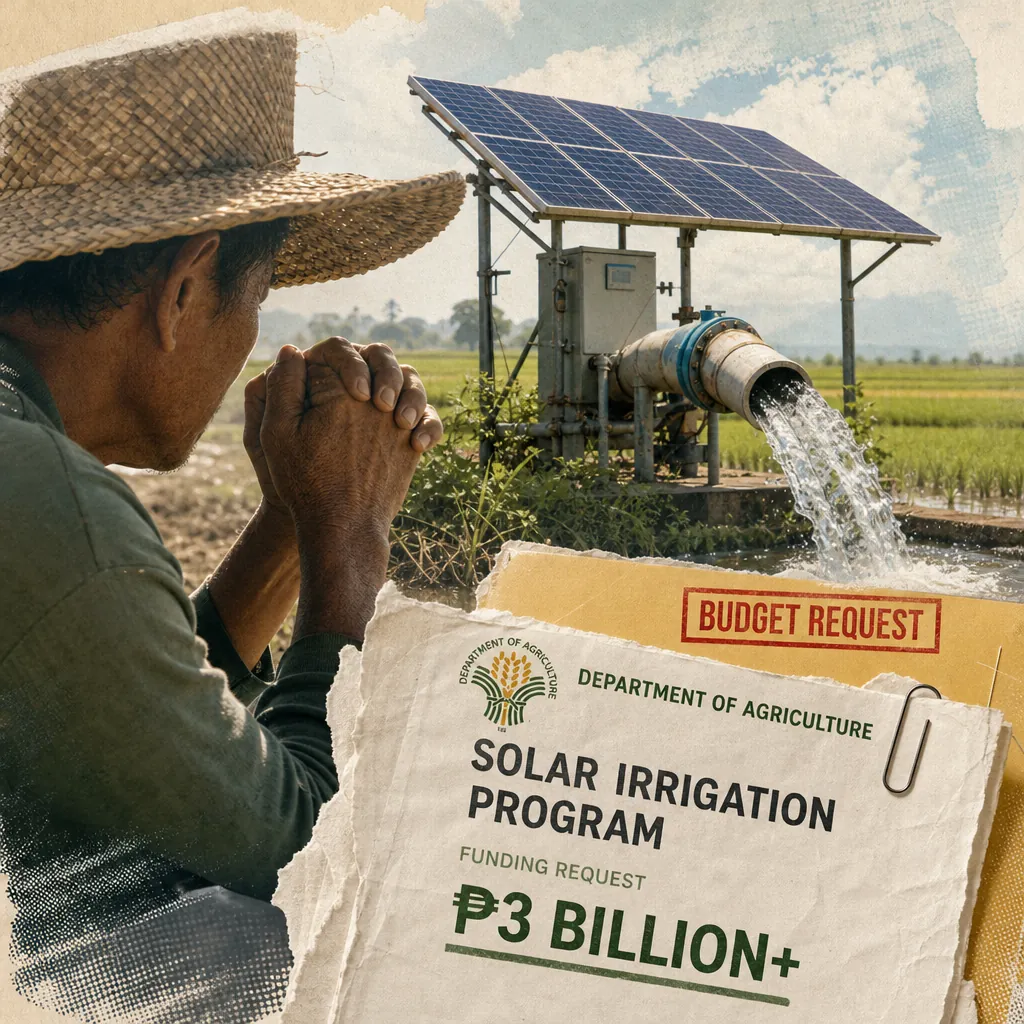
Inflation at 7.8% Pulls PSE Down 0.28% as Jobs Rate Rises
Philippine inflation hit a three-year high of 7.8% in October, dragging the stock index 0.28% lower while unemployment edged up to 5.4% in September. Farm output fell 5% in the third quarter as El Niño pressure built across water, heat, and food policy.
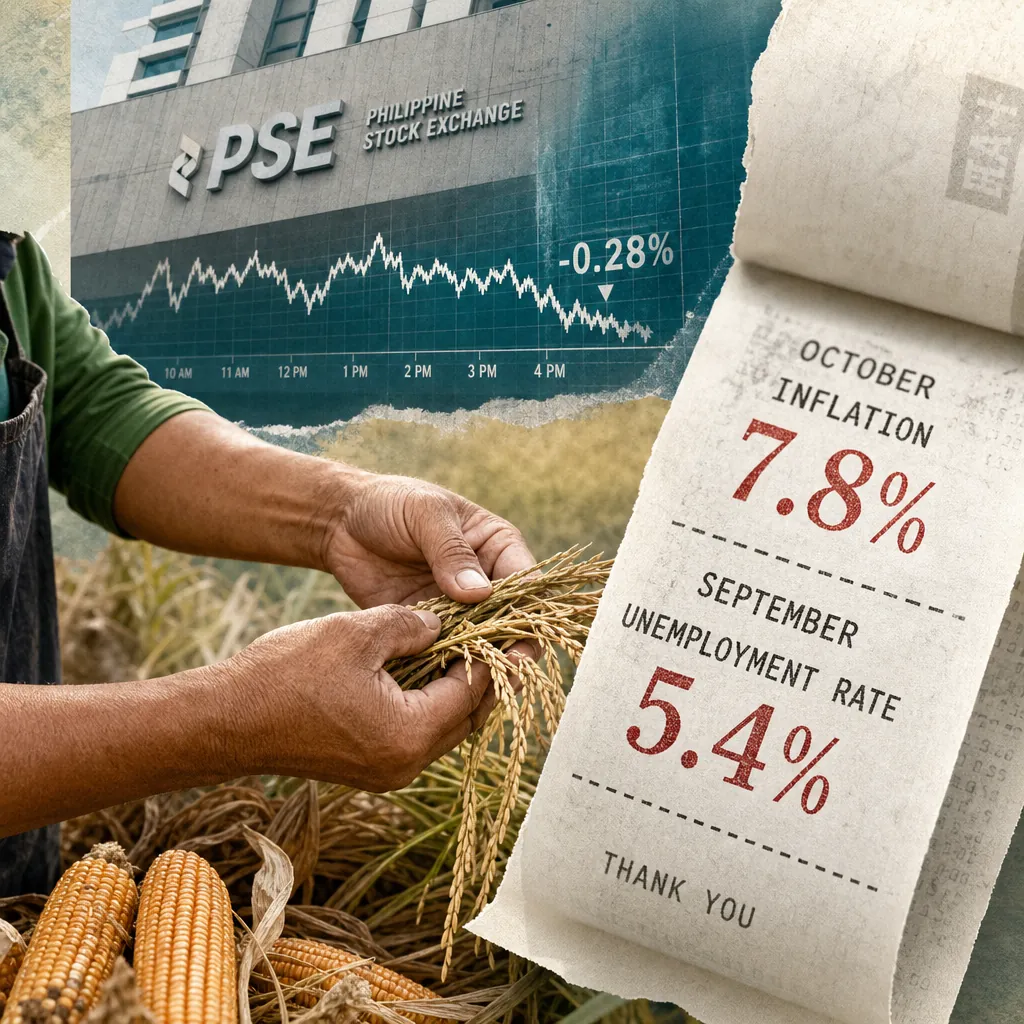
The Philippine Statistics Authority's October inflation reading of 7.8 percent — the highest since February 2023 — set the terms for Friday's business coverage, and the Philippine Stock Exchange index closed the week down 16.19 points, or 0.28 percent, at 5,761.95 as investors weighed the print78. The same day brought a second data point in the opposite direction: unemployment rose to 5.4 percent of the labor force in September from 5.3 percent in August, or 2.86 million jobless Filipinos against 2.77 million the month before65. Together the two releases describe an economy where prices are climbing faster than the labor market is absorbing new entrants, and the day's coverage fanned out from there into farm output, water policy, heat warnings, and the government's own growth forecasts.
A third release sharpened the picture. The value of agriculture and fisheries production fell 5 percent in the third quarter to ₱389.42 billion, reversing a 3.3 percent expansion in the second quarter, as palay and corn harvests dropped on weather disturbances and high input costs66. The PSA attributed the decline to the southwest monsoon, known locally as habagat, and the farm sector now faces a forecast El Niño — the periodic warming of the equatorial Pacific that brings drier conditions to the western Pacific, including the Philippines — through the coming quarters66. Deutsche Bank raised its full-year inflation forecast for the Philippines to 5.9 percent from 5.7 percent, and expects inflation to average 7.2 percent across November and December, holding below 8 percent through year-end96. The bank maintained that the Bangko Sentral ng Pilipinas, the country's central bank, has little need to raise interest rates again because price pressures remain concentrated in transport, energy, and rice rather than spread across the basket96.
On the growth side, a poll of 14 economists by the Inquirer put third-quarter gross domestic product growth at a median 2.8 percent, up from a revised 2.4 percent in the second quarter85. That would end four consecutive quarters of slowing growth, but the expansion would still rank among the weakest in 17 years outside the pandemic period and would leave output below the government's own targets85. The stock market's modest decline, the farm contraction, and the inflation print all point the same way: the Philippine economy is entering the final quarter of 2026 with prices near a three-year high, farm supply under weather stress, and growth recovering only weakly.
Key themes
- Inflation reaches 7.8% in October, the highest since February 2023. The PSA reading was up from 7.2 percent in September and within the central bank's 7.1 to 8.1 percent forecast range, driven by higher transport fares, energy costs, and rice prices96. The PSE index fell 0.28 percent on the day, with services the worst-performing sector at minus 1.39 percent78.
- Unemployment rises to 5.4% as more Filipinos join the labor force. The jobless count reached 2.86 million in September from 2.77 million in August, while labor force participation climbed to 64.5 percent from 64 percent, or 53.19 million Filipinos from 52.56 million65. Job creation did not keep pace with the number of people entering the market.
- Farm output falls 5% in the third quarter to ₱389.42 billion. The contraction followed a 3.3 percent expansion in the second quarter and was driven by lower palay and corn production after monsoon damage and high input costs66. El Niño is expected to reduce output further in the coming quarters66.
- Economists see third-quarter GDP at 2.8%, ending four quarters of slowdown. The median estimate of 14 economists surveyed by the Inquirer points to a pickup from 2.4 percent in the second quarter, but growth would remain among the weakest in 17 years outside the pandemic85.
- Deutsche Bank raises its 2026 inflation forecast to 5.9%. The German lender lifted its full-year estimate from 5.7 percent and expects 7.2 percent average inflation in November and December, while arguing the central bank need not raise rates again96.
- Senator Legarda proposes cheaper water for low-income households and penalties for heavy commercial use. The proposal, the second item in her 10-point action plan against El Niño, calls on water districts and regulators to impose higher charges on golf course irrigation, commercial pools, and industrial washing, with the revenue subsidizing poor households' bills19.
- Police move against illegal water connection syndicates in Metro Manila. The National Capital Region Police Office ordered all five police districts to intensify operations after arresting two alleged leaders of groups in Baseco Compound, Port Area, Manila, that charged residents ₱5,000 to ₱10,000 for unauthorized connections to main supply lines43.
- PAGASA records dangerous heat index levels in four areas. Zamboanga City hit 43°C and San Jose in Occidental Mindoro, Iloilo City, and La Granja in La Carlota, Negros Occidental each recorded 42°C as of 5 p.m. Friday18. The heat index measures discomfort from combined temperature and humidity, and PAGASA classifies 42°C to 51°C as dangerous, with elevated risk of heat cramps and heat exhaustion45.
How the narratives stack
Dominant. The inflation print and its market aftermath anchored the day's business coverage. The PSE index's 0.28 percent decline, the sector-by-sector breakdown showing services down 1.39 percent and financials the only gainer at plus 1.24 percent, and Deutsche Bank's revised forecast all treated the 7.8 percent October reading as the central fact of the week7896. The unemployment release, published the same day, was folded into the same frame: an economy where prices outrun job creation65. Within the items captured here, this was the most heavily covered economic story, and the coverage value attached to the inflation and market items reflects that weight — the PSE index story alone carried an estimated ₱145,512 in advertising-equivalent value, the measure of what the same space would have cost as paid advertising78.
Counter-narrative. The farm output contraction and the El Niño warnings formed a second, quieter story about supply-side pressure that the inflation number only partly captures. The 5 percent drop in agricultural production to ₱389.42 billion, the PSA's attribution to monsoon damage, and the expectation of further losses under El Niño describe a food-supply problem that will feed into rice and vegetable prices in the coming quarters66. Senator Legarda's water-pricing proposal and the NCRPO's crackdown on illegal water connections belong to the same story: the government is preparing for a dry spell that will strain both farm output and urban water access1943. This thread ran through the day's coverage but did not dominate it.
Emerging. The third-quarter GDP estimate of 2.8 percent, due for official release later, is the next data point that will test whether the economy is stabilizing or continuing to weaken85. The economists' poll is a forecast, not a result, and the gap between the 2.8 percent median and the government's targets is the number to watch. Separately, the Bangko Sentral's next policy decision will be read against Deutsche Bank's argument that no further rate hike is needed96. If inflation stays below 8 percent through December as the bank expects, the case for holding rates steady strengthens; if it does not, the central bank faces a harder choice.
Under-covered. The labor market's structural problem — job creation failing to keep pace with labor force entry — received less sustained attention than the inflation headline. The 5.4 percent unemployment rate and the 0.5-percentage-point rise in participation together describe an economy adding workers faster than it adds jobs65. That is a slower-moving story than a three-year inflation high, but it bears directly on household incomes and on the government's ability to sustain domestic demand.
Platform insights
The day's monitoring captured no social-media engagement data for this topic, so platform-level behavior cannot be described from the available material. The coverage reviewed here is entirely online news, and the conversation it records is a policy and data conversation rather than a public one.
Key voices and communities
The Philippine Statistics Authority. The PSA released both the September unemployment figure and the third-quarter farm output data on Friday, and its October inflation print the day before set the week's tone656678. The agency's numbers are the common reference point for every other voice in the conversation.
Economists and forecasters. The 14 economists polled by the Inquirer on third-quarter GDP and Deutsche Bank's revised inflation forecast represent the analyst community whose estimates shape market expectations ahead of official releases8596. Their framing — weak recovery, concentrated price pressures, no need for further rate hikes — is the frame the business press carried.
Senator Loren Legarda. Her 10-point action plan against El Niño, and specifically its second item on water pricing, put a legislative voice behind the water-scarcity story19. The proposal targets commercial users — golf courses, pools, industrial washing — and would redirect the revenue to low-income households' bills.
The National Capital Region Police Office. The NCRPO's directive against illegal water connection syndicates, issued after the arrest of two alleged group leaders in Baseco, represents the enforcement arm of the water story43. The syndicates charged residents ₱5,000 to ₱10,000 per connection, according to police intelligence reports43.
PAGASA. The weather bureau's heat index readings and its weekend forecast — northeast monsoon rains over Northern Luzon, dangerous heat in four areas — provided the day's physical context184528. PAGASA's classifications give the public a scale for judging heat risk, and its El Niño advisories feed directly into the farm and water stories.
Narrative streams
Inflation at 7.8% pulls the stock index down 0.28%
The Philippine Stock Exchange index closed Friday at 5,761.95, down 16.19 points or 0.28 percent for the week, as investors weighed the October inflation print of 7.8 percent78. The reading was up from 7.2 percent in September and marked the highest level since February 2023, when inflation stood at 8.6 percent78. Within the index, only financials gained, rising 1.24 percent; services fell 1.39 percent, mining and oil 0.99 percent, industrial 0.42 percent, holding firms 0.29 percent, and property 0.38 percent78. International Container Terminal Services Inc. retreated 1.39 percent to ₱817 on ₱1.17 billion in trading value, and Globe Telecom lost 1.40 percent to ₱1,47878.
The price pressures were concentrated in transport fares, energy costs, and rice, according to the coverage96. That concentration matters for the central bank's calculus: if the increases are confined to a few categories rather than spread across the basket, the Bangko Sentral has more room to hold rates steady than a broad-based inflation episode would allow. Deutsche Bank's note made exactly this argument, raising its full-year forecast to 5.9 percent while maintaining that the central bank has little need to tighten again96. For businesses carrying debt or planning capital spending, the difference between a rate hold and a rate hike in the first quarter of 2027 is the difference between a stable financing cost and a higher one. For households, the 7.8 percent print means the peso in hand buys less than it did a year ago, and the categories driving the increase — transport, energy, rice — are the ones low-income families spend the largest share of their budgets on.
Unemployment rises to 5.4% as labor force participation climbs
The jobless rate rose to 5.4 percent of the labor force in September from 5.3 percent in August, putting the number of unemployed Filipinos at 2.86 million, up from 2.77 million65. The increase came as labor force participation climbed to 64.5 percent from 64 percent, equivalent to 53.19 million Filipinos from 52.56 million65. More people entered the market looking for work, and job creation did not absorb all of them.
The reading was nearly flat month-on-month but marked another increase after unemployment eased in August for the first time following three straight months of increases65. That pattern — three rises, one decline, another rise — describes a labor market that is not deteriorating sharply but is not generating enough positions to keep pace with population and participation growth. For the government, the number complicates the growth story: domestic demand depends on household incomes, and household incomes depend on employment. For employers, a larger labor pool means more applicants per opening, which tends to hold wage growth in check. The economists' third-quarter GDP estimate of 2.8 percent, while an improvement on 2.4 percent, is consistent with an economy creating jobs slowly85.
Farm output falls 5% as El Niño approaches
The value of agriculture and fisheries production fell 5 percent in the third quarter to ₱389.42 billion, according to the PSA, reversing a 3.3 percent expansion in the second quarter66. The decline was driven by sharp drops in palay and corn output after weather disturbances and high input costs66. The PSA attributed the contraction to the habagat, the southwest monsoon that brought damaging rains during the quarter66.
The farm sector now faces El Niño, the periodic warming of the equatorial Pacific that shifts rainfall patterns and typically brings drier conditions to the Philippines66. The Department of Agriculture has warned that the phenomenon is expected to reduce output further in the coming quarters66. For consumers, the link is direct: rice is already one of the categories driving the 7.8 percent inflation print, and a smaller palay harvest tightens domestic supply at the same time that imported rice costs more because of the peso's weakness and global prices96. For farmers, the combination of weather damage and high input costs compresses margins in a sector where most producers are smallholders. The government's response — importation, price monitoring, and now the Baguio City task force on imported agricultural crops — addresses the supply side, but the weather risk is not something policy can control8.
Water pricing and illegal connections as El Niño preparations
Senator Loren Legarda called on Friday for more affordable water rates for low-income families and stronger measures against excessive commercial water consumption, as the second item in her 10-point policy action plan against El Niño19. The proposal asks local water districts, service providers, and regulators to explore penalties or higher charges for non-essential commercial use — golf course irrigation, commercial swimming pools, industrial washing — with the additional revenue used to subsidize poor households' bills19.
The same day, the National Capital Region Police Office ordered all five police districts in Metro Manila to intensify operations against syndicates installing unauthorized water connections43. The directive followed the arrest of two alleged leaders of illegal water tapping groups in Baseco Compound, Port Area, Manila; police intelligence reports said the groups charged residents ₱5,000 to ₱10,000 to install unauthorized connections to main supply lines43. NCRPO officer-in-charge Police Brig. Gen. Christopher Abrahano instructed district commanders to coordinate with water concessionaires, local governments, and barangay officials on joint inspections and to target organizers, financiers, and collectors43.
The two stories describe the same problem from different angles. Legarda's proposal treats water as a pricing question: charge commercial users more, protect poor households. The police operation treats it as an enforcement question: illegal connections divert supply and create safety hazards, and the syndicates profit from residents who lack affordable legal access. For water districts and concessionaires, the coming dry spell will test both the pricing structure and the enforcement capacity. For low-income households in areas like Baseco, the choice between a ₱5,000 illegal connection and an unaffordable legal one is the practical form the policy debate takes.
Dangerous heat and the weekend forecast
PAGASA recorded dangerous heat index levels in four areas on Friday: 43°C in Zamboanga City and 42°C in San Jose, Occidental Mindoro; Iloilo City; and La Granja, La Carlota, Negros Occidental, as of 5 p.m.18. The heat index measures the discomfort the body experiences from combined air temperature and humidity, and PAGASA classifies 42°C to 51°C as dangerous, with increased risk of heat cramps and heat exhaustion45. The agency forecast that San Jose, La Granja, and Zamboanga City would continue at 42°C on Saturday, possibly through Sunday45.
Separately, PAGASA's 4 p.m. forecast said the northeast monsoon, or amihan, would bring cloudy skies and light rains over Northern Luzon — Cagayan Valley, Apayao, Kalinga, Mountain Province, Ifugao, and Aurora — on Saturday, with the monsoon expected to strengthen further28. The combination of dangerous heat in the central and southern Philippines and monsoon rains in the north is the standard November pattern, but the heat readings matter for outdoor workers, the elderly, and communities without reliable cooling. For employers in construction, agriculture, and transport, the dangerous-level classification is a signal to adjust outdoor work schedules. For local governments, it is a public-health alert.
Growth forecasts point to a weak recovery
The Philippine economy likely grew 2.8 percent in the third quarter, according to the median estimate of 14 economists surveyed by the Inquirer, up from a revised 2.4 percent in the second quarter85. If realized, the figure would end four consecutive quarters of slowing growth and bring expansion back to the pace recorded in the first quarter85. It would still be among the weakest expansions in 17 years outside the pandemic period and below the government's targets85.
The forecast attributes the pickup to improving government spending and resilient exports, with domestic demand still weak85. For the government, the gap between 2.8 percent and its targets is the fiscal problem: slower growth means less tax revenue at the same time that inflation raises the cost of public services. For the central bank, weak growth alongside high inflation is the hardest combination to manage, because the tools that fight inflation — higher rates — also slow growth. Deutsche Bank's argument that no further rate hike is needed rests on the view that inflation is concentrated rather than broad-based96. The third-quarter GDP release will test that view: if growth comes in at or below 2.8 percent while inflation stays near 8 percent, the central bank faces a stagflation-like trade-off that its forecasts do not currently assume.
Conversation trajectory
Third-quarter GDP release (observation window: next 2–4 weeks). The official PSA release will confirm or revise the 2.8 percent median estimate85. A print at or above 2.8 percent would support the view that the slowdown has bottomed; a print below would raise questions about the government's full-year target and increase pressure on the central bank to choose between growth and inflation.
November and December inflation (observation window: monthly releases through January 2027). Deutsche Bank expects inflation to average 7.2 percent across the two months, holding below 8 percent96. If the actual prints exceed that, the case for a rate hike strengthens; if they come in lower, the central bank's hold becomes easier to defend.
El Niño developments (observation window: through the first quarter of 2027). The farm output contraction and the water-policy proposals both depend on how severe the dry spell turns out to be6619. PAGASA's El Niño advisories and the Department of Agriculture's production estimates will be the checkable signals.
Bangko Sentral policy meeting (observation window: next scheduled meeting). The central bank's decision will be read against Deutsche Bank's no-hike argument and the inflation trajectory96. A hold would signal confidence that price pressures are contained; a hike would signal the opposite.
Trigger events. The PSA's third-quarter GDP release, the next inflation print, any PAGASA upgrade of El Niño severity, and the central bank's next policy decision are the events that would move this story from a data-driven watch to a policy response.
Response guidance
Frame inflation coverage around the categories driving it. Transport, energy, and rice account for the bulk of the 7.8 percent print96. Communications that explain which prices are rising and why are more useful to households and businesses than a single headline number.
Treat the unemployment release as a demand signal. The rise to 5.4 percent alongside higher labor force participation means more people are looking for work65. Employers recruiting in the fourth quarter face a larger applicant pool and should expect wage expectations to be shaped by the inflation print.
Prepare for El Niño messaging on water and food. The farm contraction, Legarda's water-pricing proposal, and the NCRPO crackdown all point to a dry spell that will affect both supply and access661943. Organizations operating in affected regions should have clear guidance ready on water conservation, heat safety, and food supply contingency.
Use PAGASA's heat index scale in public communications. The dangerous-level classification of 42°C to 51°C is a concrete threshold the public can act on45. Outdoor-work employers and local governments should align their advisories with the agency's readings rather than issuing separate scales.
Avoid presenting forecasts as results. The 2.8 percent GDP estimate and Deutsche Bank's 5.9 percent inflation forecast are projections, not official data8596. Communications that treat them as confirmed outcomes will need correction when the official releases arrive.
Watch the peso and imported-food costs. Rice is both an inflation driver and a farm-output story9666. Organizations with exposure to imported agricultural commodities should track both the exchange rate and the importation policy environment, including local monitoring initiatives like Baguio City's new task force on imported crops8.
See the full picture behind today's signals.
This report draws from Media Meter's MediaWatch, our real-time monitoring engine tracking 2,470+ Philippine sources across print, broadcast, digital, and social. Explore how the platform turns raw coverage into decision-grade intelligence, then see how it's configured for teams like yours — whether you're in PR agencies, corporate comms, government, or marketing.
Want more? Browse our Report Library for sector and crisis intelligence, or request a demo and we'll have your brand set up before the call.
Want this kind of intelligence on your brand?
This brief is built on the same MediaWatch methodology that runs continuously across every brand we monitor. See your competitive landscape, Impact Score, and narrative trajectory in a 30-minute demo.