Marcos pushes safer online transactions for MSMEs
President Marcos met the Private Sector Advisory Council's digital infrastructure group to press for stronger protection of online banking, commerce and government services, as a Pasay parcel-scam hub holding 159 foreign nationals was dismantled and factory activity contracted for a third time this year.
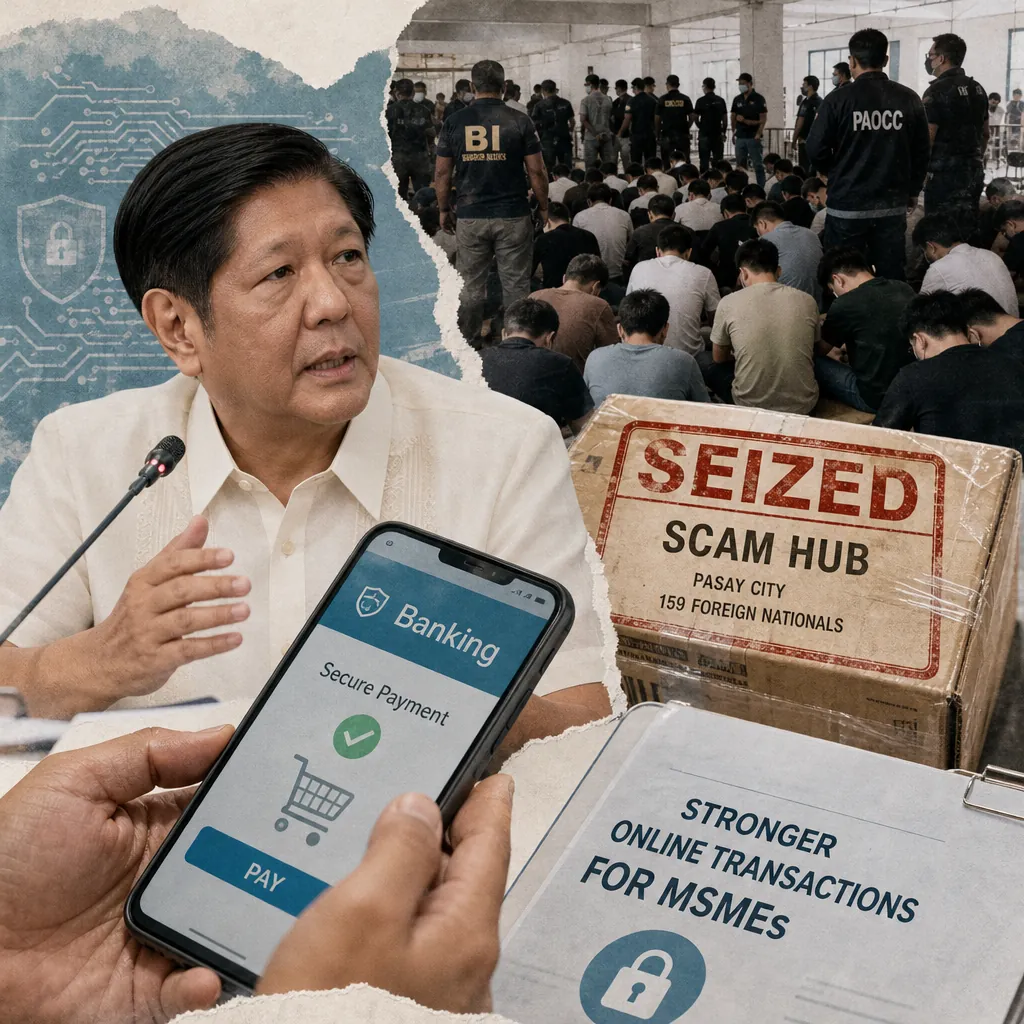
President Ferdinand Marcos Jr. met the Private Sector Advisory Council's (PSAC) Digital Infrastructure Sector Group at Malacañan Palace on Tuesday for the eleventh time, and the Presidential Communications Office said he used the session to press for stronger protection of digital systems and online services as cybersecurity threats grow20. The same day, police in Pasay City announced they had rounded up 159 foreign nationals at an alleged "parcel scam hub" that had operated for three months, with a Chinese national and two Malaysians identified as the masterminds623. Those two developments, arriving together, framed a day of Philippine business and policy news in which the country's shift to digital transactions and its exposure to digital crime moved on the same track.
The economic backdrop was less encouraging. S&P Global's survey of about 400 manufacturers put the Philippines' Purchasing Managers Index (PMI) at 49.1 in October, down from 49.6 in September and below the 50 mark that separates expansion from contraction — the third month this year that factory activity has shrunk88. Moody's Ratings, meanwhile, said infrastructure spending and the energy transition should keep the country's sustainable bond market growing; the Philippines ranks third in Southeast Asia for such bonds, with $23 billion issued between 2017 and the third quarter of 2026, or 17 percent of the regional total97. DigiPlus Interactive Corp., the operator of BingoPlus, ArenaPlus and GameZone, reported a 12-percent fall in net income to P8.9 billion for the first nine months of 2026 from P10.11 billion a year earlier, with net gaming revenue after tax down 17 percent to P16.2 billion28.
Labor and household news rounded out the day. The National Wages and Productivity Commission approved a P40 to P45 daily minimum wage increase for private-sector workers in Western Visayas and Negros Occidental, with agricultural workers moving from P520 to P565 and non-agricultural workers in establishments with more than 10 employees moving from P550 to P59016. Quezon City Rep. Patrick Michael Vargas filed House Bill No. 11028, the proposed Informal Workers Health Benefits and Insurance Act, to extend health insurance to public utility drivers, delivery riders, street vendors and other informal-sector workers2. Manila Water released its November desludging schedule and urged customers to have septic tanks cleaned every five years13. And Pagasa warned that a strong to very strong El Niño could persist through the first quarter of 2027, threatening Metro Manila's water supply as reservoir inflows fall85.
Key themes
- Marcos presses for safer online transactions as digital crime surfaces in Pasay. The President told the PSAC digital group that digital security is an essential part of the expanding digital economy, citing consumers, workers and micro, small and medium enterprises (MSMEs) who depend on internet platforms for banking, commerce, education and government services20. Hours later, the Philippine National Police (PNP) detailed a parcel scam operation that had targeted Vietnamese, Chinese, Malaysian and Indonesian nationals for three months623.
- Factory activity contracts for a third time in 2026. The PMI fell to 49.1 in October from 49.6 in September, with S&P Global reporting weaker demand at home and abroad and unusually hot weather linked to El Niño weighing on production88. A reading under 50 means manufacturers surveyed reported less activity than the month before.
- A P40 to P45 wage increase is approved for Western Visayas and Negros Occidental. The National Wages and Productivity Commission, chaired by Labor Secretary Francis Tolentino, cleared the Regional Tripartite Wages and Productivity Board 6 increase, which takes effect this month16.
- A lawmaker moves to insure informal workers. House Bill No. 11028 would give public utility drivers, delivery riders, food vendors and other informal workers a financial safety net for health emergencies, a group Vargas said receives too little protection from government2.
- Sustainable bonds draw a growth outlook from Moody's. The ratings agency said the Philippines' $23 billion sustainable bond market, the third largest in Southeast Asia, should expand on infrastructure and energy-transition financing, provided governance and reporting standards hold97.
- DigiPlus posts lower earnings as gaming revenue weakens. Net income fell 12 percent to P8.9 billion in the first nine months, and earnings before interest, taxes, depreciation and amortization dropped 25.4 percent to P8.3 billion from P11.13 billion28.
- El Niño puts Metro Manila's water supply under pressure. Pagasa expects a strong to very strong El Niño through the first quarter of 2027, with below-normal rainfall and prolonged dry spells reducing inflows into reservoirs serving the capital85.
- Police secrecy becomes a public argument. PNP chief Gen. Jose Melencio Nartatez Jr. said there is "always secrecy in our police operations" after Sen. Panfilo Lacson urged discretion in high-profile cases, a remark made at the same briefing where the parcel scam arrests were announced12.
How the narratives stack
Dominant. The digital-economy story carried the day's policy weight. Marcos's meeting with the PSAC digital group, the Pasay parcel scam operation and the PNP's remarks on operational secrecy all landed within hours of one another, and each drew coverage in the items reviewed here2062312. The parcel scam story in particular generated multiple reports — an initial account of the 159 foreign nationals rounded up, a follow-up naming the three masterminds, and a separate piece on Nartatez's response to Lacson — which is the clearest sign in this set that editors treated it as a running story rather than a one-off police item. The President's statement gave it a policy frame: the same digital rails that carry MSME payments and government services also carry fraud, and the government is being asked to secure both.
Counter-narrative. The manufacturing data cut against any reading of the economy as steady. The PMI has now contracted in three separate months of 2026, and October's reading of 49.1 was weaker than September's 49.688. S&P Global attributed part of the drag to El Niño-linked heat, which ties the factory story to the water-supply warning from Pagasa85. DigiPlus's earnings decline fits the same picture of softer consumer demand: the gaming operator blamed a weaker macroeconomic environment for a 17-percent fall in net gaming revenue after tax28. Read together, these items describe an economy in which demand is cooling at the same time that policy attention is fixed on digital security and wage relief.
Emerging. The informal-sector health insurance bill is the newest item in the set and the one with the least institutional momentum behind it. House Bill No. 11028 has been filed but not scheduled for committee action, and Vargas's statement framed it as a gap-filling measure rather than a response to a specific incident2. The wage order for Western Visayas and Negros Occidental is further along — approved by the National Wages and Productivity Commission and due to take effect this month — but its economic effect will only show up in later labor and price data16. Moody's outlook on sustainable bonds belongs here too: the agency described growth as dependent on governance and reporting improvements that have not yet been made97.
Under-covered. The El Niño water-supply warning received a single detailed treatment in this set despite its reach into household water access across the capital region and its connection to the factory slowdown85. Manila Water's desludging reminder, a routine service announcement, ran alongside it13. Neither drew the volume of coverage that the parcel scam and the President's digital-security meeting did, even though the water story has a longer horizon and affects more households directly.
Platform insights
The day's social activity ran through the same channels the news stories describe. The PNP's briefing was held at a Pasay City office and covered by reporters who filed from the scene, with the chief's remarks circulated through the PNP's own Facebook presence and picked up by news accounts126. Sen. Lacson's call for secrecy discipline was made in a post on X, formerly Twitter, which is where the exchange between the senator and the police leadership became visible to the public12. The parcel scam story moved through Facebook and X as outlets posted the 159-person figure and the masterminds' nationalities, and the "rescued and persons of interest" phrasing from the police briefing traveled with it623. Reddit and YouTube carried no measurable activity on these stories in the material reviewed here.
Key voices and communities
The Presidential Communications Office and the Private Sector Advisory Council. The PCO released the readout of Marcos's meeting with the PSAC Digital Infrastructure Sector Group, framing digital security as a component of the digital economy rather than a standalone law-enforcement matter20. The PSAC is a body of private-sector advisers that meets with the President on specific sectors; its digital group's eleventh meeting with Marcos signals that the topic has become a standing agenda item.
The Philippine National Police leadership. PNP chief Gen. Jose Melencio Nartatez Jr. and Criminal Investigation and Detection Group for the National Capital Region chief Police Col. John Guiagui briefed reporters on the parcel scam, naming the three masterminds and describing the scheme's method: callers working from a database of would-be victims236. Nartatez's separate remarks on secrecy, made at the same briefing, put the police in the position of defending their communication practices while announcing a major operation12.
Labor and wage institutions. Labor Secretary Francis Tolentino chairs the National Wages and Productivity Commission, which approved the Western Visayas wage order, and RTWPB-6 chairman Sixto Rodriguez Jr. confirmed the approval16. The regional wage board system is the mechanism through which minimum wages are set in the Philippines; boards study conditions in each region and recommend increases, which the national commission then reviews.
Quezon City Rep. Patrick Michael Vargas. Vargas's filing of House Bill No. 11028 puts the informal workforce — drivers, riders, vendors — into the health insurance debate, a group that falls outside the coverage that formal employment provides2.
Moody's Ratings and S&P Global. The two ratings and research firms supplied the day's forward-looking economic assessments, one on sustainable finance and one on factory activity9788. Their reports carry weight with investors and with government agencies that cite them in budget and policy documents.
Narrative streams
Digital security moves to the top of the President's business agenda
Marcos's eleventh meeting with the PSAC Digital Infrastructure Sector Group produced a statement from the Presidential Communications Office saying he "considers digital security an essential component of the country's expanding digital economy as more Filipinos increasingly depend on internet-based platforms for banking, commerce, education and government transactions"20. The PCO said he expressed concern over how online threats affect consumers, workers and MSMEs, and that he is working with industry leaders on the problem20. The PSAC is a council of private-sector executives who advise the President on specific industries; its digital infrastructure group has now met with him eleven times, which makes digital policy one of the more frequently discussed topics in his advisory calendar.
The statement did not announce a specific measure, and the PCO release described the meeting as a call for stronger protection rather than a new program20. What gives the item weight is its timing. On the same day, the PNP announced the dismantling of a parcel scam hub in Pasay City where 159 foreign nationals, including 128 Indonesians, were rounded up6. Police said the operation had run for three months and targeted Vietnamese, Chinese, Malaysian and Indonesian nationals, and that the workers had entered the country as tourists without work visas6. CIDG-NCR chief Guiagui described the method: the group called would-be clients from a database of victims23.
For MSMEs, the practical stake is trust in the payment and delivery systems they now rely on. A scam operation that runs for three months from a single Pasay office, staffed by foreign nationals on tourist visas, is a reminder that the fraud infrastructure can be assembled quickly and cheaply. The President's framing ties consumer protection to the same platforms that carry small-business transactions; the policy question is whether the government's response will be enforcement alone or will extend to the platform-level safeguards that the PSAC discussion implies.
A parcel scam hub in Pasay and the argument over police secrecy
The parcel scam story developed in two directions on Tuesday. The first was the operation itself: 159 foreign nationals rounded up, three masterminds identified as one Chinese and two Malaysian, and a scheme that police described as new623. The second was a procedural argument. Sen. Panfilo Lacson posted on X urging authorities to keep high-profile cases discreet and to publicize information only after an operation is complete, and Nartatez responded at the Pasay briefing that "there is always secrecy in our police operations"12.
The exchange matters beyond the parcel scam. Lacson's post referenced the hunt for Sen. Ronald "Bato" dela Rosa, a separate case that has put police communication under scrutiny12. Nartatez's answer — that the police talk when there is a need to give details — was an attempt to hold both positions: transparency about the Pasay operation and discretion about the dela Rosa case. The PNP also rejected calls for a "shoot-to-kill" approach in serving a warrant against dela Rosa, amid what INQToday described as fabricated quote cards attributing such a call to a lawmaker30.
For the business sector, the read is about confidence in law enforcement as a service to commerce. Scam hubs target foreign nationals and cross-border payment flows; the speed with which police publicize an operation affects whether victims in other countries come forward, and the secrecy argument affects whether future operations succeed. Companies that depend on cross-border e-commerce and remittances have a direct interest in which norm prevails.
Factory activity contracts again as El Niño weighs on production
The Purchasing Managers Index fell to 49.1 in October from 49.6 in September, according to S&P Global's survey of about 400 manufacturers88. The index is a diffusion measure: a reading above 50 means more manufacturers reported improvement than deterioration compared with the previous month, and below 50 means the reverse. October was the third month this year below the threshold88. S&P Global said output continued to decline, though at a slower pace, as the downturn in demand deepened, with weaker demand in both domestic and overseas markets and a smaller drag from foreign sales88. The firm also cited unusually hot weather linked to El Niño as a factor weighing on production88.
The El Niño connection runs through a separate warning. Pagasa, the state weather bureau, describes El Niño as unusually warm sea surface temperatures in the central and eastern tropical Pacific, and in the Philippines it is associated with below-normal rainfall, prolonged dry spells and higher temperatures85. Pagasa has warned that a strong to very strong El Niño could persist through the first quarter of 2027, reducing water inflows into reservoirs serving Metro Manila85. The same dry conditions that threaten household water supply also affect industrial production, particularly for manufacturers that depend on water for cooling or processing.
For manufacturers, the read is that the current downturn is being driven by demand weakness rather than supply constraints, which limits what cost-side measures can accomplish. S&P Global noted that price pressures across the domestic manufacturing sector persisted even as demand fell88. Companies planning capital spending into 2027 will be weighing a third contraction month against the expectation that El Niño conditions ease after the first quarter.
Wage boards approve a P40 to P45 increase for Western Visayas and Negros Occidental
The National Wages and Productivity Commission approved the increase set by the Regional Tripartite Wages and Productivity Board 6, with agricultural workers receiving a P45 daily increase that raises their minimum from P520 to P565 and non-agricultural workers in establishments with more than 10 employees receiving P40, raising their rate from P550 to P59016. RTWPB-6 chairman Sixto Rodriguez Jr. confirmed the approval on Tuesday, and the new wage orders are due to take effect this month16.
The regional wage board system is the Philippines' mechanism for setting minimum wages. Each region has a tripartite board — government, employers and workers — that reviews economic conditions and recommends increases; the national commission, chaired by the Labor Secretary, reviews and approves them. The Western Visayas increase follows a similar order for Soccsksargen workers, who are due to receive a P41 daily increase starting Nov. 1916.
For employers in the region, the increase raises the floor for entry-level pay in agriculture and in larger non-agricultural establishments, with smaller establishments covered at a different rate. For workers, the increase is a partial offset to inflation, though the size of the offset depends on price movements in the region's own consumption basket. The wage order's effect on hiring and prices will show up in regional labor force data over the coming quarters.
A bill to insure informal workers
House Bill No. 11028, the proposed Informal Workers Health Benefits and Insurance Act, would extend health insurance coverage to public utility drivers, delivery riders, street vendors and other frontline workers in the informal economy2. Vargas said many Filipinos choose informal work but receive too few benefits and protections from government2. The bill has been filed in the House of Representatives but has not been scheduled for committee hearings.
The informal sector in the Philippines includes a large share of the transport, retail and delivery workforce, and those workers generally fall outside the coverage that formal employment provides through the Philippine Health Insurance Corp. and the Social Security System. Vargas's proposal would create a separate mechanism for them. For insurers and health-care providers, the bill signals a possible new covered population; for employers in the gig and delivery economy, it raises the question of whether contributions would fall on platforms, workers or the state. The bill's prospects depend on committee action, which has not been scheduled.
Sustainable bonds draw a growth outlook
Moody's Ratings said infrastructure development and the energy transition will boost the Philippines' sustainable bond market, citing rising investor demand for stronger governance, transparency and clear commitments on how funds are used97. The country has the third-largest sustainable bond market in Southeast Asia after Singapore and Thailand, with $23 billion in issuances representing 17 percent of the regional total from 2017 to the third quarter of 202697. Moody's said the country's vulnerability to extreme weather is making climate adaptation and resilience increasingly important financing priorities, and that further growth would depend on stronger governance, transparent reporting and clearly defined uses for the funds97.
Sustainable bonds are debt instruments whose proceeds are earmarked for environmental or social projects, and investors increasingly require reporting on how the money is spent. For Philippine issuers — banks, utilities and infrastructure companies — the Moody's assessment is a signal that the market is deep enough to absorb more issuance but that the reporting standards will determine the pricing. The El Niño warning and the factory slowdown both point to the kind of climate-related spending that sustainable bonds are designed to finance8588.
DigiPlus earnings fall as gaming revenue weakens
DigiPlus Interactive Corp. reported a 12-percent decline in net income to P8.9 billion for the first nine months of 2026 from P10.11 billion a year earlier, with net gaming revenue after tax down 17 percent to P16.2 billion28. Earnings before interest, taxes, depreciation and amortization fell 25.4 percent to P8.3 billion from P11.13 billion28. President Ping Chen said the company would continue prioritizing operating efficiency while expanding its user base, and that it remains focused on "sustainable growth through self-development of compelling content, stronger user acquisitions and retention, and disciplined spending on A&P and investments"28.
The company operates BingoPlus, ArenaPlus and GameZone, digital gaming platforms that depend on consumer discretionary spending. The decline in net gaming revenue after tax, which is the revenue left after prizes and taxes, indicates that players spent less or that the company retained less per player. For the digital gaming sector, the result is a data point on how a weaker macroeconomic environment is affecting a business built on small, frequent consumer transactions — the same consumer base that the PMI and the wage order affect.
Conversation trajectory
Wage order implementation, through November. The Western Visayas and Negros Occidental wage orders take effect this month, and the first compliance reports from the Department of Labor and Employment will show whether employers in the region have adjusted payrolls16. Watch for employer-group statements on the increase's effect on small establishments, which are covered at a different rate.
House committee action on House Bill No. 11028, over the next four to six weeks. The informal workers' health insurance bill has been filed but not scheduled2. A committee referral or hearing would be the first signal of whether the measure has leadership support; without one, it remains a statement of intent.
November PMI release, early December. S&P Global publishes the PMI monthly, and the November reading will show whether October's 49.1 was the bottom of the contraction or part of a longer slide88. The El Niño factor will be visible in any commentary on weather-related disruptions.
Pagasa's El Niño advisories through the first quarter of 2027. The state weather bureau has warned that strong to very strong conditions could persist into early 202785. Watch for updates to the advisory and for water-utility statements on reservoir levels, which would indicate whether the supply threat is intensifying.
PNP communication on the dela Rosa case and the parcel scam follow-up. Nartatez's remarks on secrecy and the PNP's rejection of "shoot-to-kill" calls set up a period in which police communication will be scrutinized1230. Further arrests or charges in the parcel scam case, or a resolution of the dela Rosa warrant, would be the trigger events.
Sustainable bond issuance in the fourth quarter. Moody's outlook depends on governance and reporting improvements97. A new Philippine sustainable bond issuance with detailed use-of-proceeds reporting would confirm the agency's growth expectation; a delay would suggest issuers are waiting for clearer standards.
Response guidance
Digital-security messaging. Companies that handle consumer payments or data should prepare plain-language statements on how they protect transactions, framed around the same concerns Marcos raised — banking, commerce and government services20. The parcel scam's method, calling victims from a pre-built database, is the kind of detail that makes fraud advice concrete; customer communications that describe it will land better than generic warnings23.
Fraud-victim support channels. The Pasay operation targeted foreign nationals, but the scheme's mechanics apply to domestic consumers as well6. Businesses with customer-service operations should ensure that fraud reports route to a trained team and that response times are published, since the police case has raised public awareness of parcel scams.
Wage-order compliance. Employers in Western Visayas and Negros Occidental should confirm payroll adjustments against the new rates before the orders take effect this month, and should communicate the change to workers in writing16. Employers in other regions should expect similar board actions and prepare for the same process.
Informal-worker policy positioning. Companies in delivery, transport and retail that rely on informal or gig workers should track House Bill No. 11028 and prepare a position on whether contributions should fall on platforms, workers or the state2. Early engagement with the bill's authors is more useful than reacting after a committee hearing is scheduled.
Supply-chain weather planning. Manufacturers should review water-dependent operations against Pagasa's El Niño advisory and build contingency plans for the first quarter of 202785. The PMI's citation of hot weather as a production drag makes the case for early planning concrete88.
Sustainable-finance reporting. Issuers considering sustainable bonds should invest in use-of-proceeds reporting before approaching investors, since Moody's identified governance and transparency as the conditions for market growth97. The $23 billion market size gives a benchmark for what investors have already accepted.
Police-communication sensitivity. Companies that comment publicly on criminal cases should avoid speculation about ongoing operations, given the PNP's stated preference for discretion and the controversy over the dela Rosa case1230. Statements that acknowledge the investigation without naming suspects or predicting outcomes are the safer course.
See the full picture behind today's signals.
This report draws from Media Meter's MediaWatch, our real-time monitoring engine tracking 2,470+ Philippine sources across print, broadcast, digital, and social. Explore how the platform turns raw coverage into decision-grade intelligence, then see how it's configured for teams like yours — whether you're in PR agencies, corporate comms, government, or marketing.
Want more? Browse our Report Library for sector and crisis intelligence, or request a demo and we'll have your brand set up before the call.
Want this kind of intelligence on your brand?
This brief is built on the same MediaWatch methodology that runs continuously across every brand we monitor. See your competitive landscape, Impact Score, and narrative trajectory in a 30-minute demo.