Fare hike starts Sept 28 as LTFRB orders posted matrices
The Land Transportation Franchising and Regulatory Board reminded jeepney and bus operators to display updated fare matrices before the September 28 increase takes effect, while the Land Transportation Office revoked a taxi driver's license for life and moved against a television host over a seatbelt violation.
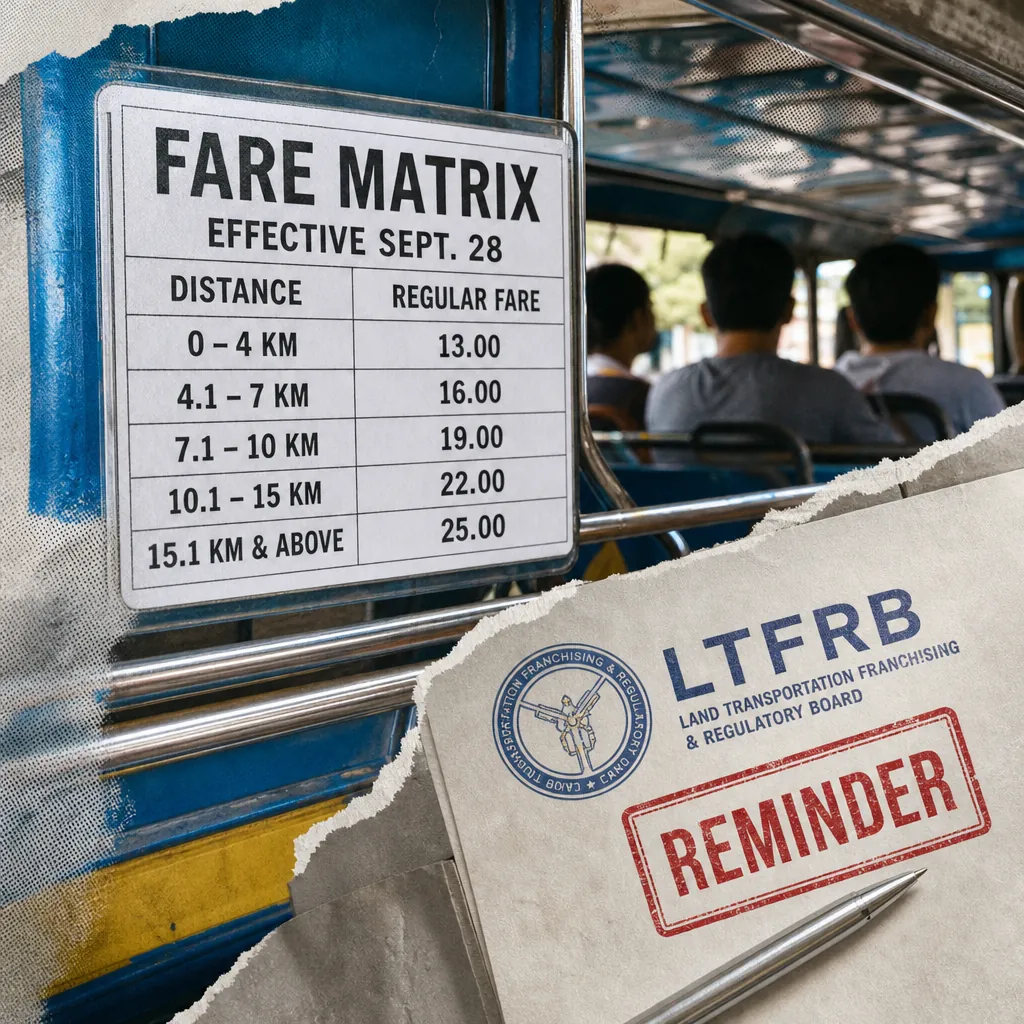
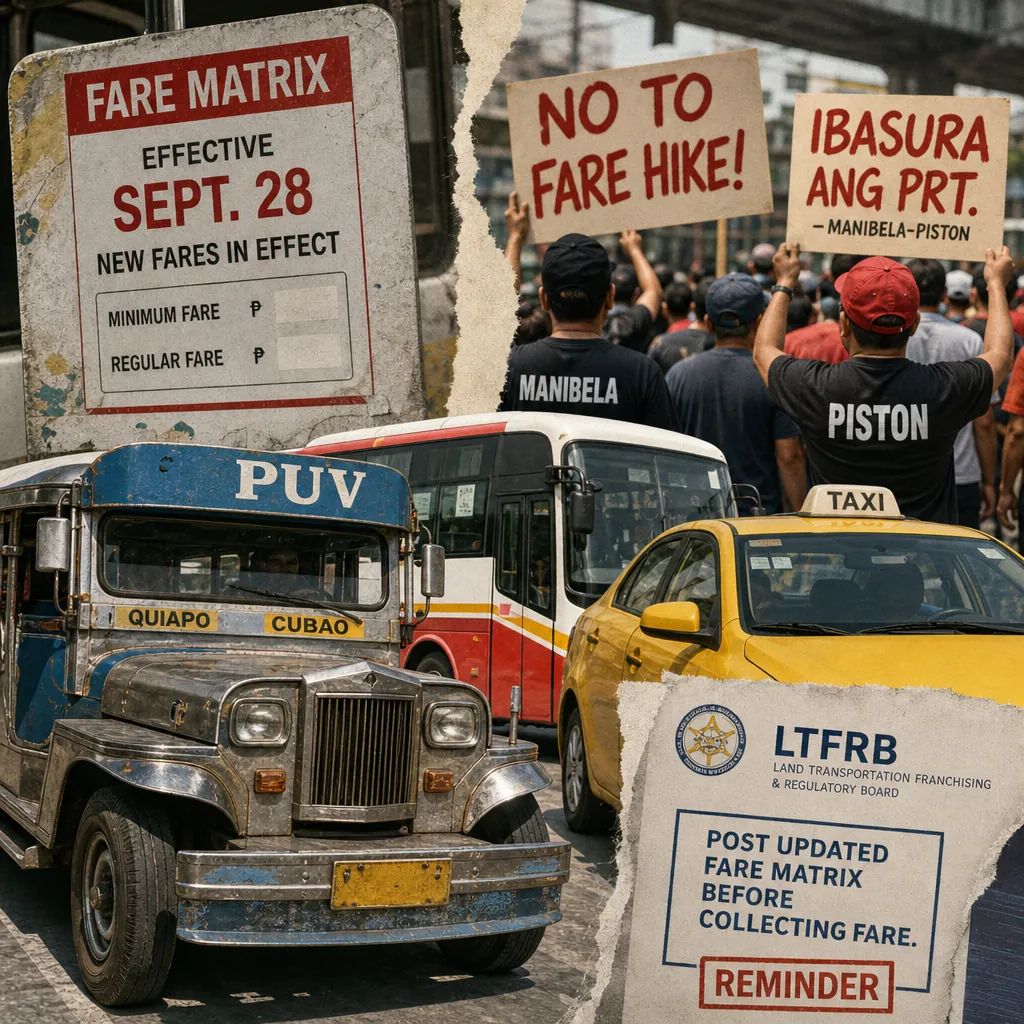
A single peso is about to change hands several million times a day. On Saturday, September 26, the Land Transportation Franchising and Regulatory Board (LTFRB) — the agency that issues franchises to public utility vehicles and approves what they may charge — told drivers and operators to make sure the updated fare guide, or matrix, is posted inside their vehicles before the increase takes effect on Monday, September 28 3. The reminder, posted on the agency's social media page, came after the Department of Transportation (DOTr), the cabinet department that sets national transport policy, approved higher fares for traditional jeepneys, modern jeepneys, city buses and other public vehicles 3.
The same day, the Land Transportation Office (LTO) — the agency that licenses drivers and registers vehicles, separate from the LTFRB — announced the harshest penalty available against a taxi driver accused of raping a passenger in the early hours of September 12, and confirmed it is pursuing a television host who filmed himself driving without a seatbelt 2731. Both stories ran in the Philippine Star's Filipino-language sections and were picked up by the Manila Bulletin's online edition, which carried the LTFRB advisory in Filipino 32731.
What ties the day together is enforcement. The fare increase is the first time in years that the government has raised the minimum charge across several vehicle classes at once, and the LTFRB's message was less about the money than about compliance: post the matrix, or riders will report you 3. The LTO's two cases, meanwhile, show the agency using its power over licenses — the document that determines whether a driver can earn a living — as its main tool for discipline, in one case permanently and in the other pending an appeal 2731.
Key themes
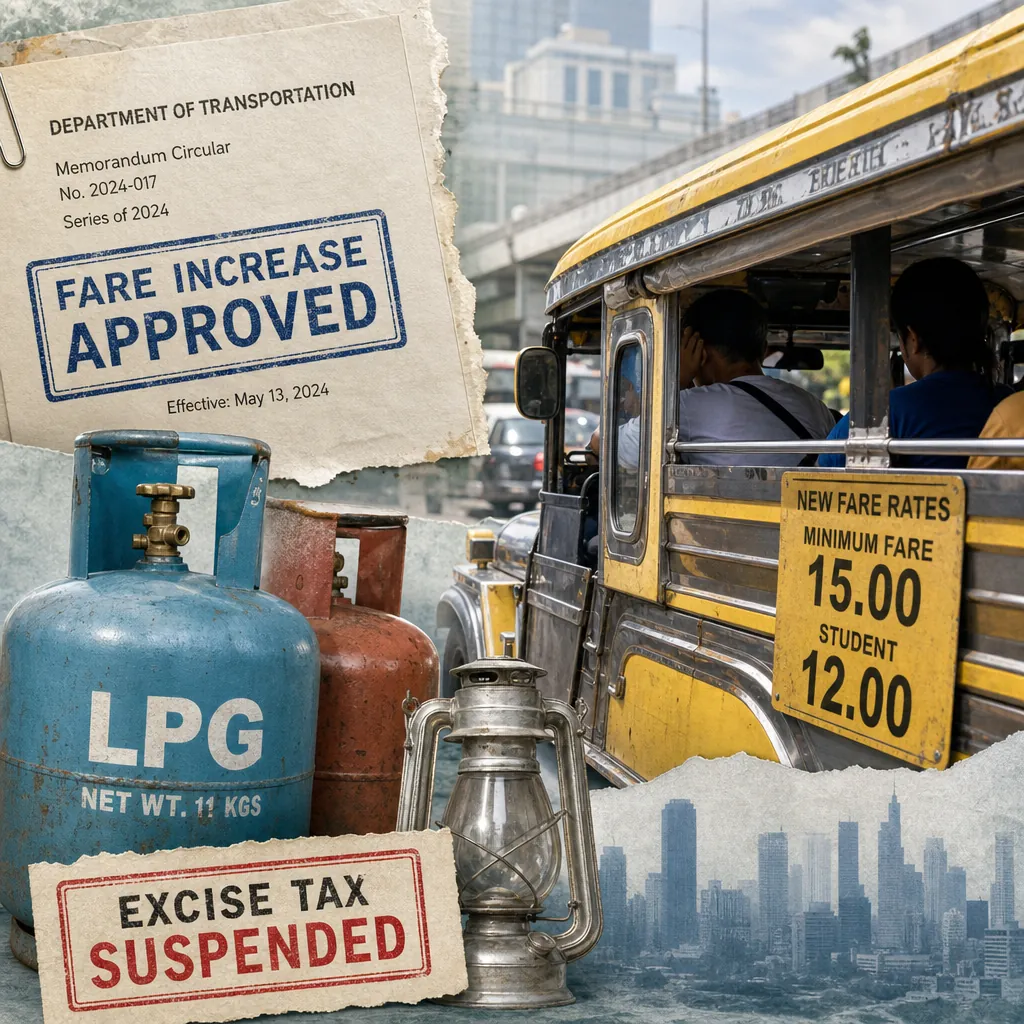
- A one-peso jeepney increase takes effect Monday, September 28. The minimum fare for a traditional jeepney rises from ₱13 to ₱14, and for a modern jeepney from ₱15 to ₱17, with city buses and other public vehicles also adjusted 30. The LTFRB's Saturday advisory told operators to post the new matrix inside their units before charging the higher fare 3.
- The LTFRB is asking passengers to police the posting rule. The agency said the updated fare guide can be downloaded free from its website, ltfrb.gov.ph, and urged the public to report any vehicle that fails to display one 3. That turns riders into the enforcement layer for a rule the agency cannot check vehicle by vehicle.
- A taxi driver loses his license for life over a September 12 rape complaint. The LTO revoked the GSM taxi driver's license and declared him an "Improper Person to Operate a Motor Vehicle" after its Intelligence and Investigation Division confirmed he was driving the taxi at around 3 a.m. on September 12 and admitted in a sworn statement to sexual activity inside the vehicle 27.
- The taxi's operator was also cited for franchise violations. The LTO found the operator liable for Breach of Franchise and for employing a discourteous driver, meaning the penalty reached past the individual driver to the business that put the vehicle on the road 27.
- A television host faces a license case over a seatbelt video. Ian Red, a host on the noontime show Eat Bulaga, was caught driving without a seatbelt while recording a vlog, and the LTO has scheduled a hearing on the case 31. Assistant Secretary Markus Lacanilao said public figures should model the law rather than break it, because new drivers copy what they see 31.
- The LTO's regional office in Central Visayas trained staff on digital tools and frontline service. LTO-7 ran sessions on September 23 with the Department of Information and Communications Technology on the Philippine National Public Key Infrastructure digital signature and the eGovPH Super App, plus a customer-service course for its Public Assistance and Complaints Desk 28.
- The fare increase is being framed as a survival measure for drivers, not a windfall. A Philippine Star opinion column argued the extra peso is roughly the cost of an additional liter of diesel, and that without it jeepney operators could not keep running as fuel prices rise 30.
- A separate opinion piece tied vehicle choice to the country's territorial dispute with China. A Freeman column recounted a road confrontation with a BYD — a Chinese-made electric car — and argued that buying Chinese products helps China violate Philippine territorial rights 32.
How the narratives stack
Dominant: the fare increase and the posting requirement. The LTFRB's Saturday advisory is the day's most consequential transport item because it changes what millions of commuters pay starting Monday and puts a compliance obligation on every jeepney and bus operator in the country 3. The Philippine Star's opinion page amplified it with a column explaining the economics from the driver's side — the added peso against the cost of diesel 30. Within the items captured here, this is the story with the widest practical reach: it touches every commuter who boards a jeepney, bus or modern jeepney, and every operator who must print or download a new matrix before Monday.
Counter-narrative: the LTO's disciplinary cases. The rape case and the seatbelt case are not about fares at all; they are about the state's power to take away a driver's ability to work 2731. The lifetime ban is the strongest signal the LTO can send, and the fact that it also cited the operator shows the agency is willing to reach the business behind the driver 27. The Ian Red case is smaller in consequence but larger in visibility, because it involves a television personality and because the alleged violation — vlogging while driving unbelted on a highway — is the kind of behavior the LTO says inexperienced drivers imitate 31.
Emerging: the LTO's push to modernize its own front line. The LTO-7 training on digital signatures and the eGovPH Super App is administrative news, but it points to a direction: the agency wants transactions and documents handled digitally, and it is training the staff who deal with the public to use those tools 28. The Philippine National Public Key Infrastructure is the government's system for issuing secure digital signatures, and the eGovPH Super App is the government's single mobile portal for public services; both are meant to reduce the need for in-person visits 28.
Under-covered: the operator side of the fare equation. The day's items say what drivers will collect and what the LTO will punish, but they say little about how operators will absorb the cost of printing new matrices, retraining conductors, or adjusting boundary arrangements with drivers. The opinion column gestures at the driver's fuel costs 30, but the business side of the increase — how much of the extra peso reaches the driver versus the operator — is not addressed in the material captured here.
Platform insights
- Facebook: The LTFRB's advisory was distributed through the agency's own social media page, which is where the posting requirement reached drivers and operators directly 3. This is the platform where the compliance message lives, and where passengers were told to file reports about vehicles without matrices 3.
- X: No posts from this platform appear in the material captured for this window.
- Reddit: No posts from this platform appear in the material captured for this window.
- YouTube: No posts from this platform appear in the material captured for this window. The Ian Red case involves a vlog, but the item describes the video as the basis of an LTO case rather than as a monitored social post 31.
Key voices and communities
The LTFRB as the day's primary communicator. The agency used its own channels to push a single, practical instruction — post the matrix, download it free, report violations — rather than to explain the fare increase itself 3. Its framing is compliance-first: the increase is assumed, and the job now is making sure riders see what they are being charged.
The LTO and Assistant Secretary Markus Lacanilao. Lacanilao is the named official in both disciplinary cases, and his quoted reasoning in the Ian Red matter is about example-setting: television hosts should not be seen breaking traffic law because young drivers will assume it is acceptable 31. That framing positions the LTO as a moral authority on road behavior, not just a licensing office.
Jeepney drivers and operators. They are the group the fare increase is meant to keep solvent. The Philippine Star column gives them a voice by translating the peso into diesel: the added fare is roughly one more liter of fuel, and without it, the column argues, drivers cannot support their families 30.
Commuters as reporters. The LTFRB's instruction to report vehicles without posted matrices makes passengers an enforcement community 3. This is a shift in role: riders are not just paying the higher fare, they are being asked to check that the paperwork is in order.
LTO-7 personnel and the DICT. The Cebu training brought the regional LTO together with the Department of Information and Communications Technology, the agency responsible for the government's digital infrastructure, to build skills in digital signatures and the national services app 28.
Narrative streams
The September 28 fare increase and the matrix rule
The concrete change is small in pesos and large in reach. A traditional jeepney ride that cost ₱13 will cost ₱14; a modern jeepney ride that cost ₱15 will cost ₱17; city buses and other public vehicles are also adjusted 30. The DOTr approved the increase, and the LTFRB's Saturday advisory set the compliance terms: every operator and driver must display the updated fare guide inside the vehicle before charging the new rate, and the guide can be downloaded free from ltfrb.gov.ph 3. The agency also asked the public to report any vehicle that does not post one 3.
For commuters, the practical effect is that the posted matrix becomes the reference point for a dispute. If a driver charges ₱14 but the matrix inside the jeepney still shows ₱13, the rider now has a specific, reportable violation to cite. For operators, the requirement means reproducing and posting new materials across every unit in a fleet within a weekend — a small cost per vehicle that multiplies across thousands of franchises. The read for the sector is that the increase shifts a compliance burden onto operators and a verification burden onto passengers, and the first week of implementation will be judged by whether matrices actually appear. The LTFRB has made the rule checkable and the reporting channel public, which means the agency's own performance will be measured by how it handles the reports it invited 3.
The context matters here: fare adjustments in the Philippines are typically contested, with driver groups arguing that fuel and parts costs outrun the approved minimum and commuter groups arguing that wages have not moved. The Philippine Star column frames the current increase as a rescue measure for a sector the author says would otherwise stop operating 30. That framing — the peso as survival, not profit — is the argument operators will use if the increase proves insufficient.
A lifetime license ban over a rape complaint
The LTO revoked the license of a GSM taxi driver and barred him permanently from holding a driver's license, after its Intelligence and Investigation Division investigated the September 12 complaint 27. The driver confirmed during the investigation that he was driving the taxi at around 3 a.m. that day, and in a sworn statement admitted to sexual activity inside the vehicle 27. The LTO declared him an "Improper Person to Operate a Motor Vehicle," a classification that removes the legal basis for him to drive professionally 27. The operator of the taxi was separately found liable for Breach of Franchise and for employing a discourteous driver 27.
The significance for the transport sector is the precedent of reaching the operator. A franchise is a privilege granted by the state to run a public service; a breach finding puts that privilege at risk and signals that the LTO will treat the employment of a driver who commits a crime as a franchise problem, not just a criminal one 27. For taxi and ride-hailing operators, the case is a reminder that vetting and supervising drivers is a licensing condition, not a human-resources preference. For passengers, the outcome is a concrete consequence in a case type that often ends without one. The read for the sector is that the LTO is willing to use its heaviest administrative penalty — permanent disqualification — in cases involving passenger safety, and that operators should expect their own franchises to be examined when a driver is accused.
A television host, a seatbelt, and a vlog
Ian Red, a host on the noontime show Eat Bulaga, was caught on video driving without a seatbelt while recording a vlog, and the LTO has set a hearing on the case 31. Assistant Secretary Markus Lacanilao explained the agency's concern in an interview: the seatbelt law prohibits what the host did, the incident happened on a highway, and the host even got out of the vehicle and back in during the recording 31. His stated worry is imitation — that new and young drivers will see a television personality doing it and conclude it is allowed 31.
The case is small in legal weight and large in visibility. It puts the LTO's enforcement in front of an entertainment audience, and it tests whether the agency treats celebrity violations the same way it treats ordinary ones. The read for the sector is that public-facing drivers — hosts, influencers, delivery riders who post their routes — should assume that content showing a traffic violation is itself evidence, and that the LTO will act on it. The agency has framed the case around example-setting, which means the outcome will be read as a statement about whether fame affects the penalty 31.
LTO-7 trains its front line on digital government tools
The LTO's regional office for Central Visayas held two training activities on September 23: one with the Department of Information and Communications Technology on the Philippine National Public Key Infrastructure digital signature and the eGovPH Super App, and one on frontline customer service for its Public Assistance and Complaints Desk 28. The digital signature system is the government's framework for verifying electronic documents, and the eGovPH Super App is the national mobile portal for government services; the training included hands-on exercises so staff could use both in daily operations 28.
The customer-service course matters because the complaints desk is where the public's reports — including the fare-matrix reports the LTFRB invited 3 — eventually land. The read for the sector is that the LTO is building the back-office capacity to handle digital transactions and public complaints at the regional level, which is where most drivers and vehicle owners actually interact with the agency. If the digital tools work, the practical effect for the transport sector is less time spent in line for licenses and registrations, and a more traceable record of complaints.
The fare increase as a cost-of-living story
The Philippine Star's opinion column reframes the fare increase from a policy decision into a household budget item 30. Its argument: the peso is treated as loose change by most people, but for drivers it is the difference between buying an extra liter of diesel and not, and fuel prices continue to rise 30. The column acknowledges that the increase strains the public's pocket but concludes that the DOTr had to approve it so the transport sector does not stop operating 30.
This is the frame that will dominate public discussion of the increase in the coming week: not whether the LTFRB posted the right notice, but whether the extra peso is justified and whether it reaches the driver. The read for the sector is that the increase's legitimacy will be judged on two things — whether service improves or at least holds, and whether drivers can show that the added fare offsets fuel costs. Operators and driver groups that want public sympathy should lead with the diesel arithmetic, because that is the argument the coverage has already validated 30.
A road confrontation becomes an argument about Chinese vehicles
A column in The Freeman, the Philippine Star's Cebu-based sister paper, recounted a traffic incident in Talamban in which a BYD — described as an expensive car made in China — counter-flowed and then honked at the writer's 1970 Volkswagen Beetle when oncoming traffic blocked it 32. The writer used the incident to argue that buying China-made products helps China violate Philippine territorial rights 32.
The column is opinion, not news, and its evidentiary basis is a single road encounter. But it is part of the day's transport conversation because it connects vehicle choice to the broader territorial dispute between the Philippines and China, a subject that regularly surfaces in Philippine media. The read for the sector is that car brands with Chinese ownership or manufacturing will continue to face political headwinds in the Philippine market that have nothing to do with the vehicles themselves, and that dealers and distributors should expect the association to be raised in public discussion regardless of product quality.
Conversation trajectory
September 28–30: the first days of the new fares. The increase takes effect Monday, September 28 3. Watch for reports of vehicles without posted matrices, disputes between drivers and passengers over the charged amount, and the LTFRB's response to the reports it invited 3. The agency's credibility on this rule depends on visible follow-through within the first week.
The Ian Red hearing. The LTO has scheduled a hearing on the seatbelt and vlogging case 31. The outcome will indicate whether the agency's example-setting rhetoric translates into a penalty, and whether the case becomes a template for other public figures caught on video violating traffic rules.
The rape case's next stage. The LTO's administrative action is complete — lifetime disqualification and a franchise violation finding against the operator 27. The criminal case, if filed, will proceed separately, and the operator's franchise status may face further scrutiny. Watch for whether other operators in the same fleet are examined.
Fuel prices and the sufficiency of the increase. The opinion column's argument rests on diesel costs 30. If fuel prices rise again in the coming weeks, driver groups are likely to argue the increase is already insufficient, and a new petition for another adjustment could follow. The next scheduled fuel price adjustment is the natural trigger to watch.
LTO digital services rollout. The LTO-7 training on the eGovPH Super App and digital signatures 28 is a regional pilot of a national direction. Watch for whether other regional offices announce similar training, and whether the digital tools reduce processing times for licenses and registrations in Central Visayas.
Response guidance
For transport operators: post the matrix before Monday, and keep proof. The LTFRB's requirement is specific and checkable, and passengers have been told to report violations 3. Operators should download the updated guide from ltfrb.gov.ph, post it in every unit, and keep a record of when each vehicle was updated, because the first complaints will be about individual jeepneys and buses, not fleets.
For driver groups: lead with the diesel arithmetic. The most persuasive public argument for the increase is the one already in print — that the added peso is roughly a liter of fuel 30. Driver representatives should be ready with current fuel price figures and typical daily consumption to show what the increase does and does not cover.
For taxi and ride-hailing companies: treat driver vetting as a licensing issue. The LTO's finding against the operator in the rape case shows that a driver's conduct can put the franchise itself at risk 27. Companies should document their screening, training and complaint-handling procedures, because those records are what distinguish an operator that exercised care from one that did not.
For public-facing drivers and content creators: assume the camera is evidence. The Ian Red case began with a vlog 31. Anyone who films themselves driving should assume the footage can be used in an LTO proceeding, and that violations visible on camera — no seatbelt, phone use, unsafe maneuvers — will be treated as admissions.
For commuters: know the posted fare and the reporting channel. The LTFRB has made the matrix the reference point and its website the source 3. Riders who are overcharged or who board a vehicle with no posted guide should note the plate number and route and file a report, because the agency's enforcement model now depends on those reports.
For automotive brands with Chinese manufacturing: expect the political frame to persist. The Freeman column is opinion, but it shows that vehicle purchases are being discussed in the context of the territorial dispute 32. Brands should be prepared for the association to surface in public forums and should keep their messaging focused on product and service rather than engaging the political argument directly.
See the full picture behind today's signals.
This report draws from Media Meter's MediaWatch, our real-time monitoring engine tracking 2,470+ Philippine sources across print, broadcast, digital, and social. Explore how the platform turns raw coverage into decision-grade intelligence, then see how it's configured for teams like yours — whether you're in PR agencies, corporate comms, government, or marketing.
Want more? Browse our Report Library for sector and crisis intelligence, or request a demo and we'll have your brand set up before the call.
Want this kind of intelligence on your brand?
This brief is built on the same MediaWatch methodology that runs continuously across every brand we monitor. See your competitive landscape, Impact Score, and narrative trajectory in a 30-minute demo.