Fed Hike Tests BSP as Peso Pressure Builds
The US Federal Reserve's first rate increase since 2023 narrowed the Bangko Sentral ng Pilipinas' room to cut, while analysts projected slower remittance growth and a rebound in Philippine shares. The captured coverage also included a House vote on anti-espionage legislation and Manila's housing trust fund deal with LandBank.
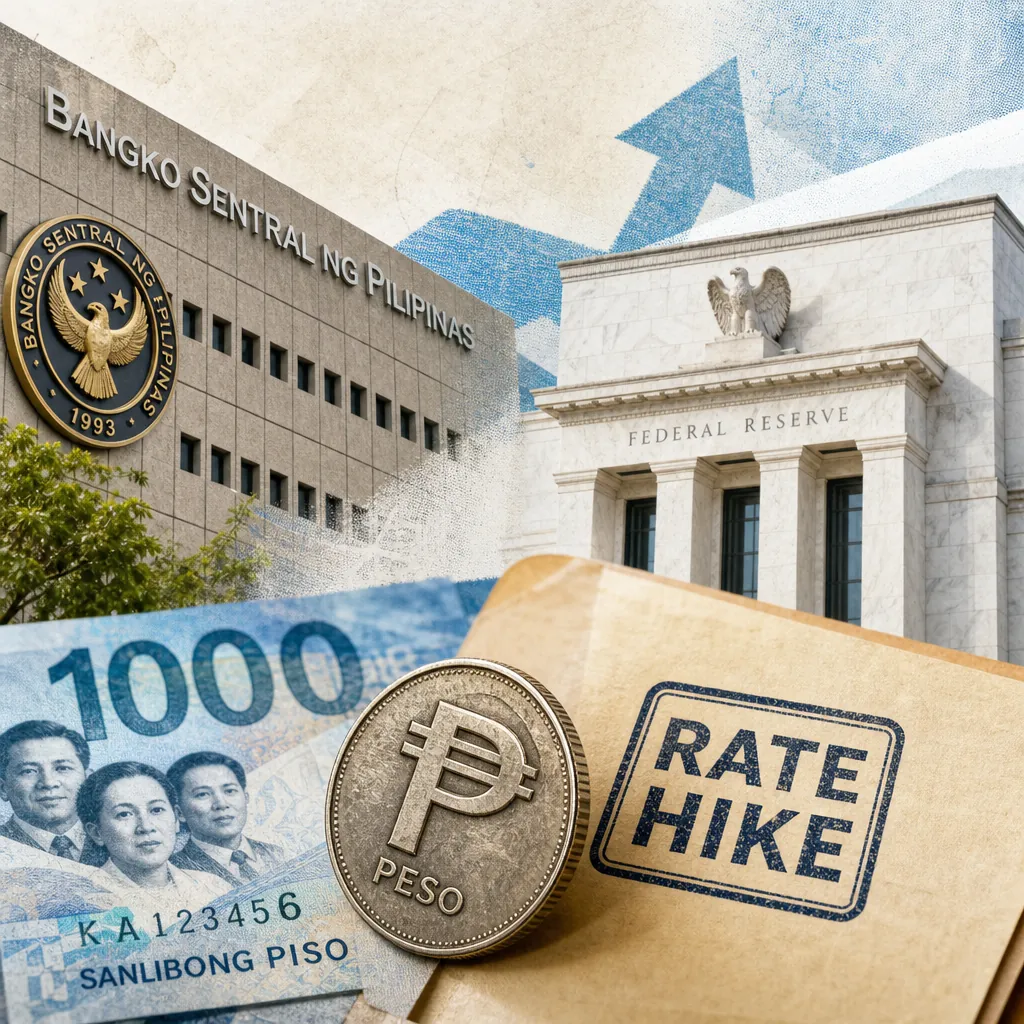
The US Federal Reserve raised its benchmark interest rate by a quarter of a percentage point on Wednesday to a range of 3.75 percent to 4 percent, its first increase since July 2023, and the decision reshaped the day's financial conversation in Manila.12 The move was unanimous, and Fed Chair Kevin Warsh said at a news conference that "the plain fact is that inflation is too high and has been for too long."12 Philippine analysts spent Thursday working out what it means for the Bangko Sentral ng Pilipinas (BSP), the country's central bank, which sets the benchmark rate that local banks use to price loans.14 The peso and the stock market both moved on the news, and the coverage that followed split between two questions: how much room the BSP has left to cut, and whether the Fed's credibility gain is worth the volatility it introduces.2
The BSP's policy rate sits at 5 percent, and analysts said the central bank still holds a positive differential over the Fed, meaning Philippine rates remain higher than US rates and give policymakers space to avoid an emergency move.14 Leonardo Lanzona, an economist at Ateneo de Manila University, said an off-cycle increase "would look more like panic than strategy when the central bank still has room to be deliberate," and he expects a quarter-point hike at the BSP's October meeting instead.14 NewsCentral reported that economists see the Fed move narrowing the BSP's room for monetary easing in the near term and creating pressure to follow the hawkish stance, with the Fed's own projections putting personal consumption expenditures inflation at 3.7 percent this year and 2.3 percent next year, and the median federal funds rate at 4.1 percent by end-2026.42
On the equities side, the Philippine Stock Exchange index (PSEi) — the benchmark that tracks the country's largest listed companies — climbed 41.70 points, or 0.70 percent, to close at 5,958.64 on Thursday, snapping a two-day losing streak and recovering from a three-month low.1944 Michael Ricafort, chief economist at Rizal Commercial Banking Corp., said the Fed's hike was taken positively because it "shows the Fed is serious about delivering on the price stability objective," and he noted that easing Middle East oil supply concerns also lifted sentiment after Brent crude prices fell.44 Holding firms led the advance, with Ayala Corp. gaining 5.05 percent to ₱508 and SM Investments Corp. rising 2.20 percent to ₱535; SM Investments was the most actively traded stock, with 32.29 million shares changing hands for ₱16.84 billion, and total market turnover reached ₱25.50 billion.19 SM Investments has a share-buyback program of up to ₱60 billion and bought back 305,000 shares on Sept. 15 at prices ranging from ₱522.50 to ₱529, with settlement on Sept. 17.19
Key themes
- Fed's first hike since 2023 narrows BSP's room to cut. The US central bank raised rates by a quarter point to 3.75–4 percent, and Philippine economists said the BSP will likely respond with a measured quarter-point increase in October rather than an emergency move, because the BSP still holds a positive rate differential over the Fed.1442
- PSEi rebounds 0.70 percent on bargain hunting. The benchmark index closed at 5,958.64, up 41.70 points, after a 1.51 percent decline the previous session, with holding firms leading and SM Investments the most traded stock at ₱16.84 billion.1944
- Remittance growth projected to slow to about 2 percent. Maybank Investment Banking Group maintained a 2.2 percent growth forecast for 2026, or $36.4 billion, below the BSP's 2.7 percent target, while UnionBank expects 2 percent, citing weak overseas deployment and Middle East tensions.3338
- House passes anti-espionage bill 224–10. House Bill No. 9642 expands espionage to cover sharing any classified matter in peace or war and unauthorized access to critical infrastructure representations, with violators facing life imprisonment and fines up to ₱20 million.1
- Manila signs ₱50-million housing trust deal with LandBank. Mayor Isko Moreno and LandBank signed an agreement to invest funds from the Manila Urban Settlements Office Housing Trust Fund, sourced from mandatory monthly contributions of vertical housing beneficiaries, to finance in-city housing.102449
- GCash IPO draws attention to retail participation. A lawmaker said the Mynt Inc. initial public offering could bring 49 million GCash users, about 42 percent of the population, into the stock market, while the PSE president addressed criticism over the ₱10 maximum price.25626364
- Life insurers now cover 55 percent of Filipinos. The Philippine Life Insurance Association said the sector covers 63.5 million people, supported by 857 branch offices and more than 228,000 licensed advisors, with ₱69.2 billion in benefits paid in the first half.55
- Excise tax hikes could push 2027 inflation to 4.5 percent. Chinabank Research said proposed Department of Finance tax increases on sweetened beverages, alcohol and tobacco could push inflation above the BSP's 2–4 percent target band.56
How the narratives stack
Dominant: The Fed's rate hike and its knock-on effects on the BSP, the peso and the stock market dominated the captured financial coverage. The story ran across multiple outlets — Inquirer Online, NewsCentral, The Edge Markets, Esquire and The Financial District — and carried the largest single-item coverage value in the set, with the Manila Times column on the flood-control money trail drawing an estimated ₱1.02 million in advertising-equivalent value, though that item belongs to a separate corruption story.1114424421219 Within the captured set, the Fed story's dominance rests on the number of outlets that picked it up and the breadth of angles — monetary policy, equities, remittances and inflation — rather than on any single engagement figure.
Counter-narrative: The PSEi's rebound and the bargain-hunting framing cut against the idea that higher US rates are straightforwardly bad for Philippine assets. The index rose 0.70 percent on the same day the Fed hiked, and Ricafort read the move as confidence-building rather than destabilizing.44 The Financial District's report noted the rebound followed a 1.51 percent decline the previous session, and holding firms led the advance.19 The counter-narrative is not that the Fed is good for the Philippines; it is that the market's reaction was more nuanced than a simple risk-off move.
Emerging: Two stories sit at the edge of the day's financial conversation. The first is the GCash IPO, which drew a lawmaker's projection that 49 million users could participate and a PSE president's explanation that the ₱10 figure is a maximum cap, not a final price.256264 The second is the AI readiness question: the BSP said Philippine capital markets are not ready for AI in trading, advising or prediction because customers are resistant, while ING Bank said the labor market is highly exposed to AI but has so far seen job transformation rather than job destruction.5457 Both stories are early-stage and will need more data before they become dominant.
Under-covered: The Sept. 15 deadline for banks to update bond-pricing algorithms ahead of a possible JPMorgan index inclusion passed without movement, according to a Manila Bulletin column that noted "no movement" and "no modification" in the marketplace.59 The story matters because the change is intended to prepare peso-denominated government bonds for inclusion in a JPMorgan Chase & Co. index next year, and the column said the situation remained unchanged as of writing.59 It drew a single item in the captured set and no social traction.
Platform insights
Facebook: The day's financial stories circulated mainly through news outlet pages and shared links rather than through original posts. The GCash IPO discussion was the most likely to generate comment activity, given the platform's broad consumer reach and the 49-million-user figure cited by the lawmaker.25 The remittance story also has a natural Facebook audience because overseas Filipino workers and their families are heavy users of the platform, but the captured writeup does not include engagement figures for either story.
X: The Fed decision and the BSP's response are the kind of story that typically drives quote-tweet commentary from economists and market watchers, but the captured material does not include X-specific engagement data. The Esquire piece, which framed the Fed chair's stance as a rebuke to political pressure, is the most likely candidate for X circulation because of its political angle.12
Reddit: The anti-espionage bill is the story most likely to generate Reddit discussion, particularly in Philippine politics and law communities, because of civil rights concerns raised by lawmakers who voted against it.1 The bill's broad definition of spying and its penalties — life imprisonment and fines up to ₱20 million — are the kind of detail that drives thread-level debate, but the captured writeup does not include Reddit engagement figures.
YouTube: No YouTube-specific activity appears in the captured material. The housing trust fund signing and the GCash IPO announcement are the stories most likely to generate video coverage, but the captured set does not include any video items.
Key voices and communities
Philippine economists and bank research teams. Leonardo Lanzona of Ateneo de Manila University, Michael Ricafort of Rizal Commercial Banking Corp., Maybank's Suhaimi Ilias and team, UnionBank, and Chinabank Research drove the analytical framing of the Fed's impact on the BSP, remittances and inflation.14443356 Their projections — a quarter-point BSP hike in October, 2.2 percent remittance growth, 4.5 percent inflation in 2027 — set the terms of the debate.
Government officials and agencies. BSP Technology & Digital Innovation Office director Mark Anthony B. Perez said customers are resistant to AI in capital markets, and the BSP's data on bank assets and life insurance coverage provided the day's hard numbers.545355 Manila Mayor Isko Moreno and LandBank's Mario Sabino Jr. signed the housing trust agreement, and House members voted 224–10 on the anti-espionage bill.101
Lawmakers and policy advocates. Rep. Jan "JP" Padiernos of the House Committee on Banks and Financial Intermediaries framed the GCash IPO as a way to broaden retail participation, while the 10 lawmakers who voted against the anti-espionage bill raised civil rights concerns.251
Corporate communicators and award watchers. Sun Life Philippines, LandBank, Security Bank and Metrobank all appeared in the captured set through awards and recognition stories — the Philippine Quill Awards, the HR Excellence Awards, TIME's World's Best Companies ranking and Metrobank's service awards.618312130 These items are corporate communications rather than news, but they show how banks and insurers are positioning themselves.
Overseas Filipino worker communities and their families. The remittance slowdown story speaks directly to households that depend on money sent home from abroad, and the BusinessMirror editorial framed the deceleration as a structural warning.4533
Narrative streams
Fed hike forces BSP to weigh inflation against growth
The Federal Reserve's quarter-point increase to 3.75–4 percent was its first since July 2023, and it came despite public calls from President Donald Trump for rate cuts.212 Fed Chair Kevin Warsh said the decision was unanimous and that "inflation is too high and has been for too long," and he declined to answer questions about Trump.12 The Fed's projections put personal consumption expenditures inflation at 3.7 percent this year and 2.3 percent next year, with the median federal funds rate at 4.1 percent by end-2026.42 For the Philippines, the immediate question is whether the BSP follows with its own hike or holds. Lanzona said the BSP still has a positive policy-rate differential with the Fed, giving it room to avoid an outsized or off-cycle increase, and he expects a quarter-point hike in October.14 NewsCentral reported that economists see the Fed move narrowing the BSP's room for easing and creating pressure to follow the hawkish stance.42 The read for the sector: Philippine borrowers with dollar-denominated debt and companies that rely on imported inputs face higher servicing costs if the peso weakens further, while banks with large government bond holdings face mark-to-market pressure if local yields rise. The BSP's October meeting is the next decision point.
PSEi rebounds as bargain hunters return
The PSEi rose 41.70 points, or 0.70 percent, to 5,958.64 on Thursday, recovering from a three-month low after a 1.51 percent decline the previous session.1944 The index traded between an intraday low of 5,902.00 and a high of 5,974.15.19 Holding firms led with a 1.45 percent gain, powered by Ayala Corp.'s 5.05 percent rise to ₱508 and SM Investments' 2.20 percent increase to ₱535.19 SM Investments was the most actively traded stock, with 32.29 million shares changing hands for ₱16.84 billion, and total turnover reached ₱25.50 billion.19 Ricafort attributed the rebound to the Fed's credibility signal and easing oil concerns.44 The read for the sector: the rebound is technical and driven by bargain hunting rather than a change in fundamentals, so the market's direction over the next few weeks depends on whether the BSP's October decision and the peso's path confirm or reverse the Fed's signal. The Financial District's report noted the rebound followed a 1.51 percent decline, which means the index is still below where it started the week.19
Remittance growth slows to about 2 percent
Maybank Investment Banking Group maintained its 2026 remittance growth projection at 2.2 percent, or $36.4 billion, slightly below the BSP's 2.7 percent target, and warned that "downside risks from heightened geopolitical tensions, particularly in the Middle East, remain elevated and could contribute to greater month-to-month volatility."33 UnionBank expects full-year growth to ease to 2 percent, citing weak overseas Filipino worker deployment and global geopolitical woes.33 The BusinessMirror editorial called the 2.3 percent year-to-date increase for January to July 2026 the slowest pace in six years and said it is "a clarion call for structural economic reform."45 Remittances are the money overseas Filipino workers send home, and they are one of the country's largest sources of foreign exchange, supporting household consumption and the peso. The read for the sector: banks and money-transfer operators that earn fees on remittance flows face slower volume growth, while households that depend on remittances have less cushion against inflation. The BSP's next remittance data release will show whether the July recovery continued into August.
Anti-espionage bill passes House despite civil rights concerns
The House of Representatives passed House Bill No. 9642 on final reading with 224 votes for and 10 against, expanding the country's espionage laws to cover the sharing of any "classified matter" in times of peace or war if disclosure could harm the country by giving an advantage to foreign or domestic actors.1 The bill also makes unauthorized access to any sketch, layout, blueprint or multimedia representation of "critical infrastructure" and national defense assets a form of spying, unless obtained through open sources or "other lawful means."1 Violators face life imprisonment without parole and fines of up to ₱20 million.1 Some lawmakers raised concerns that the broad definition of spying could be used to crack down on dissent.1 The read for the sector: media organizations, researchers and technology companies that handle infrastructure or defense-related information face new legal risk if the bill becomes law, and the definition of "classified matter" will determine how broadly the law reaches. The bill now moves to the Senate, where its scope may be narrowed.
Manila signs housing trust deal with LandBank
Manila Mayor Isko Moreno and LandBank Vice President and Chief Trust Officer Mario Sabino Jr. signed an agreement on Wednesday allowing the city government to invest about ₱50 million from the Manila Urban Settlements Office Housing Trust Fund through LandBank.1024 The funds come from mandatory monthly contributions paid by beneficiaries of the city's vertical housing projects, not from general taxpayer revenue.2461 Moreno said the arrangement is intended to make the housing program sustainable so future mayors will not need to tap the city's General Fund, and he described it as "the start of a long journey of the in-city vertical housing."1049 The city's goal is to provide families living in informal settlements and rental accommodations with decent and secure housing within Manila.10 The read for the sector: the deal creates a dedicated financing mechanism for Manila's housing program, which could serve as a model for other local governments, but the ₱50 million initial investment is small relative to the scale of the informal settlement problem. The fund's growth depends on continued beneficiary contributions and investment returns.
GCash IPO raises questions about retail participation and pricing
Mynt Inc., the parent company of GCash, is preparing for an initial public offering on Oct. 20 at the Philippine Stock Exchange, and Rep. Jan "JP" Padiernos said the IPO could bring 49 million GCash users — about 42 percent of the population — into the stock market.256263 Padiernos, a member of the House Committee on Banks and Financial Intermediaries, said the user base gives Mynt the potential to bring more ordinary Filipinos into the stock market as it prepares for one of the largest IPOs in Philippine corporate history.25 PSE President and CEO Ramon Monzon addressed criticism over the ₱10 share price, saying the figure "serves strictly as the maximum cap and starting point for the underwriters' bookbuilding process, not the final price," and that social media criticism reflected a "public misinterpretation of the 'up to' price in listing applications."64 Capital market expert Jonathan Ravelas and Scam Watch Pilipinas convenor Jocel de Guzman welcomed the IPO announcement at the Kapihan sa Manila Bay news forum.63 The read for the sector: the IPO could broaden retail participation in the Philippine capital market, but the pricing controversy shows that investor education is a gap. Brokers and the PSE face pressure to explain how bookbuilding works before the offering opens.
Life insurers cover 55 percent of Filipinos as premium income rises
The Philippine Life Insurance Association said the industry now covers 63.5 million Filipinos, equivalent to around 55 percent of the population, supported by 857 branch offices, more than 228,000 licensed financial advisors and about 18,400 employees.55 The industry paid ₱69.2 billion in benefits during the first half.55 The read for the sector: the coverage figure shows that life insurance has moved from a niche product to a mass-market one, but the industry's growth depends on maintaining its agency network and convincing younger Filipinos to buy protection products. Singlife Philippines and GCash launched a term insurance plan priced at as low as ₱65 a month with up to ₱1 million in coverage, which shows how digital channels are being used to reach customers who might not engage with traditional agents.58
Excise tax hikes could push 2027 inflation above target
Chinabank Research said proposed excise tax increases on sweetened beverages, alcohol and tobacco could push inflation to 4.2 percent based on first-round effects alone and to as high as 4.5 percent when second-round effects are included.56 If realized, inflation would exceed the BSP's 3 percent target and the upper end of its 2–4 percent tolerance band, and it would be higher than Chinabank's own 3.9 percent forecast for 2027.56 The research noted that higher excise taxes would likely be passed on to consumers, as observed following the Sin Tax Reform Law of 2012.56 The read for the sector: manufacturers of sweetened beverages, alcohol and tobacco face higher costs and potential volume declines, while the BSP faces a harder trade-off between supporting growth and containing inflation. The Department of Finance's proposal still needs legislative approval.
Banks' assets grow 10.72 percent as lending and deposits expand
Assets held by the Philippine banking industry rose to ₱30.716 trillion as of end-July, 10.72 percent higher than ₱27.742 trillion a year prior, according to preliminary BSP data.53 Universal and commercial banks held the bulk at ₱28.711 trillion, up 10.73 percent, while thrift banks held ₱1.408 trillion, up 8.95 percent.53 Assets slipped 1.33 percent from the ₱31.129 trillion recorded as of June.53 The read for the sector: the year-on-year growth shows that banks are still expanding their balance sheets despite higher interest rates, but the month-on-month decline suggests that the pace may be moderating. The BSP's next data release will show whether the July dip was seasonal or the start of a slower trend.
AI readiness lags in capital markets as labor market shows resilience
The BSP said Philippine capital markets are not ready for the use of artificial intelligence for trading, advising or prediction because the country's investor base remains hesitant about new technologies.54 Mark Anthony B. Perez, technical advisor and director at the BSP's Artificial Intelligence and Data Analytics Hub, said "customers are resistant to the use [of AI in capital markets]" and that adoption depends on market maturity.54 Separately, ING Bank said the Philippine labor market and services exports are highly exposed to AI but remain largely resilient, with the technology so far transforming jobs rather than eliminating them.57 ING Regional Head of Research for Asia-Pacific Deepali Bhargava cited an International Labour Organization study published in July showing that 28.1 percent of workers in the Philippines have at least minimal exposure to generative AI, second in ASEAN only to Singapore's 42.2 percent.57 The read for the sector: financial institutions that want to deploy AI in trading or advising face customer resistance and regulatory caution, while workers in exposed occupations face pressure to adapt. The BSP's stance suggests that AI adoption in Philippine finance will be gradual.
Conversation trajectory
BSP October policy meeting (4–6 weeks). The BSP's next rate decision is the most concrete trigger. Lanzona expects a quarter-point hike, and the Fed's move has narrowed the BSP's room to cut.14 If the BSP holds instead, the peso could come under more pressure; if it hikes, borrowers face higher costs. Watch the BSP's statement for language on the peso and inflation.
August remittance data (2–4 weeks). The BSP's next remittance release will show whether the July recovery continued. Maybank and UnionBank both expect full-year growth of about 2 percent, below the BSP's 2.7 percent target.33 A weaker-than-expected print would reinforce the structural reform argument in the BusinessMirror editorial.45
GCash IPO bookbuilding (2–4 weeks). The IPO is scheduled for Oct. 20, and the bookbuilding process will determine the final price. Monzon's explanation that ₱10 is a maximum cap, not a final price, sets up a test of whether the PSE and underwriters can manage retail expectations.64 Watch for the final price and the level of retail participation.
Senate action on the anti-espionage bill (4–8 weeks). The bill passed the House 224–10 and now moves to the Senate, where its scope may be narrowed.1 Watch for committee hearings and amendments, particularly on the definition of "classified matter" and the treatment of open-source information.
JPMorgan index inclusion deadline (next few months). The Sept. 15 deadline for banks to update bond-pricing algorithms passed without movement, according to the Manila Bulletin column.59 The change is intended to prepare peso-denominated government bonds for inclusion in a JPMorgan Chase & Co. index next year. Watch for whether banks update their systems before the index review.
Excise tax legislation (6–12 months). The Department of Finance's proposed excise tax increases on sweetened beverages, alcohol and tobacco still need legislative approval.56 If passed, they could push 2027 inflation to 4.5 percent. Watch for committee hearings and the BSP's response.
Response guidance
Banks and financial institutions: prepare for a higher-for-longer rate environment. The Fed's hike and the BSP's likely quarter-point response mean that loan pricing, deposit rates and bond portfolios will need to be reassessed. Communicate clearly with borrowers about variable-rate exposure and with depositors about rate changes. The BSP's October meeting is the next decision point, and the peso's path will determine whether the pressure intensifies.1442
Remittance-dependent businesses: plan for slower volume growth. Money-transfer operators, banks with remittance franchises and retailers that serve OFW families should adjust their forecasts to about 2 percent growth rather than the BSP's 2.7 percent target. The Middle East remains the key risk, and any escalation would hit deployment and flows.3345
Capital market participants: explain the GCash IPO process before the offering opens. The social media criticism over the ₱10 price shows that many retail investors do not understand bookbuilding. Brokers, the PSE and the underwriters should publish plain-language explanations of how the final price is set and what the maximum cap means. The IPO's success depends on retail participation, and confusion could suppress demand.6463
Media and technology companies: track the anti-espionage bill's Senate path. The bill's definition of "classified matter" and its treatment of open-source information will determine how much legal risk journalists, researchers and technology firms face. Engage with Senate committees during hearings to clarify the scope and protect lawful reporting.1
Insurers and digital financial platforms: use the coverage gap as a growth opportunity. Life insurers cover 55 percent of Filipinos, which means nearly half the population lacks protection. Singlife and GCash's ₱65-a-month term plan shows that digital channels can reach price-sensitive customers. Insurers should invest in products and distribution that fit the budgets of the uncovered segment.5558
Local government units: study Manila's housing trust model. The LandBank agreement creates a dedicated financing mechanism from beneficiary contributions rather than general funds. Other cities with informal settlement challenges could replicate the structure, but the ₱50 million initial investment is small relative to the need. LGUs should assess whether beneficiary contributions can sustain the fund at scale.102449
Corporate communicators: separate recognition stories from news. The day's captured set included several awards and recognition items — Sun Life's Quill and HR Excellence awards, LandBank's six Quill Awards, Security Bank's TIME ranking and Metrobank's service awards.618312130 These are corporate communications, not news, and they should be pitched to the outlets that cover them rather than to financial desks focused on the Fed and the BSP.
See the full picture behind today's signals.
This report draws from Media Meter's MediaWatch, our real-time monitoring engine tracking 2,470+ Philippine sources across print, broadcast, digital, and social. Explore how the platform turns raw coverage into decision-grade intelligence, then see how it's configured for teams like yours — whether you're in PR agencies, corporate comms, government, or marketing.
Want more? Browse our Report Library for sector and crisis intelligence, or request a demo and we'll have your brand set up before the call.
Want this kind of intelligence on your brand?
This brief is built on the same MediaWatch methodology that runs continuously across every brand we monitor. See your competitive landscape, Impact Score, and narrative trajectory in a 30-minute demo.