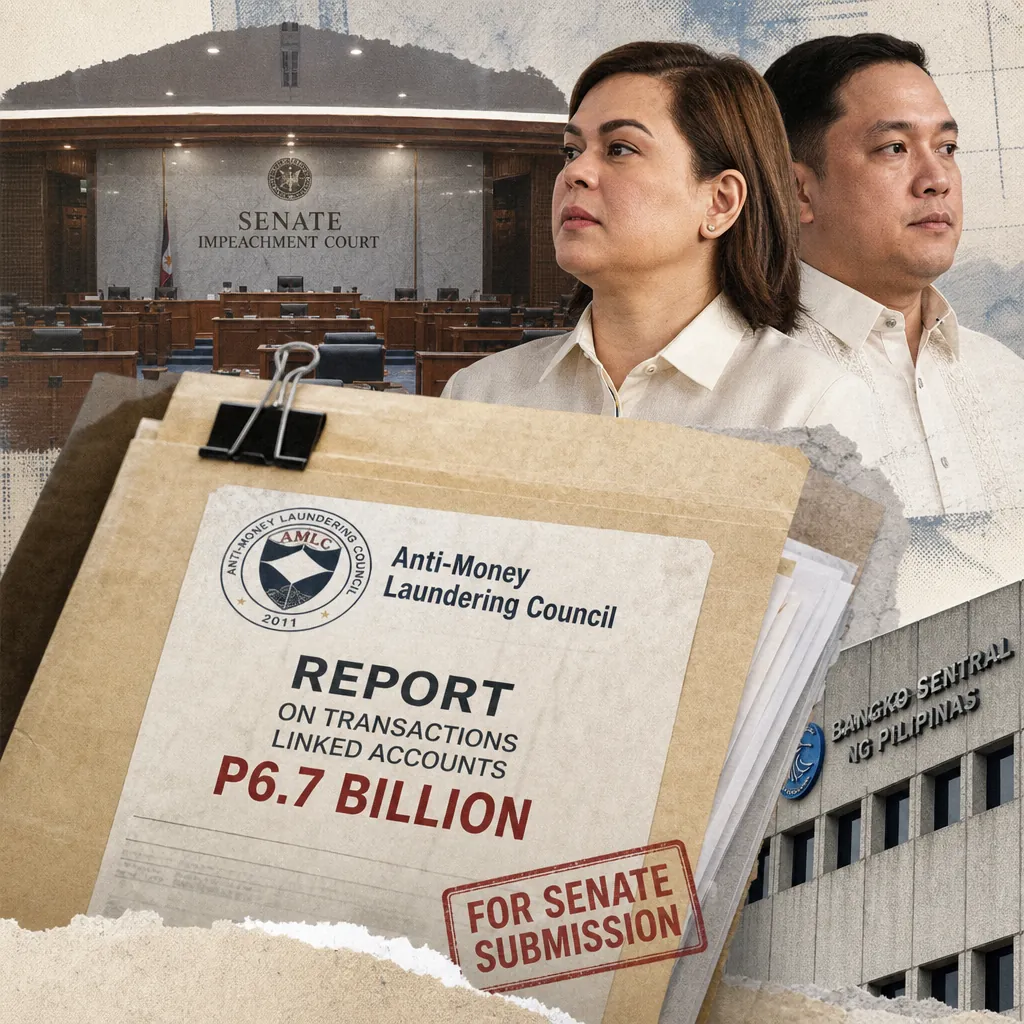
Sara Duterte SALN Trial Puts Bank, AMLC Records in Play
Prosecutors said they will match Vice President Sara Duterte's declared wealth against tax, bank and Anti-Money Laundering Council records, a story that drew the day's heaviest coverage and the most social attention. Separately, the central bank reported July remittances at a seven-month high and flagged geopolitical and cyber risks to financial stability.
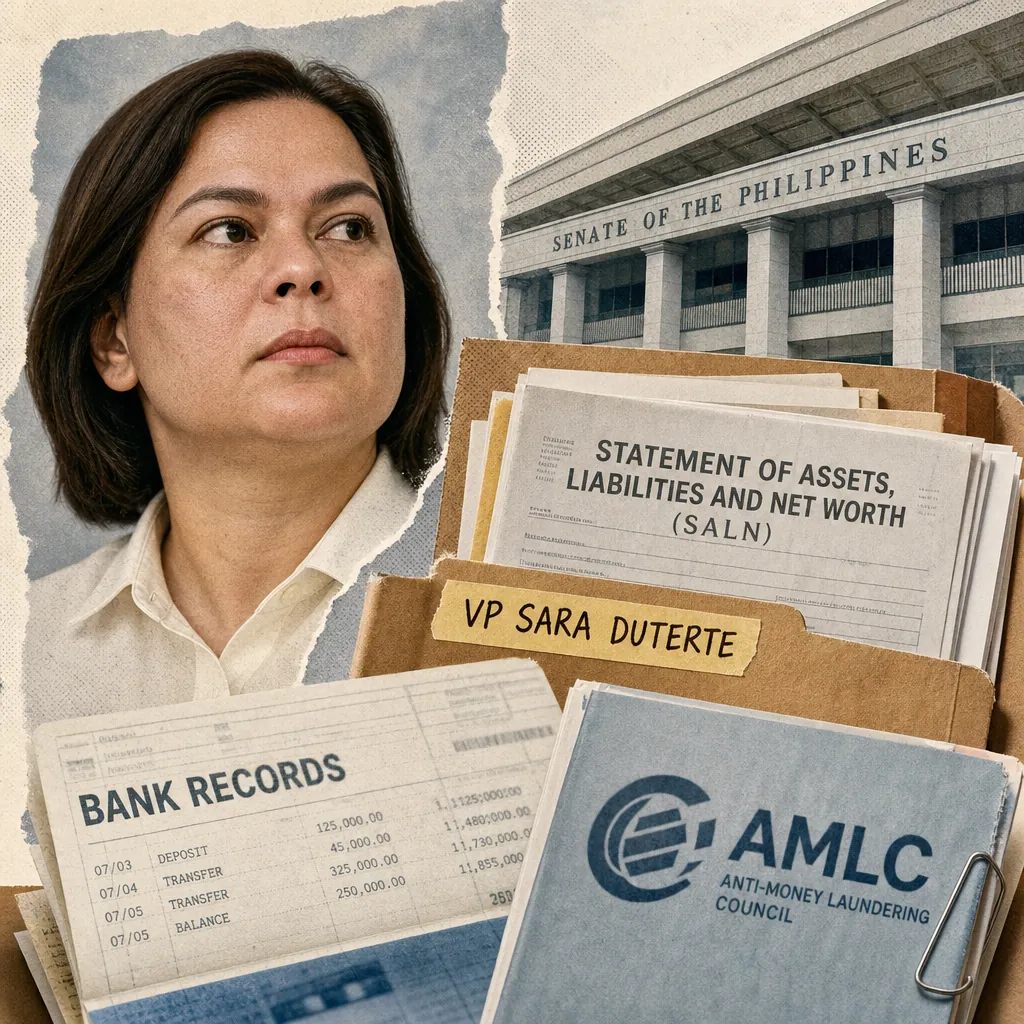
Vice President Sara Duterte's declared wealth will be checked against tax, bank, corporate and Anti-Money Laundering Council records, prosecutor Rep. Terry Ridon told reporters after the 25th day of her impeachment trial on Tuesday, September 15, 2026.9 The announcement, carried by Inquirer Online, was the single most-read item in the day's captured banking and finance conversation: the same headline reached 1,681 views on X and drew 25 reactions on Facebook, including seven "haha" and one "angry" reaction, with no comments on either post.2 The story's substance came from the courtroom itself, where an Office of the Ombudsman records officer testified that Duterte declared no cash on hand or in bank from 2019 to 2025 and that her declared net worth rose from P7.25 million in 2007 to P98.66 million in 2025.333
That testimony, and the prosecution's plan to test it against bank and anti-money-laundering records, is the day's lead. It matters beyond the trial because it places the country's financial-intelligence infrastructure inside a politically charged proceeding: the Anti-Money Laundering Council is the interagency body that receives and analyzes suspicious-transaction reports from banks and other covered institutions, and the Bureau of Internal Revenue holds tax filings. When prosecutors say they will compare a public official's declared assets against those records, the institutions themselves become part of the story, and banks become the parties that must respond to subpoenas without appearing to take sides.
The rest of the day's captured coverage was quieter and more routine. The Bangko Sentral ng Pilipinas reported that cash remittances hit a seven-month high in July, the Financial Stability Coordination Council said the banking system can absorb shocks from Middle East tensions and volatile markets, and the Securities and Exchange Commission said the planned GCash initial public offering would test the local market's capacity for large deals.294661 A survey on digital payment fees, a rural-bank guarantee program, a new insurance chief operating officer and a fuel-subsidy proposal rounded out the business pages.4425815 None of it drew the social attention the SALN story did, and none of it carried the same regulatory sensitivity.
Key themes
- Prosecutors will match Duterte's SALNs against bank and AMLC records. Rep. Terry Ridon said the prosecution intends to present records from the Securities and Exchange Commission, the Bureau of Internal Revenue, the Anti-Money Laundering Council and the Philippine National Police Firearms Division, using the SALNs as the reference point against which later evidence is tested.9 The framing puts bank accounts and anti-money-laundering documentation inside an impeachment proceeding.
- An Ombudsman witness testified Duterte declared no cash or bank deposits from 2019 to 2025. Karen Batu, officer-in-charge of the Office of the Ombudsman's Central Records Division, authenticated and read the SALNs, and testified that the declared net worth rose by P91.4 million, or 1,260.7 percent, between 2007 and 2025.3 A separate report put the 2025 figure at P98.66 million against P7.15 million in 2007, a 1,280-percent increase.33
- The SALN story reached 1,681 views on X and 25 reactions on Facebook, with no comments. The X post carried the headline and a link; the Facebook version carried the same headline and drew the day's only "angry" reaction.2 The absence of comment threads means the audience consumed the item without forming a visible debate around it.
- Cash remittances rose 1.9 percent year on year to $3.24 billion in July, a seven-month high. The Bangko Sentral ng Pilipinas said the July inflow was the largest since December 2025's $3.52 billion, and that cumulative January-to-July remittances grew 2.3 percent to $20.39 billion.2949 An analyst warned the year-to-date pace was the slowest in six years for a January-to-July comparison.36
- The Financial Stability Coordination Council named geopolitical tension, cyberattacks and supply-chain disruption as the top risks to the financial system. The interagency council, chaired by BSP Governor Eli Remolona Jr., said the system remains well-positioned to absorb shocks while it tightens monitoring of liquidity, leverage, concentration and interconnectedness.4627
- The SEC said the GCash operator's planned P92.3-billion IPO would test the market's depth. SEC Chair Francis Ed Lim said the Mynt Inc. offering demonstrates the capital market's capacity to absorb large equity transactions and could draw more retail investors into equities.6163 Mynt plans to price the offer on October 1 and list under the ticker "GCASH" on October 20.63
- A central bank-backed survey found that cutting digital payment fees roughly doubled transactions. A study of 15,000 RCBC mobile banking users by Innovations for Poverty Action Philippines, with the BSP and RCBC, found users doubled their transactions after fees were cut to zero, while another RCBC platform saw about a 30-percent increase.4
- State-run PhilGuarantee is backing loans through nearly 100 rural banks. Twenty-nine members of the Rural Bankers Association of the Philippines use its credit guarantee facility for micro, small and medium enterprises, 45 use its agriculture program, and 24 use its housing guarantee program.42
How the narratives stack
Dominant. The SALN-to-bank-and-AMLC story dominated the captured set by both measures that matter here. It was the most-read social item, at 1,681 views on X against 173 for the next item, and it was the most heavily covered news story, with at least five separate items in the set: the Inquirer report on Ridon's remarks, the Inquirer's Day 25 trial highlights, the Manila Times podcast headline, the BusinessMirror report on the Ombudsman testimony, and the Philstar Filipino-language report.93334079 The Inquirer's Ridon story alone carried an estimated P232,848 in advertising-equivalent value, the notional cost of buying the same space as paid advertising, and the BusinessMirror item on the Ombudsman testimony carried P981,288.940 The dominance is a property of the items gathered here, not a claim about all coverage that day.
Counter-narrative. The BSP's remittance data offered the day's clearest good news, and it ran across at least six outlets in the set, including BusinessWorld, the Manila Times, Philstar, the Daily Guardian and the BusinessMirror.4926805436 The counter-narrative is not that remittances are booming; it is that the headline number and the underlying trend point in different directions. July's $3.24 billion was a seven-month high, but the 2.3-percent cumulative growth for January to July was the slowest for that period since 2020, when remittances contracted 2.4 percent.36 Jeremaiah Opiniano of the Institute for Migration and Development Issues told the BusinessMirror that overseas Filipino workers are being stretched by war-related inflation, and that the economy should brace for continued slowing.36
Emerging. The GCash IPO story is building toward a dated event. Mynt Inc. plans to raise as much as P92.3 billion by offering 9.23 billion common shares at an indicative price of up to P10 each, with pricing on October 1, the offer period from October 6 to 12, and listing on October 20.63 The SEC chair's comments, carried by BusinessWorld, Inquirer, Malaya, the Manila Times and Head Topics, frame the listing as a test of whether the local market can absorb a deal of that size and whether it can pull ordinary Filipinos into equities.6165632462 A related development points the same way: retail investors can now subscribe to Arthaland preferred shares at P500 each through GStocks PH inside the GCash app, with Series G paying 7.3260 percent a year and Series H paying 7.8105 percent.48
Under-covered. Two stories with real consequences for households and small businesses drew little attention in the captured set. The first is the fuel-subsidy proposal: the Land Transportation Franchising and Regulatory Board wants to raise the per-liter discount for public utility vehicles from P12 to P20, a measure that would go to the Department of Transportation and then to Malacañang for approval, and that acting chairperson Greg Pua Jr. acknowledged might be judged too high.15 The second is the Visayas power supply problem: the Institute for Climate and Sustainable Cities said the Visayas had recorded 134 yellow and red alert days as of September 14, and that four coal units with a combined 532 megawatts of capacity have suffered extended outages this year.64 Both stories affect operating costs for businesses and transport fares for commuters, and both placed low in the day's attention.
Platform insights
- X. X carried both of the day's tracked posts and amplified the politically sensitive one far more widely: the SALN headline reached 1,681 views with 7 likes and 3 shares, against 173 views for the Blu Girls sponsorship post.12 The pattern is that X moves financial-accountability news into a fast news-sharing stream, where reach accumulates without comment-level debate.
- Facebook. Facebook produced the emotional reactions. The SALN post drew 25 likes, 1 love, 7 haha and 1 angry reaction, and the Blu Girls post drew 2 likes, 1 care reaction and a single comment.12 The reaction mix on the SALN post, with "haha" outnumbering "love" and "angry" combined, indicates a skeptical or mocking reception rather than outrage, and the platform is where that sentiment is visible.
- Cross-platform duplication. The same Blu Girls text and the same SALN headline each appeared on both X and Facebook on September 15, which points to news-desk syndication rather than platform-native conversation.12 For monitoring purposes, the duplication means the same item can be counted twice, and the engagement figures should be read per platform rather than summed.
Key voices and communities
Prosecution and Ombudsman records officials. Rep. Terry Ridon and Ombudsman records officer Karen Batu drove the day's dominant story. Ridon set out the documentary plan, naming the SEC, BIR, AMLC and PNP Firearms Division; Batu authenticated the SALNs and supplied the figures that gave the story its numbers.9340 Their framing is evidentiary: the SALNs are the baseline, and the financial records are the test.
Business and financial press. BusinessWorld, the Manila Times, Philstar, Malaya, the Daily Guardian, the BusinessMirror and Inquirer Online carried the day's market and policy stories, from remittances to the FSCC risk survey to the GCash IPO.49268063533661 This group sets the terms of the sector conversation, and its coverage of the SALN story is what moved the item into the banking and finance keyword space.
The central bank and its coordinating bodies. The Bangko Sentral ng Pilipinas appeared in three distinct roles on the same day: as the source of remittance data, as chair of the Financial Stability Coordination Council, and as a partner in the digital payments fee study.29464 Its statements set the official tone, which was that the system is resilient while risks remain elevated.
Sports and community-investment audiences. Cebuana Lhuillier's support for the Philippine Blu Girls ahead of the 20th Asian Games in Aichi-Nagoya, Japan, generated a small, positive thread with negligible engagement.1 The community is small in this dataset, but it shows where a remittance and pawnshop brand is placing its goodwill.
Narrative streams
Prosecutors will test Duterte's declared wealth against bank and AMLC records
The prosecution's plan, announced by Rep. Terry Ridon after Tuesday's hearing, is to compare the wealth declared in Vice President Duterte's Statements of Assets, Liabilities and Net Worth against tax, bank, corporate and other financial records.9 A Statement of Assets, Liabilities and Net Worth is the annual disclosure that Philippine public officials must file, listing what they own, what they owe and their net worth; it is the standard document used to check whether a public official's wealth is consistent with their salary and other lawful income. Ridon said the records to be presented include those from the Securities and Exchange Commission, the Bureau of Internal Revenue, the Anti-Money Laundering Council and the Philippine National Police Firearms Division, and that bank accounts and other financial instruments would be obtained through subpoenas.9
The Anti-Money Laundering Council is the interagency body, composed of the BSP governor, the SEC chair and the Insurance Commission chief, that receives suspicious-transaction reports from banks and other covered institutions and can investigate suspected money laundering. Its appearance in a political accountability story is what gives the item its regulatory weight: the council is named as a source of evidence, not as an investigator of a bank.
The evidentiary foundation came from the witness stand. Karen Batu, officer-in-charge of the Office of the Ombudsman's Central Records Division, testified that Duterte declared no cash on hand and in bank from 2019 to 2025, and that her declared net worth rose by P91.4 million, or 1,260.7 percent, from 2007 to 2025, covering her time as Davao City vice mayor and mayor through her current term as vice president.3 The Manila Times reported the same trajectory as a rise from P7.25 million in 2007 to P98.66 million in 2025, a 1,280-percent increase over 18 years.33 The BusinessMirror reported that Duterte declared several business interests in her SALNs without indicating corresponding shares of stock or acquisition costs, beginning with her 2007 filing, which listed Davao Emerging Taipan Corp., Davao Bounty Times Food Corp. and City Hall King Chow Foods Corp.40
The read for the sector is that banks and the AMLC are now named parties in a proceeding they do not control. Any institution that receives a subpoena for account records must comply with lawful process while avoiding any appearance of political alignment, and communications teams should expect questions about deposit secrecy, due process and the difference between a records request and a finding of wrongdoing. The distinction matters legally: under Philippine banking law, banks may release account information only in the circumstances the law allows, and cooperation with a lawful inquiry is not evidence of any violation.
July remittances hit a seven-month high while the underlying trend slows
Cash remittances sent home through banks rose 1.9 percent year on year to $3.24 billion in July, the Bangko Sentral ng Pilipinas reported, the highest monthly level since December 2025's $3.52 billion.49 Personal remittances, a broader measure that includes money sent through informal channels and remittances in kind, rose 2 percent to $3.6 billion from $3.53 billion a year earlier.26 Land-based workers sent $2.65 billion of the cash total, up from $2.59 billion, while sea-based workers sent $590 million, unchanged from a year earlier.26 The United States remained the top source, followed by Singapore and Saudi Arabia.49
The headline and the trend diverge. Cumulative remittances for January to July reached $20.39 billion, up 2.3 percent from $19.93 billion in the same period of 2025, which was the slowest pace for a January-to-July comparison since 2020, when the figure contracted 2.4 percent.36 The BSP estimated full-year inflows at $36.6 billion, a 2.7-percent increase over 2025.29 Jeremaiah Opiniano of the Institute for Migration and Development Issues told the BusinessMirror that overseas Filipino workers are being stretched by war-related inflation and other economic pressures, and that the country should brace for continued slowing.36
Remittances matter to the financial sector because they are a stable, low-cost source of household income and foreign exchange. They fund food, education, housing and health care for millions of families, and they support consumer spending that banks and lenders depend on. The read for the sector is that remittance-linked products, from account-to-account transfers to remittance-backed lending, face a slower growth environment than the July headline suggests, and that institutions pricing those products should plan around mid-single-digit annual growth rather than the double-digit rates of earlier years.
The central bank's risk council flags geopolitics and cyberattacks
The Financial Stability Coordination Council said geopolitical tensions, cyberattacks and global supply-chain disruptions are the risks financial institutions are watching most closely, based on its annual Survey of Salient Risks, which gathers views on threats to the financial system over the next 12 to 24 months and over a three-to-six-year horizon.27 The council is the interagency body that monitors and manages risks to the financial system as a whole; it is chaired by BSP Governor Eli Remolona Jr. and includes the SEC, the Insurance Commission and the Philippine Deposit Insurance Corporation, among others.27
Remolona said global risks remain elevated because of Middle East tensions and volatile financial markets, but that the financial system remains well-positioned to absorb shocks.46 The council said it is tightening preemptive monitoring and strengthening its assessment of liquidity, leverage, concentration and interconnectedness, covering the linkages among banks, nonbank financial intermediaries, corporations and financial markets.4647 It also said sound capital and liquidity positions continue to support lending growth driven by household consumption and business financing needs.47
The read for the sector is that supervisors are telling banks to prepare for shocks that originate outside the banking system. Cyberattacks and supply-chain disruption are operational risks that no single institution can fully control, and the council's emphasis on interconnectedness means banks should expect scrutiny of their exposure to nonbank lenders and to each other. For risk and compliance teams, the practical implication is that scenario planning should include a cyber incident at a third party and a supply-chain break, not only credit and market shocks.
The GCash IPO is being framed as a test of the local market
The Securities and Exchange Commission said the planned initial public offering of Mynt Inc., the operator of the GCash e-wallet, shows the Philippine capital market can accommodate large equity transactions.61 Mynt plans to raise as much as P92.3 billion by offering 9.23 billion common shares at an indicative price of up to P10 each, with pricing scheduled for October 1, the offer period from October 6 to 12, and listing on the Philippine Stock Exchange under the ticker "GCASH" on October 20.63 An initial public offering is the first sale of a company's shares to the public, and the proceeds give the company capital to expand while giving investors a stake in the business.
SEC Chair Francis Ed Lim said the offering demonstrates the market's capacity to absorb sizeable equity transactions and mobilize investor demand at scale, and that Mynt's broad user base could widen retail participation by bringing more Filipinos into equities.6165 Philstocks Financial research manager Japhet Tantiangco said investors are watching the coming listings closely and that successful fundraising could perk up the local market.24 The Manila Times reported that the offering is expected to become the largest fundraising activity on the Philippine Stock Exchange.24
A parallel development shows how retail access is changing. Retail investors can subscribe to Arthaland Corp.'s Series G and Series H preferred shares through GStocks PH inside the GCash app from September 14 to 25, 2026, at P500 per share, with Series G paying 7.3260 percent a year and Series H paying 7.8105 percent.48 Preferred shares pay fixed dividends and rank ahead of common shares when dividends are distributed. The read for the sector is that the IPO and the Arthaland offering together test whether ordinary savers will move money from deposits into market instruments, and that banks and brokers should expect competition for retail funds if the listings perform well.
A central bank-backed study finds that cutting payment fees roughly doubles transactions
A survey of 15,000 mobile banking users at Rizal Commercial Banking Corp. found that users doubled their transactions after the bank reduced fees to zero, while another RCBC mobile banking platform saw about a 30-percent increase.4 The study was conducted by Innovations for Poverty Action Philippines with the Bangko Sentral ng Pilipinas and RCBC, and randomly assigned customers different InstaPay fee levels, including zero and low fees.4 InstaPay is the central bank's real-time, low-value fund transfer service that lets customers move money between accounts at different banks.
RCBC said the findings aligned with the BSP Consumer Expectation Survey, which showed one in three Filipinos consider high fees a barrier to more frequent use of digital payments.4 The read for the sector is that pricing, not just convenience, determines how often people use digital payments, and that banks and e-wallets weighing fee changes now have local evidence that zero or low fees can expand transaction volume enough to offset the lost fee revenue. The finding also matters for the central bank's financial-inclusion goals, because it suggests that the cost of moving money is a bigger obstacle than access to a smartphone app.
Rural banks get expanded guarantee cover for small borrowers
State-run Philippine Guarantee Corp. is backing loans through nearly 100 rural banks to help small businesses, farmers and low-income homebuyers obtain financing.42 Twenty-nine members of the Rural Bankers Association of the Philippines use its credit guarantee facility for micro, small and medium enterprises, 45 participate in its agriculture program for farmers and fisheries, and 24 use its housing guarantee program, which is designed to reduce lenders' risk in extending home loans to low-income borrowers.42 A credit guarantee means the government corporation promises to pay part of a loan if the borrower defaults, which lets a bank lend to borrowers it would otherwise consider too risky.
PhilGuarantee president and CEO Alberto Pascual discussed expanding the programs with RBAP president Patrick Bryan Absin and other association officials at a September 7 meeting, and said the association has been a longstanding partner in expanding financial inclusion to farmers and entrepreneurs.42 The read for the sector is that rural banks, which serve borrowers outside the reach of large commercial banks, are being given a way to lend more without carrying all the default risk themselves, and that the program's reach depends on how many rural banks sign up and how quickly guarantees are processed.
A remittance brand's sports sponsorship drew little attention
Cebuana Lhuillier, a major player in the domestic remittance and pawnshop sector, was named as a backer of the Philippine Blu Girls softball team ahead of the 20th Asian Games in Aichi-Nagoya, Japan.1 The story ran on X and Facebook on September 15, reaching 173 views on X with minimal engagement, and drawing 2 likes, 1 care reaction and a single comment on Facebook.1 The tone was promotional and focused on national representation, with no critical framing and no service-quality complaint.1
The read for the sector is that sponsorship goodwill published without distribution support does not generate visibility on its own. The view-to-engagement ratio on the X post suggests the content may have been promoted rather than organically shared, though the monitoring writeup does not say whether the post was boosted. For financial brands with community programs, the lesson is that positive content needs amplification to register, and that the absence of negative service discourse around these brands in the captured data is itself a signal of a quiet period for consumer complaints.
Conversation trajectory
The SALN and AMLC story will grow with each hearing day. The impeachment trial is proceeding on a daily schedule, with Day 25 on September 15 and further sessions expected through the coming weeks. Each hearing day that produces new financial records or new testimony gives the story a fresh news peg, and the prosecution has said it intends to present SEC, BIR, AMLC and PNP records.9 Watch for any coverage that names a specific bank or financial institution, which would move the story from a personality-anchored account to an institution-anchored one. Observation window: the next two to three hearing days.
The GCash IPO has dated milestones that will generate coverage. Mynt plans to price the offer on October 1, run the offer period from October 6 to 12, and list on October 20.63 Each of those dates is a scheduled news event, and the pricing outcome will show whether investor demand matches the SEC chair's description of the market's capacity. Observation window: October 1 to October 20.
Remittance data will be tested against the slowing trend. The BSP publishes remittance figures monthly, and the next release will show whether July's seven-month high was a seasonal bump tied to the school season or the start of a recovery. The analyst view is that the slowdown will continue because overseas workers are stretched by inflation.36 Observation window: the next monthly BSP remittance release.
The fuel-subsidy proposal moves through the bureaucracy. The Land Transportation Franchising and Regulatory Board will submit its P20-per-liter proposal to the Department of Transportation, which will forward it to Malacañang for approval, and economic managers will assess whether the amount is affordable.15 A decision either way affects transport operators' costs and commuter fares. Observation window: the next few weeks, pending the agencies' review.
Trigger events. Congressional or legal hearings on the SALN and AMLC document matching would generate a significant engagement increase across both platforms. The Asian Games softball competition in Aichi-Nagoya will either validate or deflate the sponsorship narrative around Cebuana Lhuillier. Any new BSP or AMLC circular in the same period could reframe the bank-records story as a policy compliance matter.12
Response guidance
On the SALN and AMLC story, prepare a process-and-law answer before reporters ask. Banks and financial institutions should have a pre-cleared statement ready that explains that account information is released only under the circumstances Philippine law allows, that any lawful request follows established due process, and that cooperation with an inquiry is not a finding of wrongdoing. The statement should avoid any language that could be read as taking sides in the political proceeding.
On deposit secrecy, keep the explanation simple and factual. Customers who see bank records mentioned in a political story may ask whether their own accounts are exposed. The answer is that deposit secrecy rules protect account information and that disclosures require legal authority; communications teams should be able to state this in one or two sentences without legal jargon.
On the GCash IPO, separate company news from market commentary. Institutions with retail customers should expect questions about whether the listing is a good investment and whether it signals a stronger market. Responses should stick to what is confirmed, the pricing date, the offer period and the listing date, and avoid predicting how the shares will perform.63
On remittances, lead with the household impact. The July figure is a seven-month high, and the slower cumulative trend is the more useful number for planning. Messages aimed at overseas Filipino workers and their families should focus on the cost and speed of sending money, which is where the digital payments fee study found the biggest barrier.436
On the fuel-subsidy proposal, avoid committing to an outcome. The measure is still with the Department of Transportation and Malacañang, and economic managers have not decided whether P20 per liter is affordable.15 Institutions with transport or logistics exposure should describe the proposal as under review and note that any change would affect operating costs across the sector.
On the Visayas power situation, treat it as an operating-cost issue. The region recorded 134 yellow and red alert days as of September 14, and four coal units with a combined 532 megawatts of capacity have had extended outages this year.64 Businesses with Visayas operations should factor the supply risk into cost planning, and lenders with exposure to energy-intensive borrowers should monitor it.
On sports and community content, time it against the news cycle. Sponsorship and community-investment posts carry low direct risk, but publishing them during a heavy political news period can read as tone-deaf. Schedule such content after checking the day's news, and do not attach it to political threads.1
On cyber and geopolitical risk, use the council's language. The Financial Stability Coordination Council said the system can absorb shocks while risks remain elevated.46 Institutions communicating with customers or investors can use that framing, which is accurate and does not overstate either confidence or alarm.
See the full picture behind today's signals.
This report draws from Media Meter's MediaWatch, our real-time monitoring engine tracking 2,470+ Philippine sources across print, broadcast, digital, and social. Explore how the platform turns raw coverage into decision-grade intelligence, then see how it's configured for teams like yours — whether you're in PR agencies, corporate comms, government, or marketing.
Want more? Browse our Report Library for sector and crisis intelligence, or request a demo and we'll have your brand set up before the call.
Want this kind of intelligence on your brand?
This brief is built on the same MediaWatch methodology that runs continuously across every brand we monitor. See your competitive landscape, Impact Score, and narrative trajectory in a 30-minute demo.