Fuel price hikes and agricultural job losses dominate conversation as consumer anxiety deepens
The day's conversation was dominated by forecasts of another diesel price hike and a Senate warning that agriculture job losses signal deeper labor issues, with social media reflecting public frustration and linking energy costs to food and electricity prices.
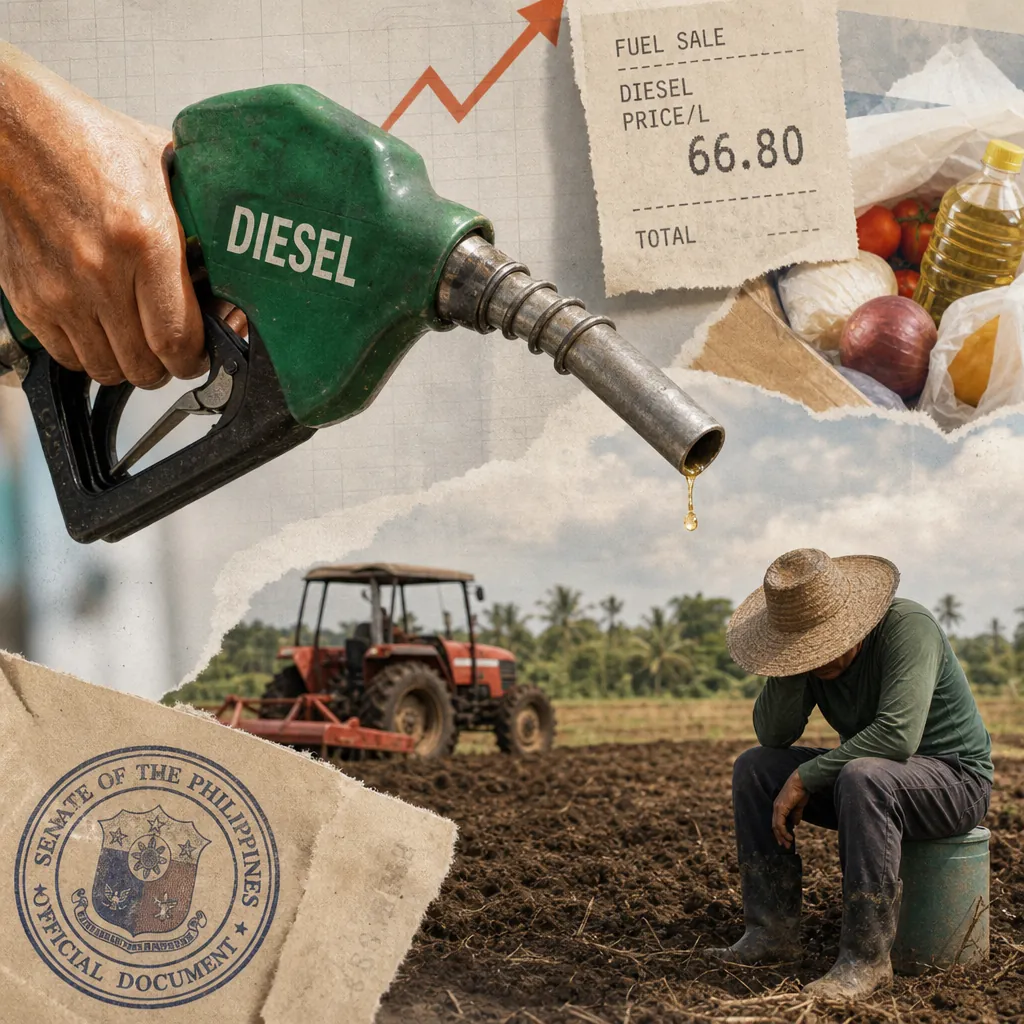
The conversation on July 11, 2026, was shaped by two overlapping narratives: the relentless cycle of fuel price increases and a Senate alert that the country's rising unemployment—particularly the loss of 905,000 agriculture jobs year-on-year—points to unresolved structural problems. Social media engagement was highest on posts that connected these themes to everyday hardship, with a farmer's story from Isabela drawing over 1,800 sad reactions and a fuel price forecast post generating a mix of angry, sad, and even cynical 'haha' reactions. The day's coverage also included a range of other topics—from a P3 billion cigarette smuggling seizure to a nickel mine rehabilitation story—but the energy-cost and labor-market threads carried the most public resonance.
Key themes
- Another diesel price hike forecast for the coming week — Industry sources, cited by multiple outlets, projected a diesel increase of P2.50 to P4.50 per liter, with kerosene also rising by P2.20 to P4.20 per liter. Gasoline, however, could see a slight rollback of up to P1.25 per liter or a small increase. The forecast was attributed to strong global demand and declining inventories, with Middle East tensions as a backdrop. The Manila Bulletin Online report on this drew attention as a continuation of the weekly price-adjustment cycle that has kept consumers on edge since late 2025.
- Senator Villanueva warns agriculture job losses signal deeper labor issues — Citing the May 2026 Labor Force Survey, Senator Joel Villanueva noted that unemployment rose to 4.8 percent (2.50 million Filipinos), up from 2.41 million in April and 2.03 million a year earlier. The agriculture and forestry sectors lost 905,000 jobs year-on-year, which Villanueva linked to rising rice imports (2.75 million metric tons in the first half of 2026) and falling local palay production. His statement, covered by the Manila Times Online, framed the job losses as a warning that deeper labor issues remain unresolved.
- Fuel prices linked to electricity and food costs — A July 10 report from One PH explicitly tied the diesel forecast to a Meralco rate increase of over 34 centavos per kilowatt-hour, framing both as a compounding burden. The farmer story from INQUIRER.net on July 11—detailing how drought and diesel-powered irrigation costs are squeezing a 55-year-old farmer in Isabela—drew 1,802 sad reactions, 154 care reactions, and 42 comments, illustrating how fuel prices cascade into food production costs.
- Public frustration expressed through mixed emotional reactions — A Facebook post from Radyo Todo on July 11 forecasting diesel hikes received 33 'haha' reactions alongside 9 sad and 1 angry reaction, suggesting a mix of cynical humor and genuine frustration. A post from One PH on July 10 about the diesel hike garnered 17 likes but 5 angry reactions and 9 comments. These patterns indicate that while the public is fatigued by the repetitive nature of price hike announcements, the emotional response remains strong.
- Government response and political backlash — Senator Bam Aquino's Senate Resolution No. 508, calling for an investigation into high electricity rates, was shared on July 11, with Aquino arguing that money meant for food, medicine, and education is being consumed by power bills. A broadcast from DZAR 1026 on July 10 covered protests in Manila against government corruption, linking fuel and electricity price hikes to broader anti-government sentiment.
- Other notable stories in the day's coverage — The article set also included a range of non-energy stories: a P3 billion cigarette smuggling seizure in Cebu, a nickel mine rehabilitation feature, a student cocktail competition winner, a new coffee shop in BGC, a PBA basketball game, a magnitude 5.0 aftershock off Sarangani, and a feature on a singer's delayed dream. These items, while not central to the dominant conversation, contributed to the overall media landscape.
How the narratives stack
Dominant — Within the captured set, the dominant narrative is the ongoing fuel price hike cycle, with the July 11 forecast of another diesel increase generating the most direct coverage and social media engagement. The Manila Bulletin Online article on the forecast, with an estimated advertising-equivalent value of P154,568, was one of the higher-value items in the set. Social media posts from Radyo Todo and One PH on the same topic drew notable emotional reactions, confirming that this story continues to resonate with the public.
Counter-narrative — A counter-narrative comes from government and industry sources who frame the price increases as market-driven and beyond domestic control. The Manila Bulletin article attributes the diesel hike to "strong demand and declining inventories" globally, and earlier reports consistently cite Middle East tensions. This framing attempts to depoliticize the increases, but public sentiment—as seen in the angry and sad reactions—suggests limited acceptance of this explanation.
Emerging — The agriculture job loss story, as highlighted by Senator Villanueva, is an emerging narrative that connects fuel prices to broader economic pain. The loss of 905,000 agriculture jobs year-on-year, combined with rising rice imports and falling local production, points to a structural crisis that could intensify if fuel costs remain high. This story has the potential to shift the conversation from mere price complaints to demands for policy intervention.
Suppressed — The story of the P3 billion cigarette smuggling seizure, while covered by Philstar Online with an estimated advertising-equivalent value of P712,957, did not generate significant social media engagement in the captured data. Similarly, the nickel mine rehabilitation story from Daily Tribune Online, despite its positive framing, received little public attention. These stories are overshadowed by the more emotionally charged fuel and labor narratives.
Platform insights
- Facebook — Facebook was the primary platform for emotional and community-driven reactions. The farmer story from INQUIRER.net dominated with 1,802 sad and 154 care reactions, showing how personal hardship stories amplify outrage. Posts from One PH and Radyo Todo on fuel hikes drew a mix of angry, sad, and haha reactions, indicating a public that is both frustrated and weary. The platform's reaction buttons allow users to express nuanced emotions, making it a key channel for gauging sentiment.
- YouTube — YouTube served as the main source for news broadcasts. A BNC Agenda segment on July 10 covering fuel and electricity hikes reached 100,111 views and 72 comments, indicating peak public interest. Earlier, a March 12 24 Oras video on fuel hikes had 12,571 views and 42 comments. YouTube engagement spikes when videos tie fuel to broader crises like weather and protests.
- Twitter — Twitter was used for quick forecast updates and trend tracking. A March 19 tweet with a photo of Batanes diesel prices at P126.20 per liter amassed 11,821 views and 19 shares, showing that visual evidence of actual local prices resonates more than generic forecasts. A May 8 tweet on a diesel rollback gained only 68 views, indicating lower engagement for less dramatic news.
Key voices and communities
- Mainstream news broadcasters — ABS-CBN, GMA, UNTV, and BNC drive the factual reporting on fuel prices, with their newscast clips generating the highest viewership. Their framing consistently ties price hikes to Middle East tensions and global supply disruptions, using DOE forecasts and unnamed oil industry sources as credibility anchors.
- Government and regulatory stakeholders — The Department of Energy (DOE) is the authoritative voice on price forecasts, while Senator Bam Aquino and Senator Joel Villanueva use energy and labor issues to advocate for policy changes. Aquino's resolution on electricity rates and Villanueva's warning on agriculture jobs represent a legislative push to address the root causes of consumer pain.
- Affected consumer communities and micro-enterprises — The public, especially farmers and small business owners, are the most emotionally engaged group. The farmer story from Isabela is a prime example: it shows how fuel costs directly impact agricultural production and household budgets. Comments and reactions on such posts reveal a deep sense of hardship and helplessness.
- Oil industry sources and traders — Anonymous "oil industry sources" provide the price forecasts that news outlets amplify. Their credibility stems from access to Mean of Platts Singapore (MOPS) data and foreign exchange averages. While not directly visible to the public, they set the agenda for the weekly price adjustment narrative.
- Political opposition and activist voices — Politicians like Senator Aquino and protest groups use energy cost increases to criticize the administration's economic management. The July 10 protest coverage from DZAR 1026 indicates that fuel and electricity hikes are fueling broader anti-government sentiment.
Narrative streams
The weekly fuel price hike cycle: a source of public fatigue and frustration
The conversation around fuel prices has become a predictable weekly ritual: industry sources provide forecasts, news outlets amplify them, and the public reacts with a mix of anger, sadness, and cynical humor. On July 11, the Manila Bulletin Online reported that diesel could rise by P2.50 to P4.50 per liter, with kerosene also increasing, while gasoline might see a slight rollback. The article, worth an estimated P154,568 in advertising-equivalent value, attributed the diesel hike to "strong demand and declining inventories" globally. This forecast follows a pattern that has been repeating since November 2025, with earlier peaks reaching P15 to P21 per liter for diesel in March and April 2026.
Social media reactions to these forecasts have evolved. A Facebook post from Radyo Todo on July 11 received 33 'haha' reactions alongside 9 sad and 1 angry reaction—a sign that some users are resorting to gallows humor to cope with the relentless increases. A post from One PH on July 10 garnered 17 likes but 5 angry reactions and 9 comments, indicating that while engagement may be lower than during the peak in March, the emotional charge remains. The repetition of these forecasts has normalized the idea of sustained inflation, making smaller increases (P2–P4) feel like a relief, yet still generating negative reactions.
For the sector, this narrative stream means that any business reliant on logistics—from food delivery to manufacturing—will face continued cost pressure. The public's fatigue also creates a risk of desensitization: if consumers stop reacting to price hikes, the pressure on government to act may diminish, but the underlying economic pain persists.
Agriculture job losses: a structural warning
Senator Joel Villanueva's statement on July 11, covered by the Manila Times Online with an estimated advertising-equivalent value of P250,320, highlighted that the agriculture and forestry sectors lost 905,000 jobs year-on-year. The overall unemployment rate rose to 4.8 percent in May 2026, equivalent to 2.50 million unemployed Filipinos, up from 2.41 million in April and 2.03 million in May 2025. Villanueva linked this to the country's increasing dependence on imported rice—2.75 million metric tons in the first half of 2026—and a projected shortfall in local palay production against the government's 20.28 million metric ton target.
This narrative stream connects directly to fuel prices: higher diesel costs raise the expense of irrigation (fuel-powered pumps), transport, and fertilizer, squeezing farmers' margins. The farmer story from Isabela, which drew 1,802 sad reactions on Facebook, is a microcosm of this trend. The farmer, Eddie Matute, spent up to P10,000 to irrigate just two hectares due to drought, and he delayed planting because of high input costs. His story illustrates how fuel prices cascade into food production, threatening both rural livelihoods and national food security.
For the sector, this stream signals that the energy-cost conversation is broadening into a food-cost and employment crisis. Companies in the food supply chain—from agribusiness to quick-service restaurants—should prepare for increased scrutiny of their pricing and sourcing practices as consumers become more aware of the farm-to-table cost chain.
Government response and the risk of political backlash
Government messaging on fuel prices has consistently emphasized that the increases are driven by global factors beyond domestic control. The DOE's forecasts are treated as authoritative, and officials have mentioned possible aid for affected sectors. However, public sentiment remains skeptical. Senator Bam Aquino's Senate Resolution No. 508, filed in July 2026, explicitly links high electricity costs to reduced spending on food, medicine, and education, framing energy prices as a systemic burden. His Facebook post on the resolution received 26 likes and 9 comments, indicating modest but engaged support.
More concerning for the administration is the emergence of protest coverage. A July 10 broadcast from DZAR 1026 covered "libo-libong raliyista sa Maynila" (thousands of protesters in Manila) against government corruption, with fuel and electricity price hikes cited as grievances. This suggests that the energy-cost narrative is being weaponized by opposition groups, potentially shifting blame from global markets to domestic policy failures.
For communicators, this stream underscores the need for proactive messaging that acknowledges public pain while outlining concrete steps—such as targeted subsidies or fuel vouchers—to mitigate the impact. Silence or generic reassurances risk being filled by opposition voices.
Other notable stories in the day's coverage
The article set for July 11 included several stories outside the dominant energy-labor narrative. The largest by advertising-equivalent value was the Philstar Online report on the seizure of P3 billion worth of smuggled cigarettes in Cebu, worth an estimated P712,957. The Bureau of Customs and NBI served search warrants and seized 59 container vans of cigarettes from China. This story, while significant in value, did not generate notable social media engagement in the captured data.
Other stories included a feature on Rio Tuba Nickel Mining Corporation's mine rehabilitation practices (Daily Tribune Online, P126,048), a student cocktail competition winner (Manila Times Online, P164,640), a new coffee shop in BGC (Manila Times Online, P183,120), a PBA basketball game (Inquirer Online, P138,128), a magnitude 5.0 aftershock off Sarangani (GMA News Online, P68,880), and a feature on a singer's delayed dream (Manila Times Online, P677,040). These stories, while not central to the day's dominant conversation, contribute to the overall media landscape and may be of interest to specific audiences.
Conversation trajectory
Over the next 1–2 weeks, the conversation is likely to be shaped by the actual implementation of the forecasted diesel price hike, expected on Monday or Tuesday. If the increase is at the higher end of the forecast (P4.50 per liter), expect a spike in angry and sad reactions on social media, particularly on Facebook. The farmer story from Isabela may also see renewed attention if drought conditions persist or if rice prices rise.
In the 2–4 week window, the agriculture job loss narrative could gain traction if the PSA releases further data or if Senator Villanueva's statements are picked up by more outlets. The Senate Resolution No. 508 on electricity rates may also move forward, potentially leading to hearings that keep the energy-cost story in the news.
Key trigger events to watch:
- The DOE's official price adjustment announcement for the week of July 13, 2026.
- Any movement on Senate Resolution No. 508, which could bring energy–food linkage into formal hearings within 4–6 weeks.
- Updates on Magat Dam water levels, which affect irrigation and rice production.
- Further protest coverage if fuel and electricity prices continue to rise.
Response guidance
For communicators in the energy, food, and logistics sectors, the following approaches are recommended:
- Acknowledge the pain: Avoid defensive language when price adjustments are necessary. Instead, frame increases as a last resort after exhausting internal efficiencies. The public mood is already negative, as shown by the high number of sad and angry reactions on fuel-related posts.
- Provide transparency: Communicate any price adjustments with clear explanations and advance notice. This builds trust in a volatile environment. For example, a quick-service restaurant could announce that it is absorbing some cost increases through operational efficiencies before passing on any remaining costs.
- Highlight support programs: If your company has programs to help consumers cope—such as value menus, loyalty discounts, or fuel-efficient logistics—promote them proactively. The farmer story from Isabela shows that the public empathizes with those most affected; companies can position themselves as part of the solution.
- Monitor political discourse: The linkage between fuel prices and government policy is being exploited by opposition figures. For clients like Malacañang, preemptive messaging around targeted aid programs for transport and agriculture sectors is critical. For corporate clients, avoid politicized language and focus on what the company can control.
- Prepare for the agriculture narrative: The loss of 905,000 agriculture jobs is a structural issue that will not be resolved quickly. Companies in the food supply chain should develop talking points that address how they are supporting farmers and rural communities, such as through sustainable sourcing or direct procurement programs.
See the full picture behind today's signals.
This report draws from Media Meter's MediaWatch, our real-time monitoring engine tracking 2,470+ Philippine sources across print, broadcast, digital, and social. Explore how the platform turns raw coverage into decision-grade intelligence, then see how it's configured for teams like yours — whether you're in PR agencies, corporate comms, government, or marketing.
Want more? Browse our Report Library for sector and crisis intelligence, or request a demo and we'll have your brand set up before the call.
Want this kind of intelligence on your brand?
This brief is built on the same MediaWatch methodology that runs continuously across every brand we monitor. See your competitive landscape, Impact Score, and narrative trajectory in a 30-minute demo.